I Was Sold Into a Peace-Treaty Marriage—Then the Mafia Boss Said Four Words That Shattered My World

PART 1
Nobody warned me that the most dangerous moment of my life would smell like cheap bourbon and wrong cologne.
I had prepared for fear. I had dressed for it — white silk, cathedral length, the kind of gown that announces sacrifice more than celebration. I had stood at the altar of St. Raphael’s in front of four hundred people who represented the full taxonomy of power and violence in this city, and I had been afraid in the controlled, functional way my father had spent twenty years training me to be afraid: quietly, usefully, without showing it on my face.
What I had not prepared for was the feeling that something was simply wrong.
My name is Chiara Ferrante. My father is Aldo Ferrante, and I have known since I was fourteen that I was a political instrument. Not a daughter — an instrument. A future signature on a future agreement. A name to be placed beside another name when the timing finally suited the men in the room.
The timing finally suited them six weeks ago.
The Ferrante family and the Toscano family had been bleeding each other for three years. Not publicly — the newspapers never reported it, and the politicians at our wedding today certainly pretended to know nothing about it. But the violence had been real, and the losses had been real, and eventually both sides grew tired of the accounting.
One marriage, they said. One ceremony to seal the truce.
The groom was Nico Toscano.
I had never seen his face. That was tradition — the Toscano family observed an old Sicilian custom at weddings, the bridegroom masked until the formal reception. I had spent three weeks trying to learn everything about a man I couldn’t picture: that he was thirty-two, that he had controlled his family’s operations for five years without visible weakness, that other men described him in the specific reverent shorthand used for things they feared.
Deliberate. Precise. Cold as mid-January.
The man standing beside me at the altar was none of those things.
I knew it within thirty seconds.
His grip on my hand during the exchange of rings was rough in a way that had nothing to do with nerves — it was the grip of someone testing the limits of what they could take. The mask was silver, traditional, covering the upper half of his face. But the body language beneath it was wrong. Loose where it should have been contained. Slightly unsteady. The smell of alcohol close and recent.
Not fear-cold. Not precisely controlled.
Something else entirely.
I told myself I was imagining it. I smiled at the right moments. I signed the documents. I accepted the congratulations of four hundred people with the composure my mother had modeled for me from childhood: still water, no current visible on the surface regardless of what moved beneath.
And then I was alone in the bridal suite of the Toscano estate, waiting.
The room was extraordinary in the way of old money — not showy, but weighted. Heavy curtains. Stone floors covered by carpets that had been expensive fifty years ago and hadn’t needed to justify themselves since. A window overlooking the river, where lights from passing boats made slow gold shapes on the water.
When the door opened, the man who came in was still wearing the mask.
He poured a drink without speaking. Drank half of it standing up, looking at me the way you look at something you’ve purchased and are appraising for the first time.
“You can take the mask off,” I said.
“Later.”
His voice hit me wrong. Too loose. The consonants slightly blurred.
I kept mine even. “It’s been a long night. I’d like to see my husband’s face.”
He smiled. Not pleasantly.
“What you’d like,” he said, “stopped mattering about four hours ago.”
I held very still.
Because the man everyone described as deliberate and cold would not say that. The man three years of whispered reputation had constructed in my mind would not say that. He would have said something quieter and more frightening — something that controlled the room rather than testing it.
This man was testing me.
And he wasn’t Nico Toscano.
He crossed toward me, and I did not step back — stepping back would have told him something I didn’t want him to know — and the smell was wrong, the gait was wrong, and I was calculating rapidly behind a face I kept completely neutral.
Then the door opened again.
No knock. No announcement. Just the door swinging wide as if walls were optional, and the atmosphere in the room changed so immediately and completely that it felt physical — a drop in temperature, a shift in pressure, the particular alteration of air that happens when someone walks in who is accustomed to a room reorganizing itself around their arrival.
The man in the doorway was not masked.
Tall. Dark suit, no tie, collar open — the only relaxed thing about him. A scar ran along his jaw from the corner of his mouth toward his ear, pale against darker skin, old enough to have stopped being dramatic and started being simply part of his face. He was perhaps thirty-three, and he stood in the doorway of his own bridal suite looking at the scene in front of him with the specific quality of stillness that I would come to recognize as his version of fury.
His eyes moved from the man near me to me.
Dark eyes. Absolutely present.
He said nothing for three seconds that felt considerably longer.
Then, to the man beside me, very quietly: “Why are you in my room?”
The masked man’s posture changed entirely. The loose confidence evaporated. What replaced it was something closer to animal calculation — caught, assessing exits.
“Nico,” he started.
“Take the mask off.”
A beat. Then the mask came off.
The face beneath it was similar enough to mean family. Younger. Softer. The face of someone who had spent his life adjacent to power without ever having been required to generate his own.
I looked at Nico Toscano — the real one — and said, very calmly: “He is not you.”
Four words.
The room contracted.
Nico’s gaze moved to mine for the first time, and what passed through his expression in that moment was not relief or gratitude. It was assessment — fast and total, like a calculation performed in an instant. He was reading me the same way I had been reading the room: for what I would do next, for what I was.
Then he looked at the man beside me, and the assessment was over.
“Marco,” he said. “Leave.”
Marco did not leave. Marco tried something with his hands, something fast that I didn’t entirely follow, and then he was on the floor with his arm at an angle arms don’t naturally achieve, and Nico was adjusting his sleeve as if he’d done nothing more than move a chair.
He looked down at his cousin with an expression that contained no heat whatsoever.
“Go downstairs,” he said. “Wait.”
Marco went.
The door closed.
In the silence that followed, I realized my heart rate had barely changed, which told me something about the past three years of conditioning for exactly this kind of moment that I wasn’t sure I wanted to examine.
Nico turned to look at me fully.
“How long did you know?” he asked.
“From the ceremony,” I said. “He held my hand wrong.”
Something shifted in Nico’s expression — not quite surprise, but the particular attention of someone receiving information they find useful.
“Most people wouldn’t have noticed,” he said.
“I’m not most people.”
A pause.
“No,” he said. “You’re not.”
He moved toward the window, and the city spread out below us, indifferent and enormous, rivers of light moving through the dark.
“That was a test,” I said.
He didn’t answer immediately.
“Was it?” I pressed.
“Everything is a test,” he said finally. “The question is whether you know you’re being evaluated.”
I looked at the back of his head. At the precise cut of his jacket. At the hands clasped behind his back — still, deliberate, giving nothing away.
“And did I pass?” I asked.
Nico turned from the window.
For the first time all night, the faintest thing that was not quite a smile moved through his expression.
“You’re still in the room,” he said.
Then he reached into his jacket, and I felt the sudden animal certainty that whatever came next was going to reorder everything — and I was right, but not in the way I expected.
He set a photograph on the table between us.
“Before this marriage becomes what it needs to be,” he said quietly, “I have to ask you something.”
I looked at the photograph.
A Chicago street. Night. A girl, maybe seventeen, at the mouth of an alley, visible only from the back — dark hair, a coat I remembered wearing.
My breath caught.
“Milan,” he said. “Seven years ago. You were at the conference with your father.”
I kept my face still.
“There was a man killed that night,” Nico said. “In the alley behind the Brera hotel.”
My pulse was very loud inside my own skull.
“I know who pulled the trigger,” he continued. “I know who gave the order.” A pause. “What I need to know is why a seventeen-year-old girl was standing in that alley and chose to say nothing afterward.”
I looked at him across the space of our wedding suite.
At this man I had married to end a war, who had tested me on my wedding night and was now testing me again, in a different and more permanent way.
“Because,” I said carefully, “I wasn’t there by accident.”
The silence that followed was the longest of my life.
Then Nico said: “I know.”
—
PART 2
The photograph stayed on the table between us.
I had looked at it for perhaps three seconds before I understood what it confirmed — not just that he knew I had been in that alley, but that he had been waiting, possibly for a long time, for the moment to ask.
“Who sent you?” he asked.
“That’s a complicated answer.”
“Simplify it.”
I met his eyes. “I was seventeen. I didn’t choose the assignment. The assignment chose me through my father’s position, and I was too young and too loyal to understand what I was agreeing to.”
“Who?”
I held his gaze. “Federal contacts. Organized through someone my father trusted. I was told I was helping protect the family.”
Nico was quiet.
“I watched you that night,” I said. “In the alley. I saw what you did to the man on his knees.” I kept my voice steady. “I never filed a report. I never told anyone what I saw. I went back to the hotel and I sat with it and eventually I decided that what I’d witnessed was not the thing I’d been told I was looking for.”
“What had they told you you were looking for?”
“Evidence of expansion. Weapons movement. Nothing like what I actually saw.” I paused. “You killed a man who had sold information that got two of your father’s associates killed. I understood that, even at seventeen.”
Nico looked at me for a long moment.
“You stopped,” he said.
“Yes.”
“Why?”
“Because I realized I was being used,” I said. “And I decided that wasn’t something I was willing to continue.”
The rain against the window had picked up. Below us, the estate’s grounds were dark and wet, the security lights throwing pale circles onto the lawns.
“Three years ago,” Nico said, “someone inside this family began feeding information to federal authorities. Small things at first. Then operational details.”
I went still.
“My father’s arrest last year,” he continued, voice even, “was not random. Someone handed them the case.”
“You think it was me.”
“I thought it might be,” he said. “Past tense.”
Something in my chest loosened slightly.
Then he said: “Marco believed it was you. That’s why tonight happened.”
The picture reorganized itself. Marco, not a test arranged by Nico — a move arranged against him. Against me.
“Your cousin is the leak,” I said.
Nico’s jaw tightened by one degree. “Yes.”
“He set me up to look guilty.”
“He set you up to give me reason to remove you from the equation before you learned anything that could identify him.”
Outside, somewhere deep in the estate, gunfire erupted.
Three shots, then a fourth.
Nico moved before the sound finished — jacket aside, weapon in hand, crossing to the door in the same motion, and I was already on my feet because I had not spent three years becoming a Ferrante daughter to stand still when the shooting started.
“Stay here,” he said.
“No.”
He turned, and his expression was the specific kind of impatient that means there isn’t time for an argument.
“I’m faster than you think,” I said. “And you’re about to walk into a hallway full of men who may have been paid to make sure you don’t walk out the other end.”
A beat.
“Stay behind me,” he said.
We moved into the corridor together, and I understood immediately that the situation was worse than three gunshots suggested.
—
PART 3
The east corridor of the Toscano estate was forty meters of marble, oil paintings, and currently a significant amount of broken glass.
Marco’s men had come in through the servant entrance at the far end — three of them that I could see, with two more covering the staircase. Nico’s security had responded, and the result was the particular chaos of a firefight in an enclosed expensive space: noise everywhere, visibility compromised by smoke from what smelled like a flash device, and the constant recalculation required when the geometry kept changing.
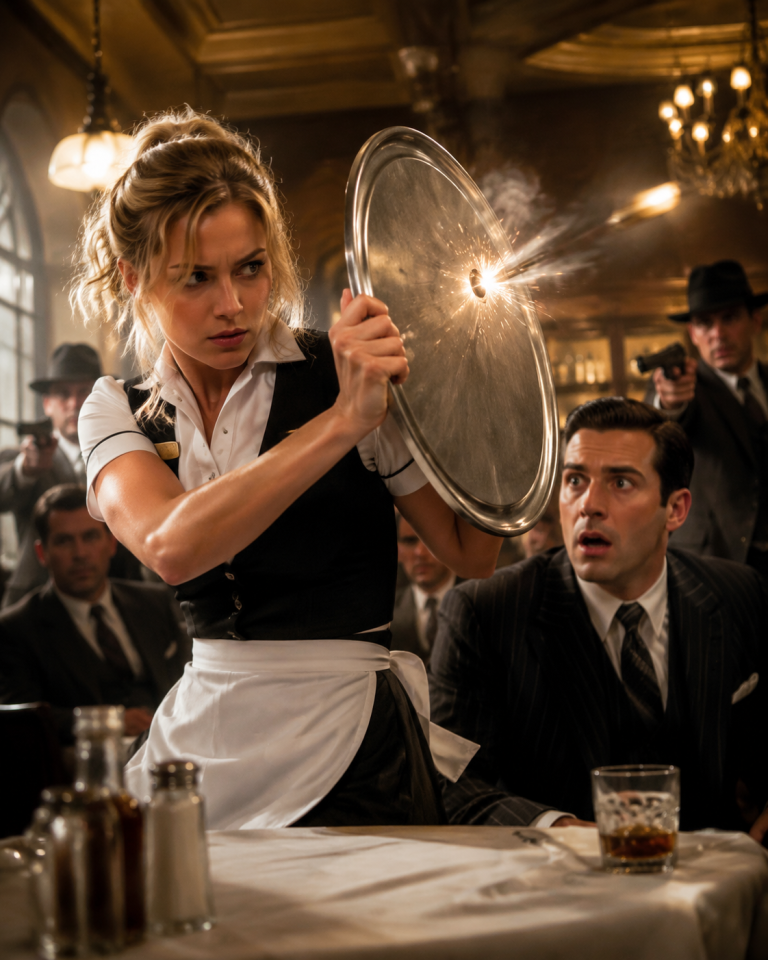
Nico moved through it the way water moves through a rocky channel — finding the gaps, never presenting a stationary target, communicating with his security team in the clipped shorthand of people who had trained together for years. I stayed close and low, and when one of Marco’s men appeared from behind a doorframe at an angle Nico hadn’t seen, I knocked a heavy bronze lamp from the wall table into the man’s path hard enough to take his footing out, which was sufficient.
Nico glanced back at me.
Said nothing.
Kept moving.
We found Marco in the estate library — a room that had been designed for quiet and was currently serving as his command position, three rifles pointed outward, a phone pressed to his ear. He looked up when we came through the side door, and what crossed his face was the complicated expression of a man who had planned for multiple outcomes and was now confronted with one he’d ranked as unlikely.
“Put the phone down,” Nico said.
Marco didn’t. “You should’ve listened when I warned you about her.”
“You didn’t warn me about her. You tried to use her to remove a witness.”
“She’s FBI.”
“She was recruited at seventeen and walked away at eighteen.” Nico’s voice was patient in the specific way of someone who is done with a conversation and is simply finishing it. “You’ve been feeding operational details to federal contacts for two years. I have the records.”
A pause.
“My father’s arrest,” Nico continued. “The Castellano seizure. The Bari operation.”
Marco’s expression shifted through something I’d only seen on people who had been very confident for a very long time and are suddenly not. “The family needed to evolve—”
“The family needed you to stop making independent arrangements,” Nico said. “And you didn’t.”
The phone call had ended, or Marco had ended it. He set the device down on the desk with a care that suggested he was buying seconds to think.
“She’s still a liability,” Marco said. He looked at me. “Whatever she told you, she was placed in your orbit intentionally. The people who recruited her—”
“Placed her in my orbit eight years before this marriage was arranged,” I said. “Which means the only person in this room who’s been operating on someone else’s schedule is you.”
The silence that followed had a specific quality — the kind that means something has been said that everyone in the room knows is true and nobody can immediately counter.
Nico looked at his cousin for a long moment.
“Put the rifles down,” he said.
Marco’s men looked between them. The calculation was brief and, in the end, obvious: they were employed, not loyal. The rifles went down.
Marco himself took longer. But eventually he, too, made the calculation.
—
The federal operation arrived at two forty-seven in the morning.
I knew they were coming approximately forty minutes before they arrived, because the phone in my wedding clutch — which I had not used in eight months — received a single text from a number I had not contacted in seven years.
*Assets moving. Stay clear of ground floor.*
Nico found me standing at the window reading it.
He read it over my shoulder without asking.
“Old contact,” I said.
“I gathered.”
“I didn’t call them.”
“I know.” He was quiet for a moment. “Marco made one more call before we got to the library. He gave them the estate layout and told them you were here voluntarily as a cooperating witness.” He paused. “He assumed I would have had you removed by then.”
I looked at the text again. “Whoever sent this is still trying to protect me.”
“Yes.”
“Which means they know I didn’t betray you.”
“It would appear so.”
Outside, the first vehicle appeared on the approach road — headlights in the dark, moving slowly with the deliberate pace of a column that expects to find what it’s looking for.
“What happens now?” I asked.
Nico was quiet for a moment. When I looked at him, his expression was the careful, considered kind — the one I’d started to understand meant he was about to say something that had been thought through rather than improvised.
“Marco will be processed tonight,” he said. “The information he provided will complicate things for approximately the next eighteen months, after which the federal case will collapse because the primary cooperating witness will be unavailable to testify.”
“Unavailable.”
“Relocated,” he said. “At considerable personal expense, because despite everything, he is family.”
I looked at him.
“And the estate?” I asked.
“Is mine.” He said it without emphasis. Simply as fact. “As are the operations, the accounts, and the alliances — including the one we formalized today.”
“The one that was supposed to end a war.”
“It did end a war,” he said. “The question was always whether it would start a different one.”
Downstairs, I could hear his security team managing the federal arrival with the particular practiced efficiency of an organization that had done this before — not fleeing, not fighting, simply presenting the version of events that was documentable and defensible and let the more complicated truth remain where it lived, in the spaces between official records.
“They’ll want to talk to me,” I said.
“Yes.”
“I’ll tell them I haven’t had active contact with the Bureau in seven years and that my marriage was a family arrangement entered into voluntarily.” I paused. “Which is true.”
“All of it?”
“All of it that’s their business.”
The faintest thing that was almost a smile moved through his expression again — more visible this time than it had been on our wedding night, which felt like a year ago and had been approximately five hours.
“You’re surprisingly good at this,” he said.
“I’ve been being managed by powerful men my entire life,” I said. “It turns out the skill set transfers.”
He looked at me for a moment — the direct, present attention I’d begun to recognize as his version of consideration.
“I owe you an apology,” he said.
I blinked.
“For Marco,” he continued. “He was my problem. I should have resolved it before tonight.”
“You didn’t know it would escalate this quickly.”
“I suspected more than I acted on.” His jaw tightened briefly. “That’s the apology.”
I held his gaze. “Accepted.”
Below us, voices — formal, official, the specific register of federal authority presenting itself as routine. Nico’s security team’s responses, measured and cooperative.
“We should go down,” I said.
“Yes.”
Neither of us moved immediately.
“One question,” I said. “Before we go.”
He waited.
“You knew I’d been in that alley in Milan. You knew about the Bureau connection. You agreed to this marriage anyway.” I held his eyes. “Why?”
Nico was quiet for a moment.
“Because the reports from that period describe an asset who gathered no actionable intelligence, submitted no useful intelligence, and terminated her involvement eight months in with no explanation provided.” He paused. “In intelligence work, that pattern means one of two things: the asset was incompetent, or the asset decided the assignment was wrong.”
“And you assumed the second.”
“I verified the second,” he said. “Three months before the wedding was arranged.”
I absorbed this.
“You investigated me before agreeing to the marriage.”
“I investigated everyone who would be living in this house,” he said. “You were not exceptional in that regard.”
“But you verified specifically—”
“That you were someone who had been handed an assignment she didn’t choose, had made a judgment about it, and had walked away from something that would have been significantly easier to simply continue.” He looked at me steadily. “Yes. I verified that specifically.”
The rain against the window had softened. Below, the federal vehicles sat in the drive, lights running, the quiet machinery of an official process doing what official processes do.
“We should go,” I said again.
This time we did.
—
The federal interview lasted three hours.
I sat across from two agents in a ground-floor room that Nico’s attorney had efficiently converted into something resembling a formal interview space, and I answered every question I was asked with the complete and specific truth: I had been recruited at seventeen through a family associate, I had conducted no meaningful intelligence-gathering activity, I had terminated my involvement in early 2019, and I had had no contact with any Bureau handler since that time. I did not mention the text. The text had been sent to a phone registered under a name I hadn’t used in seven years, which had existed for reasons the Bureau had arranged and could, if they chose to pursue it, explain to themselves.
They didn’t pursue it.
By five in the morning, they had what they’d come for — which was Marco, who was being processed separately and whose cooperation, such as it was, had already been extensively documented. The marriage, the estate, the Toscano operations: none of it was what they’d driven out here for.
Nico walked me back upstairs when it was done.
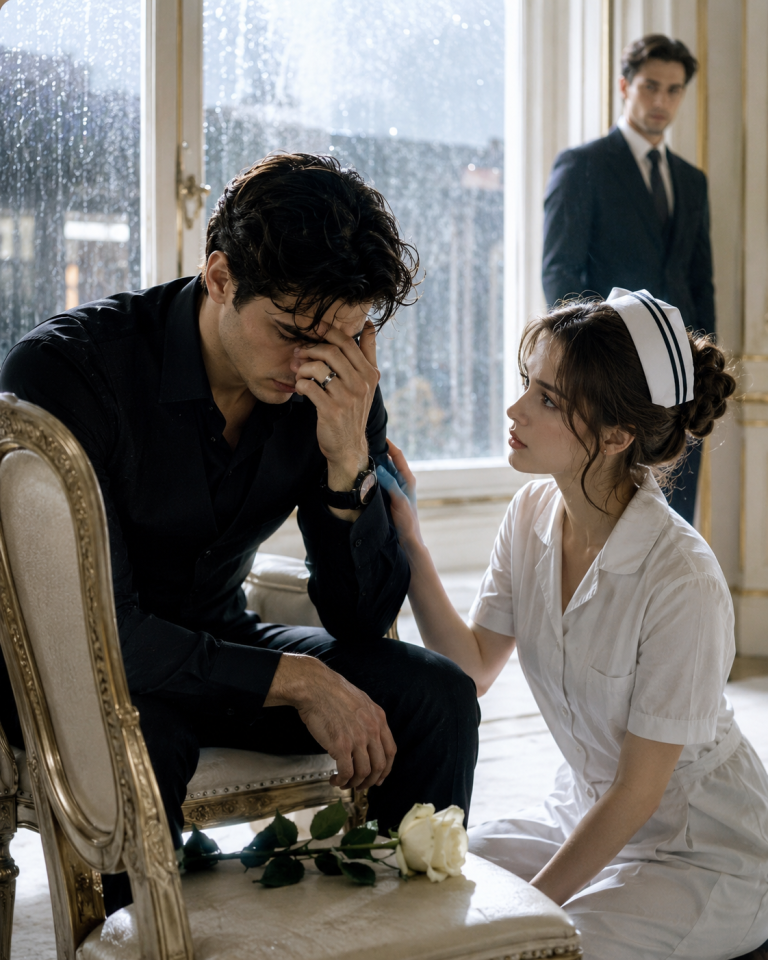
The bridal suite looked different in the pale early light — less theatrical, more simply a room. The silver mask Marco had worn was still on the floor near the fireplace, where it had landed when Nico had removed it. Neither of us picked it up.
I sat on the edge of the bed and worked the pins out of my hair, which had been architectural and was now collapsing with the exhaustion of approximately nine hours of sustained tension.
Nico sat in the chair near the window.
For a while, neither of us spoke.
“My father didn’t know about the Bureau,” I said. “In case that wasn’t clear.”
“I know.”
“He would have been—” I stopped. “He gave me to this marriage to protect the family. He believed he was making the best available trade.”
“He was,” Nico said. “The truce is real. Whatever else happened tonight, the agreement stands.”
I looked at him across the room. At the scar and the stillness and the controlled, deliberate way he occupied space — not dominance exactly, but the deep assurance of someone who had learned very early where his own boundaries were and had never needed to test them against someone else’s.
“You’re not what I expected,” I said.
“I know.”
“I expected colder.”
“I am cold,” he said. “I’m simply cold in ways that don’t show up until you’re looking for them.”
“Is that a warning?”
“It’s information,” he said. “You seem to prefer it.”
I almost smiled.
“What happens to us now?” I asked. “Past the truce.”
Nico was quiet for a moment — the considered kind of quiet, not the absent kind.
“I imagine we find out,” he said. “Over time. Without either of us pretending to know already.”
I looked at my hands. At the ring on my left hand — the one Marco had forced onto my finger at the altar, which was technically the wrong ring, though nobody had mentioned this in the chaos and I had stopped being able to care about it somewhere around the third hour.
“I was handed to you like a peace treaty,” I said. “That’s what tonight was supposed to be.”
“Yes.”
“I don’t intend to spend the rest of my life being a peace treaty.”
Nico’s expression shifted — a small movement, very deliberate.
“Good,” he said. “I didn’t marry a peace treaty.”
I looked at him.
“Then what did you marry?”
He held my gaze across the quiet room, in the early morning light that was coming gray and slow through the window, with the city beginning its ordinary day somewhere below us, entirely unaware.
“Someone with better instincts than anyone else in that cathedral last night,” he said. “Someone who understood what was wrong before I’d announced it. Someone who, when the situation became violent, stayed and made herself useful rather than retreating to safety.”
A pause.
“Someone worth the trouble of finding out,” he said.
The room settled into quiet. Not the compressed silence of danger or secrets. Just the ordinary quiet of two people at the end of a very long night, sitting with something that was too new and too complicated to name yet, but was real.
Outside, dawn was coming in over the river.
The city was waking up.
I reached over and set the silver mask on the windowsill, where the light caught it and made it something less threatening than it had been in the cathedral — just metal, just a tradition, just a thing that had served its purpose and could now be put down.
Then I looked at my husband.
At Nico Toscano, who had investigated me before he agreed to marry me, who had let me walk beside him into violence instead of ordering me away from it, who had just told me, in the most precise and careful language of a man who did not waste words, that he thought I was worth the trouble.
“Get some sleep,” I said.
“You first.”
“That’s not how it works.”
“In this house,” he said, “it is.”
The corner of my mouth moved.
“We’re going to argue about everything,” I said.
“Probably,” he agreed.
“You’ll lose occasionally.”
“I’m aware.”
The light kept coming, gray into pale gold, and the river below us caught it and gave it back, and the day that was beginning outside was ordinary and enormous and entirely indifferent to what had happened in this room.
I had been sold into a peace treaty.
I had survived a test, and a betrayal, and a gunfight, and a federal interview, all in the same night.
I had told the truth to a dangerous man and he had believed me.
And now I was sitting in the first light of the morning after my wedding, in the strange and provisional quiet of something that had not yet decided what it was going to become, and I found — to my own considerable surprise — that I was not afraid.
Not of him.
Not of what came next.
Not of the life that was beginning to take shape in the space between us, carefully, without either of us pretending to have mapped it yet.
My mother had survived this world through stillness.
My father had survived it through calculation.
I had survived this particular night through something else — through the willingness to look clearly at what was actually in front of me, rather than the version of it I’d been handed.
That seemed like enough to build on.
Outside, the city moved.
Inside, we stayed quiet for a while longer.
It was enough.