The Mafia Boss Chose His Mistress’ Son Over His Pregnant Wife—Three Years Later, His Triplets Refused to Speak to Him

## PART 1
Once, on a January morning so cold the lake had hardened into hammered pewter, Matteo Moretti had tucked a folded square of white silk into Camille’s coat pocket and pressed his mouth to her temple.
“Can’t have my wife freezing,” he’d whispered, “before she takes over the world.”
A single crimson camellia was stitched into one corner of that silk. He had always remembered she hated gloves.
That was the man she had married.
Tonight, the same handkerchief lay on the cream leather seat beside her, and it had stopped being a kindness. She had folded it around a hospital discharge envelope — and the envelope did not carry her name.
It carried the name Daniela Cross.
And beneath it, a four-year-old boy. Sam Moretti.
A child who wore her husband’s surname.
A child who did not share one drop of her blood.
Rain fell on the black Maybach in slow, deliberate strokes, the way a thing falls when it has decided exactly how long to make you suffer. Three small lives turned beneath her ribs — thirty-seven weeks along — as if even they could feel the silence sealing the car shut.
Walter Briggs, who had driven the family for twenty-two years, kept both hands on the wheel and his eyes carefully off the mirror.
The car slid through the iron gates of the Moretti estate on Ashbury Lake Road, past the cypress, past the marble lions, past the men in dark coats who pretended not to notice a pregnant woman coming home alone from the hospital with the proof of her husband’s other life folded in her lap.
Every window of the house burned gold in the rain.
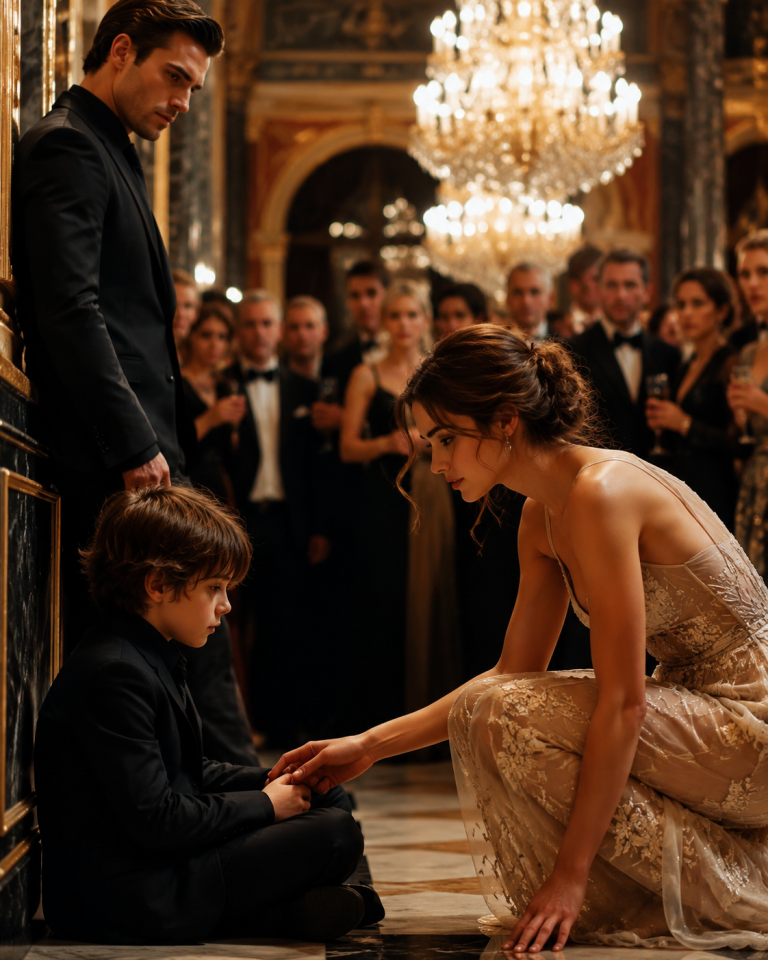
Matteo stood beneath the front portico, smoking. He did not come down the steps. He waited the way powerful men learn to wait, certain the world will close the distance for them.
Camille opened her own door before anyone could reach it.
The cold slid down the back of her neck. Her ankles screamed on the wet stone, but she walked toward him anyway. She had spent nine months teaching herself how not to shake.
She held up the handkerchief, the red camellia facing the sky.
“You were at Hartwell Memorial tonight,” she said. Her voice held. She was proud of that, even later.
He exhaled smoke. “Camille.”
“You signed her discharge papers. Not mine. Not your wife’s — the one carrying your children. Hers. Daniela’s.” She drew a breath. “And the boy. Sam. You gave him your name. You put him on your insurance. You signed like a father.”
Matteo studied the cigarette as if the answer were written in its ember.
“A nurse came into my exam room by mistake,” Camille went on. “Holding those papers. She smiled and said, ‘Mrs. Moretti, your son’s ready to go home.’ Your son, Matteo.”
He finally looked at her. Not with shame. Not with fear.
With exhaustion.
And that was the moment she understood: this was not a secret that had slipped loose. It was a life he had already chosen. She had simply arrived late to the funeral of her own marriage.
“There are three in here,” she whispered, both hands on her belly. “Three. The doctor told you on Tuesday. You were in the car. You heard him.”
He looked away.
“You said, ‘Not now.'”
The words lay between them like something that had stopped breathing.
“That was your first sentence,” she said, “after learning you had three children coming.”
He flicked the cigarette into the wet gravel. It hissed and died.
“Daniela almost died tonight,” he said, as though calm could turn it reasonable. “Septic shock. Sam was terrified. He’s four. He needed me there.”
“And these?” Camille pressed her palms to her stomach. “Did they need you?”
His mouth opened. Closed.
That was the answer.
Rain soaked through her cardigan. Her hair clung to her cheek. Somewhere behind them a fountain poured into itself, beautiful and pointless.
“You have the name,” Matteo said at last. “The house. The accounts. The doctors. You’ll be fine.” A pause, softer, as if gentleness could make it merciful. “They won’t.”
Camille did not cry. Later she would be proud of that in the small, ruined way survivors are proud of things no one else will understand.
She set the handkerchief on the wet marble step between them, the camellia facing up. Like a flag being lowered.
“Then I let you go,” she said.
His eyes narrowed. “Don’t be dramatic.”
“I’m not.” She turned her back to him. “I’m being exact.”
He said her name once. She did not turn.
Walter opened the rear door. For the first time in twenty-two years, he did not bow. He only looked at her with eyes too wet to blame on weather.
“Where to, Mrs. Moretti?” he asked quietly.
She eased herself in, one hand cradling her belly.
“Anywhere,” she said, “that isn’t his.”
What she did not yet know — could not have known, with three heartbeats still hidden inside her — was that her children had been listening that night. And that they would not forgive the world with words for a very long time.
## PART 2
By dawn, Camille Moretti was Camille Hale again. By noon she had closed three accounts, moved the money her late father had quietly left her, and driven out of Chicago without telling a single soul.
She kept the camellia handkerchief. She did not know why. Not yet.
Three years later, in a fog-soft harbor town in Maine called Mistlow Cove, she lived above a bookstore that smelled of salt and old paper, and she had three children who understood every word in the world and would not speak one of them.
Two girls and a boy. They laughed. They hummed in the bath. They tapped songs on the floorboards with spoons. They signed *more,* and *book,* and *Mama.* They pointed, nodded, wrote in careful chalk on a board by the register.
But no voices came. Not at one. Not at two. Not at three.
A psychologist in Portland had called it shared selective mutism — something that can take root in multiples when the womb itself was steeped in fear. Camille had nodded and said nothing about the rain, the portico, the cigarette, or the two words spoken over three unborn lives.
She told no one in Chicago where they were.
But that same week, eight hundred miles south, a junior accountant clearing an old Moretti safe-deposit box found a sealed envelope wedged behind a stack of deeds. Matteo nearly told her to bin it — until he saw the handwriting.
Hers. Dated the night she left.
He emptied his office and sat alone behind glass on the forty-second floor, not opening it for ten minutes. When he finally did, the silk slid into his palm. White. The crimson camellia. And folded inside, one ultrasound — three small curled shadows floating in a single dark sea.
On the back, in Camille’s narrow hand, seven words:
*They heard you say not now.*
Matteo read them standing. Then sitting. Then he read nothing at all for a long time.
By morning, he had stopped pretending the past would stay buried.
He picked up the phone to find them.
## PART 3
He did not call one of his own men — not the old neighborhood ghosts who solved problems with cash and silence. He hired a woman named Ruth Calloway, a retired federal analyst with gray eyes and zero tolerance for men who mistook regret for redemption.
“I need you to find someone,” Matteo said.
Ruth looked at the folder he slid across her desk and did not touch it. “Does she want to be found?”
He said nothing.
“That’s usually the answer,” Ruth said.
“It’s about my children.”
“Men always discover the word *my* once it’s too late.”
He almost dismissed her. Instead, he lowered his eyes. “Find them. Don’t approach them. Don’t frighten her. Don’t let anyone else know they exist.”
She studied him a long moment, then took the folder.
It took four months. Camille had done what frightened women with means do well — she had made herself dull on paper. No accounts in her married name. No forwarding address. No social media. Cash where cash would do. A maiden name and a quiet lease above a shop in a town too small to interest anyone who didn’t already know to look.
Ruth’s report ran three pages. Clipped to the front was a photograph: three children on the worn steps of a faded-blue bookstore — *Crane’s Books & Other Quiet Hours* — eating shaved ice from paper cones. A girl in yellow boots. A girl with two braids. A boy in the middle, holding a small chalkboard.
On it, in painstaking child’s print: *The sea is loud today.*
“Why is he writing instead of talking?” Matteo asked.
Ruth slid the second page over. “All three. Shared selective mutism. They don’t speak to anyone.”
He looked up slowly. “Not even to her?”
Ruth’s voice gentled despite herself. “Not out loud.”
He stood so fast the chair rolled back and struck the wall. “I’m going.”
“That’s a mistake.”
“I didn’t ask.”
“No,” she said. “Men like you rarely do.” She leaned in. “You paid me to find them. Now hear the rest. Your ex-wife built those children a safe life without you in it. Walk into it like weather because guilt finally got loud, and you’ll hurt them all over again. You’re their biological father. That is not the same thing as being invited.”
The words landed somewhere he couldn’t defend.
“I have to see them,” he said.
Ruth gathered her files and stood. “Then start by understanding one thing. You don’t get to be the hero of the wound you opened.”
Two days later he drove to Maine alone. No convoy. No security. No Daniela. No Sam. One black SUV, an overnight bag, the ultrasound, and the camellia handkerchief in the inner pocket of his coat.
Crane’s Books sat at the bottom of a street that tilted toward the harbor — faded blue paint, white shutters, window boxes spilling lavender, a brass bell shaped like a fish above the door. Matteo stood across the street for nearly five minutes. He had faced men with guns and felt steadier.
When he pushed the door open, the brass fish rang.
Three children looked up from a low table by the window, where they were folding paper boats out of old newspaper. The girls sat shoulder to shoulder on either side of the boy. The boy held the chalk.
They did not run to him. They did not smile. They did not hide. They watched him the way deer watch a man who hasn’t yet shown what kind of hunger brought him.
Matteo knew at once which one was his son. The same grave stillness Camille had worn the night she walked into the rain.
*His son.*
No. *Her* son.
The correction hurt, and because it hurt, he knew it was the truth.
“You’re not allowed in this room.”
Camille stood halfway down the back staircase, a mug of tea steady in her hand. She did not drop it. He wondered if she’d taught herself, after him, never to drop anything.
She looked different. Not older. Clearer. Hair cut to her jaw, a cream sweater, wool socks, no jewelry but a thin silver chain. Her face had softened. Her eyes had not. Her eyes were the door he had shut.
“Camille—”
“No.” Quiet. Finished.
One of the girls picked up the chalk, wrote something, and turned the board toward her mother. Camille read it, gave a single small nod, and came down the last steps to set her tea on the counter.
“Five minutes,” she told him. “On the porch. Not in here. Not near them.”
Outside, the sea was gray and restless. He stood at the rail; she stayed by the door, close enough to vanish the instant she chose. He took the handkerchief from his coat and laid it on the railing, the camellia facing up — exactly as she had left it on the marble step three years before.
He had practiced the gesture for hours in the car. By the slight tightening of her mouth, he understood she recognized the rehearsal and was untouched by it.
“I found your envelope,” he said.
“It wasn’t an envelope,” Camille said. “It was a receipt.”
He took the blow. He had earned it.
“They don’t speak,” he said. “Because of me.”
She looked out at the harbor. The waves answered for her — slow, cold, indifferent.
“I want to know them,” he said.
“No. You want relief. You want a door to open because guilt has made your house too small to live in.”
“That’s not fair.”
“Fair was three years ago, in the rain, when I asked whether your unborn children needed you and you decided I’d survive without you.” She turned to face him fully. “You chose, Matteo. With a cigarette in your hand. You chose a woman who almost died and a boy who needed his father, and you told yourself I’d be fine because I had your name. I gave the name back. I left the house. I fired the doctors. And they still don’t speak. Whatever you came here to fix is older than your guilt, and it was never yours to fix.”
Inside, the brass fish rang. A fisherman with a white mustache stepped in, nodded at the children, and pulled a paperback off the mystery shelf. Without glancing up from her boat, the girl in yellow boots slid one across the table toward him. He pocketed it like a passport and left.
Matteo watched through the glass, his throat tight. “They have a whole life.”
“Yes.”
“I have a son in Chicago.”
“I know. Sam is seven now. He sleeps with the hallway light on.”
His head turned sharply. “How could you possibly know that?”
“Because he was a child dragged into adult wreckage too. I checked once. Quietly.”
That struck harder than any accusation. The woman he had abandoned had still made sure the boy he chose was alive.
“Daniela—”
“I don’t want that name on this porch.” Her voice stayed level, but iron moved through it. “Not because I hate her. I’m too tired to hate anyone. Because they—” she nodded at the window, three small heads bent over folded paper— “have never once heard her name. And they won’t hear it from you.”
He had come braced for fury. Instead she handed him a border he could not cross. Boundaries are the hardest thing for men like Matteo Moretti, because they cannot be won. They can only be honored.
“What do I do?” he asked.
For the first time since he arrived, something like sorrow crossed her face. “You leave. And then you write one letter. Not to me. To them. You tell them, in plain words, what you did. Not what you felt. Not what you lost. What you *did.*”
“Will you read it to them?”
“No. I’ll give it to them. They can read it, or burn it, or hand it to the ocean. Their choice.” She reached for the doorknob. “Children can live with what their parents did to them. What they can’t survive is parents who spend a lifetime pretending it never happened.”
Then she went inside, and the handkerchief stayed on the railing. He did not pick it up. For the first time, he understood it had never been his to take back.
He drove to a motel outside Portland and wrote the letter with the curtains open to the dark Atlantic. It took eleven hours and four drafts and a bottle of whiskey he never opened. In the morning he called Ruth Calloway and asked her to mail it, because he finally grasped that he could not be trusted to deliver it without turning the moment into something about himself.
The letter began:
*Dear Maren, Lark, and Eli,*
*My name is Matteo Moretti. I am the man whose name your mother chose to leave off your school papers. That was her right, and it was wise.*
*Before you were born, I was given a choice, and I made it badly. I was told there were three of you, and I said, “Not now.” I am sorry those were among the first words you ever heard, while you were still safe inside your mother. I am sorry I made the world feel dangerous before you had even seen it.*
*Your mother stayed. Your mother chose you. Your mother built a place where people wait for your words instead of taking them.*
*You owe me nothing. Not your voices, not your forgiveness, not a meeting or a birthday or a single Christmas. I have put a photograph in here so you know my face, if you want it. If you don’t, give it to the sea. I will not come again unless your mother tells me you have asked for me. And if you never ask, I will carry that, because love that arrives too late does not get to make demands.*
*Matteo Moretti*
Edith Crane carried the envelope upstairs on a Thursday. Camille knew what it was before she touched it; some things bring their own weather.
She read it alone at the kitchen table while the children sorted donated books below. She read it once, then again, and only on the third pass did the tears come, quiet ones. Not forgiveness — she had learned forgiveness was not a clean sheet thrown over something ugly, not a performance owed to whoever finally admitted the harm. Sometimes it wasn’t required at all. Sometimes the only mercy was that the wound, at long last, stopped bleeding.
At noon she called the children up.
Maren came first, a stack of picture books to her chin. Lark followed, yellow chalk tucked behind one ear. Eli came last, holding a paper boat folded from a grocery receipt. They climbed into their chairs, and Camille set the envelope in the center of the table.
“This is from the man whose name isn’t on your school papers,” she said. “He says he’s sorry. You can read it now, later, or never. You can keep it, tear it up, or give it to the sea. Whatever you decide, I’ll help you.”
Maren reached for the first page. Lark leaned in until their foreheads almost touched. They read the slow, careful way children read once they’ve learned that words matter more than noise.
Eli did not lean in. He climbed into his mother’s lap — something he had not done in nearly a year — and pressed his ear to her collarbone, just above her heart, the way he had as a baby. As if, before words and books and chalkboards, there had only ever been this one sound. Her heartbeat. The first language he ever knew.
When the girls finished, Lark lifted the chalkboard and wrote one word.
*Sea.*
So they went.
Down the back stairs, through the shop, past Edith, who took one look at Camille’s face and said nothing — only reached beneath the counter, pulled out three small coats, and handed them over. Past the bakery, where Mrs. Ferris lifted a hand. Past the docks, the gulls, the slap of rope on wood. Past the white-mustached fisherman, who tipped his cap and asked nothing.
The tide was coming in when they reached the rocks. The sea folded into itself below, gray-green and endless under a bright, cold sky.
Camille held the photograph. The children held the letter, one corner each, Eli in the middle.
They did not throw it. They folded it. Page by page, crease by crease, they turned eight pages of apology and one photograph into a single white paper boat with a sharp little prow. Maren made the folds clean. Lark pressed the edges. Eli held the center steady.
When it was done, they stood and looked at it — eight pages of *I’m sorry,* one face, three years of silence, and one choice finally returned to the people it had always belonged to.
Eli crouched at the lip of the rocks. Camille reached out, afraid he’d slip, but Maren took one side of his coat and Lark the other, and together they held him while he set the boat on the water.
It spun once. Then the tide caught it. It lifted over one ripple, then another, turned its small paper nose toward open water, and drifted.
Camille watched it go and thought of Chicago. Marble steps. A cigarette burning orange in the rain. The sentence she had carried for three years like a stone lodged between her ribs. *You’ll be fine.*
She had not been fine.
She had given birth with no one beside her. She had signed papers with a shaking hand. She had slept upright between three bassinets, terrified that if she closed her eyes one of them would stop breathing. She had learned which cry belonged to which child in the dark. She had learned to fix a sink, change a tire, file taxes, and tell bedtime stories in three different voices, and to keep smiling at strangers who said *must be so hard without their father,* as if the absence were the tragedy and not the man who caused it.
She had built a life out of the ash of someone else’s decision.
No. She had built it out of love.
The boat shrank. White against gray. Then smaller. Then almost nothing.
Eli watched until it was a speck. Then he opened his mouth.
Camille stopped breathing.
The wind moved through his dark hair. His lips parted. And for the first time in three years, her son spoke.
“Mama.”
Tiny. Rough. Imperfect. Barely louder than the water.
But there. Alive.
She did not move. She had trained herself to hold still through betrayal, through labor, through fear. Nothing had prepared her for joy.
Eli turned to her, wide-eyed, startled by himself. Then he said it again. “Mama.”
Behind her, Maren made a small sound into her hands. Lark cried without a single noise. And then, because triplets share more than a womb, Maren opened her mouth.
“Mama.”
Lark drew one shaking breath. “Mama.”
Three voices. None practiced. None perfect. All reaching the same shore at the same moment.
Camille dropped to her knees on the rocks and gathered them into her coat — all elbows and tears and warm small bodies — and held them until they squeaked. She wanted to say *I’m here. I heard you. I would have waited forever.* But for once she didn’t need words. She only listened.
And the children said it again. And again.
*Mama. Mama. Mama.*
A week later, a small envelope arrived at the Moretti offices in Chicago. No return address. No letter. Inside was one thing: the camellia handkerchief, clean and dry, folded once. For a moment Matteo thought she had simply sent it back. Then he found the scrap of paper tucked inside, three lines in careful child’s print:
*We let the sea keep your letter.*
*We kept our voices.*
*Please don’t come.*
He sat down slowly. Beyond his door, men waited with contracts and threats and all the old machinery of his power. Inside, Matteo Moretti held a square of silk and understood that the only decent thing left to him was to obey.
He did not go to Maine. He did not call. He sent no gifts. Every year, on the triplets’ birthday, he wrote three letters and locked them in a drawer unmailed — not in hope of being praised for his restraint someday, but because apology had become the only honest prayer he had left.
He changed other things too, quietly. He moved Daniela and Sam out of the estate and into a house that belonged wholly to them and not to a ghost. He put Sam in therapy. He told Daniela the truth she had avoided, and the larger one he had avoided more.
“I used you as an excuse,” he said.
She looked older in the kitchen light. “And I let you.”
They did not become enemies. They did not become happy. They became honest — which is sometimes the first kindness adults owe a child. Years on, Sam would grow into a gentle teenager who still kept a small lamp burning at night but no longer apologized for it. Once he would ask, “Do I have brothers or sisters?”
Matteo would close his eyes. “Yes. But they aren’t mine to give you.”
And Sam, who understood more than a boy his age should, would nod.
In Mistlow Cove, the triplets did not suddenly turn loud. Healing rarely shows up like a parade. Maren spoke first in whispers, mostly to books and to birds. Lark sang before she held a conversation, humming invented tunes while she shelved novels downstairs. Eli chose his words the way you choose stones from a beach — slowly, only the ones worth the weight of carrying.
But they spoke. To Camille. To Edith. To the white-mustached fisherman. To the woman at the bakery. And eventually to the wider world, always on their own terms.
The chalkboard stayed by the register. Not because they needed it anymore. Because some part of them loved it. Because their silence had never been their shame.
It had been their shelter.
One October afternoon — three years after the letter, six after the rain — Camille stood on the porch above the bookstore, watching her children race along the harbor path. Maren was laughing. Lark was shouting at Eli not to cheat. Eli was, without question, cheating.
Edith came out with two mugs of tea and stood beside her. “You ever think about going back?”
Camille smiled faintly. “To Chicago?”
“To anything.”
Below them, Eli skidded on wet grass, rolled, sprang up, and took a dramatic bow while his sisters booed.
Camille wrapped both hands around the warm mug. “No.”
Edith nodded, as if it were the only answer she had expected.
The sea past the harbor glittered under a pale sun — patient, indifferent, kind in the way old things are kind. Out of habit, Camille reached into her coat pocket for a handkerchief she no longer carried. Her fingers found nothing, and for a heartbeat she felt the absence.
Then Maren called from the path. “Mom! Watch!”
Camille looked up. All three children stood on the rocks, paper boats in their hands. They launched them at the same time, cheering as the tide caught the folded paper and pulled it toward the horizon.
Not toward Matteo. Not toward the past. Not toward any name that had ever tried to own them.
Only toward open water. Only toward a life wide enough to hold every voice that had finally chosen to come home.
And when her children called her name again, Camille answered.