HE THREATENED HER FOR TOUCHING HIS DEAF SON — THEN A WAITRESS’S FOUR WORDS BROUGHT THE MOST FEARED MAN IN THE CITY TO HIS KNEES

## PART 1
The gun was already halfway out of his coat before Daniel Ashgrove realized his own hand had moved without asking permission.
Some instinct older than reason had taken over — the same instinct that had kept him breathing through two decades of enemies, betrayals, and men who smiled while planning his funeral. It told him only one thing, over and over, drowning out every other thought: *a stranger has her hands on your son.*
It didn’t matter that the stranger was an exhausted waitress in a flour-dusted apron, her hair falling loose from its knot, her sneakers split at the seam. It didn’t matter that his son was laughing — actually laughing, a small breathy sound Daniel hadn’t heard from him in four years. All that mattered was the woman’s palm resting gently on Eli’s shoulder, and the cold certainty rising in Daniel’s chest that something was happening to his child that he did not control.
“Take your hand off him.” His voice was quiet. Quieter than any shout could ever be.
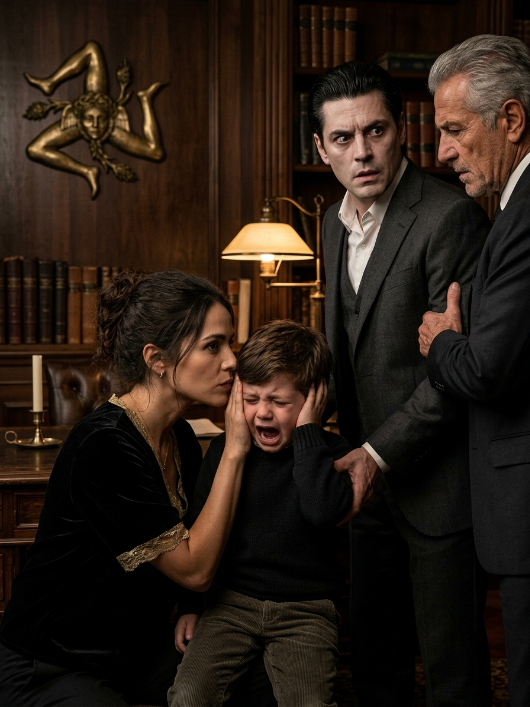
The diner froze around the words. Forks stopped in midair. Behind the counter, the cook reached for the volume knob on the ancient radio and killed the music, as if some part of him understood that no song deserved to keep playing through whatever came next. Two men in dark coats had gone still at Daniel’s shoulders, hands drifting toward the places under their jackets where decent men kept nothing.
The woman — Ruth, according to the crooked name tag pinned above her heart — did not flinch. She stayed crouched beside the boy in the booth, her tired eyes lifting to meet Daniel’s without a trace of the fear that should have been sitting there.
“I wasn’t hurting him,” she said.
“He’s deaf.” The words came out like an accusation, though he wasn’t sure at whom. “He can’t hear a single thing you say to him.”
“I know that.”
“Then why does he look at you like—”
“Because I wasn’t talking,” Ruth said, cutting him off gently. “I was signing.”
Daniel’s hand stopped moving.
For four years he had thrown money at his son’s silence the way he threw money at every other problem in his life — as though it were a debt that could simply be paid off and closed. Specialists flown in from three continents. Devices fitted and refitted. Speech therapists who charged more per hour than most people made in a week. He had attacked Eli’s deafness the way he attacked a rival business: with pressure, capital, and the refusal to accept that some doors do not open for money.
And in thirty seconds, at two in the morning, in a diner that smelled of burnt coffee and old grease, this stranger had done something none of those specialists ever had. She had made his son’s face open up like a window letting in light for the first time.
“I was just saying hello,” Ruth added quietly, glancing down at the boy, then back up at him. “The only way he’d actually hear it.”
That sentence landed in Daniel’s chest harder than any bullet ever had.
He had spent four years believing that loving his son meant protecting him — from bullets, from kidnappers, from strangers, from the cruelty of a world that stared too long at a boy who never turned his head at loud noises. He had built a fortress around Eli’s silence without ever once stepping inside it himself.
“Sit down,” he heard himself say to Ruth, though his hand had finally, slowly, come away from his coat.
“I’m working,” she said. “There are other tables.”
“Sit,” Daniel said again, and this time there was something underneath the command that wasn’t quite a threat — something closer to a man realizing, all at once, in the middle of the night, in a diner he’d never meant to walk into, that he had been asking the wrong question for four straight years.
Eli tugged at Ruth’s sleeve. His small hands lifted, uncertain, and made a shape in the air — clumsy, but unmistakable once you’d seen it made correctly.
*More,* he signed. *Please.*
Ruth’s face softened in a way that had nothing to do with fear of the men standing over her.
“He wants more,” she told Daniel, as if she hadn’t just risked her life for a four-year-old boy she’d known for less than ten minutes. “Cherry pie. He pointed at the case earlier.”
Daniel looked at his son — really looked, the way he hadn’t in longer than he wanted to admit — and for the first time in four years, he did not know what to do with the ache rising behind his ribs. It had no name he recognized. It didn’t respond to money, or threats, or the careful architecture of control he’d built his entire life around.
Outside, thunder rolled low across the city, and headlights swept once across the rain-streaked window, then vanished into the dark — a detail Daniel’s mind filed away and did not yet understand mattered at all.
## PART 2
Three hours earlier, Daniel had been standing in his penthouse above the river, watching Eli stack wooden blocks with the same fierce, silent concentration he brought to closing deals that were never really about the things people assumed.
The tower fell. Eli didn’t flinch — just stared at the wreckage a moment, then reached for the first block and started again, alone, the way he did everything.
That silence broke something in Daniel that no amount of money had ever managed to fix.
His wife, Vivian, had died hours after giving birth, a sealed letter meant for him disappearing into the chaos that followed — chaos his second-in-command, Preston Hale, had quietly taken control of that same night, before Daniel had even finished grieving enough to ask where it had gone. For four years he’d told himself her last wish had simply been *protect our son.* He had done that much. Walls, guards, fortunes spent.
He had never once asked what Eli actually needed from him.
So tonight, watching his son crawl after a rolling block and smile up at him the polite, distant smile he gave strangers, Daniel had ordered the car without a destination in mind and ended up outside a diner that smelled like the wrong side of the city — the last place on earth anyone expected to find a man like him at two in the morning.
Now, sitting across from a bleeding waitress and a laughing son, Daniel felt something in his chest come loose right before the front window exploded in gunfire, and every fear he’d spent four years building walls against came roaring back at once, louder than any silence had ever been.
## PART 3
Glass rained down like shattered ice. Daniel hit the floor on instinct, screaming his son’s name into chaos that swallowed the sound whole, certain for one unbearable second that he had lost everything that mattered in the space of a single breath.
Then he saw her.
Ruth was behind the counter, curled over Eli’s small body, shielding him with her own back, blood already darkening the sleeve of her uniform. Her hands never stopped moving against his palms — slow, steady, deliberate even as the world came apart around her. *Breathe. Look at me. Safe. I’m here.*
She had taken the shrapnel meant for his son without a single second of hesitation, and she hadn’t even known his name.
Daniel carried her out himself, over every protest she made, and by morning she was lying in a guest room larger than her entire apartment, a private doctor’s stitches closing the wound in her shoulder while she drifted in and out of a sleep too heavy to fight. When she woke, Daniel was standing at the foot of the bed holding a cashier’s check with more zeros on it than she had ever seen written by hand.
“For saving him,” he said. “And for staying. Full-time. Teach him. Be his voice.”
Ruth looked at the check for a long moment. Then she tore it in half, and again, letting the pieces fall across the blanket like snow that didn’t belong in that room.
Daniel’s jaw tightened. “Do you understand what you just—”
“You can’t buy your way into being his father,” Ruth said, before he could finish. Her voice was rough with exhaustion, but it didn’t waver. “You already tried that for four years. It didn’t work, and it never will. You want him to stop being alone in that silence? Then stop paying strangers to walk in there for you. Go yourself.”
“I don’t know how,” Daniel said, and the words cost him more than any negotiation ever had. They came out low, almost broken, nothing like the voice that ran warehouses and controlled shipping lanes and made judges answer calls they didn’t want to take.
“Then start badly,” Ruth told him. “That’s how everyone starts.”
For three weeks after that, the most feared man in the city knelt on the floor of his own library, fumbling through hand shapes with fingers more accustomed to violence than tenderness. He mixed up *hungry* and *angry.* He told his son, once, that his shoes were sad, and Eli laughed so hard he toppled backward off the rug, and Daniel — stiff, proud, unused to being anyone’s joke — found himself laughing too, low and rusty, like a door that hadn’t opened in years.
He walked out of two lessons in frustration. He came back both times, because Eli was always waiting in the doorway when he did, watching his father try.
One evening, under a ceiling of projected stars, Daniel sat on the edge of his son’s bed and raised his trembling hands.
*I love you,* he signed, slow and clumsy. *My son.*
Eli’s lip quivered. Then both small hands flew up, faster and surer than his father’s ever could be.
*I love you, Dad.*
Daniel pulled him close and cried for the first time since Vivian’s funeral, and did not turn his face away from it the way he always had before.
It should have been the end of the hardest part. Instead, it was only the beginning of what came next.
The change in Daniel did not go unnoticed by the men who worked for him. Rumors moved through the organization the way rumors always did — quiet, fast, impossible to trace back to a single mouth. The boss had let a waitress into his house. The boss left meetings early for lessons with his hands. Somewhere in that whisper network, Preston Hale — the man who had organized Vivian’s funeral, chosen Eli’s doctors, and quietly discouraged sign language as a “delay to verbal development” — began to understand that something in his carefully built position was shifting beneath him.
Preston found Ruth alone in the hallway outside the playroom one afternoon, his cufflinks catching the light, his voice as soft and even as it always was right before something dangerous happened.
“You’ve made yourself important around here,” he said.
“Eli made communication important,” Ruth answered. “I just showed up.”
“Daniel has enemies. People close to him get used by those enemies. Sometimes without even realizing it.”
“Is that advice, Mr. Hale, or a threat?”
“That depends entirely on how smart you turn out to be.”
Ruth held his gaze without blinking. “I’ve been poor my whole life. Don’t mistake that for stupid.”
Preston’s thin smile didn’t move, but something behind his eyes did — and later that night, when he passed the dining room, Eli looked up, stiffened, and lifted both hands.
*Wolf,* he signed, pointing straight at Preston’s back.
Ruth frowned and knelt beside him. “Sweetheart, why did you sign wolf?”
But Eli, only four, had language now without yet having enough of it to explain a complicated fear. He signed it again — *wolf, light, bad car* — grew frustrated when Ruth couldn’t piece the fragments into a full sentence, and finally buried his face against her side, shaking.
She meant to tell Daniel that same night. She never got the chance.
At ten o’clock the estate went into lockdown. A warehouse had been hit. Two men were dead, and a shipment worth more than most people saw in a decade had vanished into the dark. Only three people had known the changed delivery route — Daniel, Preston, and Ruth, who had been sitting in the library when the call came through.
Preston arrived at Daniel’s office with proof already in hand: an envelope discovered in Ruth’s room, containing cash, a burner phone, and a note written in block letters describing the exact route that had just been hit.
Daniel stared at the items laid out across his desk. Ruth stood across from him, pale, furious, disbelieving.
“You think I did this?”
He didn’t answer fast enough, and the silence answered for him.
“I took shrapnel in my shoulder for your son,” Ruth said, her voice shaking now, not from fear but from something closer to grief. “And that’s still not enough for you to trust me over him.”
“Someone may have paid you to get close enough to do worse,” Daniel said, and hated every word of it even as it left his mouth.
“You learned the signs,” Ruth said quietly. “But you still don’t know how to listen.”
That was when Eli ran into the room, breaking free of the nanny at the door, his eyes moving fast between the cash on the desk, Ruth’s stricken face, and Preston standing calm and untouched near the window. Terror flooded the boy’s face. He rushed to his father and grabbed his sleeve, hands flying too fast to follow.
*Wolf. Wolf. Bad. Light. Car. Phone.*
“Slow,” Daniel signed back, awkward but urgent. “Tell me slow.”
Preston stepped forward smoothly. “The boy is upset. This isn’t the moment to—”
Daniel raised one hand, and for the first time in years, Preston actually stopped talking.
Eli took a shaking breath and pointed directly at Preston. He mimed holding a phone to his ear. He pointed toward the window and flicked his fingers open and shut, like headlights sweeping past in the rain. Then he struck one small fist into his palm.
*Bad car. Diner. Wolf told bad car.*
The air left Ruth’s lungs in a rush. She understood before Daniel did — the headlights she’d noticed sweeping the window right before the shooting, the black SUV outside the diner, and now her memory sharpening around a detail she hadn’t thought to question: Preston, stepping out to take a call minutes before they’d even chosen which diner to stop at.
Daniel’s eyes moved slowly toward the man he had trusted since they were both too young to know better.
“Noah is a traumatized deaf child describing shadows,” Preston said, calm as ever, though a small muscle jumped once beneath his jaw.
“Noah,” Daniel signed to his son, ignoring Preston entirely. “Truth?”
Eli nodded fiercely, tears streaking down his face. *Truth.*
Daniel turned back to Preston. “Open your jacket.”
“Daniel—”
“Open it.”
The guards along the wall shifted, uncertain now in a way they had never been before, their loyalty suddenly split down a line that had always run straight through Preston as much as through Daniel himself.
Preston’s hand moved fast — faster than a man who spent his days behind a desk should have been able to move — but Daniel had survived too many rooms like this one to miss it. He caught the wrist before the gun cleared the jacket, and the weapon hit the floor with a sound that seemed too small for what it meant. Guards shouted. Eli screamed without any sound at all, his whole small body shaking. Ruth grabbed the heavy brass lamp off the desk and swung it hard into Preston’s shoulder, buying Daniel the half-second he needed to drive the man into the wall and pin him there with a forearm across his throat.
“Why?” Daniel’s voice broke on the word.
Preston’s composure finally cracked, hatred pouring through the gap. “Because Vivian was going to ruin us. She wanted the docks clean, the accounts closed, wanted your money moved into some charity for children exactly like him.” His chin jerked toward the doorway where Eli stood frozen. “She made you weak before she’d even finished dying.”
Daniel went white.
“You never even read her letter, did you?” Preston pushed, breathless under the pressure of Daniel’s arm, smiling through it like the truth itself was a weapon he still had left to use. “The one she gave the nurse. The one I made disappear that night, while you were too busy falling apart to notice anything else. She knew the baby might be born deaf — her family had a history of it. She’d already started learning to sign before he was even born. She made videos for him. For you.” His mouth twisted. “I burned most of them. Kept one. Insurance, in case a man like you ever got sentimental enough right before it cost him everything.”
Daniel hit him once — hard enough to end the conversation, not hard enough to end anything else.
The guards took Preston out through the service entrance, the same way deliveries came and went, as if the house itself understood there was no dignity left to spare for him. Ruth sat on the floor of the office afterward, her back against the cold leg of the desk, the adrenaline draining out of her all at once and leaving something closer to grief in its place. She had almost lost her life twice in one night — once to a bullet meant for a child, once to a lie meant to bury her — and no amount of money in the world had ever been able to buy her out of either moment. Only the truth had done that. Only a four-year-old boy’s stubborn, broken hand-shapes, refusing to stay quiet even when every adult in the room wanted him to.
Daniel knelt in front of her, Eli still clinging to his shirt, and for a long moment none of them said anything at all, in any language.
“I owe you more than a torn-up check,” he finally said.
“You don’t owe me anything,” Ruth answered. “You just finally listened to somebody who couldn’t talk.”
By dawn, the evidence was sitting on Daniel’s desk, pulled from Preston’s private safe: offshore transfers, messages to rival crews, the full plan behind the diner attack, and a small drive labeled simply *V.A. — Personal.*
Daniel didn’t watch it right away. He sat instead in the playroom until the sun rose gray over the water, Eli asleep against his chest, Ruth beside them with her bandaged shoulder aching and her face still pale from a betrayal she’d narrowly survived twice in one night.
When he finally slid the drive into a laptop, Vivian appeared on the screen — alive, pregnant, smiling through eyes that looked tired in exactly the way his own had looked every night for four years.
“Linc,” she said — no, *Daniel*, he corrected himself through the blur in his eyes, hearing his own name in a voice he’d almost forgotten the exact shape of — “if you’re watching this, then either I got scared and gave it to you myself, or something went wrong and someone else had to.”
Her hands rested over her belly. “The doctor says there’s a chance our baby might be born deaf. I know you. You’re going to try to fight it — you’ll fly in the best people in the world and you’ll think love means winning. But if our son grows up living in silence, don’t turn that silence into a prison for him. Meet him inside it instead. Learn him. Let him teach you.”
On the screen, she lifted her hands and, slowly, carefully, signed the words herself.
*I love you.*
Then she laughed, soft and self-conscious. “I’m terrible at this. You’ll probably be worse. Start badly anyway, okay?”
Ruth pressed a hand over her mouth. Daniel bowed his head and let himself cry without turning away from it, the way he’d learned to, finally, over three clumsy weeks in a library full of flashcards.
Eli woke and crawled toward the laptop, having only ever seen photographs of his mother, never anything that moved. Vivian signed again from the screen, and this time Daniel signed the words back to his son at the exact same moment.
*Your mother loves you.*
Eli pressed both small hands flat against the screen, as if he could hold on to something that had never once had the chance to hold him.
The fallout could have become another war. The old Daniel might have made it one, might have filled the streets with retaliation and called it justice, the way he’d been taught to call it that his entire life. But Ruth had already changed the only question that mattered to him now — not *who must pay,* but *what kind of world will my son inherit if I keep answering everything with more violence.*
Preston was handed to federal authorities through a lawyer who knew exactly where every legal body in the organization was buried. The evidence dismantled half the network built quietly under Daniel’s name for over a decade. Daniel made no attempt at innocence. He struck a deal that cost him money, properties, and men who had only ever followed him because fear happened to pay well.
Some people said he’d gone soft. He let them say it.
Soft, he had learned, was not the opposite of strong. It was only the opposite of dead.
In the weeks that followed, Daniel found himself doing things he never would have imagined a year earlier. He sat in on Eli’s therapy sessions instead of paying someone else to summarize them for him afterward. He learned the sign for *proud* before he learned the sign for half the business terms he used every day, because Eli asked for it first, tugging on his sleeve every time he finished a puzzle or tied his own shoe for the first time. He fired the speech specialist who had once told him signing would delay his son’s development, and hired two new teachers instead — one deaf, one hearing, both fluent enough to argue with each other about grammar in front of Eli just so the boy could see disagreement handled without anyone raising a fist.
Ruth stayed. Not because of the money — there wasn’t any money involved anymore, not after the second check followed the first one into pieces on the floor — but because Eli had started reaching for her hand at the end of every lesson and refusing to let go until she signed *see you tomorrow* back to him, slow enough that he could catch every letter.
Daniel noticed the way his son’s shoulders had changed in those months. Less hunched. Less careful. A boy who had once flinched at the collapse of his own building blocks now threw his whole body into laughter without checking first whether anyone was watching.
It wasn’t a fairy tale. Some nights Daniel still woke from dreams about warehouses and gunfire, reaching automatically for a weapon that wasn’t there anymore because he’d finally, quietly, given most of that world away. Some nights Ruth still dreamed about hospital corridors and unpaid bills and a sister who never got to grow old enough to be angry about any of it. Grief didn’t disappear just because a better ending had arrived. It only made room, eventually, for something to grow up alongside it.
Six months later, the old diner reopened under a new name — Wren’s Table, after the sister Ruth had raised, loved, and lost to a world that never once bothered to learn her language while she was alive to need it. The windows were new. The booths were repaired. The jukebox, rebuilt by a retired mechanic who refused payment twice before finally accepting free pie for life, stood polished in the corner with a bass stronger than it had ever had before.
By day the café served coffee and eggs and pie the way it always had. In the evenings, the back room filled with free sign language classes — parents and children meeting each other halfway, some through speech, some through signs, some through tablets, some through nothing but touch and patience.
On opening night, Eli stood by the jukebox in a small navy suit, solemn and proud, while Daniel stood beside him looking, for once in his life, genuinely out of his depth in a room where nobody feared him.
Ruth walked over carrying two slices of pie.
“You look terrified,” she said.
“I’ve negotiated with senators with less anxiety than this.”
“That’s because senators don’t expect you to be honest about anything you’re feeling.”
“I’d rather be shot at again.”
“No,” Ruth said. “You wouldn’t.”
Daniel looked down at his son. “No. I wouldn’t.”
A little girl approached Eli and signed, *Do you want to dance?* Eli glanced up at his father out of old habit, asking permission the way he still sometimes did.
*Your choice,* Daniel signed back.
Eli grinned and ran for the jukebox. The bass rolled out low and steady, and children pressed their palms to the wood, laughing as the vibration climbed up through their hands and into their chests. Parents watched with wet eyes, some trying clumsily to copy the rhythm, some simply holding their children closer than they had in a long time.
“I found the rest of Vivian’s files,” Daniel said quietly, standing beside Ruth near the counter. “Preston didn’t burn all of them. There are more videos. Birthdays. First day of school. Bad days, she said, in case he ever had any.”
Ruth’s expression softened all the way through. “That sounds exactly like a mother.”
Daniel nodded, and across the room Eli turned and waved both hands hard to catch his attention.
*Dad! Dance!*
Daniel stiffened on reflex. “I don’t dance.”
“You run a community café now,” Ruth said, smiling. “Your reputation was already ruined the day you tore up my rent money and cried in a library.”
He gave her a look that had no real weight behind it anymore, just warmth where the warning used to be.
Then the most feared man in the city crossed the room, knelt beside his son, and pressed his scarred hands flat against the vibrating wood of the jukebox. Eli took one of those hands in both of his own and tapped out the rhythm against his father’s knuckles, exactly the way Ruth had done for him that first impossible night.
Daniel followed the beat. Badly, at first.
Then better.
The whole room watched, and for the first time in longer than he could remember, Daniel didn’t care that they were watching. He wasn’t performing power anymore. He was simply receiving joy, clumsy and unearned and entirely his.
Eli laughed without a single sound, his shoulders shaking with it, and Daniel laughed with him, rough and unfamiliar, surprised every time by the sound of his own happiness.
Near the counter, Ruth rested one hand over the scar on her shoulder. It still ached whenever rain came in, and she suspected it always would. But some scars, she had come to understand, weren’t only reminders of the worst night of a person’s life. Some of them were proof that a life had turned, at exactly the right terrible moment, toward something better.
Across the room, Daniel caught her eye and lifted both hands, signing slowly enough that everyone nearby could follow along.
*Thank you.*
Ruth shook her head, and signed back just as clearly.
*Keep learning.*
He nodded once, and meant it the way he had never quite managed to mean anything before.
Eli grabbed his father’s face between two small hands, turning his attention back to where it belonged, and signed as fast as his fingers would let him.
*I love you, Dad.*
This time, Daniel answered without a single second of hesitation.
*I love you, my son.*
The words made no sound at all.
But everyone in that room who needed to hear them, finally did.
Later that night, after the café had emptied and the last of the coffee cups had been stacked away, Ruth found Daniel standing alone by the window, watching Eli sleep in a booth with his coat folded under his head like a pillow. Rain had started up again outside, soft this time, nothing like the storm that had first brought them all together in a room like this one.
“He’s going to want to come back every Saturday,” Ruth said, leaning against the frame beside him. “You know that.”
“Good,” Daniel said. “So am I.”
She glanced at him, surprised by how easily the word left him — a man who used to measure every sentence before he spoke it, weighing cost against consequence the way he weighed everything else in his life.
“You’ve changed,” she said.
“I had help.” He looked down at his hands, the same hands that had once reached for a gun in a diner doorway, now stiff and sore from an entirely different kind of practice. “I still get it wrong. I probably always will.”
“Start badly,” Ruth said, smiling despite the ache still living in her shoulder. “That’s how everyone starts.”
Daniel reached over and gently woke his son, lifting him against his shoulder the way he used to lift him as an infant, back when Eli’s silence had still felt like something to be afraid of rather than something to be learned. Eli stirred, blinked at his father’s face, and without opening his eyes all the way, lifted one small hand and pressed it against Daniel’s chest — not a word, not quite a sign, just a boy checking that the heartbeat under his palm was steady and close and staying.
It was.
Outside, the rain kept falling over a city that had once feared the sound of Daniel Ashgrove’s name and now, slowly, was learning a version of him that didn’t need to be feared at all. Somewhere beneath the noise of traffic and thunder, a boy who had spent his whole life in silence was finally, fully understood — not because the world had grown quieter, but because someone had finally cared enough to learn the language of the quiet he’d been living in all along.
**THE END**