A PENNILESS SEAMSTRESS STUMBLED INTO A CATTLE BARON’S ENGAGEMENT PARTY — THEN HE CALLED HER HIS WIFE IN FRONT OF TWO HUNDRED GUESTS

PART 1
Dust doesn’t settle in Marrow’s Bend. It just waits.
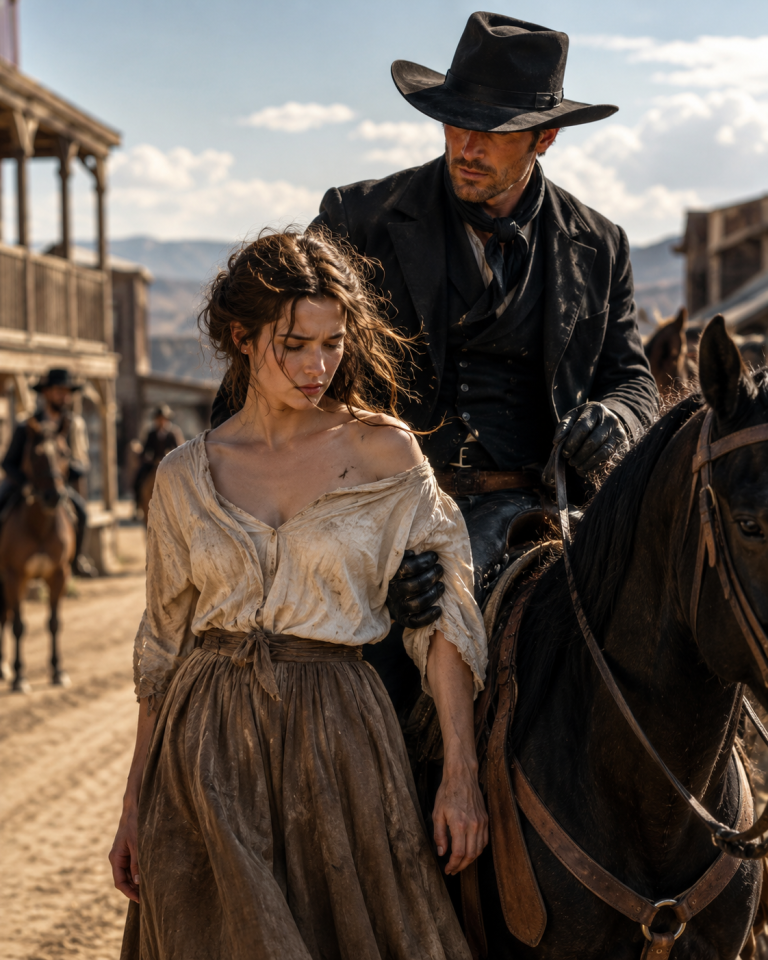
Ada Quinn had walked four miles because the stagecoach fare was fifty cents she didn’t have, and her boots knew it. Every step up the Kessler ranch drive kicked up a small gray cloud that clung to her hem, to the one gray dress without visible patches, to the satchel of needles and thread she carried like a shield.
Room and board. Fair wages. Start immediately.
*Immediately* was the word that mattered. Immediately meant before the bank took her father’s house. Before his medicine ran out. Before she had to choose which disaster to let win.
She was twenty feet from the porch when she heard the violin.
Bright. Quick. Laughter underneath it, the easy kind that belongs to people who have never counted coins by candlelight.
Ada stopped walking.
Through the tall windows she could see it now — color, movement, dresses that cost more than her father earned in a year. A party.
She pulled the foreman’s note from her pocket. Smoothed the creases with her thumb.
*Tuesday. Four o’clock. Come to the house.*
The church bell had struck four as she crossed the gate.
*Wrong door,* she told herself. *Servants use the back.*
She’d already turned to find her way around when the front door opened.
A woman stepped out in silk the color of champagne, dark hair swept into a twist that had clearly required a lady’s maid and an engineering degree. She looked at Ada the way you’d look at something tracked in on a boot.
“Can I help you?”
The words were polite. The tone was not.
“I’m here about the seamstress position.”
The woman’s eyebrows climbed. More faces gathered in the doorway behind her, drawn by the particular pleasure of watching someone squirm.
“*The seamstress position.* Today?”
“Yes, ma’am. I was told—”
“Catherine.” A man’s voice, cultured, faintly bored, from somewhere inside. “Who is it?”
Catherine didn’t turn around. Her eyes stayed on Ada like a cat watching something small.
“Some girl claiming she’s here about a seamstress job.”
The disbelief spread through the crowd like a spilled drink.
“I’m sorry.” Ada backed up a step. “There’s been a mistake.”
“There certainly has.”
Catherine came down the porch steps, and the crowd followed her like a parade behind a queen. Ada’s heel caught on a loose stone. She stumbled, caught herself, and lost her grip on the satchel.
It hit the drive and burst open. Thread. Needles. A half-finished shirt some customer still owed her three jobs for.
Someone laughed.
Ada dropped to her knees to gather it, cheeks burning hot enough to start a fire, and every second stretched like taffy while the perfumed, cruel, beautiful crowd watched her scrabble in the dirt.
“Oh, this is precious,” a drunk young man drawled. “Better than the string quartet.”
More laughter.
Ada didn’t look up. If she looked at their faces she’d either cry or scream, and neither would help.
*”That’s enough.”*
The new voice cut through the noise like a blade — deep, quiet, needing no volume at all. The laughter died mid-breath.
Ada raised her head.
He stood at the top of the steps, and the crowd had parted for him without seeming to notice they’d done it. Tall in a way that seemed almost unfair. Shoulders straining a black suit jacket. A face built of hard angles and storm-cloud eyes, the kind of face that had forgotten how to smile a long time ago.
*Colt Kessler.* She’d never seen him. Everyone had heard the stories.
He came down the steps slow, deliberate, and the crowd retreated like a tide going out. His eyes never left her face.
“You’re the seamstress.” Not a question.
Ada got to her feet, clutching her satchel to her chest. “I — yes, I thought—”
“I know what Reuben told you.”
He stopped three feet away. Up close he wasn’t just big. There was something else — a coiled stillness, like weather about to break.
“You were supposed to go to the east wing. Not the main house.”
“I didn’t know. I’ll just—”
“You’ll stay.”
Ada blinked. “What?”
Kessler turned to the crowd, his expression unreadable.
“Catherine. Everyone. I appreciate you coming. There’s been a change of plans.”
Catherine’s face went pale, then red. “Colt, what are you—”
“The engagement is off.”
A glass shattered somewhere in the stunned silence that followed.
“You can’t be serious. Your father arranged—”
“My father is dead.” His voice didn’t change, but something in the air did. “And I’m not marrying you.”
Catherine looked like she’d been slapped. “After everything — the contracts, the alliance between our families—”
“Void. All of it.”
He turned back to Ada.
Before she could process what was happening, he’d closed the distance between them and taken her hand. His grip was warm, almost too firm, through her thin glove.
“Because,” Colt Kessler said, loud enough for two hundred people to hear, “I’m already married.”
The world tilted sideways. Ada’s mouth opened. No sound came out.
Around them, chaos erupted — shocked voices, Catherine’s cry of outrage rising above it all, someone demanding an explanation — and it all seemed to reach Ada from very far away, muffled, like she was underwater.
Colt leaned in close, his voice dropping to something only she could hear.
“Play along. I’ll explain later. Do this and I’ll pay you more than ten years of sewing would ever get you.”
Then, louder, pitched straight at the crowd, at Catherine, at the whole shattered evening:
“Everyone. Meet my wife. Ara Kessler.”
PART 2
His arm came around her waist like something rehearsed, and the crowd surged forward with questions, accusations, Catherine’s voice climbing above the noise demanding to know *when*, demanding to know *how*, demanding to know why no one had been told.
Ada couldn’t breathe. Couldn’t think.
Colt’s hand was iron-hard at the small of her back, and she realized, distantly, that without it she would have gone straight down.
“This is insane,” Catherine spat, shoving through the crowd. “You’re lying. This is some desperate—”
“Careful, Catherine.” Colt’s voice could have frozen whiskey. “You’re speaking about my wife.”
“*Your wife?*” A laugh, shrill, disbelieving. “This — this ragamuffin shows up covered in dust and you expect us to—”
“I don’t care what you believe.” His arm tightened around Ada’s waist. “The marriage is legal. Witnessed. Binding. And you’re trespassing on my property.”
Catherine’s face went bloodless. “Your father promised—”
“I don’t give a damn what my father promised. Get out. All of you.”
For a long moment, nobody moved.
Then Catherine turned on her heel and stalked toward a waiting carriage, her skirts snapping behind her like a flag torn loose. The crowd drained away after her — some quickly, some throwing glances back over their shoulders — until the drive stood empty except for the dust their leaving had raised.
Colt waited until the last carriage vanished around the bend.
Then he let go and stepped back, putting three feet of clean air between them.
Ada swayed, catching herself on the porch railing. Her heart was trying to beat its way out through her ribs.
“What the *hell* was that?”
“A solution.” He dragged a hand through his hair, undoing what little order it had left. “To both our problems. If you’re smart enough to see it.”
“Smart enough? You just told two hundred people I’m your wife.”
“I did.”
“I’m not your wife.”
“Not yet.”
He looked at her then — really looked, and something in the look made her breath catch. Not kindness. Not warmth. A kind of grim calculation, like he was measuring her for a coffin.
“But you could be. For a year. Maybe less if we’re lucky.”
Ada took a step back. “You’re insane.”
“Probably.” He pulled a silver case from his jacket, lit a cigarette one-handed against the porch rail. “But I’m also rich, and you’re broke. So let’s talk business. Your father owes the bank four thousand dollars. The house is collateral. You’ve got two months before they seize it.”
Something in her chest went cold and still. “How do you—”
“I know every debt in this county. It’s my business to know.” He exhaled smoke through his nose. “You can’t save that house in time. Not sewing peace-work for fifteen dollars a month.”
“And you can?”
“One telegram. Tonight. The debt disappears.” He flicked ash into the dirt. “In exchange for a year of your life. You play my wife. Publicly. Convincingly. You live here, attend events, smile when you’re supposed to smile. In return I clear your father’s debt, pay you two hundred a month, and at the end of the year, you walk away with ten thousand dollars cash and a clean divorce. No questions asked.”
Ada’s head spun. Two hundred a month. Ten thousand at the end. That was impossible money — more than she’d see in a lifetime of mending shirts.
“Why me?” she managed.
He smiled then, and it wasn’t a pleasant expression at all.
“Because you’re nobody,” he said. “And I’m done letting other people think they own my life.”
She wanted to slap him. Wanted to walk away and tell him to burn in hell with his money and his cold arithmetic.
Instead she found herself asking the only question that mattered.
“What happens if I say no?”
PART 3
He didn’t answer right away. He just watched her, the cigarette burning down between his fingers, the last of the sunset bleeding orange and violet across land that stretched further than she could see.
“Then you walk back to town,” he said finally. “Your father’s house gets seized in two months. You keep sewing for fifteen dollars until your hands give out, and I marry Catherine Whitmore and spend the rest of my life being managed by a woman who thinks a wedding ring is a business acquisition.”
He said it flat. Not cruel. Just true, the way a man states a fact he’s already made peace with.
“That’s not a choice,” Ada said. “That’s a threat wearing a suit.”
“It’s an offer.” He crushed the cigarette under his boot heel. “You’re the one deciding what to call it.”
She looked past him at the house — three stories of white paint and glass windows that caught the dying light like teeth, columns and a portico that belonged in the Deep South and not on the Wyoming frontier. It looked like someone had stolen a plantation house as a joke and dropped it in the wrong country.
It would never be hers. Not really. But for one year, she could pretend, and at the end of that year she’d have enough to give her father his medicine, his house, maybe his breath back.
One year. She could survive anything for one year.
“One condition,” she said.
Kessler raised an eyebrow.
“No one can know it’s fake. Not your staff, not your business partners. No one. If we’re doing this, we do it all the way.”
Something that might have been respect flickered across his face.
“Agreed.” He straightened. “Then I need a few things from you tonight. A story — how we met, when we married, details people will ask about. Clothes, because you can’t look like that and be my wife. And in the morning, you go see your father. Tell him the truth.”
Her stomach dropped. “What do I tell him?”
“That you married me to save his house.” Colt’s expression gave nothing away. “He doesn’t need the rest.”
Ada nodded slowly. Her hands had stopped shaking. Her heart had slowed to something close to normal.
This was happening. She was doing this.
He extended his hand — strong, scarred, offering salvation and lies in equal measure.
She shook it.
“We have a deal.”
*
The house was bigger inside than it had any right to be. Colt led her through a marble entrance hall, past a staircase that belonged in a cathedral, down a corridor of stern-faced portraits that all seemed to share his jaw and his general disapproval of everything.
“Your family?” Ada asked, struggling to match his stride.
“Unfortunately.”
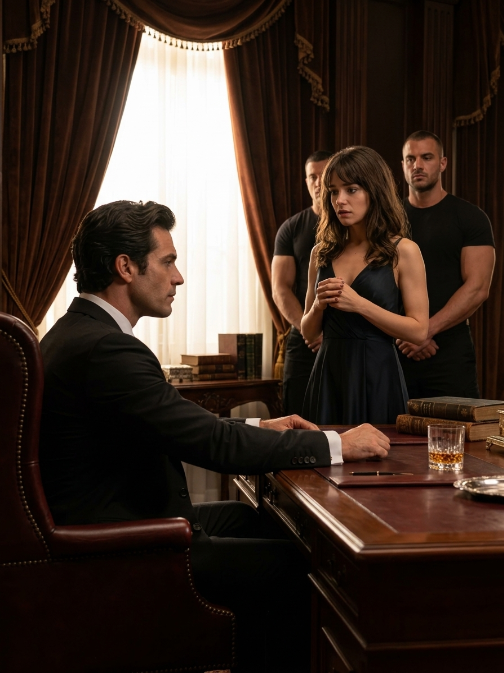
He pushed open a heavy door into an office — massive desk, leather chairs, a fireplace big enough to roast a pig — and poured two glasses of amber liquid from a crystal decanter.
“I don’t drink,” Ada said.
“You do now.”
The whiskey burned going down but steadied something in her chest that had been rattling loose since he’d first taken her hand in front of two hundred strangers.
“We need a story,” he said, leaning against the desk. “Believable enough for two hundred people who just watched you claim me out of nowhere.”
“Romantic?” she said dryly.
“It’s not supposed to be romantic. It’s supposed to be plausible.” He thought for a moment. “We met six months ago. You were sewing in town. I came in for repairs. I kept coming back. Eventually I asked you to dinner.”
“Where?”
“The Sterling Hotel. Private dining room. Red wallpaper, terrible paintings of fruit. The steak’s good, the wine’s overpriced.”
“I’ve never been there.”
“You have now.”
“Then what?”
“Then I courted you quietly. We kept it secret because—”
“Because you knew your father wanted you to marry Catherine,” Ada finished, “and you didn’t want to deal with his reaction.”
“Right.” His mouth twitched — almost a smile, not quite. “We married three weeks ago. Small ceremony. Judge Patterson officiated.”
“Will he back that up?”
“He’ll do whatever I pay him to do.”
“Comforting.”
“You wanted it all the way,” he said. “This is all the way.”
Ara set down her glass. “Your staff. They’ll know I wasn’t here three weeks ago.”
“I’ll handle them. As far as anyone knows, you were finishing work commitments in town. Today’s the day you moved in.”
“And my father?”
Colt refilled his glass. “Will he tell people otherwise?”
The question hung there. She thought of her father — sick, proud, desperate to believe his daughter might still get a chance at something better. If she told him she’d married well, married rich, married into safety — would he question the timeline, or would relief simply drown the question before it could form?
“No,” she said quietly. “He won’t.”
“Then we’re set.” Colt straightened. “You’ll have a room next to mine. Connecting door — people will expect it. It locks on both sides. Use it.”
“Believe me, I will.”
“Tomorrow we go into town. Let people see us. Start building the story.” He moved toward the door, then stopped. “This isn’t going to be easy, Ara. People will talk. Catherine’s family won’t take this lying down. You’re walking into a war zone.”
“I’ve been in war zones before,” Ara said. “Just different kinds.”
Something shifted behind his eyes. “I suppose you have.”
*
Mrs. Granger, the housekeeper, had a mouth that looked like it had never once considered smiling and iron-gray hair pinned tight enough to hurt. She led Ara to a room bigger than her father’s entire house, four-poster bed, a wardrobe that could have clothed a dozen women, windows overlooking land that seemed to run all the way to forever.
“Dinner’s at seven sharp,” Mrs. Granger said. “Mr. Kessler doesn’t tolerate lateness.” Her eyes traveled over Ara’s dusty boots and dress. “I’ll send Lucy up with something you can actually wear.”
“I appreciate it.”
“It’s not kindness, girl. It’s necessity.” She paused at the door. “I don’t know what game you and Mr. Kessler are playing, and I don’t care. But this house has rules. You’ll follow them, or you’ll answer to me.”
The door shut with a decisive click.
Ara stood alone in the enormous room, more alone than she’d felt in years. She walked to the window and pressed her forehead to the cool glass. Outside, the sky bled orange into purple, indifferent to what she’d just done. Married a stranger. Sold a year of her life to a man who looked at her like a chess piece.
But her father’s house was safe. And in a year, she’d walk away with enough to start over somewhere far from here.
*One year,* she told her reflection. *You can survive one year.*
Her reflection didn’t look convinced.
A knock came at the connecting door. It opened before she could answer, and Colt stood in the frame, jacket off, sleeves rolled to his elbows.
“I forgot to give you this.”
He held out a small wooden box. Inside, nestled in velvet, sat a gold ring with a small diamond that caught the last of the light.
“It was my mother’s,” he said. “People will expect you to wear it.”
“Won’t she mind?”
“She died when I was twelve. She wouldn’t care what we’re using it for.”
Ara slipped it onto her finger. It fit perfectly, which felt like either a good omen or a terrible joke.
“It’s beautiful,” she said quietly.
“It’s a prop.” His voice went flat. “Don’t read anything into it.”
“I wasn’t.”
“Dinner at seven.” He was already retreating. “Don’t be late.”
The door closed with a finality that felt like a statement.
Ara looked down at the ring — a dead woman’s jewelry on a living woman’s lie — and laughed, short and sharp, and it sounded slightly unhinged even to her own ears.
*
Dinner was a stilted, awkward affair in a room built for thirty and currently holding two, with enough empty table between them to park a wagon. Sixteen-year-old Lucy served course after terrified course while Ara and Colt ate mostly in silence.
Finally, Ara set down her fork.
“We can’t do this.”
Colt looked up. “Do what?”
“Sit here like strangers. People expect newlyweds to at least talk.”
“Married people don’t have to talk at dinner.”
“Newlyweds do.” She leaned forward. “If we’re going to sell this, we need to be convincing. That means learning about each other. Where you went to school. What you do all day.”
“Tutors, here on the ranch. I manage cattle operations, negotiate contracts, and solve problems most people can’t.” He picked up his wine. “Your turn. Where are you from?”
“Marrow’s Bend. My mother died when I was eight. Fever. My father raised me — a carpenter, until his lungs started failing. I sew because someone had to earn money while I took care of him.”
“Siblings?”
“No.”
“Friends?”
“Not anymore. Hard to keep friendships when you’re too busy surviving.”
Something flickered in his eyes. “I know the feeling.”
They looked at each other across the polished wood, and for a moment the performance fell away entirely — two people who’d learned the hard way that the world doesn’t hand you anything you don’t fight for.
“We should talk about boundaries,” Colt said, setting down his glass. “In public, we’re affectionate. Not excessive. I’ll take your arm, you’ll take mine. If anyone asks, we’re happy.”
“And in private?”
“In private, we’re business partners. Your room, my room. We coordinate the story and stay out of each other’s way.” He paused. “No feelings.”
“No feelings,” Ara confirmed. “What if I break the rules?”
“You won’t.” His expression hardened. “But if you did — the deal’s off, and you lose everything.”
*
The next morning he drove her into town himself. Marrow’s Bend looked exactly the same as it had the day before, dusty and small and shabby in a way it hadn’t seemed until she’d spent one night behind glass windows that cost more than her father’s whole house.
Her father stood on the porch, leaning on his cane, thinner than she remembered.
“Ara? What—” He saw Colt and his face shifted to alarm. “What’s going on?”
She climbed the three steps and took his free hand. “Papa. I have news. Good news. I got married.”
“You *what?*”
“Three weeks ago. I wanted to tell you sooner, but everything happened so fast.”
“Three weeks ago you were working at the shop.” His voice climbed. “Who—”
“Colt Kessler, sir.” Colt came up the steps, hand extended. “I understand this is a shock.”
Her father’s face went white. “The cattle baron. Ara, what have you *done?*”
“I fell in love, Papa.” The lie tasted bitter as pennies. “We kept it quiet because of his family, but we couldn’t wait any longer.” She squeezed his hand. “Your debts are cleared. The house is safe. You can rest.”
Her father’s eyes filled. “Ara, you shouldn’t have—”
“It’s done, and I’m happy. I promise.”
Over his shoulder, she caught Colt watching them, his expression unreadable. This was what they’d bought with their lie — her father’s relief, his gratitude, his tears. It should have felt like victory. It felt like drowning.
They stayed an hour, long enough for the news to travel through Marrow’s Bend like wildfire. By the time they climbed back into the carriage, half the town stood watching, and someone called out a question about the wedding — why no one had been invited.
Colt ignored it and took the reins. “Smile,” he murmured. “Look happy.”
Ara forced her mouth into something resembling joy and waved.
Inside, her stomach churned the entire ride home.
*
Six weeks passed in a blur of performance and proximity. Church socials, where she learned to talk polite nonsense with ranchers’ wives who barely hid their curiosity. Shopping trips with his hand steady at the small of her back while half the town pretended not to stare. Riding lessons, his voice startlingly patient, teaching her to sit a horse properly.
It was the small things that undid her. The way he’d started pouring her coffee without asking how she took it, because he’d paid attention and remembered. The night she’d worked late altering a dress and found him asleep in the chair outside her door, as if he’d been standing guard. The afternoon he canceled a business meeting because her father had taken ill, and drove her to town without a single word of complaint.
These weren’t performances. These were the moments between performances, when no one was watching and they happened anyway.
The real Colt Kessler — the one who emerged once the doors closed and the audience vanished — was nothing like the cold cattle baron she’d expected. Sharp-witted. Dryly funny. A shelf of poetry in his office he pretended not to own. A scar along his ribs from a horse kick at seventeen, another on his shoulder from a bullet he refused to explain.
And she was falling. Not all at once — slowly, the way a cliff erodes under relentless water.
The realization hit her on a frost-bitten Tuesday morning, when Mrs. Granger mentioned offhand that the master had ordered apple tarts from the kitchen because Ara had once mentioned, weeks ago, that her mother used to make them.
Such a small thing. A kindness he’d probably already forgotten.
Ara stood in the dining room staring at the pastry on her plate, and felt her chest tighten around something that absolutely could not be allowed.
She was in love with her fake husband. And she had no idea what to do about it.
*
Then the fence lines got cut. Thirty head of cattle gone from the north pasture. Colt rode out that night with Reuben and the hands, fury banked hard behind a controlled voice, and came back at dawn with nothing to show for it, three days running.
That was the week of the Harvest Festival — the biggest social event of the season, and the one appearance Colt couldn’t afford to miss and couldn’t afford to attend.
“You’ll go without me,” he told her, jaw tight with exhaustion. “Make an appearance, stay an hour, make my excuses. Reuben will stay close.”
“I don’t want to face that crowd alone.”
“I know. But if we both miss it, Catherine’s investigators will use it as proof the marriage is failing.”
She went. Burgundy silk with gold trim, Lucy’s hands working magic in her hair, and for the first hour it was manageable — smiles, congratulations, the practiced excuse about ranch emergencies.
Then Catherine found her near the refreshment table.
“Mrs. Kessler. How lovely, though I notice you’re here alone.” Her voice was pitched just loud enough for nearby conversations to still. “It must be difficult, being abandoned at social events so soon after the wedding. Some might call it *telling.*”
“Some might call it responsible,” Ara said. “Running a ranch doesn’t stop for parties.”
“Of course not. But a husband who truly cared would make time.” Catherine leaned in, voice dropping to something poisonous. “Unless there’s nothing real to prioritize. My investigators have been very thorough, you know. Six months of secret courtship and not a single witness. It’s almost as if the entire relationship was invented whole cloth.”
“Privacy or fiction,” Ara said. “So hard to tell the difference.”
“The truth has a way of coming out. And when it does, this whole charade collapses. You’ll go back to your pathetic little life, and Colt will finally understand he can’t escape his obligations through cheap theatrics.”
Something in Ara snapped — six weeks of smiling through judgment, of falling for a man she couldn’t have while playing a role she was starting to despise.
“You’re right about one thing,” she said quietly. “The truth does come out. And the truth is Colt chose me. Not for contracts or alliances. He chose me because I don’t want anything from him except what he’s willing to give. That terrifies you, doesn’t it? The idea someone might value him for himself.”
Catherine’s face went from pale to scarlet. “You don’t know anything about him.”
“I know he’s happier without you. That’s enough.”
A commotion broke out near the entrance before Catherine could answer — raised voices, the crowd parting. Colt strode through, dust-covered, wild-eyed, still in his work clothes, scanning the festival with barely controlled desperation until his gaze locked on Ara.
He crossed the distance in six strides and pulled her into his arms.
“Are you all right?” His voice was rough against her ear.
“I’m fine. What—”
“I caught them. The thieves. Reuben’s got them locked in the barn.” His hands moved over her shoulders, checking her for injury. “One of them said something about the festival. About you being here alone. I thought—” He didn’t finish it. Didn’t need to.
He’d left his captured thieves and ridden hell-bent to town because he’d been afraid *for her.* Not for the arrangement. Not for appearances.
For her.
The whole square had gone still, watching. Catherine stood frozen, her expression somewhere between shock and calculation.
“Colt,” Ara said softly. “I’m okay. Nothing happened.”
He pulled back just enough to look at her, hands still gripping her shoulders, eyes storm-dark. “I should have been here with you. I shouldn’t have made you do this alone. Making you face these people, asking you to lie for me, pretending—” He stopped. Seemed to realize where they were. What he was saying. Who was listening.
It was too late. The mask had already cracked wide open.
Ara reached up, her hand finding his cheek, and the touch was electric — real, not performance.
“Take me home,” she whispered.
He nodded, took her hand, and they walked out of the festival together while Catherine’s voice rose behind them, shouting something about proof, about fraud, about vindication.
Ara didn’t hear the words. She heard only her own heartbeat, and felt only his hand wrapped around hers like she was the one solid thing in a tilting world.
*
“That was a mistake,” Colt said, back at the ranch, pacing to the window of his office with his back to her. “What I said at the festival. What I almost—” His hands clenched. “I wasn’t thinking. I was worried about you and I let my guard down.”
“Are we?” Ara’s voice was barely above a whisper. “Frauds?”
“We have a contract. An arrangement. That’s all this is.”
“Is it?”
He turned to face her, and the look in his eyes made her breath catch. “It has to be.”
“Why?”
“Because anything else is too dangerous.” He moved closer, something warring behind his expression. “I made the rule for a reason. Feelings create vulnerabilities. They give people power over you that they’ll use to destroy you the second it’s convenient.”
“Who destroyed you?” The question came out softer than she meant it. “Who made you so afraid to feel anything?”
For a long moment he didn’t answer.
“My father,” he said finally. “He loved my mother more than anything in the world. When she died, it broke something in him. He became ruthless. Cold. His business partners used his grief as leverage and pushed through deals he never would have accepted. He spent fifteen years trying to regain control, and it killed him.” His jaw tightened. “I watched what love did to him. What loss did. I swore I’d never give anyone that kind of power over me.”
“So you built walls.”
“I built survival.”
“And what are you surviving, Colt? Because from where I’m standing, you’re not living. You’re just existing.”
“It’s safer.”
“Maybe. It’s also lonely.” She stepped toward him. “You want to know what’s really dangerous? Six weeks watching you work yourself to exhaustion because you won’t trust anyone else to do it right. Watching you be kind when no one’s looking. Realizing underneath all the cold calculation there’s a man who’s been hurt so badly he’s forgotten how to hope for anything better.” She took the last step, closing the distance entirely. “Colt, I’m in love with you.”
The words came out in a rush, unstoppable.
“I tried not to be. I kept my distance, followed your rules. But somewhere between the lies and the performances and the quiet mornings drinking coffee, I fell in love with you. I know that’s not what we agreed on. I know it breaks the contract. But it’s true, and I’m tired of pretending it’s not.”
The silence that followed was deafening.
“You can’t,” he said finally. His face had gone pale. “You’re confused. This is gratitude. Proximity—”
“Don’t tell me what I feel.” Her voice cut clean through his rationalizing. “I’m not confused. I’m in love with you, and you can accept that or not, but you don’t get to diminish it.”
He took a step back. Then another, like she were something dangerous he needed distance from.
“This ends now,” he said. “The arrangement. The marriage. All of it.”
The words hit like a physical blow. “What?”
“I’ll wire the bank in the morning. Ten thousand, plus compensation for the six weeks. You can leave tomorrow. Start over.” His voice had gone mechanical. Empty. “Consider the contract fulfilled.”
“You’re ending this.” Her voice shook. “You’re sending me away.”
“I’m setting you free. This was always temporary. You knew that.”
“*Free?*” A laugh broke out of her, sharp and cracked. “You think this is freedom? You’re running. You’re so terrified of feeling something real you’d rather blow up everything we’ve built than admit you might actually care about me.”
“I don’t.”
“You’re lying.”
“I’m protecting us both.” His control was fracturing now, his voice climbing. “You think this ends well? One of us gets hurt. Probably you. And I won’t be responsible for that.”
“So instead you’re hurting me now. Preemptively. How noble.”
“It’s practical.”
“It’s cowardice.” Her hands were fists at her sides. “You talk about survival like it’s some kind of virtue. But you’re not surviving, Colt. You’re hiding. And you’re doing it so well you can’t even see when someone’s offering you a chance at something real.”
His face had gone to stone. “Pack your things. Reuben will drive you to town in the morning.”
“I don’t need anything from you.”
“Except what I owe you. I’ll wire the money.”
“I’ll be gone by noon.”
She turned and walked out, spine straight, head high, and made it exactly as far as her own bedroom door before her knees gave out and the tears finally came.
*
Morning came gray and bitter. Ara woke on the floor still in her burgundy dress, face swollen from crying, a half-packed trunk sitting by the door like a verdict.
Lucy knocked softly, then let herself in to help finish the folding. “Is it true you’re leaving?”
“Yes.”
“But why? Everyone says you and Mr. Kessler are so happy. Mrs. Granger says she’s never seen him smile so much.”
The words went in like a knife between the ribs.
“Sometimes things don’t work out the way people think they will.”
Lucy was quiet a moment, smoothing a green silk dress into the trunk. “My mama used to say some people are so scared of getting hurt, they hurt themselves first, just to prove they’re strong enough to survive it.” She looked up. “I think that’s Mr. Kessler. Ever since his mama died, and then his pa after — he’s all alone in this big house. Sometimes I catch him just standing at the windows staring at nothing. I think maybe he doesn’t know how to be any other way.”
“Or maybe he does,” Ara said, “and he just doesn’t know how to ask for help.”
She left the ring on the dresser. She couldn’t take it — it had been his mother’s, and it felt wrong to carry it into a lie that had already ended.
Reuben drove her home in silence, his weathered face carefully blank. As they pulled away down the long drive, she saw Colt for one second, standing in the barn doorway, covered in dust, looking like he hadn’t slept in days. Their eyes met across the distance. The pain in his face was so raw she had to look away before she did something stupid, like ask Reuben to stop the carriage.
Then the barn was behind them. The gates. The ranch, gone.
*
Her father was waiting on the porch, already having heard something — news traveled fast in a small town.
“The marriage,” he said. “It didn’t work out.”
“No, Papa.” Her voice came out steadier than she felt. “But the house is safe. The debt’s cleared. All of it.”
She let him believe what everyone else would believe — that it had been real, brief, passionate, and doomed. Another cautionary tale about hasty decisions. It was easier than the truth.
A bank draft for fifteen thousand dollars arrived four days later, along with a single unsigned line in Colt’s handwriting: *The additional five is compensation for the distress I caused. Consider all obligations fulfilled. I hope you find the fresh start you deserve.*
No apology. Just cold, clinical closure.
She folded the paper and put it in a drawer and did not look at it again.
By the end of the week, the town gossip had reached a fever pitch. Catherine Whitmore was crowing to anyone who’d listen — the marriage a sham, falling apart exactly as she’d predicted, proof that Colt Kessler couldn’t escape his obligations through cheap theatrics.
Ara listened to it all with a face carved from stone and said nothing.
Except at night, when she couldn’t sleep, and she kept seeing his face in that barn doorway. The raw pain in his eyes. The way his hands had shaken when he ended it.
That wasn’t the face of a man who didn’t care. That was the face of a man terrified of caring too much.
*
Two weeks after she left, Lucy appeared in her father’s workshop doorway, twisting her apron in her hands.
“It’s Mr. Kessler,” she said. “He’s terrible. Barely eating, barely sleeping. He fired two ranch hands for small mistakes. Mrs. Granger says she’s never seen him this bad, not even after his father died.”
“Why are you telling me this?”
“Because someone needs to.” Lucy’s eyes filled. “The lawyers are coming next week. Catherine’s family — they’re going to force him to honor the original engagement. And I think he’s going to let them. Not because he wants to. Because he doesn’t care about anything anymore.”
The needle slipped in Ara’s hand, opening a thin red line across her finger. She barely felt it.
“That’s his decision to make.”
“Is it? Or is he just making it out of fear?” Lucy’s voice climbed, urgent now. “I never saw Mr. Kessler smile until you showed up. I never heard him laugh. And then you came, and he was different — softer, like he remembered how to be human. Now you’re gone and he’s worse than before, because he knows exactly what he’s missing.”
Ara stood, pacing to the window, watching Marrow’s Bend go about its small, contained, safe business.
She could stay here. Build a quiet life. Let the gossip die down and let people forget the strange marriage that ended before it began.
Or she could fight.
Fighting meant risking rejection again. Meant walking back onto that ranch and demanding he look at what he’d thrown away. Meant making herself vulnerable to a man who’d already proven he’d choose fear over her, once.
But Lucy was right about one thing. Colt was fighting too. Fighting himself. Fighting the idea that he could deserve something good.
Maybe he needed to see someone was willing to fight for him just as hard.
“When are the lawyers coming?” Ara asked.
“Thursday.”
Two days. Not much time to save a man from himself. But she’d always been good with deadlines.
*
She spent the next two days preparing. A trip to the bank to deposit her fifteen thousand and get a receipt proving it. A visit to Judge Patterson, who answered a few careful questions about contract law. An hour in her father’s workshop, borrowing tools, cutting a strip of good leather, working a single word into it with a heated awl until her hands ached.
*Choose.*
Wednesday night she barely slept. By dawn she was exhausted and wired in equal measure, her stomach a fist of nerves. Reuben arrived at eight to find her waiting on the porch with a small bag.
“Miss Ara — I wasn’t expecting—”
“Mr. Kessler didn’t send you. I know. I’m sending myself.” She climbed into the carriage before he could argue. “To the ranch. Please.”
Reuben studied her a long moment, then a slow smile crossed his weathered face.
“Yes, ma’am. About time.”
*
Mrs. Granger’s eyes went wide when the carriage pulled up. “Miss Quinn — I didn’t know you were coming.”
“Neither did I, until yesterday.” Ara straightened her shoulders. “Where is he?”
“In his office. He’s meeting with the lawyers in an hour, and he specifically said—”
“I know what he said.”
She moved past the housekeeper, down the familiar hallway that felt now like marching toward an execution. Her hands were shaking, her carefully prepared speech evaporating from her mind with every step. She reached the office door and didn’t let herself hesitate. Didn’t knock. Just pushed it open.
Colt stood at the window, back to her, silhouetted against the morning light. Thinner than she remembered. Braced like a man expecting impact.
“Mrs. Granger, I said I didn’t want—”
He turned. The words died in his throat.
For a moment they just stared at each other across the width of the office. Ara saw everything Lucy had described — the exhaustion, the hollowness, the look of a man who’d won every battle except the one that mattered.
“Ara.” Her name came out broken. “What are you doing here?”
“Stopping you from making the biggest mistake of your life.” She set her bag on the desk. “Or the second biggest. The first was letting me go.”
His jaw tightened. “We’ve been through this. The arrangement’s over. You got your payment.”
“This isn’t about the arrangement anymore, and you know it.” She moved closer. “The lawyers are coming today. Catherine’s family. They’re going to force you to honor the engagement contract.”
“Let them.”
“You don’t mean that.”
“Don’t I?” His voice went hollow. “What does it matter who I marry? Catherine, some other woman my business partners approve of. They’re all the same. Alliances and obligations.”
“And you think that’s what you deserve? A life sentence with someone you don’t love, doing penance for the crime of having a heart?”
His hands clenched. “You need to leave.”
“No.” She held her ground. “You sent me away because loving me felt dangerous. Uncontrollable. And you’ve spent your whole life trying to control everything. But here’s what you didn’t count on — I’m just as stubborn as you are. I didn’t fall in love with the cattle baron or the fortune or the man everyone else thinks you are. I fell in love with who you are when you stop performing. When you choose kindness over control. That person doesn’t exist? He pours my coffee in the morning. He reads poetry he pretends not to own. He rode out at midnight to catch thieves because he couldn’t trust anyone else to do it right. He’s terrified of being vulnerable and brave enough to protect the people he cares about anyway.” She took the last step. “He’s you, Colt. And that’s who I love.”
His expression cracked. “You don’t understand. Everyone I’ve ever loved has left. My mother died. My father became a stranger. And you—” His voice broke. “You’re the first person in fifteen years who made me think maybe it didn’t have to be that way. That maybe I could let someone in without it destroying me. That terrified me more than anything. So I destroyed it myself first.”
“And how’s that working out for you?” Her eyes burned. “Does it feel safe, Colt? Does any of it actually feel safe?”
Silence stretched between them, taut and terrible.
“No,” he finally whispered. “It feels like dying.”
“Then stop.” She closed the last of the distance, her voice fierce now. “Stop dying. Stop choosing fear over everything else. I’m scared too. Loving you is the most terrifying thing I’ve ever done, because I know you could break my heart without even trying. But I’d rather risk that than spend the rest of my life wondering what we could have been.”
He looked at her like a drowning man looks at shore.
“What if I hurt you again?”
“Then I’ll survive it. And I’ll still be here. Because that’s what love is. Choosing someone even when it’s hard. Even when they’ve given you every reason to walk away.”
“I don’t deserve you.”
“That’s not your decision to make.” She pulled the leather bracelet from her bag, the word burned dark into its surface. “I’m choosing you, Colt Kessler. All of you. The broken parts. The scared parts. This is my answer. My choice.” She held it out, her hand steady even as her heart broke open all over again. “Now you have to make yours.”
He stared at the bracelet like it might burn him. His throat worked. His jaw was tight, and she could see the war happening behind his eyes — fifteen years of self-preservation screaming at him to refuse, to choose known pain over unknown risk.
“I can’t,” he said, and his voice broke on the word.
“Yes, you can.”
“I don’t know how to be what you need. I’ve been alone so long I don’t remember how to be anything else.”
“Then we’ll figure it out together.” Her hand didn’t waver. “I’m not asking you to be perfect. I’m asking you to choose something other than fear, for once in your life.”
“What if I fail?”
“Then we fail together. But at least we’ll have tried.”
Outside, carriage wheels crunched on gravel. Voices in the entrance hall. Mrs. Granger, saying something about the master being occupied.
Time was running out.
Colt looked at her, really looked, and his face went so vulnerable it hurt to see.
“I loved you the moment you told Catherine I was happier without her,” he said. “At the festival. You were defending me and I realized — you were the first person in my whole life who’d fought for me without expecting anything back. And it terrified me so badly I couldn’t even admit it to myself.”
Her breath caught. “I’ve been miserable without you. Every morning I reach for you before I remember you’re gone.”
“So don’t push me away anymore.”
His hand came up slowly, trembling, and closed around the bracelet. His fingers brushed hers, and the contact sent something electric through her whole body.
“If I do this,” he said quietly, “it’s not temporary. It’s not a contract. It’s real. All of it. And I’m going to be terrible at it. But I’ll try. Every day.”
“That’s all I’m asking.”
He slipped the bracelet onto his wrist, the leather dark against his skin, the word *CHOOSE* facing upward like a promise.
The office door burst open.
*
Catherine Whitmore strode in flanked by two men in expensive suits, and stopped short at the sight of Ara. Her face cycled through shock, fury, and calculation in the space of a breath.
“You,” she spat. “What are you doing here? The marriage is over. You took your payment and left.”
“And came back,” Ara said evenly. “Funny how that works.”
One of the lawyers cleared his throat. “Mr. Kessler, we’re here to discuss reinstatement of your engagement to Miss Whitmore, given the fraudulent nature of your recent marriage—”
“There was nothing fraudulent about it.” Colt’s voice was iron. “And there won’t be any reinstatement. The original contract is void.”
Catherine’s eyes narrowed. “Your father signed—”
“My father is dead, and I’m not him.” Colt moved to stand beside Ara, his shoulder brushing hers. “I’m not honoring a contract made by a man trying to control my life from beyond the grave. I’m making my own choices, starting now.”
“The penalty clause alone is fifty thousand dollars.”
“I’m aware. Send the bill.” He reached for Ara’s hand, lacing their fingers together. “It’s worth every cent.”
The lead lawyer stepped forward, tone consiliatory. “Mr. Kessler, be reasonable. The Whitmore family has significant influence over the cattle markets. Refusing this alliance could have serious consequences for your operations.”
“Then I’ll deal with the consequences.”
“You’ll regret this,” Catherine said, voice climbing. “My family will freeze you out of every market, every contract. You’ll watch your precious ranch crumble because you were too stubborn to see reason.”
“Try it,” Colt said flatly. “I’ve survived worse than your family’s disapproval.”
Catherine’s face went scarlet. She turned to leave, then paused at the door.
“This isn’t over.”
“No,” Colt said quietly. “I’m making a choice I should have made years ago.”
The door slammed. The sound echoed through the office like a gunshot.
For a moment neither of them moved. Then Colt’s shoulders sagged, and he looked at her with something like wonder.
“I just blew up my entire business network for you.”
“You did.” Ara agreed. “Regretting it yet?”
“Ask me in fifty years.”
She laughed — shaky, relieved. “That’s a long time.”
“Good.” He pulled her closer, his free hand coming up to cup her face. “I’m going to need at least that long to figure out how to do this right.”
*
They married again on a Saturday morning in late November, frost on the ground, the sky so blue it hurt to look at. Judge Patterson officiated, flanked by Reuben, Mrs. Granger, Lucy, and Ara’s father, who cried through the whole ceremony. Ara wore a cream dress she’d sewn herself, wildflowers in her hair that Lucy had picked that morning. Colt wore his best suit and the leather bracelet, the word *choose* visible on his wrist.
No contracts. No arrangements. Just two people deciding to build a life despite every reason it might not work.
Catherine’s lawsuit came exactly as threatened — nearly seventy-five thousand dollars in penalties and damages. Colt read the papers at breakfast, set them aside, and reached for his coffee.
“Worth it,” he said, when Ara asked.
The first year was lean. Contracts dissolved. Partnerships fell away. But Colt rebuilt slowly, on merit instead of family connections, and the ranch came back smaller but truer, more efficient, more entirely his own.
*
Three years later, Ara stood in the exact spot where she’d first crashed an engagement party in a borrowed dress and dusty boots, watching the ranch hands prepare for the autumn cattle drive. Beside her, Colt held their daughter, eighteen months old, dark hair and her mother’s stubborn chin, while their son kicked impatiently against the inside of her belly, due any day now.
“Mama, down,” the toddler demanded, squirming in Colt’s arms.
“Not until Reuben brings the gentle horses,” Colt said patiently. “We talked about this.”
She pouted, then settled. Colt caught Ara’s eye over their daughter’s head and smiled — an expression that still looked slightly surprised, as if he couldn’t quite believe this was his life now.
Reuben appeared with two saddled mares. Their daughter shrieked with joy and launched herself toward the nearest one, utterly fearless, patting its nose while the horse nuzzled her gently.
“She’s going to be trouble,” Colt said, helping her into the smallest saddle.
“She gets it from you.”
“She gets the stubbornness from *you.*”
Ara laughed, resting a hand on her swollen belly. “This one’s going to be worse. I can already tell.”
“Then we’re doomed.” But Colt was smiling as he said it, one hand steadying their daughter, the other reaching for Ara. “Completely doomed. Best kind there is.”
They stood together, watching their daughter ride slow circles under Reuben’s careful supervision, and Ara thought about the girl she’d been three years ago — desperate, scared, walking into the wrong room and accidentally finding everything she’d never known to hope for.
“Do you ever think about how we started?” she asked. “The lie of it?”
“Sometimes.” Colt considered. “Usually when I’m trying to explain to Clara why lying is bad, and she points out her own parents met through one.”
“What do you tell her?”
“That sometimes people find the truth through a lie. That the best things in life come from taking risks you probably shouldn’t.” He pulled her closer, hand warm on her back. “That her mother walked into the wrong room at exactly the right time, and changed everything.”
“I didn’t change everything. I just gave you permission to change yourself.”
“Same thing.” He kissed her temple. “I was dying slowly before you showed up. Going through motions. Building an empire and forgetting why any of it mattered.” He watched their daughter wave from the saddle, her face alight. “You reminded me I could want things I’d convinced myself were too dangerous to want. A family. Happiness. A future that wasn’t just endless work and walls.”
Ara leaned into him, felt the baby kick between them, and understood that this was what choosing looked like. Not one dramatic decision, but a thousand small ones. Choosing patience when frustration came easy. Choosing vulnerability when walls felt safer. Choosing each other, over and over, until the choosing became as natural as breathing.
“I love you,” she said quietly.
“I know.” His voice was soft, certain. “And I love you. No fear. No hesitation. Just true.”
They stood there in the afternoon light, surrounded by the life they’d built from a lie, a fear, and a stubborn, desperate hope — messier and harder than any contract could ever have predicted, and worth every risk it had taken to find it.
Their daughter called out something about wanting to go faster. Colt sighed and went to negotiate with his fearless child, crouching beside the horse with the same patient, careful hands he’d once used to teach a frightened seamstress how to sit a saddle, and faith that she could learn.
The old Colt Kessler would never have allowed himself this. The vulnerability. The mess. The terrifying, beautiful reality of letting people matter.
He’d chosen differently. Chosen fear over safety, chaos over control, love over the fortress he’d spent fifteen years building.
And it had saved him.
Ara pressed a hand to her belly, felt their son move beneath her palm, and smiled at the wide gold light falling over the ranch — the same light that had once caught the windows of a house that didn’t belong in this landscape, the day she’d walked up the wrong driveway and found, somehow, exactly where she was always meant to be.
THE END