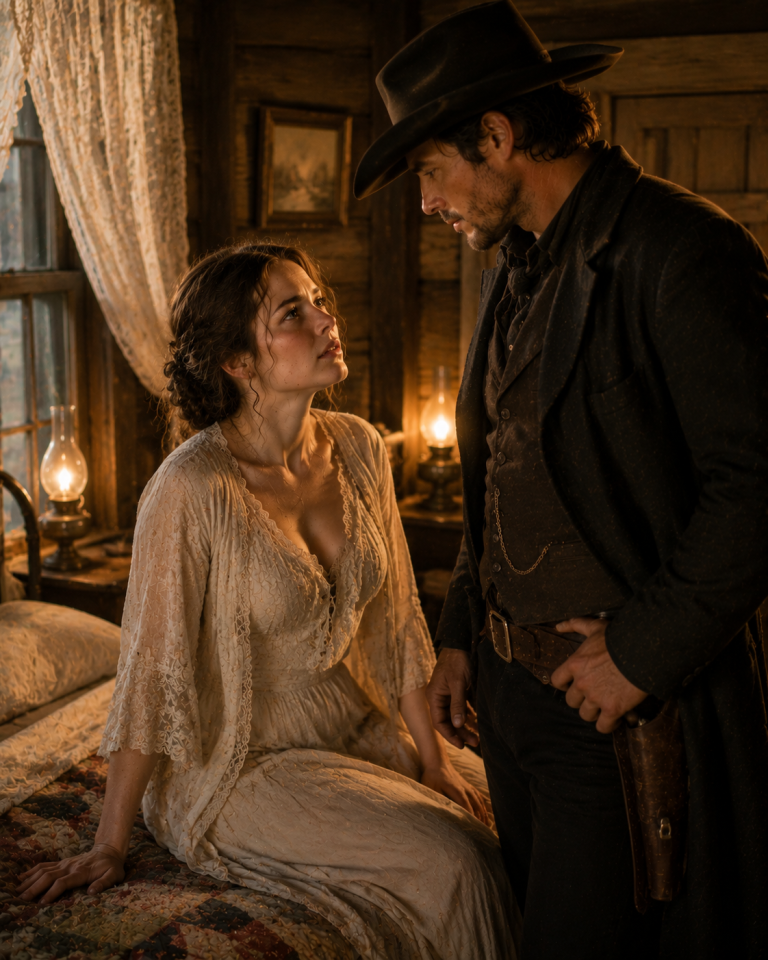
A BEATEN STRANGER WALKED INTO A LAWLESS TOWN WITH NO NAME AND NO MEMORY — THEN A JUDGE CALLED HER HIS MISSING DAUGHTER

PART 1
The sun had been brutal that day, the kind that cracks the earth and bleeds dust into the air.
Silver Bluff sat in a valley that offered no shade and no mercy — just rock, scrub brush, and the occasional vulture circling something already dead. It wasn’t a town people came to on purpose. It was where you ended up when everywhere else had spit you out.
She appeared on the eastern road just past noon.
At first she was only a shape in the heat shimmer, something a tired pair of eyes might invent. But as she came closer, dragging one leg behind her like it no longer belonged to her, people started to notice.
Not because they cared. Because she was wrong.
Her dress had been blue once. Now it was the color of old blood and dirt, torn at the shoulder so badly the fabric hung in strips. Her hair was matted dark with sweat, or worse. Her face was a ruin of purple and yellow, one eye swollen nearly shut, her lips split and crusted.
She walked like she’d forgotten how.
Jacob Finch was loading grain sacks outside Mercer’s General when she passed close enough for him to catch the smell of her — sweat, and something sour underneath. Something wrong.
“Jesus,” he muttered.
She didn’t look at him. Didn’t seem to see him at all.
“Hey,” Jacob called after her. “You need—”
She didn’t stop. He didn’t follow.
By the time she reached the center of town, a crowd had gathered — not to help, to watch. People leaned in doorways, whispered behind their hands. No one came closer.
Sheriff Darius Cole sat outside his office, boots on the railing, a cigarette burning between two fingers. He watched her the way a man watches a stray dog. When she finally stopped in front of him, swaying, barely upright, he took a long drag and let the smoke out through his nose.
“You lost?”
She didn’t answer. Her good eye stayed fixed on something in the distance only she could see.
Cole’s boots hit the planks. “I asked you a question.”
Nothing.
He stood, flicked the cigarette into the dirt, and stepped close enough to see the tremor running through her hands, the shallow, fast rhythm of her breathing.
“What’s your name?”
Her lips parted. For a second it looked like she might speak. Then her jaw closed again, tight.
“You deaf, mute, or just stupid?”
A woman’s laugh cut through the crowd, sharp and cruel. The stranger’s head turned just enough to register it. Her expression didn’t change. No fear. No anger. Nothing.
Cole grabbed her arm. Not gently.
She flinched, pulling back on instinct, but he held on.
“I don’t know what you’re running from,” he said, low enough that only she could hear it, “and I don’t care. But you don’t walk into my town looking like something dragged out of a grave and expect—”
She jerked free. Not forceful. Just a sudden, desperate twist of her whole body.
He let go, more surprised than angry.
“Get her out of here,” someone muttered.
“Probably diseased,” someone else added.
Cole spat into the dirt. “You got somewhere to go?”
Nothing.
“Figured.” He turned for his office. “There’s a church two streets over. Reverend Harper might take pity on you. Might not. Either way, you’re not my problem.”
The door slammed behind him. The crowd drifted apart, back to whatever small lives she’d interrupted, until the street stood empty except for her — a ghost nobody wanted to acknowledge.
She started walking again.
The church door was open, thin voices inside struggling through a hymn. She stepped in. The singing stopped.
Reverend Harper froze mid-gesture at the pulpit. Fifteen faces turned to stare.
“Can I help you, miss?”
She didn’t move. Didn’t speak.
He came down slowly, like she might bolt. “Are you hurt? Do you need a doctor?”
“Nothing,” she managed. It was barely a whisper.
An older woman in the front pew — Martha, the crowd called her, though not the Martha who mattered later — clutched her Bible tighter.
“She’s trouble, Reverend. Look at her. She’s been in a fight, or worse. You let her stay, and whatever she’s running from follows her here.”
Harper looked back at the stranger, at her unmoving silence, and his face folded with something like real regret.
“I’m sorry,” he said. “I truly am. But we don’t have the resources.”
She turned and walked out before he’d finished the sentence.
The boarding house wouldn’t take her. The saloon wouldn’t let her in. The blacksmith told her to move along before she scared his customers. The doctor’s office was dark, a note pinned to the door saying he was ten miles south, tending a ranch that mattered more than she did.
By nightfall she had nowhere.
She found the alley behind Mercer’s, where they stacked the empty crates, and sat down against the wall with her knees pulled to her chest. The smell was rot and piss, but it was out of sight, and that was something.
Every part of her hurt. Her ribs ached with every breath. Her leg throbbed. Her face felt made of broken glass.
She closed her eyes. Sleep didn’t come. Just the cold.
Sometime after midnight, she heard voices at the mouth of the alley.
“There she is.”
Footsteps. Close.
Three men stood silhouetted against the faint light from the street — young, drunk, looking for entertainment.
“What’s the matter?” the tallest one asked, crouching in front of her, his breath reeking of whiskey. “Cat got your tongue?”
She stared at him and said nothing.
He reached out, fingers brushing her hair.
She grabbed his wrist.
PART 2
It wasn’t a strong grip — she didn’t have the strength left for that — but it was sudden enough to startle him. He jerked back, stumbling, and his friends laughed harder.
“Feisty,” one of them said.
The tall one’s face darkened. He straightened, rubbing his wrist. “You think you’re tough?”
He kicked her. Not hard. Just enough to make a point. His boot caught her ribs and she gasped, curling inward.
“That’s what I thought.” He drew his foot back for a second kick.
A hand caught his ankle mid-swing.
He froze, looked down, then up.
Rowan Hail stood behind him, silent as a shadow — a big man, broad-shouldered, a face carved out of stone and old scars, hair tied back, eyes cold enough to make people step away without thinking about why.
He didn’t say a word. Just held the ankle, unmoving.
“Let go,” the tall man said, trying to sound confident.
Rowan twisted. The man yelped, stumbling, catching himself on the wall. His friends already had their hands up, backing away.
“We weren’t—”
Rowan looked at them. That was all it took. They ran, the tall man limping after them, cursing.
Rowan crouched, keeping his distance from the woman still curled against the wall. “You hurt bad?”
Nothing.
“Can you walk?”
Still nothing. He sighed, looked down the alley, then back at her, arguing with himself and clearly losing.
“Hell.” He bent down and scooped her up. She was lighter than he expected — all bones and bruises. She stiffened in his arms but didn’t fight.
“Relax,” he said. “I’m not them.”
She didn’t relax. But she didn’t struggle either.
No one saw them leave. No one cared enough to look.
His cabin sat an hour into the hills, hidden among rock and pine, invisible from the valley below. One room, a stone fireplace, a single bed in the corner. He set her down on it, lit a lantern, and pulled a basin of water and a clean cloth from the shelf with the efficiency of a man who did everything alone, and had for a long time.
“I’m going to clean those cuts,” he said. “You can fight me if you want. You’ll lose.”
She didn’t fight.
He worked in silence, careful around the swelling, and she flinched at her split lip but didn’t pull away.
“You got a name?”
No answer.
“Fair enough.”
He moved to her hands, cleaning the broken nails, the scraped knuckles.
“You don’t have to tell me what happened,” he said quietly. “But if someone’s looking for you, I need to know.”
She looked at him then. Really looked. Her good eye was dark, almost black in the lamplight, and there was something in it he couldn’t name.
“I don’t know,” she whispered.
Rowan frowned. “You don’t know what?”
“I don’t know who I am.”
The words sat in the room, heavy and strange.
“You don’t remember?”
“I remember pieces. Pain. Running. But before that—” She shook her head. “Nothing.”
He was quiet a long time, turning it over.
“All right,” he said finally. “Then we’ll figure it out.”
She blinked. “Why?”
“Because you’re here now,” Rowan said simply. “And I don’t leave people to die in alleys.”
He stood, gathering the basin. “You can have the bed. I’ll sleep by the fire.”
“I don’t—”
“It’s not a discussion.”
He turned away, banking the fire, spreading a blanket on the floor. She watched him, and for the first time since walking into Silver Bluff, something shifted in her chest.
Not trust. Not yet.
But something close.
PART 3
Morning came cold and gray. Rowan woke before dawn the way he always did, put coffee on, and checked on her. She was still asleep, curled on her side, breathing steady. Outside, his gelding stood tied near a lean-to, snorting in the sharp, pine-scented air.
He’d known this was a mistake the moment he picked her up in that alley. Getting involved with people, especially people in trouble, was something he’d sworn off years ago. It never ended well. It always cost more than you meant to give. But he’d looked at her, beaten and alone, and something in him had broken open. Or maybe it had already been broken, and this was just the next crack.
When he came back inside she was sitting up, looking around like she wasn’t sure where she was.
“Coffee?” He poured two cups.
She nodded, wrapping both hands around the tin mug, soaking in the warmth. Outside, birds started up, tentative and distant.
“What happens now?” she asked eventually.
“You rest. Heal. Then we see.”
“See what?”
“If anyone comes looking for you. If your memory comes back. If—” He shook his head. “I don’t know. We take it one day at a time.”
“You don’t know me. I could be dangerous.”
“You could be,” Rowan agreed. “I doubt it.”
“Why?”
“Because dangerous people don’t end up half dead in alleys. They’re the ones who put other people there.”
She didn’t have an answer for that.
“There’s bread and dried meat in the cabinet,” he said, standing. “I’ve got work outside. Yell if you need anything.”
He grabbed his coat, and at the door: “Rowan.”
He stopped, surprised — he hadn’t told her his name.
She looked at him, her expression unreadable. “Thank you.”
He nodded once and left.
*
The days fell into a rhythm. Rowan worked — chopping wood, mending fences, hunting. She stayed inside at first, moving slowly, testing the limits of her battered body. He didn’t push her to talk, didn’t ask questions she couldn’t answer. The silence between them wasn’t comfortable, but it wasn’t hostile either — just the quiet of two people who didn’t know what to say.
Slowly, things shifted. She started helping — small things first, dishes, sweeping, folding blankets, then bigger ones. Tending the fire. Cooking simple meals. Mending torn clothes. He never asked her to. She just did it.
One evening, about a week in, he came home to a warm cabin and the smell of stew. He stopped in the doorway, staring.
“Is it bad?” she asked, suddenly uncertain.
“No,” Rowan said quietly. “It’s good.”
They ate together, and for the first time the silence felt less like distance and more like peace.
Peace in Silver Bluff never lasted. Rumors traveled. Rowan Hail, the mountain hermit, the man who’d lost everything and disappeared into the hills — and now he had a woman. Sheriff Cole didn’t like not knowing things in his jurisdiction, and two weeks after the stranger arrived, he rode out with two deputies to find out why.
Rowan saw them coming from a distance. He set down his axe.
“We’ve got company,” he told her.
“Who?”
“Law.”
Her face went pale. “They’re here for me.”
“Maybe. Maybe not.” He pulled down a rifle, checked it. “Either way, you stay inside. Don’t come out unless I say.”
He stepped onto the porch as Cole dismounted, his deputies staying mounted, hands near their guns.
“Rowan. Been a while.”
“Not long enough.”
“Heard you had some excitement in town a couple weeks back. Heard you took something that didn’t belong to you.”
“She’s not a thing.”
“So she is here.” Cole’s smile widened. “Mind if I talk to her?”
“Yeah, I do.”
“Look,” Cole said, hardening, “you want to live like a hermit, that’s your business. But someone shows up beaten to hell with no name, no story — that’s my business.”
“You don’t know anything about her.”
“I know enough.” His hand drifted toward his gun.
Rowan’s rifle came up faster. The deputies drew.
The cabin door opened.
“Don’t,” Rowan said sharply.
She ignored him, walking to the porch edge — still bruised, still thin, but something new in her eyes.
Cole stared at her. “Do you know who you are?”
“No.”
“There’s a man in Silver Bluff. Judge Harland Cross. Says his daughter was taken from their home three weeks ago. Beaten, dragged off. Offering five hundred dollars to whoever brings her back.”
She didn’t react.
“She’s not his daughter,” Rowan said flatly.
“How do you know?”
“Because she doesn’t want to go.”
Cole’s hand tightened on his gun. “That’s not how this works, Hail. If she’s who he says, he can come ask her himself. But you’re not taking her anywhere.”
For a moment it looked like Cole might push it. Then he saw the look in Rowan’s eyes — cold, certain, willing to die on this hill — and he holstered his gun.
“This isn’t over.”
“Yeah,” Rowan said. “It is.”
They rode off. Cole called back over his shoulder, “Judge Cross is a powerful man, Hail. You really want to make an enemy of him?”
Rowan didn’t answer.
When they were gone, she turned to him. “Why did you do that?”
“Because it’s what’s right.”
“You don’t even know me.”
“No. But I know men like Cole, and men like this judge, and I know what happens when they decide they own someone.”
She looked at him a long moment. “I don’t think I’m his daughter.”
“I know. But someone’s looking for you. And they’ll come back.”
“Let them,” Rowan said, and meant it.
*
That night by the fire, whiskey between them, she told him about the dreams that had started that first night — a room with blue wallpaper, voices arguing, cigar smoke, a feeling of being trapped. She told him about the shadow of a family she couldn’t name — warmth, bread baking, a woman’s laugh, a man’s deep voice, and underneath all of it, a feeling that she’d failed them somehow.
“Maybe someone made you forget,” Rowan said. “Control. Fear. To make you easier to use.” He’d seen it before, he told her — people broken down until there was nothing left but what they were told to be.
“Is that what you think happened to me?”
“I don’t know. But those bruises are layered. Old ones under new ones. Whoever had you, they had you a while.”
Later, drawn to his shelf of battered books, she opened one and found a child’s drawing pressed inside — crude pencil, two stick figures holding hands under a crooked house and a sun.
Rowan took the book gently from her hands. “My daughter drew that,” he said finally. “Sarah. She was six.” A pause. “Was.”
He told her about the fire, three years back — how he’d been held up in town, how by the time he got home the house was already gone, how he’d found his wife Eliza and his son Thomas and Sarah in what used to be the bedroom, trying to get out through the window.
“Everyone said I should move on,” he said. “So I built this place instead. Figured if I stayed far enough from everything, maybe it wouldn’t hurt as much.”
“Did it work?”
He looked at her. “What do you think?”
She crossed the space between them and took his hand. He didn’t pull away.
*
Someone was watching the cabin. Rowan had known for two days — a shape in the treeline, moving when he moved. When it finally made its move, five men rushed the cabin at night. Rowan met the first with a knife before he could fire; the second went down with a broken knee. A third appeared in the doorway and she fired the rifle he’d spent a week teaching her to use, and watched him fall clutching his shoulder.
They ran into the trees. In the chaos that followed — gunfire, shouting, branches tearing at her face — Rowan killed two more. Two got away. When the smoke cleared, she’d taken a life for the first time she could remember, and felt nothing but hollow.
“First time?” Rowan asked quietly.
“I don’t know. Maybe not.”
“It doesn’t get easier. Anyone who tells you it does is lying.”
They packed what they could carry and left as the first snow began to fall. “Will you come back?” she asked, looking at the cabin disappearing into the storm.
“I don’t know.”
*
The plan, once they reached Judge Cross’s house at dawn, was audacity itself: walk through the front door.
“That’s the plan?” she said.
“People expect you to sneak around. They don’t expect you to knock.”
The butler’s face shifted from confusion to alarm. Sheriff Cole appeared, hand on his gun. “Well. This is unexpected.”
Then Judge Harland Cross himself — tall, silver-haired, a face handsome in a cold, carved way. His eyes landed on her and something flickered there. Triumph.
“Caroline,” he said softly. “Thank heaven. You’re safe.”
She went very still. “That’s not my name.”
“Of course it is. You’re Caroline Cross, my daughter. Taken from our home nearly a month ago by men seeking revenge against me.”
“She doesn’t remember you,” Rowan said.
“I know. The trauma.” Cross’s voice broke, convincingly. “But she’s home now. That’s what matters.”
She studied his face, searching for anything familiar. There was nothing. Just a stranger wearing concern like a mask.
“I don’t know you,” she said. “If I was your daughter, you’d be different. Desperate. You’d look like Rowan looked when he talked about his children. But you don’t. You just look pleased.”
Cross’s expression hardened. “Sheriff, remove this man.”
Cole drew his gun. Two more deputies appeared with weapons raised.
“Let her walk out that door,” Rowan said. “She goes free. No one follows. And I won’t burn this house down around your ears.”
“Brave words for a man with three guns on him.”
“I didn’t say I’d survive burning it down.”
Cross’s jaw tightened. “Caroline knows things. Things she doesn’t remember yet, but will. And those secrets could destroy me. So no — she doesn’t get to leave.”
Her blood went cold. “What secrets?”
Cross ignored her. “Do it.”
Everything happened fast. Rowan disarmed Cole, sent the deputies sprawling. “Run!” he shouted, and she bolted, out the door and down the steps, gunshots cracking behind her. Rowan reached the horse a heartbeat after her, blood streaming from a cut above his eye, and they thundered out of Silver Bluff as half the town woke to chaos, Judge Cross standing on his porch, his face twisted with rage.
*
They rode into the wilderness, ambushed twice more along the way — the second time by a scar-faced man who told them plainly: Cross wanted her, and Rowan was optional, disposable.
“I’m not leaving her,” Rowan said.
Gunshots erupted from the treeline, not theirs. Two attackers fell before Martha Quinn stepped out — tall, iron-gray hair in a braid, rifle over her shoulder, eyes sharp enough to cut.
“Rowan Hail. Still getting into trouble, I see.”
Martha’s cave-cabin, half dug into a hillside, was stacked floor to ceiling with newspapers, maps, and files. She listened to their whole story without interrupting, then spread a folder of yellowed clippings across the table.
Seven women, vanished over three years, all within two days’ ride of Silver Bluff. All cases gone nowhere. No bodies, no suspects.
“You think Cross was involved?” Rowan asked.
“I think the disappearances stopped about a year ago,” Martha said, “right around when Cross started talking about his daughter coming to live with him. No one ever saw this daughter. There’s no Caroline Cross. Never has been.”
The stranger backed away from the photographs of dead women who might have been her. “So what am I? One of them, someone he took?”
“Maybe. Or maybe you’re something else entirely. But whatever you are, it’s enough that Cross will kill to keep you.”
They spent three days coaxing memory loose. Martha’s questions circled patient and relentless — the smell of cigars, the blue wallpaper, hands with a gold ring bearing a snake eating its own tail.
“An ouroboros,” Martha said, going still. She held up a photograph of Cross shaking hands at a formal event, the same ring visible on his finger. “It’s a group. A secret society, if you like. Wealthy men. Powerful men. They call themselves the Circle. I’ve been chasing rumors about them for years.”
The memory tore open the rest of the way. A room full of men in expensive suits. Herself in a blue dress that wasn’t hers, standing against a wall with other women. The smell of smoke and whiskey and something darker underneath. Being taken from a cellar somewhere, cleaned up, dressed, told to smile or it would be worse. Money changing hands. Women disappearing into back rooms with men who paid the most. Judge Cross, always watching, the ring catching the light.
“I heard things,” she said. “Names. Companies. Crimes.”
And she remembered the ledger — kept in Cross’s study, paranoid vigilance around it, a key he wore on a chain. Names, dates, payments, everything.
“We can’t go back there,” Martha said. “The place will be a fortress now.”
“Then we find another way,” Rowan said.
*
The plan was desperate and dangerous and probably wouldn’t work, which was about all they had. Martha rigged a distraction at the east end of town — an explosion loud enough to pull most of Cross’s guards away. While it burned, the stranger walked back through the front door of the judge’s house, in plain sight, offering a bluff: a deal to forget everything she remembered, in exchange for money and freedom, on the pretense she’d already written it all down and given it to someone untraceable.
Cross saw through half of it and not the other half — enough to hesitate, not enough to fold.
“You’ve developed some spine,” he said. “But you’ve made a critical mistake. You came back.” He turned to Cole. “Search her. Lock her upstairs.”
The window exploded inward. Rowan came through in a roll, gun already up, and put down both remaining guards inside the room before Cole could draw. “Study’s upstairs,” he told her. “Go.”
She kicked the study door open on the fourth try, forced the stuck window, jammed a letter opener into the safe’s seam and hammered it with a brass bookend until the lock gave. Inside: cash, jewelry, and the ledger.
Guards burst in as she grabbed it. She fired her hidden revolver at the window instead of at them, shattered the glass, and jumped — a stupid, desperate thing that drove the air from her lungs and screaming pain through her ankle when she hit the ground. Martha, waiting with a rifle, dropped two more guards from cover and got her moving into the trees just as the house behind them exploded into fire.
“Rowan,” she said, trying to turn back.
“If he’s still alive, running back there gets you both killed,” Martha said, and pulled her deeper into the woods.
They rode for hours before making camp, the stranger clutching the ledger, unable to make the last images — gunshots, an explosion, black smoke pouring from the windows — fit into any story where Rowan survived.
Near midnight, a single rider approached through the trees, moving slow, like he was hurt.
It was Rowan. Burned. Bleeding. Barely standing.
She caught him as he stumbled. “You’re alive,” she said, and it came out like a prayer.
“Barely.” His voice was rough with smoke. “Cross tried to burn the evidence. It got out of hand. Cole got a shot into my shoulder before I made the window.”
He collapsed before she got an answer about Judge Cross. Martha worked on the burns and the bullet wound while the stranger held his hand and refused to let go.
*
He healed slowly over the following days. A messenger eventually arrived with word from Martha, who had ridden out to spread the ledger to every newspaper and lawman not in Cross’s pocket: the story was breaking across three territories, twenty-three men arrested, including two judges and a territorial governor. The Circle was finished. Judge Harland Cross was dead — killed in the fire at his own home, whether by accident or his own hand no one could say for certain. Three women had been found alive in a building Cross owned outside town. Twelve others were found only as graves.
“It’s over,” she said.
“It’s over,” Rowan agreed. It didn’t feel like victory. It felt like exhaustion and grief and relief tangled together into something too complicated to name.
“What now?” she asked.
“What do you want?”
“I want to go home.”
“You don’t have a home.”
“Yes, I do.” She met his eyes. “A cabin in the mountains. If it’s still standing.”
“It might not be much anymore.”
“Then we’ll rebuild it.”
“We?”
“If you’ll have me.”
Rowan took her hand. “I’d have you.”
*
On the ride back, camped in a meadow that held no memories, good or bad, she told him she wanted a new name — not Caroline, another cage Cross had built, and not whatever name she might once have had, buried too deep to reach.
“I’m Rowan Hail,” he told her. “That name carries my family, my losses, everything I’ve survived. Changing it wouldn’t change any of that. But you’re not carrying anything. You’re empty.”
“You’re not empty,” he said. “You’re carrying everything you’ve survived, too. You just don’t have a word for it yet.”
He told her, gently, about Sarah chasing butterflies she never caught, and the day she came running in believing she’d finally caught one, opening her small hands to reveal only a dead leaf blown past. How they’d buried it in the garden anyway, because to her it had been something precious.
“You were a good father,” she said.
“I tried.”
That night she chose a name. Simple. Clean. No history attached to it.
“Anna,” she said.
“Anna it is.”
*
The cabin still stood when they reached it — bullet holes in the walls, one window shattered, a door hanging crooked, but standing, the forest already beginning to reclaim the trampled clearing. It took two weeks of work to make it livable again. Anna learned to measure boards and drive nails straight and scrub blood from wood floors until her knuckles bled and the stain finally lifted.
Martha rode in with an envelope — reward money, more than Anna had ever seen — and a deed to the property, finally, legally theirs.
“You’re free now,” Martha told her before riding off to tie up the remaining threads of a broken Circle. “Try to remember what that means.”
*
They spent that winter finishing the cabin properly — a real bed, blankets, books, seeds for a garden Anna discovered she wanted to tend. She painted the walls warm cream, never blue. One evening she noticed Rowan had moved his dead wife’s jar of buttons to a less prominent shelf.
“This isn’t a shrine anymore,” he said. “It’s a home. I’m not forgetting. I’m learning to live alongside it instead of inside it.”
That spring, sitting on the porch, Anna told him she’d remembered her mother’s face — beautiful, sad, trying and failing to protect her from something. A father who may have sold her to pay a debt. A mother crying, saying sorry over and over in the dream.
“I’m sorry,” Rowan said.
“It’s not your fault.”
“I know. I’m still sorry it happened.”
Watching the sunset, she said she wanted to do something for the women Martha had found — the survivors who’d need places to start over. “We have money. We have space.” Rowan considered the responsibility, the risk of questions and assumptions.
“Then let’s do it,” he said. “This place was a tomb for too long. Maybe it’s time it became something that helps people live instead.”
*
By the first year’s end, five women lived in a bunk house they’d built together. Rowan taught them to shoot, to survive, to fix what broke. Anna taught them to choose new names if they wanted, to sit with silence without drowning, to laugh again even when it felt impossible. Some moved on to lives elsewhere. Some stayed.
A cemetery grew on the hill above the compound — twelve wooden markers for the women who hadn’t escaped, each one given a name where a name could be found, and *unknown* where it couldn’t.
Anna and Rowan fell in love slowly, carefully, learning each other’s scars and where they could touch without causing pain. Five years after that first terrible night, Martha returned with word that the last member of the Circle had been convicted. Twenty years.
“You’ve built something remarkable here,” Martha told Anna. “You’re not the woman without a name anymore. You’re Anna. And you’ve made that name mean something.”
*
Ten years after the alley behind Mercer’s General, Anna stood on the porch at sunrise, gray threading her dark hair, her hands rough from a decade of work, her body marked by scars old and new — and more alive than she had ever imagined possible that first terrible night.
Rowan came out and handed her coffee, his own hair gone mostly silver now, his eyes clear and at peace in a way they hadn’t been the night he found her.
“Another group arriving today,” he said. “Three women, two children.”
“We’ll make room.”
“We always do.”
They stood together as the compound woke around them — smoke rising from chimneys, voices calling greetings, children’s laughter carrying toward the gardens. The bunk houses held people learning to live again. The workshop rang with the sound of things being made instead of broken. And on the hill, twelve markers stood silent witness to the cost of everything they’d survived to build this.
“You know what I realized?” Anna said. “That night in Silver Bluff, when I couldn’t remember my own name — I thought I’d lost everything. But maybe I hadn’t lost anything at all. Maybe I’d just been given a chance to become who I was always meant to be.”
Rowan put his arm around her. “And who’s that?”
Anna smiled into the rising light, the garden stretching green and growing before them, the whole broken, rebuilt, breathing world of the place they’d made out of nothing.
“Someone free.”
THE END