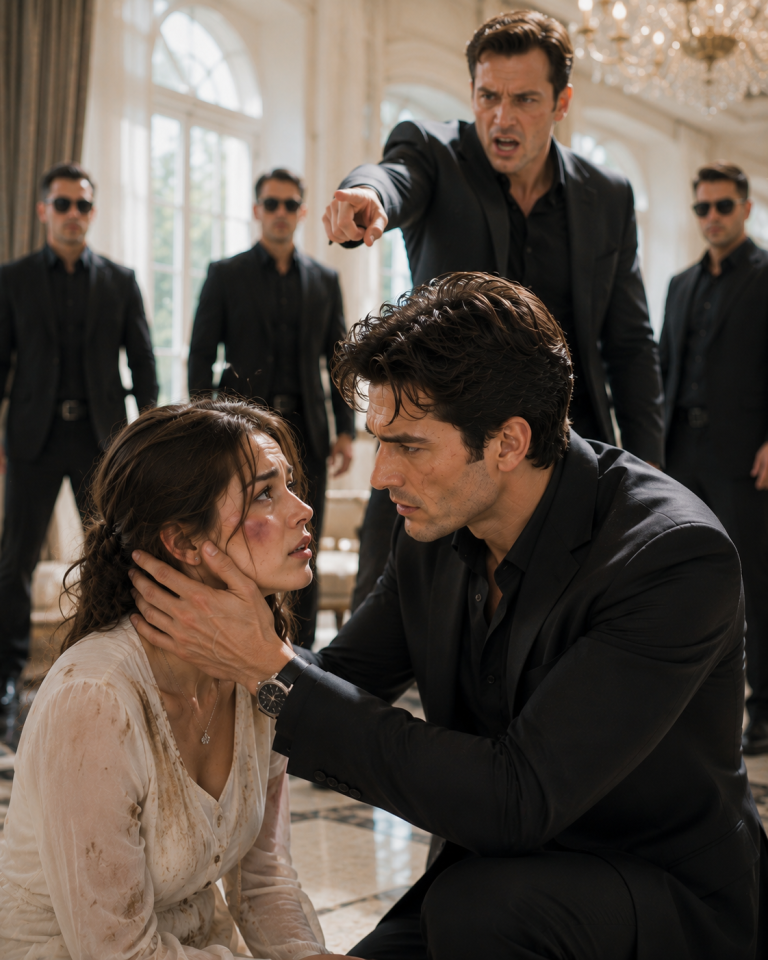
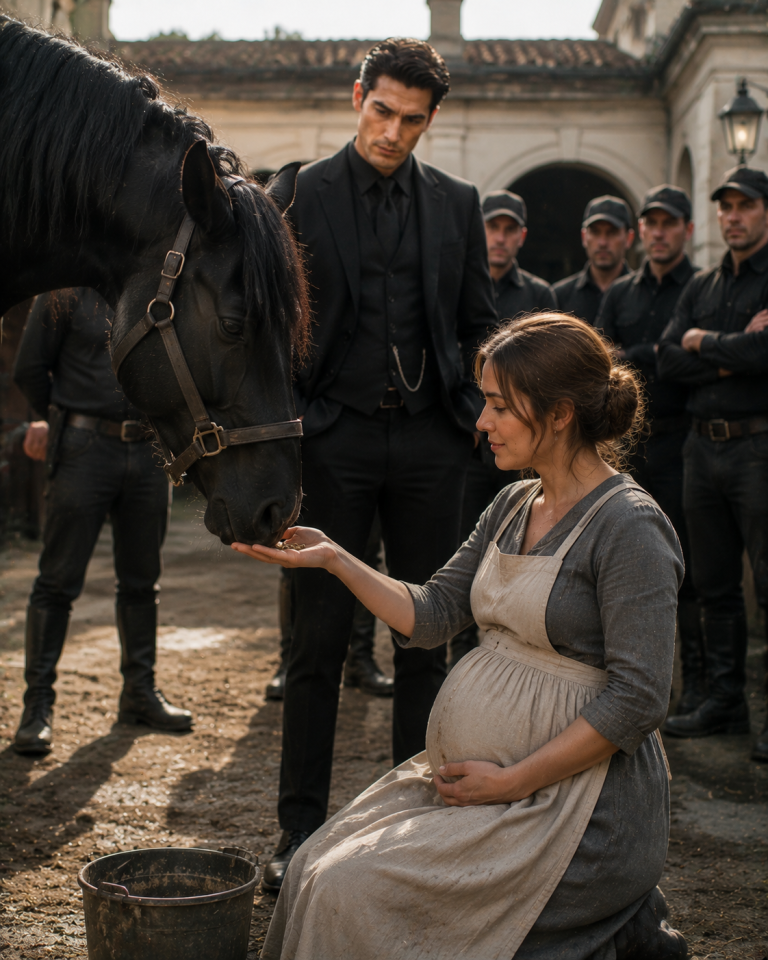
He Thought She Was Just His Uncle’s “Ugly” Girl—Then the Mafia Boss Couldn’t Resist

## PART 1
She didn’t speak once at the reading of the will.
She didn’t need to. She sat in the corner of the boardroom like a piece of furniture someone had forgotten to remove, and the men around the long table forgot she was there, and that forgetting was exactly what she had spent years learning to use.
Her name was Sera Conti. Twenty-two years old. Ward of the late Domenico Ferrara, patriarch of the Ferrara syndicate, who had raised her from age nine because her father — his most loyal soldier — had died catching a bullet that was meant for him in a Naples warehouse. Domenico had never adopted her. Never named her an heir. Never publicly claimed anything beyond old debt and quiet obligation. She existed in the Ferrara household the way certain truths exist in criminal families: acknowledged in private, inconvenient in public, spoken of carefully or not at all.
The library was her territory.
The gray sweaters were her armor.
The thick-rimmed glasses were the last thing people noticed before they stopped noticing her entirely.
That suited her perfectly.
The men around the table tonight wore expressions ranging from grief to hunger. Domenico had died on a Thursday, and by Friday, the circling had begun. Estate lawyers. Senior capos. Two cousins with competing interpretations of loyalty. And Raffaele Ferrara, the crown prince of all of it, sitting in the center chair like he had already measured it for his spine.
Raffaele was twenty-nine and looked like God had designed him specifically to make other men feel insufficient. Dark suit, darker eyes, a jaw that had never been uncertain about anything in its entire existence. He ruled rooms with the kind of authority that didn’t require volume — just a specific quality of stillness that made other people calculate their words before they used them. He was, by any objective account, exactly the kind of man who should have inherited an empire.
He was also, by Sera’s close and private observation, exactly the kind of man who would burn one down through arrogance if no one stopped him.
She had been watching him for three years.
He had never once looked back.
Lorenzo Bianchi, the family’s consigliere, stood at the head of the table with the will in his hands and the weight of the dead man’s intentions pressing visibly on his shoulders. He read the opening clauses. The vineyards. The hotel group. The shipping network. The offshore structures. Every piece of the Ferrara empire passed through the document like inventory.
Raffaele sat back as each item was read, satisfaction arriving in small increments across his face.
Then Lorenzo reached the condition.
“However—”
The word fell into the room like a stone into still water.
“—the transfer of full leadership authority is contingent upon the following: Raffaele Ferrara must marry Sera Conti within forty-eight hours of the reading of this document. The marriage must remain legally binding for a minimum of three years. During that period, both parties must reside together and maintain a unified presentation before the family and its interests.”
Silence.
Then, from across the table, Raffaele’s cousin Luca smiled.
It was a small smile. Patient and soft, like a man who had practiced it for this specific occasion.
Raffaele stood slowly.
He looked at Lorenzo. Then at Luca’s smile. Then, for the first time in perhaps years, at the corner of the room where Sera sat with her hands folded.
She met his gaze.
She did not look away.
He did.
“No,” he said.
Lorenzo’s expression didn’t change. “If you refuse—”
“I heard the clause. The answer is no.”
“If you refuse, or if the marriage dissolves before the three-year period concludes, leadership and full estate transfer to Luca.”
Luca spread his hands in a gesture of modest readiness.
Raffaele turned on him. Something cold and precise moved through his eyes.
Then back to the corner.
“You,” he said to Sera. The word had the texture of something dragged reluctantly from his throat. “You are the condition.”
Sera looked at him the way a chess player looks at a piece they have been waiting for the board to deliver.
“Your uncle’s words,” she said. “Not mine.”
Raffaele walked toward her. Not quickly. The controlled pace of a man reminding himself of his own restraint with every step.
“I will not insult you,” he said, voice low enough that only she could hear it. “But I will be honest. You are not what I planned. You are not what I wanted. If I agree to this, it is because I have no choice. Do not mistake legal compliance for anything warmer.”
Sera looked up at him.
“I have lived in your family’s house for three years,” she said quietly. “You have spoken to me perhaps six times. Please do not waste any of those six times explaining the nature of your feelings.”
His jaw tightened.
“And if I refuse?”
“Then Luca gets everything. Including the Naples debt he has been concealing from you for seven months.” She paused. “Which I thought you might want to know before you made a principled stand.”
Raffaele went very still.
The room had not heard this exchange. It had happened in whisper range, in the corner, in the thirty seconds the other men spent pretending not to watch.
But Sera watched Raffaele’s face with the focus of someone reading a text they have already studied in a different language. She saw the moment the information landed. Saw him recalibrate. Saw arrogance war with intelligence and intelligence win, barely, by the narrowest possible margin.
He looked at her for three full seconds.
“Sign the papers,” he said to Lorenzo, not moving his eyes from hers.
Then, very quietly, to Sera alone: “This is not finished.”
“No,” she agreed. “It is just beginning.”
Neither of them meant the marriage.
—
## PART 2
The chapel was cold, old, and honest in the way only buildings that have witnessed centuries of human error can be.
There were no flowers Raffaele had ordered. No music he had selected. The pews held only the required witnesses — senior men of the family, a lawyer, two notaries, and Luca near the back with an expression that had been carefully assembled into gracious defeat.
Raffaele stood at the altar in black and looked like a man attending his own court martial.
When the doors opened, nobody in the room had a particular expectation.
What they saw was a woman in white who walked alone and walked steadily, not hurrying, not hesitating, arriving at the altar with the same unhurried deliberateness with which she apparently did everything.
The dress was simple and slightly too large. Her hair was pinned back severely. Her glasses sat in their usual position. She looked, to most of the men present, exactly as she always had — quiet, plain, uninteresting, the girl who lived in the library and didn’t make trouble.
Raffaele looked at her differently now, though he wouldn’t have admitted it. He was seeing the face of someone who had just told him something true in a room full of people performing truth, and that was not a thing he encountered often.
He did not offer his hand.
She didn’t ask for one.
She simply took her place.
When the priest instructed him to kiss the bride, Raffaele bent and pressed his mouth to the corner of hers — cold, brief, designed to communicate that nothing had changed in the transfer of his name.
As he pulled back, he caught a faint scent. Something clean and faintly sharp. Rosemary, maybe, and something colder underneath.
It annoyed him in a way he couldn’t immediately locate.
The reception was held at the Ferrara penthouse in Milan.
Raffaele’s companion, Chiara, arrived in scarlet. She was impossible not to notice — that was her function, and she was excellent at it. She found Sera at the head table sitting with water and a straight spine and an expression that communicated nothing whatsoever, and she circled.
“The little librarian,” Chiara said, with the particular lightness of a woman who finds cruelty aesthetically pleasing. “Congratulations on the promotion. Don’t worry — Raffaele and I have an understanding. You keep the title. I keep him.”
Sera set down her glass.
“That is fine with me,” she said. “I have no interest in managing a man who requires a separate woman to keep him entertained.”
Chiara blinked.
“What I do require,” Sera continued, pleasantly, “is that no one embarrass this family in public. If you can manage that, we will have no difficulties.”
Raffaele, watching from across the room, saw Chiara’s expression collapse like a building whose foundation had been quietly removed.
He turned away before anyone saw him almost smile.
Something had changed in the room.
Not loudly. Not visibly enough for the careless to register.
But the men who had spent years underestimating Sera Conti felt it, even if none of them could name it yet.
The mouse, it seemed, had been studying the cat.
And she had taken very careful notes.
—
## PART 3
The first three months of the marriage were an exercise in parallel solitudes.
Raffaele continued exactly as before. Dinners, negotiations, late nights in rooms where money and loyalty were bought and spent in equal measure. He appeared publicly with Chiara arranged on his arm like a declaration. He came home at hours that communicated indifference with architectural precision.
Sera claimed the study.
It was the room Domenico had used most — not his formal office, but the smaller, older space that smelled of leather bindings and the particular dust of documents handled often. Shelves of real books alongside shelves of things that looked like books but weren’t. A desk too large for one person that she populated with organized piles and color-coded tabs.
Raffaele avoided the room the same way he avoided anything that reminded him of his uncle’s authority.
Until a Tuesday in October when he came home earlier than expected, found the penthouse quiet, and walked the halls of his own house with the low-grade restlessness of a man with too much energy and nowhere clean to put it.
Light beneath the study door.
He pushed it open.
Sera was at the desk surrounded by papers that were very clearly not fiction.
Financial statements. Freight manifests. Tax filings. Corporate structures mapped across three sheets of legal paper in handwriting so small it was almost architectural.
She finished a notation before she looked up.
He noticed she always finished the sentence before reacting to the interruption. He didn’t know whether to be irritated or impressed.
“What are you doing?” he asked.
“I am reviewing the Genoa port accounts.”
“Those are syndicate documents.”
“Yes.”
“You don’t have authorization for those.”
“I have the passwords Domenico gave me four years ago. Whether that constitutes authorization is a question of semantics.”
Raffaele stepped into the room.
“Those are not yours to read.”
Sera looked up at him over her glasses.
“Your gross margin on the Genoa route has dropped nine percent over six months. The fuel expense is falsified. The cargo weight declarations are understated by an average of eighteen percent. Someone has been shaving the route for months.”
Raffaele’s voice went flat. “Who.”
“I want to show you the numbers before I give you the name.”
“Give me the name.”
“Sit down, Raffaele.”
Nobody told him to sit down.
He sat down.
Sera turned the documents toward him. She walked him through the numbers methodically — not condescendingly, but with the particular patience of someone who has prepared for the exact level of resistance they expect to encounter. She showed him the pattern in the freight weights. The shell company in Cyprus. The account the money was routing to, two degrees of separation from an obvious origin point.
When she stopped talking, Raffaele sat in silence for a moment.
“Luca,” he said.
It was not a question.
“He has been building a private reserve for over a year,” Sera said. “The Genoa accounts are only the portion I can document cleanly. I suspect the full amount is considerably larger.”
Raffaele looked at the papers. Then at her.
“You could have left this alone,” he said. “If Luca removes me, the marriage ends. You get sympathy. You get out.”
“I gave Domenico my word.”
“To protect an empire that never protected you.”
Sera was quiet for a moment.
“He raised me,” she said finally. “Not warmly. Not with declarations. But he made sure I had books, tutors, safety, and enough of his time to understand how this family actually operates rather than how it presents itself.” She paused. “I don’t require warmth to honor a debt.”
Raffaele looked at her for a long time.
He had spent three months performing dismissal. Cataloguing her irrelevance. Reducing her to the inconvenience she was supposed to be.
Looking at her now, across a desk covered in documents she had organized while he was busy being admired, he felt something shift in his understanding of the past three months. Not all at once. Just at the edges. A slow recalibration.
“Why didn’t you tell me sooner?” he asked.
“I needed to verify the full picture before I brought you incomplete information.”
“How long have you been working on this?”
“Since the week after the wedding.”
He stared at her.
“Three months.”
“Yes.”
“While I was—”
“Demonstrating indifference publicly. Yes. I noticed.”
He said nothing.
Sera began organizing the papers back into their ordered piles.
“The annual consortium dinner in Florence is in three weeks,” she said. “The old families will be there. If you want to move against Luca with full witness, that is the venue.”
Raffaele absorbed this.
“You have a plan.”
“I have the outline of one. You will need to supply the parts that require the kind of credibility I don’t have in that room.”
“And you supply the parts that require the kind of intelligence I apparently haven’t been applying.”
Sera didn’t respond to that.
He stood to leave.
“Raffaele.”
He stopped.
“Whatever you decide to do with this information,” she said, “Luca cannot know we have it. He has men inside your regular channels. He’s been watching.”
Raffaele turned slowly.
“How do you know that?”
“Because I’ve been watching too.”
He left the study and stood in the hallway for a long moment.
He realized, with a clarity that arrived too late and too completely, that the woman he had married as a punishment was the most dangerous person under his roof.
Not dangerous to him.
Dangerous for him.
He didn’t sleep well that night.
—
He ended things with Chiara the following week.
Not cruelly. Not dramatically. He told her the truth in the most economical version available: the arrangement had served its purpose and was now finished. She cried. He waited. She accused. He listened. She left.
He told Sera the same evening.
She was in the study.
“I ended it with Chiara,” he said, from the doorway.
Sera didn’t look up from her book.
“I’m aware.”
“You’re—” He stopped. “How are you aware.”
“Because she called Isabella Ferrante within twenty minutes and the entire northern social circuit knew within the hour. I received a condolence message from three women I have never personally met.”
He stared at her.
“None of this particularly affects you,” he said.
“No. But it affects the family’s optics, which is part of what I agreed to manage.” She finally looked up. “Was that your decision or a strategic calculation?”
He considered lying. Decided against it.
“Both.”
She nodded once and returned to her book.
He remained in the doorway.
“You are not going to ask why?”
“No.”
“You’re not curious?”
“I am curious about many things. Your motivations for conducting your personal life are not currently among them.”
He was quiet.
“You don’t make anything easy.”
“Ease was never the offer.”
He went back to his room.
He stared at the ceiling for an hour, thinking about how different the past three months would have looked if he had gone into that library on the first night and asked what she was working on.
—
The consortium dinner in Florence was held in a fourteenth-century palazzo that smelled of frescoes and old ambition. Every significant family in the northern network sent representation. The Sicilian contingent arrived with their usual ceremony. The Venetians brought their usual impenetrable courtesy.
Raffaele had always attended these events as the obvious heir — admired, expected, unchallenged. He moved through them with the ease of a man who confused familiarity with safety.
This year, the old families asked specifically to see his wife.
That request had been communicated to Raffaele three days before the dinner.
He found Sera in the study.
“You know about Florence,” he said.
“Alessandro sent the seating arrangements yesterday.”
He sat across from her. “You could have mentioned it.”
“You didn’t ask.”
He exhaled. “Fine. You need to come.”
“I know.”
“And you cannot look like—” He gestured vaguely.
Sera looked up. “Like what.”
“Like you would rather be reading.”
“I always look like I would rather be reading. That is my natural expression.”
“This evening requires something else.”
“Noted,” she said. “I will be ready at seven.”
“That is not enough information.”
“That is all the information I have to give you.”
He left unsatisfied and returned at six fifty-eight to find her descending the staircase and learned, somewhat abruptly, that he had never properly looked at her before.
The dress was deep green silk, cut with the precision of something designed by someone who understood that elegant women don’t adorn themselves — they arrive. Her hair was loose for the first time he could remember, dark and deliberate against the green. The glasses were gone. Her eyes, without their usual magnification and barrier, were amber and sharp and entirely unimpressed by his expression.
She reached the bottom of the stairs.
“Close your mouth,” she said.
“Where did you—”
“I have always looked like this,” she said, collecting her evening bag. “You simply never had a reason to check.”
He handed her into the car in silence.
The palazzo received them.
Raffaele had walked into hundreds of rooms that rearranged themselves for him. He knew the sensation — the slowing of conversations, the recalibration of attention, the specific social shift that happened when power entered a space.
This was different.
The room rearranged itself for her.
Not because she was beautiful — though she was, in a way that made several men reassess conversations they’d been having about the De Santis girl. Because she walked in as if she had already been there, had already read the room, already assessed everyone in it, and found the assessment neither alarming nor impressive. She arrived with the composure of a woman for whom this was not an audition.
Chiara, somewhere in the back of Raffaele’s mind, had always needed the room to see her.
Sera didn’t need anything from the room at all.
Luca found her midway through the evening.
He materialized at the edge of a conversation she was having with two older bosses, flanked by two of his men, wearing the particular smile of someone who has been rehearsing the scene he is about to perform.
“The librarian,” he said. “Cleaned up for the occasion.”
Sera turned.
The two older bosses settled their attention on the exchange.
“Tell me,” Luca continued, addressing the room more than her, “how much did my cousin spend on the transformation? It must cost something, decorating a charity case for public consumption.”
The nearest conversations had gone quiet.
Raffaele had begun moving toward them from across the room.
Sera didn’t look for him.
“It cost considerably less than the four point seven million euros you moved through shell companies in the past fourteen months,” she said. Her voice was clear enough to carry to the men who mattered. “Though I suppose that does put cosmetic expenses in perspective.”
The silence that followed was the kind made of many people doing very fast calculations.
Luca’s face flushed. “You have no idea—”
“Freight manifests from Genoa, weighted discrepancies documented across eleven shipments. The Cyprus account. The Moscow proxy. The timeline matches your expanded private security contracts by six weeks, which is consistent with preparation for a leadership move.” She looked at the two bosses beside her. “I have submitted the documentation to the commission review tonight. I assumed they would want the full picture before any formal proceedings.”
The older men looked at each other.
Then at Luca.
Raffaele reached Sera’s side.
His hand settled at the small of her back — not ownership, not theater, just the reflexive positioning of a man who had just arrived at the one place he should have been standing all along.
“My wife has been thorough,” he said to the room.
Luca’s voice rose. “You’re going to take her word over family—”
“Family,” Raffaele repeated, very quietly, “is what you had before you started stealing from it.”
The room held.
Luca looked at his own men.
Their faces told him what he needed to know about the nature of loyalty purchased with funds that had just been publicly exposed as stolen.
He reached for something — a phone, a weapon, the last available move.
The room moved faster than he did.
The bosses had seen enough.
In the car afterward, driving north out of Florence, the city disappearing behind them in amber and black, Sera sat with her hands folded and her gaze on the window.
“You laid the trap six weeks ago,” Raffaele said.
“Longer.”
“Before the wedding.”
She said nothing, which was its own kind of confirmation.
“You knew Domenico would name you the condition.”
“He discussed it with me.”
Raffaele looked at her profile.
“And you agreed.”
“I trusted his judgment about what the family needed.”
“Not about me.”
She turned then. “He thought you were salvageable. I reserved judgment.”
The car was quiet for a moment.
“And now?”
Sera looked at him steadily.
“You sat down when I asked you to. You listened when I showed you evidence instead of demanding conclusions. You ended something that was damaging your position before I asked you to. You stood beside me tonight instead of in front of me.” She paused. “The jury is still deliberating.”
Raffaele absorbed that.
“What would move them toward a verdict?”
“Time,” she said. “Consistency. Don’t perform change — practice it. Those are different things.”
He looked out the window.
“My uncle knew you would do this,” he said.
“He knew I would protect the family. He hoped you would become worth protecting.”
The distinction arrived in his chest with more force than he expected.
“You pity me,” he said.
“I did,” she said. “Past tense.”
He looked at her.
“What changed?”
“You did. Slightly. Marginally. In ways that suggest potential.”
“That is the least enthusiastic endorsement I have ever received.”
“I imagine most of your endorsements have been enthusiastic, unearned, and delivered by people who wanted something from you.”
He had no answer for that.
They drove in silence.
Somewhere north of the city, rain began.
Raffaele watched it on the glass and thought about a version of himself that had married Sera Conti and spent three years performing contempt so successfully that he had missed everything she was.
He had spent his whole life surrounded by people who reflected his power back at him in ways designed to make him feel safe.
She was the first person in years who had reflected something true.
—
The weeks following Luca’s exposure were dangerous in the specific way of concluded confrontations where the outcome is clear but the consequences are still settling.
Luca was stripped of his positions and referred to the commission. His private security apparatus unraveled quickly without funding. He retained enough of his original support to remain a secondary concern, but the threat had been defanged at its source.
Isabella — Raffaele’s one-time companion, who had made a quiet information-sharing arrangement with Luca in the belief that she was investing in the future — departed for Paris with the speed of someone who had correctly identified the direction of the wind.
Raffaele did not watch her go.
He was in the study with Sera, reviewing the restructuring of the northern port contracts.
This had become the shape of their evenings. Not planned. Not performed. Just present — both of them at the desk that was too large for one person and exactly right for two, with documents organized into Sera’s systems and espresso that Raffaele had started making himself because he noticed how she took it and she never asked for anything.
He made it with two sugars and set it beside her elbow without announcing it.
She drank it without looking up.
That unremarkable exchange meant something to him that he couldn’t fully articulate.
One evening he asked the question he had been constructing for weeks.
“Why the disguise?”
Sera finished a notation.
“I don’t follow.”
“The sweaters. The glasses. The deliberate invisibility.”
She set down her pen.
“I was nine when I came into this family. The men in it were dangerous. The women who attracted their attention had difficult lives.” She was quiet for a moment. “I learned to be unremarkable. Unremarkable women get access to rooms they would otherwise be excluded from. They hear things. They are trusted with documents because no one fears what they might do with information.”
Raffaele looked at her.
“You were building intelligence infrastructure for years.”
“I was learning to see clearly in a world that doesn’t like to be seen.”
“And now?”
She looked at him. “Now the situation has changed enough that the camouflage is less necessary.”
“You choose when to be visible.”
“Yes.”
“You chose to be visible in Florence.”
“The occasion required it.”
“You chose what color to wear. What time to remove the armor.”
“I always choose,” she said. “That was the point.”
He sat with that.
“I spent three months treating you like furniture,” he said.
“Yes.”
“While you were doing—” He gestured at the desk. “—all of this.”
“Yes.”
“I owe you an apology.”
Sera looked at him steadily.
“You owe me several. And an apology is not the same as accountability.” She picked up her pen. “But you may proceed.”
He proceeded.
He apologized for the chapel. For the reception. For Chiara, specifically for the public quality of it — the deliberateness of the insult, the pleasure he had taken in watching her sit straight-spined at the head table and refuse to perform damage for his entertainment.
He apologized for three months of cruelty designed to prove he was above the situation.
He apologized for calling her unremarkable, in different ways, in front of the people who worked for him.
She listened to all of it without rushing him toward conclusion.
When he finished, she said: “You don’t get forgiven because the accounting was thorough.”
“I know.”
“You don’t decide when the damage is healed.”
“I know.”
“You don’t use this as currency toward something warmer.”
He held her gaze. “I know.”
She looked at him for a long moment.
“You may continue earning it.”
He nodded.
That was enough.
For now, that was entirely enough.
—
Three months later, the annual Ferrara Foundation gala was held at the restored Teatro Lirico in Milan.
It was Sera’s idea.
Not the gala — those had existed for years, performative charity events designed to launder the family’s image in institutional amber. Her idea was to change the focus. Real charity. Children who had lost parents to organized crime. Communities whose infrastructure had been exploited by the systems the family ran. Rehabilitation programs. Legal aid.
Raffaele’s first instinct was resistance. His second instinct was to watch Sera build the argument with such methodical precision that resistance became structurally untenable.
His third instinct was to fund it fully and stay out of her way.
She let him attend.
The evening was the first Ferrara event in recent memory that did not feel like theater. The conversation was substantive. The guests included people who had earned their presence through work rather than fear. When the northern bosses looked at Sera across the room — now a public figure in her own right, recognized by people in legitimate sectors who had no idea what kind of evenings she spent in the study reviewing freight manifests — they looked at her with the particular expression of men recalibrating a threat assessment they had previously felt comfortable keeping low.
Near the end of the evening, Lorenzo found Raffaele at the edge of the terrace.
“Domenico would have found this very satisfying,” Lorenzo said.
Raffaele looked across the room.
Sera was in conversation with a magistrate, a shipping executive, and the director of a legal aid nonprofit. She stood among them the way she always stood — perfectly at ease, drawing nothing unnecessary toward herself, hearing everything.
“He planned for her,” Raffaele said.
“He hoped for you,” Lorenzo said. “Planning and hoping are not the same thing.”
“He knew she was the access.”
“He knew she was the intelligence. He didn’t know what you would do with it.” Lorenzo paused. “He thought you might be worth something underneath the performance. He wasn’t certain.”
Raffaele was quiet.
Across the room, Sera looked up and found him.
Not the way Chiara used to look at him — that performed searching, the need to confirm she had the room’s most important gaze. Sera looked at him the way a partner checks on a collaborator in the middle of a long project. Are you still standing. Is anything on fire. Do you need something.
He wasn’t. Nothing was. He didn’t.
He lifted his chin slightly.
She turned back to her conversation.
Later, when the last guests had gone and the terrace had emptied and Milan glowed below them in the particular gold of a city that has been beautiful for centuries and plans to continue, Raffaele brought two glasses of wine and stood beside her at the railing.
He did not take her hand.
He had learned the value of waiting.
She took his.
The gesture was small. Deliberate. Entirely on her terms.
He felt it the full length of his arm.
“Do you think about leaving?” he asked.
“Sometimes.”
The honesty settled between them without demanding a response.
“Do you still want to?”
She looked out at the city for a while.
“I wanted a life no one else drew the shape of,” she said. “I still want that. But this life has been becoming mine for months now. The shape is changing.”
“Into what?”
She turned to look at him.
“Into something I chose,” she said. “Partly.”
“Only partly?”
“The beginning was not my choice. The middle has been. The end remains to be determined.”
He looked at her profile in the gold light.
“What would the end look like?” he asked. “If you were designing it.”
She was quiet for a long moment.
“Like this,” she said. “But with more certainty that the man beside me has finished becoming someone worth standing beside.”
“And have I?”
She looked at him.
“You are in progress,” she said. “Promising progress. Don’t stop.”
He turned toward her.
She turned toward him.
He waited — the full necessary pause, the time she needed to decide, the space that was hers and had always been hers.
Then she stepped in.
The kiss was slow. Honest. Nothing like the chapel, which had been a gesture of disrespect wearing the costume of a ceremony. This was two people who had spent months studying each other across documents and difficult conversations, choosing each other across the specific, unglamorous distance of actual knowledge.
When they separated, she rested her head against his jaw.
“Domenico was right about one thing,” she said.
“Only one?”
“You are occasionally educable.”
He laughed — quietly, into her hair, the kind of laugh that arrives when something true and improbable has become real.
—
The proposal arrived without theater.
It happened in the study.
He came in one evening to find Sera reading, Domenico’s old lamp making amber of the room, rain beginning outside against Milan in the particular rhythm she had told him once helped her think. He sat across from her and waited for her to finish the page.
She looked up.
He opened his hand.
In it was a ring that had belonged to his grandmother — not flashy, not recent, a thing with history in it, chosen because it looked like something that had already proven it could last.
“I am not asking you to belong to me,” he said. “I am asking whether you want to keep building this together. Specifically, and legally, and on terms you set.”
Sera looked at the ring.
Then at him.
“Those are better terms than the original contract,” she said.
“Considerably.”
“Offered with more information.”
“Yes.”
“And without a forty-eight-hour deadline.”
“You can take as long as you need.”
She looked at the ring for another moment.
“Yes,” she said.
She held out her hand.
He put the ring on her finger and she looked at it with the focused attention she gave everything — measuring, assessing, deciding whether she found the thing acceptable on its own terms.
Apparently she did.
She reached across the desk and took his face in both hands and kissed him with the direct, decided energy of someone who has finished deliberating and arrived at a conclusion.
He kissed her back with everything he had been learning to be.
—
Years later, the Ferrara family’s restructuring would be studied as a case study in legitimate transition. The shipping network reoriented. The financial structures exposed to sunlight over years of patient work. The old bosses retired or redirected with the specific incentives that come when the alternative has been made sufficiently clear.
Raffaele ran it with the discipline he had always had and the judgment he had spent years acquiring.
Sera ran the legitimate side with a precision that made people who had initially dismissed her memorize her name.
They were not a fairy tale. They were a functioning partnership between two people who had entered a terrible arrangement and, through different routes, found their way to something real.
Raffaele still sometimes said the wrong thing. Sera still sometimes chose strategic silence over the directness he was learning to want. There were evenings in the study that ended in arguments and mornings that required the particular work of choosing the other person when the easier option was simply distance.
They did that work.
Daily.
That was the part people who heard the story later always underestimated — not the warehouse confrontation, not the gala reveal, not the moment Raffaele realized in a cold chapel that the woman beside him was not what he had assumed. But the daily work. The ongoing, unspectacular, occasionally frustrating labor of two people deciding every day to keep building.
One evening, with their daughter asleep in the next room and the study quiet around them, Raffaele looked at Sera across the desk and said, “He knew, didn’t he. Domenico. He knew exactly what he was doing.”
“Yes,” Sera said.
“He knew you were the only person who could protect the family from its worst instincts.”
“He knew I was willing to.”
“Including from me.”
Sera looked up.
“Especially from you,” she said. And then, more quietly: “And for you. When you were ready.”
He reached across the desk.
She gave him her hand.
Outside, Milan hummed and gleamed, ancient and ongoing, indifferent to any particular story being lived inside any particular light.
But inside the light, something had been built from an insult, a will, and two people who had refused to become only what other people decided they were.
That was enough.
That was, in fact, everything.
—