He Saved the Schoolteacher From the Storm—But the Nine Months That Followed Made the Whole Valley Speechless

**PART 1**
The horse came to town alone, saddle still fastened, reins dragging, eyes wild with the particular panic that comes from separation in whiteout conditions. Martha Kingsley saw it first from the general store, a mare she recognized instantly as Dr. Morrison’s buckskin, and her blood went cold enough that the jar of preserves she was reaching for slipped from her fingers.
The blizzard that arrived late October morning had been forecast for days, but forecasts in Ravenshollow, West Virginia, were as reliable as promises made by men with nothing to lose. The temperature had been mild at dawn. By afternoon, winter had simply decided to arrive early, and it had arrived with violence.
By the time they found Dr. Morrison collapsed near Creek Stone Bridge, it was clear his heart had given out in the cold, and the Morrison farm fifteen miles north — where fever was burning through one of the children — still needed a physician.
Eleanor Hawthorne was reading to her students when Martha brought the news. Twenty-three faces went silent as Eleanor absorbed the particulars: Morrison dead, the road impassable within the hour, the child burning up, and only Eleanor herself in Ravenshollow who’d learned enough basic medicine over eight years of being the nearest thing to a doctor’s assistant to possibly attempt the journey.
She was forty-three years old. She had not expected to be brave anymore.
She stood, set down the reader, told the children to go home, and saddled her mare with fingers that didn’t shake because she’d learned, years ago, not to let fear become visible to the world.
The storm broke over her five miles out.
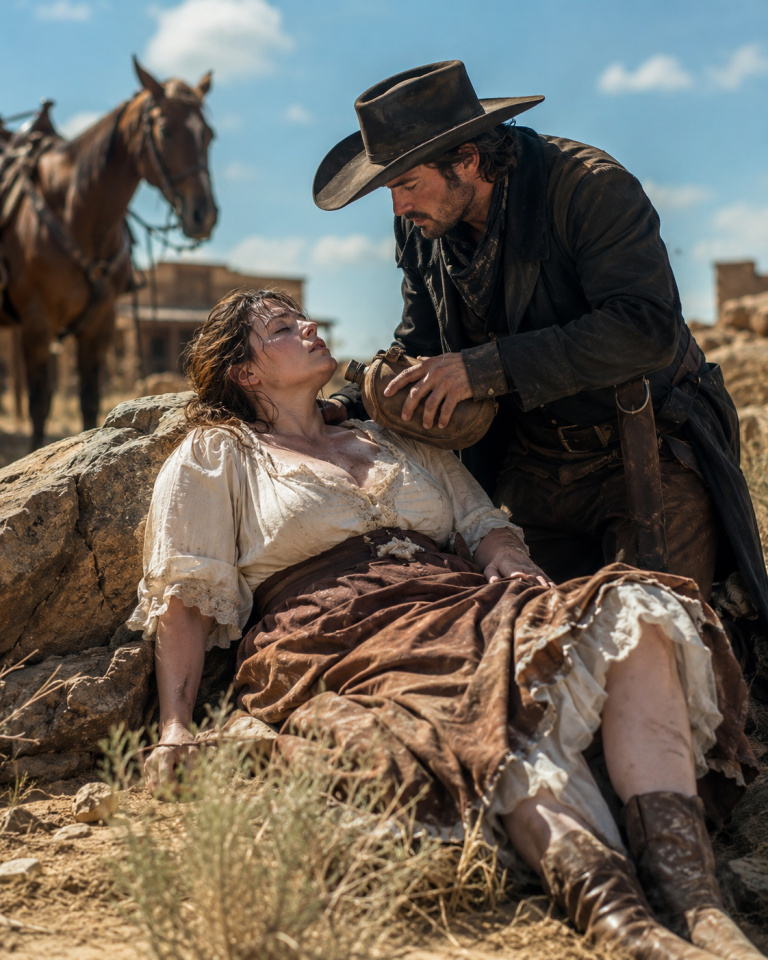
One moment the trail was discernible beneath her horse’s hooves. The next, the world had become a white room with no walls and no exit, wind screaming through the pines with the kind of force that promised to strip skin from bone if it tried hard enough. Eleanor hunched over the mare’s neck, talking to the animal in a low, steady voice, trying to communicate that they would not die today despite what the mountain was suggesting, when the mare rose suddenly and Eleanor felt herself falling into nothing.
She hit the snow hard enough that the impact drove the breath from her lungs. Her ankle twisted beneath her, and pain shot up her leg so bright it nearly blinded her — that particular pain that means damage, real damage, not the kind you could walk through.
The mare bolted.
Eleanor dragged herself toward what she hoped was the trail, though in white this complete, trail and forest and sky all looked identical to the nothing that precedes death. Her hands were already going numb. Snow was beginning to accumulate in her hair, on her lashes, inside the cloth of her gloves where skin was still warm enough to melt it into ice that formed with lethal precision.
If she stayed down, she knew exactly what happened to people in mountain storms.
She’d heard the stories. Warnings, really. Don’t get caught out. Don’t fall. Don’t let yourself rest because sleep in these conditions meant never waking again.
She had managed perhaps ten yards when her ankle gave entirely and she collapsed again, this time without the strength to drag herself further. The cold was moving faster now, seeping through her coat and skirts with a patient inevitability, stealing heat from her extremities like a thief working systematically through a house. Her vision was starting to blur at the edges.
And then, impossibly, a shadow.
Enormous.
Impossible.
At first Eleanor thought delirium had come for her, that her mind had begun the merciful dissolution that preceded death in circumstances like these.
But the shadow solidified into a shape and the shape became a man, impossibly tall, impossibly broad, carrying her out of the snow before she could form a single coherent thought about how that was physically possible for someone to move so quickly through whiteout conditions.
His coat wrapped around her — heavy, lined with fur, still warm from his body heat.
His heartbeat was steady beneath her cheek when she pressed against him, thundering with exertion but controlled, certain, the heartbeat of a man who’d never panicked in his life.
Ravenshollow’s mountain ghost, the one they called an eight-foot freak who lived on the ridge above town and barely spoke to anyone, was carrying Eleanor Hawthorne through a blizzard like she weighed nothing at all, like saving a stranger’s life was a simple matter of choosing to do it.
She managed one word: “Marcus?”
She thought she heard him laugh, low and shocked, as if her even knowing his name was the most improbable thing that had happened to either of them.
Then warmth swallowed her.
A cabin. Firelight. The particular smell of cedar smoke and pine resin and something else — the soap he’d washed his hands with that morning, perhaps, or just the natural scent of a man who lived close to the land.
She was in a bed — not his, because he was sitting across the room watching the fire with an intensity that suggested he’d been there all night, every line of his body tense with worry — and her wet clothes had been carefully removed and replaced with blankets. Her ankle was wrapped with meticulous care. Heat stones wrapped in cloth lay at her feet like prayer, keeping her warm through the night.
“How long?” Her voice was hoarse with cold and exhaustion.
“Six hours.” He didn’t turn from the fire. “You kept trying to walk into the blizzard in your sleep. You were having nightmares about the storm still coming. I had to hold you back so you wouldn’t do something dangerous.”
She understood what that meant — he’d held her all night through her fever dreams, kept her from fleeing into weather that would have killed her.
“You saved my life.”
Finally he looked at her. For just a moment she saw it — the weight of all the ways the world had told him he was too much, too large, too strange to be anything but a cautionary tale.
“Anyone would have,” he said.
“No,” Eleanor answered, quiet and certain. “They would not have.”
**PART 2**
The storm lasted three days.
Three days trapped in one cabin.
Three days sharing meals.
Firelight.
His carvings.
Eleanor discovered he made them — birds, flowers, tiny people with expressions somehow captured in wood.
She picked up a carved fox.
“You made this?”
He nodded, uncomfortable with the attention.
“It’s extraordinary.”
A flush touched his ears.
She smiled.
“Your mother taught you?”
He said “mother” so softly it told her everything about a boy raised by a small, fierce woman and abandoned by a man too cowardly to see past size.
One night, Eleanor asked—
“Why never marry?”
Marcus nearly choked.
“I apologize if that’s too direct.”
“No,” he said finally.
“Women don’t stay comfortable around me.”
“Because of your height?”
“Height. Size. Blood. Face.”
Eleanor tilted her head.
“You think you’re frightening?”
He looked at her like the answer was obviously yes.
She set down her bowl.
“Marcus.”
He met her eyes.
“You are the gentlest man I have ever met.”
Silence.
Complete.
His breathing changed.
Slower.
Like something inside him had fractured open.
“No one ever said that.”
Her chest tightened.
“How is that possible?”
He gave a sad smile.
“People see giant first.”
“And never look again,” Eleanor finished.
She stared at this man.
At the boy abandoned.
At the soul the world had decided was monstrous simply for existing in a body that wouldn’t fit inside their comfort.
“I see more,” she whispered.
**PART 3**
The storm ended. The roads cleared. Eleanor returned to Ravenshollow by mid-afternoon that third day, limping on an ankle that would take weeks to fully heal, knowing she would face questions about where she’d spent three nights and with whom.
What surprised her was that she didn’t care.
Marcus returned to his ridge, fifteen miles north of town where the pines grew thick and the nearest neighbor still lived a good half-mile away. For the first time in thirty-two years, the silence of the cabin felt lonely instead of peaceful.
Something had irrevocably shifted in both their lives.
Eleanor found herself pausing at her classroom window, looking toward the mountains, watching the ridge line where smoke rose from his cabin each evening. She graded papers with less precision than usual. She found herself spacing out during lessons, thinking about how his heartbeat had sounded steady beneath her cheek while the storm tried to kill them both outside. During the day she was a schoolteacher, proper and precise and careful. During the night she dreamed of a man eight feet tall carrying her through white, the only solid thing in a dissolving world.
Marcus, meanwhile, was slowly going mad.
He’d spent his whole life believing that loneliness was the price of existing in a body this large, in a face that carried both his parents’ bloodlines in ways people found unsettling. He’d accepted the isolation the way he’d accepted his height — as a fact of existence, neither good nor bad, simply the shape of his life. But three nights in Eleanor’s proximity had rewritten something fundamental in him.
He found reasons to come to town.
First it was timber delivery — legitimate work, money needed. Then it was to repair fences at the schoolhouse. Then just to pass by on some manufactured errand, hoping to catch a glimpse of her crossing the schoolyard or emerging at day’s end with papers under one arm and resignation in her posture that he recognized as the weight of teaching thirty children with insufficient resources.
Small wooden toys began appearing on the schoolhouse steps. A horse, recognizable by the arch of its neck and the detail in its mane. A bird with wings spread for flight. A tiny person sitting cross-legged with a book open on their lap, every detail of it rendered with the tenderness of an artist who loved the subject. The children adored them. Eleanor found each one and held it in her palm and understood, with a certainty that made her chest tight, exactly who had left it.
She took them home. Arranged them on her windowsill. Traced the chisel marks with her fingers and understood that this was how Marcus loved — not with words he’d never learned to say easily, but with his hands, with labor, with the painstaking transfer of care into physical form.
Town gossip, which had always found the mountain giant a subject of fascination and mockery in equal measure, shifted into overdrive.
“She’s forty-three,” the women said in the dry-goods store, as though age had assigned her to some lesser category of human worth.
“He’s thirty-two,” they added, as if an eleven-year gap was the primary impossibility in a man eight feet tall courting a widow of moderate means.
“She’s past her years for children,” someone offered — a cruelty so casual it barely registered as one, except that Eleanor heard it and felt it land somewhere true in her, in the part of her that had resigned herself to the particular loneliness of middle age and childlessness.
At the saloon, three weeks after Eleanor and Marcus had begun a tentative courtship conducted primarily through wooden gifts and careful conversations at the edge of town, a drunk rancher named Hayes decided he’d stumbled on the funniest thing he’d heard all year.
“I’ll tell you what that giant’s thinking,” Hayes announced to a room full of ranchers. “Breeding with the old schoolteacher. She’s past her useful years anyway, so what’s the harm?”
The laughter that erupted was the kind that felt like permission — permission to mock, to diminish, to reduce whatever was happening between Eleanor and Marcus to something less than dignified.
Marcus, who had come to town that day to deliver timber and had walked into the saloon for a single drink, went very still.
Hayes, emboldened by the laughter and by whiskey, decided he wasn’t finished. “That what you’re after, giant? Someone who can’t possibly give you children?”
The whole room tensed.
Marcus set down his drink and turned toward Hayes with all the terrible certainty of a man who’d been diminished his entire life and had decided in that moment to stop accepting it.
Then he smiled.
Not a kind smile. A smile that made every man in the room remember that eight feet tall was tall enough to change the nature of a room just by standing.
“You done?” Marcus asked.
Hayes swallowed. Lifted his drink again. “Tell me I’m wrong.”
Marcus stepped forward. Not threatening, yet. Just closing the distance.
“I don’t need children to love her,” he said quietly. “Not because she can’t have them. Because that’s not why someone chooses to spend their life beside another person. You would know that if you’d ever loved anything the way she deserves to be loved.”
He turned around and walked out of the saloon.
Behind him, the room had gone completely silent. Not the silence of shame, necessarily, but the silence that comes when someone has stated a simple truth so plainly that denying it becomes impossible.
It took Marcus three months to work up the courage to propose.
Three months of visiting town more frequently than was necessary. Three months of building up to the moment, of lying awake in the cabin wondering if he should even attempt it, if the very asking might frighten her away. He’d carved the ring in secret during long winter evenings, shaping cherry wood into a band smooth enough to feel like skin, inlaying it with a line of silver he’d hammered himself from a coin his mother had left him — the only thing of material value he owned besides the cabin that had become his home.
He proposed on a hillside above Ravenshollow that overlooked the entire town spread below them like a map of the world, with the mountains rising behind them and the wind carrying the smell of pine and the promise of spring. Eleanor gasped when she saw the ring because she understood, instantly, the labor that had gone into it, the hours of patient work, the deliberation of every chisel mark. She wept before he even finished asking, shaking her head up and down wordlessly because her voice had gone somewhere beyond her reach.
“Yes,” she finally managed. “Yes. Yes. Yes.”
They married in April in the Ravenshollow church, and the whole town arrived with the kind of morbid fascination mixed with genuine curiosity that had become standard whenever Eleanor Hawthorne and Marcus Thornwood were the subject. The schoolchildren threw wildflowers — Eleanor’s students, many of whom had held the carved toys Marcus had left on the steps, understood without being told that this was a man worth celebrating. Eleanor’s only living relative, a cousin from three towns over, wept openly. Half the town watched with skepticism. The other half watched with their hands over their mouths, moved by something larger than skepticism — the recognition of love arriving so late and so unlikely that it had become almost holy.
Marcus wore a suit tailored to his height by the seamstress in Ravenshollow, an alteration that took three weeks and cost him most of the money he’d saved from timber work, but he wore it like armor made of dignity. Eleanor wore cream-colored wool with pearl buttons, and her graying hair was pinned with the same flowers the children had thrown.
When Marcus kissed her at the altar, the church went absolutely silent — not the silence of disapproval, but the silence that settles when something real and large and undeniably important is happening, when everyone present understands they’re witnessing a moment they’ll remember for decades.
Six months into marriage, Eleanor found herself going soft and heavy in ways she’d attributed to middle age and contentment. But the nausea that arrived each morning, the way food she’d loved for decades suddenly turned her stomach, the exhaustion that settled into her bones by midday — these weren’t the simple changes of a woman entering her fifth decade.
She was sick in the mornings. Exhausted by noon. By evening, her body wanted nothing but rest. She blamed age, blamed the stress of adapting to life in a cabin on a ridge, blamed the mountain weather and her body’s natural descent toward the end of all such potential.
When the traveling physician who’d taken over Morrison’s practice arrived for Eleanor’s annual examination, she didn’t think to mention the symptoms. It was routine, something she’d done faithfully each spring since arriving in Ravenshollow.
He emerged from the bedroom where he’d examined her, and something in his face was wrong. Not wrong exactly. Stunned. Shocked. As if he’d found something impossible and was still deciding whether to report it or bury it forever.
“Mrs. Thornwood,” he said carefully, “do you know you’re pregnant?”
Silence.
Complete silence.
Eleanor stared at him. Marcus, who’d been reading in the corner, looked up from his book.
“I’m sorry?” Eleanor said, as though she’d misheard something simple and obvious.
“You’re pregnant. I’d estimate approximately five and a half months along.”
Eleanor’s mind simply refused to process the words. At forty-three, after fifteen years without a monthly cycle, after fifteen years of assuming her body had passed beyond all such capacity, after a lifetime of being told that this was the particular cruelty women her age faced — the window closing, the possibility retreating, the knowledge that she would remain forever childless — her body had apparently decided to rebel against all expectation.
“That’s impossible,” she said.
The doctor smiled. “And yet. Sometimes bodies surprise us. Particularly when someone has finally found enough joy and security to relax the thousand small tensions that can prevent conception. Stress is a powerful preventative. So is being alone, being uncertain, being afraid.”
He gathered his things and left her sitting on the bed, stunned into immobility.
Marcus hadn’t moved. Eleanor looked at him and saw that he’d gone very still — not an angry still, but the still of a man trying to contain something too large to remain contained.
“Marcus?” she said carefully.
He blinked. Once. Twice. Three times.
Then the eight-foot giant — the man Ravenshollow had spent years mocking, calling cursed, calling unnatural, treating as spectacle — stood and walked out onto the porch.
Eleanor followed and found him gripping the railing so hard his knuckles had gone white.
“Marcus?”
He couldn’t speak. He simply shook his head, shoulders shaking.
Eleanor placed a hand on his back and felt him trembling. “Darling?”
“We made life,” he said finally, his voice rough with emotion. “You and me. We actually — ” His voice broke. He tried again. “They said you were too old. They said it was impossible. They laughed at us, Eleanor, and they said — ”
He couldn’t finish.
She took his hand and placed it on her belly, still barely curved, not yet showing the obvious swell that would come.
“There’s a baby,” Eleanor said softly. “Our baby. They made it.”
Marcus dropped to his knees on the porch, still holding her hand against her belly, and wept in a way that had nothing to do with sadness. He cried with the kind of intensity that only comes when someone has spent their entire life believing they’d never be allowed to have this — not the child, but the proof, the evidence, the concrete reality that he was worthy of love, that his body wasn’t a curse but a home, that someone had chosen him and that choice had resulted in life.
Eleanor ran her fingers through his hair, through the beard he kept trimmed now because she’d taught him to, and whispered things to him that she’d never had the words to say before: *You were never the cursed one. You were just waiting for someone to love you the way you deserved. This baby is proof. This baby is proof that I chose you, that my body chose you, that the world is finally going to see what I’ve known since that blizzard ended and you carried me to your cabin — you are extraordinary, and you were always meant to be a father.*
The pregnancy defied every medical expectation placed on forty-three-year-old bodies. Eleanor bloomed the way some women do in middle age, having finally found enough security and joy to relax the vigilance she’d maintained for fifteen years. Her body remembered what it had been made for. Marcus attended every appointment with the traveling physician, held her through episodes of nausea, and moved through town with such obvious pride that the remaining skeptics gradually quieted.
By August, Eleanor was enormous, her belly preceding her by a full handspan, and Marcus had taken to building furniture in preparation — a crib scaled to their child’s probable size, a rocking chair that could accommodate both of them, shelves in the expanded cabin that they’d already begun furnishing with books.
One evening, toward the end, they sat on the porch he’d built specifically to accommodate the height of his rocker. Eleanor rested her head against his shoulder, one of his enormous hands gentle on her belly, feeling the child move underneath his palm.
“I keep thinking about that storm,” Eleanor said. “If the horse hadn’t bolted. If Dr. Morrison hadn’t died. If I’d been five minutes faster, or five minutes slower, we would never have met.”
“You wouldn’t be here,” Marcus said.
“We wouldn’t have become this.”
Marcus was quiet for a long moment. “I’d been watching you,” he said finally.
Eleanor looked up at him. “What?”
“For years. From town. From the ridge. You were always kind to everyone, even the children no one else wanted to teach. I watched you stand in that storm like you were bent on saving a stranger’s child, like it never occurred to you to refuse.” He paused. “I’d already decided you were extraordinary before the blizzard ever hit.”
“You watched me for years?” Eleanor’s voice trembled.
“My mother made me promise to find someone with a gentle heart and the courage to see past what this body looks like.” Marcus took her hand and pressed it to his chest, over his heart. “I found you. The storm was just making sure neither of us could pretend anymore what was happening.”
Their daughter arrived at the end of August during a summer thunderstorm that seemed to mirror the blizzard that had brought her parents together. Grace came screaming into the world with powerful lungs, with dark hair plastered to her scalp, with a grip that made the midwife laugh. She had Marcus’s colouring and Eleanor’s fine features, and hands that were already noticeably large.
The physician examining her reported with some amusement that the infant was in the ninety-ninth percentile for size, built apparently for a life of extraordinary reach.
Marcus held her like she was made of glass that might shatter if he breathed wrong, this tiny human who existed only because a man and woman had chosen each other against every reasonable objection. He wept without shame or attempt at composure. Eleanor watched him and understood, in that moment, the full weight of what she’d given him — not just a child, but proof. Evidence. Concrete manifestation that he was worthy of love, that his size and strangeness weren’t curses or punishments but simply the particular shape of his soul, and that love, when it finally came, didn’t care about any of it.
Grace grew into a girl who inherited both parents equally. She had her father’s gentleness and her mother’s determination, his capacity for patience and her appetite for knowledge. By the time she was eight, she could recite poetry her mother taught her and carve wood under her father’s guidance, creating pieces that showed promise of his extraordinary talent. The town, which had once mocked, now celebrated her as a wonder — proof that sometimes the most improbable unions produced the most remarkable results.
By Grace’s third birthday, Ravenshollow’s skepticism had fundamentally and permanently shifted.
The first time most people saw Marcus holding his daughter, something in them underwent a transformation they couldn’t quite name. There was no possible way to mock what you were witnessing — an eight-foot man with hands the size of dinner plates cradling a tiny child who looked at him with complete trust, who grabbed his beard with her small fists and laughed without fear, who fell asleep against his chest at the town gatherings Eleanor had slowly convinced him to attend.
Children born after Grace’s arrival grew up knowing the mountain giant as something other than mythical, other than cursed, other than the cautionary tale parents told to keep them in line. He was Mr. Thornwood, the man who carved wooden toys that appeared without being requested, who fixed the schoolhouse roof without waiting to be asked, who once spent an entire afternoon helping the blacksmith’s daughter learn to read her letters when the traveling tutor hadn’t arrived for weeks.
Grace herself became a small ambassador of sorts — a walking, breathing, laughing proof that the impossible was not only possible but could be thriving and healthy and extraordinary. At five, she read at an eighth-grade level. At seven, she was already showing talent for the carving arts, sitting beside her father in the cabin workshop, her small tools adapted to fit her still-growing hands. By ten, she’d created pieces that attracted attention from collectors in larger cities, people who wrote asking who’d trained her and seemed astonished to learn it was the mountain man everyone had once called cursed, the man even Hayes had mocked.
Eleanor taught for another five years before deciding to retire from the schoolhouse and tend her own child full-time. She wrote curriculum that was later adopted by other schools in the territory. She delivered babies for women who’d once been skeptical of her relationship with Marcus, using the medical knowledge she’d accumulated over decades. She became, by the slow accumulation of small acts, more respected than she’d ever been in her youth.
Marcus continued his work with timber and carving, but added something new — he began teaching other young people, particularly those who felt too large or too strange to fit anywhere else, that there were ways to make beauty with their hands, that size and difference didn’t preclude gentleness. Grace became his first serious student, and by her teen years was producing work that rivaled his own.
Years later, on the expanded porch of the cabin that had itself grown and evolved over decades, Marcus sat with Eleanor asleep against his shoulder while their daughter — grown now, brilliant and kind and impossible in the best ways — slept on his chest the way she always had, a child never quite grown out of being held by her father’s enormous, gentle hands.
The same townspeople who had laughed at Hayes’s crude joke in the saloon now removed their hats when Marcus walked by, not from fear but from genuine respect and something like awe. They’d spent years watching him navigate the world in that massive body, never once using his strength as weapon or excuse, never once letting the town’s cruelty convince him he was less than worthy. They’d watched Eleanor stand beside him and add her own quiet dignity to his, teaching by example that love wasn’t about fitting expectations but about seeing truly.
Marcus’s mother, long dead, had made him promise something he’d spent thirty-two years believing was impossible. He thought of her often now, of her certainty that the love living inside this enormous body was meant for someone, that he carried enough tenderness to sustain a family if he could just find the person brave enough to accept it.
“What are you thinking?” Eleanor asked, stirring.
Marcus looked at their sleeping daughter, at the hands she’d inherited from him — enormous, capable, beautiful. “I’m thinking about how my mother knew something I spent my whole life doubting. That I was worth loving. That this body wasn’t punishment but just the shape I came in.”
“Every time she holds your hand,” Eleanor said softly, “she’s proving your mother right.”
“Every time,” Marcus agreed.
Years later, when Grace was old enough to tell her own children about their grandfather’s extraordinary life, she would tell them about the blizzard that changed everything, about how her mother had gotten lost in the snow and her father had found her, about how two people everyone else overlooked had created something beautiful and undeniable and loud with life. She would tell them that the whole town had eventually learned what her mother understood immediately and what her father finally believed — that the people we’re quickest to call monstrous are often the ones carrying the most capacity for gentleness, and that love arrives on its own schedule, indifferent to age or size or what anyone says is possible.
And they lived, both of them, knowing that truth in every cell and in every moment that followed. The eight-foot mountain man who had once believed himself unworthy of love, and the forty-three-year-old widow whom the world had written off as past her prime — they built a life so full of grace and purpose that entire families in Ravenshollow changed their understanding of what was possible, what was beautiful, what was worth protecting in this world.
The eight-foot giant who’d once stood at the edge of Ravenshollow’s society, mocked and diminished and told he was too strange to ever belong to anyone, spent the rest of his life proving that mockery wrong. Not by apologizing for existing, not by making himself smaller or softer or less. But by loving openly and completely, in a way that made the entire valley eventually understand what they’d all been too blind to notice: that sometimes the most remarkable love stories are the ones between two people everyone else had already written off as impossible. And they lived, always.