He Paraded His Mistress Into a VIP Boardroom—Then Froze When His Wife Walked In as the CEO

—
## PART 1
Anthony Vance believed he had built an empire with his own two hands.
The penthouse on the 70th floor of Sterling Tower. The company that bore his name — Vance Cortex. The reputation that made junior executives go quiet when he walked into a room. He had a wife who never asked questions and a mistress who never stopped asking for things, and in his mind, both arrangements suited him perfectly.
This morning, he barely looked at his wife.
“Less lipstick, darling,” he murmured to Clara Decker, not glancing up from his tablet. Clara pouted, blotting her mouth on a napkin. “I’m your executive assistant, Anthony. I’m supposed to look impressive.” She trailed a manicured finger down his tie. “Besides. I am the opera.”
Anthony allowed himself a small, satisfied smile. Clara was sharp, decorative, and utterly without the one quality he’d come to resent in his wife — humility.
In the kitchen, Eliza packed a canvas bag. Slacks, a beige cardigan, hair pulled back plain. She could have been anyone’s unremarkable wife. She pressed two fingers briefly against her temple, the way she’d been doing more often lately, and set a small orange pharmacy bottle back into her purse before he could notice it.
“Big day for you too, Eliza,” he called out, the words dipped in condescension.
“Another bake sale for the Reed Foundation,” she said simply.
The Reed Foundation was her little project — community gardens, literacy drives, named for her late father. Anthony found it quaintly pathetic. “That’s nice, honey,” he said, already turning back to Clara. “We’re finalizing a partnership today. Big day for us.”
He kissed Clara’s cheek in the doorway — a public claim of ownership — then ruffled Eliza’s hair on his way out like she was a child he was fond of.
“Don’t wait up, kitten. We’ll be celebrating late.”
“Good luck, Anthony,” Eliza said quietly, watching him go. “You’ll need it.”
He didn’t hear her. He was already in the elevator, Clara’s waist under his arm, his mind on the only thing that mattered: Reed Innovations.
They were the white whale of the tech world — a venture firm that had appeared from nowhere three years ago with an almost supernatural instinct for biotech and clean energy, secretive, untouchable, and until recently run by a board no one could name. Today they were announcing a new CEO. And that CEO was personally reviewing Vance Cortex’s proposal for a merger worth billions.
“You’re nervous,” Clara whispered as the elevator climbed toward the 90th floor.
“I’m not nervous. I’m focused.” This deal would make him untouchable — a bigger penthouse, a yacht, and finally, the quiet divorce he’d been quietly arranging. He’d give Eliza the old country house. It suited her.
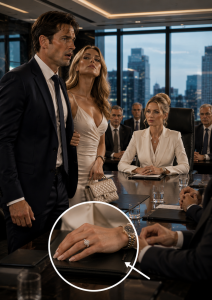
The boardroom was a cathedral of dark glass and colder ambition. Four board members in severe suits watched Anthony and Clara enter with a single flicker of unified appraisal.
“Mr. Vance,” said one — Mason Thorne. “And your assistant?”
“Clara Decker. My EA. Fully briefed on the merger,” Anthony said smoothly, though Clara barely knew the difference between a stock option and a stockpot.
“We’re waiting on our CEO,” said a woman at the far end.
Anthony felt a bead of sweat trace his spine. Everything he’d built — everything he’d lied for — funneled into this room.
The main doors hissed open.
“Apologies for the delay,” Mason said, rising with the rest of the board. “Please welcome our President and Chief Executive Officer.”
A woman walked in wearing a custom teal suit that radiated authority he’d never once associated with anything in his own house. Her hair, which he’d last seen twisted into a careless ponytail over breakfast, was cut into a severe, gleaming bob. Sharp architectural glasses framed a face he knew — and didn’t, not like this.
Clara looked up from her tablet, her voice a thin thread of confusion. “Anthony. Who is that?”
The woman set her satchel down at the head of the table and looked directly at him. Her eyes weren’t the soft, forgiving eyes from the breakfast table. They were the eyes of something that had just cornered its prey.
“Good morning, gentlemen.” Her gaze slid to Anthony, then to Clara. “An unexpected pleasure.”
His mouth filled with sand. “It’s — it’s —”
“I believe you were expecting a Mr. Reed,” she said, a thin smile with no warmth in it at all. “He was my father. I am Eliza Reed. And this is my company.”
The silence that followed was so absolute Anthony could hear his own heartbeat hammering against his ribs.
—
## PART 2
The name came out of him like something torn loose. “Eliza?”
She didn’t blink. “Please, Mr. Vance. Sit. And your assistant.” She gestured to the chairs like a woman seating guests at a dinner party she had no intention of enjoying.
Anthony fell into the chair. Clara sat too, stiff as a mannequin.
“Let’s begin your presentation,” Eliza said, folding her hands. “You claim Vance Cortex’s primary asset — the Vance Quantum encryption algorithm — is your own design.”
“It is,” Anthony managed. “I built it ten years ago. It’s the foundation of my company.”
“Is it?” Eliza tapped her tablet. The wall screen lit up behind her — lines of code, side by side. “This is Project Daedalus. Authored by Dr. Jonathan Reed. My father. Dated twelve years ago.”
The two blocks of code were nearly identical. Renamed variables. A few cosmetic changes to mask the signature. Nothing more.
“You were always lazy, Anthony,” Eliza said, and there was something almost gentle in the way she said it — the gentleness of a verdict already decided.
Clara made a small, strangled sound. “This — this is a fabrication —” Anthony started, his voice rising into something desperate.
“Sabotage?” Eliza actually laughed — short, humorless. “Mr. Vance. I own you.” She rose and began to pace behind her chair, her voice carrying to every corner of the room. “For ten years I have lived as your quiet gardening wife. For ten years I’ve watched you spend money made from my father’s stolen genius. I’ve watched you belittle me. I’ve watched you flaunt your indiscretions.” Her eyes flicked, briefly, to Clara. “And the entire time, the Reed Foundation wasn’t planting petunias. It was an incubator. We built Reed Innovations for one purpose.”
She stopped directly behind his chair. Anthony didn’t dare turn around.
“To become big enough,” she whispered, close to his ear, “that one day we could buy your stolen little empire — just to tear it apart, piece by piece.”
She returned to her seat and said, without raising her voice at all, that Vance Cortex would be served with an injunction within the hour, and a lawsuit for the company’s entire valuation. Nearly three billion dollars.
The elevator ride down was a silent scream. Clara’s mascara had already begun tracing thin black lines down her face by the time the doors opened onto the lobby.
“You destroyed me,” she hissed. “That woman just destroyed both of us — do you understand what this does to me? I’m tied to you!”
She was right. And Anthony, standing in the marble lobby of a building he no longer belonged in, realized he hadn’t even thought of her at all.
His phone was already buzzing. His lawyer’s office — disconnected. His COO — unreachable. Something in his chest turned to ice.
Eliza hadn’t been bluffing about the timeline.
And when he finally burst through the doors of his own penthouse, expecting to beg, to rage, to fight for something — he found it empty. Not just empty of Eliza.
Empty of everything. His closets bare. His office stripped. The safe behind the painting standing open, hollow, waiting.
On the marble kitchen island sat a single white envelope. His name written across it in her neat, precise hand.
He tore it open with shaking fingers — and the first line alone told him this was only the beginning.
—
## PART 3
*Anthony, I assume your meeting did not go as planned.*
The letter’s opening line sat on the marble counter like a held breath. Anthony read it standing in the empty living room, his coat still on, his hands shaking so hard the paper rattled.
*By the time you read this, the injunction will be public, and your board will have been notified of your gross misconduct and foundational fraud. You’re probably wondering where your things are. They’re in a storage unit in Gary, Indiana. The key is at the bottom of this envelope. I imagine it suits your future prospects better than this penthouse ever did.*
*You must be out by five o’clock today. At 5:01, the locks change and you will be arrested for trespassing.*
*You made a critical error in judgment, Anthony — many, actually, but this one is my favorite. You always assumed this apartment was yours. You signed the checks. You never read the incorporation documents. The Sterling Tower penthouse is not owned by you, or by Vance Cortex. It’s owned by the Chicago Community Development Fund — a subsidiary of the Reed Foundation.*
*You’ve been paying rent to my company for ten years. The car is mine. The art is mine. The chair you’re probably leaning on right now is mine.*
*This isn’t a divorce, Anthony. This is an eviction.*
His legs gave out. He slid down the cabinet, the letter fluttering from numb fingers, and stared at the clock. 3:42 p.m. He had a little over an hour to pack a life that, it turned out, had never belonged to him at all.
The sheer, patient brilliance of it was suffocating. She hadn’t just built a rival company. She had quietly bought the ground beneath his feet, years before he’d ever noticed her watching.
To understand the scope of what Eliza Reed had done, you had to understand her father.
Dr. Jonathan Reed had been a gentle kind of genius — a computer science professor at the University of Chicago who saw code as poetry, not currency. His star student, Anthony Vance, saw it as a weapon. Charismatic, ambitious, quick, Anthony had latched onto the older man like a surrogate son and, through him, met Eliza — twenty-two, freshly graduated, grieving her mother, and certain Anthony worshipped her father exactly as much as she did. They married within the year. Six months later, Dr. Reed died of a sudden, massive coronary.
Anthony had been a pillar through the funeral, the estate, her grief. *It’s all just notes, kitten,* he’d told her, boxing up her father’s hard drives and journals. *Academic stuff. I’ll make sure it’s archived properly.*
Drowning in grief, she’d simply nodded.
The first crack appeared two years later, when Anthony — a mid-level consultant until then — suddenly launched Vance Cortex on the back of a single revolutionary product: the Vance Quantum algorithm. It made them millionaires almost overnight. Eliza had been proud. But *quantum* was a word her father used constantly, and a small, cold seed of doubt had lodged itself somewhere she couldn’t yet name.
The seed grew during a business trip Anthony took to Tokyo — a trip she’d later learn was with his first mistress. Alone, Eliza searched the university’s digital archive for her father’s work. His published papers were all there. His personal projects — the ones he’d been working on before he died — were missing, checked out under Anthony’s name two years earlier and never returned.
She tore their house apart that night. Behind a case of wine in the cellar, in a locked file cabinet Anthony had told her held old tax returns, she found a crowbar’s worth of the truth: her father’s original journals and hard drives.
She spent the next seventy-two hours in the study, cross-referencing her father’s handwritten notes against the Vance Quantum source code. It wasn’t theft. It was grave robbing.
But it was her father’s journal that turned her blood to something closer to acid. The last six months of entries weren’t about code. They were about Anthony — his growing pressure to sign over patent rights, an argument about “protection,” a mention of new blood pressure medication Anthony had picked up for him, *so thoughtful*. Chest pains. Dizziness. *He said it was normal for the dosage. He’s so helpful.*
Eliza had dropped the journal on the floor. He hadn’t just stolen from her father. He had pressured him, stressed him — possibly worse. She would spend years chasing an answer to that question, and never quite catch it. But the theft, she could prove. And the theft, in the end, would be enough.
That night, in every sense that mattered, Eliza Reed died. And a different Eliza Reed — the CEO — was born.
She didn’t confront him. She copied the drives and put the originals back exactly where she found them. She used her inheritance — money Anthony found beneath his notice — to open a small foundation as cover, then quietly began building the real thing behind it: funding the researchers her father had respected, operating under her maiden name through shell corporations, never once letting her photograph be taken. She hosted his dinners. She smiled at his jokes. She endured a rotating cast of his assistants, each younger and brasher than the last, because she understood something Anthony never had — that revenge wasn’t a fire. It was a glacier. Slow. Inevitable. Capable of grinding mountains to dust.
Reed Innovations was that glacier. And on the day of the merger meeting, it had finally reached the sea.
—
Anthony ended up at a two-star motel near O’Hare — the only place that would take his maxed-out card. The storage unit in Gary held garbage bags of clothes and nothing else. It took two days of panic before he found a lawyer willing to see him: not Ben Glass, long since unreachable, but Mitch Wallace, whose office smelled of stale coffee and whose highway billboard promised *In a wreck, get a check.*
Mitch read through the fifty-page injunction with visibly sinking color. “This accuses you of stealing the IP that is your company,” he said slowly. “It names Clara Decker as a co-conspirator in an embezzlement scheme — a million-two funneled to her through a shell contract.”
“Consulting fees,” Anthony snapped.
“She’s twenty-four with a liberal arts degree, Anthony. The feds are going to love this.” Mitch set the papers down. “And that’s not even the big problem. You’re not just being sued by your wife. You’re being sued by your own board. They voted, unanimously, to remove you as CEO. You exposed the entire company to criminal liability. You’re radioactive.”
There was nothing left to negotiate from strength. There was only mercy to beg for.
The settlement meeting took place a week later in a gray, neutral mediation office. Eliza arrived flanked by two attorneys and Eleanor Hayes — the most feared corporate litigator in the state, a woman who looked, Mitch would say later, like she ate lawsuits for breakfast.
“My client is here as a courtesy,” Eleanor said. “Let’s be clear about your position. You have none.”
Mitch tried anyway — a clean divorce, Anthony walks from Vance Cortex, Eliza drops the fraud charges. Eleanor’s smile in response was the most frightening thing in the room.
“Let’s review the breaks,” she said, and opened a folder. The IP theft — the original drives, the journals, a signed affidavit from Anthony’s former COO, David Smith, confirming Anthony had once bragged that *the old man practically gifted me the code before he croaked.* Wire fraud. Mail fraud. Twenty to thirty years. The embezzlement — Clara, in exchange for immunity, had given a full deposition: every text, every email. Another ten years. And the company itself: the board had already agreed to a full buyout to avoid total insolvency. Vance Cortex, as of that morning, no longer existed.
“There’s nothing to walk away from,” Eleanor said simply.
Anthony finally looked at his wife. “Eliza. Please. After all the years. Don’t send me to prison. I’m sorry I cheated. I’m sorry I was an ass. But prison —”
“I’m not interested in the cheating,” Eliza said quietly. “That’s a symptom. I’m interested in the disease. The disease that let you steal my father’s life’s work and build a monument to yourself on his grave. The disease that let you call me a kitten while I built an empire underneath you.” She stood. “But prison isn’t the point. My father wasn’t vindictive. He was a builder. Prison creates a martyr, and I have no interest in making you one. I’m interested in making you irrelevant.”
The document Eleanor slid across the table asked for everything: a full confession held in trust, surrender of his passport, a lifetime non-disclosure agreement, and a permanent injunction barring him from tech, finance, or security work anywhere in the world, for life. Nothing in it would ever be undone. It would follow him to the end of his life, whatever shape that life took.
“That’s a professional death sentence,” Mitch breathed.
“That’s the point,” Eliza said. “You don’t go to prison. You cease to exist. You’ll live the rest of your life as a nobody — the man you always were, without my father’s genius to hide behind.”
Anthony picked up the pen with a shaking hand and signed away the name that had once sat atop skyscrapers.
—
The months that followed became a series of descending circles. The severance — fifty thousand dollars, “just enough to ensure you couldn’t claim destitution,” as Eleanor had put it — bought him a one-bedroom in Joliet that smelled of boiled cabbage and damp carpet. The tech world was smaller than he’d ever realized; word traveled that Vance was untouchable, a fraud, and he couldn’t get an interview for a job stocking shelves. He ended up dispatching cars for a third-rate service, working nights under the name Art V., routing drunk pickups from a fifteen-inch monitor in a windowless trailer.
One night near 3 a.m., a call came through for a pickup two blocks from Sterling Tower. A flicker of bitter nostalgia made him route it to himself.
The woman waiting at the curb was Clara — mousy brown hair where the blonde used to be, a plain black dress, holding her shoes to rub her feet. She got in without looking at him.
“O’Hare, please. And step on it.”
“Rough night?” he asked, and something in his own voice sounded like gravel.
She looked up. Recognition didn’t bring the explosion he expected — just a long, exhausted sigh. “Anthony. My God. Look at you.”
“Look at you,” he said back, bitterness rising anyway.
“With what money?” she laughed, dry and hollow. “Immunity meant I didn’t get charged. It didn’t mean I kept the consulting fees. I’m a hostess now. At the restaurant I used to own a piece of. People who don’t even see me. Going back to Ohio. My sister’s couch.”
They drove in silence for a while, the tires humming beneath them.
“She won so completely,” Clara said finally, more to the window than to him. “She didn’t just take the money. She took our names. She made us unpeople.”
“She was always smarter than us,” Anthony admitted — the first time he’d said it out loud.
“No,” Clara said, shaking her head. “It wasn’t about smart. It was about patience. We were sprinters. She was a marathon runner. She was playing for legacy.”
At the departures curb, she pulled a crumpled twenty from her purse and tossed it onto the seat. “Take it, Art. You’ll need it more than I will where I’m going.” She picked up her single worn suitcase, and for a moment, at the sliding doors, she looked back — not at him, but at the skyline behind him, like she was saying goodbye to something bigger than either of them. Then she was gone.
He took the twenty. He needed the gas.
—
Fourteen months in, the man who’d once commanded boardrooms was gone, replaced by a hollow-eyed dispatcher who looked sixty at forty-five. His anger, which had burned for the first six months, had cooled into something dense and inert. He no longer dreamed of revenge. He barely dreamed at all.
The letter that changed everything arrived on a gray Tuesday — certified, heavy stock, the kind that used to mean an acquisition and now meant only trouble.
It was from the University of Chicago Medical Center. *Miss Eliza Reed has requested your presence. The matter is urgent.*
The jolt that went through him wasn’t fear, exactly. It was recognition. The game he’d thought was long over had one more move.
He lied to his supervisor for the first time in fourteen months — *family emergency* — and drove into a skyline he no longer recognized as his own, into the same hospital where Dr. Jonathan Reed had died years before. The irony sat in his chest like a stone.
At the information desk, a nurse asked if he was family.
“No,” he said, the word tasting like ash. “I’m Anthony.”
“Oncology wing. Seventh floor. Room 712.”
*Cancer* hit him harder than any lawsuit had. He thought, absurdly, of the tired way she’d pressed her fingers to her temple that last morning at the breakfast table, the pill bottle she’d slipped back into her purse before he could ask. He’d never asked. He’d never once asked her anything.
The room was large and private, with a view of the city he’d lost. None of it mattered next to the bed. The woman in it wasn’t the CEO in the teal suit, or the wife in the beige cardigan. She was a small, pale shape swallowed by white linens, her sharp bob gone, replaced by soft fuzz, an IV line disappearing into a bruised arm. But when she turned her head, her eyes were exactly the same. The eyes of the architect.
“Anthony,” she whispered. “You came.”
He sat in the hard plastic chair, a universe away from her. “The letter said it was urgent.”
“It is. Ovarian cancer. Stage four.” Her voice was flat, like she was reading a financial report. “I’ve had it longer than you’d think. Longer than that morning in the boardroom, if you want to know.”
“I’m sorry,” he said — and to his own sick astonishment, he meant it.
“Don’t be. I spent a decade building an empire to bring you down, and I did. That part’s finished. Mason Thorne runs Reed Innovations now. My father’s name is on three new patents. It will outlive me.” Her eyes found his. “It will certainly outlive you.”
“So why am I here? To watch me watch you die?”
“No.” She reached, with visible effort, for a small black recorder on the nightstand. “This is the last piece. My deposition. Clara’s testimony. David Smith’s affidavit, under oath, about what he says you told him about your father. Everything that could still put you in a federal courtroom, on top of what you already signed. My lawyers have instructions to release it the moment I die, if I don’t tell them otherwise first.”
His mouth went dry. “Eliza —”
“I’m not destroying it,” she said, before he could hope. “I called you here to tell you it exists, and that I’ve decided to let it stand. Not for you. For the record. For him.” Her gaze didn’t waver. “You’ll go on being Art V. No name, no money, no future in the only work you ever knew. That was always going to be your sentence, and it doesn’t end today. But if you ever try to be Anthony Vance again — if you ever try to build anything on his name, or mine — this stops being insurance. It becomes evidence. Do you understand me?”
“I understand,” he said, and something in his chest that had been braced for a full year finally, quietly, gave way — not to relief, but to the plain, permanent weight of it.
“Then we’re finished,” she said. “That’s all I wanted to say. Go home, Anthony. Whatever that means for you now.”
He stood. He didn’t ask forgiveness, and she didn’t offer it. There was nothing left to negotiate, nothing left to confess. He looked once at the woman who had built his ruin with the same patience her father had once poured into a line of code, and he understood, finally and completely, that she had never once needed him to understand it.
He walked out without saying goodbye. His shoes squeaked down a hallway that seemed too long. In the elevator, his reflection in the steel doors was still a stranger’s face. He pushed through the main doors into a cold, bright afternoon, and stood there while the city moved around him, loud and indifferent.
His phone buzzed in his coat pocket. A text from his supervisor: *Gary, where are you? Shift started 10 minutes ago.*
He looked at the message. He looked up at the skyline that used to be his.
Then he turned his collar up against the wind and started walking toward the bus stop. He had a shift to get to, and, for the first time in fourteen months, nothing left to fear from the past — only the long, flat, unglamorous work of living inside what remained.
Behind him, on the seventh floor of a hospital that had once taken her father, Eliza Reed closed her eyes and let the recorder sit, untouched, on the nightstand — the last piece of a ledger she had finally, entirely, closed.
**THE END**