He Married a Mail-Order Bride Without Hope — Then She Turned His Broken Ranch Into a Loving Home

—
## PART 1
The stagecoach was three hours late, and Silas Cade told himself he did not care.
He stood outside the small station at Copper Creek, his back against a weathered post, watching the empty road cut through the Montana valley like a scar. October wind carried the sharp promise of winter ahead of itself. He had lived on his mountain twelve years. He had survived storms that tore roofs off barns and cold that cracked bone straight through. A woman stepping off a coach would not change any of that. That was what he told himself, standing there with a lawyer’s letter folded inside his coat pocket next to a photograph worn soft at the edges — a letter that used words like *right of way* and *proving up* and had put a deadline on everything he’d built.
It wasn’t the first warning. Three weeks back he’d found a length of surveyor’s ribbon tied to a fence post half a mile below the cabin, orange and new against the gray wood, and a stake driven into frozen ground where no stake had any business being. He’d pulled both up and burned them in the stove that night, and told himself it meant nothing. Men scouted land all the time that never came to anything.
Inside the station, men laughed over tobacco and cards. Silas stayed outside with the wind.
Dust rose on the horizon. The groan of wheels reached him before the shape of the coach did. He straightened but didn’t step forward, his fingers tightening once around the photograph in his pocket before he let it go.
The door opened. A woman climbed down carrying one battered case, mud darkening the hem of her dress from the long journey, her hat plain, her coat simple wool. Smaller than he’d pictured from her letters. Not fragile. Just quiet. Her eyes found him at once and held there. Neither of them smiled.
The circuit preacher was waiting inside, as arranged by wire three weeks prior — a formality Silas had insisted on before either of them left Copper Creek, because a man could not contest a land claim on behalf of a woman who was, on paper, a stranger to him. It took four minutes. Clara signed her name — *Clara Boyd*, and then, in the same steady hand, *Clara Cade* — and Silas signed his, and the preacher stamped the county register, and that was the whole of it. No kiss. No crowd. Just two people making a fact true that neither of them yet felt.
“You understand what this is,” Silas said afterward, outside the station, before he’d lifted her case.
“A business,” Clara said. “You said as much in your letter.”
“There’s a railroad man been writing me. Wants my land for a spur line. Says a man alone with no filed heir, still working toward final proof on his claim after this many years, is easy to argue against in a land office.” He looked at her directly for the first time since she’d stepped off the coach. “Married, with a wife on the property corroborating continuous residence, I’m a good deal harder to argue with.”
“And that’s the whole of what you’re offering.”
“That’s the whole of it,” he said, and something in his voice made it clear he believed that was a kindness, telling her plainly rather than dressing it up. “I should tell you plain — I never filed my final proof. Homestead law gives a man five years to prove up a claim with continuous residence and improvement before it’s his outright. I let mine run past ten without doing the paperwork, because there wasn’t anybody in this territory checking close on a man nobody wrote letters to. That’s changed.”
“And a wife makes the paperwork easier.”
“A wife makes it so I’ve got a witness under oath who isn’t me, saying I’ve lived and worked this ground every year I claimed to. That’s what proving up wants. A man alone has to take his own word for it.”
“Good,” Clara said. “I didn’t come out here for romance. I spent five years copying land deeds and filing homestead papers in a law office in Hamilton County before I answered your advertisement. I understand exactly what you’re describing.”
Something in Silas’s face shifted at that, though he didn’t remark on it — only nodded once, the way he’d come to nod at things worth remembering.
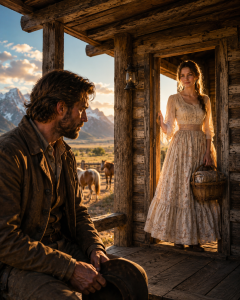
Two hours later they were riding the narrow trail up toward his cabin, Clara seated behind him, careful not to touch him, the wind carrying pine and the smell of coming snow. He didn’t speak again the whole climb. The cabin came into view as the sun dropped behind the ridge — weathered logs, one window catching the last orange light, smoke stains climbing the chimney, no curtains, no garden, nothing soft anywhere a person looked.
Silas swung down, tied the horse, lifted her case, and walked inside without looking back. The door scraped across the floor as she followed.
One room. A cast-iron stove in the corner. A table with two chairs. Shelves lined with tins and jars arranged with a precision that had nothing to do with taste and everything to do with a man who needed to know exactly where everything stood.
“Your room’s through there,” he said, pointing at a narrow door. “I sleep in the loft.”
She nodded once.
“You handle the cooking in the house,” he went on. “I handle everything outside.”
He crouched at the stove and fed kindling into its cold belly. The fire caught slow. Light crept up the walls. Clara opened her valise and drew out a folded piece of white linen embroidered with small yellow daisies, the edges worn thin from years of washing, and spread it across the rough pine table without a word.
Silas stood. His eyes moved to the cloth. A muscle tightened in his jaw, then eased. He said nothing.
Supper was beans and hard bread, eaten across a table with that tablecloth lying between them like a question neither one of them knew how to ask yet. When he finished, he rinsed his plate in the bucket and climbed the ladder to the loft without another word.
Clara sat alone by the fire and, later, wrote a letter by lamplight, her handwriting even and unhurried — a legal clerk’s hand, though Silas didn’t yet have the word for what he was watching from the gap in the loft floorboards. He filed the thought away and said nothing about it either.
Two weeks passed in a rhythm that needed no explaining. Clara rose before dawn when frost feathered the inside of the window glass, built the fire, ground the coffee, wrapped her shawl tight. By the time Silas came down from the loft the cabin was warm. He never thanked her. He never once left without drinking a full cup. She learned his habits without asking — the left peg for his coat, the way he checked the door latch twice each night, the way he never began eating until she’d sat down, even with his own plate already full.
The quiet that filled the cabin wasn’t cruel. It was careful. And then, on one of the days Silas rode the fence line, he found a second stake driven into the ground, closer to the cabin than the first, a fresh survey flag snapping in the wind above it. He pulled it and said nothing to Clara that evening, but she noticed the set of his jaw at supper and filed it away the way she’d learned to file the rest of what he didn’t say.
The first snow came early that same week.
By afternoon the world outside had gone white. By evening the wind was screaming against the walls. Silas had left at dawn to check the fence line and hadn’t come back. Clara kept the fire burning, reheated water, ground fresh coffee, waited. The clock ticked past six. Past seven.
The door burst open at last in a gust of snow, and Silas stumbled through it, shoulders white, beard crusted with ice — and Clara saw it immediately, the slight hitch in his step, the way his right shoulder rode lower than the left. Hurting. She poured hot coffee into a tin cup and held it out. Their fingers brushed at the handoff. Both went still.
“You didn’t have to wait up,” he said.
“I wasn’t waiting,” she said, steady as stone. “Just not sleepy.”
He drank long and slow, letting the heat sink in. “Coffee’s good.”
“It’s been on the stove a while.”
“I know.” For the first time since the station, he looked at her — truly looked — and something in his eyes cracked, thin as ice before it breaks.
Outside, the storm kept raging. Inside, the fire burned warm. And between them, in the quiet, something shifted that neither of them was ready to name.
—
## PART 2
The storm didn’t end that night. It howled against the cabin until the windows rattled and the roof groaned under the weight of new snow. Silas lay awake in the loft, staring into the dark, replaying a look he hadn’t meant to give and a crack in his chest he hadn’t meant to feel.
Before dawn he climbed down anyway, his leg protesting, and struggled one-handed with the coffee pot until the pain in his shoulder flared sharp.
“I can do that,” Clara said from the doorway. “I’ve got it.”
“You don’t.”
She crossed the room and took the pot from him. He let her. That was the first thing that changed — he let her.
“There’s liniment in my case,” she said, setting his cup down. “Camphor and coal oil. Helps with stiffness.”
“I’m fine.”
“I know.”
That evening, the bottle sat half empty on the table when he came in from the woodshed. He said nothing about it. Neither did she.
Days slipped into weeks. Snow deepened until the world shrank to white silence and the small circle of warmth inside the cabin. Clara carried water, split kindling, learned the slope of the land, and Silas watched her move through his space like she’d always belonged in it, whether he meant to notice or not. One afternoon she restacked the wood pile while he was out — heavy logs at chest height, kindling near the door, order where there’d only ever been habit.
“You moved the wood,” he said that night.
“It was a mess.”
“It was fine.”
“Now it’s better,” she said, and he studied her a long moment before he nodded, once.
Later that week the wobble in her chair disappeared. She ran her fingers under the seat and found fresh-cut wood fitted clean beneath the leg.
“Chair’s fixed,” he said. “It was crooked.”
“It was fine.”
“Now it’s better,” she said back to him, and something close to a smile pulled at the corner of his mouth before he could stop it.
The first real fracture came three days before Christmas. Clara was sweeping near the ladder when the broom caught on something wedged against the wall — a small pine box, dark with age. She should have left it where it sat. She opened it instead.
Inside: a photograph in a cracked brass frame, a young woman with serious eyes and a gold ring, and a letter folded so many times the creases had gone soft as cloth.
She closed the lid and pushed the box back into the shadows, and said nothing about it that night.
But Silas felt it anyway. He moved differently at supper, kept his eyes on his plate, climbed to the loft while the fire still burned high instead of banking it down first the way he always did. A door had shut somewhere inside him, and Clara watched it happen without knowing yet what she’d opened.
On the third night, the silence finally broke. They sat across from each other with the fire throwing red light up the walls, and Silas was sharpening his knife, the scrape of it filling the room — until it stopped.
“Her name was Eliza,” he said.
—
## PART 3
Clara did not look up from her mending, giving him room to keep going or stop, whichever he needed.
“February of ’70,” Silas said. “Bad winter — worse than this one’s shaping up to be. She took sick. I rode down for medicine and a storm came in three days before I made it back.” The knife slipped from his fingers and hit the floor, and he let it lie there. “When I got here,” he said, voice gone rough, “she was already gone.”
The fire popped. Wind pressed at the glass.
“Twelve years,” he said. “Figured if I didn’t let anyone in, I couldn’t lose anyone again. Never filed the final proof on this place either, if you want the truth of it. Man doesn’t finish claiming land he’s half hoping will finish him first.”
Clara set her mending aside. “My husband didn’t hit me,” she said quietly. “Didn’t yell. Didn’t drink. He just didn’t see me. Five years in that house and I might as well have been a ghost living in the walls.” She looked up and met his eyes across the fire. “When he died, I felt nothing. That scared me worse than grief ever could have.” Her voice steadied itself the way it had the first day, ground she could stand on. “That’s why I answered your advertisement. I wanted to feel like a person again.”
Silas stared at her through the flames. “I see you,” he said.
The words hung there, plain and unpracticed. “The way you move the wood so I don’t have to strain reaching. The way you heat the coffee three times over so it’s never gone cold when I come in. I see you, Clara.”
Her breath caught. She didn’t answer right away — and something in his face closed again while he waited, the old habit reasserting itself faster than the new one could hold it back.
“You said that the way a man says thank you to a hired hand,” she said finally, quieter than she meant to. “I didn’t come two thousand miles to be seen the way you see a well-stacked wood pile, Silas.”
“That’s not—”
“Isn’t it, though?” She stood, gathering her mending. “Everything you’ve told me about wanting me here has been about proving up a claim. I understand the arrangement. I signed my name to it plain as you did. But don’t call it seeing me and mean *useful* underneath it.”
“I didn’t mean it that way.”
“I don’t know what way you meant it,” Clara said, “because you’ve told me exactly one true thing about yourself in six weeks, and you told it to the fire, not to me.” She went to her narrow room and shut the door, not hard, but final.
Silas sat a long while with the dropped knife still on the floor, and didn’t go after her, because some part of him agreed with what she’d said and didn’t yet know how to say so.
He was gone before dawn, out the door and up toward the fence line before she woke — not running from her, though it would take him weeks to be certain of that himself, but needing the cold and the work the way he’d needed it for twelve years whenever a thing got too large to hold still with.
He found the mare loose from the corral an hour out, spooked by something in the brush, picking her way along a shelf of snow above the same slope that had given him trouble twice already that winter. He knew that ground. He knew what a warm afternoon followed by a hard freeze did to snowpack sitting over loose shale, and he knew the mare didn’t. He went after her anyway, because she was his the same way the fence line was his, the same way — though he wouldn’t have said it in those words yet — Clara was becoming his, and he had already lost enough things by arriving a day too late to matter.
He caught her lead rope with one hand and hauled her off the unstable shelf with the other, and the ground went out from under both of them at once — the mare scrambling free, snorting, unhurt, and Silas going down with the collapsing shelf, rock and hard-pack snow carrying him thirty feet before it stopped. His right leg came to rest pinned between two boulders at an angle that would have made any man’s stomach turn to look at.
“Clara.” His voice came out cracked, though there was no one within a quarter mile to hear it yet.
She found him that way twenty minutes later, having gone looking the moment she noticed both his boots and the mare’s lead line missing from the peg — not because she’d forgiven the morning yet, but because the fear that ran through her at the empty hooks had answered a question she hadn’t let herself ask outright. She dropped to her knees beside him. His pulse was weak, his skin gone the color of the snow around him.
She braced her shoulder against the larger rock and pushed with everything she had. It didn’t move.
“Again,” he whispered.
They counted together. On three she shoved and he pulled, and a sound tore out of him as his leg came free, the rock settling back with a grinding thud that she felt in her own teeth. She dragged him through the snow — two hours through wind and rising light, her lungs burning, her arms shaking — and did not stop once, and did not say a single word about the fight from the night before, because there would be time for that later if there was going to be a later at all.
Inside, she rebuilt the fire and cut away his trouser leg. The bone sat wrong beneath swollen skin. She tore her own calico dress into strips and bound splints tight, gave him small drops of laudanum, and held him through the worst of it while he cursed and groaned and trembled under her hands.
“I went after the mare,” he got out at one point, teeth chattering through the pain, “because I couldn’t stand losing one more thing I hadn’t said the truth about first.”
“Don’t talk,” Clara said, but she didn’t let go of his hand either.
The weeks that followed stripped him down to something plainer than pride. He could not stand. Could barely sit without the color draining out of his face. Clara did what needed doing — water, food, wood, bandages — and he snapped at her the first few days out of a shame he didn’t have another way to spend.
“I can do it myself.”
“You can’t.”
“Leave me be.”
“No.”
She never argued past that single word. She just kept coming back, and somewhere in the second week, without either of them marking the exact hour it happened, the fight from before the accident quietly finished itself — not with an apology exactly, but with him saying, one evening while she changed the dressing on his leg, “You were right. About what I said by the fire,” and her answering, “I know,” in the same plain tone she used for everything true, and both of them letting it lie there, settled, the way the rock had settled back into the mountain.
By the third week he’d started saying thank you, quiet and unpracticed, like a language he was only now learning to speak. One night she fell asleep in the chair beside his bed, her hand wrapped around his. When he woke before dawn she was still there, and he lay watching her breathe in the firelight and understood, for the first time in twelve years, that the thought of being alone again frightened him more than any storm ever had. He didn’t let go of her hand.
Eight weeks after the accident, Silas could stand with the help of a cane he’d carved himself in the long hours he couldn’t do much else. Walking was slow and cost him plainly, but he refused to stay in bed. Clara watched him from the stove one late-February afternoon as he practiced crossing the room, each step visibly costing him, his jaw tight but his feet moving.
That was when they heard the horses. More than the two they’d half expected all winter, hooves muffled by snow but steady, deliberate, unhurried in a way that told its own story before anyone spoke a word.
Clara’s hand froze around the wooden spoon. Silas turned toward the door, instinct sharp despite the weakness still living in his leg.
“Get the rifle,” he said quietly.
She moved without hesitation, lifted the Winchester down from above the door, and placed it in his hands. His grip trembled, and he braced the stock against his thigh to steady it as three riders came out of the treeline. The man in front wore a bowler hat and a coat too fine for mountain wear, a gold watch chain glinting at his vest. The two behind him hung back — one broad-shouldered and unreadable, the other younger, rangy, his eyes going to the ground more than to the cabin, a man who looked like he’d rather be anywhere else.
“Mr. Cade.” Crane swung down from his horse with the ease of someone used to being obeyed. “Horan Crane. Northern Pacific Railroad. Believe you’ve had my letters.”
“Burned every one,” Silas said.
Crane smiled thin. “Then you’ll want to hear this part fresh. The territorial government’s authorized acquisition of rights of way for the new spur, and your land sits square in the corridor. I’ve had our surveyors mark the line twice now since October.” He glanced, deliberate, toward the fence line where Silas had pulled two flags over the winter. “Someone’s been interfering with federal survey markers. That’s its own trouble, separate from the land question.”
“Wasn’t federal,” Silas said. “Wasn’t marked as such either.”
“It will be, once the filing’s confirmed.” Crane unfolded a document sealed in dark wax. “According to Northern Pacific’s records, Mr. Cade, your original claim was never carried to final proof. Ten years past the statutory five, with no continuous-residence affidavit on file and no heir of record. A homestead left unperfected that long reverts to public domain on petition, and the railroad’s petitioned.”
Silas tried to step forward. His bad leg buckled under him, the rifle slipping from his grip and clattering to the porch boards. He went down hard onto his knees, then his hands, pain shooting through the still-mending bone — and worse than the pain was knowing Crane was watching it happen.
“Perhaps,” Crane said, soft as a knife, “you should sit down.”
Before Silas could force himself upright, Clara stepped out onto the porch.
“My husband will stand when he’s ready,” she said, calm as still water.
Crane blinked. “Your husband?”
“Silas Cade. We were married in the Copper Creek circuit court, October the fourteenth, witnessed by Reverend Wills and recorded the same afternoon.” She met his eyes without flinching. “A married homesteader proving continuous residence has his wife’s sworn corroboration standing alongside his own. That closes the exact gap your petition is built on, Mr. Crane — the part where a man alone has only his own word.”
The younger hired man’s eyes came up off the ground for the first time, flicking toward Crane, then away again.
“That will need verification,” Crane said, recovering fast.
“It will get it,” Clara agreed. “May I see the document?”
Crane hesitated a half second too long before handing it over — a professional slip, small, but Silas, watching from the porch boards where he still knelt, caught it the way he caught every small thing on this mountain that didn’t sit quite right.
Clara studied the page a long moment, then handed it back without comment beyond, “We’ll see you in Helena, Mr. Crane. I trust the district court still hears land-office matters on the second Tuesday.”
Crane’s jaw tightened at being read so plainly, but he only remounted. “We’ll return with proper authority.”
“Do,” Clara said. “We’ll be ready.”
As the three of them turned to ride, the younger hired man’s horse sidestepped near the porch, close enough that only Silas heard him mutter, not quite to himself, “Wish I’d never taken this work,” before Crane snapped his name — *Garvey* — sharp enough to carry, and the young man fell back into line without another word.
Silas filed that away the same careful way Clara had been filing things all winter.
—
They rode into town two days later, Silas’s leg bound tight under his trousers, his jaw set the whole way down the trail. Before the courthouse, Clara stopped at the land recorder’s office and spent an hour with the clerk going through original filings while Silas, on his cane, went the other direction — down to the livery, where he’d once helped a rangy, half-grown boy named Tom Garvey pull a colt through a bad breech birth the winter after Eliza died, back when Silas still let himself do small kindnesses for neighbors he never called friends. He found the boy’s father instead, older now, working a forge alone.
“Tom’s boy’s mixed up with the railroad crew,” the elder Garvey said, not meeting Silas’s eye. “Took the pay ’cause we’re behind on our own claim taxes. Crane’s been buying up debt on three families along the creek, quiet-like, then offering their sons work stamping paper nobody explains too close. Tom don’t like it. Told me so himself. Don’t see what choice he’s got, though, with what we owe.”
Silas thanked him and said nothing more, but he carried that the whole walk back to the courthouse, and he was the one who told Clara, not the other way around, that whatever waited on the witness stand from Tom Garvey would come from a boy backed into a corner by debt, not a man volunteering conscience for its own sake — which meant, Silas said, that somebody was going to have to give him a corner to back out of instead.
The courtroom in Helena was crowded by the time Judge Brennan called the matter. Crane sat at a polished table flanked by two lawyers who looked, from the first exchange, considerably better prepared than a man arguing alone in the snow. Their opening argument was sharper than anything Crane himself had offered on the mountain — they cited the statute on unperfected claims chapter and verse, produced their own survey showing the spur’s most economical grade ran directly through Cade land, and called their own witness first: a company surveyor who testified, calm and credentialed, that no continuous-residence affidavit for the Cade claim existed anywhere in the Helena land office’s records, going back to the original filing.
“Because I never filed one,” Silas said when his turn came, before his own counsel could object to him volunteering it. “I’m not going to sit here and pretend otherwise. I let the paperwork lapse. That’s true and I own it.” He looked at the judge rather than at Crane’s table. “What isn’t true is that the land was abandoned or unimproved. I’ve got twelve years of it in my own hand to prove otherwise.”
He produced, from inside his coat, a battered ledger he’d kept without ever calling it evidence — fence repairs, a new roof in ’78, a well dug in ’75, a season’s timber cut and sold to the mill in Bozeman with the receipt still folded inside the back cover. Crane’s lead counsel came at it hard on cross, calling it self-serving, unwitnessed, exactly the kind of document a man invents after the fact when he sees a petition coming.
“Then ask the mill,” Silas said. “Ask them whose name is on that receipt and whose timber they bought. Ask the county whose taxes have been paid every year since ’70, even the years I didn’t file the proof paper alongside them. A man doesn’t pay taxes on land he’s abandoned.”
That drew a murmur from the gallery, and the first real crack in Crane’s lawyers’ composure — but it wasn’t enough on its own, and everyone in the room could feel it wasn’t.
Clara took the stand next, and Crane’s counsel came at her harder than they had at Silas, plainly having decided she was the case’s real threat. They challenged her standing to testify to residence she’d only shared five months of. They challenged whether a proxy-arranged marriage conducted the same afternoon a stranger stepped off a stagecoach could carry the legal weight of genuine corroboration, or whether it was, as the lawyer put it, “a legal fiction assembled for the purpose of this very hearing.”
“It’s neither,” Clara said. “It’s a marriage recorded in this territory’s own courthouse, which your office had every opportunity to contest before filing your petition and chose not to, because you assumed a man alone on a mountain wouldn’t think to marry before you moved on him. That assumption was wrong. It doesn’t make the marriage a fiction. It makes your timing bad.”
The judge allowed it, over objection, and Clara went on to lay the disputed document from the mountain porch beside the county’s true filing — pointing not merely to the ink, though she noted that too, but to the recording number stamped in the corner, a sequence that belonged, by the district’s own ledger, to a parcel forty miles east that had been recorded the previous spring.
“Your document claims to be an original federal filing,” she said, “but it carries a recording number already assigned to another claim entirely. Either Northern Pacific’s filing clerk made an extraordinary coincidence of an error, or this was drawn up after the fact and stamped with a number chosen because no one expected a claimant’s wife to have spent five years cataloguing exactly this kind of ledger for a living.”
Crane’s lead counsel objected that the recording-number argument required the clerk who’d allegedly stamped it, not a self-taught witness reading numbers off a page. Judge Brennan, visibly less patient with the railroad’s table than he’d been an hour before, allowed that the objection had merit — and asked, pointedly, whether Northern Pacific cared to produce that clerk.
It was Crane, not his lawyers, who answered too fast. “The clerk’s no longer with the company.”
“Convenient,” the judge said, dry, and the gallery didn’t bother hiding its reaction this time.
That was the opening Silas had been waiting for. He rose, cane and all, and asked the court’s leave to call one further witness — not on the land question, he said, but on the matter of who had actually prepared the document in dispute. Tom Garvey was sitting in the back row, where Silas had made certain, through the boy’s father, that he’d be told the hearing was open to anyone who cared to attend.
Crane’s counsel objected that the man wasn’t on their witness list. The judge noted, evenly, that he wasn’t on Cade’s original list either, but that a court interested in getting to the truth of a forged filing had some latitude to hear from a man who might know something about it, and gestured Garvey forward.
The boy stood slow, plainly not having expected to be called, and looked once at Crane’s table before he spoke — long enough that Silas, watching, saw exactly what passed between them: not an appeal for help, but Crane’s stare going flat and cold, already writing the boy off rather than risking a word in his defense.
That was what did it, in the end. Not a stranger’s conscience arriving out of nowhere, but a boy watching the man who’d bought his family’s silence decide, in front of the whole room, that he wasn’t worth spending a single word to protect.
“My name’s Tom Garvey,” he said, voice shaking but carrying. “Mr. Crane’s company bought up debt on three families’ land along the creek this winter, mine included, and then hired the sons to do work nobody explained too close. I stamped that filing with a number Mr. Crane gave me off a list, using a seal I bought off a peddler passing through Bozeman. I didn’t know at the time exactly what it’d be used against. I know now. I’m not looking to hang for it, but I won’t sit in the back of this room and watch him let it land on me alone when he’s the one who wrote the number down.”
The courtroom erupted. Judge Brennan called for order twice before it settled, then turned a long, unhurried look on Crane’s table.
“I’m ordering an investigation into Northern Pacific’s Montana filings, effective today,” he said, “and suspending every pending railroad land petition in this district until it’s concluded. Mr. Garvey, you’ll speak with the district attorney regarding your own exposure here — I’d advise full cooperation, and I’d note for the record that a young man who volunteers testimony against his own interest tends to be looked on more kindly by a court than one who waits to be caught.” He looked back to Crane. “As for the Cade claim specifically — this court finds sufficient evidence of continuous residence and improvement, corroborated by sworn testimony, that the petition for reversion is denied outright, pending nothing further. Mr. Cade, I’d suggest you file your final proof paperwork properly this time, now that you’ve got a wife willing to stand up in a courtroom and do half the work of it for you.”
A ripple of laughter went through the gallery, the first easy sound of the whole proceeding. Silas didn’t laugh. He sat back down, hard, the cane clattering against the bench, and let out a breath that felt like it had been held since October.
Outside the courthouse, the cold air felt different going in than it had going out.
“You knew,” Silas said to Clara. “About the recording number. Before we ever walked in.”
“I suspected the number the moment I saw it didn’t match the format the Helena office uses for current filings,” she said. “I didn’t know for certain whose parcel it belonged to until the clerk pulled the ledger for me two days ago.” She glanced sideways at him. “You’re the one who found Garvey a reason to stand up, though. I wouldn’t have thought to go looking for the boy’s father.”
“Figured a man cornered by debt needed somewhere to go besides straight into a company’s pocket,” Silas said. “Twelve years alone teaches a fella to recognize when somebody else is doing the same thing he used to.”
They didn’t imagine, riding back, that it was entirely finished. Northern Pacific’s lawyers filed notice of appeal within the month, and a company man came through Copper Creek that same spring making quiet inquiries about buying up the Cade claim outright now that the fraud made the territorial papers and the railroad wanted the whole business behind it fast. Silas turned the offer down flat, twice, and the second time the man didn’t come back. The appeal itself dragged the better part of a year through the circuit court before a federal audit of Northern Pacific’s Montana filings — prompted, in no small part, by Judge Brennan’s original order — found enough irregularity elsewhere in the company’s paperwork that the spur got rerouted through the valley floor instead, sparing three other homesteads along the creek besides the Cades’ own. Horan Crane was let go from the company before summer, and nobody in Copper Creek troubled themselves overmuch about where he went after.
It wasn’t the kind of ending where the trouble simply stopped existing. It was the kind where two people had fought hard enough, together, that the trouble finally had somewhere else to be instead of on their mountain.
They rode back up as the last of that first winter finally loosened its grip. April came in with melting snow and the creek waking up loud beneath the ice. The cabin didn’t feel like a fortress anymore. It felt lived in — a second chair pulled up that hadn’t been there before, the daisy tablecloth left out on the table most days instead of folded away after supper, the ledger Silas had carried into court sitting open on a shelf now instead of hidden, because there was nothing left in it that needed keeping quiet.
One evening Silas asked her to sit with him on the porch. The sky burned pink and gold over the ridge, snow retreating to the highest peaks, the valley below showing its first hints of green.
“Twelve years,” he said quietly. “I told myself I was strong because I was alone.” He watched the light fade off the far ridge rather than look at her yet. “I was just scared. Scared of losing someone again, and scared enough of saying so plain that I near lost you over it before the mountain ever got the chance.”
He reached into his coat and drew out a small carved mountain bluebird, its wings delicate and smooth under her fingers when he set it in her palm.
“I don’t have a ring,” he said. “Buried the last one with her, and I won’t pretend otherwise to you, because you’ve never once asked me to.” He turned the bird over once in her hand before letting it go. “I’m not asking you to replace anyone, Clara. I’m asking you to stay — not on paper. For true, this time. Not because it’s useful. Because I see you, and I said that the first time meaning it more than I let you know.”
Clara looked at the bird, then at the man beside her, who had finally learned, the hard way and the slow way, that strength had never once meant being alone, and that being seen and being useful weren’t the same thing, even when they happened to overlap.
“I’ve been staying,” she said softly, “since the first night I kept the coffee warm. I was only ever waiting on you to say it wasn’t the coffee you meant.”
He let out a breath that felt like twelve years finally leaving his chest.
They sat there as the stars came out over the ridge. He didn’t kiss her. He didn’t make any promise bigger than the one already sitting between them. He simply held her hand, and the cabin at their backs stopped being only his — the tins arranged with careful precision, the fixed chair, the ledger no longer hidden, the tablecloth worn soft with two people’s washing now instead of one.
When she rose to go inside, she paused in the doorway.
“Tomorrow,” she said, “I’ll make the coffee.”
A small, unguarded smile touched his mouth. “I know,” he said.
**THE END**