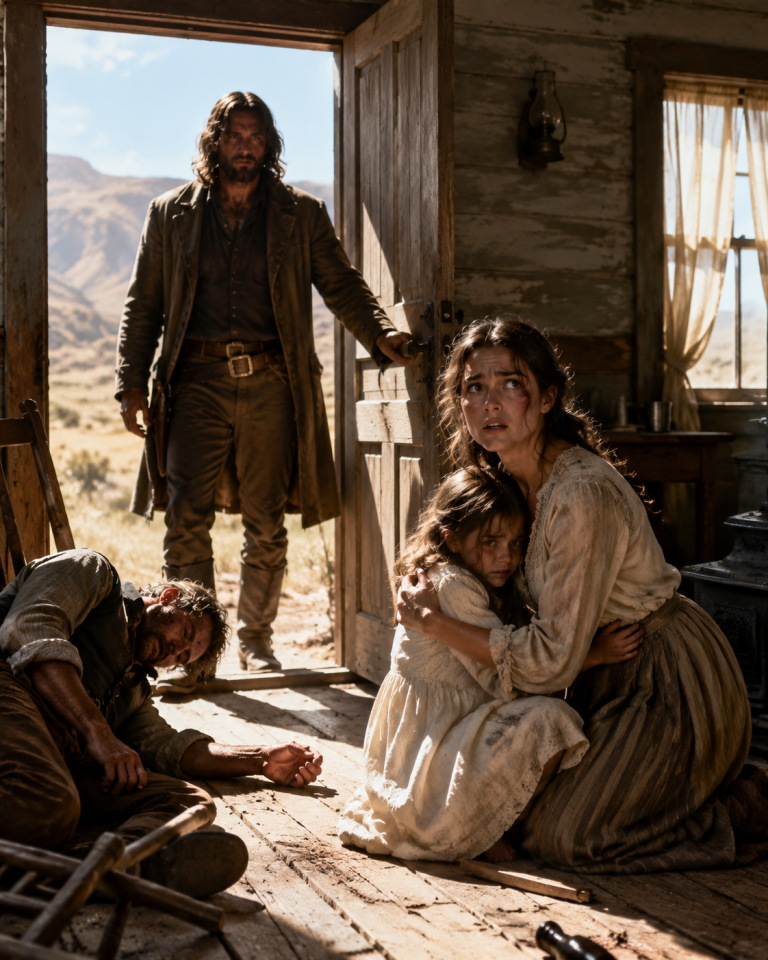
The night I cooked supper for his seven hungry children, I thought I had finally found a safe place—until I opened his desk and found six one-way train tickets… and realized the widowed cowboy had never planned for all of us to survive the week.

## PART 1
The first sound Ruth Calloway heard when the wagon rolled through the gate of Harrow Creek Ranch was not a welcome.
It was a gunshot.
The team lurched sideways and the driver swore and hauled back on the reins, and Ruth grabbed the seat with both hands and her traveling bag slid off her lap into the footwell, and for one clear second she thought she had come all the way from Kansas to eastern Wyoming to die in somebody else’s emergency.
Then she saw the boy.
Eleven, maybe twelve, thin in the shoulders, standing on the porch with a rifle too long for him and hands shaking with what it had taken to use it. At his feet: a rattlesnake in two pieces. On the bottom step: a small boy in a nightshirt, sitting in the dirt and crying without shame. On the top step: a girl in a faded green dress, already reaching for the rifle with the ease of someone who had learned to secure weapons the way other people learned to close doors.
The driver looked at Ruth sideways. “Ma’am. I can turn around.”
Ruth looked past the porch to the ranch.
It had been something, once. You could still read it in the bones — the width of the barn, the way the corrals were laid, the stone foundation under the house. But that was history now. The fences sagged. The chicken yard listed. The barn roof had the particular slump of a thing that had been meaning to fall and was just finishing the paperwork. The cottonwoods along the creek had gone gray at their tips from drought, and the yard itself held the quality of a place that had stopped pretending.
Ruth picked up her bag. “No,” she said. “This is where I’m going.”
The driver handed down the cast-iron skillet she’d wrapped in burlap. She’d carried that skillet from Wichita to Dodge City to three different railroad camps and through one year of grief that had made her domestic arrangements both practical and beside the point. If the Lord had ever made a thing more reliable than seasoned iron, He’d kept it off the market.
By the time she reached the porch steps, the girl had the rifle cracked open.
“You’re the cook?” she said.
“I am if this is Harrow Creek.”
“It is.” The girl’s eyes moved over Ruth the way you assessed a load before deciding whether the wagon would take it. “I’m Clara Marsh. You’re the third.”
“The third cook?”
“The third to come since the ad ran. The first lasted two weeks. The second lasted nine days.” Clara handed the unloaded rifle back to the boy, who took it with the careful dignity of someone who had just done something he needed to be seen as having done competently. “If you’re fragile, easily offended, or given to fainting, I’d rather know now than find out when it matters.”
Ruth looked at her.
Clara was thirteen, maybe a little less. Something had happened to her face — not to the features themselves but to the expression behind them, which had been scraped clean of anything that cost too much. Her braid was tight enough to pull the corners of her eyes slightly upward. There was flour on her left sleeve and the specific mud of garden work on her right boot.
Two kinds of labor. One person.
“I’m too tired for fragile,” Ruth said. “Too old for fainting. And the last time I was easily offended it was by a man who told me cornbread was supposed to be sweet, and that argument ended in my favor.”
Something moved in Clara’s expression. Not quite a smile. The shape of one, maybe, waiting to see if the occasion warranted it.
The boy with the rifle let out a breath he’d been holding.
“That’s Eli,” Clara said. “He shot the snake because the little one was barefoot. And that’s Owen on the step, he’s four. And you’ll meet the others inside.”
“And your father?” Ruth asked.
“He’ll be back when he’s back.”
The house was clean in a way that made Ruth set her jaw and not say anything.
Not warmly clean. Controlled clean. The kind of clean that came from people who understood that one more thing going wrong might be the thing that broke them, so they kept the surfaces bare and the floors pale and everything in its place because controlling small things was the only practice left when the large ones had got away. No smell of breakfast. Soap and old wood and a cold underneath everything that had nothing to do with the temperature.
She found the kitchen and recognized it immediately.
A woman’s kitchen that was trying to run on a child’s knowledge of what a woman would have done. The bread on the table was straight-sided and correct. The beans were sorted and labeled. The potatoes were stacked by size because someone had been told they should be and had done it without knowing why.
Ruth set down her skillet.
“You made that bread?” she asked Clara.
“Someone had to.”
“How old is the recipe?”
Clara blinked. “It was Mama’s.”
“It’s a good one. She knew what she was doing.”
The blinking again — that specific adjustment of a child not prepared to receive a normal observation about a normal thing.
Three more faces appeared in the doorway. Twins, maybe nine, one of each, with the same pointed chin and eyes that were doing arithmetic on Ruth before she’d finished speaking. Behind them: a small dark-haired girl, perhaps six, who stood half inside and half outside the doorway as if she hadn’t decided yet whether this room was safe. And Owen had followed Ruth in from the porch and was now standing at her elbow with tear-dried cheeks and the look of a child who attached himself to warmth on principle.
“Lucy, Thomas, Bea, Owen,” Clara said, by way of introduction. “You already saw Eli.”
Eli had come in without announcement and taken a position against the wall. Pretending he wasn’t watching.
Ruth crouched down to the level of the younger ones. “I’m Ruth Calloway. I cook, I mend, I can bring a fever down and make biscuits that have reformed worse men than any of you are old enough to be. I can’t promise everything will be fine. But I can promise supper.”
Thomas immediately said, “What kind of supper?”
Lucy said, “Don’t answer him. He’ll just argue about it.”
Bea said nothing. She watched Ruth with the specific quality of a child who had decided some time ago that observation was more useful than participation.
Ruth noticed.
She rose and looked at Clara. “And your father?”
Clara had gone back to the cutting board. “He’ll come when he comes.”
—
He came at dusk.
His name was Samuel Marsh, and he filled the kitchen doorway the way weather filled an open window — you felt him before he spoke. Tall. Broad in the chest from years of work rather than years of health. A scar along his jaw from something old. Exhaustion written so deep into his face it had become structural.
All six children stiffened in the way that children stiffened when they were afraid of what a parent’s mood would be that night, and the sight of it hit Ruth somewhere professional observations were supposed to live.
His eyes moved from the table — set, food on it, children in their chairs — to Ruth at the stove.
“You came,” he said.
“The ad was specific about the need,” Ruth said. “And I don’t have much call to be selective.”
He nodded in the transaction-complete way of a man who had been contracting with the world for so long that courtesy had become abbreviated. “Smells good.”
“Sign you should sit down and have some.”
Clara inhaled sharply.
Eli’s expression went through three things in quick succession.
Thomas stopped chewing entirely.
Samuel looked at Ruth with the flat attention of a man deciding how much to let this matter.
“I take supper in the office,” he said.
“Not tonight.”
The silence was the kind that could go either way.
Samuel looked at the empty chair at the head of the table. At the children watching him. At the food going warm on the stove. At Ruth, who had not looked away and was not going to.
He sat down.
No one moved for a moment.
Then Ruth picked up the serving spoon. “All right,” she said. “Unless this family has made a religious decision against gravy, pass your plates.”
It was not a warm supper. It was not easy. Samuel ate without speaking, and the children ate with the particular careful energy of people not entirely sure the rules hadn’t changed. But it was the first time in nearly a year that they had all been in the same room for a meal, and Ruth had been doing this work long enough to know that first times, even clumsy ones, were what came before second times.
That night she found him on the back porch.
The sky was enormous in a way Kansas had never prepared her for. The darkness beyond the creek was absolute, and somewhere in it a coyote was working through something complicated.
“You enjoy bossing strangers around?” he asked without turning.
“Only when they need it and won’t ask for it.”
He made a sound that could have become a laugh in a different season of his life. “Clara said you’d be trouble.”
“I hope she said useful trouble.”
He finally turned and looked at her properly. His eyes were a washed-out gray that had probably been clearer once, before whatever had done this to him had taken the clarity along with the rest.
“Why did you come?” he said. “All this way. For a job like this.”
Ruth considered telling him about Daniel, about the year she’d spent nursing him through something that had no good ending and then the year after that when she’d found that the world had kept going without her permission. But she only said: “Because staying still wasn’t helping anyone, including me.”
Something shifted in his face by a fraction.
“You’re widowed.”
“Seven months.”
“I’m sorry.”
“Don’t be. It doesn’t change the arithmetic.”
He was quiet for a moment. Then: “What does your arithmetic say about this place?”
Ruth leaned against the porch rail. “It says your oldest daughter is holding this family together through sheer refusal to stop. It says your son nearly had to shoot a snake before breakfast because he’s doing the work of a man at twelve. It says one of your little girls has decided silence is safer than speech, and your youngest cries like he’s practicing for something permanent.” She paused. “It says a person who loved this family lived here, and the hole she left has everyone trying to fill it by working harder.”
His hand tightened on the rail.
“You’ve been here six hours,” he said.
“I have eyes.”
He looked at her for a long moment. “And what do they say about me?”
Ruth considered. “That you loved your wife. That you love your children. And that you’ve confused not breaking down with not showing up.”
His jaw flexed.
“That,” she said more quietly, “is not the same thing.”
He didn’t answer. But the next morning he came to breakfast.
Not smoothly. Not without cost. He stood in the doorway the way a man stood when he wasn’t sure if the room would take him back. But he came. And because he came, Eli stopped having to look like the only grown man in the house. And because he came, Clara sat down long enough to drink a full cup of coffee instead of eating standing over the counter. And because he came, Owen climbed into his lap with the confidence of a child reclaiming a right, and stayed.
That was how the weeks began.
—
## PART 2
Ruth learned Harrow Creek the way you learned any complicated thing: by watching what happened when no one thought she was watching.
Clara had been the woman of the house so long she had stopped knowing how to be thirteen. Eli had made himself indispensable because Samuel’s collapse had frightened him more than the funeral had. The twins used mischief the way some people used prayer — as proof that ordinary life was still available. Owen needed contact the way he needed air: a hand on his hair, a voice saying his name, evidence that people stayed. And Bea had seen her mother die and decided words were too fragile a currency for a world that did that, so she had stopped spending them.
Samuel tried.
Ruth saw him trying. Some days he came to meals, some days he came to the barn while Eli was working, some days he sat with Owen while the boy tried to explain something that could not be explained. Progress looked like two steps and one step back and sometimes no steps, which was different from nothing.
But there was something wrong underneath it.
She felt it first in town.
She had gone in with Clara and Eli for supplies — flour, salt, lamp oil, thread — and before she’d finished measuring coffee she had heard three things: that the banker Harlan Peck had ridden out to Harrow Creek twice in the last week. That a man named Aldous from the county seat had asked the sheriff what he knew about the Marsh situation. And that the sheriff had said, in the carrying voice of a man who didn’t care who heard him, “Two weeks at the outside.”
Two weeks to what.
She saw Samuel across the street when they came out, standing in front of the bank with Peck beside him and a sheaf of papers between them that neither man looked happy about. Samuel took the papers and folded them inside his coat when he saw Ruth.
He straightened too fast.
That night she asked him what the banker wanted.
“Ranch business,” he said.
“Business that needs a sheriff present.”
“Peck likes witnesses when he’s threatening people.” He kept his eyes on the harness he was mending. “Debt notice. Nothing new.”
It might have been true. It sat wrong anyway.
Because after that, his office stayed locked.
Because Clara let slip, in the brittle way of someone who had been carrying something and needed to put it down for one second, that her father had been selling cattle for weeks.
Because Ruth found him one morning before light at the kitchen table with something spread before him that he covered with both forearms when she came in, and she had enough experience with people hiding things to recognize the specific quality of *not this, not yet* that lived in that gesture.
She let it go. Children needed to be fed and floors needed to be scrubbed and Clara needed to be sent outside occasionally to remember she had a childhood available if she wanted it.
Then Owen woke up burning.
Ruth got the willow bark tea into him. She got the vinegar cloths on his neck. She asked Clara for the laudanum that had once lived in the medicine cupboard.
Clara said her father had moved things after the last cook went through his office. She thought there might be some in his desk.
Samuel was out with Eli at the north fence.
Ruth took the spare key Clara said she was fairly sure still lived in the flour crock, and opened the office door.
She found the medicine in the bottom left drawer.
She also found, because God has the specific dark humor of a novelist who has painted Himself into a corner, the packet beneath it.
Six envelopes. Samuel’s handwriting, careful and deliberate, on each one.
*Clara. Eli. Lucy. Thomas. Bea. Owen.*
Ruth’s throat went dry.
Under the envelopes: train tickets. Six of them. One-way. Six different cities.
Under the tickets: legal papers. Guardianship transfers. Church placements. Foster arrangements. Beside one entry, in a stranger’s handwriting: *quiet temperament, suitable for household placement.* That was Bea’s name above it.
Ruth stood in that office for a long moment while the meaning assembled itself.
Samuel was not fighting for the ranch.
He was dismantling the family.
And she — God help her — had been hired to put warmth back into the house just in time to make the children easier to hand away.
She heard the front door. Bootsteps. Two sets.
Samuel and Eli, back early.
She did not have time to put the papers away before Samuel appeared in the doorway.
He saw the open packet in her hands.
Everything in his face went somewhere else.
Eli looked between them. “Pa?”
“Upstairs,” Samuel said.
—
## PART 3
Eli did not go upstairs.
He stood in the doorway with the look of a boy who had already been carrying too much and had just discovered the weight had a name.
Samuel closed the office door behind him with the care of a man who understood that the next few minutes were going to break something and wanted to choose what.
Ruth held up the tickets.
“Tell him,” she said.
Samuel’s eyes went to his son.
Eli was twelve. He had shot a snake before breakfast to protect his little brother. He had been hauling fence wire and milking and accounting for six children’s safety since before he should have been asked to spell his own name correctly.
“There’s a debt,” Samuel said. “The bank’s calling it in. By the end of the month we lose the land.”
Eli stared at him.
“These—” Ruth set the tickets on the desk. “These are the plan he made. Six children. Six one-way tickets. Six families who agreed to take one of you.”
The sound that came out of Eli was not a child’s sound.
He crossed the room and swept the tickets off the desk with one arm. “You were going to *sell us.*”
“I was not selling—”
“Then what do you call tickets with our names on them going six different directions?” Eli’s voice cracked and he kept going. “What’s on the back of the stock ledger? What are those numbers by our names?”
Samuel closed his eyes.
In the hallway, the door had been open long enough. Clara was there. Behind her, Owen in his fever-flush nightshirt, blinking. Lucy and Thomas side by side. And Bea, who had been standing there the longest, who stood the way she always stood: making herself small and watching everything.
Clara said, “Tell me she’s lying.”
Her voice was flat with the specific flatness of someone who already knew the answer.
Samuel looked at his children. All six of them. The six faces he had finally started looking at again.
“I was trying—”
“You were going to break us apart.” Clara said it without any emotion in it at all, which was worse than if she’d screamed. “You were going to send Bea to live with people she doesn’t know and Owen to—”
“I thought if you were placed before winter—”
“You promised Mama.”
The room went completely still.
Clara’s voice had changed. The flatness was gone. What was under it was worse.
“You said after the funeral. You said whatever happened. We stayed together.” Her throat moved. “You promised.”
Bea spoke then.
She had not spoken more than ten words in the month Ruth had been there. She had a small, specific voice that she used like a budget.
“Are we too expensive to keep?” she asked.
Samuel looked as if he’d been shot in a place no one could see.
“No,” he said, immediately. “*No.* Baby, no.”
“Because we can help more,” Bea said. “I can do more. Lucy and Thomas can do more. We can eat less.”
“Bea.” His voice broke.
Owen started crying with the abandon of a four-year-old who understood enough.
Ruth stepped into the gap between Samuel and the doorway. “Take them upstairs,” she said to Clara. “All of them. I’ll be up shortly.”
“I’m not leaving Owen with him,” Lucy said, fierce and immediate.
“Then I’ll bring Owen,” Ruth said. “Go.”
They went. Not quickly. Clara last, and she turned in the doorway and said with thirteen-year-old precision that would have made a judge flinch: “Mama died once. You just made her die twice.”
When the hallway was empty, Samuel sat down in his chair like a man who had finished something he couldn’t take back.
Ruth stood in the middle of the office.
She wanted to say many things. She had a full inventory of them. She had been building it since the moment she’d seen Bea’s name on a placement sheet with *quiet temperament* written beside it by a stranger.
Instead she said: “If you had told me the truth, I would have helped you fight it.”
He looked up.
“Fight what?” His voice was ragged. “I owe Peck three months of payments on land that produced half what it should in the drought and nothing in the flood year. The cattle are worth less than what I owe on feed. I did the arithmetic forty times and it came out the same.”
“Did you try anyone besides the bank?”
“I—”
“Did you ask the Murphy brothers? Did you speak to Sheriff Aldredge about the county relief fund that the state approved in April? Did you write to any of the church circuit about emergency placement support for *the whole family* rather than breaking it apart?”
He stared at her.
“No,” he said.
“Why not?”
A long pause. “Because I’d already decided it was over.”
“You decided.”
“Yes.”
“While your children were still here. While the land was still standing. While there was still *time*—” She stopped. Made herself be quiet for a moment. “You decided it was over and then you hired me to make them comfortable before you took the floor out from under them.”
Samuel covered his face with both hands.
“Yes,” he said into them. “That’s what I did.”
Ruth picked up one of the tickets. Looked at it. Put it back.
“I should leave,” she said.
His hands came down. The fear in his face was naked and undisguised. “Maggie—”
“Ruth.”
“Ruth.” He caught himself. “Please.”
“You should have trusted me.”
“I know.”
“You should have trusted *them.*”
His jaw worked. “I know.”
“You don’t get to decide a family is finished while it’s still breathing.”
He didn’t answer. There was no argument left that wasn’t a worse argument.
Ruth walked out before she started crying in front of him, because she was very close to it and she didn’t think it would help anything.
—
Nobody slept much that night.
Clara barred the bedroom door with a chair, which was a statement more than a precaution. Eli sat up in the hall with the rifle until Ruth came and took it away, gently, and sat with him until he stopped needing to hold it. The twins whispered for hours in a register too low for Ruth to make out the words, which was probably better. Owen cried himself into exhaustion against Ruth’s shoulder. And Bea lay in her bed with her eyes open and one hand wrapped around Ruth’s wrist like she was keeping track of something that might otherwise leave.
Before dawn, Ruth went outside.
The sky was doing the particular thing eastern Wyoming skies did in the dark, which was be enormous.
Samuel was already in the yard, saddling the bay.
“Where are you going?” she said.
“Town. Peck. To finish it before I lose my nerve.”
Ruth looked at him. At the set of his shoulders. At the way he held the saddle horn as if he were bracing against something.
“If you put those papers in Peck’s hands before you’ve explored one other option,” she said, “you will spend the rest of your life knowing you chose the banker’s convenience over your children’s suffering.”
He turned.
“And I’ll be honest with you,” she continued. “You’ll survive it. You’ll tell yourself it was the only road and eventually you might almost believe it. But Clara won’t. Eli won’t.” She paused. “Bea won’t ever speak again.”
His whole body went rigid.
“She was already getting quieter,” Ruth said. “Did you notice? Every week, fewer words. She made herself small because she thought maybe if she didn’t take up too much room, she’d get to stay. And then she found out it didn’t matter how small she made herself.”
Samuel’s hand was white on the saddle horn.
“Peck will wait one more day,” Ruth said. “Go inside. Sit at that table with your children. And then let me make some inquiries, because I spent four years cooking for railroad camps and I know who in this county has money they didn’t earn honestly and would rather donate some of it than have the conversation about where it came from.”
She was not sure any of that was true. She was making something out of what she had, which was her skillet and her nerve and the specific arithmetic of a woman who had nothing left to lose.
Samuel looked at her.
Then he took his horse back to the stall.
—
The Murphy brothers were the first call she made.
Not because she knew them but because Eli mentioned once, in the way children mentioned useful things when they weren’t thinking, that old Patrick Murphy had borrowed Samuel’s bull for a season and hadn’t settled the accounting, and a man who owed a debt to a neighbor had a particular kind of motivation.
Patrick Murphy owed two hundred dollars in equivalent.
He paid it in labor and seed, which was better.
Sheriff Aldredge turned out to know about the county relief provision because his own brother-in-law had used it, and there was a thirty-day extension on foreclosure proceedings available for hardship cases that Peck had, it turned out, neglected to mention.
Aldredge found this interesting in a way that suggested he intended to have a conversation with Peck about his definition of full disclosure.
Nora Whitfield who ran the boardinghouse in Miles City had known Clara’s mother and upon learning the situation donated three months of credit so the family could come into town for the winter while the house was being improved, which was not a small thing.
None of it was a miracle.
It was the arithmetic of decency when enough people decided to do it at the same time.
Ruth assembled these pieces over four days while Samuel sat at his kitchen table and looked at his children and did the work of learning to look at them again. She did not tell him everything she was doing until she had it settled enough to present, because men in shame were not reliable partners for plans that required optimism.
When she told him, he was quiet for a long time.
“Why?” he said.
“Because your children needed a reason to believe they were worth fighting for,” Ruth said. “And because I’m not good at sitting still when there’s a problem that has solutions.”
“That’s not the only reason.”
She looked at him.
He looked back. “You didn’t have to do any of this. You could have left the day you found the tickets.”
“I thought about it.”
“Why didn’t you?”
Ruth thought about Daniel, who had spent his last months telling her that she was the kind of person who stayed and that this was both her greatest inconvenience and the best thing about her.
“Because Bea asked me,” she said, “if the house was going to have a cook for Christmas.”
Samuel’s face did something complicated.
“And I told her I expected so,” Ruth said. “I try not to tell children things that aren’t true.”
—
The smoke appeared on the last day of September.
Ruth smelled it before she saw it, which was how prairie fires usually introduced themselves. She was in the kitchen garden when the smell came with the wind from the south, and she looked up at the sky and the sky had a line in it that shouldn’t be there.
She went inside and said, calmly, “Come and look at the south ridge.”
Clara looked. Turned. “Pa!”
Samuel came out of the barn at a run.
What followed was the specific controlled chaos of people who had agreed, without words, that everything they had been fighting about was less important than this.
They moved. Clara packed food and the photograph of her mother and the medicine kit. Eli got the horses. Samuel and Ruth went room to room. The twins were told they were allowed to each take one thing and they each took one thing and then swapped them, which was somehow the right thing to do. Owen took his blanket. Bea took a jar of her mother’s preserved plums that had been on the top shelf since spring because nobody had been able to decide whether to open them or not.
Samuel loaded the wagon.
Ruth went to the office.
She put the six envelopes in her apron pocket. The tickets. The guardianship papers. All of it.
When she came out, the fire had crossed the creek line and the barn was starting.
“Now,” Samuel said.
He met her eyes as he said it.
Ruth climbed up.
The wagon ran hard for the ridge road. The horses knew what fire was and needed no encouragement. Behind them, the home that had fought too many battles and lost interest in pretending finally stopped pretending all at once, and the light of it lit the whole valley in orange and made the dark around them seem very dark.
They were half a mile up the road when Samuel said, without taking his eyes from the horses, “Caleb. Eli. Whatever your name is.” He stopped, recollected himself. “Everyone. I need to say something.”
The children looked at him.
“I was going to send you away,” he said. “I was going to split you up and send you to strangers because I couldn’t see any other road and I was too proud to ask for help finding one. I had the tickets. I had the papers signed.” His voice did not waver, which Ruth thought was probably the hardest thing he’d ever done. “It was wrong. There is not a word for how wrong it was. I looked at every person in this wagon and decided to take away the only thing you had left, which was each other.”
The fire behind them was very loud.
“I won’t ask you to forgive me tonight,” he said. “I won’t ask you to forget it. But I need you to hear me say it out loud in front of witnesses, because I said it to myself in private for weeks and talking to myself about it clearly wasn’t enough.” He cleared his throat. “I was wrong. You are not a problem I have to solve. You are the reason I’m on this wagon instead of standing in a burning house. And I’m sorry.”
The wagon ran on in the dark.
After a moment, Eli said, “Were you going to do it? Actually?”
“Yes.”
“What stopped you?”
Samuel looked at Ruth.
Ruth looked at the road.
“Truth,” Samuel said. “And a woman who wasn’t willing to let me make the worst mistake of my life without making a significant amount of noise about it.”
Clara was crying. Silently, with the efficiency of someone who had a lot of practice not letting crying stop her from doing other things. Thomas had his arm around Lucy with the specific unselfconsciousness of twins who only remembered they were performing when nobody was watching. Owen was asleep against Ruth’s side.
Bea said, from beneath the blanket she had pulled around both herself and the jar of plums: “Are you going to do it now?”
“No.”
“Ever?”
“Never.”
She considered this. Then: “Okay.”
Just okay. The smallest possible container for a very large decision.
That was Bea.
—
The church in Miles City took them in with the particular efficiency of a community that had been organizing around disasters for generations. Other families were there from the same fire. The basement smelled of coffee and too many people being brave in a small space.
Nora Whitfield appeared at nine o’clock and said she had the third floor, if they wanted it, and they wanted it.
The gossip started within forty-eight hours, which was faster than Ruth had expected and slower than she deserved to be surprised by. She had come with a grieving man to a ranch with six children and now they were sharing a building and everyone in Miles City had an opinion.
She endured it for three days.
On the fourth, a woman named Mrs. Ames said, over the dining room breakfast table and directly at Clara, “It’s a shame how quickly some women find their way into situations they weren’t invited to.”
Ruth put down the coffee pot.
She crossed the room without hurrying and stood in front of Mrs. Ames’s table.
“Let’s save time,” she said. “You believe I came to that ranch to find a husband. You believe Samuel has been led astray by grief and a calculating woman. You believe six children learning to trust the world again should do it while worrying about what kind of woman is feeding them. Have I missed anything?”
Mrs. Ames went pink.
“What I did at that ranch,” Ruth said, “was cook and clean and sit with a child who had stopped speaking and take a rifle away from a twelve-year-old who shouldn’t have had to carry one. Their father almost made a terrible choice. Then he made the harder one. That is not a scandal. That is the whole point of people.” She straightened. “If anyone in this room wants to call that immoral, I’d invite them to say so where the children can hear it and see whether the righteousness survives the specific company.”
The room was quiet.
Nora Whitfield, from the kitchen doorway, said, “Coffee’s hot, Mrs. Calloway. Don’t let yours get cold.”
—
Peck came to the boardinghouse three days after the fire.
He brought Aldredge, because Aldredge had asked to be present, and the expression on Peck’s face suggested this invitation had not been comfortable.
“The fire changes things,” Peck said.
Samuel looked at him.
“County relief is approved for burned properties. Sixty-day suspension on collection. If you rebuild smaller and hold stock conservative, I can extend the note another season.”
Ruth watched Samuel receive this information.
She watched the specific thing that happened when a man who had convinced himself that arithmetic only ran one direction discovered it could be reasoned with.
“You told me two weeks,” he said.
“I told you two weeks in the situation as it was.”
“And it never occurred to you to mention the relief provision.”
Peck looked at his hat.
Aldredge said, pleasantly, “It occurred to me. That’s why I’m here.”
Samuel looked at Ruth.
She looked at the wall.
“If this family is going to rebuild,” Samuel said, “I need to know who I can count on.”
“That’s a question for your neighbors,” Aldredge said. “Not for me. But I can tell you that Patrick Murphy has been asking around about the situation, and the Methodist circuit has a fund for exactly this kind of hardship, and Nora Whitfield’s credit line is—” he glanced at Nora in the doorway “—apparently more flexible than the posted terms.”
Nora said, “Posted terms are for guests. These are family.”
Ruth looked at her quickly.
Nora met her eyes with the calm of a woman who had decided something and wasn’t going to be talked out of it.
—
By November, a new house stood on the old foundation.
Four rooms and a sleeping loft. Not the house that had burned. Smaller, tighter, better insulated, with windows that actually fit their frames. Eli built the porch rail. Clara and Ruth sewed the curtains. Lucy chose the color — a particular shade of blue that Clara said looked wrong and that ended up looking exactly right. Thomas spent three weeks complaining about every aspect of construction and then was the first one to run across the finished floor.
Owen carried nails.
Bea placed her mother’s photograph on the shelf by the front window and then stood in front of it for a long time and then said, “Good spot,” and went to help with supper.
Bea was talking again.
Not the way she’d talked before her mother died — Ruth had never known that version of her — but steadily, with the careful specificity of someone who had decided words were worth the risk again. She used them like a budget. She spent them on things that mattered.
The day they moved in, Samuel stood at the stove with a piece of paper in his hand.
Ruth was at the table. Clara was distributing cups. Eli was in the doorway. The four younger ones were in various arrangements of motion.
“Before supper,” Samuel said. “There’s something I want to do.”
He opened the firebox and held the paper over it until it caught.
Clara said, “What was that?”
“The last copy of the placement papers,” Samuel said. “Aldredge said I should keep one for legal purposes.” He watched the page curl black. “I disagree.”
Nobody said anything.
The paper went to ash. He closed the firebox.
He turned and looked at his children.
“I cannot undo what I almost did,” he said. “I know that. And I’m not going to pretend it didn’t happen, because you deserve better than a father who revises history. But I can tell you that there will never be another paper in my hand that separates this family while I’m still alive to stop it.”
Eli looked at the floor.
Clara crossed the room and stood in front of her father. She looked up at him with the face of someone who had been carrying a very heavy thing and was deciding whether to set it down.
“If you scare us like that again,” she said carefully, “I will make the rest of your life extremely inconvenient.”
Samuel looked at her for a moment.
“That seems fair,” he said.
Clara put her arms around him with the sudden, whole-body commitment of a child who had been waiting a long time to do it and had finally run out of reasons not to.
After that the others came in like a tide: Lucy from one side, Thomas from the other, Owen attaching himself to Samuel’s leg with the tenacity of a person who had found something and intended to keep it. Eli waited longest, then came in too, because there were kinds of grief that only the weight of people could address.
Bea stood back.
Then she crossed the room and tucked herself into the space under Samuel’s arm that seemed, in fact, to have been measured for her.
Ruth stood at the stove with her skillet and a dish cloth and tears she was doing nothing about.
Samuel looked over the pile of his children at her.
He didn’t say anything.
He didn’t need to.
—
Winter came with serious intent that year, and the Harrow Creek family met it with the specific preparation of people who understood that survival was logistics.
Samuel learned things. He learned that asking for help was a different kind of work than refusing it and that the second kind was less impressive than he’d been told. He learned that supper at the table every night was not a small thing. He learned that Bea had very precise opinions about cloud formations and that these opinions were surprisingly reliable weather predictions. He learned that Eli could whistle the same five notes until a man wanted to move to another county, and also that hearing those five notes meant the barn chores were done and his son was happy enough to whistle, which changed the arithmetic considerably.
In February, on a night when the wind was doing something theatrical outside and the fire was doing its job inside, Ruth and Samuel sat at the kitchen table after the children were in bed and worked through the spring planting calculations.
At some point the calculations were done and they kept sitting there.
“I owe you,” Samuel said.
“You pay me thirty dollars a month,” Ruth said. “Which we both know is generous.”
“That’s not what I mean.”
“I know what you mean.”
He turned his coffee cup in his hands. “You could leave in spring. You’d have good references. You could go anywhere.”
“I know.”
“Is that what you want to do?”
Ruth looked at the table. At the window where the frost had made patterns on the glass that Bea had named this morning before breakfast. At the doorway where she had stood on that first night with her skillet and her nerve and not much else.
“No,” she said. “It isn’t.”
Samuel put his coffee cup down.
“I’m not asking you to replace Ellen,” he said. “I don’t think that’s something a person can do or should try to. But I want you to know that what happened here — what *you* did here — that wasn’t nothing. It was the opposite of nothing.”
“Samuel.”
“I’m not finished.” He looked at her directly. “I want to ask you to stay. Not because I need someone to feed the children. They can feed themselves now, more or less, at least if we’re defining ‘more or less’ generously. I want you to stay because this house is better with you in it and I don’t want to find out what it’s like without you.”
Ruth was quiet.
“That is not the most elegant thing anyone has ever said to me,” she said.
“I know. I practiced a better version and forgot it when I sat down.”
She looked at him: the scar on his jaw, the gray in his eyes that had been there when she’d arrived and was a shade lighter now, the specific quality of a man who had been to the worst version of himself and come back and was trying to deserve the return.
“Ask me again in spring,” she said.
His expression moved through several things.
“That’s not no,” he said.
“No,” she said. “It’s not.”
—
Spring came.
The pasture that had burned put up new grass in the way burned ground did, which was stubborn and green and thoroughly indifferent to what had happened to it. The new barn frame went up with Murphy labor. The garden Clara planted was bigger than last year’s. Bea taught Owen the names of six clouds and made him repeat them until he had them right, which took longer than either of them expected.
He asked her in spring, on the porch at dusk, while six children pretended very badly not to be listening through the screen door.
He said: “Ruth Calloway. I am asking you to stay. Not because anyone needs rescuing — although your record on that front is frankly excellent — but because you belong here, and I think you know that, and I’d rather you say it out loud so the children stop pretending they can’t hear.”
Through the screen door, Thomas made a sound. Lucy elbowed him. Owen said, audibly, “She’s gonna say yes,” and Eli told him to be quiet with the authority of a boy who was almost fourteen and felt this keenly.
Bea said nothing.
Bea was watching Ruth.
Ruth looked past Samuel at the six faces badly pretending to be elsewhere. At the house that wasn’t the house she’d arrived at. At the life that wasn’t the life she’d come for and was somehow the one she was standing in.
“Yes,” she said.
Inside the screen door, Owen whooped. Thomas and Lucy immediately began arguing about who had predicted it first. Eli said something in a voice that was trying to be too cool for this moment and not quite making it. Clara made a sound that was not crying and was also clearly crying.
Bea pressed her hand flat against the screen and smiled.
—
Years later, when visitors asked how it had happened — a widowed cook and a widowed rancher and six children and a house that had burned down and been built back up — the children each had their version.
Owen said she arrived like a cavalry charge because Owen had read too many adventure stories.
Thomas said the biscuits had done half the work, which Ruth considered a fair assessment.
Lucy said she had known from the first supper that it was going to work because Ruth had made Samuel sit down at his own table, and anyone who could make her father sit down was worth keeping.
Eli said she was the first adult who had talked to them like the truth was something they were allowed to hear.
Bea said, simply: “She found the tickets and she stayed anyway.”
Clara, who had been the woman of that house since she was twelve and who had learned to be thirteen again only gradually and in pieces, said the truest version of it.
“She came for a job,” Clara would say. “She found a family that was trying to break apart at the seams, and instead of treating that as a reason to leave, she treated it as a reason to stay. Not because we needed saving. Because she’d decided we were worth the difficulty.” A pause. “That is different. Most people help when help is easy. She helped when it wasn’t, and that’s the version of help that actually counts.”
And Ruth, hearing this said about her, thought of six one-way train tickets burning on a porch that no longer existed.
She thought of Bea’s hand on her wrist in the dark.
She thought of a cast-iron skillet she had carried from Kansas, faithful as anything, through grief and new country and one enormous gamble that had turned out to be not a gamble at all but a direction she’d been heading without knowing she’d been heading anywhere.
She thought of Daniel, who had told her she was the kind of person who stayed.
He had been right about that.
She had always been better at staying than at any other thing.
And the world, it turned out, had needed that more than it had needed anything else she could offer.
*THE END*