He Cut Off Her Hair in Front of the Town — Then the Loner Rancher Stepped Between Them

—
## PART 1
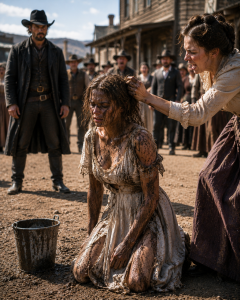
Ruth Anne Callaway’s knees hit the dirt before the first cut came. She didn’t scream. She’d learned that screaming only made Ada Hadley press harder. The shears bit into her hair, thick auburn strands falling into the dust like something dying. The crowd watched. Nobody moved.
Then a voice, low and rough as drag chain over stone, broke through the silence. “Take your hands off her.”
Josiah Harlon hadn’t spoken to another soul in eight years. But he was speaking now, and every man in that street heard the promise underneath his words.
The shears were dull. That was the thing Ruth Anne kept thinking about while Ada sawed through another lock of her hair — not sharp, clean shears that would’ve done the job quick. Dull ones. The kind used on a sheep you didn’t care about cutting. “Hold still,” Ada said. Ruth Anne held still. She’d been holding still for two years.
The sun beat down on the alley between the stable and the feed store, the kind of heat that pressed against the skull and made the air shimmer. A dozen people stood watching, maybe more — women from the mercantile, men who tipped their hats to her on Sundays and now couldn’t find her eyes. “You think you’re something, don’t you?” Ada’s voice carried, pitched for the crowd. “Think because you can read, because you can scratch out letters like some schoolteacher, that makes you better than my boy’s family.” The shears caught on a knot and yanked. Ruth Anne’s head jerked sideways; she bit the inside of her cheek hard enough to taste iron.
“My Virgil’s barely cold and she’s already got ideas,” Ada announced, turning to the onlookers like a preacher delivering sermon. “Found her writing a letter. A letter to a lawyer in Abilene, asking about property rights. Property that belongs to us.” A murmur rippled through the crowd.
The letter had been real. She’d written it by lamplight with hands that shook, every word chosen careful as a footstep on thin ice — asking about widow’s rights, about whether a dead man’s family could keep a woman against her will.
“Levi.” Ada’s younger son stepped forward, jaw set, holding a tin bucket. Ruth Anne knew what was in it before he tilted it — ash and axle grease stirred into a paste black as sin. “Ma,” Levi said, low enough only Ruth Anne and Ada could hear. “Maybe we don’t need to do the face part. Folks are watching.”
“That’s the point,” Ada said.
Levi hesitated. For one breath, Ruth Anne thought he might refuse, and his eyes met hers — not kindness, not really, but a cousin of it. Discomfort. The look of a man who knew the line between correction and cruelty and could see his mother crossing it. Then he dipped his hand in the bucket.
“Turn her,” Ada ordered. Levi’s fingers, slick and black, pressed against Ruth Anne’s jaw, forcing her face toward the crowd. The paste was cold, thick, smelling of char and grease. He smeared it across her cheeks, working fast like he wanted it over with. Ruth Anne closed her eyes. Behind them, she saw her father’s face, the way he’d looked teaching her to read by the window of his blacksmith shop. *Words are the only thing they can’t chew off you, Ruthie. A man can take your land, your money, your name, but he can’t unread what you’ve read.* They were trying to unread her now.
“Open your eyes,” Ada commanded. “You look at these people. You let them see what happens to a woman who forgets her place.”
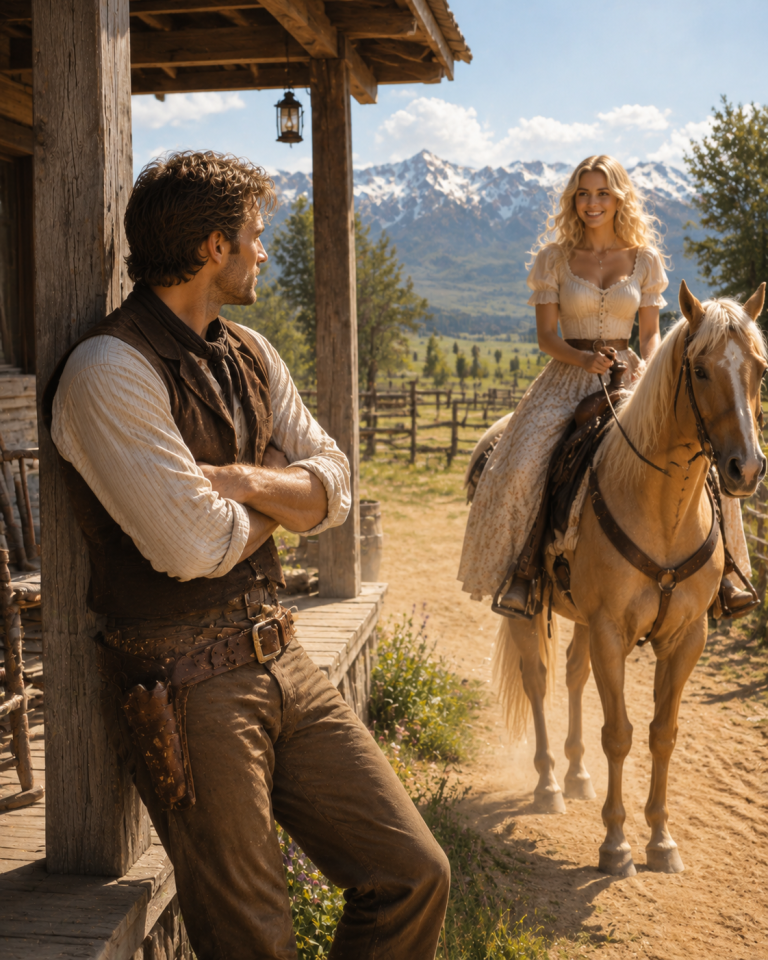
Ruth Anne opened her eyes. The faces swam before her — Mrs. Patterson clutching her shawl like a shield, old Deaks the farrier leaning against the wall with his mouth a thin line, the Fletcher boy staring slack-jawed. Then, at the edge of the crowd, a space where there hadn’t been one before. A man she’d only seen from a distance, always alone, always passing through town like he didn’t quite live there though he’d been there years. Josiah Harlon, weight settled, a busted hinge for the corral gate still in his left hand, hat shadowing the upper half of his face, jaw set like stone. He didn’t push through the crowd. He didn’t need to. People moved for him the way water moves around a rock — not from fear, but because they understood the rock wasn’t moving first.
“I said, open your—” Ada started.
“I heard what you said.” Josiah’s voice cut across hers, low, unhurried, flat as a planed board. He wasn’t loud. He didn’t need to be. The alley went quiet the way a room goes quiet when somebody drops a hammer.
Ada turned toward him, shears still in her fist. “This is family business, Mr. Harlon.”
“Doesn’t look like family business.” He looked at Ruth Anne — not at the paste on her face, not at the ragged patches where her hair had been cut. He looked at her eyes. “Looks like a woman being held down against her will in the middle of the street.”
“She’s kin,” Levi said, straightening. “She married my brother.”
“Your brother’s dead.” The words landed like a stone dropped in still water. Levi’s face flushed dark, his hand coming away from Ruth Anne’s jaw. “You don’t know anything about it,” Levi said.
“I know what I’m looking at.” Josiah set the hinge down on a barrel near the wall, slow, deliberate, freeing both hands. “And what I’m looking at is finished.”
Ada laughed, one sharp sound like a branch cracking. “Finished. Who do you think you are? You don’t speak to anyone in this town for years, and now you’ve got opinions on my family.”
“Don’t need opinions.” Josiah stepped closer — not toward Ada. Toward Ruth Anne. “Ma’am,” he said quietly. “You all right to stand?”
—
## PART 2
Her scalp burned where the shears had scraped. Her right arm ached where Levi had gripped it. “I don’t know you,” she whispered.
“No, ma’am, you don’t.”
“Then why?”
He was quiet a beat. “Because nobody else is going to.” Something cracked open inside her chest — not warmth exactly, not hope, but the space where those things might grow.
“You sit back down,” Ada snapped. “We’re not done.”
“Her name,” Josiah said without turning around, “is Ruth Anne. And you are done.” Levi moved fast, placing himself between Josiah and his mother, hand resting on his revolver — not drawing, just letting the weight of the gesture speak.
“Mister,” Levi said. “I’m going to give you one chance to walk away.”
Josiah’s eyes dropped to Levi’s hand, then lifted again. “Appreciate the offer. Do the same for you.” He hadn’t raised his voice once, hadn’t squared for a fight. He stood the way a fence post stands. Rooted.
Levi turned the argument toward theft instead — clothes, silver, a quilt his mother had made. Ruth Anne’s voice came before she’d planned it, rough but steady: “I never took a thing from your house except the dress I’m wearing. And your mother didn’t make that quilt. I did.”
Old Deaks pushed off the wall. “Seen Ruth Anne stitching it on the porch myself. That pattern ain’t your mother’s work.” Ada’s face went pale, then red, and Josiah pulled the neckerchief from his throat and held it out — not placing it on her, letting her choose. She took it, fingers brushing his calloused hand.
“You can’t just take her,” Ada snapped, fear creeping into her voice now. “She’s ours.”
“Law says a widow’s her own person,” Josiah said calmly, “unless you’ve got a paper that says different.”
“I’ll go to the sheriff,” Ada threatened.
“Good,” Josiah said. “Tell him what you were doing when I found you.”
—
## PART 3
Ada looked around the alley for support and found none. Mrs. Patterson stared at her shoes. The Fletcher boy turned away. “Come on, Ma,” Levi muttered finally, and the Hadleys were gone, the crowd parting around their retreat, only scattered pieces of Ruth Anne’s hair left behind in the dust.
Josiah looked back at her. “Can you walk?”
“I think so.” Her ankle twisted on a loose stone, and his hand appeared instantly at her elbow, not grabbing, just steady. They left the alley for Main Street, bright and wide in the heat, his gelding waiting near the rail, calm and the color of wet sand.
“Where are you taking me?” Ruth Anne asked.
“My place. Seven miles out.”
“Why?”
“Because they’ll come looking for you in less than an hour, and there isn’t a place in town that’ll keep them out.” She studied him. “I don’t even know your name.”
“Josiah Harlon.”
“I’m Ruth Anne Callaway.”
“I know.” He swung up onto the saddle and reached down. She hesitated, then placed her hand in his, and he pulled her up behind him with effortless strength. “You can hold on if you need to,” he said. “I won’t think anything of it.” She kept her hands on the saddle instead. Not yet.
They rode out of Brier Creek at a slow walk, the town fading behind them into dust and sage and open land stretching wide under the sun. After a mile, her grip loosened, the neckerchief still twisted in her hand.
“Mr. Harlon,” she said quietly.
“Josiah.”
“Josiah. What happens when they come for me?”
For a long moment he didn’t answer, the gelding’s hooves beating a steady rhythm on the road. Then, quiet, even: “Guess they’ll find out I’m home.”
The gelding stopped at the porch rail as evening wind moved across dry grass. Josiah swung down first and held out his hand. Ruth Anne stared at it a moment, then took it, her boots touching the wooden step, her knees nearly giving out.
“Steady,” Josiah said.
“I’m steady.” She wasn’t, but saying it made it closer to true. He pointed toward the bench by the door. “Sit a minute. I’ll bring water.” She sat because her legs refused otherwise, hands trembling in small quick movements she couldn’t stop, the blue neckerchief twisted in her fingers, black stains already drying.
Josiah returned with a tin basin and a clean rag. He set it beside her and stepped back without hovering. “For your face.” Then he walked toward the barn, leaving her alone with the quiet.
Ruth Anne dipped the cloth and pressed it to her cheek. The cool water cut through the grease slow. She scrubbed harder than she meant to, each pass feeling like peeling something deeper away. When the paste was gone, she looked down into the dark water. The face staring back barely looked familiar — hair ragged and uneven where Ada’s dull shears had hacked through it, skin red and raw. But her eyes were clear.
When Josiah returned, she sat upright, jaw set. “Thank you for the water,” she said.
“You hungry?”
“I’m not hungry.”
“Should eat anyway.” He studied her a moment, then nodded once. “All right.” He went inside. The cabin smelled of coffee and wood smoke, everything simple and worn from long use by one person — a table, two chairs, a stove, a narrow bed visible through the open doorway. He set a cup in front of her. “Drink.” She wrapped both hands around it. The coffee was strong and hot and better than anything she’d tasted in months.
“There’s a room through there,” he said. “Bed’s made. You take it. I’ll sleep out here.”
“I’m not putting you out of your own bed.”
“You’re not putting me anywhere.” He took a slow drink from his own cup. “Bad shoulder doesn’t like the mattress anyway. War injury. Shiloh. Minié ball went in clean, came out ugly.” He said it like he was talking about weather. “Fourteen years ago.”
Ruth Anne studied him across the table. “You live out here alone?”
“Yes, ma’am.”
“For how long?”
“Eight years.” He didn’t offer more, and she didn’t push, though she noticed the number matched exactly how long the town said he’d stopped speaking to anyone, and filed the coincidence away rather than ask outright.
After a while she set the cup down. “You should know something,” she said.
“What?”
“You don’t owe me anything.”
“This isn’t about owing. It’s about warning.” She told him everything — about Virgil Hadley, the drinking, the years in that house where Ada treated her like hired help she never had to pay, about the letter to the lawyer asking whether a widow had any rights at all. Josiah listened without interrupting. When she finished, he asked one question.
“That boy Levi. He want to marry you?”
Ruth Anne flinched. “Ada’s been pushing it since the funeral. Keep the widow in the family. Keep the land clean.”
“And you said no every time.”
“That’s why the hair. That’s why the face.”
“You don’t say no to Ada Hadley and walk away clean.” Josiah leaned back in his chair. “Then we make sure the truth is louder than she is.” He was quiet a moment, turning his cup once on the table before he added, unprompted, the way a man offers something only once he’s decided it’s owed. “My wife’s name was Margaret. Fever took her nine years back, second winter after I came home from the war. I sat with her four days straight and couldn’t do a single thing to stop it. Stopped talking much to anybody after that, not out of grief exactly. Out of the particular kind of useless a man feels when he’s watched something he loved get taken and couldn’t lift a hand to change it. Figured silence was safer than watching that happen twice.” He met her eyes. “Wasn’t going to let it happen a second time today, whatever it cost me.”
The next morning, Ruth Anne stood on the porch beside him drinking coffee while the windmill creaked slow in the early light. “Put me to work,” she said.
“Work?”
“I can feed chickens, mend fences, cook better than whatever those beans were last night.” It took him three seconds to realize she was teasing him. “That bad?”
“I’ve had worse,” she said. “Not by much.” He almost laughed, and something changed between them in the space of it.
The days that followed stayed quiet. She cleaned the coop, cooked meals, mended clothes. Josiah repaired fences and tended cattle. Neither spoke much, but the silence stopped feeling empty.
One afternoon, a rider appeared on the road — Sheriff Tucker, bringing news that Ada had filed a complaint claiming Ruth Anne had been kidnapped. Tucker listened careful when Ruth Anne told him plain she’d left of her own free will, and nodded slow. “If you say you’re here by choice, ma’am, that’s good enough for me.” But he warned them Ada wouldn’t let it rest there, and he was right.
Ada arrived the next morning with her sons and a writ signed by Judge Puett — the whole yard filling with tension thick enough to choke on. Tucker had ridden out ahead of them, some instinct telling him this was coming, and stood between the two parties when the Hadleys reined up.
“Mrs. Callaway,” he said calmly. “Are you here of your own choosing?”
Ruth Anne stepped forward. Her voice didn’t shake. “Yes, sir, I am. Nobody took me. Nobody forced me. I left because I was worked without pay, beaten, and humiliated. I am a widow and a free woman, and I am not going back.”
The words settled over the yard like thunder. Tucker wrote it down, then closed his notebook. “That statement supersedes the writ, Mrs. Hadley. You can file a claim in court if you like, but this woman stays where she is.”
Ada’s face twisted. “This isn’t over.”
“Maybe not,” Tucker said. “But today it is.”
The wagon turned. The Hadleys rode away, and Ruth Anne watched the dust settle before she sat down hard on the porch steps and cried — not from sadness, from relief so deep it shook her bones. Josiah sat beside her without touching her. Just there, solid, steady.
Weeks passed. A lawyer from Abilene, the same one Ruth Anne had written to that first careful letter by lamplight, confirmed she had a legal claim to part of the Hadley property under territorial widow’s-share statute, her marriage to Virgil recorded plain and proper in the county register at Miller’s Crossing despite Ada’s last attempt to claim otherwise. Ruth Anne rode into Miller’s Crossing herself to fetch the certified copy, unwilling to let even that small piece of the fight be handled entirely by someone else on her behalf.
Ada, cornered at last by paper she couldn’t argue around, offered a settlement. Ruth Anne agreed to it on one condition of her own devising: Ada had to write the truth in her own hand, plain and complete — that she had cut Ruth Anne’s hair, blackened her face, and held her against her will in the middle of a public street. It took two visits from the lawyer and the quiet, unspoken threat of a county courtroom before Ada finally signed it, but she signed it, and the fight ended there, on paper, in her own admitted handwriting rather than anyone else’s account of what had happened that day.
One evening on the porch, Josiah handed Ruth Anne a small wooden box. Inside was a silver hair comb.
“Margaret’s,” he said quietly. “My wife’s.”
Ruth Anne held it carefully. “Josiah, this is the most beautiful thing anyone has ever given me.” She placed it in her hair; it fit perfectly. Then she stepped closer. “I have an answer for you,” she said.
“An answer?”
“You asked what happens when all this is finished.” He nodded. “I stay,” she said. “Not because I have nowhere else to go. Because I want to. Because I love you, Josiah Harlon.”
He stared at her a long moment, then his hands rose slowly and held her face. “I love you too, Ruth Anne Callaway.” He kissed her gently.
Three weeks later, they were married under the cottonwood tree by the creek, Sheriff Tucker standing witness, old Deaks riding twelve miles just to attend. The silver comb held Ruth Anne’s growing hair in place as she said yes. That evening they sat on the porch watching the sun fall behind the hills, Ruth Anne leaning against Josiah’s shoulder, the windmill turning slow, the garden growing green beside the south fence.
And for the first time in her life, Ruth Anne Callaway Harlon was standing exactly where she had chosen to be, on ground that had cost her nearly everything to reach and that she now intended to keep — not out of fear, not out of duty to anyone else’s name, but because it was, at long last, entirely and only hers.
**THE END**