Every Mail-Order Bride Ran From the Mountain Man — Then the Plus-Size Woman Refused to Leave Instead

—
**PART 1
The wind howled through the pines the morning the seventh bride left, and Daniel Mitchell stood in the doorway of his mountain cabin and did not call after her. He never did. He simply watched the wagon roll away over frozen ground until it disappeared behind the bend, and then he closed the door and leaned his back against it, dragging his palms down over his face.
Seven brides. Seven disappointments. Seven long weeks of trying to convince someone that a life carved out of Colorado rock and pine was worth staying for.
At thirty-two, Daniel had built everything he owned with his own two hands — the cabin, the traps, the fences, the life. He could survive anything the mountain threw at him. The one thing he couldn’t seem to build was a reason for a woman to stay in it with him.
He wrote to the broker in Denver again anyway. The man promised, as he always did, that this next one would be different — a seamstress from the east named Ruth Gutierrez, twenty-eight, practical, used to hard work. The broker mentioned, almost as an afterthought, that she was a woman of a fuller figure, as though that detail alone might make her more likely to survive up here than the last one had.
Daniel didn’t care about her size. He only cared whether she’d run.
Three weeks passed. The mountain paths turned to ice, the air turned sharp and mean, and Daniel told himself, the way he always did, not to expect anything. Hope was a luxury the mountain didn’t forgive.
When the supply wagon finally dragged itself up the pass one bitter morning, groaning like something exhausted, Daniel felt not hope but a grim kind of awareness — that this might be the last chance he was willing to take.
A large figure sat beside old Pete on the driver’s bench, wrapped head to toe in thick wool.
“Got your bride here, Mitchell,” Pete called, easing the horses to a stop. “Roughest run I’ve made all season. Weather’s turning bad. Real bad.”
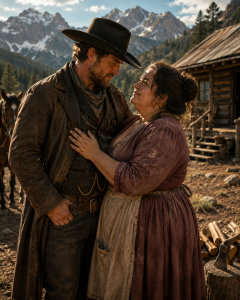
The woman climbed down carefully — steady, sure, nothing clumsy or frightened in the way she moved. When she turned to face him, Daniel found himself looking into dark, thoughtful eyes that studied him back with calm understanding instead of fear.
“Mr. Mitchell,” she said, her voice level and warm. “I’m Ruth Gutierrez. I’ve come as we arranged.”
“Welcome to the mountain, ma’am,” Daniel managed, unsure of himself in a way he hadn’t expected. “I hope the journey wasn’t too hard.”
“I’ve endured worse,” Ruth said simply. She looked past him at the snow-heavy pines, the quiet valley, the cabin he’d built log by log over three summers. “It’s harsh. But it’s also beautiful.”
When Pete pulled away, Ruth didn’t watch the wagon go. She didn’t chase after it the way some part of Daniel had already braced himself for. She simply stood firm against the cold wind, waiting for him to speak first.
“Come inside,” he said. “You shouldn’t stand out in this.”
Inside, the cabin was warm and solid, and Ruth ran a hand along the smooth wooden table like she was reading something written into the grain.
“You built all this.”
“Took me three summers,” Daniel admitted.
“It’s good work,” she said. “You know how to make things that last.”
Something in Daniel’s chest loosened at that, quietly, without his permission.
That evening he cooked venison stew and fresh bread, and Ruth ate with a gratitude that felt entirely unforced. “The bread is good,” she said. “You bake it yourself?”
“Had to learn,” he said, a little embarrassed. “No one else here to do it.”
“I can bake. I can sew. I can preserve food.” Her dark eyes held his. “I won’t be a burden, Mr. Mitchell.”
“It’s not about earning your keep,” Daniel said. “It’s about surviving up here.”
Ruth nodded once, like she’d filed the answer away for later use, and Daniel found himself watching her the way he hadn’t watched anyone in a very long time — not with the hope he’d trained himself out of, but with something quieter and more dangerous. Curiosity.
By the end of the first week, Ruth had risen before dawn every morning to keep the fire going, mended every torn seam in his winter clothes, and reorganized his pantry with the efficient hands of someone who had never once, in her whole life, been given the luxury of standing still. She didn’t complain about the cold. She didn’t flinch at the isolation. She asked questions — sharp, specific, useful ones — about the weather, the traps, the animal tracks in the snow, and listened to his answers like a woman studying a language she intended to master completely.
When Daniel warned her that January would seal them into the cabin for weeks at a time, snowbound and alone, he watched her face for the fear he’d seen in six other faces before hers.
It never came.
“Then we must be prepared,” Ruth said simply, and the word *we* settled into Daniel’s chest and stayed there long after she’d gone back to her mending, refusing, no matter how hard he tried, to let go.
—
**PART 2
The word stayed with him through supper, through the evening chores, through the long quiet hour after the lamps were lit, when Daniel found himself watching Ruth’s hands move over her needlework instead of doing anything useful himself.
*We.* Not *you’ll be prepared.* Not *I hope you’ll manage.* We.
None of the other six had ever spoken about the coming winter as anything but a sentence being handed down to them. They’d flinched at the word *January* the way people flinched at bad news. Ruth had simply reached for a plan.
It unsettled him more than it should have — the way a man gets unsettled by weather that refuses to behave the way weather is supposed to.
“You’re staring,” Ruth said, without looking up from her stitching.
“Didn’t mean anything by it,” Daniel said, too quickly.
“I didn’t say you did.” A small, unhurried smile. “I only noticed.”
He busied himself checking the door latch that didn’t need checking, buying himself a few seconds he badly needed. Six women had sat in that same chair by that same fire, and every one of them had eventually asked him some version of the same question — *how long do the storms usually last* — with a tremor underneath it that told him exactly how the story would end before it had properly begun.
Ruth hadn’t asked that question yet. When she finally did, three nights later, as wind rattled the shutters for the first time since her arrival, her voice carried no tremor at all.
“How bad does it get?” she asked, setting her needlework in her lap.
“Bad,” Daniel said honestly, because he’d promised himself years ago never to soften it for anyone. “Snow to the windows some years. Weeks where the pass closes both directions. A man can lose fingers to frostbite walking fifty feet to the woodpile if he’s careless.”
He waited for the flinch.
Ruth studied the fire for a moment, turning the information over the way she seemed to turn everything over — carefully, without panic.
“And the seven women before me,” she said. “Is that when they left? Before the worst of it, or after they’d already seen it?”
The question landed harder than he expected. Daniel had never once been asked to account for the others out loud, and something about the way Ruth asked it — not cruel, not pitying, just precise — made him answer more honestly than he’d planned to.
“Before,” he admitted. “Every one of them left before the first real storm hit. Something about this place tells a person everything they need to know before the mountain even tests them.”
“And what did it tell them?”
Daniel looked into the fire instead of at her. “That I wasn’t going to be easy to love. That the life wasn’t going to be easy either. Most people want one soft thing to hold on to. I never had a soft thing to offer.”
The silence that followed wasn’t uncomfortable, which surprised him more than anything else that had happened since her wagon pulled up the mountain.
“I didn’t come here for soft,” Ruth said finally. “I came here because your letters never once tried to sound like something they weren’t.” She met his eyes across the firelight, steady in a way none of the others had managed even on their calmest day. “I need you to understand something before this goes any further, Mr. Mitchell. I have already survived one marriage that ended badly, and I did not travel three weeks across half a continent to survive a second one the same way.”
Daniel’s chest went tight. “What happened to the first?”
Ruth’s hands went still in her lap, and for the first time since she’d stepped off that wagon, something crossed her face that looked almost like grief carefully kept behind glass.
“He died,” she said. “But that isn’t the part that matters. The part that matters is what I learned from it — and I don’t think you’re ready to hear all of what that means for you yet.”
She rose then, banking the fire for the night with the same unhurried competence she brought to everything, and left Daniel sitting alone with the wind outside and a question inside him he hadn’t expected to still be carrying by the time the first real blizzard of the season finally broke over the mountain three days later.
—
**PART 3
The storm arrived at noon two days after that conversation, and it arrived like something with a grudge.
Daniel had smelled it coming that morning — a particular flatness to the cold, a stillness in the pines that the animals always noticed before people did. By the time the first gusts hit the cabin walls, he’d already hauled in the last of the firewood and checked the roof lines twice.
Ruth stood at the doorway wrapped in her thick shawl, watching him work with steady eyes, and something in her stillness told him she understood exactly what was coming.
By nightfall the wind was roaring through the pines like a living animal, throwing snow sideways hard enough to erase the world outside the windows entirely. Daniel paced from corner to corner, checking the cabin’s bones the way he always did when the mountain started testing its own construction — walls, roof beams, the old chinking along the north wall that had never quite sat right since it settled the previous spring.
Ruth sat by the fire, sewing a leather strap with hands that never once shook. “You’re worried,” she said, without looking up.
He stopped pacing, surprised. Most people never noticed when his mind tightened like this. “The north wall,” he admitted. “It settled last spring. If the wind keeps up, the gap could widen.”
“Show me.”
He grabbed a lantern and led her to the corner, where a thin, cold draft slipped through a narrow seam between two logs, carrying snowflakes in on every strong gust.
Ruth examined it with the same sharp attention she brought to everything. “Do you have old cloth?”
He brought her strips of worn linen from the storage trunk, and together they packed the gap tight, her smaller fingers reaching into spaces his never could. When they finished, she stepped back, satisfied.
“That will hold for now.”
“Thank you,” Daniel said, and meant it in a way that went deeper than the wall. He had been alone so long that sharing a problem felt almost dangerous — like admitting a weakness he’d spent years learning to hide.
Ruth studied him in the lantern light. “Is this why you wanted a wife? To have help?”
“Part of it,” he admitted. “Not the biggest part.”
“Then what is?”
The storm screamed against the shutters. Daniel stared into the dark window where snow flashed past like white fire, and for the first time in longer than he could remember, he let someone hear the true answer.
“The quiet,” he said. “It gets so quiet up here you forget what your own voice sounds like. You start wondering if you’re still a man or just another part of the mountain.”
Ruth nodded slowly, like she recognized the shape of that particular loneliness from somewhere else entirely. “In the city, you’re surrounded by people and still invisible. That noise is worse, I think. This quiet at least has space in it. Space for thought. Space for two people to learn each other.”
Daniel looked at her a long moment. Ruth didn’t speak often, but when she did, her words landed with the solidity of something carved rather than spoken.
The storm lasted three days. Ruth never once complained. She stretched their supplies into meals that felt generous rather than rationed, mended his heaviest coat by lamplight, and moved through the cabin with a calm purpose that kept fear at a distance neither of them had to acknowledge out loud. By the time the wind finally died, Daniel understood something he hadn’t let himself believe yet.
She hadn’t cracked. She hadn’t panicked. She hadn’t once spoken of leaving.
When the sun broke through the following morning, the world outside had been buried in white nearly to the windows, the trees glittering like they’d been strung with something other than ice. Ruth stood in the doorway wrapped in her shawl, breath rising in pale clouds as she looked out over the transformed valley.
“My God,” she whispered. “It’s beautiful.”
Daniel found himself looking at her instead of the mountains — snow catching in her dark hair, her usually guarded face open with something close to wonder.
“Yes,” he said softly. “It is.”
—
The days that followed settled into a rhythm Daniel had never known with anyone. Ruth woke early to tend the fire; he checked the trap lines before first light. She prepared breakfast and hung wet clothes to dry; he hauled water and repaired what the storm had loosened. Neither of them needed to fill the silence with talk they didn’t mean. They moved around each other like two people the mountain had shaped for the exact same life.
One evening, with the fire burned low and Ruth sewing quietly beside it, she spoke without looking up from her needle.
“I was married once,” she said. “Before this. He died. Consumption. We were married six months.” She paused, threading the needle again with steady hands. “I learned then that love isn’t enough on its own. You need trust. Purpose. Partnership.”
Daniel stared into the flames, giving her the space he sensed she needed to finish.
“Is that why you answered my advertisement?” he asked finally.
“You wrote honestly,” Ruth said. “No promises of easy days. No lies. Just the truth of what this life would cost a woman. I respected that more than I’ve respected most things men have written to me.”
“And what have you learned since you got here?”
Ruth looked up, her dark eyes steady on his face. “That we work well together. That we don’t irritate each other, even after three days snowed in together with nowhere to go. That you keep your word.” A small pause. “That you’re the kind of man I could build a life with.”
The words settled into Daniel’s chest like something warm and solid, the way a good foundation settles once it’s finally load-bearing.
Winter deepened around them. Some nights Daniel came in from the trap lines after dark to find the fire built up and his gear already drying beside it, waiting. “You don’t need to wait up for me,” he told her once.
“I know,” Ruth said. “But I worry when you’re gone too long.”
Daniel stopped in the middle of the room, caught entirely off guard. No woman had ever said those words to him without fear threaded underneath them — fear of the mountain, fear of him, fear of what might happen to her if something happened to him first. Ruth said it like a simple fact, the way she said most things.
The next morning he began teaching her to read the weather properly, to recognize which tracks meant danger and which meant nothing at all, to handle the rifle with confidence instead of caution.
“We’re partners,” he told her, watching her sight down the barrel. “You need to know how to survive if something happens to me.”
She practiced until she hit every target he set, her hands never once trembling, and Daniel watched her with a respect that had quietly become something else entirely.
Then one morning, rifle lowered, she turned and faced him with the same quiet directness she brought to everything.
“Daniel,” she said. “Are you satisfied with our arrangement?”
He blinked. “What do you mean?”
“We live as business partners. Sharing work, but not life. Is that what you want? Or were you hoping for more?”
Heat rose in his face, and he looked at his boots, at the snow, anywhere but her eyes. “I want more,” he admitted finally. “But I’ve learned not to expect what I can’t earn.”
Ruth’s smile was warm in a way he hadn’t seen from her before. “Then tell me this. What are you willing to do to earn a real marriage?”
“Whatever it takes,” Daniel said, without a moment’s hesitation.
Ruth stepped closer, close enough that the mountain wind seemed to pause around them. “Then we understand each other.”
Ruth Gutierrez had not come to Colorado chasing some fantasy of rescue. She had come looking for the truth, plain and unadorned, and Daniel realized — standing there with the wind settling around them like it, too, was waiting to hear what came next — that truth was the one thing he had always had in abundance, even when he hadn’t known how to offer it to anyone before her.
Their real marriage was only just beginning.
—
Spring crept slowly into the mountains, thawing the deep winter snow and revealing the land beneath it in patient stages. For the first time in months, Daniel and Ruth could walk the property without fighting through waist-high drifts, and though the air still carried a sharp bite, the sun on their faces felt like something earned.
By then their partnership had settled into something steady and sure — the rhythm of two people who had already survived the mountain’s worst together and trusted the shape of each other’s competence without needing to test it further. But with the thaw came something new, growing quietly alongside everything they’d already built.
One morning Ruth walked the edge of the cabin’s foundation, hands on her hips, studying it the way she studied everything.
“We should add another room,” she said.
Daniel looked up from the woodpile. “Another room?”
“A place for sewing. Your woodworking.” She paused, and when she spoke again her voice had gone careful in a way he’d never heard from her. “And maybe, someday, a nursery.”
The word hung in the mountain air like a flame catching. Daniel had dreamed of a family once, long ago, before seven wagons rolling away had taught him to stop.
“You want children?” he asked.
Ruth’s dark eyes didn’t waver. “I want a real family. A home built on honesty and work and respect.” She held his gaze. “Do you want that too?”
Daniel felt the truth of it rise from somewhere deeper than he’d expected. “More than anything,” he said, and that settled it.
They began the addition that same afternoon — Daniel cutting timber while Ruth measured, planned, held boards steady, hauled the smaller logs, mixed chinking, and offered ideas sharp enough to make the work faster and better than it would have been alone. Daniel found himself smiling more in those weeks than he had in years combined.
When the first supply wagon of the season finally struggled up the mountain, old Pete climbed down and stared at the half-built addition with open surprise.
“Well, I’ll be,” he said. “Looks like you two are settling in for good, Mitchell.”
Daniel rested a hand on Ruth’s shoulder. “She’s not going anywhere.”
“We’re building something real here,” Ruth said, with a firmness that needed no further explanation.
Pete chuckled and unloaded his parcels, among them a letter from the marriage broker in Denver, asking with brisk professional patience whether Daniel still required further candidates.
Ruth read it over his shoulder and shook her head once. “Tell him we’re done,” she said. “Tell him the right woman already came.”
Daniel wrote back that same evening: *No more candidates needed. Found the woman who stayed.*
That night, sitting together on the porch as the sky burned gold over the peaks, Ruth leaned into him, warm and solid against his side.
“Do you ever regret coming here?” he asked.
“Never,” she said simply. “This is where I belong.”
—
Summer brought long, steady days — Ruth’s garden thriving under her careful hands, Daniel’s trap lines running smoother than they had in years, evenings spent trading stories and plans by a fire that no longer felt like the only voice in his life. Nothing between them felt forced. Nothing felt uncertain. Their lives had settled together the way two pieces of the same rough-cut wood settle once they’ve been properly joined.
A traveling preacher passed through the mountain pass that autumn and stayed for supper, watching the quiet, practiced way Daniel and Ruth moved around each other — passing tools without asking, finishing each other’s thoughts, working like two people who’d been together their whole lives rather than a single year.
“You two have something rare,” he told them before he left the next morning. “Something built on more than romance.”
“We built this on purpose,” Ruth said, smiling. “On work. On choice.”
“Love grew after the foundation was strong,” Daniel added, and found he believed every word of it.
That night, long after the preacher had gone, Ruth asked him quietly by the firelight, “Do you think we love each other?”
Daniel looked at her across the flames — the same woman who’d stepped off a wagon into a blizzard and never once flinched, who’d packed a drafty wall with worn linen on her first night in his home, who’d asked him what he wanted instead of what he expected.
“I think we built something stronger than most people ever find,” he said. “And yes. I think it’s love.”
Autumn swept color across the mountainsides — orange, gold, deep red climbing the hills as they prepared for their second winter together, their movements practiced now, their division of labor requiring no discussion at all. One evening, knitting by the fire, Ruth asked him something that had clearly been sitting with her for a while.
“I’ve been thinking about the women who came before me,” she said. “Why do you think none of them could stay?”
Daniel set down the harness he’d been repairing. “They wanted something that wasn’t real. An easier life. A softer man. A prettier dream than the one this mountain actually offers.”
Ruth nodded slowly. “They came here hoping to be saved. Not hoping to work.”
“You came looking for truth,” Daniel said. “And you stayed because you understood it when you found it.”
Ruth’s answering smile held no doubt in it at all. “Everything worked out exactly right.”
The first snow of their new winter fell softly outside the cabin that night, gathering on the window glass while Daniel watched it settle. The world felt peaceful. Steady. Strong in a way he’d stopped believing his life could ever be.
—
When spring returned, the biggest change of all arrived with the thaw. Ruth was carrying their first child.
Daniel stood in stunned, quiet joy when she told him, and in the days that followed the cabin itself seemed to hold more light than it ever had before — the mountains somehow kinder, the world somehow fuller than he had let himself imagine it could be.
“Are you scared?” he asked her one evening as they stood on the porch, watching the sunset paint gold across the peaks.
“A little,” Ruth admitted, her hand resting over the small swell beneath her apron. “But not about us. We’ll raise our child on the values we already live by every day. Hard work. Honesty. Respect. That’s what matters.”
Daniel rested a hand over hers. “We’ll raise them right.”
Through that summer, as Ruth’s belly grew, Daniel built the extra room they’d planned the year before, carved a cradle by hand from timber he’d chosen himself, stocked supplies with the care of a man preparing for the most important winter of his life, and wrote down every scrap of mountain knowledge he wanted to pass on someday — the weather signs, the animal tracks, the small daily competencies that had once been all he had to offer anyone, and had turned out, in the end, to be exactly enough.
Old Pete arrived with the supply wagon that autumn and laughed with open delight at the sight of Ruth. “Well, now,” he said. “Looks like this mountain’s finally getting itself a new generation.”
As the wagon rolled away down the pass, Ruth slipped her hand into Daniel’s.
“Do you think our child will love this place the way we do?” she asked.
Daniel looked out at the mountains that had shaped him, tested him, driven away seven women who hadn’t wanted what it asked of them, and finally given him a family in return for simply telling the truth about what that cost.
“They will,” he said. “Because they’ll grow up learning its ways. And they’ll grow up knowing they were born from a true partnership.”
When the first snows of their third winter began to fall, Daniel and Ruth stood together at the cabin window, watching the world turn white again the way it had turned white every year of his life on this mountain. This time there was no dread in the season ahead of them. Only peace. Only quiet excitement. Only gratitude, settling over the cabin like snow settling over pine.
The mountain man who had watched seven brides leave without a word had finally found the one woman who refused to go — the one who matched his silence with her own steady kind, who built a life beside him instead of waiting to be rescued from one, and who stood now at his side with a child growing between them, ready to face whatever winter came next, together, as a family that the mountain itself had helped to forge.
THE END