A STORM TRAPPED A LOST COWBOY IN A CAVE WITH AN ARMED APACHE WOMAN — BY DAWN, NEITHER OF THEM WAS WHO THEY’D BEEN THE NIGHT BEFORE

PART 1
The sun hung merciless and white in a sky scoured so clear it looked polished, pouring heat over the open country until the prairie itself seemed to shimmer under the weight of it. At twenty-two, Wyatt Calloway still carried enough boyishness in his face to earn the word *tenderfoot* from the older hands, but there was already a stubbornness in the way he sat a saddle — a lean, deliberate pride that squared his shoulders any time somebody hinted he wasn’t yet a real cowboy. He’d left Willow Bend three days back, hired on to help push cattle north to summer pasture, meaning to prove something on that drive. To the crew. To his father. Maybe most of all to himself.
Now, alone under a brutal noon sky with his water running low and his horse starting to labor beneath him, he’d have settled for simply making it home alive.
A thunderstorm had cut him loose from the rest of the crew — come on fast and mean across open country, violent wind, sudden lightning, the kind of rolling panic that scatters cattle and makes horses forget every good habit they ever learned. His mare, Rosie, had spooked and bolted, carrying him well past any landmark he recognized before he got her calmed. Since then he’d been riding through country the older men back in Willow Bend only ever spoke of in lowered voices. Apache land. That was how they said it — like the ground itself belonged not just to another people, but to a different order of danger entirely.
He’d heard the stories his whole life. Raids. Ambushes. Riders who moved in and out of canyon shadow like ghosts. He’d believed some of it, dismissed some of it, and carried the whole weight of it with him regardless. Every shadow thrown by a tall mesquite sent his hand drifting toward the Colt at his hip. He’d never killed a man. Never even drawn on one. But over the course of that long, brutal day, the weight of that revolver had become the closest thing he had to comfort.
Rosie picked her way carefully through the broken ground, ears constantly shifting, nostrils flaring at scents he couldn’t read. Wyatt trusted her instincts more than his own nerve. His father had told him once, in one of those rare moments he offered advice instead of correction, that a horse senses danger before a man’s willing to admit it to himself. *Trust the horse over your own eyes.* Wyatt had rolled his eyes at seventeen, too sure wisdom only counted if it arrived with some drama attached. Now, alone in hard country, he wished he’d taken every one of Everett Calloway’s lessons more seriously.
He thought about his father often when he was scared.
Everett hadn’t been an easy man. Wyatt’s mother’s death, when Wyatt was seven, had hardened him into something severe and spare. He’d raised his son on calloused hands, silence, chores, and expectation — taught him to rope, ride, mend tack, judge cattle, and keep moving when every tired bone in his body wanted to quit. But tenderness seemed to be something Everett had simply misplaced the day his wife died and never found again. Their cabin outside Willow Bend hadn’t been cruel exactly. Just quiet in a way that grew heavier with every passing year. Wyatt had left partly for wages of his own, partly to find out whether there was more to living than trying to satisfy a man who never once seemed satisfied.
Now, with the heat wringing moisture out of his mouth faster than he could swallow and Rosie’s flanks gone dark with sweat, the whole tangled ache of his father mattered a good deal less than the immediate problem of water.
Then he saw green.
It cut through the lower valley below him in a ribbon of cottonwood and willow, unmistakable even at a distance. Water. Relief hit first, bright and immediate, caution following close on its heels. In country like this, water meant life — but it also meant convergence. Deer. Predators. Travelers. Apache riders. Outlaws. Anyone with sense enough to survive out here knew exactly where the water lived.
Still, without it, both he and Rosie would be finished before the next sundown.
He guided the mare down a narrow deer trail, loose rock sliding under her hooves. The air cooled as they dropped into canyon shade, the relief of it paired with a fresh unease. The walls closed in on either side. The silence changed shape. Even the wind seemed to hesitate down there. The back of Wyatt’s neck prickled with the unmistakable sense of being watched, though scanning the ledges above showed him nothing but scrub, stone, and the odd lizard darting between cracks.
The trail opened onto a spring-fed pool, clear and still except for the ripples Rosie’s muzzle made as he let her drink. He kept one hand near his pistol while she drank, then crouched and scooped water into his own mouth in greedy handfuls — mineral and earth and relief so sudden it nearly hurt. He splashed some over his face and the back of his neck, closing his eyes for one foolish second as the coolness cut clean through the heat.
When he opened them, he noticed the tracks.
Hoofprints pressed into the soft mud at the pool’s edge. Small ponies, not cattle stock. Several animals. Fresh enough the water hadn’t yet softened their edges. Wyatt’s heartbeat changed rhythm. He should leave. Mount up, ride hard while there was still light. But Rosie needed rest, and he wasn’t sure anymore which direction even counted as safety. So he drank again, faster this time, and lifted his eyes toward the sky.
The weather had turned while his attention sat on the water. Dark clouds massed in the west, rolling up in thick, bruise-colored shapes edged purple at the rims. He smelled the storm before the wind reached him — that sharp, metallic scent of electricity and hard rain on dry ground. He knew enough about desert storms to understand how fast they turned deadly. Flash floods. Lightning. Mud where there’d only been dust minutes before. Whatever fear he carried about Apache riders, he didn’t doubt for a second that the storm was the more immediate threat.
He scanned for shelter and finally spotted a narrow cleft in the rock face, nearly hidden behind thorny mesquite. Forcing Rosie through it was miserable work — thorns tearing his sleeves, scratching the mare’s flank. But past the screen of brush lay a deeper cave carved into the stone, wider and drier than it first appeared.
He’d only just loosened Rosie’s saddle when the storm broke.
Rain came fat and hard, turning the world outside the cave into a sheet of silver noise almost instantly. Lightning cracked close and bright enough to erase the walls for an instant, thunder rolling through the canyon and straight into Wyatt’s bones. Rosie whinnied and danced sideways; he put a hand to her neck, talking low until she settled.
The cave was dry. That much mattered. Dry and deep enough to keep the worst of the storm off them. Still, Wyatt didn’t trust it. He checked his rifle for the tenth time. Checked the Colt again. Set the rifle close, pulled his bedroll around his shoulders as desert cold replaced the day’s heat with unnerving speed. He didn’t dare build a fire — smoke traveled, light called out. So he sat in the dark listening to rain and thunder, thinking of Willow Bend, the saloon, the easy careless world he’d been so eager to leave three days back. He thought of Emmeline Hargrove too, the banker’s daughter, who’d smiled at him after church the Sunday before he rode out. He’d meant to ask her to the summer dance once the drive wrapped up. It felt now like it belonged to another man’s life entirely.
The storm worsened after full dark. Water began creeping across the cave floor near the entrance, and Wyatt moved himself and Rosie deeper toward the back. It was then, in a lightning flash so bright it turned the cave to daylight for the briefest instant, that he realized he wasn’t alone.
He caught a shape against the far wall and his whole body reacted before thought could catch up, hand flying toward the Colt. Another flash lit the shape again and corrected his first impression.
Not a man.
A woman.
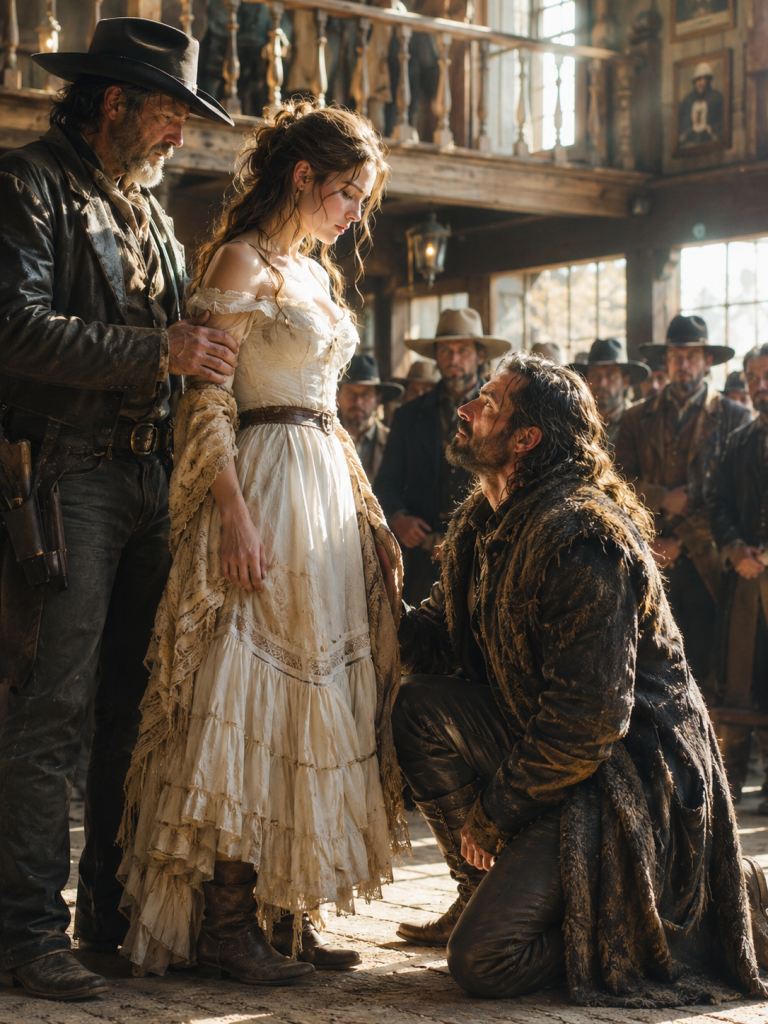
She stood very still, wrapped in a deerskin dress worked with bead patterns that flashed pale in the light, long black hair loose over her shoulders. Her dark eyes were wide and fixed on him with a ferocity that reminded him, stupidly and instantly, of a wildcat cornered in a trap. A skinning knife sat in one hand, angled not wildly but with a readiness that had clearly been practiced.
She was Apache.
Younger than he expected too — twenty, maybe less — but nothing childish in the way she held herself. Fear, yes. Wariness, absolutely. But control besides, the kind that only comes from knowing danger too intimately to waste energy on panic.
Neither of them moved for a long moment. Rosie snorted and shifted between them, unsettled by a tension that had turned into its own weather inside the cave. Wyatt’s hand stayed near his pistol, but he didn’t draw. Something in her face told him drawing too soon would end whatever chance he had of surviving the night without blood soaking into the sand.
“Easy,” he said. His voice sounded wrong in the cave, too loud and too soft at once.
Her eyes narrowed. “You leave,” she said, English accented but clear. “This my place.”
Wyatt glanced at the curtain of rain outside. “Can’t do that. Storm’s too bad. I’ll stay on my side. You stay on yours.”
Her laugh came bitter and brief. “White man’s promise worth nothing.”
The words stung, because he knew enough history to understand she hadn’t earned that opinion of him personally, and yet it had been earned somewhere, by somebody. He drew his hand slowly away from the pistol and lifted both palms.
“I ain’t looking for trouble. Just shelter. Same as you.”
She studied him a long, tense moment, then lowered the knife, very slightly. “You stay there. Come close, I cut you.”
“Understood.”
He moved to the far side of the cave with Rosie, keeping his motions deliberately slow so she could track every shift of his body. He rubbed the mare down with burlap, checked her hooves, tried to let the routine of it steady the strangeness of the whole situation.
“What’s your name?” he asked eventually.
Silence stretched long enough he figured she’d refuse to answer at all. Then: “Grace. My white name.”
PART 2
“Grace,” Wyatt repeated quietly.
She gave the smallest nod. “My Apache name is not for you.”
“Seems fair enough.”
She watched him another long moment, then crouched beside a bundle near the cave wall, producing dried venison and a small leather flask. She ate without once taking her eyes off him.
Wyatt reached into his saddlebag. “Got coffee.”
Grace frowned. “Coffee?”
He held up a small tin. “Beans.”
She looked suspicious. “You poison?”
He almost laughed. “No.”
“You sure?”
“Been drinking it for years.”
“That explain why white men so loud.”
The remark caught him completely off guard, and against all reason, he laughed — short, honest. Grace blinked, then, despite herself, the corner of her mouth twitched. For the first time, the cave felt a little less like a battlefield.
Hours passed. Rain hammered the canyon. Lightning flashed again, closer this time. Then came a sound neither of them expected — a horse screaming.
Both were on their feet instantly. Grace reached the cave entrance first, Wyatt right behind her. A flash flood had exploded through the canyon, dragging trees and rocks and mud through the dark like toys. A young Apache pony fought desperately against the current, one leg pinned under a fallen log.
Without thinking, Grace ran. Wyatt caught her arm. “You’ll drown!”
“My horse!”
“It’ll kill you!”
She pulled free anyway. Wyatt cursed under his breath and ran after her.
Together they fought into the freezing torrent. Grace hacked at branches with her knife while Wyatt threw every ounce of strength he had against the log. The current very nearly swept them both away. Then, finally, the log shifted, the pony wrenched free, and Wyatt caught Grace just as the water ripped her feet out from under her, both of them crashing together onto the muddy bank.
For several seconds neither moved. Then Grace looked at him. “You came.”
“Couldn’t let you drown.”
“You could have.”
“I couldn’t.”
She stared at him, her voice dropping nearly to a whisper. “Most white men would have.”
Wyatt looked away. “I ain’t most men.”
Morning came clear and cold. The storm had reshaped the canyon overnight — part of the entrance had collapsed, their only trail home buried under tons of rock. Wyatt examined the slide. “No getting through this way.”
Grace climbed higher onto the rocks. “There another trail.”
“You know it?”
She nodded. “Dangerous.”
“How dangerous?”
She looked at him seriously. “If lucky.” A pause. “Only little dangerous.”
Wyatt sighed. “That’s comforting.”
They traveled together after that. The canyon narrowed into cliffs so steep the sky above shrank to a ribbon. Grace walked with total confidence; Wyatt followed. Twice she warned him away from rattlesnakes coiled under sun-warmed rocks. Three times he helped her across ledges too narrow for safe footing. They learned each other’s rhythm without either one mentioning it — when Wyatt stopped to help Rosie over loose stone, Grace waited; when Grace paused to gather healing herbs, Wyatt kept watch. By the second day, the silence between them had stopped feeling hostile.
That evening they camped beside another spring, and Wyatt noticed fresh footprints. Boots. Not moccasins. Five men. Grace saw them too, her face hardening. “Bad men.”
“How can you tell?”
“They hunt.”
“Hunt what?”
She looked directly at him. “Me.”
His stomach tightened. “Why?”
Grace hesitated, then spoke. “My father chief.”
Wyatt waited.
“He make peace with settlers.”
“And?”
“Some Apache hate him.” She looked away. “Some white men hate him too.” She touched a small leather pouch at her neck. “I carry treaty.”
Wyatt frowned. “What treaty?”
“Names.” Her voice dropped. “White traders selling guns to make war.”
The blood drained from Wyatt’s face. If a list like that existed, it could expose half the corruption in the territory. No wonder she was being hunted.
Gunfire shattered the evening. A bullet struck the tree inches above Wyatt’s head. “Down!”
Five riders burst from the brush — not soldiers, not Apache. Outlaws. Their leader laughed. “There she is!”
Wyatt drew his Colt. “You know these men?”
Grace nodded once. “They killed my brother.”
Something cold settled in Wyatt’s chest. He stood. “You stay behind me.”
She frowned. “You one man.”
“Still enough.”
The first outlaw charged. Wyatt fired; the horse screamed, the rider fell. A second came from the left — Grace’s knife buried itself in his shoulder before Wyatt even turned. The whole fight lasted under a minute. When it ended, two men had fled and three lay groaning in the dirt.
Wyatt lowered his revolver. Grace stared at him. “You fight good.”
“My father taught me.”
She nodded slowly. “So did mine.”
PART 3
The treaty reached Fort Adair three days later. Wyatt insisted on escorting Grace there himself. Army officers gathered around the leather pouch in stunned silence. Captain Reeves read the names twice, then looked up. “My God.”
Half the trading companies supplying weapons to both sides stood exposed in that list — corrupt officials, merchants, politicians. Arrests began within weeks. A war that might have cost hundreds of lives never happened, because one Apache woman refused to surrender, and one lost cowboy chose to believe her.
Wyatt expected to ride home after that. Instead Grace asked quietly, “You leave now?”
He smiled. “I suppose.”
She looked toward the mountains. “You not afraid anymore.”
He laughed softly. “I was never afraid of you.”
“No?”
“No. I was afraid of what people told me to believe.”
She looked at him a long moment. “Now?”
“Now I think they lied about a great many things.”
Months later, Wyatt rode back into Apache territory. Not with soldiers. Not with traders. Alone. Grace met him outside her father’s village.
“You came back.”
“Said I would.”
“You white men say many things.”
“I know.”
“And?”
“Wanted to prove I’m different.”
Her father watched from a distance, then approached slowly. “You saved my daughter,” Chief Iron Cloud said.
Wyatt shook his head. “She saved me too.”
The chief smiled. “Then perhaps the Creator sent that storm for a reason.”
Years passed. Wyatt learned Apache. Grace learned more English. He stopped measuring his own courage by gunfights won. She stopped measuring white men by old betrayals never hers to forgive. When they married beneath a cottonwood beside the same spring where they’d first met, both peoples came. Not because every old prejudice had vanished overnight, but because two stubborn young people had refused, in the end, to let fear write the ending for them.
Much later, when their children asked how the two of them had met, Grace always laughed first. “In a cave.”
Wyatt nodded. “She threatened to cut me.”
“I meant it.”
“I know.”
“What changed?”
Wyatt looked at her with the same expression he’d worn for decades now. “I finally listened.”
Grace squeezed his hand. “And you became a man.”
He smiled, and shook his head. “No.” He looked toward the mountains where the storm had once trapped them together. “I just stopped trying to prove I already was one.”
Travelers across the territory still swapped stories about the young cowboy trapped overnight with an Apache bride. Some called it a tale of danger. Others called it a romance. But those who truly understood the story knew it was simpler than either.
One storm had trapped two strangers inside a cave. By sunrise, neither of them had turned out to be the person the other one had expected. And that single night changed far more than just two lives.
It changed the future of everyone who might otherwise have died believing fear instead of truth.
THE END