A Lonely Rancher Saved a Freezing Stranger — Then She Revealed a Secret That Changed His Entire Life

—
## PART 1
The wind in Montana that winter of 1882 wasn’t just wind. It cut through bone like a blade and screamed across the empty plains like something alive, and that afternoon the storm came down off the northern mountains with a fury that erased the world whole — snow swallowing the land until sky and earth blurred into one endless wall of white.
Luke Callahan rode straight into it because his cattle wouldn’t wait on better weather. Ice clung to his beard. Every breath burned going down. He’d spent four hours combing a small valley for his herd, and what he’d found there had left a weight in his chest that had nothing to do with the cold — three calves frozen where they’d died, a steer buried under a drift, the rest huddled with their backs to the wind, crusted white. The land always took its share. There was nothing to be done for the dead ones. He scattered the last of the feed he’d packed on the mule, shored up the windbreak best he could, and turned Bess toward home before the light gave out entirely.
Then Bess stopped.
She snorted hard, ears flat against the wind, and refused to move another step no matter how Luke coaxed her. He pulled his scarf down and squinted into the blowing snow until a shape resolved out of the white that didn’t belong there — a fine blue carriage, tipped on its side, one wheel shattered, the frame splintered through in three places. A trunk lay thrown open nearby, silk and fine linen scattered and snapping in the wind like trapped birds. That kind of carriage belonged on a city street, not a lonely ranch trail in the middle of a Montana blizzard.
A horse lay dead close by, legs stiff, half buried already. Luke scanned the wreck with his hand resting near his revolver, and that was when he saw the drag marks — someone had crawled clear of the carriage under their own power.
He followed the trail twenty yards through drifting snow and found her curled inside a snowbank, face down, small and dark against all that white. He turned her over with hands gone clumsy from cold, and his breath caught. She was young. Her face had gone pale blue, ice clinging to her lashes, lips cracked and nearly colorless. Her coat was fine dark wool, torn open and useless against weather like this, and underneath it he could see the lace of an expensive blouse. This was not a woman who belonged out here.
He stripped off one mitten and pressed two fingers to her throat. Stone-cold skin. For a long moment, nothing. Then — faint, once, then again — a heartbeat.
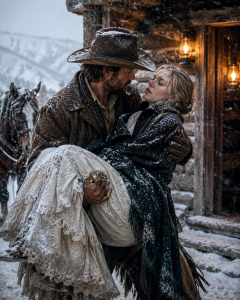
Luke cursed under his breath and didn’t waste time thinking past the next hour. He tore off his own coat and wrapped it around her, and she weighed almost nothing when he lifted her. Getting her onto Bess was the hardest part of the whole ride, the horse shifting nervous under a dead weight that wouldn’t help itself, but he managed it, climbed up behind her, and pulled her cold body in tight against his chest.
The ride back felt like the longest mile of his life. Snow struck his face like needles. He bowed his head over her frozen hair and said, low, to no one in particular, “Stay alive.” When the dark shape of his cabin finally appeared through the storm, it looked like something closer to a miracle than a building he’d cut and stacked himself two winters back.
He half carried, half dragged her inside, and the door shutting behind them cut the storm off so completely it felt like a different world. He laid her on the bearskin rug in front of the cold hearth and struck a match with shaking hands until the kindling caught and warmth started climbing the walls. Whiskey between her lips got a weak cough out of her, then a swallow, and Luke let out a breath he hadn’t known he was holding.
“That’s it,” he muttered. “You fight now.”
The storm kept howling outside for three days straight, burying the door halfway up the frame, rattling the single window under the weight of ice. The world beyond the cabin walls simply stopped existing. Inside, Luke worked through that first night cutting away her frozen boots and stockings with careful hands, turning his face aside when he had to peel the torn coat and damp silk off her, because leaving her in wet cloth would kill her as surely as the cold outside would. He wrapped her in every blanket he owned, melted snow by the fire, and worked warmth back into fingers gone red, then a deep, frightening purple. She winced even unconscious.
Near dusk her eyes opened — the color of a winter sky — and she gasped and tried to sit up, panic flashing bright across her face at the sight of a scarred stranger kneeling over her.
“Easy,” Luke said, hands raised. “You’re safe.”
“Where am I?” Her voice came out dry and thin.
“My cabin. Found you in the snow near a wrecked carriage.”
Her eyes moved fast around the rough log walls, the rifle mounted over the door, the man himself, and settled on something close to fear. “My carriage,” she whispered. “The men. Were there men?”
“Just you and a dead horse.”
She went quiet at that in a way that told him more than an answer would have. Later, when she’d managed a little broth from a tin cup, she said her name was Anna.
Luke knew before the word had finished leaving her mouth that it wasn’t true. Out here, though, a person had a right to their own secrets, at least for a while, and he let it lie.
—
## PART 2
The second night, the storm reached its full fury, wind striking the cabin walls like fists. Luke slept on the floor near the door, as was his habit, and gave her the bunk. Sometime past midnight, she started murmuring in her sleep, restless words that made him sit up in the dark.
“No. Not his. It’s not yours.” A pause, then, clearer: “Langley. They took it. They took everything.”
Luke frowned into the dark. *Langley* wasn’t a name that meant nothing in this territory — it was the largest ranch in it, half the valley carrying that brand. Before he could turn the thought over any further, she cried out and jerked upright, eyes wide with a terror the storm alone hadn’t put there.
He crossed the room and steadied her by the shoulders. “You’re dreaming. It’s just the storm.”
Slowly the panic drained out of her, and she leaned into him, trembling, her head coming to rest against his chest without either of them deciding it should. Luke hadn’t held another person in years. He didn’t move away.
By morning the lie had already started cracking under its own weight.
“My name is Victoria,” she said quietly, watching him fry salt pork at the hearth.
“Victoria,” he repeated, and something in the word sat truer on her than *Anna* ever had.
Over the day that followed, trapped inside four walls with nowhere else for either of them to be, she told him the rest in pieces. Her father had died two months back and left her his ranch outright. His foreman, a man named Morgan, believed — or claimed to believe — that Arthur Langley had promised the land to him instead, verbally, with no witnesses left living to say otherwise. When she’d refused to sign it over, the trouble had started slow and then all at once. She’d been riding for Bozeman to file her father’s real will with the territorial marshal — a filing that, under territorial probate law, had to happen within a fixed window or a competing claim could be recorded and stand unchallenged until a court finally got around to sorting it out months or years later — when armed men had run her carriage off the trail.
Luke listened without interrupting. He knew men like Morgan. He also knew, better than he wanted to admit, what it looked like from the inside to leave a place behind rather than face what was owed there.
“Do you understand what I’m telling you?” she asked when she’d finished.
“I know about gunfire,” he said. “And I know about leaving places behind.”
That night, wolves started circling the cabin, their howls sharp and close enough that the mule screamed in the lean-to. Luke grabbed his rifle despite the ache already settled deep in his shoulder from two days of hard riding.
“Stay inside,” he told her, and stepped out into blue twilight where gunshots cracked and snarls tore the air, and didn’t come back in until the wolves had scattered — bleeding, one bite already blackening at the edge where a wolf’s teeth had caught his forearm before the animal died.
—
## PART 3
Victoria didn’t panic at the sight of him. She cleaned the bite with whiskey, threaded his heavy needle with steady hands, and stitched the wound closed while he sat gritting his teeth by the fire — the same steadiness, he noticed, that had let her lie still and freezing rather than scream when he’d first found her, and it told him something about the woman underneath the borrowed name. Their eyes met in the firelight while she worked, and something shifted between them that neither one named out loud.
The storm broke on the third morning, but the danger hadn’t. Luke rode to the ridge to check the valley entrance and saw them from high ground — six riders moving slow through deep snow, men who hadn’t come to check on a lost carriage. He followed at a distance and retrieved a leather saddle tag one of them had dropped along the trail, the name burned into the leather enough to make his jaw tighten.
*Morgan.*
He raced back to the cabin. “Six riders. They’ll be here by dark.”
Victoria stared at the tag and went pale in a way that had nothing left to hide behind. “My name is Victoria Elizabeth Langley,” she said finally, the whole truth settling heavy in the room between them. She wasn’t a rancher’s daughter running from a wreck. She owned the largest spread in the territory, and a man wanted it badly enough to have already tried killing her once for it.
“That name change what I’m willing to do about those riders?” Luke asked.
“No,” she said. “I only wanted you to know it before they came.”
By dusk, the riders had the cabin surrounded. Morgan’s voice carried across the snow, easy and confident in the way of a man who’d never once had to answer for what he did in weather like this. “Send the woman out and you live, Callahan.”
“She’s not coming out,” Luke answered from behind the log wall, and the gunfire started before the echo of his own voice had finished.
Logs splintered. One man fell to Luke’s rifle before he’d even cleared the treeline properly. Another dropped in the doorway when Luke burst out and fired point-blank, the cold biting less than the fear did in that moment. Victoria loaded cartridges with shaking hands and passed rifles back and forth as fast as he could empty them, the cabin turned fortress around the two of them. After two men lay dead in the snow, Morgan pulled the rest of his riders back.
“This ain’t over!” he shouted into the frozen dark. “We’ll be back.”
When the silence finally settled, Victoria looked at Luke like she was seeing him fresh. “You killed them.”
“They came to kill you,” he said, reloading slow, his face gone hard in a way she hadn’t seen yet. “I ain’t no hero. I’ve done this before.” He said it plain, no more dressing it up than he’d dressed up anything else since pulling her out of the snow. Years back in Kansas, he told her, he’d shot a man over a land dispute — a foreman, same as Morgan, though he didn’t say the name yet — and run north afterward to build something small enough that nobody would ever come asking about it.
Victoria listened. She didn’t pull away, not that night, sitting close enough beside him at watch that their shoulders touched while two bodies froze under the stars outside. But something in the way she went quiet afterward told him the reckoning on that story wasn’t finished — only postponed, the way most hard things got postponed in a blizzard, because there wasn’t room yet to feel the whole weight of it.
Morning came cold and clear, the sky bright and cruel like the storm had never happened at all. The two dead men still lay half buried outside. The fight wasn’t over, and both of them knew it.
“They’ll come back,” Luke said.
“Then we don’t wait for them here,” Victoria answered, steady now in a way that had nothing left of the frightened woman he’d carried in over his shoulder three nights before. Morgan knew where the cabin was. Staying meant waiting to be picked off on ground he’d already scouted.
“We go to your ranch,” Luke decided. “Walls, food, shelter — and the one place he won’t expect us to run toward instead of away from.”
He buried the dead men in deep drifts without prayer, packed what little food and ammunition remained, and they rode out at first light, Victoria in the saddle and Luke mounted behind her despite the pain already burning hot up his wolf-bitten arm. The journey was brutal — snow swallowing the trail, wind cutting through every layer, fever starting to climb in him with every mile, the bullet-free but battered shoulder throbbing with each stride of the horse. Victoria felt his strength failing by degrees and said nothing about it, because there was nothing to say that would have made either of them stop.
They reached the Langley ranch at sunset — a wide valley, a large house standing silent, smoke rising steady from its chimney. Morgan was already inside, comfortable in a place that wasn’t his.
Luke hid the horses in an aspen grove near the barns. “You stay here,” he told her.
She followed him anyway.
They crept close enough to catch voices through an open parlor window. Morgan was laughing, easy and unhurried, the same tone he’d used shouting threats into the dark the night before. “The girl died in that storm,” he was saying to someone unseen. “Soon as the pass clears proper, I’ll have the new will filed with a judge who owes me a favor bigger than his conscience. Arthur Langley left the ranch to me. That’s the story, and there’s nobody left breathing to argue different.”
Victoria’s hands closed into fists at her sides.
“They’re erasing me,” she whispered.
Before Luke could stop her, she stepped out of the shadows into the yard.
“Morgan,” she called, her voice ringing clear across the open ground.
The front door burst open. Morgan stood in it with a rifle already in hand, shock plain on his face for exactly as long as it took him to recover his composure. Luke was already running after her, and the shooting started before either of them had covered half the distance to the porch.
Luke fired first, dropping the man closest to the door. Inside the parlor, chaos broke loose — another rider went down — while Morgan returned fire from the porch itself. A bullet caught Luke high in the shoulder, spinning him half around, blood spreading fast across his coat. Morgan laughed, stepping closer, unhurried the way a man gets when he thinks the fight’s already decided.
“You again, Callahan,” he sneered. “Still killing foremen.”
Victoria froze at the word.
Morgan’s smile turned cruel when he saw it land. “This man killed your father’s foreman ten years back. Shot Abe Selby dead in Kansas before he ever crawled up here calling himself a rancher. I replaced Selby myself, after. Small territory, this business. Word travels.”
The air went out of the yard. Victoria stared at Luke. “You killed him. Abe Selby — you knew my father’s name from the start and never once said it.”
“It wasn’t like that,” Luke managed through the pain, “and I didn’t know your father’s name till you said Langley in your sleep. Selby drew on me over a fence line dispute that wasn’t even mine to fight — I was hired help same as he was, and he came at me first with a gun already clear of the holster. I ran because a dead man’s kin don’t much care whose gun cleared leather first, only that their man’s the one in the ground.”
There wasn’t time for her to answer that. Morgan raised his revolver to finish what the first shot had started. Victoria moved without thinking — grabbed the iron poker from the parlor hearth through the open door and threw it hard enough to catch Morgan’s arm and send his shot wide. Luke lunged, too weak to make it count, and Morgan threw him off easily and brought the gun back level. Victoria hauled Luke through the door and out into the snow as bullets chewed the wall behind them, dragging him toward the horses barely conscious, and didn’t stop until the ranch house was well behind them and the hills had swallowed their tracks.
That night, in a hollow between pine trees, she held him while fever burned through his body and the wolf bite went black at the edges with infection. She tore strips from her own dress to bind the shoulder wound tighter.
“You can’t die,” she whispered, cradling his head against her chest. He murmured broken pieces of Kansas and a fair draw that no one but him had ever heard the whole truth of.
“Tell me the rest,” she said, low, while he drifted in and out. “Not for Morgan’s sake. For mine.”
What came out of him in pieces over that long, half-conscious night was plainer than the version Morgan had thrown at her like a weapon: a hired hand’s dispute over a fence line that wasn’t his to fight, a man twice his size going for a gun first, and twelve years of running not because he’d done wrong exactly, but because he’d never once let himself find out whether a court would have called it wrong or not, and running from the question had felt safer than an answer either way.
“I believe you,” Victoria said finally, somewhere near dawn, “and I’m still angry you let Morgan be the one to tell me instead of you. That’s a different thing than not believing you, but it’s real all the same.”
“I know,” Luke said. “Wasn’t sure yet how to say a thing I’d spent ten years making sure nobody asked me about.”
“Next time,” she said, echoing something neither of them had said aloud before but both understood anyway, “say it before somebody else gets the chance to say it uglier.”
She stayed awake until the first light touched the mountains, and when it did, he was still breathing.
They rode back to the ranch at sunrise. Victoria no longer ran from anything. She walked straight toward the house with Luke’s revolver in her hands, steadier than her voice had been three days earlier in a snowdrift.
Morgan stepped onto the porch, unbothered, almost amused. “You came back to beg?”
“I am Victoria Elizabeth Langley,” she said, clear enough to carry across the whole yard. “This land is mine. Leave.”
Morgan laughed and swung his gun toward Luke instead, who’d staggered up from the trees behind her, unarmed and bleeding out slow. The shot came fast. Luke went down hard on the porch steps, and Morgan turned the gun toward his head to finish it.
Victoria remembered, in the half-second she had to remember anything, her father’s voice from years back on a hillside with a borrowed pistol in her hands: *Do not pull. Squeeze.*
She squeezed.
The shot cracked through the whole valley. Morgan’s cruel smile emptied out of his face as he looked down at the red spreading fast across his own chest, and then he folded forward into the snow and didn’t move again. The men still standing with him broke and ran without a backward look.
Victoria dropped the revolver and went to Luke. He was alive — barely. She dragged him inside her father’s house, cleaned his wounds with whiskey, wrapped them in clean linen pulled from her mother’s chest, and fought his fever for days straight without once leaving his side.
When the territorial marshal finally rode in weeks later, he found Morgan’s body under rock and ice where the thaw had started giving up its secrets, and Victoria seated calm at her father’s desk with the ledger open and the forged will laid out in front of her, its false signature plain against the genuine one filed properly at last in Bozeman. Luke sat out on the porch through the questioning, pale and diminished, both arms damaged past full repair.
“He saved my life,” Victoria told the marshal, twice, until it was written down exactly that way. The law declared the Langley ranch hers outright, the forged will struck from any standing it might otherwise have claimed.
Spring came slow that year. Snow melted, rivers broke loose, green pushed up through ground that had spent a hard winter frozen solid. Luke healed, though not completely — his right arm never got its full strength back, the fast draw that had once kept him alive in Kansas gone for good, the wolf bite leaving his left arm scarred and tight in cold weather for the rest of his life. He wasn’t the gunman he’d been anymore, and there were mornings that cost him something to accept it.
Victoria rebuilt the ranch around both of them. Old hands came back. Fences got mended. Cattle filled the fields again, and the house kept its bullet holes rather than plaster over them, because she’d decided they were part of its story now and not something to be ashamed of.
One evening Luke saddled Bess quiet in the barn, meaning to leave before either of them had to say the words out loud.
“I brought you nothing but blood,” he said when she found him there, his hand already on the girth strap.
“You brought me life,” she answered, and took his broken hand and pressed it flat over her own heart. “You stayed the whole winter when you could’ve run the first night I woke up scared of a stranger in his own cabin. You told me the truth about Kansas, even angry, even late. That’s enough, Luke. It’s more than enough.”
He didn’t leave.
Months later, they rode together across golden hills in late summer, the land alive in every direction the eye could reach. Luke looked over at her and shook his head, something close to a real smile pulling at his mouth.
“Didn’t know I was saving the richest woman in the territory,” he said.
Victoria guided her horse closer until their knees touched. “You didn’t,” she said gently. “You just saved me. The rest was only ever paperwork.”
They rode on beneath the wide Montana sky — two people who’d survived a winter that had tried to take everything from both of them, and had chosen, in the end, to keep each other instead.
**THE END**