A Little Girl Hid Under Cardboard and Begged a Mafia Boss to Save a Baby—Then He Noticed Her Necklace

PART 1
There are three minutes at the end of every Tuesday night that belong only to Dario Fera.
He has never explained them to anyone in the organization. He has never needed to. The people around him have learned, over eight years of reading the specific temperature of his silences, that the walk from the rear exit of Cavendish to the waiting car is not negotiable. Three minutes in the alley behind the restaurant. Three minutes where the city keeps going and no one calls him boss and no one reminds him what he is.
He is not entirely sure, himself, what he does with the three minutes.
Standing, mostly. Feeling the cold air do what cold air does to a man who has spent four hours in a room where everyone is performing for him. Chicago in December has a particular quality of dark — not the dark of absence but the dark of presence, the lake pushing something cold and wide through every alley, every gap between buildings.
Tonight it had been a territory dispute. Six men in good suits agreeing to terms they had already decided to accept before they arrived, the ritual of resistance necessary for their own dignity. Fine. He understood the ritual. He had been watching men perform it at his father’s table before he could read.
He buttoned his overcoat and stepped into the alley.
Then he heard the baby.
His hand went inside the coat before thought arrived, the reflex of eleven years — fingers closing around the grip, body already turning toward the sound, because in his world no sound was neutral and nothing came from nowhere.
The cry was weak. It came from behind the industrial dumpster at the alley’s far end, where the yellow light from the kitchen exhaust fan didn’t reach.
He moved closer.
Slowly. Silently.
He lifted a piece of wet cardboard.
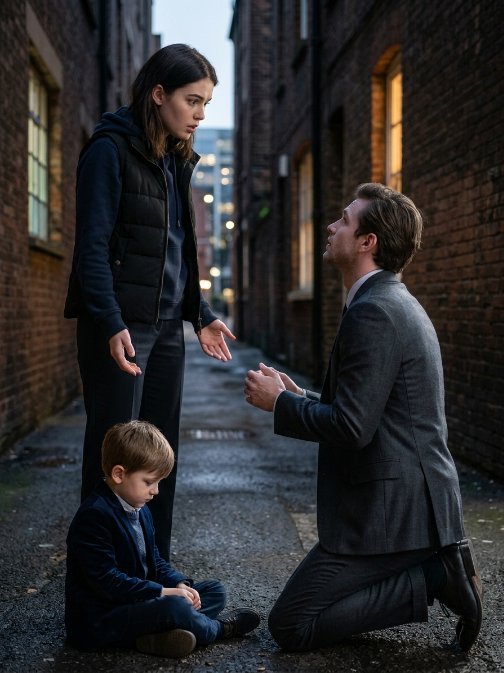
A girl looked up at him.
Seven years old, possibly eight — small enough that the size was hard to read in the dark. A torn coat. Dark hair plastered to her face by the cold. Lips so pale they were nearly colorless. And in her arms, wrapped in something gray and filthy, a baby. Newborn-small. Eyes shut. Chest moving in the shallow, uneven way of a body working very hard to stay above a threshold.
The girl did not scream.
She did not scramble back.
She only pulled the baby tighter against her chest, the motion of someone who has decided that if anything is going to take this child, it will have to remove her first.
For a moment, Dario Fera stood in a Chicago alley holding a piece of wet cardboard and experienced something he had not felt in a very long time.
He had no calculation.
“What’s your name?” he said.
Her eyes searched him. He could see the evaluation happening — the coat, the posture, the gun-shaped weight under his arm she was too young to name but old enough to sense.
“Isa,” she said.
“And him?”
She looked down at the baby.
“Luca.”
“Where’s your mother?”
Isa looked away.
He understood the shape of that silence. He had lived inside it for years.
He stripped off his overcoat and wrapped it around both of them. Then he pulled out his phone, and his hand was shaking, and it had not shaken in public since the morning he identified his sister Mara in a hospital in Kenosha three years ago.
“Gio,” he said when the driver answered. “Bring the car. Right now.”
The Bentley came and they rode through the snow toward Lake Shore Drive, heat blasting through every vent, and Isa sat with her back against the door and her arms locked around Luca and did not look at the city or at Dario. Only at the baby’s face.
He called Dr. Nadia, who had been managing the private health concerns of the Fera household for six years and who answered at any hour without complaint.
“I need you at the house. An infant — maybe eight weeks. Hypothermia, shallow breathing. A child with him. Bring everything.”
“I’m coming,” she said.
The estate sat back from the lake behind an iron fence, white stone under snow, every window burning gold in the dark. Gio swept through the gates without slowing.
Sandro Vieri was waiting in the entrance hall.
He was forty-two, lean, unhurried, with the kind of face that had learned to present exactly what a room needed to see. He had stood at Dario’s right hand for twelve years. He knew the name of every man Dario trusted, every door Dario used, every hour Dario kept.
His eyes moved from Luca to Isa.
They lingered on her face for a moment that lasted slightly too long.
A calculation. A recognition. Quickly adjusted.
Dario saw it.
“I’ll have rooms prepared,” Sandro said.
“Already handled,” Dario said, though it wasn’t.
He carried Isa upstairs himself.
Dr. Nadia arrived within forty minutes. She worked through the night on Luca — temperature, pulse, color, breathing — and when she finished, she swaddled him in clean blankets and placed him under a warming lamp and said, “Another hour in that alley and you would have been looking at a different outcome.”
Isa did not sleep. She refused food and would not let Luca out of her sight until his breathing had steadied into something that sounded certain. Then exhaustion simply took her — mid-watch, her head sliding sideways, her hand stretched through the crib rails to rest on his blanket.
Dario stood in the doorway for a long time.
He had not cried when they buried Mara.
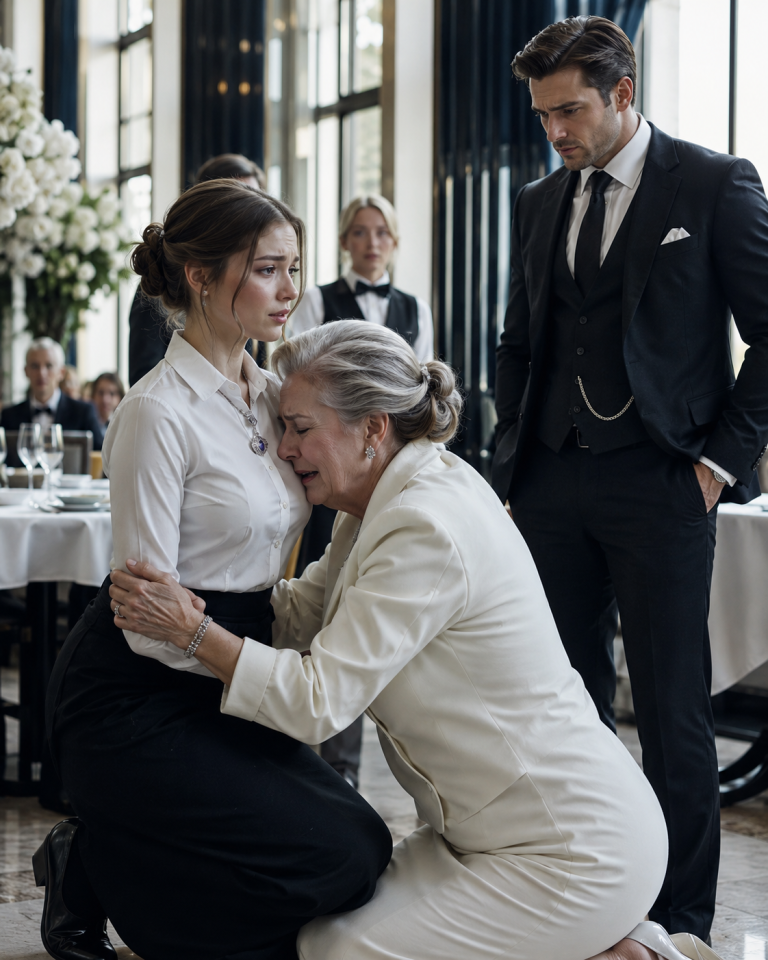
He had stood at the graveside in a black suit and watched the Chicago winter take her, and he had not cried, because grief in his world was something you converted into action or you buried it or it consumed you, and he had chosen to bury it, and for three years that had worked well enough.
He did not know what to do with the feeling that was moving through him now.
At dawn, Isa woke the way children wake when they have learned that sleeping too deeply is a risk — all at once, already sitting, already checking.
She went straight to the crib. Gripped the rail. Watched Luca’s chest.
When she was certain, she began to sing.
Something in Italian. Not fluent — the Italian of a child repeating sounds heard from someone beloved, the shape of the language present even where the words weren’t quite right. Dario, who had been awake all night in the leather chair at the end of the hall, stood up and followed the sound without deciding to.
He stopped at the door.
He knew that lullaby.
His mother had sung it. Mara had sung it to herself the winter she was sixteen and thought no one was listening.
He could not speak for a moment.
Isa turned.
“He’s warmer,” she said. “But still cold.”
Dario forced air into his lungs.
“Are you hungry?”
—
PART 2
He made breakfast while the cook was still sleeping.
Toast. Eggs. Warm milk. He set the plate in front of her at the kitchen island and sat across from it and watched her eat with the deliberate economy of a child who has learned that meals are not guaranteed. After a few bites she folded part of the toast and slipped it into her dress pocket.
“You don’t have to do that,” Dario said. “There’s more.”
Isa looked at the pocket.
“Just in case,” she said.
He did not argue.
“Isa. Do you have a last name?”
Her forehead creased.
“Mama said I shouldn’t.”
“Your mama — where is she?”
Isa set down her fork.
“She got sick last week,” she said. “She didn’t wake up. Then a man came. He said he was helping. He took me to a house with other children. Then two days ago he gave me Luca and said to hold him, don’t let anyone see, don’t tell, just walk.”
Dario kept his face still.
“What did this man look like?”
“Tall. Nice shoes. A watch that shone.”
Her hand drifted to the front of her dress. He noticed a shape beneath the fabric — something small and flat, close to her chest.
He said nothing about it.
Not yet.
At 9:07 that morning, a black SUV came through the outer gate without slowing and two of his men were down in the snow before the car had stopped.
Dario moved fast, took the stairs two at a time, found Isa standing frozen at the top of them with Luca in her arms. She hadn’t screamed. That frightened him more than the sound of the windows going.
He swept both children into the east-wing safe room, set Isa down inside it, told her to stay, locked the steel door, and went back.
The firefight was brief. His men were better prepared for violence at close range than whoever had come through the gate. When it was over, he walked out into the snow and crouched beside the nearest body.
On the dead man’s wrist was a watch.
On the underside of the band, a mark: two interlocking lines forming a symbol he recognized from six months of border disputes and port negotiations.
Roland Pace.
His rival. The man who had made eight figures disappear through shell companies, whose name appeared in three federal investigations without ever being charged, and with whom Dario had maintained a careful, costly peace for two years.
Sandro appeared at his shoulder.
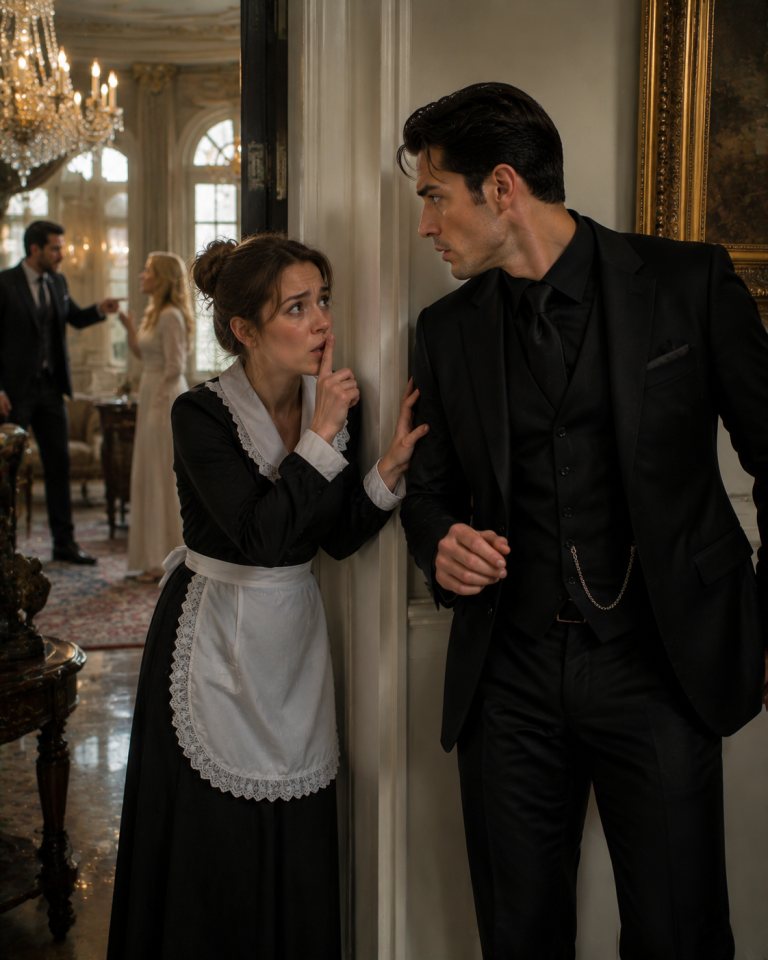
“Send them away,” Sandro said. “The girl and the baby. Whatever this is, it came with them.”
Dario looked at the house.
Behind a steel door, a child sat in the dark holding a baby she had refused to set down.
“No,” he said. “They stay.”
Sandro’s jaw moved once.
“As you say,” he said.
Dario turned away.
And for the first time in twelve years, he decided to look at the man beside him.
Cass Whitfield arrived at noon in a truck that looked wrong beside everything else in the driveway.
Fifty years old. Former Chicago PD homicide. Pushed out four years ago when he got too close to Pace’s money trail. Now he worked the cases that couldn’t go through official channels.
Dario told him about the alley, the children, the attack, and the watch.
He didn’t mention the shape under Isa’s dress.
He wanted Cass to see her first.
They found her upstairs, building a tower from sugar cubes on the floor beside Luca’s crib.
Cass sat down on the rug.
He was six feet one and broad-shouldered and he folded himself onto the floor beside her with the unhurried ease of someone who had spent decades talking to people who needed to not feel crowded.
“My name is Cass,” he said. “I used to find people.”
Isa watched him.
After a moment, she pushed one sugar cube across the floor toward him.
He took it without comment.
He spoke to her for nearly an hour — about the snow, about whether she liked drawing, about Luca’s sleep schedule. Then, piece by piece, she began to talk.
She and her mother had lived in Bridgeport. A man in their building named Mr. Sorrel had lived downstairs. One night, through a closet door, she had seen three men hurt him. He had crawled. He had written something on the floor with his blood.
“He wrote numbers,” she said. “I was scared. But Mama said to remember important things. So I wrote them down before the numbers washed away.”
Cass went very still.
“Can I see what you wrote?”
Isa reached into the front of her dress and pulled out a small leather notebook.
Cass opened it.
His face changed on the third page.
Twenty-three digits. A child’s careful handwriting.
He looked at Dario.
“This is an access key,” he said. “Specifically, the master key to a private clearinghouse called the Meridian Network — the accounting layer beneath the accounting layer. Cartels, weapons brokers, bought officials. Mr. Sorrel was apparently their accountant.”
The room was very quiet.
“Whoever holds this key,” Cass said, “can move money, freeze accounts, expose names. Pace has been hunting it for seven months.”
Dario looked at Isa.
At the sugar cube tower.
At a seven-year-old child who had copied down a dying man’s message because her mother had told her to remember important things.
“Does anyone else know she has it?”
“You, me, her,” Cass said.
“Keep it that way.”
That night, Dario sat with Isa in the library while Luca slept upstairs.
She was sounding out words from a picture book about an animal that got lost and found a home.
“For-est,” she tried.
“Forest,” Dario said.
“Forest.” She said it again, satisfied.
When she finished the last page, she looked up at him. Not the evaluation she had given him in the alley — this was something less guarded.
Later, after she fell asleep beside the fire, he stood over her with a blanket.
The firelight found the angle of her cheekbone. The curve of her jaw.
He stood there for a long time.
Sandro had told him Mara died in a car accident in Kenosha. That was the report. That was what Dario had buried, because the alternative — that someone had reached his sister and he had not been fast enough — was something he had refused to survive.
Now he stood in his own library looking at a child who sang Italian lullabies she had learned from someone she called Mama, and the shape of a question he was not ready to ask was beginning to form.
The next morning Isa drew a house.
Small windows, round-topped. A wooden porch. Pine trees behind the roofline. Window boxes.
Dario recognized it.
He had grown up hearing stories about that house. A small property in Wisconsin that Mara had rented for a summer, before she fell in love with the wrong man and their father drew a line, and Dario had watched her cross it and said nothing and spent three years carrying the weight of that silence.
“Where did you see this house?” he asked.
Isa looked at the drawing.
“I don’t think I saw it,” she said. “I just know it.”
Then she moved and her collar shifted and a pendant slipped free of her dress.
Silver. Small. A butterfly.
He reached forward with one careful finger and turned it over.
On the underside of one wing, an engraving.
*M.*
He had given Mara that necklace on her twenty-second birthday. He remembered it precisely — he had picked it up at a shop on Wabash because she had mentioned once that she liked things small enough not to be noticed.
The air left the room.
“That’s pretty,” he said, and his voice was almost steady. “Where did you get it?”
“Mama gave it to me,” Isa said. “She said it came from someone who loved us and would have looked for us if he’d known.”
Dario set down the coffee cup he was holding.
Set it down very carefully.
He went to find Dr. Nadia.
That evening, Nadia began a blood comparison.
She asked for a sample from Dario and from Isa. She ran it against what she had from Mara’s medical records — records she kept for the household the way she kept everything, quietly, without being asked.
While she worked, she told him something else.
About Luca.
“This child wasn’t neglected,” she said. “He was in regular medical care until forty-eight hours before you found them. Clean. Nails trimmed. Someone used sterile technique on a vaccine site on his upper arm. This isn’t an abandoned baby.” She paused. “He was placed.”
Dario waited.
“Someone knew the girl would stay put if she was holding something that needed her. Someone knew she would walk exactly where they wanted her if the stakes were high enough.”
The safe house attack came four hours later.
Before the results did.
—
PART 3
He moved them in the night — Isa, Luca, Nadia, Gio — to a three-room apartment in Pilsen that existed under no name he had ever used. Two exits. A fire escape. A courtyard that Cass had swept himself before they arrived.
He told four people the new address.
His lawyer.
His cousin.
His head of security.
And Sandro.
Sandro alone he told something different: a property in Evanston, a house near the lake that Dario owned under a trust, that he had never used and had no plan to use.
“I’ll move them Friday,” Dario said. “Midnight. Just you and me.”
Sandro placed one hand over his chest.
“No one hears it from me,” he said.
Dario put his hand on Sandro’s shoulder.
“You’re the only one I trust,” he said.
The words tasted like rust.
Two nights later, Cass called from the Evanston property at 1:40 a.m.
“You were right,” Cass said.
Three men. The property was being watched. They had moved in when the lights came on — timer lights Dario had set before driving away, the oldest trap there was, and Sandro had walked them straight into it.
“Where is he?” Dario said.
“Still there,” Cass said. “He came himself. I think he wanted to be sure.”
Dario drove.
The Evanston house sat on a corner lot, old brick, two stories, the lights burning amber behind the curtains. On the lawn, three of Pace’s men were zip-tied. Cass stood at the gate with his hands in his pockets. Two of Dario’s men flanked the front door.
Sandro was inside.
Not with Pace’s people.
Not with Dario’s.
For himself.
Dario walked in alone.
The front room smelled of smoke from a toppled lamp. Sandro stood in the hallway with a gun at his side, and in the moment before anything was said, Dario saw something he had not seen in twelve years of working beside this man.
Fear.
“You knew,” Sandro said.
“Long enough.”
“How?”
“You looked at her face,” Dario said. “The first night. You adjusted.”
Sandro laughed — short, hollow.
“I didn’t expect the resemblance to be that strong. She has Celia’s coloring but she’s—” He stopped.
“Say her name again,” Dario said quietly.
“Celia Novak. Your singer from the West Village. The woman you spent four months in love with before she disappeared.” Sandro’s jaw worked. “I took her. I had reasons at the time that seemed like strategy. She was a liability — you were letting her see things, hear things. I moved her. Held her in a property in Waukegan. She gave birth there.”
The house was very quiet.
“Mara found her,” Sandro continued. “I don’t know how. Your sister had contacts I never fully mapped. She took Celia and the child and moved them to Wisconsin. I found the property two years later. By then Celia was sick — the kind of sick that happened to people who’d spent eight months under the conditions I’d arranged.” He looked at the floor. “Celia died before I could get to them. But Mara was there.”
“The accident in Kenosha,” Dario said.
“There was no accident,” Sandro said.
Dario’s breathing went very even.
“Mara was bringing Isa to you,” Sandro said. “She had figured out the whole story. She was going to bring you the child and the evidence. She had a meeting point arranged. I found out through a contact of hers who didn’t know which side they were really on. I intercepted her on the road.” He paused. “She knew. Before the car — she knew what was happening. She didn’t run.”
The room moved slightly, in the way rooms moved when the ground beneath them had changed.
“And Luca?”
Sandro looked up.
“Celia had a sister. She gave Luca to the sister to keep until Isa could be placed. The sister died in the fall. Celia’s arrangement was that if anything happened to her — to any of them — Isa was to go to Don Treviso with the baby and be put in Dario Fera’s path.”
“You arranged Isa’s path,” Dario said. “The house with the other children. The instruction to walk.”
“I needed the key,” Sandro said. “I’d been trying to get the Meridian key for Pace for eight months. When Sorrel died and I understood what the girl had seen — what she’d written down — I needed her in your house. I thought you would keep her at arm’s length. I thought I could get close enough to take what she had.”
“You put a child in an alley in December,” Dario said.
“I put a child who was already in an alley in a more directed position,” Sandro said.
The distinction didn’t help him.
Dario raised the gun.
Sandro didn’t reach for his own.
That was the last thing he did correctly.
Pace was arrested outside the Evanston property, shouting at federal agents who had arrived forty minutes after Cass made a phone call to the right desk at the right agency with the right case number. The Meridian key had been delivered at noon — hand-carried by Cass, who had spent thirty years doing things by hand when they mattered. Accounts began freezing. Names began surfacing. Three state officials stopped answering their phones.
Sandro went with the federal agents, not the lake.
That was Isa’s doing, without her knowing it — Dario had made the decision while watching her build a tower from sugar cubes, understanding that there were ways of handling things that would let him look at her in twenty years without having to explain certain choices.
He drove back to Pilsen with his shoulder bandaged and the morning coming gray over the lake.
Cass was at the kitchen table. Luca was in the portable crib. Isa was asleep on the couch under a blanket that Nadia had folded over her without waking her.
She woke when Dario came through the door.
She was across the room and into his arms before he could set down his keys.
He caught her. Held her. Pressed his eyes shut.
“You came back,” she said.
“I said I would.”
She pulled back and looked at his face with the assessing eyes of a child who has learned that adults’ faces are where the truth lives.
“Are you hurt?”
“A little. I’m all right.”
She looked at the bandage on his shoulder.
“More than a little,” she said.
He almost laughed.
—
The DNA results had been waiting in Nadia’s phone for six hours.
She pulled him aside while Isa was feeding Luca.
“The comparison to Mara’s sample,” Nadia said. “There is a connection. Strong. Closer than I initially expected for aunt and niece, which is why I ran an additional comparison.”
Dario looked at her.
“Against my sample,” he said.
“Yes.”
The silence lasted a moment.
“Celia Novak,” Dario said.
“I don’t need a sample from her,” Nadia said quietly. “The result is clear.”
She showed him the page.
He read it.
He read it again.
Then he sat down on the hallway floor, which was not something Dario Fera did, and for a long time he didn’t speak.
Mara had known.
She had found Celia and the child and she had protected them for three years, in a house with round windows and a wooden porch, and she had been bringing the truth to him on a road in December and she had died on the way there.
She had never gotten to tell him.
But she had put the necklace around the child’s neck before she left.
She had put his initial on it.
And sent her toward him anyway.
He found Isa in the kitchen with Luca on her lap, both of them looking out the window at the courtyard where a sparrow was doing something on the top of the fence.
“Isa,” he said.
She turned.
He sat in the chair across from her.
“I need to tell you something,” he said. “Something your mama wanted you to know when it was safe.”
She went still in the way she went still when things mattered.
“The woman who took care of you before your mama got sick,” he said. “The one she called Mama Mara.”
Isa nodded.
“She was my sister,” Dario said.
Isa’s hand went to the butterfly necklace.
“And your mother,” he said, “was someone I loved, a long time ago, before she disappeared and I didn’t know why.”
He watched her process this.
“She disappeared because someone took her away,” he said. “The same person who hurt Mara. I didn’t know any of it until now. I spent three years thinking Mara died in an accident. I didn’t know you existed.”
Isa’s lower lip trembled.
“Did you look?”
The question arrived the way children’s questions arrived — without any attempt to soften it, straight to the marrow of the thing.
“I didn’t know to look,” he said. “I am so sorry. If I had known—”
“Mama Celia said you would have looked,” Isa said. “She told me. She said you would have turned the city over.”
Dario’s eyes filled.
He had not cried at Mara’s funeral.
He had not cried when they told him Elena Novak was gone and they had found no trace.
“Isa,” he said. “I’m your father.”
She looked at him.
Long enough that he understood she was comparing this new fact against everything she had already sorted and filed.
Then her hand came off the necklace and she reached across the table and put it over his.
Small. Warm. Certain.
“Mama Celia said your heart was not dark,” she said. “She said it was just waiting.”
He turned his hand over and held hers.
He did not speak for a while.
Neither did she.
Luca made a sound of mild complaint and they both looked at him, and Isa used her free hand to adjust the blanket around him, and the morning continued in the particular way that mornings continue after the worst has happened and the surviving has begun.
—
Three months later, the Fera estate no longer smelled of cigars and careful calculation.
The east-wing safe room stayed unlocked and empty. The portrait of his father that had hung in the entrance hall was in the attic. The front windows were open most days, which Dario had previously considered a security consideration and now considered unremarkable.
He had spent the winter cutting the worst of what his father’s organization had been — not all at once, not dramatically, but with the specific patience of a man who understood that you could not dismantle a structure you hadn’t built without knowing what held it up. The legitimate businesses, he held. The rest went to people who could be held accountable for it, or to federal evidence rooms, or to the bottom of Lake Michigan, depending on the category.
Cass had not gone back to retirement. He was, as he put it, “between decisions,” which meant he ate at the estate three nights a week and let Isa teach him card games he pretended to be bad at.
Nadia came every Tuesday. Luca was thriving in the specific way of babies who have been thoroughly frightened into good health — round-cheeked, loud, unimpressed by his own survival.
And in April, Dario drove them to Wisconsin.
The house had been empty since Mara’s death. He had arranged for it to be maintained — the same groundskeeper, the same window boxes, the same blue door she had painted the summer she lived there. He hadn’t been able to say why he’d kept it up. Now he understood.
They arrived at dusk.
Isa stood on the porch for a long time, looking at the pine trees, at the window boxes, at the particular shape of the roofline she had drawn from memory in a house she had never consciously been to.
“I knew it,” she said. “I did know it.”
“You were here,” Dario said. “When you were very small. You wouldn’t remember.”
She looked at him.
“Mama Mara brought me here?”
“She lived here for a while. With your mother. And you.”
Isa turned back to the trees.
The last light was going, the sky doing the thing it did in Wisconsin in April — turning colors that seemed implausible until they happened, rose and violet over the pines.
Luca was asleep inside in the portable crib, Nadia reading nearby, the sound of a warm room visible through the window glass.
“Dad,” Isa said.
The word landed in him the same way it always did — not like a title but like something physical, a small weight settling in the center of his chest.
“Yes.”
She pointed at the first star appearing.
“Is that one for them?”
He stood beside her and looked up.
“Yes,” he said. “That one.”
She leaned slightly against his arm.
He put his hand over hers on the porch rail, and she turned her palm up and held it, and they stood there while the stars came out one by one over the Wisconsin pines and Luca slept warm inside and the house that had been waiting held them without ceremony or requirement — simply held them, the way places hold the people they were built for, without needing to be asked.