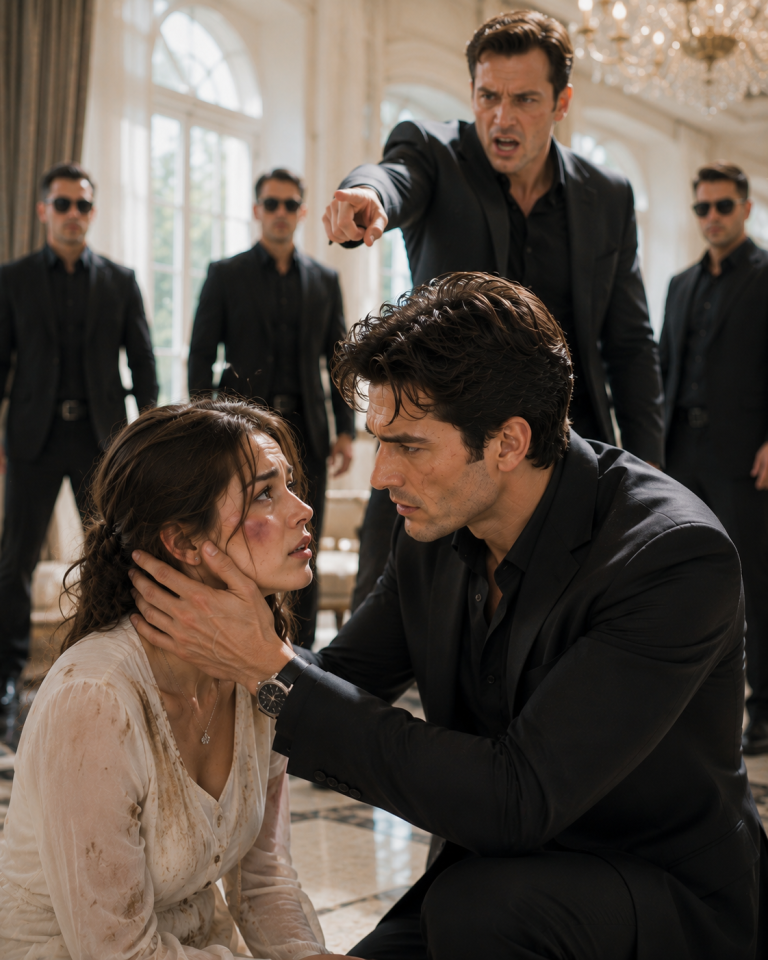
A TRAUMA NURSE DEFIED HER CHIEF OF SURGERY’S ORDER TO LET THE CITY’S MOST FEARED MAFIA BOSS DIE ON HER TABLE — WHAT SHE FOUND HIDDEN IN THE HOSPITAL’S CONDEMNED WING STARTED A WAR

PART 1
The rain came down in sheets against the reinforced windows of St. Jude’s Medical Center. 2:14 a.m. on a Tuesday — the dead hour of the graveyard shift, when the world outside was supposed to go quiet.
For Clary Jenkins, it never did.
At twenty-eight, Clary was the best trauma nurse on the floor, working with a cool, mechanical precision governed by a fierce moral compass that treated every life on her table as equal, no matter what sins the person carried into the room with them.
That philosophy was about to be tested harder than any shift ever had.
The automatic doors of the emergency bay shattered off their tracks as three black Escalades crashed onto the ambulance ramp, ignoring every triage protocol in existence. Before security could even reach for their radios, a dozen men in tailored Italian suits swarmed the entrance — moving like a military unit, coats falling open just enough to reveal shoulder holsters.
“We need a doctor *now*,” bellowed Leo Rossi, a known enforcer for the city’s most dangerous syndicate. Suspended between two massive guards, coughing blood onto a ruined white dress shirt, was Nicholas Russo — thirty-two years old, undisputed head of the Russo family, a man who controlled the city’s ports, construction unions, and underground casinos. Even half-conscious, he radiated an authority that made the whole trauma bay feel smaller.
Clary didn’t hesitate. “Get him on a gurney. Trauma bay one. Move.”
She didn’t care about the guns, or the suits, or the name attached to the chart. She saw a crashing patient. She pressed sterile gauze against the worst of the bleeding on his right side, called out for O-negative blood and two large-bore IVs, and barked at the junior nurses frozen in the doorway to get moving.
That was when a hand closed hard on her shoulder and yanked her back.
“Step away from the patient, Nurse Jenkins.” Dr. Harrison Caldwell, chief of surgery and hospital administrator — a man who cared far more about St. Jude’s reputation and his own bank account than the oath printed on his diploma — looked at Nicholas, then at the mobsters filling his lobby, his face an unreadable mask.
“He has a perforated lung and possible arterial bleeding,” Clary pleaded. “He needs an OR immediately.”
“I said step away.” Caldwell turned to Leo Rossi. “Gentlemen, St. Jude’s is not equipped to handle a situation of this magnitude safely. We are instituting a lockdown. A specialized secure transport is already en route to take Mr. Russo to a private surgical facility run by our affiliates.”
Leo’s hand drifted toward his jacket. “He doesn’t have time for a joyride, Doc. You fix him here, or I paint this lobby with your brains.”
“If you shoot me,” Caldwell said, not flinching, “there’s no surgeon left to operate. Transport is five minutes out. We’ll stabilize him here with pressure dressings until they arrive. That is my final clinical decision.”
Clary stared at him in horror. Five minutes. Nicholas wouldn’t survive three.
She’d worked trauma long enough to recognize exactly what Caldwell was doing. He wasn’t stabilizing a patient. He was stalling. And then the pieces slid into place: the whispers about Caldwell’s gambling debts, the rumors that Victor “the Viper” Moretti — Nicholas Russo’s biggest rival — had been buying off officials for years. Caldwell was on Moretti’s payroll. That “secure transport” wasn’t an ambulance. It was a cleanup crew.
Nicholas’s eyes flickered open just long enough to find hers. No fear in them — only a burning, defiant rage against the dying of the light. His hand closed around her wrist, smearing blood across her skin.
“Don’t let them,” he rasped, the words bubbling with blood.
Caldwell pried Nicholas’s fingers off her. “Nurse Jenkins, wait in the breakroom. I will monitor his vitals until transport arrives.”
“He will die, Dr. Caldwell. You are killing him.”
“You are dangerously close to losing your license. I am your superior. Get out. Now.”
Security flanked the Russo enforcers, and Leo Rossi looked torn, unaware of the medical stakes, trapped between holding a gun on a doctor and trusting that same doctor to keep his boss alive.
Clary backed out of trauma bay 1, her hands stained with Nicholas Russo’s blood, the heavy doors sealing a mafia boss in with his executioner.
The clock read 2:22 a.m.
She paced the sterile hallway just out of sight, heart hammering, the rain drumming against the building like it was keeping time with her pulse. She closed her eyes, remembering the oath she’d taken the day she received her nursing pin. *I will devote myself to the welfare of those committed to my care.* There were no exceptions written into that oath for criminals.
She made her decision. If she let Nicholas Russo die on that table, she would be no better than the men who’d put three bullets in him.
Clary sprinted for the resident lounge and found Dr. Liam Hayes — brilliant, chronically anxious, first-year surgical resident — frantically reviewing flashcards.
“Liam. I need you now. Bring a mobile surgical kit and the heavy clamp set. Meet me at the service elevator in sixty seconds.”
“Clary — what? Why? I’m not supposed to—”
“A man is bleeding to death because Caldwell is stalling. If you ever wanted to be a real doctor, tonight is your night. Sixty seconds.”
She ran for the supply closet, grabbed six units of O-negative blood, and reached the electrical panel for the emergency ward. With a silent prayer, she threw the breaker.
Darkness swallowed the hallway, followed a second later by the dim red hum of emergency backup lights — and, beneath the confused shouting of Russo enforcers and hospital security scrambling in the dark, Clary Jenkins slipped through the side connecting door into trauma bay 1, where Dr. Harrison Caldwell was doing exactly what she’d expected: checking his gold Rolex, and nothing else.
—
PART 2
Caldwell startled at the power surge. Before he could react, Clary grabbed the wrench off the oxygen cart and brought it down hard across the back of his knee. He collapsed, yelping.
“You crazy bitch,” he hissed. “You’re dead. You hear me? Dead.”
Clary ignored him, released the gurney’s wheels, and shoved it toward the back exit — into the old, decommissioned east wing.
“Hey! What’s going on in there?” Leo Rossi’s voice boomed through the main doors.
“I’m saving his life! Hold the door!” She threw her weight into the gurney until she reached Operating Room 4 — stripped of modern tech, but still wired to the generator. Liam waited there, trembling, gripping a sterile tray.
“Clary — that’s Nicholas Russo. If he dies here, his men will flay us alive. If he lives, the police—”
“Stop talking and scrub in.” She heaved Nicholas onto the table. “We don’t have an anesthesiologist. I’m pushing propofol and fentanyl. You open him up, find that arterial bleeder, and clamp it. I manage vitals.”
Nicholas’s breathing rattled, terrifyingly shallow. Liam picked up the scalpel, hands shaking, and looked at her. She nodded, eyes fierce.
“Cutting now,” he whispered.
For forty-five minutes, the OR became a battleground — blood soaking through Liam’s scrubs, painting Clary’s forearms crimson, the monitor screaming as Nicholas’s heart began to fail.
“Pressure’s dropping. He’s crashing. Where is it, Liam?”
“I can’t see — there’s too much blood—”
Clary didn’t think. She reached her bare hands into the surgical cavity, navigating by pure instinct, until her fingers found a pulsing tear.
“Here — I’ve got my finger on the hepatic artery. Clamp it right above my hand.”
Liam slammed the clamp down. The bleeding stopped. The monitor climbed, sixty-five, seventy, eighty-five over sixty, his heart finding a rhythm again. Not out of the woods — but no longer actively dying.
Liam slid down the tiled wall, gasping. Clary let out a shaking breath and began suturing.
That was when the heavy metal doors of the OR were kicked violently off their hinges, and four men stormed in with assault rifles raised — led by a man Clary had never seen, cold reptilian eyes, tailored gray suit, and a name she already knew from breakroom whispers before he said a single word.
—
PART 3
### I. The Viper’s Transport
“Well, well,” the man purred, looking down at Nicholas’s unconscious body. “Dr. Caldwell said he had a rogue nurse on his hands. Seems the rat was telling the truth.”
Victor “the Viper” Moretti. Caldwell’s “secure transport” had finally arrived — and it hadn’t come to take Nicholas Russo to a hospital. It had come to finish the assassination Caldwell’s stalling had been buying time for.
Moretti raised a silenced pistol, aiming it squarely at Clary’s forehead. “You did a great job patching him up, sweetheart. But it’s time for you and Dr. Frankenstein down there to clock out permanently.”
Before he could pull the trigger, a thunderous explosion tore through the hallway. Gunfire erupted — loud, unsilenced, and deafeningly close. Leo Rossi and the Russo enforcers crashed through the adjoining scrub room windows in a storm of glass and lead. Moretti’s men returned fire, and Clary threw herself over Nicholas’s body, using herself as a human shield while bullets shredded the ancient medical equipment around them.
Ten seconds. It felt like an eternity.
When the smoke cleared, Moretti’s men lay dead on the floor. Moretti himself was bleeding from a shoulder wound, pinned to the wall by Leo Rossi, a combat knife pressed to his throat. Leo looked past his bleeding rival and found Clary still draped protectively over the surgical table — the clamped artery, the empty blood bags, the steady rise and fall of Nicholas’s chest.
“You saved him,” Leo said, his rough voice edged with something close to reverence.
Beneath her, Nicholas stirred. The sedation was wearing thin. His dark eyes fluttered open, found her face through the smoke, and held there. Slowly, he lifted a bloodstained hand and brushed his knuckles against her cheek.
“I owe you my life, nurse,” he whispered, voice dark and gravelled. “And a Russo never forgets a debt.”
Clary stood frozen as his men carefully unhooked him from the monitors to move him somewhere actually secure. She had just saved the most dangerous man in Chicago. Watching him be carried away, his eyes still fixed on hers with a predatory intensity she couldn’t name, she understood with total clarity that she had traded her quiet, ordinary life for something infinitely more terrifying.
### II. What It Cost
The fallout arrived by 8 a.m. the next morning. Clary stood in St. Jude’s HR office flanked by two armed security guards while Dr. Harrison Caldwell — knee heavily braced from where she’d struck him — sat behind a mahogany desk looking every bit the sanctimonious bureaucrat instead of a man who had nearly orchestrated a murder.
“Gross insubordination. Assault on a superior. Aiding and abetting a known fugitive.” He slid a termination letter across the desk. “I’ve already contacted the Illinois Board of Nursing. Your license is suspended pending a full criminal investigation. The police will be in touch shortly. You are finished in Chicago.”
Clary didn’t sign it. She walked out with her chest tight, rage and grief tangled together into something almost unbearable. She had done the right thing. She had honored her oath. And it had cost her everything she’d spent six years building.
Liam Hayes had already been quietly transferred to a rural clinic downstate — his career buried before it had properly begun, a casualty of a decision she had talked him into making. She carried that particular guilt for a long time afterward, long after everything else had resolved itself. The system wasn’t broken, Clary understood now, watching it close around both of them with such practiced efficiency. It was working exactly as men like Caldwell had designed it to work.
For three weeks she hid in her cramped second-floor apartment in Logan Square, draining her savings on a lawyer who seemed more afraid of the hospital’s legal team than interested in defending her. She applied for waitressing jobs, for retail jobs, for anything at all. Every background check that turned up a pending felony investigation closed a door behind her, politely, apologetically, without exception.
She called Liam once, during those weeks, unable to stand the silence any longer. He picked up on the fourth ring, his voice flat and careful in a way it had never been in the resident lounge.
“They gave me a choice,” he told her. “Resign quietly and keep my license, or fight it and lose everything. I resigned.”
“Liam, I’m so sorry. I asked you to help me. I dragged you into—”
“You didn’t drag me anywhere,” he said, and for a second she heard something of the boy who’d picked up the scalpel with shaking hands. “I chose to cut. Nobody made me do that. I just — I need some time before I can talk about it without wanting to put my fist through a wall.” He hung up gently, which somehow hurt worse than if he’d slammed the phone down, and Clary sat holding the dead line for a long time afterward, understanding that some debts didn’t have a clean way to be repaid.
The system wasn’t broken, she thought, staring at her own reflection in the dark window. It was working exactly as men like Caldwell had designed it to work.
But the real terror wasn’t the poverty, or even the guilt. It was the paranoia. Black SUVs idled across the street on Fullerton Avenue for hours at a time, engines running, no one getting out. Silent calls came at 3 a.m., the line going dead the second she answered, three nights running, then five, then every night. She started sleeping with the kitchen knife under her pillow and hating herself a little more each morning for how normal that had started to feel. Victor Moretti had survived the shootout at the hospital — and in the world he ruled, leaving a witness alive to testify against the very man protecting him was a fatal miscalculation he clearly intended to correct before it cost him everything.
Clary knew, with the same clinical certainty she once used to read a crashing patient’s vitals, that it was only a matter of time.
### III. Three Minutes
It happened on a suffocatingly humid Tuesday evening. Clary was boiling water for cheap pasta, trying to hold onto some small ordinary ritual in the middle of everything, when the deadbolt on her front door gave a sickening crack, and the door came off its hinges before she could even reach the kitchen knife on the counter behind her.
Two men stepped into her living room, unmasked, because they didn’t intend to need masks.
“Scream and I’ll put a bullet in your spine before you hit the floor,” the taller one growled, raising a suppressed pistol.
Clary froze, her medical mind hyperfocusing on the weapon almost against her will — nine millimeter, close range, massive tissue damage, unsurvivable — and then the window to her fire escape shattered inward, and a shadow detached itself from the dark.
Leo Rossi moved with terrifying, practiced violence — no shouting, just action. A combat knife into the gunman’s shoulder, pinning him to the drywall, while his other hand swept the second man’s legs out from under him hard enough that his skull cracked against the cast-iron radiator. Five seconds. The threat was gone, and the apartment was suddenly, ringingly silent except for Clary’s own breathing.
“Pack a bag, nurse,” Leo said, wiping his blade clean on the unconscious man’s jacket, breathing hard but controlled. “You have three minutes.”
“I’m not going anywhere with you,” Clary stammered, backing away toward the kitchen. “You brought this into my life.”
Leo’s stare didn’t soften. “Moretti sent these guys because Caldwell tipped him off that you’re about to be subpoenaed by the DA. He wants you dead so you can’t testify about his little delay tactics in the ER. You stay here, you die tonight. You come with me, you live.” A beat, flat and final. “Three minutes.”
She grabbed a duffel bag, threw in clothes, her passport, and her battered copy of *Gray’s Anatomy* because some habits die harder than fear does, and followed him out into the humid dark, stepping over two unconscious men in her own living room like it was the most ordinary thing in the world.
### IV. The Warehouse Beneath Lake Forest
Forty-five minutes later, the armored Escalade passed through wrought-iron gates on Sheridan Road, into an estate hidden behind centuries-old oak trees. Leo led her past men holding submachine guns, down into a converted sub-basement — and Clary stopped dead in her tracks.
It wasn’t a dungeon. It was a state-of-the-art intensive care unit, better equipped in some respects than St. Jude’s had ever been. Sitting up in a mechanical hospital bed, surrounded by financial ledgers and encrypted laptops, was Nicholas Russo — color back in his face, moving with the stiff, guarded posture of a man nursing a freshly sutured abdomen, dark eyes locking onto hers with that same predatory intensity she remembered from the operating room floor.
“Welcome to my home, Clary.”
“You ruined my life,” she fired back, fear curdling straight into exhaustion and anger. “I saved you, and in return I lost my job, my license, and now I’m being hunted in my own kitchen.”
He didn’t flinch. “Caldwell ruined your life. Moretti is trying to end it. I am the only reason you are currently breathing.” He gestured to a chair beside the bed. “Sit.”
She sat, reluctantly, arms crossed, refusing to give him the satisfaction of looking comfortable in his presence.
“I told you a Russo never forgets a debt,” Nicholas continued, leaning forward despite the pull on his stitches. “I’m going to give you your life back. But to do that, I need to destroy Victor Moretti and Harrison Caldwell completely. And I need your help.”
“I’m a nurse. Not a gangster. I don’t kill people.”
“I have enough men who kill people.” A dark smirk. “I need your brain. When my people hacked Caldwell’s financials, we found a gap — he’s laundering millions for Moretti, but the money vanishes before it ever hits the offshore accounts. There has to be a physical ledger. A paper trail. Caldwell’s too old-school to trust the cloud with something that could put him away for life.”
Clary studied him for a long moment — the tailored bandages, the encrypted laptops, the men with submachine guns standing quiet guard just outside the door — and felt the last of her exhaustion curdle into something closer to clarity.
“Why not just kill him?” she asked. “You’ve killed men for less. I watched Leo pin one to my drywall with a knife two hours ago.”
“Because killing Caldwell doesn’t clear your name,” Nicholas said simply. “It doesn’t give Dr. Hayes his residency back. It doesn’t stop the next Caldwell from making the next deal with the next Moretti, because nothing about the system that let him do this in the first place would have changed. A body in an alley is quiet, Clary. Quiet doesn’t fix what he broke.” He held her gaze, and for a moment the predatory calculation in his eyes gave way to something almost sincere. “I don’t do quiet anymore. Not when it comes to you.”
She didn’t know what to do with that — with the particular weight of a mafia boss telling her, in a converted basement ICU with blood still drying under her fingernails, that he’d chosen the harder, slower, legal path because of her — so she said nothing at all, and let the silence answer for both of them.
Clary’s mind raced back through years of walking St. Jude’s halls — to the decommissioned east wing, the very corridor she’d dragged Nicholas through to save his life, and to Caldwell’s bizarre, ironclad rule that no janitorial staff was ever permitted into the old administrative records room on the fourth floor, a rule she’d once assumed was simply another example of hospital bureaucracy run amok.
“The east wing,” she whispered. “Room 402. It’s supposed to be condemned. But the lock is a high-security biometric scanner. That makes no sense for an empty room.”
Nicholas’s eyes lit with dangerous satisfaction. “Leo. On it.”
“Boss,” Leo grunted from the doorway, already moving before the sentence finished.
### V. The Ledger
The next forty-eight hours were a masterclass in organized, bloodless warfare — the kind Clary hadn’t known existed, the kind that made the shootout at the hospital feel almost crude by comparison. Nicholas didn’t send hitmen to the hospital. He used Clary’s intelligence to send an elite ghost team into the east wing under cover of a scheduled fire-alarm maintenance check Leo had arranged with a bribed contractor days in advance. They bypassed the lock, extracted the physical ledgers, and vanished before the morning shift ever arrived, leaving behind nothing but an empty room that had been empty, officially, for years anyway.
The books contained exactly what Nicholas had suspected: detailed records of Caldwell funneling Moretti’s drug money through St. Jude’s own Charitable Pediatric Foundation, skimming twenty percent off the top to pay down debts from a decade of losing streaks at private tables across three states.
Nicholas had meant what he’d said in the basement. It had to be done legally, and it had to be a spectacle big enough that no one — not even a hospital board desperate to protect its own reputation — could quietly bury it.
On a Friday morning, an anonymous, heavily encrypted data dump landed simultaneously on the desks of the FBI’s organized crime division, the IRS, and the lead investigative reporter at the *Chicago Tribune*. By noon, the hospital was crawling with federal agents. Dr. Harrison Caldwell was arrested mid-press-conference — the same conference he’d called that very morning to reassure donors about the hospital’s “unimpeachable integrity” — handcuffed and dragged out in front of the flashing cameras of every local news station in the city. The charges were staggering: money laundering, racketeering, conspiracy to commit murder.
To save himself, the coward flipped on Victor Moretti within the week, trading decades of the Viper’s secrets for a plea deal in a white-collar facility with a golf course and a library, which was, Clary thought when she heard about it, its own kind of obscene justice, but justice nonetheless.
Moretti, watching his empire collapse in real time as his own laundering pipeline turned into the prosecution’s star exhibit, tried to run — a private charter booked out of O’Hare under a false name that fooled absolutely no one who mattered. But Nicholas was, as always, three steps ahead. When Moretti stepped onto the tarmac, he wasn’t met by his pilots. He was met by Leo Rossi and a dozen heavily armed federal marshals, tipped off anonymously by the Russo syndicate itself, in an irony Clary suspected Nicholas savored more than he let on. Moretti was taken into custody without a single shot fired — the gang war ended, and Nicholas Russo’s control over the city secured beyond any question that mattered.
### VI. The Testimony
Clary sat in a wood-paneled federal courtroom two months later, hands folded tightly in her lap, and watched Harrison Caldwell’s lawyer try, and fail, to make her sound unstable, vindictive, or unqualified to say what she’d seen. She answered every question in the same flat, clinical voice she’d once used to call out vitals over the scream of a crashing monitor, and when the prosecutor finally asked her to describe, in her own words, what Dr. Caldwell had ordered her to do on the night of November the fourteenth, she looked directly at Caldwell — who would not meet her eyes — and said it plainly.
“He ordered me to let a dying man wait for an ambulance that was never coming, because the man who owned that ambulance had paid him to make sure it arrived too late to matter.”
The silence that followed felt, to Clary, like the exact twin of the silence in trauma bay 1 the night this had all started — the kind of silence that exists right before someone finally, irreversibly, tells the truth. She left the courthouse that afternoon without looking back once, and for the first time in months, she slept through an entire night without waking at every car door slamming on the street below her window.
Nicholas did not attend the trial. He told her later it was a deliberate choice — his presence in that courtroom would have handed Caldwell’s lawyers exactly the narrative they wanted, a corrupt nurse in the pocket of the mob, rather than the truth of a woman who had simply refused to let a man die on her watch. It was, Clary understood slowly, the first time anyone connected to that world had ever put her credibility ahead of his own convenience, and it told her more about who Nicholas Russo actually was than any of the violence she’d already witnessed him commit on her behalf.
### VII. The Clinic
Three months later, with Caldwell’s corruption fully exposed and splashed across the front page for the better part of a week, the Illinois Board of Nursing issued Clary Jenkins a formal public apology — a document she read twice, slowly, sitting alone at her kitchen table, before she let herself believe it was real. Her license was reinstated in full, her record wiped clean of every bogus felony charge Caldwell had ever filed against her. Liam Hayes was quietly, without fanfare, reinstated to his surgical residency at a hospital two counties closer to the city than the one he’d been exiled to, which was as close to an apology as the system was ever going to offer him.
St. Jude’s new administration, eager to distance itself from Caldwell’s name entirely, offered Clary the position of head of trauma, with a salary increase that would have solved every money problem she’d carried for years.
She turned it down.
Instead, she stood in the center of a newly renovated warehouse in the West Loop — cutting-edge medical equipment, pristine surgical bays, a fully stocked pharmacy, millions of dollars of infrastructure built from the ground up over ten quiet weeks while she’d been deciding, slowly and deliberately, what she actually wanted the rest of her life to look like. The heavy metal doors rolled open, and Nicholas Russo walked in, moving fluidly now, his wounds fully healed, dressed in tailored charcoal that made him look less like a street enforcer’s boss and more like the king of the city he had, in every practical sense, become.
“The MRI machine arrives tomorrow,” he said, looking around the finished space with something that might have been pride, if a man like Nicholas Russo allowed himself something that simple. “Are you sure this is what you want, Clary? You could have had the corner office at St. Jude’s. The title. The salary. The easy version of this.”
Clary looked at him, a soft, confident smile touching her lips. “The system at St. Jude’s only works for the people who can afford it. This — this is for the people who fall through the cracks. The undocumented. The desperate. The people who show up at 2 a.m. with nowhere else to go, because nobody else will have them.”
“And the occasional mafia boss bleeding out?” Nicholas asked, stepping closer, the air between them humming with the same dangerous electricity that had sparked the night they met, the night that had cost her everything and then, somehow, given it all back with interest.
“Only if he promises not to bleed on my new floors,” she said, holding her ground as he closed the last of the distance between them.
He reached out and gently tucked a stray lock of hair behind her ear — his touch surprisingly careful, for a man with so much blood on his hands, for a man whose name alone had once made hardened enforcers go quiet in a hospital lobby.
“You saved my life, Clary. I built this clinic for you. But I won’t pretend I don’t want more.” His voice dropped, low and honest in a way she suspected very few people ever heard from him. “I am a dangerous man to stand beside. I won’t lie to you about that, not now, not after everything.”
Clary looked into his dark eyes and found, for the first time since that rain-soaked Tuesday night, that she wasn’t afraid of the shadows surrounding him at all. She had faced down a corrupt chief of surgery willing to let a man die for a paycheck. She had survived hitmen in her own kitchen. She had reached her bare hands into a dying man’s chest cavity on a rusted operating table and found the one pulsing tear that would have killed him, and closed it, because she had refused, at every single turn, to let anyone convince her that some lives mattered less than others. She knew exactly who he was.
And she knew exactly who she was, too.
“I’m a trauma nurse, Nicholas,” she whispered, stepping fully into his embrace, into the clinic she’d built out of everything that had nearly destroyed her, everything Caldwell had tried to bury and Moretti had tried to erase and Nicholas Russo, against every reasonable expectation either of them had walked in with, had helped her turn into something that would outlast all three of them. “I specialize in dangerous situations.”
**THE END**