Fiancé Moved His Mistress Into Our Home — Then He Froze When I Returned to the Gala With My Husband

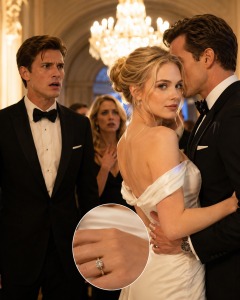
PART 1
The Chanel sandals by the marble console were a size eight. Not Clare’s size.
Arthur, the Osborne estate’s manager for a decade, stepped forward to take her suitcase, and his face was doing something careful and apologetic that told Clare everything before he said a word.
“Miss Vance. You’re back.”
Miss Vance. Not ma’am. Not the future Mrs. Osborne. She’d flown four hours from Chicago with a signed contract in her bag — Osborne Group’s exclusive development rights for the Hudson Point commercial district, a deal she’d spent a week negotiating over stale sandwiches and boardroom coffee — and she’d rushed home to tell Damen the good news. Apparently he had news of his own.
She slipped off her heels and walked up in stocking feet, the suitcase wheels clattering against the hardwood like something being dragged. The master suite door stood slightly ajar. A woman’s laugh drifted through the gap, soft and deliberately breathy.
“Damian, do you like this nightgown? I chose the champagne color specifically. It matches your sheets so well.”
Clare didn’t push the door open. Through the gap she could see Alyssa Sterling standing by the bed in a silk slip, a suitcase spilled open across the rug — lingerie, cosmetics, skincare, scattered like a flag planted on new territory. Clare had slept in that bed for two years. She’d changed those sheets herself, last month, after Damen suggested they change the color, change the mood.
Now she understood. The mood had never been the problem. The person had.
“If you like it, keep it,” Damen said, leaning against the headboard with a cigarette. “But what about Clare?” Alyssa asked, tracing his jaw. “Won’t she be mad?”
“She’s supposed to be in Chicago until Friday. I didn’t expect her back tonight. Besides, her condo’s being renovated. She needs a place to crash. Clare’s a professional. She won’t make a fuss over a guest.”
Clare’s hand tightened on the suitcase handle until her knuckles went white, nails biting into her palm. The pain was, at least, proof she could still feel something.
She went to the guest room instead. Arthur followed with the bag, avoiding her eyes the whole way, and left her alone with drawn curtains and a faint musty smell. She sat on the edge of the bed and unlocked her phone, watching the time change from 9:10 to 9:32, listening to footsteps overhead — Alyssa, probably, arranging brightly colored bottles across Clare’s own vanity.
Then she dialed a number. It picked up on the second ring, and said nothing.
“It’s me,” Clare said.
Adrienne Royce’s voice was low and even, like scotch served neat. “Is what you talked about before still on the table?”
A brief silence. “Are you sure?”
“I’m sure. Tomorrow, nine a.m., the Manhattan City Clerk’s office.”
“All right.”
She hung up and pulled back the curtains. The garden lights were on, glowing across tulips Damen had imported from Holland — tulips she’d picked out herself, down to the exact variety. He hadn’t even bothered changing those. He’d just changed her first.
Her phone buzzed. An Instagram story from Alyssa: a selfie in the champagne nightgown against the master bed’s headboard, one word for a caption. Home. Location tag: the Osborne estate, Greenwich. Maybe she’d forgotten to hide it from Clare. Maybe she hadn’t forgotten at all.
Clare liked the post. Thirty seconds later it vanished — Alyssa remembering her privacy settings a little too late. Clare had already screenshotted it, filing it away in a folder that already held the Cartier invoices Damen had paid for Alyssa, hotel confirmations, comparative flight itineraries his own assistant had been quietly forwarding her for weeks.
She had never once confronted Damen. Not because she was forgiving. Because she’d been waiting — for her heart to finish going cold, or for the exit that would land exactly right.
Now she had both.
At six the next morning, her makeup was flawless and her dress was the deep, heavy red of dried blood. At seven, she knocked on the master bedroom door.
Alyssa answered it wearing Damen’s shirt, hem barely covering her thighs, a flash of triumph in her eyes. “Clare, is something wrong so early?”
“I need Damian.”
He came out of the ensuite bathroom tying his tie, froze for half a second at the sight of her, then asked, in a tone entirely different from the one he used with Alyssa, whether something was wrong. She used to think that formality was what trust sounded like. Now she knew it was just indifference.
“The company’s sending me to Chicago. About a week,” she said, flat, like reading a quarterly report.
Alyssa looped her arm through his. “Don’t interrogate her, Damian, work’s stressful enough. Don’t worry about a thing, Clare — I’ll take good care of the house.”
The house. She actually said the house.
Clare stared at her for exactly three seconds, then smiled. “All right. I’m counting on you, then.”
As she turned to leave, Damen called her name. She stopped without turning around. Two seconds passed before he said the only thing he apparently had left to offer her.
“Have a safe flight.”
PART 2
Walking down the stairs, Clare counted in her head. Since she’d walked into the house the night before, Damen had spoken to her exactly four full sentences. Is something wrong. For how long. What project requires that much time. Have a safe flight. Not one word asking her to stay. Not one word acknowledging that any of this was wrong.
Perfect. Absolutely perfect.
She didn’t leave for Chicago that morning — not yet. With Damen gone to the office, Alyssa knocked on the guest room door holding a glass of orange juice and wearing Clare’s white Ugg slides, the ones Damen had laughed at her for owning. Clare took the juice, set it down without drinking it, and kept folding her clothes while Alyssa wandered the room like a conqueror inspecting new territory.
“I’ve been meaning to thank you,” Alyssa said, “for taking care of Damian these past two years. You can hand those duties over to me now.”
“How long have you known Damian?”
Alyssa hesitated. “Half a year.”
Half a year. He’d proposed to Clare five months ago, on a rooftop overlooking Manhattan, fireworks exploding overhead. She’d thought those fireworks were for her. Now she wasn’t sure they’d ever been.
“He said being with you feels like a business transaction,” Alyssa offered, almost gently, examining her manicure. “Endless negotiations. With me it feels like real romance.”
Clare stopped folding — not because it hurt, but because Damen had never said any of that to her directly. What he needed, what he liked, what he disliked. He never told her. Whenever she asked, his answer was always you decide. She’d mistaken that for trust. It was apathy.
“By the way,” Alyssa added, standing to smooth down Damen’s shirt, “we’re going wedding dress shopping this weekend. The wedding’s in three months. The bride’s going to be me.”
Clare laughed — not a cold sneer, a genuinely amused laugh, because it was, in its own way, hilarious. “Well. Congratulations.”
Alyssa’s face twisted at the reaction she hadn’t expected. Clare zipped her suitcase shut. “I don’t need Damian Osborne anymore. You picked up the trash I threw away. I should be thanking you.”
By the door, tears already drying, Alyssa’s parting shot came with a smirk underneath it. “You can pretend to be calm all you want, Clare. But I know your heart is bleeding.”
Clare sat back down, looked at the three-carat ring still on her finger, and took it off, setting it on the nightstand. Her phone buzzed. A single word from Adrienne — bags packed? — and she answered with one word of her own. Yes.
That night, after dinner she barely touched, after Damen offered her a farewell glass of wine and the exact same two words — safe travels — as that morning, Clare thanked Arthur for two years of quiet loyalty and told him she wasn’t coming back.
At two a.m., she rolled her suitcase past the master suite one last time, past a sliver of light and the sound of two people breathing evenly in their sleep. She left the ring behind. Underneath it, a folded printed note. Four words. I don’t need you.
By the time Damen realized what had actually happened, three full days had passed — and the woman he’d assumed would simply disappear quietly into a hotel somewhere had already signed her name, in a downtown clerk’s office, to something that would take considerably more than an apology to undo.
PART 3
She didn’t drive to Manhattan that night. She drove to JFK, parked in long-term at Terminal 4, swiped her card deliberately to leave a paper trail suggesting an international departure, and locked her primary phone in the glove compartment. A black Lincoln Navigator was already waiting at the curb.
“Miss Vance. Mr. Royce sent me.”
Damen could track the Porsche all he wanted. He’d find an empty car and a dead phone. Clare was already a ghost.
“You’re out,” Adrienne said, when he called from the back of the Navigator.
“Yes.”
“Did you cry?”
She let out a dry laugh. “No.”
“Good.” A pause, his voice low with sleep. “He isn’t worth it.”
Four words that warmed her more than two years of Damen’s declarations ever had.
At three forty in the morning, she let herself into a one-bedroom condo on the twenty-second floor of a Manhattan high-rise — her own, bought two years earlier with her own savings, mortgage paid automatically from her own salary account, a fact Damen had never once known existed. A woman should always have a fallback plan. Now it was the only sanctuary she had.
She spent the next hour scrubbing him out of her life with the same precision she brought to closing a deal. Three hundred and twenty-one photos, deleted. Contact, deleted. Unfollowed everywhere. Removed from delivery addresses, banking quick-lists, food app histories. An email to the wedding planner canceling the venue, the caterers, the invitations — with the penalty invoices forwarded directly to Damen’s assistant. A resignation letter, scheduled to hit HR at nine sharp. Instructions to her attorney: liquidate her nominal shares in Osborne Group at market open.
By five, it was done. She washed her face, changed into a crisp white blouse and tailored trousers, and looked at herself in the mirror. Twenty-six years old. No redness in her eyes. A perfectly practiced smile.
The city clerk’s office opened at nine. She stood at the back of the line, no bouquet, alone, while Damen called her secondary phone — she let it ring through, then answered without speaking. His voice was thick with sleep and confusion. Arthur had told him she’d left for a business trip in the night. She confirmed, flatly, that yes, you had to leave at night to catch early flights. In the background, Alyssa’s voice murmured a question he brushed off with nobody, go back to sleep.
“Did you take off the ring?” he finally asked.
“I left it for your next fiancée. Don’t mention it.”
Something shattered on his end of the line — a glass, probably, against hardwood. She hung up and powered the phone down entirely.
At nine, a black Rolls-Royce pulled up. Adrienne stepped out in a charcoal suit, hair slightly less immaculate than usual, and admitted — with the visible discomfort of a man who’d never had to make an excuse in his life — that traffic had made him twenty minutes late. Clare found, to her own surprise, that she found it almost charming.
His attorney was waiting with an ironclad prenuptial agreement drafted overnight: in the event of a separation, Clare retained full equity in any properties she chose, plus a trust, while her own assets stayed fully insulated. Adrienne signed it without argument, adding a line beneath his signature that wasn’t legally required at all. I, Adrien Royce, am marrying you with no intention of ever getting a divorce.
The registration took ten minutes. A judge had waived the standard waiting period that morning, at Adrienne’s request the night before. In a small VIP room with sunlight pouring through lace curtains, they exchanged two platinum bands — an R engraved on one side, a V on the other, no declarations of eternal love, just two names fitting together — and a clerk pronounced them husband and wife with a firm metallic stamp.
Ten minutes. In the main hall, couples with bouquets were still waiting in line, none of them noticing the woman in the white blouse who had just permanently altered the direction of her life.
“Hungry?” Adrienne asked on the courthouse steps, hands in his pockets, as casual as commenting on the weather.
“A little.”
“What do you want?”
“Belgian waffles. With mascarpone and fresh berries.”
He’d clearly expected something trendier. He drove her to an unassuming diner five minutes away, took off his jacket, rolled up his sleeves, and ordered like a regular — which, judging by the barista’s reaction, he apparently was. Over waffles, Clare tried to call the debt between them settled.
“We’re even now,” she said. “You said you owed me.”
“No, we aren’t.” He transferred his bacon onto her plate. “I’ll be paying that back for the rest of my life. This — ” He paused. “I wanted to do this.”
*
He gave her a key to a penthouse he already owned outright — Tribeca, twenty-eight floors up, passcode her own birthday — and told her, gently, not to rush. Live alone a while. Tell him when she decided what she wanted. It took Damen three full days to notice something was seriously wrong, mostly, Clare learned later from a hushed and trembling Arthur, because Alyssa had spent those three days performing an entire relationship for his Instagram followers while Damen kept drinking heavily enough that he stopped and stared at the closed guest room door before Alyssa steered him upstairs.
By day three, security footage showed the truth plainly enough — Clare rolling her suitcase out at two a.m., pausing outside his door, never once looking back. Under the diamond ring on the nightstand, a printed note. I don’t need you. He crumpled it, smoothed it, crumpled it again.
“Find her,” he told his assistant. “Turn the whole city upside down.”
“Should we file a missing person’s report?”
He was quiet a long time before admitting, in a hollow voice, that there was nothing to report. She wasn’t missing. She’d left.
While he tore the city apart looking, Clare sat in Adrienne’s penthouse reading a dossier his team had compiled on Osborne Group’s Hudson Point project — the same land deal she’d just spent a week securing for Damen in Chicago. Buried in the zoning filings was a detail Damen had never bothered to check: the city’s newly approved subway expansion cut directly beneath the property, on track to gut a third of his planned luxury retail space the moment it became public. She’d found the discrepancy during final negotiations. She hadn’t told him. That was the same night she’d stood outside the master suite listening to him tell Alyssa she didn’t need to feel like a second-class citizen.
“You didn’t remind him?” Adrienne asked, arriving with Sichuan takeout.
“Why should I have? He’s the brilliant CEO. He should’ve figured it out himself.”
Adrienne laughed — a real laugh, not the polite version. “Clare Vance, you are far more ruthless than I gave you credit for.”
Midway through dinner, Damen called. Adrienne put it on speaker after Clare nodded. Has she contacted you, he asked, voice frantic. Adrienne, unbothered, told him the truth — that Clare didn’t need him anymore — and hung up.
“Do you think he’ll find me here?” Clare asked.
“He won’t. And even if he did, he wouldn’t dare set foot inside.” Adrienne looked at her over the counter. “Because this isn’t his territory.”
*
A week later, an invitation arrived: the Royce Foundation’s annual charity gala, at the Plaza — the same guest list Damen was already on, his name now appended with co-sponsor, accompanied by Miss Alyssa Sterling. Adrienne had added Osborne Group to the VIP list himself.
“Why?” Clare asked.
“Because I wanted to see whether you wanted him to see you. As my wife.”
“I do.”
He produced a sapphire and diamond necklace worth more than Clare cared to think about, fastened it around her neck himself, and told her, simply, that the wife of Adrien Royce couldn’t wear anything cheap.
At the gala, in a floor-length black velvet gown, Clare caught her own reflection and didn’t recognize the woman in it — not because of the dress, but because of her eyes. With Damen, she’d always carried a trace of eager caution, checking her appearance before every event, terrified of embarrassing him. Standing beside Adrienne, seated at the head table with a freshly inked place card reading Mrs. Royce, she was an equal for the first time in longer than she could remember.
Damen arrived with Alyssa on his arm in a gown too theatrical for old money, and the room’s reaction told its own story before Damen ever saw Clare’s face. When he did, his expression ran through shock, disbelief, and a raw confusion she’d never once seen on him. He crossed the ballroom straight to the head table.
“Clare.”
“It’s been a while, Mr. Osborne.”
“You got married? To who?”
Adrienne stood, half a head taller, and answered with terrifying calm. “To me.”
Damen’s fists went white. “We were engaged five months. You disappear in the night and instantly marry someone else. Are you playing a game with me?”
Clare stood to meet his eyes. “Damian, you brought another woman into our home. You moved her into our bedroom. You let her wear my slippers. And you have the nerve to ask if I’m playing a game.”
Alyssa swept in, calling Clare’s marriage a fast replacement, heavily emphasizing the word. Clare didn’t dignify it with a look — she simply turned to Adrienne and let him answer for her, his voice carrying just far enough for the surrounding tables to hear it clearly.
“Mr. Osborne. I spent three years trying to acquire what you carelessly threw in the garbage. So tell me — who’s the replacement here?”
Damen was steered to the worst table in the room, dragging Alyssa’s ruined evening behind him, and spent the rest of dinner staring across the ballroom rather than at his own plate. Later, when Alyssa tried to buy back her dignity at the charity auction, bidding fifty thousand on a mediocre pearl necklace just to needle Clare, Adrienne started to raise his paddle. Clare stopped him — loudly enough for the room to hear that even twenty thousand for those pearls was a ripoff — and let Alyssa keep her hollow victory.
When an emerald and diamond bracelet came up next — the exact stone Clare had once told Damen she wanted to honor her grandmother’s memory, a story he’d always answered with a distracted sure, we’ll look for one someday — Adrienne bid two million dollars without blinking, silencing the entire room, and clasped it onto her wrist himself.
Damen stood so fast his chair screeched across the floor. He demanded five minutes. Clare gave them to him in the corridor outside, where she finally told him she’d been standing right outside his door the night he moved Alyssa in, and had heard every word.
“That reason,” she said, “is more than enough.”
She showed him the zoning map on her phone before she left — the red line cutting straight through his Hudson Point property, the subway entrance slated for exactly where his anchor store was supposed to go. He’d signed the contract without a second geological survey, without cross-referencing the city’s infrastructure filings, because he’d never once had to do that kind of homework himself. She had always done it for him. Not anymore.
“You did this on purpose,” he said.
“I didn’t do anything. I simply decided to stop cleaning up your messes.”
She walked away and didn’t look back. Alyssa, waiting by the restrooms clutching her cheap pearls, accused Clare of engineering the whole humiliation. Clare didn’t deny it. She reminded Alyssa, in exacting detail, exactly whose slippers, whose vanity, whose mattress, whose imported china she was currently living off of — and then plucked the pearls out of her hand, since Damen had already cut off her supplementary card the moment he sat back down.
*
Over the following three weeks, Osborne Group came apart with the precision of a controlled demolition. The city announced the Hudson Point subway expansion; the stock dropped twelve percent in a single morning. The company’s largest steel supplier terminated their contract the same afternoon — having signed, the night before, an exclusive deal with a Royce Investments subsidiary at a fifteen percent premium. Construction on the New Jersey logistics hub froze over environmental compliance issues Damen had personally, and carelessly, signed off on. By month’s end, Osborne Group’s market cap had shed nearly four billion dollars.
None of it was fabricated. Every domino had been real, sitting there waiting since long before Clare left, needing only for someone to stop quietly propping it up.
“Have you been planning this since that night at the Wharton gala?” Clare asked Adrienne, standing in his office in front of a whiteboard mapping every one of Osborne Group’s vulnerabilities in red marker.
“Yes.”
“Why didn’t you tell me?”
“Because you still loved him then. I never wanted you to feel like I was forcing you to choose.”
The final blow wasn’t a project flaw — Hudson Point’s land was clean, the permits ironclad, Damen hadn’t made a mistake on it at all. Adrienne simply took the people. Overnight, the project’s chief engineer resigned along with his entire senior team, lured not by salary alone but by equity stakes in a new firm Royce backed. Within days, the syndication banks refused to roll over Osborne Group’s credit lines. A Royce-owned private equity arm submitted a hostile buyout at sixty percent of market value. Seven votes in favor. Two opposed. Damen’s own father, Peter Osborne, cast the deciding vote to accept it.
Damen called Clare directly, voice destroyed, accusing Adrienne of orchestrating the entire collapse from the start.
“You signed the Hudson Point contract yourself,” Clare said. “You lost your engineers yourself. The banks cut your credit because your company was bleeding cash. Every one of those decisions was yours.”
“My biggest mistake,” he said quietly, “was watching you walk out of our bedroom and not stopping you.”
“Your biggest mistake,” Clare said, “was never once thinking I was important.” She hung up and blocked the number.
*
The formal acquisition signing took place in the same Plaza ballroom as the gala, arranged deliberately — same tables, same flowers, same layout. Damen walked in to find a placard reading Mrs. Royce beside Adrienne’s seat, exactly as he had that night, except this time he was the one being escorted to sign away his family’s legacy. His father sat rigid at the far end of the table and wouldn’t look at him.
Adrienne didn’t attend. His lead counsel delivered the message instead: thank you for the Hudson Point property — you saved me a great deal of time at the negotiating table.
Then the doors opened, and Clare walked in — not as Mrs. Royce, but simply as herself. She dropped a bound dossier in front of Peter Osborne: the original geological survey, delivered to Damen’s desk three months earlier with a legal memo clipped to the front reading, in red, do not sign pending environmental review.
“You never read it,” she told Damen, in front of the whole room, “because Alyssa called you crying about a panic attack, and you overrode legal to rush to her apartment instead. You signed the top two documents to fast-track the closing and went shopping at Cartier. The other five, including this one, you never opened.”
Peter Osborne slammed his cane on the floor and asked his son, in front of the entire board, whether he’d neglected a multimillion-dollar acquisition to go shopping with his mistress. Damen had no answer, because it was true.
“Did you know that report was in there?” Damen asked her, voice cracking. “You calculated all of it.”
“Damian, I was your fiancée, not your executive assistant. Doing your due diligence was a courtesy born of goodwill, not an obligation. When you started taking that goodwill for granted, you shouldn’t be surprised I finally stopped.”
Peter Osborne stood, told his son plainly that every achievement he’d ever claimed had been built on Clare’s back, and left without looking at him again — pausing only to tell Clare, with real remorse, that the family had wronged her. She told him it didn’t matter anymore. It was in the past.
Alone with Damen in the emptying ballroom, she let him ask the one question he seemed to actually need answered: when had she started planning this. The answer, she told him, went back further than he probably remembered — to their one-year anniversary, the first time Alyssa climbed out of his passenger seat with a twisted ankle and an excuse, and Damen had shrugged it off as nothing.
“A woman never leaves suddenly,” she told him. “Every departure is the final result of a thousand disappointments you chose not to notice.”
She told him about the receipts she’d kept — his phone passcode that was Alyssa’s birthday, the identical souvenirs he bought on every business trip, the Tiffany’s clerk who’d told her, years ago, that Alyssa had been there the day he picked out Clare’s engagement ring. Damen collapsed to his knees on the marble before she finished walking out, and didn’t get up again until hotel security physically lifted him, nearly forty minutes later, his trousers soaked through where his knees had split against the floor.
*
Three days after that, Damen’s mother, Irene Osborne, came to see her — not about the company, she said, but about her son, who hadn’t eaten or spoken in days, who’d been found sitting in the dark clutching an old photograph after Irene had Alyssa’s belongings physically removed from the estate, along with the diamond ring Alyssa had apparently tried to steal on her way out.
“He understands now,” Irene said, weeping. “He realizes what he threw away.”
“What exactly does he realize,” Clare asked. “That he brought Alyssa into my home, or that he lost the geological survey. Is he sorry he kicked me out of our bedroom, or just sorry he didn’t think I’d actually leave.”
Irene had no answer.
“He doesn’t understand his mistake,” Clare said, gently but without giving an inch. “He simply cannot accept the price of it. If none of this had cost him his company, do you honestly believe he’d have spent forty minutes bleeding onto a marble floor?”
Irene left without arguing further, her face settling into something closer to grief than anger.
*
Half a month later, Clare and Adrienne held their real wedding — no press, just family, at his grandmother’s historic upstate estate. His grandmother pulled Clare aside afterward and produced a worn photograph: the same candid from the Wharton gala, three years old, kept framed on Adrienne’s desk the entire time.
“This stubborn boy,” she said, laughing, “I kept telling him, if you love the girl, go get her. He just kept saying, she’s with someone else.”
Near the end of the reception, an envelope arrived at the gate: a term sheet from Damen, offering triple the original purchase price to buy back Hudson Point, along with a handwritten note asking Clare to come home.
She burned it over a candle at the table without reading it twice, and told Adrienne simply, I don’t. He took her hand. Let’s go home, Mrs. Royce.
Damen was waiting under an oak tree by the private road when they left, hollowed out, desperate, offering to double whatever price she wanted for the land. Clare told him this was never about money, and handed him instead the wedding invitation she’d tucked away specifically for this — his and Adrienne’s names in gold foil, the wedding already finished.
“You used to say I never left you a way out during our arguments,” she told him. “Today I’m leaving you one. This is your way out.”
“Out to what?”
“A lifetime of regret.”
He begged for one more chance. She told him, without cruelty and without softening it either, exactly why there wasn’t going to be one — that when he’d banished her from their bedroom, all he’d offered was have a safe flight, and when Adrienne handed her the keys to his home, he’d simply said you already have the keys, don’t you. One man had pushed her out into the cold. The other had opened the door before she’d even had to ask.
“Not everyone who walks away,” she told him, “ever comes back.”
She walked back to the car and didn’t look behind her when his voice tore through the night calling her name one last time. Adrienne took her hand as the car pulled onto the highway, the city lights sweeping past the windows.
“Crying?” he asked softly.
“No. And I never will again.”
She leaned her head back against the leather, watching the world blur past the glass, and let herself, for the first time in longer than she could remember, simply rest.
THE END