Her Father Sold Her for a Sack of Flour at Eighteen — Then a Lonely Rancher Saw the Woman Everyone Else Ignored

PART 1
Dry Hollow, Wyoming Territory. Late spring, 1884.
The sun hammered the dirt road outside like it had a grudge against the whole territory. Wagon wheels groaned past. Horses stamped and blew. But the dust in Tullis General Store hung in the light like pale ash, drifting in slow circles through the open doorway, and for a moment it was the only thing in the room that moved gently.
Everything else was violence trying to look like discipline.
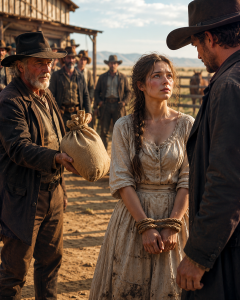
Thomas Rose hauled his daughter across the threshold by the wrist, the same grip a man used on a sack of feed, not on a living girl. Eden stumbled behind him, her torn hem dragging over the floorboards, her hair loose and falling across her face like something she could hide behind. She was eighteen. She carried herself like a woman who had already buried several lives inside one body — the girl who used to hum while she churned butter, the daughter who used to believe things would get better once the harvest came in, all of them folded away somewhere Thomas Rose had never once bothered to look.
“Eighteen years I kept you alive,” Thomas growled, dragging her toward the counter. “Eighteen years, and nothing to show for it.”
She caught herself against a barrel of dried beans. Her hands shook. Her eyes did not.
She did not cry. She did not beg.
“Please,” she said anyway, because some part of her still hoped the word might work this time.
He shoved her hard enough that she nearly went down again. “Don’t start. You eat the flour. You can figure out why I need more.”
Around them, the store had gone still in that particular way a room goes still when everyone is deciding whether to be brave. Mrs. Pratt froze mid-reach with a basket of oats balanced on her hip. Old Mr. Cray pushed his spectacles up his nose and stared, and said nothing, because no one in Dry Hollow contradicted Thomas Rose. He was known for his temper long before anyone bothered learning anything else about him.
He pointed at Eden the way a man points at a dog he has decided isn’t worth its feed. “Useless girl. Can’t work the forge. Can’t hitch a mule.” He laughed, short and ugly. “A son would’ve fed us. But you — I’d trade you right now for one sack of flour.”
Somewhere near the fabric shelf, a spool of thread hit the floor.
Eden went down to her knees. Not because he pushed her. Because she chose it, right there in the middle of the store, her hands fisting in her skirt.
“Pa. Please. Let me stay until Ma gets better.” Her voice trembled, but it held. “She’s burning up with fever. She needs someone to wash her. Someone to cool her head. I won’t eat. I won’t rest. Just let me care for her.”
For one breath, the store was silent enough to hear the dust settle.
Then Thomas scoffed. “Care doesn’t fill a man’s stomach.”
The bell above the door jingled. Boots came in slow and sure, unhurried in a room that had forgotten how to be unhurried. Gideon Rhodes carried trail dust on his coat and something heavier than dust behind his eyes — a grief that had aged him past his years without touching his face. He’d come in for seed grain. He stood still instead, looking at a girl on her knees while her father tried to trade her dignity for flour.
Eden kept her head down. She didn’t know yet whose boots those were. She only knew her father’s voice, sharper now, aimed at a stranger.
“See that?” Thomas called out. “She ain’t worth much. If somebody traded me one sack of flour for her, I’d call it a blessing.”
Gideon’s jaw tightened. He crossed the floor, set his hat on the counter without a word, and said, in a voice that didn’t need to be loud to fill the room:
“She’s leaving with me.”
The gasp that went through the store felt like wind through dry grass.
Thomas spun around. “You serious?”
“Yes.”
Gideon didn’t blink.
“What will you give?” Thomas snapped, already circling him like the offer might vanish if he didn’t grab it fast enough. “She ain’t going free.”
PART 2
Gideon turned to the storekeeper instead of to Thomas, which seemed to unsettle Thomas more than any answer could have.
“One sack of your best flour,” Gideon said. “And a bottle of fever tonic. Send both to the Rose cabin.”
The store went so quiet the dust seemed to stop moving. Then Thomas let out a long, ugly laugh.
“You really are a fool.”
“Maybe.” Gideon’s eyes didn’t leave him. “But I won’t watch a man sell his own daughter for flour while she’s on her knees begging for her mother’s life.”
Eden lifted her head. She found Gideon’s face and searched it for the thing she’d learned to expect from men who looked at her too long. She didn’t find it. What she found instead was something steadier, something that asked nothing of her.
“I don’t need saving,” she whispered.
“I’m not saving you,” he said, quiet enough that it was almost only for her. “I’m making sure you walk out of here on your own two feet.”
The storekeeper set the sack on the counter. Thomas snatched it before it had even settled, hugging it to his chest like a man cradling something precious for the first time in his life. “Take her. She’s yours now.”
Eden rose on legs that barely held her. She gathered her small cloth bundle — a worn Bible, her mother’s handkerchief, a tin comb, the entire weight of her life in one hand — and walked past her father without a single word for him.
Gideon stepped aside. “After you, Miss Rose.”
Before he followed her out, he turned back once. “She’s no object,” he told Thomas. “Today’s flour is the last thing you’ll ever get with her name attached.”
Thomas didn’t look up from the sack.
Outside, the sun hit Eden’s eyes and burned the way it always had — except this time the burn carried something underneath it she didn’t have a name for yet. Something small. Something trembling. Something that might, if she let it, grow into hope.
The wagon rolled north for the better part of a day, dust rising thin behind the wheels, the sky widening with every mile like it was making room for something new. Eden sat in the back with her knees drawn to her chest and her bundle held against her heart, watching a stranger’s shoulders — strong, but tired in a way that had nothing to do with the road — and wondering what a man like that wanted with a girl like her.
He didn’t ask her anything. She didn’t offer anything. The silence between them didn’t press. It simply existed, calm as open sky.
By dusk he’d built a fire near a dry creek bed, torn a loaf of bread in half, and set her portion on a flat rock without a word, without a glance, without asking anything of her in return. When the fire burned low and the coyotes started calling somewhere out past the dark, Eden finally found her voice.
“How long do you plan to keep me?”
Gideon didn’t move. He stared up at the stars like the answer had been written there a long time ago, waiting for someone to ask.
“As long as you want to stay.”
She had heard a great many things said to her in her life. Orders. Insults. Threats.
She had never once heard anyone hand her a choice.
PART 3
She lay awake a long time after that, turning the words over like a coin she wasn’t sure was real. *As long as you want to stay.* No man had ever given her the keeping of her own days before. Even the offer of it felt like something that might be taken back if she reached for it too fast, so she didn’t reach. She only lay there, listening to the fire tick down to embers, and let herself, for the first time in longer than she could remember, fall asleep without bracing for a hand or a voice to wake her.
The next day the wagon rolled into a narrow valley, and the land opened into a small ranch tucked between low hills and fields gone gold with early grass. The house stood weathered but not broken — porch sagging on one side, a shingle or two missing off the roof — and yet it wore its wear differently than her father’s cabin ever had. It looked lived in. Not ruined.
Eden stepped onto the porch. The boards creaked beneath her slight weight. She pushed the door open and the air inside came out cool and still, carrying the ghost-smell of old ashes and bread once baked by someone else’s hands. Her fingers trailed across the fireplace mantle and came away dusty. Beneath the dust, faint carvings — a child’s name, worn nearly to nothing. Someone had loved this house once, and loved it hard enough to leave marks.
A creak sounded behind her. She turned.
Three children stood in the hallway doorway, watching her the way a person watches weather rolling in — unsure yet whether it means rain or ruin. Luke, eight, dark-haired and wary. Eli, six, thumb hovering near his mouth. Little Sarah, five, half-hidden behind her brother’s sleeve, eyes enormous.
No one spoke.
Then Gideon came in behind her and stood still. “These are my children,” he said quietly. “They’ve had a hard year.”
“I won’t disturb them,” Eden said, and meant it.
She walked past the children into the kitchen, found flint, and struck a spark against the cold hearth until fire caught and climbed. She checked the pantry — dried beans, a little lard, a small sack of flour, not much, but she had lived on less her whole life. She cooked. She set the bowls on the table without calling anyone to it, and stepped back to let them come on their own terms.
Slowly, Luke moved first. Then Eli. Then Sarah, small feet dragging. They ate in careful silence, watching her over the rims of their bowls the way children watch anything new that might turn out to be dangerous.
Later, when the house had gone quiet and the children were down, Eden sat by the fire she’d built with her own hands. The room felt warmer than the flame alone accounted for. A small sound behind her — she turned to find Sarah holding out a wrinkled paper, a wobbly red flower drawn across it in a child’s careful, uneven strokes.
“I drawed you something,” Sarah whispered. Then, after a beat, quieter still: “It was for Mama. But now it’s for you.”
Eden’s breath caught somewhere she hadn’t expected it to. She took the drawing with both hands like it might break. “Thank you,” she said, and for the first time in longer than she could count, she smiled and meant it all the way through.
Sarah lingered a moment longer, working up to something. “Are you gonna go away? Like Mama did?”
Eden set the drawing carefully in her lap. She didn’t reach for the girl, not yet — she’d learned young that comfort offered too fast could frighten a person as much as harm could. “I’m not planning on it,” she said instead. “Not unless somebody sends me.”
“Papa won’t send you,” Sarah said, with the flat certainty of a five-year-old who has decided a thing and doesn’t intend to be argued out of it. Then she was gone down the hall, bare feet slapping the boards, and Eden sat a long while with the drawing in her lap and something loosening slowly behind her ribs.
She did not sleep in the good room. She’d taken one look at the small chamber off the kitchen — narrow cot, a shelf, a window facing the east fields — and claimed it before anyone could offer her anything grander. It suited her. It was hers in a way nothing in her father’s house had ever been hers, not even the air she breathed there.
That first week, she learned the house the way a person learns a new horse — slow, watchful, never assuming it wouldn’t startle. She learned which floorboard by the hearth complained under weight. She learned that Eli woke twice most nights and needed a hand on his back, not words, to settle again. She learned that Luke didn’t like being thanked in front of his brother and sister, but would stand a little taller if she caught him alone afterward and said it quiet.
She learned Gideon by inches, the way you learn weather — not by asking, but by watching what he did when no one required anything of him. He mended a hinge on the barn door before anyone had complained of it squeaking. He read to Sarah some nights, low and patient, the same three worn pages of the same worn book, because she liked the rhythm of it more than the story. He never once raised his voice at the children, not even when Eli broke the good milk jug, not even when Luke tracked mud clean across a floor Eden had just scrubbed. His anger, when it came at all, came quiet and cold and aimed only ever at things that deserved it.
One evening, drying a plate at the window, she watched him standing alone at the edge of the west field, hat off, head bowed, in front of a small marker she hadn’t noticed before — a plain wooden cross, weathered gray, half-swallowed by grass. She didn’t ask about it that night. She didn’t need to. She understood grief without explanation; she’d been raised inside a house built entirely out of things nobody explained.
A few days later, Luke told her without being asked, the way children sometimes hand you the truth plainly because the adults around them won’t. “That’s where Mama is,” he said, kicking at a stone. “She got a fever last winter. Papa dug it himself. Wouldn’t let nobody help.”
Eden didn’t say she was sorry. Sorry felt too small and too easy for what the boy was carrying. She only nodded, and reached out, and let her hand rest briefly on the crown of his head, and he let her, which told her more than any words could have.
Her first morning waking under that roof, before any of the children stirred, she lay still a moment in the gray predawn light and waited for the familiar tightening in her chest — the old habit of listening for her father’s boots, bracing for whatever mood had woken with him. It didn’t come. There was only the wind moving through the grass outside, and somewhere farther off, a rooster deciding it was time. She rose, dressed, and had the fire going and coffee near ready before she heard the first small feet padding down the hall, and something about doing it unasked, unafraid, and entirely on her own terms settled into her like a stone finding the bottom of still water.
Two months passed at the Rhodes homestead the way slow rain passes — not loud, not eventful, but soaking into everything until nothing underneath stayed the same. Eden woke with the sun. She swept the floors, baked bread, taught the children their letters at the kitchen table, mended anything that asked for a stitch. She worked without complaint, but not out of fear anymore. She worked because the house came alive a little more with every task she touched, and because, for the first time in her life, no one was keeping score of what she owed.
Eli learned to sound out simple words, his tongue working slow and careful around each one. Sarah trailed after her everywhere, drawings clutched in small fists like offerings. Luke — quiet, watchful Luke — began standing a fraction taller every time Eden praised the way he’d stacked the woodpile or minded his sisters.
She belonged there. Not because anyone had claimed her. Because she had built herself into the rhythm of the place, board by board, same as the house had been built once, long before her.
There was a Sunday in that stretch of weeks she came to think of, quietly, as the first good day — not because anything remarkable happened, but because nothing did. Gideon fixed a wagon wheel while Luke handed him tools he hadn’t asked for and mostly guessed right. Eli fell asleep in the shade of the porch with a barn cat curled against his ribs. Sarah made Eden sit still long enough to braid a crown of dried grass into her hair, declaring her, with great solemnity, a queen. Eden let her. She had never in her life been anyone’s queen, even in play, and she found she didn’t mind starting now.
There was also a storm that same month, the kind that rolled in fast and mean off the western ridge, rattling the shutters and setting Eli to crying in the dark. Eden went to him before she thought better of it, sat on the edge of his small bed, and hummed something wordless and half-remembered from a life that had mostly stopped feeling like hers. He quieted. When she looked up, Gideon stood in the doorway, not intruding, just watching, the way a man watches something he’s afraid to name too soon in case naming it scares it off.
One warm afternoon she noticed Gideon moving slower than usual in the yard, favoring his right arm as he split wood. She watched from the window a full minute before she went out, rolled her sleeves, took up the hatchet, and brought the first log down clean.
Luke rounded the corner, eyebrows climbing. “That ain’t your work.”
“He’s hurt.” She swung again.
Luke grabbed the next log and held it steady without another word of argument. She swung. He set another. They worked that way until dusk painted the sky the color of a healing bruise, and by the time they stopped, the woodpile stood taller than Luke himself.
Gideon found them there when he came out to call them in for supper, and stood a moment in the doorway without saying anything, taking in the boy’s sweat-damp hair and the woman rolling her sleeves back down over reddened palms.
“You didn’t have to do that,” he said to her later, once the children were fed and down.
“I know.” She didn’t look up from the mending in her lap. “I wanted to.”
He was quiet a moment. “My wife never touched an axe in her life. Said it wasn’t fitting.”
“I don’t much care what’s fitting,” Eden said. “I care what needs doing.”
Something in his face shifted then — not quite a smile, but close kin to one. “No,” he said slowly. “I don’t suppose you do.”
He didn’t say more than that, and she didn’t ask him to. But something had passed between them in the saying of it, small and unremarked, the way the most important things between two careful people usually are.
A week after that, Gideon took her into town for supplies, the two of them alone on the wagon bench for the first time since the ride out from her father’s cabin. Dry Hollow had not forgotten who she was. She felt it in the way conversation dipped low as they passed the mercantile, in the way Mrs. Pratt’s gaze followed her a beat too long over a crate of onions.
“They’re talking,” Eden said quietly, not quite a question.
“They always talk,” Gideon said. “Don’t much change what’s true.”
She thought about that longer than the sentence probably warranted, the way she’d come to think about most things he said — plain words that turned out, on closer look, to be carrying more weight than they let on. By the time they loaded the wagon and started back, she found she’d stopped watching the townsfolk’s faces for judgment, and started watching the road home instead.
That weekend, Dry Hollow held its fair. Gideon took the children, and Eden walked beside them in a blue calico dress she’d sewn with her own hands — simple, but clean, and hers. The town square smelled of roasted corn and horse sweat and someone’s peach preserves cooling on a windowsill nearby. Fiddle music scraped out from somewhere near the livery. The children kept reaching for her fingers without seeming to notice they were doing it. Sarah rode the wooden pony twice, shrieking with a joy that had nothing careful in it at all. Eli won a glass marble off a guessing game and held it up to the sun like treasure, turning it over and over to watch the light bend inside it.
More than one pair of eyes in Dry Hollow found Eden that day and lingered a beat too long — some curious, a few openly unkind — but she had learned, in two months, to let those looks slide past her the way rain slides off a roof that’s been properly shingled. Luke wandered toward the horseshoeing contest, and Eden followed him, half a step behind, the way she’d learned to follow the children instead of leading them.
That was when the voice found her.
“Well, now — if it ain’t the girl traded for a sack of flour.”
A man leaned against the hitching post, boots dusty, grin crooked with the particular meanness of someone who’d been waiting all day for an audience. “Thought you’d have been sent back by now. Or maybe you’re working as a nanny or something else.”
Eden didn’t have time to answer before a small body shot past her.
Luke slammed into the man with both fists swinging. “Shut your mouth!”
The man stumbled, grabbed Luke’s arm hard enough to shake him, and Eden was already moving forward when Gideon reached them first, sweeping the boy back with one strong arm.
“Enough,” Gideon said, and it landed with the weight of a closed door.
Luke stood there kicking dust, chest heaving, fists still curled tight with everything he hadn’t finished saying. Eden knelt and took his scraped, bleeding knuckles gently in her hands.
“You don’t use your fists,” she told him, soft. Then: “But thank you, Luke.”
His eyes dropped to the ground. Ashamed. Proud. Both at once, the way only an eight-year-old can hold two opposite things in his chest without them tearing him apart.
They left the fair early. The wagon ride home carried nothing but the crunch of wheels on dirt and the particular quiet of a family that had just learned something new about itself. That night, after supper, Eden wiped down the table while Gideon stood near the hearth, arms folded, firelight moving across a face that had gone thoughtful.
“You’ve done something I couldn’t,” he said.
She looked up.
“You made this house breathe again.”
She didn’t have an answer for that, so she gave him a small nod instead, and Gideon’s mouth curved into a smile that didn’t fade quickly — the kind that settled in and stayed.
The following week passed calm and warm, the way weeks had begun to for all of them, until an afternoon when hoofbeats echoed wrong across the field. Eden knew before she looked that the sound didn’t belong to Gideon’s team or the children’s pony. This horse was heavier, its rider seated crooked in the saddle. Her chest went tight before her mind caught up to why.
Thomas Rose slouched atop a mottled gray horse, clothes stained with sweat and trail dust, eyes wild in the particular way of a man who’d been drinking his courage up from somewhere dark. He laughed when he spotted her on the porch.
“Eden. Look at you. Living fine now. Warm home, comfortable rancher.” He swayed in the saddle. “Time to share the good life, eh?”
“There is no good life to share, Pa.” She kept her hands moving, folding, because stillness in front of him had always been its own kind of danger. “Not one you had any hand in building.”
“Watch your mouth.” He slid a boot free of the stirrup like he meant to dismount properly this time. “I’m still your father.”
“You stopped being that the day you set a price on me.” She didn’t raise her voice. She’d learned from Gideon, without either of them ever discussing it, that the loudest room doesn’t win — the steadiest one does.
Eden didn’t flinch. She finished folding the sheet in her hands and set it in the basket at her feet before she answered.
“You traded me for a sack of flour,” she said. “That day, you gave up any right to call me daughter.”
Thomas slid down off the horse, nearly losing his footing when he landed. “That was hard times, girl. You ought to thank me. Look how good you got it now.”
Gideon stepped out onto the porch behind her, silent, a wall of steady calm at her back rather than in front of her — because this wasn’t his fight to finish, and he seemed to know it.
Thomas sneered at him anyway. “You the one teaching her to talk back?”
Before Gideon could answer, the screen door banged open and Luke marched out, small face set fierce.
“You need to leave,” the boy said. “This ain’t your place anymore.”
Thomas squinted at him. “You one of hers now?”
Luke drew himself up as straight as his eight years would allow. “I’m her son. And she’s more family than you ever were.”
Eden’s breath caught somewhere in her chest. She laid a hand on Luke’s shoulder — not to pull him back, just to be touching something steady while the ground under her shifted in a direction she hadn’t expected.
Thomas spat into the dirt. “She ain’t worth half what you think.”
Eden stepped forward, and her voice, when it came, didn’t shake at all. “I’m no longer your daughter,” she said. “I’m mine.”
“You’ll regret this,” Thomas called back over his shoulder, already fumbling for the reins. “Family’s family. You’ll come crawling back when this one gets tired of you.”
“He won’t,” Eden said. “And even if he did — I’ve learned how to stand up without anybody’s help. You taught me that much, at least, even if you never meant to.”
Thomas cursed under his breath, hauled himself back onto the gray horse, and rode off weaving through his own dust, smaller and smaller until the yard went quiet again in a way that felt, for the first time, permanent.
Gideon came to stand beside her. “He won’t come back.”
She believed him. Not because he’d promised it with any particular force, but because for the first time in her life, a man’s word had never once failed to match his actions.
That night, once the children were asleep, she sat by the window a long while, watching the last of the dust her father had kicked up settle back into the road like it had never been disturbed at all. She waited to feel something enormous — grief, maybe, or triumph. What came instead was quieter than either: a kind of stillness she hadn’t known her chest could hold. She was, for the first time she could remember, simply and entirely unafraid.
Autumn came on slow, turning the fields from gold to brown, and one evening after the children were asleep, Gideon sat across from her at the kitchen table with his hands folded like a man about to ask for something he wasn’t certain he deserved.
“I’ve been thinking on how to say this proper,” he said, “and I haven’t found a way that doesn’t sound clumsy, so I’ll just say it plain. I’d like to marry you, Eden. Not because it’d look right to the town, or because the children need a mother put down on paper. Because this house is only a home when you’re in it, and I’d like that to be permanent, if you’ll have it.”
She sat with that a long moment, turning it over the way she’d once turned over four words by a dying fire — *as long as you want to stay* — testing it for the trap she’d spent eighteen years learning to expect underneath any kindness.
She found none.
“I’ll have it,” she said. “But I’ll have it because I choose it. Not because anybody traded for me twice.”
“That,” Gideon said, “is the only way I’d want it.”
They married in December, in front of the hearth Eden had first coaxed to life with her own hands. Sarah scattered dried flowers she’d saved from autumn across the floorboards with great ceremony, and Luke stood straight-backed beside his father like a small, solemn witness to something he’d helped build with his own two hands, right down to the woodpile stacked against the wall behind them. There was no priest available on such short notice out that far from town, only a circuit preacher who happened through twice a year — but he happened through that week, and it was enough. Eden wore the blue calico dress from the fair, freshly pressed, and when Gideon took her hand in front of the fire, his grip was nothing at all like the one that had once dragged her across a store floor. It asked instead of took.
Months slid by, and winter touched the land in soft white drifts across the fields. One clear, cold morning, Gideon climbed a ladder against the porch and nailed a wooden sign above the door, the letters cut clean and deep:
*THE RHODES HOME. GIDEON & EDEN. ESTABLISHED 1884.*
Eden reached up and touched the carved letters of her own name with careful fingers. “That’s my name,” she whispered, like she still wasn’t quite sure the word belonged to her.
“And no one can trade it or take it,” Gideon said.
Outside, past the porch rail, the first snow of the season had begun to fall — slow, steady, entirely unhurried, the way good things in that house had learned to arrive. Eden stood a moment longer with her fingers resting against the carved letters of her own name, Gideon beside her, the children’s laughter drifting faint from somewhere inside the walls behind them.
She thought, briefly, of a girl who had once knelt on a store floor while her own father priced her against a sack of flour. That girl hadn’t known yet that a name could be a thing worth building instead of a thing worth selling.
She had not been traded.
She had been chosen — and then, in the end, she had chosen herself.
THE END