She Saved the Mafia Boss’s Son—And One Phone Call Changed Both Their Lives

PART 1
The last customer left at eleven, and the city outside had the particular quality of a Tuesday in winter — indifferent, ongoing, too wet for pity.
Mira Vance counted the tips at the register while Sal finished in the back and the rain found the weaknesses in the diner’s old awning. She had been on her feet for eleven hours. Her shoulders ached in the specific way of someone who has been carrying trays long enough that the ache was no longer news. She folded the bills and put them in her apron pocket. The total would not cover the electric bill. She did the math twice because math could sometimes be wrong the first time.
It was not wrong.
“Night, Sal,” she called.
A grunt from behind the grill.
She went out through the back.
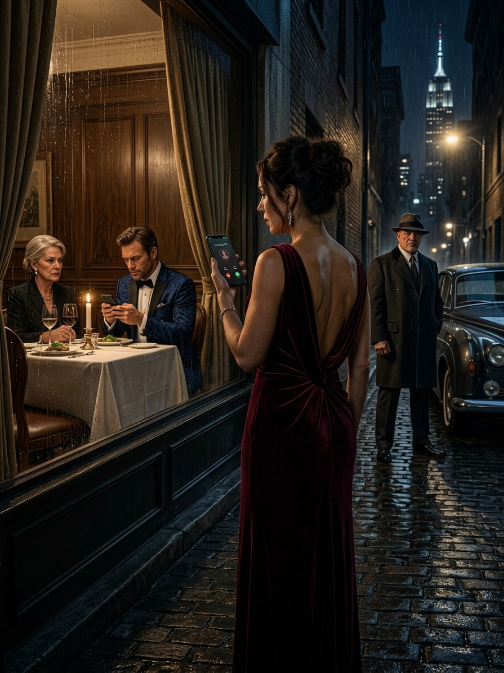
The alley behind the Silver Spoon Diner was the shortest route to the bus stop, a narrow channel between brick walls that smelled of grease and rain-wet concrete. She had walked it every night for two years without incident, which was not the same as it being safe.
Tonight her foot found something soft and yielding that groaned.
She stumbled. Her phone came out of her pocket, the cracked screen throwing weak light.
A man.
Young — her age or close to it — dressed in clothes that communicated money even soaked and crumpled and stained with the dark spreading from his side. Tailored wool coat. Good watch. The kind of quality that announced itself even in an alley at eleven on a Tuesday.
The gash at his temple was significant. The blood from his side was darker and slower, which meant something Mira didn’t want to know yet.
He was breathing.
She knelt.
Her first thought was the right one: call emergency services. Her second thought was the one that stopped her: in this neighborhood, that call brought questions she couldn’t afford. Questions about what she was doing in this alley, what she had touched, who the man was, why she had stayed. Questions that found their way back to her boss, who had already warned her once about situations that brought attention to his diner.
And Mira needed this job.
She needed it with the specific desperation of someone whose sister was three months into an experimental leukemia trial that cost more per month than Mira made in a year, and whose health insurance had recently been restructured in a way that left the trial uncovered, and whose mother was gone, and whose options were exactly the number that fit inside her apron pocket.
She touched his coat, not for his wallet — she told herself this clearly, internally, with the firmness of someone talking to a part of themselves that needed to be talked to — but for identification. She needed to know who to call.
The wallet had no cash.
It had a driver’s license.
Dante Serin.
The name meant nothing to her. She moved past it to a single card behind the license — heavy stock, engraved print, no title, no company.
*Aldo Serin.*
A phone number.
Mira did not read the newspapers. She did not have time to read the newspapers. But Meridian City ran on two kinds of people: the ones who appeared in the business section and the ones who appeared in everything else, and the name Serin belonged to the second category.
Everyone in the city’s lower precincts knew that name. Not from reading it. From hearing it said carefully.
Aldo Serin. The most dangerous man in Meridian.
The man bleeding in the alley was his son.
She should walk away.
She understood this with complete clarity. Walking away was the rational act. Staying was the kind of decision that changed the shape of a life, and Mira’s life was already shaped by enough she hadn’t chosen.
Then she thought about Nina.
About the way her sister still smiled at her from the hospital bed even when she was exhausted and nauseated and hollowed out by treatment, still tried to make jokes, still asked about Mira’s day as if it mattered, as if the daily accounting of tip money and bus schedules was something worth hearing.
If it were Nina bleeding in the dark, Mira would want a stranger to stay.
She dialed.
It rang once.
A voice answered that did not say hello. It simply said: “Yes.”
Low. Flat. The voice of a man to whom the phone was a tool rather than a social instrument.
“I’m looking for Aldo Serin,” Mira said. Her own voice surprised her — steadier than she expected.
A pause.
“You found him.”
She told him she had found his son. She gave the address. Her voice stayed level through all of it, which was remarkable given what her hands were doing.
The voice did not panic. It did not thank her. It said: “Don’t move. Don’t speak to anyone. Don’t touch him again. We are four minutes out.”
The line ended.
She put the phone in her pocket and sat on her heels in the rain and waited.
The car that arrived was a single black sedan. No fleet, no obvious security apparatus. It slid into the alley with the specific quietness of something expensive.
The man who stepped out first was large and professionally still. He didn’t look at Mira. He looked at the walls, the roofline, the doorways.
Then the rear door opened.
Aldo Serin stepped out.
He was older than she had imagined, late forties, silver touching his temples in a way that looked deliberate rather than inevitable. His suit was dark and expensive and the rain appeared to be consulting him before landing on it. His face had the kind of structure that photographs well and frightens people in person.
His eyes found her immediately.
They were dark and entirely without warmth, which was different from cold. Cold suggested temperature. These eyes suggested absence. He assessed her in the time it took to draw breath — her cheap coat, her worn shoes, the fear she was doing her best to organize into something manageable.
“You’re the girl,” he said.
Not a question. A categorization.
Mira stood up. It seemed important to be standing.
“Yes,” she said.
Another man had emerged from the passenger seat, younger and precise in his movements, carrying a black bag. A doctor. He was already beside Dante, hands moving efficiently.
Aldo walked to his son and looked down at him. His expression did not change. But something passed through it briefly, in the space between one controlled breath and the next.
Then it was gone.
“He’s stable,” the doctor said. “Head trauma and a puncture wound to the left side. Not deep. He needs fluids and rest but he’ll be all right.”
Aldo gave a single nod.
The large man lifted Dante from the pavement with the ease of someone moving something that belonged to him. They put him in the car.
The doctor followed.
The door closed.
Mira was alone in the alley with Aldo Serin.
The car’s headlights were still on, and she was standing directly in them.
“You found his wallet,” he said.
“Yes.”
“You took nothing from it.”
It was not a question either. He was stating what he had already determined.
“No,” she said. “I just wanted to find out who to call.”
Aldo stepped closer. The rain continued. He seemed to exist in a slightly different version of the same weather.
“People in this part of the city don’t help a Serin,” he said. “They run. Or they identify an opportunity. So I will ask you plainly, Miss—”
“Vance,” she said. “Mira Vance.”
“Miss Vance. What do you want?”
He already knew her name.
She understood, with a specific shift of her understanding, that he had known her name before he finished asking.
“I don’t want anything,” she said.
The corner of his mouth moved. Not a smile.
“Your sister Nina is enrolled in the Bauer trial at Meridian General. The cost is one hundred and seventy thousand per year. You are currently twelve hundred dollars behind on the portion your insurance no longer covers.” He paused. “You are not in a position to want nothing.”
Mira felt the air leave the alley.
He had spent the four minutes between her call and his arrival dismantling her privacy.
“That doesn’t change what I said,” she managed.
Aldo looked at her for a long moment.
“There is a car waiting at the end of this alley,” he said. “You will go with Luca. He will take you somewhere safe while I determine what happened tonight. You are the only witness I have. That makes you either an asset or a liability.”
He began walking toward his car.
“Which one I decide you are depends entirely on what you tell me.”
He left without waiting for her response.
The man who appeared at her elbow had a charming face and a silver ring on his right pinky.
“Miss Vance,” he said pleasantly. “I’m Luca Ferrante. If you’ll follow me.”
She followed him.
She had no way of knowing, then, that Luca Ferrante was the reason she was standing in that alley. That the man walking her to the car was the person who had arranged for Dante Serin to be lying bleeding on the pavement. That the lookout who had watched her from the diner corner before she went out the back had reported to Luca, not to the rival family everyone would soon be blaming.
She had no way of knowing that the call she had made had saved her life by about forty seconds.
—
PART 2
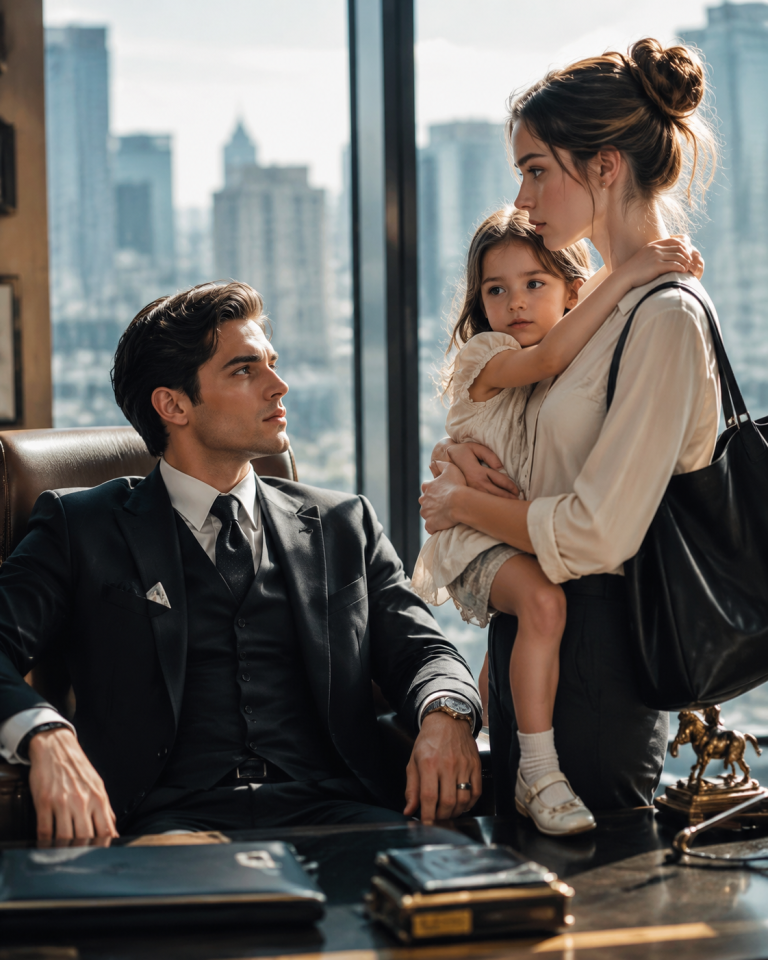
The tower occupied an entire block of Meridian City’s financial district and belonged, in every sense that mattered, to Aldo Serin.
The apartment Mira was taken to occupied the forty-third floor. The windows ran from floor to ceiling on three sides. The furniture was minimal and precise. The art on the walls was original and unsettling in the specific way of very good things — it demanded your attention and gave nothing comfortable in return.
She had a room with a closet full of clothes in her size. She had a housekeeper named Mrs. Ocha who communicated primarily in nods and excellent food. She had a view of the entire city, every lit window a life being lived, all of it visible and none of it reachable.
On the second morning, Luca brought her to the medical wing to see Dante.
He was awake. The IV line ran into his left arm. The bandage at his temple was clean and fresh. He had his father’s structure and his own expression, which was less careful and more genuinely amused.
“You’re the alley angel,” he said.
“That’s not what I’d call it.”
“My father said you refused money.”
“I didn’t do it for money.”
“He didn’t believe you.”
“I know,” she said.
Dante grinned, which looked like it hurt him slightly.
“He believes you now,” he said. “He believes everyone eventually. He just requires proof.”
Aldo appeared without announcement, the way she was learning he appeared everywhere. He stood in the doorway and looked at her, then at his son, in that order.
“He’s recovering,” he said.
“I can see that.”
“Then you can direct your gratitude somewhere useful and tell me again what you remember about that alley.”
She told him again. Everything she had told him the first night, in the same order, with the same details. He listened without interrupting.
Afterward, he said: “You saw no one approaching before you found him.”
“No.”
“No car.”
“No.”
“But when you came out of the diner, there was a man at the corner table who left before you did.”
Mira stopped.
“How do you know that?”
“Because I reviewed the diner’s camera footage,” he said. “There was a man at the corner table for forty minutes. He ordered nothing and left two minutes before your shift ended.”
She tried to remember the corner table. Tuesday nights were quiet. She did tend to notice people who occupied a table without ordering.
“He had something on his wrist,” she said slowly. “I noticed it because it caught the light. A ring. Silver. On his right—”
She stopped.
Something cold moved through her.
Luca Ferrante was standing in the doorway behind Aldo.
On his right pinky finger, a silver ring.
Mira looked at the ring.
She looked at Luca’s face.
He was watching her with the specific attention of someone tracking what she had just realized.
“Miss Vance,” Luca said pleasantly. “You were saying?”
She looked at Aldo.
His eyes were on her face.
She understood, in the silence of that moment, that he was watching exactly what she was watching.
And she understood something else: whatever she said next would determine whether she left this building.
—
PART 3
Mira said, “He had a dark jacket. I don’t remember anything else.”
Luca’s shoulders released a fraction of a degree.
Aldo’s expression told her nothing.
Luca made his excuses and left the medical wing.
The room was quiet.
Dante had been watching them both and was now staring at the ceiling with the focused expression of someone pretending to be asleep.
Aldo waited until the door closed.
“He was in the diner,” Aldo said.
Not a question.
“Yes,” Mira said.
“You recognized the ring.”
“Yes.”
Aldo looked at her steadily.
“Why didn’t you say so when he was standing there?”
“Because,” Mira said, “I have been living in your building for four days being escorted everywhere by a man I now believe arranged to have your son stabbed. And I don’t know what the protocol is in your world for the moment you realize the person who is supposed to be protecting you is the one you need protecting from.”
Dante made a sound that might have been a laugh, then decided it wasn’t.
Aldo sat down in the chair at the far wall.
For a moment he didn’t speak.
“You were a witness from the beginning,” he said. “I was told the attack was from the Pellera family. Standard territorial pressure. Luca presented it as the obvious explanation.”
“And you believed him.”
“I assessed the evidence he provided and found it consistent. That is different from believing him.” Aldo’s jaw tightened slightly. “I was already running a parallel analysis.”
“Because the obvious explanation bothered you.”
“Because perfect explanations always do.”
Dante sat up slowly.
“He was in the car the night I was attacked,” he said. “He offered to drive me to the venue. He suggested the route.”
The pieces arrived in a particular order, and each one landed harder than the last.
“The ring,” Mira said. “The man in the diner was waiting for me to come out. Not for Dante.”
Aldo looked at her.
“He knew you had found me,” Dante said slowly. “The lookout texted him before you even made the call. He had forty seconds.”
“He would have intercepted it,” Mira said. “The call. He would have gotten to me before your father answered.”
She said it flatly, because the alternative was to think about it emotionally and she wasn’t ready to do that.
“But I answered first,” Aldo said.
“Yes.”
Silence.
“He has been escorting me through this building for four days,” she said.
“Yes,” Aldo said. “He has.”
She looked at him.
“I’d like to not do that anymore.”
“You won’t,” Aldo said.
He stood and picked up his phone. He made one call, said four words in a tone she hadn’t heard from him before — not cold, not warm, something that fell between and below both — and then put the phone down.
“Luca will be contained,” he said. “There is a process for this. It is not fast, but it is thorough.”
“A process,” Mira repeated.
“Yes.”
“What does that involve?”
Aldo looked at her.
“Nothing you need to know,” he said. “Nothing you want to know.”
She accepted this because it was honest.
Three days later, Aldo came to the library on the forty-third floor where Mira had been spending her mornings. He stood in the doorway.
“Luca Ferrante was working with a Russian consortium that had been attempting to acquire entry into Meridian’s waterfront operations. His plan was to eliminate Dante, then me, during the manufactured chaos of a retaliatory strike against the Pelleras. He would have assumed control in the aftermath.”
“And?”
“And the consortium has been made aware that their investment has failed. Luca no longer poses a threat to you or to this household.”
She looked at the book in her lap.
“Is that a standard announcement, or do you usually tell people what happened?”
“I don’t usually tell people anything,” Aldo said. “You are not usual.”
She looked up.
“Because I found Dante.”
“Because you found Dante and didn’t take the money and didn’t name Luca when naming him might have gotten you killed and have been sitting in this library for three days reading instead of causing problems.”
She looked back at the book.
“It’s a very good library,” she said.
He came in and sat in the chair across from her.
“What are you reading?”
She held up the spine.
He nodded slightly.
“Calvino,” he said.
“You’ve read it.”
“A long time ago.”
She set it on the side table.
“My sister called this morning,” she said. “The trial is proceeding. The doctor said the early indicators are positive.”
“Good.”
“The hospital sent me documentation confirming the donation.” She looked at him. “There’s no way to give it back.”
“No,” he said.
“I know you said there are no strings.”
“There aren’t.”
“But I’m still here.”
He was quiet for a moment.
“You are still here because Luca Ferrante spent four days escorting you through a building where he had override codes and I felt better knowing where you were. That situation has now changed.” He looked at her steadily. “You can leave. A car will take you wherever you want to go. Mrs. Ocha will pack your things.”
“What about being a loose end?” she said. “Being a witness to something?”
“You are a witness to a man unconscious in an alley. That is not actionable information.”
“And the rest of it?”
He held her gaze.
“The rest of it,” he said, “you already decided not to say out loud when the wrong man was in the room. I believe you will continue to make that decision.”
Mira looked at the window.
The city was doing what it always did — continuing, building, spending, surviving, ignoring the parts of itself it didn’t want to see.
She thought about Luca Ferrante’s charming face. About the silver ring. About the forty seconds between the lookout’s text and Aldo answering the phone. About how easily the story could have ended in that alley, and how she had made one decision — to stay with a bleeding stranger because she thought about Nina — and that decision had changed the entire sequence of everything.
She thought about a number of things, none of which had clean conclusions.
“I’d like to stay for a few more days,” she said. “If that’s still permissible.”
Aldo was quiet.
“The library is available,” he said.
“I noticed.”
He stood.
“There’s a good collection on the third shelf,” he said. “If you finish Calvino.”
He walked to the door.
“Thank you,” she said. “For Nina.”
He paused.
“You thanked me already.”
“I’m doing it again.”
He looked back at her.
In the morning light through the floor-to-ceiling windows, with the city spread below them and a book on the table between them, the most feared man in Meridian City looked, briefly, like a man who was trying to remember something he had put aside a long time ago.
“There is a reasonable restaurant on the forty-second floor,” he said. “If you’d like to eat somewhere other than your room tonight.”
She looked at him.
“What kind of food?”
“Good food.”
She almost smiled.
“That’s not a specific answer.”
“No,” he said. “It isn’t.”
He left her in the library with the morning light and the book and the particular quality of silence that was not empty but waiting.
She picked up the Calvino.
She read for a while.
She thought about the city below — about the parts of it she had lived in, the parts she was learning existed, the distance between them and whether distance was the same as difference.
She didn’t have the answer.
She had time, which was what she hadn’t had in a very long time.
Nina’s trial was proceeding. The early indicators were positive.
Mira Vance, who had spent two years carrying more than she could manage, sat in a library forty-three floors above a city that had never asked whether she was all right, and let herself consider, for the first time, what it might mean to want something for herself.
It was a small thought.
She held it carefully.
Outside, the city went on.
Inside, for a moment, the world was quiet enough that she could hear herself think.