A Wealthy Rancher Offered a Homeless Widow His Name — Then Admitted He Only Needed an Heir

—
## PART 1
The sun had no mercy that afternoon, hanging over the Oklahoma prairie like a brass coin in a bleached sky. The red dirt road stretched endlessly, cutting through grass that rattled in the hot wind. Then a figure appeared on the horizon — a woman, thin and exhausted, carrying something in her arms, her dress once respectable calico now gray with dust, her dark hair loose and tangled.
Norah Gray had been walking three days since the boarding house in Tulsa threw her out for lack of payment. Three days since her last nickel bought a piece of bread she’d softened with water for her son. Tommy was four, small for his age from hunger, his head lolling against her shoulder, his breathing shallow and hot with fever.
“Mama, I’m thirsty,” he whimpered.
“Just a little further,” she lied. She had no idea where she was going. The last town had made it clear a widow with a fatherless child wasn’t welcome — a shopkeeper had sneered when she tried to trade her wedding ring for food. *We don’t give charity to women of your kind.*
Then, through the shimmer of heat, she saw it: a house, a barn, a corral. A ranch. “Tommy, baby, look. There’s a place.” The boy didn’t lift his head. Terror seized her — he was getting worse.
Norah forced her legs forward, reached the gate, and climbed the porch steps on legs that barely obeyed her. She knocked, weak and pathetic. Nothing. She knocked again, harder. “Please — is anyone home? My son is sick.” Her legs gave out. She hit her knees on the wooden planks and sobbed. “Please, somebody help us.”
The barn door creaked open. A man stood in the shadowed entrance, tall and broad-shouldered, his face shadowed by a weather-beaten hat. For a long moment he didn’t move. Then he stepped into the sunlight.
Elias Ward had been mending tack when he heard the knocking, and had meant to ignore it, same as always — he’d learned that caring about people only led to pain when you inevitably lost them. But then he’d heard the child’s cry, and his eyes had moved unbidden to the small wooden cradle in the corner of the barn, draped in canvas, untouched for five years. Before he’d made a conscious decision, he was moving.
He crossed the yard with long strides. The woman was on his porch, on her knees, clutching a small boy against her chest. Even from a distance he could see she was at the end of her rope — gaunt, sunburned, swaying even while kneeling. The boy in her arms looked worse: limp, fever-flushed.
“Please,” Norah managed as he stopped a few feet away. “My son, he needs water. He’s burning up. I don’t have money, but I can work. I’m a hard worker. Please, just help him.”
“How long has he been sick?” Elias’s voice was rough from disuse.
“Maybe longer than yesterday. We’ve been walking, and I couldn’t—” Her words tumbled over each other. “This morning he drank a little from a stream, but it was muddy. I think maybe that made it worse.”
Elias’s jaw tightened. Bad water on top of heat exhaustion and at least a week of malnutrition. “Come inside,” he said, already turning toward the house. “Bring the boy. I’ve got clean water and medicine.”
Norah hesitated only a moment before Tommy whimpered against her neck, and she realized she was out of choices. When she swayed trying to stand, Elias came back down the steps and, without a word, scooped Tommy out of her arms with surprising gentleness.
Inside, he laid the boy on the kitchen table and worked the pump until clear water gushed forth. “Hold his head,” he instructed, and brought a tin cup to Tommy’s cracked lips in small, patient sips. “That’s it. Easy now.”
He placed a broad hand on Tommy’s forehead. “He’s burning up. You got a name?”
“Norah Gray. And this is Thomas. Tommy.”
“Fever’s high, but I’ve seen worse. We’ll get some willow bark tea in him. Cool him down with wet cloths. He’s young and tough. Should pull through.” *Should*, not *will* — but it was more hope than Norah had allowed herself in days.
He steeped the willow bark, got several spoonfuls down Tommy’s throat, and laid a cool cloth across the boy’s forehead — all with quiet, grim efficiency. When Norah swayed on her feet, watching, Elias’s hand closed around her elbow.
“Sit. When did you last eat?”
“Yesterday. No — the day before. I gave most of it to Tommy.”
He said nothing, but his expression darkened. He ladled out a bowl of beef stew and set it before her with a spoon. “Eat.”
“I can’t. I don’t have money to pay you.”
“Not now. But I meant what I said. I can work—”
“Eat first. Talk after.” His tone brooked no argument. Norah picked up the spoon, and the first bite was transcendent. She was crying before she realized it, tears dripping silently into the stew, and Elias turned away to give her privacy, checking on Tommy again while trying to ignore the sound of quiet weeping behind him.
Whatever his failings — and Lord knew he had plenty — Elias Ward had never been the kind of man who could ignore someone in need, even if it would be easier, even if it would hurt less.
“I’m sorry,” Norah whispered. “I’m not usually—”
“You don’t normally finish eating,” Elias said, still not turning around. “Then you can tell me how you ended up on my land half-dead with a sick child.”
—
## PART 2
The spare room upstairs had a narrow bed, a wash stand, and a single framed photograph on the dresser: a young woman with kind eyes, holding flowers. *Sarah, 1895*, read the faded ink. Norah understood, without being told, that this had been meant to be a nursery. The cradle in the barn confirmed it — a child who’d never been born, or who hadn’t survived.
Over three days, the fever broke. Elias appeared like clockwork with water and medicine, never lingering, never pressing for Nora’s story or her plans. When she finally came downstairs to thank him properly, he cut through her rambling offers of unpaid labor.
“Mrs. Gray. When did your husband die?”
“Seven months ago. The influenza.”
“You’ve been on your own since then. No family?”
“My father made it clear I wasn’t welcome after I married James.” Her voice hardened. “I haven’t spoken to him in five years.”
“How’d you end up here?” She told him — the boarding house, the two weeks of walking, the towns where people assumed the worst of a woman alone with a child. Elias’s dark eyes burned, not at her. “Two weeks across Oklahoma in August. No money, no food, and not one person helped you.”
“Some did,” Norah said, lifting her chin. “But most just wanted us gone.”
“You’ll work,” Elias said finally. “But not to pay off a debt. Proper wages, same as any hand. Room and board, plus wages on top. When you’ve got enough to get wherever you’re heading, you’ll go. Fair.”
“Why would you do this?”
“Because nobody helped her either,” he said quietly, “when the fever took her, and I couldn’t save her.” He was gone before Norah could ask who *her* was — though she thought she already knew.
The weeks that followed brought a fragile domesticity: Tommy chasing chickens, Norah scrubbing a neglected kitchen back to life, Elias’s guarded silence softening by degrees over shared dinners and porch conversations about grief neither had fully named. But peace on the prairie never lasted long — and the knock that would test everything they’d quietly begun to build was still coming, riding in on a fine horse from Tulsa, wearing an expensive suit and carrying a claim on the one thing Norah could never let go of.
—
## PART 3
The second week brought Tommy following Elias more boldly around the ranch, and the rancher, though he never encouraged it, never sent the boy away either. The three ranch hands — Hank, Pete, and old Charlie — arrived midweek and quickly warmed to Norah’s cooking, especially after Charlie declared Elias’s own attempts merely “tolerable.” At the first proper dinner Norah cooked, roast chicken with herbs from the garden, Elias stared at his plate afterward and admitted quietly, “This looks like something Sarah would have made” — the first time he’d spoken his dead wife’s name aloud in Norah’s presence.
That third Sunday, in the town of Redemption, the whispers started the moment they stepped off the wagon. *That’s her, the widow woman. Convenient, isn’t it — man like Elias Ward, all alone, and a pretty woman just happens to need help.* Outside the church, an older woman named Mrs. Crowley called out: “Elias Ward, you bringing women of ill repute into our town now?”
Elias stopped cold. When he spoke, his voice carried across the street, hard as iron. “Mrs. Gray is a widow who needed work. I hired her. She and her son are under my protection. If anyone has a problem with that, they can take it up with me directly.” He turned his back on them — a deliberate dismissal.
“Thank you for defending us,” Norah said later. “You didn’t have to.”
“Yeah, I did,” Elias said. “You’re under my roof. That makes you my responsibility.”
That night, Tommy woke from a nightmare about walking again, about being thirsty. Elias appeared in the doorway, knelt at the boy’s bedside, and made him a promise: “You’re not walking anywhere, boy. Not unless you want to. This is your home for as long as you need it.” Then, at Tommy’s request, the rancher — a man who rarely spoke more than a few words a week — sat and told a simple story about a wild stallion learning to trust, until the boy fell asleep.
“He likes you,” Norah told him afterward. “He feels safe with you.”
“Kids too trusting,” Elias said. “Or maybe he’s a better judge of character than you give him credit for.”
—
The dangerous thought — that this could become permanent — turned into dangerous reality on a Tuesday evening in late September, when a rider appeared on the road wearing city clothes that looked entirely out of place against the prairie. Norah’s blood went to ice the moment she recognized him.
Vincent Gray. James’s older brother. A man who’d made it clear at her wedding that he thought James was marrying beneath him, and who’d offered nothing but judgment at the funeral.
“Nora, my dear sister-in-law,” Vincent said, dismounting with practiced ease, his smile all teeth and no warmth. “I’ve been looking for you everywhere.” He surveyed the ranch. “Interesting place you’ve landed.”
“What do you want, Vincent?”
“I want what’s mine. The boy.” At Norah’s horrified silence, he continued, reasonable and cold. “My nephew belongs with family, not in the middle of nowhere with a mother who can’t provide for him. I’ve come to take him back to Tulsa.” He produced a folded paper. “I’m his blood uncle, his guardian by law now that his father is dead. You, on the other hand, are a destitute widow living in sin with a strange man. What judge would grant you custody over a respectable, financially secure family member?”
“You’ve got about five seconds to get off my property,” a voice cut through the tension. Elias stood at the edge of the yard, rifle held loosely but unmistakably ready.
Vincent assessed him, unbothered. “You must be the famous Elias Ward. How charitable of you, taking in my poor sister-in-law.”
“The boy has a mother. He stays with her.”
“The boy has an uncle who can provide for him properly,” Vincent said, and then, when Norah begged him not to do this, offering anything, his smile turned predatory in a way that made her stomach turn — until Elias’s voice cut the moment cold. Vincent finally backed down, but not before a parting shot: “This isn’t over, Nora. I’ll give you one week to come to your senses. After that, I’m filing papers with the territorial court.” He rode off, leaving dust and dread behind him.
Norah’s legs gave out. “He’ll take Tommy,” she whispered. “He’ll use the law, use everything against me. And he’s right, isn’t he? A judge will look at me — a widow living here with you — and give Tommy to Vincent because he has money and I have nothing.”
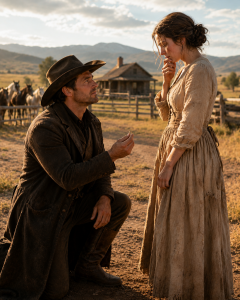
Elias was quiet for a long moment, his eyes on the horizon. “You could have a husband,” he said finally. “A judge looks at a married couple running a successful ranch differently than a bachelor uncle who’s never shown interest in the boy until now. Custody goes to the parents. Simple as that.”
“Are you suggesting—”
“Practical solution,” Elias said, flat and business-like. “You need a home. I need an heir. We can save each other.” He explained it plainly: he was forty-two, alone for five years, the ranch needed someone to pass to, and Tommy could inherit, could learn the business. “This is a marriage on paper, Nora. For protection and practicality. I’m not expecting anything beyond that.”
Tommy, oblivious to the gravity of it all, settled the matter at lunch a few days later by asking Elias directly, “Are you going to be my paw now?” — because Elias fed them, sheltered them, carved him a wooden horse, told him stories when he had nightmares. “That’s what paws do, right?”
Elias’s expression cracked, just for a moment. “Reckon that settles it, then,” he said quietly to Norah. “If you’ll have me.”
“Yes,” Norah heard herself say. “Yes, I’ll marry you.”
—
The wedding took place two days later in the kitchen, with Pastor Reynolds, Miss Maybel from the neighboring farm, and the three ranch hands as witnesses. Elias gave Norah his mother’s ring — the one that had gone to Sarah first, and then been put away. “It’s yours now if you want it,” he said. “We need this to look real.”
When Pastor Reynolds pronounced them husband and wife and told Elias he may kiss his bride, the kiss was chaste and brief — nothing like a real wedding kiss. But something in Elias’s expression shifted afterward, just slightly. Just enough.
That evening, before Elias could retreat to the barn as he always had, Vincent rode back into the yard — not alone. Behind him were a marshal and a lawyer.
“Hope I’m not interrupting the happy couple,” Vincent said with false cheer. “Very convenient timing.” The marshal, apologetic, served formal custody papers: a hearing was scheduled in two weeks. “It’s going to look exactly like what it is,” Vincent said, triumphant. “A desperate ploy by a woman of questionable character.”
“He knew,” Norah whispered after Vincent left. “He waited just long enough to make our marriage look suspicious. He played us.”
“Maybe,” Elias said, his voice hard. “But we’re not beat yet.”
—
The two weeks that followed were a blur of preparation. Elias hired a sharp lawyer, Margaret Hail, who laid out the problem plainly: the timing looked bad, and they needed to prove the marriage was real. That meant, she told them bluntly, no more sleeping in the barn.
Elias moved his things into the spare room next to Norah’s — and in the quiet intimacy of making up his bed together, Norah finally asked him the question she’d been circling for weeks. “Why did you really offer to marry me? Don’t say it was just practical.”
For a long moment he stood at the window, looking out at the prairie. “You ever lose something so completely you convince yourself you’ll never want it again? That’s where I’ve been for five years. Then you showed up with your boy, half dead and desperate, and something in me woke up.” He turned to face her. “I care about you, both of you. Don’t know when it happened. But I do.”
“I care about you too,” Norah admitted. “I didn’t want to. Didn’t plan to.”
“Caring’s not the same as loving.”
“No. But maybe it’s enough to start with.”
The town’s reaction to the marriage was mixed and cruel in places — gossip painting Norah as an opportunist, Elias as a fool taken advantage of. But quieter voices offered support, and slowly, painfully, something real was forming underneath the performance they were putting on for the court.
It crystallized on a night four days before the hearing, when Tommy woke screaming from a nightmare about Vincent taking him away. Elias sat on the edge of the boy’s bed and made a vow that had nothing to do with legal strategy. “Nobody’s taking you anywhere. You’re staying right here with your mama and with me. That’s a promise.” When Tommy asked, disbelieving, if he was really his son, Elias’s voice went rough. “Yeah. You’re really my son. Been thinking of you that way for a while now, even if I didn’t say it out loud.”
Over the boy’s head, his eyes met Norah’s, and in that look she saw everything they’d been dancing around for weeks. Not just care. Not just protective instinct. Love — real, deep, impossible to deny.
That night, after Tommy fell back asleep, Elias and Norah stood together in the hallway. “This family we’ve made,” Elias said, “it’s real to me. More real than anything’s been in five years.”
“It’s real to me too,” Norah whispered. “I was afraid to admit it. But I can’t pretend anymore. You’re not just my husband on paper.”
He kissed her then — not the chaste brush of their wedding, but real and deep and full of everything neither of them had been brave enough to say. When they finally broke apart, both breathing hard, Elias said the words plainly, the way he said everything. “I love you and Tommy both.”
“I love you too,” Norah answered. “I think I have for a while now.”
—
The hearing itself, in the imposing Guthrie courthouse, was brutal. Vincent’s lawyer painted the marriage as a fraudulent, hastily arranged scheme designed solely to block a legitimate custody claim. Witnesses from town testified to the scandalous timing. Vincent himself took the stand with false sincerity, claiming only to want what was best for his nephew.
But when Elias took the stand, his honesty was its own kind of power. “The marriage came later, yes, but not because of Vincent Gray’s threats. It came because I fell in love with her and with her son. They became my family. That’s the truth of it.” Norah’s own testimony, shaking but resolute, described how Tommy had been dying when they arrived, how Elias had saved his life and then given them a home. “Sometimes love comes fast, your honor. That doesn’t make it less real.”
The judge, reviewing the evidence, seemed moved but troubled by the suspicious timing — and was on the verge of ruling against them when a voice called out from the back of the courtroom.
“Wait.” An elderly, sharp-eyed woman stood, walking forward with a cane. “I’m Dorothy Gray. James Gray’s mother. Thomas’s grandmother. And I have something to say about this custody matter.”
Vincent went pale. Dorothy turned to the courtroom with withering contempt for her own son. “My son Vincent is not petitioning for custody out of love. He’s doing it for money. James left a trust for Thomas — fifty thousand dollars, managed by the boy’s guardian until he comes of age. Vincent has gambling debts totaling nearly that amount.” She produced bank statements, creditor letters, and a letter in Vincent’s own hand explicitly stating his plan to gain custody in order to access the trust.
The courtroom erupted. Vincent’s protests collapsed under the weight of his mother’s evidence. The judge, reading the documents with darkening expression, denied Vincent’s petition outright and ordered him to have no contact with Thomas Ward without explicit parental permission.
To Norah, Dorothy said, softening: “James loved you and your boy with everything in him. I was a foolish old woman who thought class and money mattered more than character. I was wrong. I’m sorry I wasn’t there for you after James died. I’m here now.”
Tommy launched himself into Norah’s arms, sobbing with relief. Elias’s arms came around them both, his own eyes suspiciously bright. “We won,” Norah whispered. “We actually won.”
“Told you,” Elias said roughly. “Forever and then some. Remember?”
—
The years that followed carried the Ward family through ordinary, beautiful, complicated life. Dorothy became a regular, beloved presence, eventually moving permanently to town to be near her grandchildren, arranging a proper trust and a monthly allowance that had nothing to do with charity and everything to do with love reclaimed too late for James but not too late for his son. The town’s cold judgment thawed gradually as word spread of Vincent’s exposure and Dorothy’s public embrace of her daughter-in-law.
Tommy called Elias “Pa” within days of it becoming natural, following him everywhere, asking endless questions about cows and horses and stars. The physical and emotional intimacy between Norah and Elias deepened slowly and completely — a real marriage built, brick by brick, on top of the practical arrangement that had started it. In quiet moments, Elias would talk about Sarah, about the guilt of not being able to save her, and Norah would remind him gently that Sarah would have wanted him to live, not just survive.
Winter brought its trials — a brutal storm that cost them three head of cattle, exhaustion and fear, and Elias’s dawning realization that Norah’s steady presence anchored him through it. Christmas brought Norah’s first real celebration in years: a cameo brooch that had been Elias’s mother’s, and a family photograph that Elias placed on the mantle beside Sarah’s picture, not replacing her memory but standing alongside it. “Both parts of my life,” he said. “Past and present, grief and joy. I need both to be whole.”
In March, Norah discovered she was pregnant — news that filled her with as much terror as joy, haunted by what she knew of Sarah’s fate. When she finally told Elias, his face drained of color for a long moment before he pulled her into his arms with desperate intensity. “We’re going to have a baby,” he said. “Terrified and happy. And I can’t believe we get this chance.”
Hope Sarah Ward was born on an October evening — small but healthy, dark-haired like her father, with his eyes already alert and curious about the world. “For what she represents,” Elias said, holding his daughter for the first time, tears sliding down his weathered face, “and what came before.”
Tommy took his role as big brother with fierce seriousness. The ranch grew and thrived. Dorothy became a fixture of holidays and Sunday dinners. And on their second wedding anniversary, Elias took Norah up to the ridge overlooking the ranch, the same place he used to go after Sarah died to wonder if any of it was worth continuing.
“Now I see everything,” he told her, watching the sun paint the prairie gold. “The life we’ve built, the family we’re raising, the future instead of just the past. You gave me that, Nora. You and the kids.”
“You gave us reasons too,” she said. “Safety. Home. Love we didn’t dare hope for.”
They rode back down through the darkness toward the lit window where Dorothy sat rocking Hope, and Tommy played at her feet with his wooden horses — toward the house that had become, against every possible expectation, home. Some stories begin with *once upon a time*. This one began with a woman at the end of a rope and a man at the end of his hope, and it continued, not ended, with both of them finding exactly what they needed in the last place either had thought to look.
In each other. Forever, and then some.
**THE END**