The Mafia Boss Mockingly Hired a Quiet Woman as His Bodyguard—Then She Defeated an Entire Armed Syndicate Alone

 —
—
## PART 1
Leo Costello hated Thursdays. Thursdays meant accounting — sitting in a windowless room breathing recycled cigar smoke, listening to thick-necked men lie about why their envelopes were light. Today was worse than usual. Today he also had to replace Tommy.
Tommy had been Leo’s shadow for five years — six-foot-four, built like a wall, and exactly what a mafia boss needed in a bodyguard: someone who never asked why. Tuesday morning, Tommy had stepped out of Leo’s armored Lincoln and caught three ounces of high-velocity lead in the chest. Leo had survived only because Tommy’s dying weight had jammed the door shut behind him.
Now Leo sat in the back office of a meatpacking front he owned, nursing a headache like a localized thunderstorm behind his eye, while his underboss Dom — a walking ulcer of a man — paraded replacements through the steel door.
“Next,” Dom barked.
The door creaked open. Leo didn’t look up, waiting for the thud of combat boots or the reek of cheap cologne. Instead he heard the soft, almost imperceptible squeak of worn rubber soles on concrete.
A woman stood in the doorway. Maybe five-six, drowning in an oversized surplus field jacket that had seen better decades, hair pulled into a severe knot. She didn’t stand with the puffed-up posture of a street thug. She just stood there, still, hands in her pockets, looking bone-deep tired.
“What’s this?” Leo asked.
Dom blinked at his clipboard, then at her. “The agency sent a list. She was in the waiting room with the others. Figured she was a clerical applicant who got lost.”
“I’m not lost,” the woman said. Flat. Not defensive — a statement of fact. “Sign outside said walk-ins for security logistics. I need a job.”
Leo leaned back, the leather groaning. He studied her — no makeup, dark circles under muddy hazel eyes that looked at him the way someone looks at a delayed train. An inconvenience.
“Security logistics,” he repeated. “Do you know who I am?”
“You’re the guy with the empty chair in the hallway and a blood stain on the upholstery,” she said. “Which means your last guy didn’t do his job. And now you need a new one.”
Dom flushed dull red, stepping forward. “Listen, sweetheart, this ain’t a mall cop gig. You take one wrong turn with us, you end up in a landfill. Go home.”
She didn’t look at Dom. She kept her eyes on Leo. “My name is Quinn. I don’t drink. I don’t sleep much. I don’t ask questions. And I need the money.”
Leo should have told Dom to throw her out. The Costello family was in a slow-burn turf war with the Greco brothers — car bombs replacing handshakes, paranoia the only real currency. He needed muscle, a deterrent, a monster to stand behind his chair. But looking at the endless line of identical, brainless gorillas waiting outside, a strange, cynical humor washed over him. The Grecos expected a mercenary. His own men expected a tank. He was sick of the posturing.
“Give her the job,” Leo said.
Dom froze. “Boss, come on. You’re joking. The Grecos are taking shots at you in broad daylight. She weighs a buck thirty soaking wet.”
“Give her Tommy’s gun and Tommy’s schedule,” Leo said, standing, grabbing his coat. He walked past Quinn, catching a scent of stale coffee and rain off her jacket. “You drive, Quinn?”
“I drive.”
“Good. My car’s out back. Try not to get me killed. It ruins my week.”
He left Dom staring open-mouthed at the small woman standing in the center of the slaughterhouse office. It was a joke, a middle finger to the Grecos, a test of his own untouchability. He didn’t expect her to last a week.
—
Three weeks later, the joke was wearing thin — mostly because Quinn refused to act like one. She didn’t try to prove herself. She didn’t buy a suit. She traded the field jacket for a plain black peacoat and that was the extent of her assimilation. She was simply a ghost haunting Leo’s periphery — silent in the car, silent in the corner of dim restaurant booths where Leo dealt in extortion, bribery, and occasionally blood.
She didn’t flinch when he broke a man’s nose over a gambling debt. Most people, even hardened men, had a tell when violence erupted — a twitch, a tightening jaw. Quinn had nothing. She watched a man bleed on a Persian rug with the detached interest of someone watching paint dry.
“You don’t like blood, Quinn?” he asked her one night, in the VIP section of a club he owned, bass thumping through the floor.
“I don’t have an opinion on it,” she said, scanning the crowd. “It’s just plumbing.”
Leo let out a short bark of a laugh — the first time he’d laughed in months.
It died the second glass shattered across the room. A high-stakes poker game had gone sour; a jumpy earner named Russo was screaming at a rival, reaching into his jacket. Dom fumbled for his weapon, moving like he was underwater. Leo braced for a gunshot.
Quinn was already gone from his side.
She didn’t run. She flowed, slipping through the panicking crowd with frightening efficiency. Before Russo’s revolver cleared its holster, she was behind his shoulder — no warning, no drawn weapon. She grabbed his wrist and drove her palm into his elbow. A dry, sickening snap. Before he could scream, she gripped the back of his neck and slammed his face into the poker table. The gun clattered to the floor. Russo was unconscious before he hit the carpet.
The room went dead silent. Quinn calmly set the revolver on the table, walked back to Leo’s booth, and crossed her arms. Her breathing hadn’t even changed.
“He was going to shoot the dealer,” she said quietly, answering a question Leo hadn’t asked. “Poor trigger discipline. Sweaty palms.”
Leo picked up his bourbon and drank, feeling an icy clarity settle in his stomach. He hadn’t hired a joke. He hadn’t hired a bodyguard. He’d accidentally bought a weapon of mass destruction — and he had absolutely no idea where she’d come from.
—
## PART 2
The invitation was a trap. Leo knew it. Dom knew it. Probably the valet knew it. The Greco brothers had called a sit-down on neutral ground — the penthouse of the Belmont Hotel.
“It’s a killbox, boss,” Dom argued, pacing. “One elevator. No unalarmed fire escapes.”
“If we don’t go, we look weak,” Leo said, strapping on a Kevlar vest. “We go. Five men. Tight.”
“You taking her?”
“She’s my shadow,” Leo said. “She goes where I go.”
The elevator rocketed toward the forty-second floor in suffocating silence. The doors opened onto an empty, opulent hallway. At the end, mahogany doors stood ajar. The air smelled wrong — carpet cleaner failing to mask something metallic underneath.
Dom pushed the door open with his gun barrel. The room was massive, orange city light bleeding through floor-to-ceiling windows. At the head of a long glass table sat Polly Greco. Dead, head resting in a pool of drying blood.
The peace offering hadn’t been a Greco trap. It was a trap for everyone, set by someone else entirely.
A suppressed shot cracked. One of Leo’s hitters folded in half, a neat hole in his throat. “Ambush!” Dom roared, firing blind into the shadows as suppressed fire rained from the mezzanine above.
Leo dove behind a marble pillar as bullets stitched the plaster where his head had been. Six shooters, high ground, crossfire. It was over.
Then he saw Quinn move — not to cover, but laterally into the shadows, and what happened next didn’t look like survival. It looked like something being unleashed. By the time the smoke cleared, Leo would understand that the woman he’d hired as a joke had just rewritten every rule he thought he understood about the world he ruled — and that the real threat behind that ambush had barely even begun to show its face.
—
## PART 3
Two men in black tactical gear advanced on Dom’s flank from the left. Before Leo could line up a shot, a shadow detached itself from the wall behind them. Quinn didn’t shoot. She moved in silence, snatching a heavy cast-iron poker from the hearth as she passed it, and swung it once into the back of the first man’s knee. The joint buckled with a crunch. As he dropped, she drove the poker’s point upward under his tactical helmet into his jaw. He hit the ground and didn’t move.
The second man swung his rifle toward her. She was already inside his guard — grabbed the hot barrel, redirected a burst into the ceiling, drove her knee into his groin, and finished him with the poker against his temple.
Two down. Four seconds.
She snatched the fallen rifle and rolled over the kitchen counter as the shooters on the mezzanine redirected fire, shredding the marble into a choking white cloud. “Covering fire!” Leo yelled, stepping out and firing toward the balcony. Dom and the survivors joined in. It was all the window Quinn needed. She vaulted through the dust like a wraith, reached the spiral staircase, and when a shooter leaned over the railing to get an angle, she fired from the hip in a tight burst. He crashed through the glass railing and fell twenty feet, his neck snapping on impact.
Three down. Leo watched, paralyzed. He had ordered violence his whole life. He had committed it. This was different — this wasn’t a turf war. This was an exterminator clearing an infestation.
Quinn bounded up the stairs two at a time. Gunfire, a scream, a heavy thud. Then silence, thick and total, broken only by Dom’s ragged breathing and the distant wail of sirens.
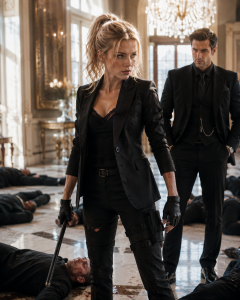
Quinn appeared at the top of the stairs, covered in white dust, a splash of someone else’s blood across her cheek, a combat knife in one hand and a stolen sidearm in the other. She descended without looking at the bodies, checked her cheap plastic watch, and wiped the blood off the face with her thumb.
“Police response time in this district is roughly seven minutes,” she said, breathing barely elevated. “We have three left. I suggest the service elevator.”
“Who the hell are you?” Leo whispered.
“I’m your logistics coordinator,” Quinn said. “We should go.”
—
The service elevator smelled of bleach and grease, grinding its way down forty-two floors. Dom leaned against the wall, cocktail napkins pressed to a bicep graze. A hitter named Carlo dry-heaved quietly in the corner. Leo watched the floor numbers tick down, the adrenaline draining into cold, hollow exhaustion.
Quinn ejected the stolen sidearm’s magazine, checked the rounds, slammed it home, and wiped her cheek clean, smearing a rusty streak across her sleeve. She looked like a mechanic finishing a shift.
“Who set it up?” Leo asked, voice raw.
“The men upstairs were using suppressed FN Five-sevens. Armor-piercing. High-end optics. No identifying patches. But their boots were laced in a uniform bar pattern. Military or ex-military PMC.” She slid the gun into her coat. “That wasn’t a mob hit. That was a corporate liquidation.”
“Corporate?” Dom scoffed, wincing. “The Grecos set us up. Suicide play.”
“Polly Greco was dead before we walked in,” Quinn said calmly, turning her flat stare on him. “Blood coagulation suggests he’d been shot at least twenty minutes prior. They used him as bait. They used you as bait. Someone is wiping the board.”
The elevator jolted to a stop in the underground loading dock. “My car’s parked three blocks east,” Quinn said, stepping into the dim light. “The Lincoln’s likely wired or watched by a sniper team. We walk.”
“I’m not walking anywhere with her,” Dom spat, pointing a shaking hand at Quinn. “Boss, look at what she just did. You think a temp agency sent that? She’s a plant. She’s the one who let them in.”
Leo looked between them. Dom was terrified — a rat backed into a corner. Quinn was perfectly still, watching him the way a predator watches a wounded animal decide which way to limp.
“If I wanted you dead, Dominic,” she said, voice dropping, “I wouldn’t have used a tactical team. I would have let you bleed out in the hallway upstairs. Put your hand down before I break your other arm.”
Dom flinched, pulling his arm back. “Enough,” Leo snapped, stepping between them, the weight of the night pressing down on his shoulders. “We take our car. We go to the yard.”
—
The yard was an abandoned impound lot on the industrial edge of the city — a relic from his father’s era, razor wire, three hungry Rottweilers, a rusted office with a cot, a safe, and a burner phone. Quinn drove a beat-up Honda that smelled of pine and damp earth, precisely at the speed limit, checking her mirrors every four seconds.
Leo’s empire felt suddenly very fragile. Men in tailored suits arguing over garbage contracts were no match for ghosts in tactical gear dropping through skylights.
At the yard, the dogs recognized him and stayed quiet. Dom and Carlo went to patch up in the back room. Leo poured two glasses of cheap whiskey, sliding one across the desk.
“I don’t drink,” Quinn said, standing at the window.
“Take it anyway.” He downed his own. “You killed five men tonight. Six, if you count the one you threw off the balcony.”
“Six,” she confirmed.
“Where did you learn to move like that?”
“I was taught.” She let the blind snap shut. “By people who are no longer breathing.”
A closed door. A vault. Leo could push, demand answers as her employer, but he knew authority meant nothing to her. “They’re going to come for me,” he said. “Whoever they are, they took out Polly Greco. They tried to take out me. They want the city. I need to know if you’re going to vanish into the rain or if I’m paying you enough to stand between me and them.”
For the first time, something flickered behind the muddy hazel of her eyes. Not pity. Recognition. “Your money is worthless right now, Leo,” she said — his first name, sending a strange jolt through his chest. “But I don’t run, and I don’t leave a job unfinished. Get some sleep. Tomorrow we hunt.”
—
Sleep was a luxury Leo couldn’t afford. At four a.m. he gave up, walking back into the main office to find Quinn in the same rolling chair, coat still on, a disassembled Glock 19 spread across a rag on the desk, cleaning the barrel with a Q-tip and solvent.
“You don’t sleep either,” Leo noted.
“Sleep is a vulnerability. I prefer brief cycles. Twenty minutes is enough.” He dragged a folding chair across from her, watching her hands — small, but mapped in pale scars, burn marks on the knuckles, a jagged white line running up her left wrist, disappearing under her sweater cuff. The hands of someone broken and put back together with rough stitching.
“You’re bleeding,” she said suddenly, not looking up. He touched his neck; his fingers came away sticky — marble shrapnel from the Belmont. She set the firing pin down, pulled a first-aid kit from a canvas bag, and stood in front of him.
“Sit still.” Her proximity was jarring — gunpowder, rain, something clean like cold steel underneath. She tore open an alcohol pad. “This will sting.” It burned like fire. He didn’t flinch. He noticed the slight unevenness of her breathing, a small crescent scar below her collarbone. She wasn’t a machine. She was bleeding her own ghosts behind a wall of absolute apathy.
“Why did you take this job, Quinn?” he asked softly, the distance between them shrinking to inches. “You don’t care about money. You said so yourself.”
Her hand paused on his neck. For a fraction of a second, her eyes met his. “Because sitting in a quiet room is too loud,” she whispered. “I need the noise. I need the static. Your world is very noisy.” She taped a butterfly bandage over the cut, fingers lingering a heartbeat too long — not a caress, a tactical read of his pulse. It burned more than the alcohol had.
She stepped back abruptly, the wall slamming into place. “We have a problem. Besides the private army trying to kill me.”
“Dominic,” Leo said, jaw tightening. “He’s been with my family twenty years. He’s loyal.”
“Loyalty is a shifting metric.” She slid the magazine home with a sharp clack. “I checked the burner phone while you were pretending to sleep. Dominic made two encrypted calls from the bathroom an hour ago, routed offshore.” A cold stone dropped into Leo’s stomach. “The tactical team at the Belmont knew our exact entry time. They knew the floor. They knew Polly Greco would be vulnerable. Only you, me, and Dominic knew we were going tonight.”
Leo stared at the rusted desk. Dom, who’d taught him how to shoot. Who’d carried his father’s casket. “If you’re wrong—”
“I’m never wrong about survival geometry,” Quinn cut in. “He’s scared. The new players terrified him. He sold you out to buy a seat at their table.”
The silence confirmed what Leo already knew — the hesitation yesterday, the insistence the Belmont was a trap while pushing him to walk into it anyway. Plausible deniability.
“Where is he?”
“Took Carlo out to check the dogs ten minutes ago.”
Leo stood, chambered a round. “I’ll handle it.”
“No.” Quinn stepped in front of the door. “He expects you to be emotional. He expects you to hesitate. I don’t.”
“He’s my mess. My family.”
“You’re paying me to keep you alive,” she said softly. “Let me do my job, Leo.”
—
The rain had stopped, leaving a clinging fog over the lot, rusted car husks looming like gravestones in the pale dawn light. They found Dom at the chainlink fence, a burner phone pressed to his ear, his injured arm hanging limp.
“I told you they survived,” he hissed into the phone. “The girl is a freak. You said your team could handle her. Now I’m stuck out here with him, and she’s watching my every move. Send the cleaners now, to the yard.”
“You don’t need to yell, Dom,” Leo said, stepping from behind a stack of shipping containers.
Dom spun, dropping the phone into a puddle, eyes darting between Leo and the darkness. Quinn stepped out of the shadows, gun aimed at his chest.
“Boss.” Dom raised his hands, face pale. “It’s not what it looks like. I was trying to buy us time. Negotiate.”
“Where’s Carlo?”
“He panicked. He ran. I swear to God, Leo, I was trying to save the family.”
“Who are they?” Leo asked, ignoring the lie.
“A syndicate out of Europe. Guy named Holden runs the stateside operations. Limitless money, Leo. Mercenaries, politicians. They told me they were going to wipe you and the Grecos out anyway. I just wanted someone from our side to survive and rebuild.”
“You sold me for scrap,” Leo said. “They’re coming, right now. They tracked the phone.”
Dom lunged for his own gun with his good hand. He never cleared the leather. Two suppressed shots coughed through the fog. His knees buckled; he looked down at the two dark holes blooming across his chest, looked at Leo, mouth opening and closing silently, and pitched forward into the mud.
Leo didn’t flinch. “You didn’t let him pull it,” he said quietly.
“I don’t believe in fair fights,” Quinn replied, lowering her weapon. “We have less than three minutes before Holden’s cleaners arrive. The dogs are quiet. That means they’re already dead. Snipers on the perimeter.”
A high-caliber round slammed into the shipping container inches from Leo’s head, showering him with rust and sparks. “Move!” Quinn yanked him hard to the right. They scrambled behind a crushed school bus as the yard erupted, flood lights shattering, submachine gun fire chewing through the metal wrecks around them.
“How many?” Leo shouted.
“At least eight. Two on sniper overwatch.” Her voice was terrifyingly calm as she checked her angles. “We can’t outshoot them. We have to blind them.”
“How?”
“Gasoline. The soil here’s soaked in it from years of leaking tanks. We need a spark.”
She didn’t wait for approval. She broke cover, sprinting low, bullets kicking up mud at her heels, and dove behind a rusted tow truck. Leo laid down covering fire, ignoring a burning graze across his shoulder. He wasn’t a boss behind a desk anymore. He was a soldier in the dirt.
Beneath the tow truck, Quinn cracked a looted flare, its harsh red light throwing demonic shadows across her face, and tossed it — not at the men, but into a depression near a stack of old oil drums. The ground itself caught fire. Years of accumulated fuel ignited into a rolling fireball that knocked Leo off his feet, flames leaping thirty feet into the air, the fog turning into a blinding orange wall of heat and smoke. The snipers’ thermal optics went useless. Screams cut through the roar as the cleaners were caught in the inferno.
Quinn emerged from the smoke, soot-covered, grabbing his arm. They ran, scrambled over the razor wire at the back fence, dropped into a drainage ditch, and moved blind in the dark until the fire faded behind them. Under a concrete overpass, miles away, the sun began to crack the horizon.
Leo lay on the cold concrete, staring at the sky. His empire was ashes. His men were dead. His most trusted friend had betrayed him. He turned his head. Quinn sat against the pylon, knees drawn up, quietly reloading, battered, bruised, and utterly composed.
“We need a new car,” she stated.
Leo started laughing — a broken, cynical sound that echoed under the bridge, until his ribs ached and the exhaustion finally overtook the panic. He wasn’t her boss anymore. He was just a ghost sitting next to a monster in the dark. And for the first time in his life, he felt entirely safe.
“Yeah,” he breathed. “We’ll get a new car.”
—
They stole a 1998 Subaru Outback from a commuter lot, smelling of stale fries and wet dog, but with a full tank and four-wheel drive. Quinn hotwired it in under forty seconds, scarred fingers working the exposed wires with surgical precision. They drove west for three hours, the burning wreckage of Leo’s empire fading in the mirror.
“We need supplies,” Quinn finally said.
“I’ve got three grand in wet hundreds and a frozen bank account that’ll flag my location the second I touch it,” Leo said, hollow. “Keep the cash.”
She pulled into a decaying strip mall outside a dying steel town, parked behind a pharmacy. “Stay low.” She returned twenty minutes later with rubbing alcohol, gauze, superglue, a prepaid phone, and water, and drove them to an anonymous motel two blocks away — the kind of place for people who didn’t want to be found.
Room 114 smelled of old cigarettes and mildew. Quinn locked the deadbolt, drew the curtains, and disappeared into the bathroom without a word. Leo heard the faucet run. He found her standing over the sink in a gray undershirt, a deep laceration running from her shoulder to her bicep, blood soaking the torn sleeve. She hadn’t made a sound. She poured rubbing alcohol directly over the open wound, jaw locked, the muscles of her neck standing out like cable, but she didn’t gasp.
“You’re hurt,” Leo said, uselessly.
“Shrapnel from the container in the yard.” She picked up the superglue.
“Let me.” He stepped into the cramped bathroom. She paused, studying him in the mirror, calculating the risk. Then she lowered the tube and stepped back. He washed his hands, worked the alcohol pad, pinched the laceration closed, ran a bead of glue along the seam — a crude battlefield fix that stopped the bleeding — and wrapped it tight.
“Thank you,” she said, flat, but the edge was gone.
“You saved my life twice tonight, Quinn. This is the least I can do.” He stepped back to the doorframe. “Who is Holden?”
She rolled her shoulder, testing the makeshift stitches. “Holden isn’t a mobster. He’s a corporate liquidator for a private military syndicate. When a foreign cartel or a rogue government wants new territory, they don’t send goons with bats. They hire Holden. He buys off politicians, removes local heavyweights, hands over a clean slate.”
Leo felt the cold wave of it land. “And I was the local heavyweight.”
“You and the Grecos. The port. Most lucrative shipping hub on the eastern seaboard. Holden was paid to remove the obstacles.”
She sat on the floor, back to the wall, gun resting on her knee — she never sat on beds. Beds were traps.
“So I’m a ghost,” Leo said. “My money’s useless. My contacts are dead or on Holden’s payroll. It’s over.”
“Over is a subjective term.”
“I have nothing left.”
“You have me,” she said simply. He stared at her in the dim light. Not comfort. A stated tactical asset.
“Why?” he asked. “Your contract’s null. You don’t owe me anything. You could walk out that door and disappear. Why stay?”
She looked down at her scarred hands. The neon sign buzzed outside for a long moment before she spoke.
“Before I came to your office, I worked for a man very much like Holden. I cleared boards. I removed obstacles. I didn’t ask questions.” She swallowed. “Then I asked a question. And they killed everyone I ever knew. They burned my life down to teach me a lesson.” She looked up, the muddy hazel of her eyes hardening into something sharp. “Holden is part of that machine, and the machine hates friction. Tomorrow, we stop running. We become the friction.”
—
They hadn’t planned an assassination. They’d planned an audit.
“Holden doesn’t operate out of a warehouse or a social club,” Quinn explained the next morning, tracing lines on a stolen municipal map spread across the motel carpet. “He operates out of a data center. High-frequency trading shell company, routing encrypted ledgers. A facility on the south docks. Looks like a server farm. Acts like a fortress.”
“If he’s got a private army, we can’t walk through the front door,” Leo said.
“We don’t go through the door. We go through the ventilation. But first, we need hardware. Your nine and my Glock won’t breach level-four body armor. We need kinetic force.”
Leo knew a guy — everyone in his position knew a guy — but this one wasn’t syndicate loyal: an independent arms dealer named Yuri, operating out of a rusted barge on the river, cash only, no interest in syndicate politics. The transaction was swift and expensive. Leo handed over every wet hundred in his money clip; Yuri slid over two canvas duffels — FN P90 submachine guns, armor-piercing ammunition, fragmentation grenades, breaching charges, two lightweight plate carriers.
“You make war, Leo?” Yuri asked, gold teeth flashing.
“No,” Leo said, looking at Quinn, already inspecting the P90’s action with terrifying familiarity. “We’re doing pest control.”
—
By midnight, torrential rain had turned the south docks into a flooded maze of shipping containers and concrete. The data center sat on a concrete pier — windowless gray stone behind a twelve-foot electrified fence, patrolled by armed guards and Belgian Malinois.
Lying on the roof of an adjacent warehouse, rain soaking through their clothes, Leo scanned through thermal binoculars. “Four exterior guards, overlapping patrol routes. Cameras are thermal. They’ll see us the second we touch the fence.”
“They won’t,” Quinn said, linking a weatherproof tablet to a jury-rigged radio jammer. “Holden’s security network is efficient but has a single point of failure. The nodes ping the main server every sixty seconds. Flood the packet, the system reboots the optical sensors to clear cache. Eight-second blind spot.”
“You know how to hack a military-grade security grid.”
“I know how to break things.” She looked at him. “Ready?”
He tightened his plate carrier and racked the charging handle of his P90. The fear had burned out back at the impound lot. Only cold, methodical anger remained. “Do it.”
She tapped the screen. “Rebooting. Eight seconds. Go.”
They dropped from the roof, sprinted across open concrete, the rain masking their footsteps. Quinn slapped a strip of C4 against the fence’s concrete anchor. Cameras flickered back on the same moment they hit the ground beneath the blind spot. A patrol guard rounded the corner, his dog straining, ears perking. Quinn moved faster than the dog could react — two suppressed shots dropped it silently. The guard reached for his radio; Leo rose and fired a controlled burst that punched clean through his ceramic plate. He’d ordered hundreds of hits in his life. He had never felt the recoil of the weapon that ended one.
Quinn triggered the small charge on the fence anchor — not an explosion, just enough to crack the concrete and loosen the bolts. She pulled the mesh back, and they slipped through.
“Main server room’s on sub-level three,” Quinn said, consulting a schematic pulled from a dead guard’s PDA. “Holden will be there. Once he knows the perimeter’s breached, he’ll try a total asset transfer and wipe the drives.”
“He doesn’t get to walk away,” Leo said.
“No,” Quinn agreed. “He doesn’t.”
The stairwell alarm tripped from the breaching charge, red emergency light pulsing with an automated voice warning of hostile intrusion. Three of Holden’s cleaners burst through the second-landing door. Quinn dropped to a knee and squeezed the trigger, the P90 chattering, brass raining, armor-piercing rounds throwing them backward. Leo laid down covering fire down the hall.
They reached sub-level three — freezing, the roar of cooling fans swallowing the sirens. Beyond a set of reinforced glass doors sat the server farm, towering black racks blinking blue and green. At the far end, behind a raised glass console, a man in a bespoke gray suit typed frantically, four armored guards around him.
“Holden,” Leo breathed, recognizing the face from a dossier Dom had shown him weeks ago. “He’s transferring the funds.”
“Ninety seconds before the accounts lock and the drives wipe,” Quinn said. “How do we play it?”
She pulled a fragmentation grenade from her vest, thumbed the pin, held the spoon down. “Loud.” She kicked the doors open and lobbed it in a high arc, landing perfectly among the four guards. The blast tore through the freezing air, shredding the console glass, sending sparks cascading down the server racks.
Before the smoke cleared, Quinn was already inside, moving through the aisles like a ghost. A wounded guard stumbled into her path; she closed the distance, drove her weapon’s stock into his throat, and finished him with two shots. Leo took the right flank, dropping a guard who popped out firing blind. The room strobed with sparks, muzzle flashes, and the steady blink of surviving drives.
Two guards remained in front of Holden. Quinn didn’t slow — she slid across the polished floor, firing one-handed to take the knee of the first guard, popped up seamlessly, tossed the empty P90, drew her knife in one hand and pistol in the other. The last guard swung his rifle; she batted the barrel aside with her pistol frame and drove the knife into the gap beneath his armpit, twisted, pulled free, and shoved him down.
Silence, save for the fans and the hiss of broken cooling pipes. Holden was backed against the shattered console, covered in dust and blood, staring from his dead guards to the small woman in the black peacoat standing over him.
“Wait, wait.” He held up his hands. “Whatever they’re paying you, I can double it. I can wire fifty million into an untraceable account right now. Just let me hit enter.” He reached for the keyboard.
Quinn shot him in the hand. He shrieked, collapsing to his knees, cradling his shattered fingers.
“You don’t understand,” he gasped. “The syndicate. They’ll hunt you to the ends of the earth. You can’t stop the machine.”
Quinn looked down at him, her eyes empty of triumph, empty of anything but the cold mechanical reality of a completed job. “I don’t want to stop the machine,” she said softly. “I just want to break its teeth.”
She shot him once, in the forehead. He collapsed onto the keyboard; the monitors flickered an error, red text flashing across the screen. The transfer had failed.
Leo looked at the dead man, felt the weight of his old life lift off his shoulders, replaced by something new and terrifying and free. He looked at Quinn, already reloading, her face an unreadable mask.
“So,” he said, his voice echoing in the ruined room, “what now?”
She slid the magazine home, looked around at the wreckage, then finally at him. “We need a new car.”
Leo smiled — genuine, cynical, entirely exhausted. “I’ll drive.”
They walked out of the freezing server room together, stepping over the wreckage, two ghosts fading back into the static of a violent world. They didn’t have an empire anymore. But they had something far more dangerous.
They had each other.
**THE END**