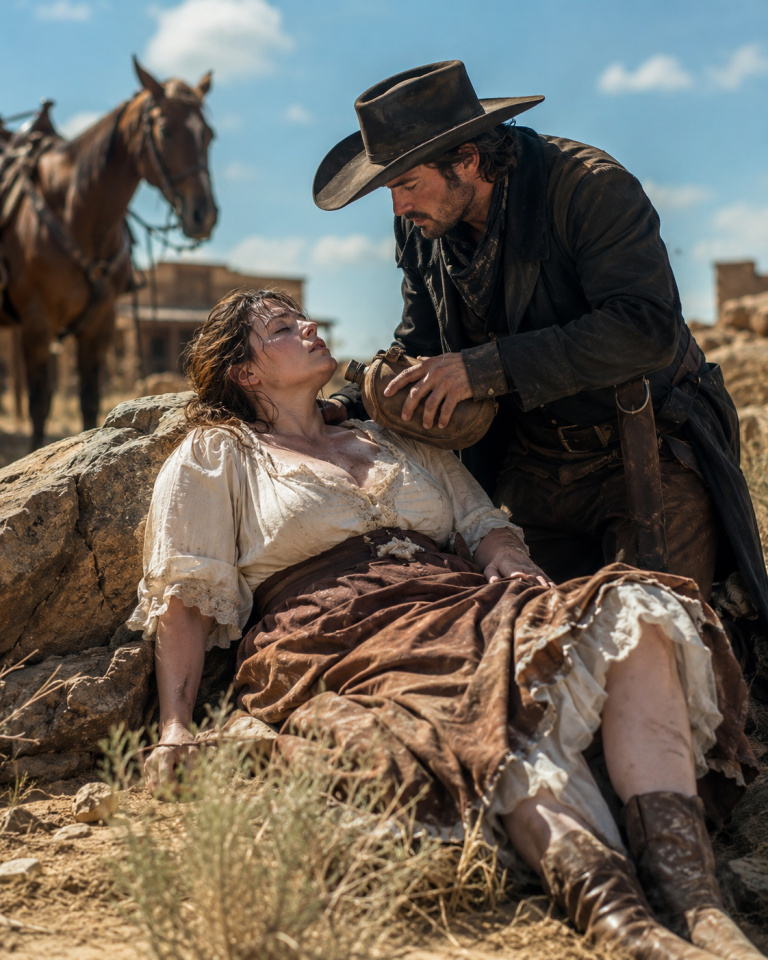
They Sent Their “Ugly Daughter” to Humiliate a Wealthy Rancher—Then He Chose Her Over Everyone Else

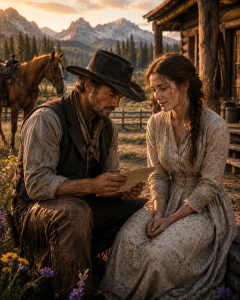
PART 1
Norah Bennett heard her own name through the parlor window before she heard the laughter that followed it, and by then it was already too late to pretend she hadn’t.
She’d been mending Caroline’s third torn hem of the month on the porch, needle moving in that automatic rhythm she’d perfected over twenty-four years of making herself useful and invisible in the same breath, when Vivien’s voice rose above the others, bright with mischief.
“Dear, sweet, unfortunate Norah,” Vivien read aloud, savoring each word like candy. “Twenty-four years old and never been courted. Father’s greatest disappointment.”
Norah’s needle stopped mid-stitch.
Through the window she could make out the shape of it now — a newspaper advertisement, a rancher out in Wyoming Territory seeking a wife of “gentle nature, modest beauty, and strong character.” Her sisters had decided, in the particular cruelty that only people who love you a little and pity you a lot can manage, that this was the funniest thing that had happened to the Bennett household in months.
“He wants modest,” Vivien said, delighted with her own wit. “Well, Norah’s certainly modest. Gentle nature — she’s about as threatening as a church mouse. Strong character — she’s put up with us for twenty-four years, hasn’t she?”
Caroline howled. Margaret’s laugh came a half-beat behind, guilty and thrilled at once. “The look on his face when she steps off that train,” Caroline gasped. “I ordered a bride and they sent me a scarecrow.”
Norah set the mending down very carefully, the way a person sets something down when their hands have started to shake and they don’t want anyone to notice. She should have marched in. She should have torn the letter to pieces in front of all three of them and told her father exactly what his beautiful daughters were plotting behind his back.
Instead she stood in the shadow of the window and listened to them compose a lie in her name — that she was eager, that she was gentle, that she longed for a new life out west — and felt something small and dangerous take root beneath the hurt. Not hope, exactly. She wasn’t fool enough to call it hope. But something.
They mailed it before their father ever found out, banking correctly that by the time he did, it would be too late to unwind without embarrassing the family name — and Thomas Bennett cared about little so much as appearances.
For six weeks, Norah told herself it would come to nothing. A rancher desperate enough to advertise for a wife in a newspaper wasn’t likely to write back to a joke. And even if he did, even if some lonely, hard-up man in the middle of nowhere decided a plain woman was better than none at all, she would simply refuse to go. She had that much dignity left, surely.
Then the letter arrived.
She was gathering eggs when she heard Vivien shriek with laughter across the yard, and she knew before she reached the house that whatever was happening involved her. All three sisters were crowded around the dining table when she walked in, passing a thick envelope hand to hand, and her father stood near the window with an expression Norah couldn’t read — shame, maybe, or the particular calculation of a man doing arithmetic with his daughter’s future.
“It seems,” Thomas Bennett said carefully, “that you’ve been corresponding with a gentleman in Wyoming Territory.”
The eggs nearly slipped from Norah’s hands.
Vivien thrust the letter at her, eyes bright with malicious glee. “Your rancher accepted your proposal. He’s sent train fare and everything.”
Norah’s eyes moved over the bold, unhurried handwriting. *I am not a romantic man,* the stranger had written. *I do not make promises about love or passion. What I can offer is security, respect, and a comfortable life… The choice is yours entirely.*
Beneath the letter, a bank draft — more money than a desperate man would ever part with.
This was not the letter of someone who’d take anyone. This was someone who meant what he said.
“Well, Norah?” her father asked, voice hardening. “What do you have to say for yourself?”
Three sisters stared at her, waiting for her to confess the scheme and spare them, or to refuse and become the family’s laughingstock all over again. Norah looked down at the honest, unflinching words of a total stranger, and felt something inside her settle into place like a key finding its lock.
“I’ll go,” she said.
The room erupted — and Norah Bennett, for the first time she could remember, didn’t feel like the one who’d lost.
PART 2
“You’ll *what*?” Vivien’s face went the color of ash.
“Norah, don’t be absurd,” Caroline sputtered, all her earlier delight curdling into something closer to panic. “It was just — we didn’t think —”
“You didn’t think he’d actually respond,” Norah said, and her voice came out steadier than she’d heard it in years. “You didn’t think I’d actually go.”
She turned to her father, who studied her for a long, unreadable moment — searching, perhaps, for desperation, or for the determination that might satisfy the only currency he understood: appearances kept, obligations settled. Whatever he found there seemed to be enough.
“Very well,” he said. “It’s an unusual match, but the man appears to be of good standing. I’ll make the arrangements.”
Twelve days of packing and barely concealed panic followed. Her sisters swung between guilt and spite, sometimes in the same sentence. Her father busied himself with logistics as though marrying off his plainest daughter to a stranger were no different from negotiating a cattle sale. Only her mother, Elizabeth, seemed genuinely shaken — coming to Norah’s room on the last night, offering an escape that Norah, gently, refused.
“When has anyone in this family ever really seen me?” Norah asked her, and her mother had no answer that didn’t end in tears.
She left with a mother’s tearful blessing, a leather journal wrapped in brown paper, and her grandmother’s music box tucked at the bottom of an old trunk — the one beautiful thing that had ever come to her instead of to a prettier sister.
Three days by train carried her from the green familiarity of Missouri to a territory so vast the sky itself seemed unfamiliar. She wrote in the journal by lamplight, wondering what kind of man wrote *I am not a romantic man* into a marriage proposal — someone hollowed out by loss, she guessed, or someone who simply refused to lie.
When the train finally slowed into a station little more than a platform and a fading sign reading RED MESA, Norah stepped down into the wind with her carpet bag and her trunk, and found the platform empty except for a sleeping yellow dog.
For one long, terrible moment, she thought he hadn’t come. That the whole arrangement had been a mistake, or worse — a joke that had reached him too, and this was his answer.
Then she heard boots on the wooden planks behind her, and turned to find a man taller than she’d imagined, weathered by wind and work, his hat in his hands and a pair of storm-gray eyes moving over her with an intensity she couldn’t name.
“Miss Bennett,” he said.
And Norah Bennett, twenty-four years old and three days from everything she’d ever known, realized she had absolutely no idea what she had just agreed to.
PART 3
“Jack Ror,” he said, and didn’t offer his hand.
Norah nodded, not trusting her own voice yet. He studied her the way she imagined a man might study a horse he was thinking of buying — not unkindly, but thoroughly, missing nothing. She knew exactly what he was seeing: the mousy hair coming loose from its pins after three days of travel, the hand-me-down dress that had been unfashionable even before it became a hand-me-down. She lifted her chin and let him look.
He simply nodded once, as if confirming something to himself, and picked up her trunk like it weighed nothing at all. “The wagon’s this way. Two hours to the ranch. We should head out before dark.”
They rode in near silence through country that made Missouri feel like a memory of a much smaller world. Golden grass rippled to the horizon; mountains stood purple against a sky too enormous to comprehend.
“It’s beautiful,” she said, not quite meaning to speak aloud.
“It’s hard country,” Jack answered. “Beautiful, yes. But hard. Winters are brutal. The work never stops.” It sounded like a warning.
“I’m not afraid of hard work,” she said. “I read that in your letter.”
Something flickered in his expression — not quite belief. He’d quoted her sister’s borrowed words back to her, words that weren’t entirely lies even if they weren’t entirely hers either. “I’ve got a housekeeper who comes twice a week,” he said. “But a place this size needs someone steady. Someone who can handle the house, help with accounts, manage supplies.”
*Steady.* Not beautiful, not charming, not accomplished. The lowest bar imaginable — and still, Norah felt a flutter of fear that she might not clear it.
“I’ll do my best,” she said quietly.
He told her, without being asked twice, that he was a widower — five years now. His wife, Sarah, had died in childbirth. Their son, Thomas, had lived. He said it flat and careful, the practiced neutrality of a man who had learned to say the words without letting them cost him anything in front of strangers. Norah understood, even in that first hour, that this was a man who had loved deeply and paid for it.
“Is that why you advertised?” she asked. “For your son? To give him a mother?”
“Partly.” His jaw tightened. “Also because ranchers around here need wives. It’s practical.” He glanced at her. “I’m not looking for romance, Miss Bennett. I don’t have that in me anymore. But I can offer you a decent life if you’re willing to work for it.”
It should have stung. Instead, something in Norah’s chest loosened. At least there would be no pretense. No trying to be something she wasn’t.
“That seems fair,” she said.
Twilight was settling over the valley when they crested a rise and Jack pulled the horses to a stop. Below them spread a ranch far larger than she’d expected — a sprawling log-and-stone house, barns, corrals, cattle dotting the darkening grassland. Lamplight glowed warm in the windows.
“Three thousand acres of deeded land,” Jack said, quiet pride threading through his voice. “My father started this place with nothing but a land grant and stubbornness. I’ve spent ten years making it into something that’ll last.”
A lanky young foreman named Ben Cooper met them at the house, tipping his hat to Norah with careful curiosity. And then Jack said the words that stole the last of her breath: “We’ll be married tomorrow.”
“Tomorrow?” she repeated faintly.
“Figured there was no point waiting.” He was already pulling her trunk from the wagon. “Unless you need time. I can send word to postpone.”
“No,” she said, steadier than she felt. “Tomorrow is fine.”
He showed her to a small room that had once been his first wife’s sewing room. “It’s small,” he said, and for the first time she heard something like apology in his voice. “But it’s yours.” Across the hall was his room, and beside his, a smaller one — Thomas’s.
That night, alone with her grandmother’s music box, Norah wound the key and let its delicate melody fill the unfamiliar room. A soft knock interrupted it — Jack, with a supper tray.
“I heard music,” he said, glancing at the small wooden box. “Sarah used to play piano. Not well, but she enjoyed it. I haven’t heard music in this house in five years.” He paused at the door. “It was nice, hearing it again.”
He left before she could answer, and Norah lay awake a long time wondering what kind of life had gone five years without music in it, and whether she was now expected to fill that silence.
*
Morning came with the mundane sounds of a household waking — a child’s voice, high and questioning, and Jack’s low answer. Norah dressed in her best blue cotton, too big in the shoulders and too short in the hem, and went down to find Jack flipping pancakes while a small boy chattered at the table about horses.
The boy stopped when he saw her, eyes going wide. Dark curls like his father’s. Bright blue eyes that must have come from his mother. A gap where he’d lost a front tooth.
“Thomas,” Jack said quietly. “This is Miss Norah. Remember what I told you?”
The boy nodded solemnly. “You’re going to be my new mama.”
The word hit Norah like a physical blow. *Mama.* This perfect, motherless child was going to call her that, and she had no idea how to be anyone’s mother.
“Hello, Thomas,” she managed. “It’s very nice to meet you.”
“Are you going to live here forever?” he asked, with a child’s directness.
“Yes. I think so.”
“Good.” He returned to his pancakes, crisis averted, stranger accepted, life continuing — and something in Norah’s chest cracked gently open.
Pastor Michaels arrived within the hour, a weathered man with kind eyes who looked between them with the particular seriousness of someone who took vows seriously even when the people making them barely knew each other. “You two sure about this?”
“We’re sure,” Jack said.
The pastor’s gaze lingered on Norah. She thought of her sisters’ laughter, her father’s disappointment, the life stretching behind her like a sentence already served. She thought of Jack’s honest letter and Thomas’s gap-toothed grin.
“I’m sure,” she said.
They stood in the parlor while morning light slanted through the windows and Thomas watched with solemn five-year-old interest. Jack had shaved for the occasion, put on a clean shirt — small gestures that told her, more than any words could, that this mattered to him even if he’d call it only practical.
“I do,” he said when the moment came, his voice steady.
“I do,” she whispered, and felt the weight of it settle over her like a second skin.
When Pastor Michaels pronounced them married and told Jack he might kiss his bride, Jack hesitated — the first real uncertainty she’d seen crack his careful control — then bent slowly, giving her time to pull away. She didn’t. His lips brushed hers, light as breath, and it was over before she’d fully understood it had begun.
Afterward, Jack pulled something from his pocket — a plain gold band, bought new in Cheyenne, he admitted, because he hadn’t wanted to hand her a ring that belonged to somebody else’s marriage.
“It’s not much,” he said, sliding it onto her finger. It was slightly too large, loose enough that she’d need to be careful not to lose it, but it felt right somehow.
“It’s mine,” Norah said simply, and that seemed to settle something in him.
“Do you mind if I call you Nora?” he asked, almost gruff about it. “Norah suits you fine, but Nora fits easier in a day.”
“No one ever has,” she said. “But I think I’d like it.”
*
The first weeks blurred together in a haze of learning. Norah rose before dawn to cook for hungry men who ate with the focused intensity of people who worked from sunrise to dark. She learned which hens were the best layers, how to read the sky for weather, how to stretch supplies against the long winter that Mrs. Chen — the sharp-eyed housekeeper who’d kept the Ror household running since Sarah’s death — warned her was coming.
Thomas became her shadow, chattering endlessly, teaching her ranch life while she taught him his letters. Jack remained courteous, appreciative, and entirely walled off, sleeping across the hall, working until dark, orbiting her like a planet that never quite aligned.
One evening, Thomas asked the question she’d been dreading. “Did you know my first mama?”
“No, sweetheart. I never met her.”
“Sometimes I try to remember what she looked like,” he said, small and troubled. “But I can’t. Is that bad?”
“No,” Norah said gently, sitting on the edge of his bed. “You were very young when she died. It’s not bad that you don’t remember.”
“Do you think she would have liked me?”
“Oh, Thomas.” Her heart cracked. “She loved you more than anything in the world. And she would want you to be happy.”
He took her hand. “I’m glad you came. Papa is less sad now.”
That night, Norah found Jack in his study, bent over account books. When she told him what Thomas had said, his pen stopped moving.
“He never had the chance to know her,” Jack said. “She died bringing him into the world. He doesn’t remember a single thing about her, and there’s nothing I can do about that.” “Do you have any pictures of her?” she asked. “Something he could see.”
“I haven’t looked at them in years.” His voice went flat, then hard, when she pushed gently — *for Thomas, so he knows where he came from* — and he stood so abruptly his chair scraped the floor. “I have work to finish.”
It was a dismissal, clear and cold, and Norah left with frustration burning in her chest. How was she supposed to build a partnership with a man who wouldn’t let her in?
*
The town of Red Mesa did not make things easier. Word had traveled fast — *that’s her, the mail-order bride, a plain little thing, isn’t she* — and Norah learned to keep her chin up under the weight of it. At the mercantile, a notice pinned beside the door announced a railroad survey team due through the territory the following year, and Norah, waiting on Jack to finish his business, read it twice and tucked it away in memory the way she’d once tucked away her father’s ledgers — quietly, and for no reason she could yet name. She also met Lydia Marsh there, blonde and pretty and entirely unable to disguise her disappointment that Jack had married anyone but her. At the restaurant, a smiling, oily man named Martin Shaw made a thinly veiled offer to buy Jack’s south grazing land, an offer Jack refused flat.
“Everything’s for sale at the right price,” Shaw said, tipping his hat as he left. Jack’s jaw stayed tight the rest of the meal.
A dinner invitation from the Marsh family proved worse. While the men talked cattle prices, Lydia cornered Norah in the parlor, needling her about isolation and Jack’s coldness and how Sarah used to complain he barely spoke to her for days during roundup season.
“That’s enough,” Norah said, sharper than she’d ever spoken to anyone in her life. “My husband is a good man, and I don’t appreciate hearing negative speculation about my marriage.” She walked out before either woman could respond.
On the ride home, Jack was quiet for a long while. “Thank you,” he finally said. “I heard what you said to Lydia through the door. Most people wouldn’t have stood up to her.”
“She had no right to speak about you like that. Or about Sarah.”
He told her, haltingly, that his marriage to Sarah hadn’t been simple — that they’d wanted different lives, that love hadn’t been enough to bridge the distance between a woman who wanted refinement and a man who wanted to build a ranch from nothing.
“Marriage shouldn’t be easy,” Norah said. “If it’s easy, you’re probably not really trying.”
He looked at her with something like surprise — and then, for the first time since she’d met him, Jack Ror smiled. Really smiled, reaching all the way to his eyes.
“You’re smarter than I gave you credit for,” he said.
“I’m smarter than anyone gives me credit for,” she replied. “I’m just usually too polite to mention it.”
He laughed — a rough sound, like he’d forgotten how — and driving home through the Wyoming twilight with a man who was slowly becoming less of a stranger, Norah felt something she hadn’t felt in years: hope.
*
October brought gold aspens and the first crisp warnings of winter. Six weeks into her new life, Norah had started to feel the rhythms of the ranch as her own. One evening, mending Jack’s torn shirt by lamplight, she asked him to teach her the ranch business beyond the house — the accounts, the grazing, the cattle.
“You said you wanted a partner,” she reminded him. “Partners share information.”
Something in his face shifted. “You’re right,” he said slowly. “I’ve been treating you like just a housekeeper. That’s not fair.”
The next morning he walked her through two hours of ledgers, and Norah proved herself quicker with numbers than he’d expected. It wasn’t as sudden a gift as it looked — she had spent years quietly correcting her father’s account books after everyone else had gone to bed, a skill nobody in Missouri had ever called intelligence, because nobody had bothered to notice. Over the months that followed, session by session, Jack taught her to read the ranch the way he did — soil, water rights, grazing rotations, market timing — until by winter she could look at a parcel of land and see what it was actually worth, not just what it looked like.
“When did you become a cattle baron?” Jack asked one afternoon, something warm and almost proud in his voice.
“When you started treating me like a partner instead of just another mouth to feed,” she said.
He went still, then nodded. “You’re right. I did that. I’m sorry.” It was the first time he’d apologized for anything, and it meant more than she expected.
They were building something. Not romance, not yet — but something solid.
That solidity was tested the week the first true storm hit. The sky turned the color of old bruises; the temperature dropped twenty degrees in an hour. Jack and the hands scrambled to shelter the cattle while Norah filled water containers and pulled out every blanket in the house. By the time the men finished securing the barn, three feet of snow had buried the world in white.
That afternoon, cornered together in the pantry taking stock of supplies, Jack admitted something he hadn’t said to anyone. “This is the first major storm since Sarah,” he said quietly. “I keep waiting to hear her pacing, panicking. She hated the isolation out here. Begged me to take her to her parents’ for the winters, and I never would, because I couldn’t leave the ranch.” His voice roughened. “And then she got pregnant, and she begged me to go to Denver for the birth, to a real hospital, and I thought she was overreacting. I was wrong.”
Norah crossed the space between them and took his hand. “It wasn’t your fault. You couldn’t have known.”
“I chose the ranch over her,” he said. “And she died for it.”
“You can’t carry that guilt forever,” Norah said firmly. “Sarah wouldn’t have wanted that. She would want you to be happy. To give Thomas a real home, not a mausoleum. To move forward.”
He stared at her — and then, instead of retreating behind his walls, he pulled her into a fierce embrace, holding her like someone drowning holds a lifeline. “I’m tired,” he whispered into her hair. “I’m so tired of being angry at myself.”
“Then stop,” she said. “Choose something else. Choose to be here, now, with me and Thomas.”
They stood together a long time in the pantry, two damaged people recognizing each other’s scars and choosing, deliberately, not to look away, before the work of the storm pulled them apart again.
The snow kept them tied together for two more days after that — digging paths to the barn, hauling feed, checking on stranded stock, falling into bed each night too spent to do anything but sleep. It was ordinary, unglamorous work, done shoulder to shoulder, and it did something the confession alone hadn’t: it showed Norah a version of Jack who trusted her to stand beside him in the middle of a crisis, not just in the quiet after one.
On the third night, with the worst of the storm finally past and Thomas long asleep, Jack found her in the hallway outside their rooms and framed her face in his hands. “Tell me if you don’t want this,” he said, his voice rough. “Tell me now, because I’m trying real hard to be a gentleman, but Nora—”
She kissed him first.
It was clumsy and urgent and nothing like the careful peck they’d exchanged at their wedding — two lonely people finally reaching for something real. When they broke apart, breathless, Jack rested his forehead against hers.
“I don’t want you to think this is just because we’re stuck in a storm,” he said.
“I know what this is,” Norah told him. “A choice. We’re choosing each other, Jack. Finally.” She smiled up at him. “We did this marriage backward. Wedding first, everything else after. Maybe that’s better, even.”
He kissed her again, slower, and asked her to come to bed — not because she had to, but because she wanted to. “I want that too,” she said simply.
Later, lying in his arms while snow buried the ranch deeper by the hour, Jack told her the truth he’d never spoken aloud — that by the time Sarah died, they’d been unhappy for months, that he’d felt relief as much as grief, and that the guilt of that relief had built the walls he’d hidden behind for five years.
“What kind of man feels free when his wife dies?” he asked. “What kind of monster?”
“A human one,” Norah said firmly. “A human being trapped in an unhappy situation. Feeling relieved doesn’t mean you didn’t love her.” She touched his face. “And then you showed up,” he said. “Plain, honest Nora, who didn’t expect anything except respect and hard work. Who saw past all my defenses to the man I used to be.”
“I’m falling in love with you,” Jack said into the darkness. “I know that wasn’t the deal. But I can’t help it.”
“Good,” Norah said through sudden tears. “Because I’m falling in love with you too, and I was terrified you’d never feel the same way.”
*
Morning brought Thomas pounding down the hallway, thrilled by the snow, and an honest conversation with a five-year-old about why Mama Nora and Papa now shared a room. “Does that mean Mama Norah is staying forever and ever?” he asked.
“Forever and ever,” Norah confirmed, and Thomas threw his arms around both their legs at once.
The storm’s aftermath cost them two calves and revealed, slowly, a Norah the town hadn’t yet met. When Jack decided to sell a rocky, low-value strip of land to Martin Shaw to fund irrigation improvements, he brought Norah to the negotiation as a full partner.
“Mr. Shaw,” she said, pleasant and unshakable, “that land connects your two largest parcels and gives you direct water access year-round. It’s worth at least double what you’re offering, and we both know it — especially once the railroad expansion comes through next year.”
Shaw stared at her, then laughed. “Well played, Mrs. Ror. I see Jack’s found himself quite a partner.”
They walked out with a price that funded exactly the improvements Norah had suggested weeks earlier, and Jack pulled her into his arms right there on the sidewalk, scandalizing half of Red Mesa. “Have I mentioned lately that I love you?”
“Not since this morning,” she said, breathless.
Word spread through town faster than the snow had melted. Mr. Henderson at the mercantile began asking her opinion on flour grades. Women who’d been coolly polite grew warmer. Even Lydia Marsh managed a stiff, grudging nod.
“What changed?” Norah asked Jack.
“You changed,” he said. “You stopped acting like you had to apologize for existing.”
*
Letters arrived from Missouri that December. Norah’s mother wrote often now, warm and curious. Her father’s single letter was stiff, but included one line that made her throat tighten: *I am pleased to hear you have found your place in the world.* Her sisters wrote too — a joint letter, half-apology and half-curiosity about the West.
Jack read over her shoulder. “Your sisters want to visit next summer. Would you mind?”
“It’s your home too,” he said. “Invite whoever you want. I admit, I’m curious to meet the women who were foolish enough to think they were better than you.”
“They were beautiful. Are beautiful.”
“So are you,” Jack said, turning her to face him. “When are you going to believe that?”
“I’m not beautiful, Jack. I’ve accepted that. I’m valuable anyway, and that’s better.”
“You’re wrong.” He cupped her face in his rough hands. “You’re beautiful because you’re real. Because when you smile at Thomas your whole face lights up. Because you make this house feel alive. I see you, Nora. All of you. And you’re the most beautiful thing I’ve ever known.”
Christmas came with fresh snow and a small, warm celebration — carved horses from Ben, hand-knitted scarves for the men, a quilt Norah had pieced from scraps of their story: her traveling dress, his work shirt, Thomas’s first outgrown shirt, the ranch brand embroidered at its center.
“Nora,” Jack breathed, staring at it. “I don’t have words.”
His gift to her was a leather journal, embossed with her name, inscribed inside: *For Nora Ror, who made our house a home and my life complete.* Tucked inside the front cover was a second, smaller box. Norah opened it to find Sarah’s gold band, the one Jack had kept locked away since the funeral.
“I’m not asking you to wear it,” he said quietly, watching her face. “I just don’t want it sitting in the dark anymore. I thought — maybe someday, for Thomas, or for a daughter, if we’re ever lucky enough. I want it to mean something again instead of just meaning what I lost.” He paused. “I’m not carrying it like a wound anymore, Nora. I wanted you to be the one I gave it to, because you’re the reason I finally could.”
Norah closed her hand gently around the box and set it beside the journal, understanding it for what it was — not a burden passed to her, but a door Jack had finally managed to close on his own terms.
That night, by the fire, Jack told her something he hadn’t planned to say. “I wrote to your sisters last week,” he said. “Told them the woman they mocked has more courage, kindness, and beauty than anyone I’ve ever met. Told them their cruelty brought me the greatest gift of my life.”
“You *didn’t*.”
“I absolutely did. Nobody gets to make my wife feel small. Not even in memory.”
*
Winter deepened, then loosened its grip as February arrived. One morning, Norah woke feeling strange — dizzy, faintly nauseous — and blamed it on supper. By the third such morning, understanding began to dawn, and with it, fear laced through with memory of Sarah.
She waited two weeks to be certain before she finally blurted it out one evening. “I’m pregnant.”
Jack froze mid-motion, removing a boot. “What?”
“I’m pregnant. I think. I’m almost certain.” Her hands twisted together. “I know it’s sooner than we probably should have — and with what happened to Sarah—”
He crossed the room in three strides and pulled her into his arms so tightly she could barely breathe. “A baby,” he said, his voice rough with emotion. “We’re having a baby.”
“You’re not upset?”
“Upset? Nora, you’ve given me everything. A home. A partner. A reason to wake up happy. And now a child.” His eyes were wet. “How could I be anything but grateful?”
“But Sarah—”
“You’re not Sarah,” he said firmly. “And this time I’m doing everything right. We’re going to Denver for the birth. I’m hiring the best doctor money can buy. I’m not taking any chances with you.” He cupped her face. “I’m not losing you, Nora. I can’t. You’re the best thing that ever happened to me.”
Thomas took the news with the enthusiasm only a five-year-old could muster, immediately appointing himself the baby’s protector and lobbying, unsuccessfully, to name it Thunder.
*
By June, when Norah’s sisters finally arrived for their long-promised visit, she was well into her seventh month and glowing despite her fears. Vivien stepped down from the wagon looking around with wide eyes at the vastness of it all. Caroline admitted, quietly, that she’d never imagined it could be beautiful. Margaret ran straight to Norah and studied her face.
“You look happy,” she said, almost wondering.
“I am,” Norah said simply.
Her sisters threw themselves into ranch life with more effort than grace, gathering eggs, helping in the kitchen, listening with real fascination as Norah explained land values and cattle operations. One evening on the porch, watching the sunset paint the mountains gold, Vivien finally said what none of them had managed before.
“I’m sorry, Norah. For everything. For the joke, for the years of making you feel small, for being too blind to see what was right in front of us.”
“We thought we were so clever,” Caroline added. “Sending you out here to be humiliated. But you weren’t humiliated. You thrived.”
“Someone we should have seen all along,” Margaret finished.
Norah felt tears prick her eyes. “I forgive you,” she said slowly. “But I won’t pretend what you did was harmless, or that it was some kind of gift. My life became beautiful in spite of your cruelty, not because of it. Those aren’t the same thing, and I need you to understand the difference.”
“You should never have needed our cruelty to find your worth,” Vivien said quietly. “That’s not something to thank us for. You’re right to make us sit with that.”
They watched Jack and Thomas together in the distance, working with a horse. Jack looked up and caught Norah’s eye, and smiled — that rare, transformed smile.
“He really loves you,” Caroline observed. “Not just married because it’s practical. Really loves you.”
“I love him too,” Norah said. “More than I knew it was possible to love anyone.”
*
The summer passed in a golden haze, Norah’s belly growing round and heavy while she remained strong. Jack kept his promise. As her time approached, they traveled to Denver, leaving Thomas with Mrs. Chen, and Jack hired not one but two doctors to attend the birth — refusing, this time, to let convenience cost him anything that mattered.
Labor began on a cool September evening, exactly one year after their wedding. Jack paced the hospital corridor like a caged animal, refusing every attempt to send him away, planting himself outside the door with the immovable determination of a man keeping a promise to himself.
Inside, Norah labored through the night thinking of Sarah, of the thin line between life and death that childbirth had always represented in that house — but also of Jack waiting just beyond the door, of Thomas back at the ranch, of the life she had built and had absolutely no intention of leaving.
Their daughter arrived with the dawn, squalling and perfect and alive. Jack stood at the bedside staring at his wife and new daughter with an expression of such profound gratitude the nurses had to look away.
“She’s perfect,” he breathed. “You’re perfect. You did it, Nora.”
“We did it,” she corrected, placing the tiny bundle in his arms. “Together.”
They named her Sarah Grace — Sarah for the mother Thomas never knew, Grace for everything that had carried Norah west and into a life she’d never dared imagine for herself. A bridge between what was lost and what had been found.
When they brought her home three weeks later, Thomas had appointed himself, with utter solemnity, the best big brother in all of Wyoming Territory. The ranch hands lined up to meet her, each gift more awkward and sincere than the last — a carved rattle from Ben, a hand-sewn blanket from Pete’s wife, a silver dollar from young Sam, offered for her future.
That night, with Sarah Grace asleep in her cradle and Thomas finally settled, Norah and Jack stood at their bedroom window watching moonlight silver the valley. His arms came around her from behind, his chin resting on her shoulder.
“Thank you,” he said quietly.
“For what?”
“For being brave enough to get on that train. For giving me a second chance at everything — at love, at family, at being the man I wanted to be.” He turned her to face him. “For seeing past the walls to the person underneath. For making this house a home.”
“Just one year,” Norah teased gently, blinking back tears.
“The first of many,” Jack said. “The first of a lifetime.”
He kissed her, slow and full of promise, while outside the wind moved through the grass and the mountains stood eternal against the dark. Inside, their children slept safe and warm, and the house that had been silent and sad for so long was, at last, entirely full of life.
Norah thought of the girl she had been — plain, overlooked, certain of her own inadequacy — boarding a train west expecting humiliation and finding, instead, an entire life waiting to be built. She had learned that beauty wasn’t symmetry or golden hair, but the courage to be fully, honestly yourself. That love didn’t require perfection, only honesty, and the daily choice to keep showing up for each other through storms and ordinary mornings alike.
The mail-order bride who’d arrived in Wyoming as a joke had become the heart of Ror Creek Ranch. The plain daughter had found her place, and it turned out that place had never been plain at all.
On the nightstand across the room, catching the last of the moonlight, sat a small wooden music box — the one beautiful thing that had ever come to her instead of to a prettier sister, carried two thousand miles from a house where she was never quite enough, into a home where she finally, completely, was.
THE END