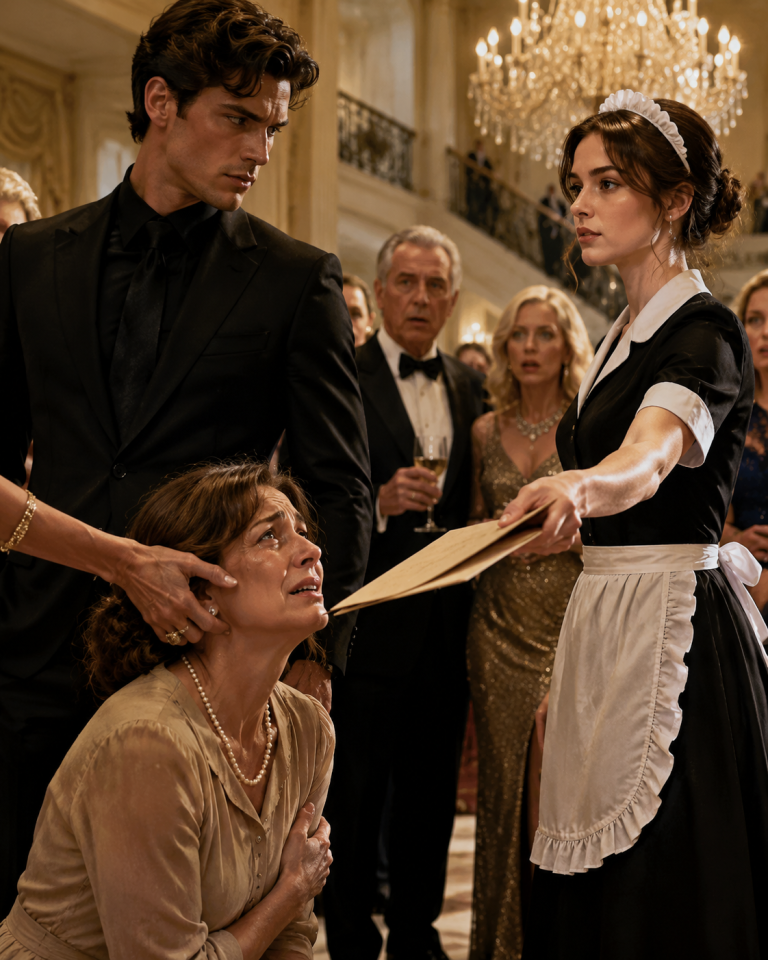
My Husband Paraded His Mistress Into My Birthday Celebration — Then I Removed Him as CEO Before Dessert


—
## PART 1
The ballroom went quiet before the band even noticed. Charlotte stood beneath a chandelier of falling crystal, one hand resting on the stem of a champagne glass she hadn’t tasted, watching her husband cross the marble floor with another woman’s hand in his.
The woman was young enough to be mistaken for his daughter if not for the way she leaned into him — golden-haired, polished, deliberate, her red dress cutting through the sea of navy suits like a fresh wound. A diamond bracelet glittered on her wrist. Charlotte recognized it instantly. Paris, twenty-eight years ago. Richard had told her it was being repaired.
Beside her, Emma made a small strangled sound. “Mom.”
Charlotte didn’t turn.
A waiter near the head table looked trapped, holding two place cards in white-gloved hands. “Mrs. Whitmore, I’m so sorry. Mr. Whitmore’s assistant said there was a seating change.” One card read *Charlotte Whitmore.* The other read *Ava Sinclair.* Ava had been placed at Richard’s side. Charlotte had been moved three seats away, between a city councilman who smelled of cigars and Richard’s golf partner, who once asked if she still handled little household things now that the company was large.
Emma reached for the card. “I’ll fix this.”
Charlotte closed her fingers gently over her daughter’s wrist. “No. Leave it.”
“Leave it?”
Charlotte’s eyes stayed on Richard, who had just lifted Ava’s hand to greet a cluster of donors — a gesture careful enough to look accidental, intimate enough to wound. “Let him finish setting the stage,” she said softly.
For thirty-four years, Richard Whitmore had believed his wife was quiet because she lacked appetite for the spotlight — too sentimental to protect herself, the woman who’d balanced his books at a kitchen table and signed his early loans out of loyalty rather than leverage. That had always been his first mistake. His second was bringing Ava Sinclair into a room full of people who had watched Charlotte build his life from nothing. His third was believing this party belonged to him.
He reached the head table and kissed Charlotte’s cheek — cold, dry, near her ear. “Happy birthday, darling.” Ava’s perfume followed him, sweet and sharp.
“You brought a guest,” Charlotte said.
His smile tightened for a fraction of a second. “Ava is important to the future of Whitmore Development. I thought tonight was the right moment to introduce her properly.”
*Properly.* The word almost amused her.
Ava extended a hand. “Charlotte, I’ve heard so much about you.”
“So have I,” Charlotte said, looking at the hand, then the bracelet.
Ava’s smile flickered. Richard cleared his throat. “Let’s not make this uncomfortable.”
Charlotte set her untouched champagne on the table. “You did that when you changed my seat.”
A pause opened around them. Guests near the table found sudden interest in the flower arrangements. Nobody left — people rarely walk away from a collision before impact.
“This isn’t the time,” Richard said, low.
Charlotte looked at the ballroom — the cake, the family photographs projected on the far wall, the employees in their best clothes, the investors who owed her more than they remembered, her two grown children standing on opposite sides of an earthquake neither of them had felt coming yet. “No,” she said. “It’s exactly the time.”
Their son Oliver stepped between them — forty, his father’s jaw, his father’s trained smile, a man who’d spent years learning to see both sides of a fire even when one side was holding the matches. “Mom. Please, not tonight.”
Emma turned on him. “Are you serious?”
“I’m trying to protect the family.”
Something behind Charlotte’s eyes cooled. “The family,” she repeated.
Richard exhaled, visibly relieved. “Your mother understands discretion. She always has.”
Charlotte heard the insult riding under the compliment. In Richard’s mouth, *discretion* had always meant *silence that serves me.* She lifted Ava’s place card between two fingers and set it neatly beside Richard’s plate.
“Enjoy dinner,” she said.
Richard blinked. “You’re being reasonable.”
Charlotte smiled. That frightened Emma more than anger would have.
“I am being patient,” Charlotte said. Then she walked to the seat they had assigned her, sat down with perfect posture, and let the room watch her husband make the biggest mistake of his life.
—
## PART 2
Six months earlier, Charlotte had found the first receipt — not lipstick on a collar, nothing so sloppy. Richard was too polished for that. It was a wire transfer buried in a vendor reconciliation file: *Ava Sinclair Strategic Image — $85,000.*
Charlotte had been the one who kept Whitmore Development alive before Richard became its public face — good with numbers, quietly holding voting control through the Eleanor Caldwell Legacy Trust, an inheritance from her grandmother that Richard knew existed but had never bothered to read the terms of. He knew it had backed the company’s first loan. He didn’t know that after he’d nearly bankrupted the business chasing an unpermitted luxury project in year three, Charlotte’s attorney had quietly converted that early help into fifty-two percent of the voting shares. To the world, Richard owned Whitmore Development. In reality, he’d stopped reading the paperwork the day Charlotte called it “just estate planning.”
She dug further. A second payment, a hundred twenty thousand. A third for a harbor penthouse lease. A fourth for jewelry — the bracelet. She printed everything, called her attorney, Beatrice Vale, and said four words: “I think it’s fraud.”
“Do you have proof of the affair, or proof of the money?” Beatrice asked.
“The money.”
“Good. Affairs make people emotional. Money makes judges listen.”
Over the following months, a forensic accountant traced routed payments, inflated invoices, and travel logged as investor outreach — and one document that stopped Charlotte’s hand cold at two in the morning, in the same kitchen where she’d once packed school lunches: a draft family governance plan that would move voting control out of the Caldwell Trust entirely. One sentence sat at its center. *Charlotte’s emotional attachment to the marriage can be leveraged during anniversary and birthday events to obtain ceremonial consent.*
*Ceremonial consent.* That was what her husband thought thirty-four years of her life amounted to.
Emma found her in the garden two weeks later, papers in her lap, no coat despite the cold. She didn’t ask if Charlotte was sure — she’d already seen Richard and Ava at the Monrose Hotel and hadn’t known how to say it. Oliver, when told, asked for evidence, frowned, and worried aloud about the company’s hundreds of employees before he worried about his mother.
“If someone steals from a house,” Charlotte asked him, “do we protect it by handing him the keys?”
By the time June arrived, Richard had planned her sixtieth birthday like a coronation — the hotel, the orchestra, a video montage where he stood in the center and she stood slightly behind. Charlotte let him. Every time he asked her opinion, she gave him nothing to work with. *Lovely. Whatever you think.* He mistook her cooperation for surrender.
Three days before the party, an unknown number sent her a photo: Ava in a dressing-room mirror, wearing Charlotte’s bracelet, captioned *Richard says red makes a woman impossible to ignore.* A second message followed. *I hope Saturday won’t be too difficult for you. Change is easier when everyone accepts it gracefully.*
Charlotte forwarded both to Beatrice. “She thinks it’s a threat,” she wrote. “It’s an exhibit.”
By noon on the day of the party, the divorce petition was filed and ready for service. The emergency corporate motion sat prepared. A special board vote had been scheduled for the following morning, pending disclosure. Richard had written his version of that night months in advance.
Charlotte had spent three of them quietly editing the ending.
—
## PART 3
At seven that evening, the Grand Mirabel filled with white roses and soft jazz. Charlotte greeted guests with a smile that made them feel safe, kissed cheeks, accepted birthday wishes, and embraced former employees who remembered when Whitmore Development had rented two rooms above a bakery and she’d answered phones while balancing payroll on a folding table.
George Bell, the retired operations chief, took both her hands. “I’ve heard rumors,” he said quietly.
“Most rumors are underdressed truths,” Charlotte replied.
His mouth tightened. “Tell me where to stand.”
“Near the front,” she said. He nodded once and moved.
By 7:45, everyone knew something had shifted. Ava didn’t behave like a guest — she behaved like a replacement inspecting the furniture, touching Richard’s arm mid-conversation, laughing too loudly at stories she hadn’t earned, calling him *Richard* in front of men who’d called him Mr. Whitmore for twenty years. Dinner began. Richard held court. Charlotte ate three bites of salmon and let the room tighten around her like a held breath.
At 8:30, the lights softened and a hotel manager handed Richard a microphone. He climbed the small stage beneath the screen of family photographs.
“Friends, partners, family,” he began. “Thank you for joining us to celebrate Charlotte.” He spoke about their marriage, their children, the early years — using *we* six times — and then his voice shifted. “But life isn’t meant to stand still. Growth requires courage. The future asks us to welcome new energy, new vision, new chapters.” Several guests glanced toward Charlotte. She kept her hands folded.
Richard smiled at Ava. “Would you join me?”
She rose in red and crossed the room slowly, savoring every step, while Emma whispered something that sounded like a prayer and a curse and Oliver half-rose from his chair, then froze.
“Many of you know Ava Sinclair as a consultant,” Richard told the room, taking her hand. “But to me, she’s become much more than that. She represents the next chapter of Whitmore Development — and of my life.”
A gasp moved through the guests.
Charlotte stood. The entire ballroom turned with her. She didn’t hurry. She walked between the tables, past the donors, past her son — who looked as if someone had finally made him watch his own house burn from the inside — and climbed the steps.
“Charlotte,” Richard said into the microphone, too loud.
“The microphone,” she said, holding out her hand.
He stared. Ava’s fingers tightened around his.
“You introduced your next chapter,” Charlotte said to the room. “It’s only polite that I introduce mine.” She reached into her evening bag and placed a cream envelope in Richard’s hand. A man seated at table twelve stood, adjusted his jacket, and said clearly: “Richard Alden Whitmore, you have been served.”
The sound that moved through the ballroom wasn’t a gasp. It was a fracture.
Richard opened the envelope with stiff fingers. His face emptied. Ava leaned in, saw the first line, and stopped smiling. Charlotte lifted the microphone from his loose hand.
“Those are divorce papers,” she said, and let the silence hold before continuing. “For thirty-four years, many of you have known me as Richard’s wife. Some of you knew me before Whitmore Development had a sign on the door — when I wrote payroll checks from a folding table and used my grandmother’s inheritance to guarantee the company’s first loan.”
Near the front, George Bell called out, “We remember.”
“What many of you don’t know,” Charlotte went on, “is that those guarantees weren’t gifts. They were converted, years ago, into voting rights held by the Eleanor Caldwell Legacy Trust.” Ava’s eyes went to Richard, uncomprehending. “It means I control fifty-two percent of Whitmore Development’s voting shares,” Charlotte said, and the room dissolved into whispers.
“That’s misleading,” Richard said.
Beatrice Vale stepped to the edge of the stage, small, silver-haired, and cold as January glass, and opened a tablet. “It’s filed with the state, acknowledged by the board, and signed by you — in 2003, 2009, and 2017.”
Charlotte turned to the screen behind her. The family montage vanished, replaced by a spreadsheet.
*Ava Sinclair Strategic Image — Consulting fee, $85,000. Consulting fee, $120,000. Luxury travel, $46,200. Harbor penthouse lease, $168,000. Jewelry — executive relations expense.*
Ava took a step back. “Richard —”
“Turn that off,” he said, but the technician, who’d worked for Charlotte’s foundation for twelve years, kept his eyes forward and did not move.
“These payments were made through company accounts under project-development categories,” Charlotte said. “Several were attached to proposals seeking trust-backed financing.”
“You told me those were personal,” Ava whispered.
“Be quiet,” Richard snapped — close enough to the microphone for every table to hear.
Charlotte clicked the remote once more. A document filled the screen. *Family Governance Transition Plan.* The highlighted line glowed above the crowd: *Charlotte’s emotional attachment to the marriage can be leveraged during anniversary and birthday events to obtain ceremonial consent.*
This time the gasp was sharp enough to cut. Oliver sat down as though his knees had failed him. Emma covered her mouth. Richard’s face went gray.
Charlotte looked at her son before she spoke again. “This is why some things cannot be handled privately.”
“That draft was never used,” Richard said.
“Because I found it.”
Ava rounded on him. “You told me she barely understood the company structure.” His head snapped toward her, but it was too late — the room had heard.
Beatrice stepped forward. “As of tonight, Mrs. Whitmore has exercised emergency voting authority under the trust protections and shareholder agreement. Mr. Whitmore is suspended from all executive authority pending an independent audit. Company cards, building access, and signing privileges are frozen. Miss Sinclair’s consulting contract is terminated effective immediately.”
“You cannot remove me from my own company,” Richard said.
“It was never only yours,” Charlotte answered.
He tried to laugh. “Without me, Whitmore Development is nothing.”
George Bell rose from the front table, his voice rough with age and anger. “That’s not true, Richard. I watched Charlotte keep that company alive while you chased applause. I watched her cover payroll when your first hotel deal collapsed. I watched her talk suppliers out of lawsuits you never even knew were coming, because she didn’t want to embarrass you.” He held Richard’s stricken gaze. “You forgot who built the floor under you.”
The applause started at one table of former employees, then spread. Charlotte didn’t smile. This wasn’t triumph yet — this still hurt — but the room had stopped watching a wife get replaced and started watching a man lose a stage he’d stolen.
Richard reached for the microphone again; Charlotte moved it out of his reach. “Enough.”
Ava stepped forward, no longer soft, the red dress that had looked like victory now looking like evidence. “I was told the marriage was over,” she said. “He told me you lived separate lives. That you only appeared together for the company.”
Charlotte glanced at the bracelet on Ava’s wrist. “Did he also tell you to wear my jewelry?”
Richard rounded on her. “Stop talking.”
“No,” Ava said. “You told me she was a figurehead.”
The word passed through the room like smoke. Oliver flinched, hearing in one evening what his father had spent years teaching other people to believe about his mother.
Emma stood. “Accepting you as what? My mother’s replacement at her own birthday party?”
Something close to shame crossed Ava’s face — almost. “Your father made promises.”
“He made vows first,” Emma said, and the sentence landed harder than any exhibit had.
Oliver rose slowly. “Dad. Tell me the restructuring plan was fake. Tell me you weren’t going to use Mom’s birthday to pressure her into signing control away.”
Richard said nothing. Oliver’s face collapsed, and Charlotte hated that part more than any of it — she had wanted him exposed, the company protected, her dignity returned in the room where he’d tried to take it. She had never wanted her children to watch their father become small.
“What happens to my contract?” Ava asked, voice sharpening into fear.
“Ava, this isn’t the time,” Richard said.
“Not the time? My name is on that screen. You promised legal protection.” She turned on him fully. “You said Charlotte would cry and leave quietly. You said after tonight she’d either sign or look bitter in front of everyone.”
The final nail, delivered by the woman wearing Charlotte’s bracelet.
Charlotte turned back to her guests. “I apologize to those who came expecting only a birthday celebration,” she said, “but I will not apologize for refusing to let my marriage be used as a business instrument. Dinner will continue for anyone who’d like to stay. The bar is open, the cake is excellent, and tomorrow morning, Whitmore Development begins its audit.”
A stunned pause — then Rachel Donnelly, Charlotte’s oldest friend, rose near the center table and lifted her glass. “To Charlotte.” George Bell followed. Emma lifted hers with tears on her cheeks. “To Mom.” One by one, most of the room rose. Not everyone — some stayed seated, unwilling to spend an alliance on dignity — but enough stood, enough glasses lifted, enough voices said her name.
Security escorted Richard out through the side doors. Ava followed after arguing with Beatrice for exactly forty-seven seconds and realizing every word was getting more expensive. When the doors closed, Charlotte turned to the silent orchestra. “Please. Something lively.” The absurdity of the first swing notes nearly broke her. Emma reached the stage first, arms around her mother; then Oliver, looking younger than forty, stripped of every defense he’d carried into the room.
“Mom. I’m so sorry.”
“You wanted to protect what you thought was whole,” Charlotte said, touching his cheek. “I should have protected you.”
“Yes,” she said gently. “You should have.” She let the truth stand between them, then pulled him into the embrace too.
—
Richard arrived at his office before seven the next morning and found his key card dead. He called Charlotte eleven times; she didn’t answer. He called Oliver, who didn’t answer either — that one seemed to hurt more, judging by the voicemail he left accusing Charlotte of turning his children against him, as though public betrayal were a rumor she’d invented over breakfast. Beatrice saved it.
By the end of the week, the audit had widened well past Ava — a shell consulting agreement run through a college friend, a land option quietly purchased ahead of a redevelopment announcement, private travel logged as community outreach. The affair had been the door. The room behind it was full of rot.
Richard came to the house four days later, collar open, hair uncombed, arrogance gone desperate at the edges. “I need five minutes with my wife,” he told her on the porch, Beatrice visible through the glass behind her.
“Your wife filed for divorce.”
“I made mistakes,” he said.
“You committed fraud.”
“Ava was nothing.”
“She was important enough to put on my stage.” Charlotte studied a face she’d known longer than any landscape — the line between his brows when he calculated, the softening around his eyes when he wanted forgiveness before confession. It used to move her. Now it only informed her. “I believe you love the version of me that solved your problems and asked for nothing visible in return,” she said.
“I don’t know how I became that man.”
“I do,” Charlotte said. “One permission at a time. Every small lie you excused. Every payment you hid. Every time you watched me trust you and chose advantage instead. People don’t become strangers overnight, Richard. They practice.”
“Is there any way back?” he asked.
She thought of the man who’d cried when Oliver was born, who’d once kissed flour off her cheek in a kitchen they could barely afford — mourned him for one instant, not the man in front of her but the one she’d believed in.
“No,” she said. One word. Final.
“What am I supposed to do now?” he asked, as she turned toward the door — the question she’d answered in a hundred forms for thirty years, which loan, which client, which crisis to smooth before anyone knew it existed.
“You live with yourself,” she said, and went inside.
—
Ava tried the press within days — a sympathetic profile about a younger woman manipulated by a powerful married man, cream sweater, no red dress, no bracelet. Charlotte closed the browser without comment. Ava’s own forwarded messages told a different story: asking whether Charlotte held real voting power or only social influence; suggesting the birthday party would be the cleanest emotional break; writing, *if she refuses to sign, make her look bitter — older wives hate looking bitter.* Charlotte sat with that one a long moment — not surprised, just struck by the particular cruelty of a woman who believed aging made another woman disposable.
The divorce took ten months. Richard fought at first, then the audit findings grew too heavy to argue with. Investors withdrew. The board removed him permanently. The company survived under interim leadership Charlotte and the trust approved — hundreds of employees whose mortgages and tuition bills hadn’t earned Richard’s punishment. Oliver asked, formally and humbly, to join the transition committee; Charlotte made him wait two weeks before saying yes, not to punish him but to teach him that her trust — financial or otherwise — was no longer automatic. She gave him one rule: *you do not protect peace by protecting lies.* He proved, slowly, that he’d heard it.
Richard moved into a rented condo after settlement obligations absorbed his personal holdings. The bracelet was recovered through counsel and sold at auction; Charlotte used the proceeds to fund a scholarship for women returning to school after divorce or financial abuse. Rachel called it the Red Dress Fund. Charlotte refused the name in public and laughed about it in private.
A year after the party, she opened the first completed project of the Whitmore-Caldwell Women’s Enterprise Center — legal workshops, small business grants, office space for women rebuilding after betrayal or bankruptcy or simply years of being told they were too late. George Bell brought a folder of old company photographs: Charlotte at twenty-nine at a folding table, calculator in hand, baby Oliver asleep in a carrier under the desk, Richard beaming beside a half-finished sign like a man already imagining the magazine cover.
For years she’d looked at pictures like that and seen only what she’d lost. Now she saw evidence — not court evidence, life evidence. She had always been there.
A young woman approached the grant table that day, a folder pressed to her chest. “Mrs. Whitmore — I just wanted to say thank you. My husband emptied our account before he left. I thought I was stupid for trusting him. Then I heard you say trust isn’t stupidity.”
“Betrayal isn’t wisdom,” Charlotte told her, and took her hand. “What are you building?”
“A catering company.”
“Then let’s talk about kitchens.”
Across the room, Emma watched her mother lean over a stranger’s business plan as if nothing in the world mattered more. “She looks happy,” Oliver said.
Emma considered it. “No,” she said. “She looks free.”
That evening Charlotte drove home alone along the water, the sky turning lavender, and let an old ache pass through her without inviting it to stay — not for the man Richard had become, but for the marriage she’d once believed she had. Healing, she’d learned, wasn’t forgetting. It was remembering without handing the memory a knife.
The house was warm with lamplight when she got home. No suits over chairs, no voice calling from another room, no performance waiting for her applause. Just quiet — which had once felt like abandonment and now felt like ownership. She made tea and stood on the back porch while the tide moved under the moon, thinking of the red dress, the stolen bracelet, Richard’s face when the voting rights filled the screen, George rising with his glass, Emma’s arms around her, Oliver’s slow, real apology.
Grace, she understood now, had never been silence. It had never been surrender. It was walking to a stage with steady hands and telling the truth without begging anyone to believe it.
She lifted her tea toward the dark water — a private toast to the woman she had been, to the woman who’d survived her, and to every woman who would one day discover that being replaced was sometimes only the painful beginning of being returned to herself.
**THE END**