His mistress flaunted my bracelet in the executive lounge—then my email exposed them to the entire company

—
## PART 1
The photos arrived in a cluster, twelve of them, timestamped between 11:44 and 11:48 p.m. Vanessa sat at the kitchen island in her silk robe and looked at the first one, then the second, then the message typed beneath them.
*Hope your quiet wife knows who really keeps him awake.*
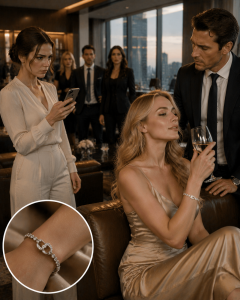
The sender was Livia Stone — twenty-seven, glossy, ambitious, and wearing Vanessa’s anniversary bracelet in photo number five. Vanessa stared at that bracelet longer than she looked at her husband’s face. Small rose gold, three tiny emeralds. Nathaniel had given it to her six years earlier, back when Sterling Bridge was a struggling software firm running on borrowed confidence and rented office space. He’d said the three stones meant past, present, and future. Apparently the future now sat on another woman’s wrist, posed on a leather couch beneath the company logo.
Vanessa zoomed in. The silver wall emblem. The restricted bourbon cabinet. A glass door behind them etched *Executive Lounge* in frosted letters. Livia hadn’t just sent proof of an affair. She’d sent proof of misconduct inside a regulated company facility, after hours, with alcohol, unauthorized access, and someone else’s jewelry.
Her phone lit again. *He says you’re too boring to even fight for him.*
Vanessa smiled — not a happy smile, the small exhausted curve of a woman who’d just been handed a document formatted by stupidity. She opened Sterling Bridge’s internal work chat, the one channel reserved for company-wide announcements, the one Nathaniel had once reprimanded a junior engineer for using to report a missing laptop charger.
She selected all twelve photos. Added one line.
*These appear to involve the CEO, an employee, company premises, after-hours access, alcohol, and personal property taken from my home. Please preserve all related records.*
She tagged legal, HR, security, the board secretary, and the audit committee chair. Her thumb hovered over send for three full seconds. Then she pressed it.
Nothing happened at first. Then the little activity indicators began multiplying, sparks catching dry grass.
Vanessa turned off her notifications, placed the phone face-down, washed her coffee mug, and went upstairs. Nathaniel’s side of the bed was cold and neat, faintly smelling of the cologne he wore when he wanted other women to notice him before he entered a room. She removed her wedding ring and set it on his pillow.
Then she slept.
The first person to actually see the photos wasn’t Nathaniel. It was a night-shift engineer named Owen Price, monitoring a server migration from his apartment, who opened the company chat expecting a deployment warning and instead found his CEO mid-kiss beside a bottle of restricted Macallan. By midnight the board secretary had called general counsel. By 12:19, HR had frozen Livia Stone’s system access. By 12:31, the audit committee chair had forwarded the post to outside counsel with the subject line *Immediate preservation — CEO conflict, possible asset misuse.*
Nathaniel didn’t see any of it until his phone buzzed itself off the executive lounge table at 10:03 the next morning. Livia picked it up — she’d fallen asleep on the lounge couch in his suit jacket, still wearing the bracelet, her confidence looking younger without an audience to hold it up.
“Nathaniel.” She shook him. “Your phone.”
He groaned, reached blindly, sat up when he saw the caller ID. *Margaret Ellis.* He answered with irritation still thick in his voice. “Margaret, unless the building’s on fire, this can wait.”
A pause on the line. Then: “Open All Hands.”
Something in Nathaniel’s face changed before he understood why. Men who live by control recognize its absence by smell. He opened the chat. Livia watched his thumb go still. Watched the blood leave his face.
“What?” she whispered.
He didn’t answer. He scrolled — once, twice, twelve photos, Vanessa’s single sentence, legal confirming a preservation hold, security confirming access logs under review, HR instructing that no one delete communications, Margaret announcing the audit committee would convene at eight a.m.
Nathaniel stood so fast the coffee table shifted.
“You sent these to her,” he said.
Livia pulled the jacket tighter. “I sent them privately.”
“Privately to *Vanessa?*” His laugh had no humor in it. “Why?”
“Because you said you were done hiding. You said she knew the marriage was over. You said she’d never do anything.”
—
## PART 2
Nathaniel stared at her the way a man stares at someone who’s confessed to lighting a fire with a candle he handed her himself. “Do you understand what you did?”
Her own anger rose to meet his. “Me? You kissed me in your company’s executive lounge. You gave me the access card. You opened the bourbon. You put her bracelet on my wrist.”
“Keep your voice down.”
“For who? The whole company’s already seen us.”
The sentence landed like a slap. Nathaniel grabbed his shirt off the chair. “Don’t contact anyone. Don’t post anything. Don’t answer calls.”
“What are you going to do?”
“Fix it.” It was what he always said. As if every consequence were a broken object waiting for his hands.
He called Vanessa. Straight to voicemail. Called again. Voicemail. Texted: *Take that down now. This is company sabotage.* No response. *Vanessa, answer me.* No response. Then, because panic makes arrogant men predictable, he wrote the sentence that would later become Exhibit B.
*If you think embarrassing me helps your divorce settlement, you have no idea what I can do.*
Vanessa didn’t read it until morning. When she did, she smiled into her coffee, wiped 146 notifications off her lock screen without opening most of them, and got dressed for a board call at eight — cream blouse, charcoal trousers, her mother’s pearl earrings. No wedding ring.
The board members filled the screen one by one — Margaret Ellis, silver-haired and severe; a compensation chair already sweating; an independent director watching everything with careful stillness; Colin Webb, loyal to Nathaniel the way men are loyal to golf partners and old myths. Nathaniel joined last, immaculate from the chest up, furious from the neck down.
“Take her off the call,” he said, without a greeting.
Margaret’s voice stayed flat. “The call has begun.”
Nathaniel leaned toward his camera. “This is a marital issue.”
Vanessa set her coffee down. “Then you should have kept it out of the executive lounge.”
—
## PART 3
Nathaniel had walked into that call prepared to minimize. Vanessa could see it in the set of his jaw — the CEO voice warming under his anger, the instinct that had survived product failures and hostile investors by converting danger into narrative.
“The images were obtained and distributed without context,” he said. “My wife is upset, understandably, but this is a private matter being weaponized through company channels.”
Margaret looked down at a document. “The images appear to show you and Ms. Stone in a restricted corporate space, after hours, with alcohol and personal property alleged to belong to Mrs. Cross.”
“Vanessa is not an employee.”
“She’s the spouse of the CEO,” the independent director said, “and the reporting party regarding misuse of company premises.”
“Reporting party?” Nathaniel snapped. “She posted intimate photos to the entire company.”
“Livia sent them to me,” Vanessa said, even. “I forwarded them to the people responsible for legal preservation. If you preferred privacy, you had several opportunities before photo number one.”
General counsel spoke for the first time. “The executive lounge is used for regulated client meetings. Access is logged. Alcohol inventory is maintained for approved events. Unauthorized badge sharing creates compliance concerns.”
Livia joined the call then, late and pale, no bracelet, her blazer buttoned to the throat. Margaret addressed her directly. “Miss Stone, were you authorized to access the executive lounge last night?”
Livia’s eyes flicked to Nathaniel. He shook his head, once — and everyone saw it.
“Mr. Cross,” Margaret said, cooling, “do not signal witnesses.”
Livia swallowed. “Nathaniel gave me his secondary access card.”
“That is not accurate,” Nathaniel said through his teeth.
“You gave it to me in the elevator,” Livia said. “You told me security never checks your logs.”
Vanessa watched the moment a mistress discovers that the man who used her to wound his wife will use her again to protect himself. It wasn’t justice yet. But it was the first window opening after years of stale air.
Margaret called for a vote — administrative leave, preservation measures, temporary board oversight, independent counsel. Colin hesitated, then raised his hand with the rest. Nathaniel sat very still.
“You do not have unilateral authority in your company,” Margaret told him.
“This board exists because I built Sterling Bridge from nothing,” Nathaniel said.
“No,” Vanessa said quietly. “You did not.”
The call went still. “What did you say?”
“Twelve years ago, Sterling Bridge was three months from insolvency. Your bank line was dead. The first institutional bridge came through Asteridge Capital. The growth round came through North Lake. The acquisition financing came through Ellison Harbor. All three were introduced through my family office.” She let that sit. “I never sat on this board because I didn’t want my marriage to become a governance issue. But do not tell them you built this from nothing.”
Margaret’s eyes sharpened. “Voting rights?”
“Simon,” Vanessa said to general counsel, “perhaps you should open the Series C side letter.”
It took Simon three minutes to find it and one sentence to summarize it: the Series C financing included a governance side letter granting protective voting rights to the Renhold Trust, through its designated representative, under specific trigger events — CEO incapacity, fraud investigation, or material misconduct involving misuse of company resources.
“Renhold is passive,” Nathaniel said.
No one answered him.
“Are you the designated representative?” Margaret asked Vanessa.
“Yes.”
Livia made a small sound — not quite a gasp, the sound of a woman realizing she’d sent victory photos to the person who owned the scoreboard.
Vanessa’s attorney, Eleanor Voss, joined the call moments later. Sixty-two, elegant, feared by federal judges for reasons Vanessa admired but never asked about. “Renhold is submitting formal notice that a qualifying trigger has occurred,” Eleanor said, “and requests immediate preservation of all records tied to Miss Stone’s compensation, access, and any communications involving Mr. Cross’s attempt to influence witness testimony. Renhold further requests Mr. Cross be placed on administrative leave from matters touching the investigation.”
“Denied,” Nathaniel said.
“You do not have the authority to deny,” Margaret told him. “You’re the subject of the investigation.”
He turned on Vanessa one last time. “You’d damage the company to punish me.”
“The company was damaged,” she said, “when its CEO turned a restricted facility into a stage for an affair, gave an employee unauthorized access, let personal property from his own home appear on company premises, and threatened the reporting party in writing.”
Livia whispered, “You threatened her?” Nathaniel didn’t look at her. That silence told the board more than a confession would have.
The vote passed unanimously except for Colin’s hesitation. Administrative leave. Preservation. Board oversight of CEO access. Renhold’s trigger formally recognized. “You will all regret this,” Nathaniel said, smile thin and dangerous.
“Maybe,” Vanessa said. “But at least it will be documented.”
—
Within days, evidence accumulated the way rain fills a metal bucket — not loud, just steady, until no one could pretend the floor was dry. Security found Livia had entered the lounge nine times in two months using Nathaniel’s badge. Finance found luxury travel coded as strategic partnership development. HR found no disclosure of the relationship at all. A facilities manager produced duplicate cleaning tickets matching Livia’s social media timestamps. Nathaniel’s former chief of staff — who’d resigned months earlier rather than keep laundering his calendar — submitted an email in which he’d instructed her to log Livia as “client-facing strategic support” for a retreat Livia never attended.
Livia called Vanessa that afternoon. Eleanor advised against answering. Vanessa answered anyway, on a recorded line.
“I didn’t know about Renhold,” Livia said. “He told me you had family money but no involvement.”
“That sounds consistent.”
A silence. “HR froze my laptop. Security wants my phone.” Another pause. “I sent those photos because I wanted you to feel small. He told me you looked down on him. That you liked being the calm, rich wife while he did all the work.”
“I do not know you well enough to hate you,” Vanessa said. It wasn’t kind. It was accurate, which sometimes hurt more.
“I wanted to believe him,” Livia admitted. “It made me feel like I was rescuing him from you instead of helping him betray you.”
That was more honesty than Vanessa expected. “Why are you calling?”
“Because he told me to delete our old messages two weeks ago. He said if I cared about him, I’d protect the company. That’s when I understood he had a script for everyone.” A breath. “The bracelet’s with security. I took it off before I left the lounge.”
“Good. I knew it was yours.” A short, cruel pause. “I’m sorry.”
“Be sorry enough to tell the truth,” Vanessa said. “And leave me out of your need to be forgiven.” She ended the call.
That night, Nathaniel came home — to a house he no longer legally owned, held instead through the Whitmore Residential Trust, a fact Eleanor produced with a post-nuptial acknowledgment he’d signed eight years earlier without reading closely. He found Vanessa in the library with Eleanor and a private security lead named Marcus standing quietly by the door.
“Who the hell is this?” Nathaniel demanded.
“Marcus. You just used his name.”
“This is still my home.”
Eleanor slid the trust document across the desk without a word.
Nathaniel’s fury cracked into something rawer — the man he’d been in the early days of Sterling Bridge, hungry, cornered, before he’d learned to hide panic elegantly. “You have always waited for a chance to prove you were above me,” he said.
That one landed close, not because it was true, but because it revealed how long he’d been fighting a version of her that didn’t exist.
“I spent twelve years making sure no room saw how often I carried you,” Vanessa said. “The investor dinners. The hospital consortium introduction. The apology letter after Austin. The board memo after you nearly lost the North Lake round. The speech after my father died, when you were too busy taking calls to remember his name in the first draft.” Her voice didn’t rise. “I didn’t carry you because I thought you were beneath me. I carried you because I loved you, and because I believed building something together sometimes means holding the beam while the other person stands in the light.”
“And now?”
“Now I am putting the beam down.”
He left with one suitcase and the wedding ring in his coat pocket. Vanessa watched from the landing until the door closed, then sat on the stairs and cried — and afterward laughed through one broken breath, because she really had slept through the whole thing, and it really had worked.
—
The investigation grew teeth. Nathaniel posted a public statement calling the leak an exploitation of private pain — then deleted it four minutes later, which only guaranteed it would outlive him. The board convened an emergency session. His attorney called the post “an emotional moment, promptly removed.” The new board chair, a retired hospital executive named Evelyn Grant who had survived a hostile merger, a Senate inquiry, and pancreatic surgery, treated Nathaniel’s ego like a scheduling problem.
“Did you consult company counsel before posting?”
“No.”
“Did you consider that describing a preservation report as leverage could intimidate employee witnesses?”
“That was not my intention.”
“Intention is noted. Impact is under review.”
General counsel then read from messages Livia’s attorney had turned over voluntarily. Nathaniel had called the executive lounge “safer than hotels — I own the building.” He’d told Livia not to message his company phone after seven because “Vanessa notices everything. She just swallows it.” He’d written, three weeks before the photos leaked, “Once the Series D closes, I’ll handle the marriage.”
*Handle.* Not end. Not discuss. Handle.
The board suspended him from all executive duties pending final investigation. The company’s COO stepped in as interim CEO. Renhold’s protective rights were formally activated for the transition period. Colin abstained; everyone else voted yes.
Nathaniel requested a mediated meeting soon after — “crisis mediation,” his attorney called it, as if the crisis were weather instead of a sequence of choices with timestamps. He arrived thinner, without a wedding ring, and opened with something close to an apology. “I want to acknowledge I made serious mistakes,” he said. “My relationship with Livia was inappropriate. I shouldn’t have threatened you. I’m sorry.”
Then came the proposal underneath the apology: thirty days’ leave, executive coaching, a revised internal statement — and in exchange, Renhold would stand down and Vanessa would release all personal marital claims as part of a “global peace.”
“No,” Vanessa said. “My marriage is not a board asset. My bracelet is not a company expense. My silence is not part of Nathaniel’s severance.” She looked at him. “You still think the consequence is the injury. The harm was what made the consequence necessary.”
“I built Sterling Bridge,” he said.
“With help,” she said. “Name it. Not in general. Name what helped you.”
He named the funding rounds. The consortium. The regulatory contacts. His voice thinned as the list grew, until she finished it for him — the board memo she’d rewritten the night before his manifesto of a pitch deck went out.
“You wanted public credit?” he asked.
“No. I wanted private respect.” That silenced him longer than anything else had. “You resented every door I opened, because walking through it made you feel less self-made. So you rewrote me as decorative. Then you found Livia and let her wear my bracelet, because hurting me privately wasn’t enough anymore. You needed proof you could give pieces of my life away.”
The mediation ended without settlement. The final investigation report — four hundred eighty pages — confirmed everything the board already suspected: badge sharing, undisclosed relationship, misclassified expenses, witness influence, the written threat, the public statement violating board instructions. The report didn’t use the word *monster*. It used the word *cause*.
At the follow-up board meeting, Nathaniel offered to resign voluntarily in exchange for preserved founder equity and release of all personal claims. “A global peace would benefit everyone,” his attorney said.
Vanessa unmuted. “No. Sterling Bridge can decide whether he remains fit to lead. I will decide what personal claims I release, through my own counsel.”
“You want me ruined?” Nathaniel asked.
“I wanted you honest,” she said. “Ruin was your backup plan.”
The board removed him as CEO for cause, unanimous except Colin. “Sterling Bridge will regret losing me,” Nathaniel said before the call ended.
“Sterling Bridge regretted enabling you,” the new chair replied.
—
The divorce became public within days — business reporters love nothing more than a marital filing attached to a fallen founder. Headlines settled on the same phrase: *the wife who slept.* Vanessa hated it. Her sister Rachel found it hilarious. Nathaniel fought over confidentiality terms so broad they would have gagged her from describing her own life to a therapist; Eleanor rejected the first offer in three sentences.
He requested one final in-person conversation. Vanessa agreed, with counsel nearby. He arrived without a tie, without the performance of power, and told her he’d found the old investor deck she’d rewritten years earlier — her comments still in the margins. “I told myself you helped because you had nothing else to do,” he said. “That was easier than admitting I needed you.”
“I know,” Vanessa said. The wound ached, but it no longer bled.
“I’m sorry,” he said — for Livia, for the bracelet, for the lounge, for making her care feel like something he survived instead of something he received. No hook followed it. No request.
“Thank you,” she said.
He signed most of the revised property terms without a fight. The settlement finalized three weeks later: Vanessa kept the house, her trusts, full separation of Renhold’s interests. Nathaniel kept certain premarital assets, reduced equity subject to clawback, and the work of rebuilding a name without her family’s scaffolding under it. The bracelet came back from security custody, cleaned, and went into her desk drawer beside the ring. She didn’t wear either one — not yet. Some objects need time to become objects again.
—
Sterling Bridge held its first company meeting without Nathaniel that spring. Vanessa sat in the back row with no official title, there because employees deserved to see her standing upright. The new CEO announced access reforms, expense oversight, disclosure requirements, and a direct line to the audit committee, and named the harm without turning Vanessa into spectacle. Afterward, the young finance analyst who’d once questioned Livia’s bonus and been made to feel stupid for it found Vanessa in the hallway, eyes wet.
“You weren’t stupid,” Vanessa told her. “You were early.”
Months later, Vanessa hung a green velvet chair where Nathaniel’s leather one had stood, moved the business biographies out of the library and poetry in, and found an old anniversary card in a drawer — *I could not have built this without you* — in handwriting from a man who had, briefly and imperfectly, meant it before pride began editing his memory. She filed it under a label that said only *past*, because clarity deserved storage more than poetry did.
She fastened the bracelet back on her wrist one evening, alone, and didn’t think of Livia first, or Nathaniel first. She thought of the woman she’d been when she first received it — hopeful, exhausted, proud of a company she’d helped save from behind a curtain that no longer needed to exist.
A year after the photos, Sterling Bridge asked her to speak at its ethics summit. She said yes for the analyst who’d almost lost her job over a bonus question. Standing where Nathaniel used to give founder speeches beneath his own oversized portrait, she told a full auditorium that gossip is what happens when the truth has nowhere formal to go — that the important part of that night hadn’t been that she slept, but that she’d stopped negotiating with behavior that needed documentation. “If someone counts on your silence because they think you’ll swallow the hurt,” she said, “they have misunderstood you.” The applause that followed wasn’t explosive. It was deep.
She saw Nathaniel once more, by accident, in a bookstore — thinner, quieter, consulting now for a nonprofit doing privacy infrastructure for small hospitals. “I read the old board memos,” he told her. “All the versions. I used to think admitting how much you’d changed would make me smaller. It didn’t. It just made the lie smaller.” She wished him well and meant it, in the specific, limited way grief allows once the paperwork is finally, actually done.
The following spring, Renhold launched the Quiet Record Initiative — training and legal support for early-career employees in compliance, HR, security, and finance, the people who see trouble before anyone powerful wants it seen. At the launch, in a modest university auditorium with no chandeliers, Vanessa told the room that power often teaches people to doubt what they saw — that the room wasn’t really restricted, the access wasn’t really improper, the pattern wasn’t really a pattern.
“This initiative exists,” she said, “because the truth needs a place to go before it becomes a scandal.” She paused, the bracelet catching the light on her wrist. “You do not have to make a scene to make a record. You do not have to destroy a place to tell the truth about what’s damaging it. And you do not have to stay awake all night carrying consequences that belong to someone else.”
That night she went home to a quiet kitchen — no shocking photos on her phone, no CEO husband, no board call forming in the dark. Only a text from Rachel: *Proud of you. Also, “quiet records” still sounds haunted.*
*Good,* Vanessa typed back. *Some records should haunt people.*
She caught her reflection in the dark window — bracelet on her wrist, shoulders loose, not untouched, not unbroken, but whole in a way that no longer required anyone else’s permission to be true.
**THE END**