HER FATHER TRADED HER TO THE “MONSTER OF BLACKWOOD PEAK” TO SAVE THE FAMILY STORE — THEN SHE FOUND OUT WHAT HE WAS REALLY GUARDING

PART 1
The wind off the Rockies had teeth in the autumn of 1878, but nothing in Oak Haven, Colorado cut colder than the sound of Josiah Higgins’s boots crossing the mercantile floor.
Damen Montgomery knew that sound. She’d learned to dread it the way other people dreaded thunder.
Her father, Arthur, was a kind man and a ruinous businessman, and the mercantile that had once been the pride of the town was now buried under ledgers written entirely in red. Higgins owned the mortgage. Higgins owned, in one way or another, most of Oak Haven.
“The grace period ended yesterday, Arthur,” Higgins said, his voice syrup over gravel. He was fifty-two, thick-necked, immaculately dressed, with eyes like tarnished coins that never quite warmed. “Three thousand dollars. By noon tomorrow, or the sheriff padlocks these doors.”
“Josiah, please.” Arthur’s hands shook against the counter. “The supply wagons were delayed by snow. One more month—”
“I am not a charity.” Higgins’s gaze slid sideways, landing on Damen with the weight of something crawling. She went very still. Everyone in Oak Haven knew what had happened to Higgins’s first two wives — dead within a handful of years each, mysterious and convenient, leaving him richer and single again both times.
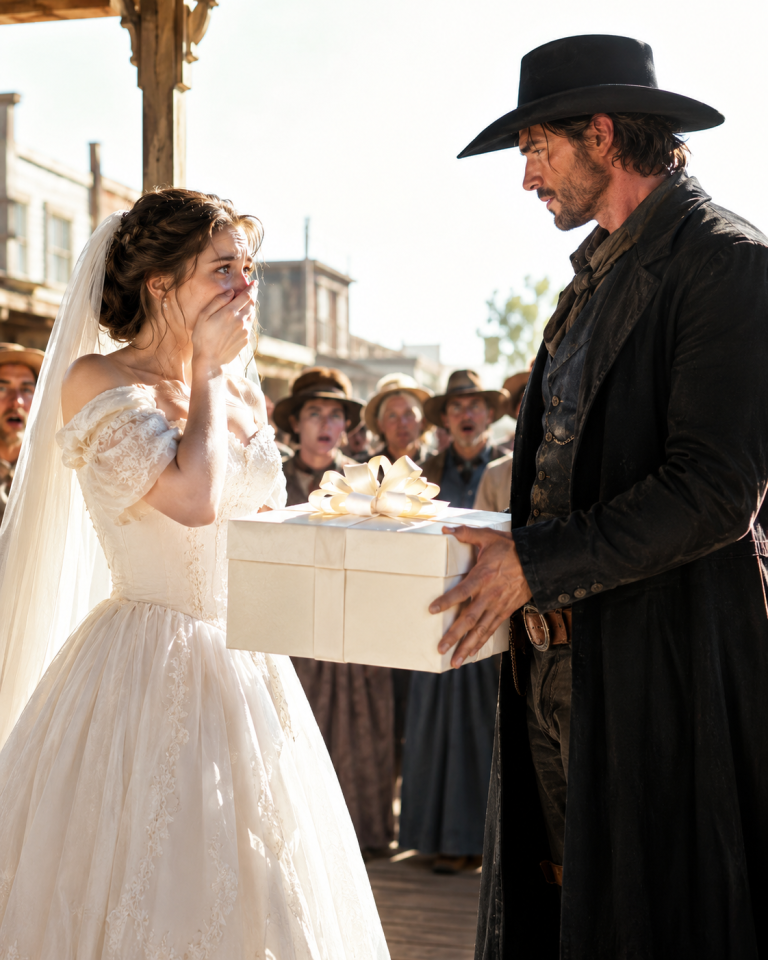
“However,” Higgins said, and smiled, “I am a reasonable man. I’ll forgive the debt in full. I’ll add a thousand dollars to keep this failing store alive.” His eyes never left Damen. “In exchange, Damen becomes my wife.”
The silence that followed felt like something breaking.
“My daughter,” Arthur choked out, looking at Damen with eyes full of helpless, useless tears. “Josiah, she’s twenty. You’re—”
“I am her salvation.” The mask slipped, just for a second, revealing the venom underneath. “Refuse, and you both sleep in the mud tomorrow. Have her at the church by sundown.”
He turned and left, and the door’s bell rang like something dying.
Arthur collapsed into a chair and wept. Damen stood frozen, running through every option and finding none. A woman alone in the Rockies in winter didn’t survive a week. She was trapped, and the walls were closing fast.
But it turned out the devil had competition in Oak Haven.
An hour before sundown, the mercantile’s brass bell didn’t ring — it shrieked, as the door was thrown open by a man who filled the entire frame and blotted out what was left of the daylight.
He was enormous. Buckskin and a heavy bearskin coat, a dark beard hiding most of his face except for a jagged pale scar that ran from his temple down to his jaw. His eyes were gray and turbulent and utterly unreadable. A Winchester rested in one hand like it weighed nothing.
Felicity Cade.
Oak Haven whispered his name the way children whisper about things in the dark. He lived high on Blackwood Peak and came down twice a year to trade. The stories said he’d killed three prospectors with his bare hands. That he ate raw meat. That he talked to wolves. Mothers used his name to frighten children into bed.
Arthur stumbled backward into a display of canned peaches. “Cade — we’re — we’re closed.”
Cade ignored him. He crossed to the counter, floorboards groaning, and set down three heavy leather pouches with a thud that had actual weight to it.
“Gold dust,” he said, voice like stones grinding at the bottom of a river. “Flour, salt, ammunition, wool. Winter’s coming early.”
Arthur’s eyes went from the gold to the mountain man to the gold again, and something desperate and half-mad lit up behind them.
“Mr. Cade — this is a fortune. More than enough for supplies. I have a debt. Three thousand dollars. If you were to loan me the rest, I’d repay you with interest—”
“I don’t deal in paper,” Cade said flatly. “Or promises. I deal in what I can carry.” He began gathering his goods.
“Wait.” Arthur grabbed his sleeve. Cade’s eyes flared, and Arthur let go instantly, but the madness in him didn’t stop. “I’ll trade. I’ve nothing left of value but — but her.”
Damen’s heart stopped beating.
She stared at her father in raw, unfiltered horror, and the silence that followed was heavier than every pouch of gold on that counter combined. She was being bartered like feed grain between a corrupt banker and a mountain savage, in the same afternoon, in the same store.
Felicity Cade turned his head and looked at her — really looked — for the first time. Not with the leering hunger Higgins had used. Something colder. More assessing.
“She looks fragile,” he said.
“She’s stronger than she looks,” Arthur pleaded.
Cade’s jaw tightened. He glanced once more at the gold, then back at her.
“Four thousand,” he said abruptly, and dropped another pouch on the counter. “I pay the debt. I leave you a thousand to keep this place open.” His gray eyes cut to Damen. “The girl marries me legally, today, before we ride up the mountain.”
Damen swayed on her feet.
“Father — no—”
“It’s the only way, Damen.” Arthur was sobbing now, all dignity gone. “It’s him or Higgins.”
Within the hour, she stood in front of Justice of the Peace Henry Caldwell, whose hands shook so badly reading the vows that he had to start twice. Felicity stood beside her, a wall of leather and fur that smelled of pine and woodsmoke and cold iron. He didn’t touch her once. He said “I do” in that same gravel voice, signed the register in one bold, aggressive stroke, and turned to her.
“Gather your warmest clothes. We lose the light in an hour.”
Outside, Josiah Higgins was already waiting with two of his enforcers, his face purple with rage.
“Cade! That woman is mine!”
Felicity didn’t flinch. He handed Damen the marriage certificate, rested one hand on the hunting knife at his thigh, and looked at Higgins with an expression that made the whole street go quiet.
“She’s my wife now, Higgins. You or your dogs take one step toward her, and I won’t just kill you.” His voice dropped low enough that it carried further than a shout ever could. “I’ll peel you.”
Higgins took a step back. Whatever bluster he’d walked out with, it wasn’t enough to survive that look.
“You’ll freeze to death up there,” he spat instead, at Damen. “And when he’s done with you, the wolves will finish it.”
Felicity lifted her onto his massive black draft horse like she weighed nothing, climbed up behind her, and took the reins without another word.
As the horse struck out toward the white peaks of the San Juans, Damen shut her eyes, one tear freezing halfway down her cheek. She had escaped one devil only to be carried straight into the den of a beast.
She had no idea, yet, how wrong that thought was.
—
PART 2
The climb into Blackwood Peak was a masterclass in misery. The temperature dropped with every hundred feet, the wind stripping the warmth out of Damen’s bones faster than she could hold onto it. She sat rigid in front of Felicity, too afraid to lean back against him, too exhausted not to.
Then the horse stopped.
She braced for him to drag her down into the snow. Instead she heard fur rustling, and a moment later a massive, impossibly warm wolf-pelt cloak settled over her shoulders. He pulled the hood up over her freezing ears with hands that were far more careful than she expected, and said nothing at all before clicking his tongue to start the horse moving again.
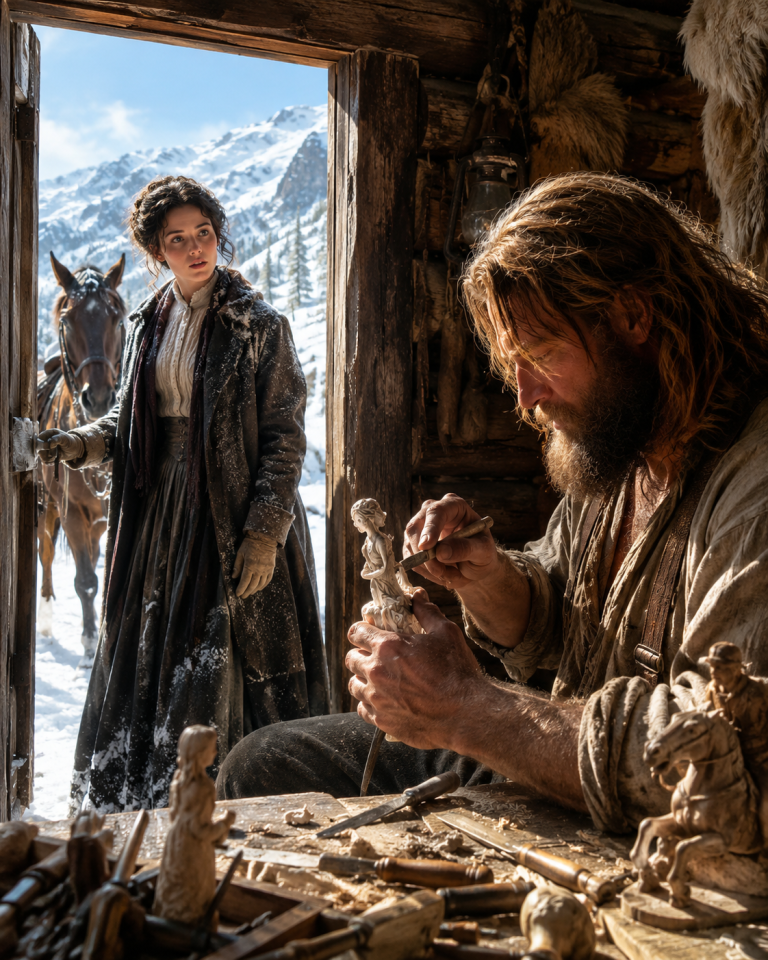
Hours later, the cabin appeared out of the moonlight — not the hovel she’d braced for, but a structure of massive hand-hewn logs, sturdy and warm, smoke rising steady from the chimney. Inside, the shock deepened. Polished floors. Thick rugs. Walls lined floor to ceiling with leather-bound books — Shakespeare, Dickens, natural history — and a mahogany desk scattered with architectural sketches. This wasn’t the den of a savage. It was a scholar’s sanctuary.
He fed her elk stew, told her the bedroom had an iron latch, and told her to lock it.
“Where will you sleep?” she asked, stunned.
“By the fire. I’m a light sleeper. Don’t wander the cabin in the dark.” A pause. “Go to sleep, Damen.”
It was the first time he’d used her name.
She woke hours later to a sound through the log walls — a small, wet cough. Curious despite herself, she wrapped a quilt around her shoulders and crept to the doorway.
Felicity wasn’t asleep by the fire. He was in the rocking chair, and cradled against his massive chest, wrapped in wool, was a child — a little boy, no older than five, pale and sweating, his eyes open but clouded with a milky film. Blind.
“I know, Toby,” Felicity murmured, his voice stripped of every rock and gravel she’d heard from him all day. “I know it hurts, Little Bear. Just breathe. Uncle Felicity’s here.”
The floorboard creaked under Damen’s foot. Felicity’s head snapped up, the predator flooding back into his face for one half-second before he recognized her and slowly, carefully, let it go.
“I told you not to wander,” he said quietly, mindful of the boy in his arms.
Damen didn’t retreat. She looked at the sick, blind child, then up at the terrifying mountain man holding him like something made of glass, and the whole shape of the day rearranged itself in front of her eyes.
“He’s sick,” she whispered.
“Lung fever,” Felicity said, jaw tight. “Three days now. Getting worse.”
“Why haven’t you taken him to the doctor in town?”
His laugh came out bitter and silent. “The doctor in Oak Haven is on Josiah Higgins’s payroll.”
—
PART 3
“Two years ago,” Felicity said, “my brother William found a vein of silver on the eastern ridge of this mountain. Higgins wanted the claim. William wouldn’t sell.” He looked down at the boy in his arms, and something in his face went very still and very old. “A week later, William’s wagon went off a cliff. He and his wife died instantly. Toby survived the fall. The fever took his sight a few days after.”
Damen’s hand rose to her mouth.
“Higgins has been trying to run me off this mountain ever since,” Felicity went on. “The stories about me — the monster, the savage — I let them spread. Monsters get left alone. It keeps his men from riding up here in the dark to finish what they started with my brother.” His stoic face cracked, just a fraction, revealing an exhaustion so deep it looked physical. “But I can’t hunt and trap and mine and nurse a sick child all at once. He needs someone. A mother’s touch. Someone to teach him how to live in the dark. I’m too rough. Too angry.” He met her eyes across the dim room. “I needed help.”
He looked at her for a long moment, the firelight catching silver in his gray eyes.
“I didn’t buy a wife, Damen. I bought a guardian for my brother’s son.” His voice roughened. “You’re safe here. No one will ever harm you under my roof. But I need you to help me save this boy.”
Damen stood in the quiet cabin, the wind pressing against the log walls outside, and felt something shift permanently in her chest. The man she’d braced herself to fear was, in truth, a shield standing between a helpless child and a world that had already tried once to kill him.
She crossed to the stove and put the kettle on.
“What are you doing?” Felicity asked.
“Boiling water,” she said, rolling up her sleeves. “My mother used peppermint and eucalyptus steam for lung fever. We have work to do, Mr. Cade.”
For the first time since she’d met him, the ghost of a smile touched his mouth.
—
For three grueling weeks, the cabin on Blackwood Peak became a battlefield, and Damen Montgomery ran it like a general.
She barely slept. Her days were built around the sharp, clean scent of eucalyptus filling the small rooms, the rhythmic thump of her palm against Toby’s small back to loosen the congestion in his chest, the soft lullabies her father used to sing to her, now passed down to a boy who couldn’t see her face but clung to her voice like a lifeline. Felicity — a man capable, by every rumor in Oak Haven, of crushing a skull with his bare hands — was utterly helpless against a fever, and he knew it. So he did the only things he could: chopped wood until the woodpile groaned, kept the stove roaring day and night, hunted elk to keep them fed, and watched Damen with an intensity that made her skin prickle every time she caught him at it.
On the twenty-first night, the fever broke.
Toby’s breathing smoothed into something quiet and even. The heat drained out of his small forehead like a held breath finally released. Damen, rocking him in the chair by the fire, felt her whole body give out at once, and she started to cry — not from sadness, just from three weeks of terror finally leaving her all at once.
A heavy warmth settled over her shoulders. Felicity had draped a quilt over her, and before she could say anything, he was kneeling beside the rocking chair, close enough that she could smell cold snow and leather on his skin. He reached out and, with a gentleness that didn’t match a single inch of his size, wiped a tear from her cheek with his thumb.
“You saved him,” he said, and his voice carried an emotion he’d clearly kept buried under ice for a very long time.
Damen looked into his eyes and, for the first time, saw straight past the scar to the man underneath — someone with a formidable intellect and a wound so deep it had cost him everything except this one blind child.
From that night forward, everything in the cabin shifted. The fear that had kept her locked behind an iron latch dissolved into something else entirely. As the snow buried Blackwood Peak under ten feet of isolation, warmth grew in its place. Felicity read aloud from his leather-bound books in the evenings — sonnets, old tales — while Damen mended clothes and Toby listened with the rapt, unseeing attention only a blind child can give a story. Felicity taught her to read the weather in the scent of pine needles, and how to load and fire a Winchester 1873 with lethal precision.
“Higgins won’t stop,” he told her one afternoon on the back porch, the echo of her rifle shot still rolling off the canyon walls. “Come the spring thaw, he’ll realize I never froze to death. He’ll want this mountain.”
“Why this mountain?” Damen lowered the rifle. “What did William find?”
Felicity led her to the barn instead of answering. Behind a false wall of hay bales sat a heavy iron safe. He spun the dial, hauled the door open, and poured the contents of one canvas bag into her open palms.
Not gold. Raw, unrefined silver ore, dull and heavy in the lantern light.
“It’s not just a claim, Damen.” His voice dropped low. “It’s a mother lode. An untouched vein running straight through the bedrock of this mountain — big enough to rival the Comstock. William found it. Higgins had him murdered for it.”
“Then why hide? Why not go to the law?”
“The local law is bought and paid for by Higgins’s bank.” He spat the words. “Walk into Oak Haven claiming this mine, and Higgins has me arrested on forged charges and hanged by sundown. I needed time. I needed a case nobody could buy.”
He crossed to a workbench and produced a stack of sealed envelopes stamped with government seals. Even isolated as Oak Haven was, the name on them meant something — James McParland, the legendary Pinkerton operative who’d dismantled the Molly Maguires before taking over the agency’s Western Division.
“McParland’s been quietly building a file for months,” Felicity said. “Higgins’s ledgers. His dead wives. The sabotage on William’s wagon.” A dangerous smile crossed his face. “The trap’s already set, Damen. We just have to survive until the thaw lets his men ride up this mountain.”
Damen looked at her husband — the beast of Oak Haven — and understood, finally, exactly what he was. Not a savage. A patient, brilliant tactician who had endured years of being called a monster to protect one blind orphan and legally bury the man who’d killed his brother. Admiration hit her so hard it nearly buckled her knees.
She crossed the barn and wrapped her arms around his waist, pressing her face to his chest. He went rigid for half a second — and then his arms came around her, holding her tighter than he ever had before.
—
The false spring of 1879 came early. By late April the deep snow had begun to give way, turning the mountain trail to thick mud but finally, dangerously passable again.
In town, Josiah Higgins was nearly giddy. For months he’d spread the story that the “savage” Felicity Cade had surely murdered Damen Montgomery over the winter — feeding the rumor with free whiskey and promises of justice until outrage was ready to ride.
“We go to Blackwood Peak,” Higgins shouted from the bank steps to a crowd of armed men. “We bring Damen home for burial, and we hang her murderer.”
By noon, nearly thirty riders were climbing the mountain trail.
Felicity heard them long before they came into view — branches cracking, horses whinnying, carried easy on the still air.
“They’re coming,” he said, calm as still water.
Fear flashed through Damen’s chest, but it didn’t own her the way it once had. The frightened girl who’d stood in her father’s mercantile that autumn afternoon hadn’t survived the winter. Someone stronger had taken her place. She loaded a Colt revolver without being asked and handed Felicity his Winchester.
“I’m your wife,” she said. “I won’t hide while our home is attacked.”
Felicity studied her for a long moment, something fierce and proud burning behind his eyes. Then he nodded.
Outside, Higgins stopped the mob fifty yards short of the cabin.
“Cade! Come out and answer for what you did to Damen Montgomery!”
Felicity stepped onto the porch, unarmed, entirely unafraid.
“The only killer here is you, Higgins.”
Higgins laughed, harsh and ugly. “Take him.”
Before a single man could move, a second voice cut across the clearing.
“There’s no corpse, Josiah.”
Damen stepped onto the porch beside her husband, and the mob went silent. She looked nothing like the girl they remembered — buckskin instead of gray wool, a revolver steady in her hand, her chin set at an angle that had nothing left of fear in it.
“He didn’t harm me,” she said, voice carrying across thirty stunned faces. “He saved me from you.”
Confusion rippled through the crowd. Rifles lowered, one after another.
“It’s a trick!” Higgins shrieked, panic finally cracking his voice. “Shoot them—”
A rifle cracked from the ridge above the posse before he could finish. Every head turned. Riding down the slope was a column of federal marshals and Pinkerton men, James McParland himself at their head.
“Drop your weapons,” McParland called, and thirty men who had ridden up that mountain full of stolen conviction obeyed almost instantly.
Higgins tried to run. Felicity was faster — one shot took the leg out from under Higgins’s horse, sending the banker face-first into the mud. Felicity hauled him upright by the collar and delivered him straight into the marshals’ hands.
McParland rode forward and nodded once to Felicity. “Evidence checks out. Higgins ordered your brother’s murder. Forged the land claims to cover it.” He glanced at the mountain behind them. “The Midnight Star mine is legally yours, Mr. Cade.”
The crowd stood frozen. The monster of Blackwood Peak wasn’t a killer at all. He was the rightful owner of the richest silver claim in the territory — and every story Oak Haven had ever whispered about him had been exactly backward.
Felicity turned to Damen, the hardness finally draining out of his face, and pulled her into his arms in front of all thirty witnesses.
“Monsters,” he murmured against her hair, “are sometimes just guardians nobody bothered to understand.”
Damen smiled and kissed him under the wide Colorado sky, and somewhere behind them on the porch, held safe in the arms of the housekeeper who’d stayed to watch him, a small blind boy turned his face toward the sound of their laughter and smiled too, without needing to see a single thing to know exactly what it meant.
—
The legend of the beast of Blackwood Peak died that afternoon on the mountain trail. What replaced it was the true story of Felicity and Damen Cade — and it spread through the territory faster than any rumor about wolves or raw meat ever had.
The silver from the Midnight Star funded Oak Haven’s first school for the blind, where Toby learned, over the following years, to read with his fingers what he could never see with his eyes, and grew up surrounded by more family than a boy who’d lost his parents on a mountain road had any right to expect. Josiah Higgins was tried and hanged in Denver within the year, his empire of quiet cruelty dismantled ledger by ledger by the very investigator he’d never known was watching.
And high on Blackwood Peak, the cabin that had once been whispered about as a monster’s den stood instead as something else entirely — full of books and firelight and a woman who had walked in expecting the worst thing that could happen to her, and found instead the one place in the territory where she was finally, fiercely safe.
Felicity Cade never fully lost the scar, or the gravel in his voice, or the wariness that a decade of being called a savage had carved into him. He didn’t need to. Damen had learned, that first winter, that the things people fear most about a man are sometimes only the armor he built around something worth protecting — and she never once, for the rest of her life, mistook the armor for the man again.
**THE END**