The CEO Dragged His Mistress to Humiliate His Ex-Wife — Then One Hidden Door Changed Everything

—
## PART 1
Marcus Vale brought his mistress to laugh at his ex-wife’s ruined house, then froze when the old front door opened from the inside and a private security team greeted her by name.
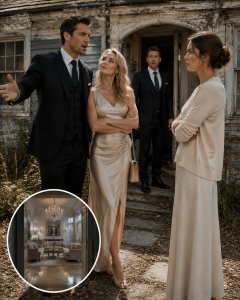
For a full second, no one spoke. Rain dripped from the broken porch roof. Ivy climbed the cracked brick walls. One upstairs window sat boarded over. From the street, the house looked like the kind of place people passed with pity and forgot.
That was why Marcus had come. He wanted pity to become a weapon. He stood at the rusted gate in an Italian coat, polished shoes carefully avoiding the mud, Serena Blake clinging to his arm in cream leather boots and a cashmere wrap, wearing the diamond bracelet Marcus had once refused to buy his wife because “practical women don’t need sparkle.”
Across from them, Elena Morris stood under a black umbrella in a plain navy coat, no visible jewelry, calm — too calm for Serena’s liking.
“So this is where you ended up,” Marcus said, his voice carrying over the rain with the polished ease of a CEO used to microphones. Serena covered her mouth with two fingers, pretending to hide a laugh. “Marcus. Be kind. It must be hard for her.”
“Is it?” Elena asked.
Marcus stepped forward. “Don’t pretend, Elena. You fought so hard to keep your dignity after the divorce, and now you’re hiding in this wreck.” Elena’s fingers tightened once on the umbrella handle — the only sign the words touched her.
Six months earlier, Marcus had ended their marriage at a charity dinner with a speech about growth and honesty, Serena two tables away in emerald silk pretending to be surprised. By morning, every gossip account in the city knew Marcus Vale, founder and CEO of Vale Meridian Capital, was moving forward with a younger woman who understood his world. Elena had said nothing — not when his lawyers rushed the divorce, not when Serena appeared in the restaurants Elena had once booked, not when Marcus kept the penthouse, the cars, and the easy sympathy of people who believed a quiet woman must have been left for a reason.
Today he wanted the final image: the billionaire CEO in front of his ex-wife’s crumbling inheritance, proof he’d risen and she’d fallen.
“I heard you refused the settlement apartment,” he said. “Pride is expensive.”
“So is ignorance.”
Serena laughed, light and false. “Marcus told me you always did that when you were cornered.”
Elena looked at the bracelet on Serena’s wrist. “Did he tell you where that came from?”
“A gift.”
“Of course.” Marcus stepped between them. “We’re not here to discuss jewelry.”
“Then why are you here?” He smiled — the same smile he used for investors before announcing a takeover. “The property is blocking my redevelopment project. This whole block is being consolidated. Your little house is the last problem. I came personally because I wanted to be generous.” He held out a folded document. “Sign the sale agreement. I’ll pay above market value — more than this place deserves.”
Elena didn’t take it. Serena glanced up at the sagging porch. “Honestly, Elena, you should thank him. This looks like one bad storm from becoming firewood.”
The insult was small, almost childish. But it landed on old ground. Elena had been born in that house. Her mother had died in the room behind the boarded window. Her grandfather had hidden company ledgers beneath the library floor during a recession her grandmother’s magnolia tree, stripped bare by winter, had outlived three owners of the block. Marcus knew none of it. He’d never asked. To him, history mattered only when it increased property value.
“You want me to sell you this house?”
“I want you to make a sensible decision for once.”
“And you brought Serena because—”
“Because Marcus doesn’t have to face unpleasant things alone anymore,” Serena answered before he could.
Elena almost smiled. Almost. “Then both of you should come inside.”
Marcus blinked. Serena’s expression changed. “Inside?”
“You came all this way to see the house. It would be rude to stay at the gate.”
“Is it safe?” Marcus asked.
“Safer than your assumptions.”
Suspicion entered his face for the first time, then pride overruled it — Marcus had built an empire by never letting hesitation show in public. If Elena expected him to retreat from an old house, she didn’t know him. That was another mistake. Elena knew him very well.
She walked up the muddy path, the old boards creaking under her shoes. Marcus followed, mouth tight with distaste. Serena lifted her coat hem, wincing when mud touched one cream boot. At the door, Elena pressed her thumb against what looked like an old brass plate. A soft electronic chime sounded. Marcus froze. The lock clicked. The door swung inward, warm light spilling across the porch.
Inside stood a man in a dark suit, in a polished entry hall of marble floors and restored wood paneling, a security tablet in one hand.
“Good afternoon, Miss Morris,” he said. “Miss Sloan is waiting in the library.”
Serena’s mouth fell open. Marcus stared past the doorway into a house that was not ruined at all.
Elena stepped inside and shook rain from her umbrella. “Welcome,” she said. “Try not to touch anything you can’t afford.”
—
## PART 2
The outside of the house had been a lie on purpose. Not neglect — a deliberate mask. Elena’s grandfather, Arthur Morris, had made his fortune understanding what people ignored; while developers tore down old neighborhoods for glass boxes, he’d quietly bought three blocks of historic properties through family trusts, restored the interiors, protected the original facades, and left enough weather on the outside to keep greedy men uninterested until the legal protections were airtight. The Morris house was the center of that plan — a private archive, family office, and legal fortress disguised as a ruin. The cracked windows Marcus had mocked were reinforced from inside with custom glass. The damaged porch concealed a modern security gate. The boarded window protected a climate-controlled document room mid-restoration.
Serena stopped on the marble like someone who’d insulted a museum’s ticket booth. “This cannot be the same house.”
“It’s amazing what people miss when they only look from the street,” Elena said, handing off her umbrella.
Marcus recovered faster, his eyes moving through the hall assessing value, ownership, threat — the oil portraits, the carved staircase, the security cameras tucked into corners. He saw money first. Then he saw control, and control bothered him more. “You renovated. You never told me.”
“You never listened when I spoke about my family.” That was true, and he hated truths that arrived without apology.
A tall, silver-haired woman appeared at the end of the hall — Margaret Sloan, Elena’s family attorney, with the calm severity of a judge who’d already read the file. “Mr. Vale.”
“Margaret,” he said, forcing a smile. “I didn’t know you handled real estate tours.”
“I handle trespass, title disputes, trust assets, and poorly drafted acquisition offers.”
They moved into the library — two floors of walnut shelves, a coffered ceiling, a fireplace restored in dark green marble. On the central table lay folders, a silver recorder, and a framed photograph of a young Elena beside an elderly man with a cane.
Marcus stared at it. “Arthur Morris.”
“My grandfather.”
He knew the name — everyone in development finance did. Arthur Morris had been a quiet legend, the kind of investor whose companies owned things no one realized were connected until a deal fell apart. He’d never connected Arthur Morris to Elena, because during their marriage she’d only ever been introduced as Mrs. Marcus Vale. He’d liked it that way.
“What is this?” he asked.
Elena sat at the head of the table. “This is the part where you explain why your company has been trying to buy my family’s protected block while pretending to offer me pity.”
Margaret opened the first folder. Inside were offer letters from three separate holding companies — different names, different addresses, similar wording. Each had tried to buy property on the block far below its protected value.
“These companies have no connection to me,” Marcus said.
Margaret slid a second page forward. “Their funding source does.”
—
## PART 3
Serena looked between the document and Marcus. “Marcus?” He shot her a look — not harsh enough to be obvious, sharp enough for Elena to see her shrink. There it was, the first crack. Serena had enjoyed standing beside a powerful man when power moved outward. She hadn’t yet learned what happened when it turned inward.
“You wanted the block for the Meridian Ark project,” Elena said.
“Do not discuss my projects,” Marcus snapped.
“Your project map includes this house. The old bakery. The pharmacy building. The carriage house. The garden lot on Willow Street. All trust assets.”
“The city wants development.”
“The city also recognizes historic protections.”
“Protections can change.”
“Not before your investor presentation next week.” That landed. For the first time, Marcus went truly still. “You needed all parcels under soft commitment before the presentation,” Elena said. “That’s why you came today with a sale agreement and a camera team. You wanted footage of the poor ex-wife finally agreeing to sell the crumbling family house to the generous CEO.”
“Camera team?” Serena said.
“Internal documentation,” Marcus said.
“No,” Elena said. “Narrative.” The word entered the room like a key. Marcus loved narrative — the self-made CEO, the visionary developer, the husband who’d outgrown a quiet wife, the ex-wife who clung to a rotting house until he kindly bought her out. He’d planned the scene perfectly from the street. He’d forgotten to ask what waited inside.
Margaret opened another folder. “The Morris Trust has already notified the preservation board, the planning office, and the investor group named in your preliminary materials that no sale or soft commitment exists.”
“You contacted my investors.”
“We corrected a false assumption.”
“You had no right.”
“You used my property in your project map,” Elena said.
“It was conceptual.”
“Then the correction shouldn’t matter.”
Serena sank into a chair without being invited, the bracelet flashing against the dark table. Elena looked at it. “Still wearing that.”
“What?”
“The bracelet. It was purchased from the account attached to our divorce escrow, two weeks before the final hearing.”
Serena’s face drained. “That’s absurd,” Marcus said. Margaret slid a receipt across the table; Serena didn’t touch it.
“You mocked my house,” Elena said, “while wearing something Marcus was supposed to disclose.” Serena’s hand drifted toward the clasp, pride fighting panic.
“Leave it on,” Marcus said. Serena froze. Elena saw the command for what it was — not protection. Ownership. Serena’s hand lowered slowly, but something in her face had changed.
—
Six months earlier, Elena had watched Marcus walk into the charity dinner with Serena and known he’d chosen the stage before choosing the words. He’d given a speech about renewal, thanked Elena for the years they’d shared, and announced their marriage had reached “a respectful conclusion” — a word she remembered because it almost made her laugh. She’d learned about it in the same moment as the rest of the ballroom.
Afterward, near the coat check: “I didn’t want you blindsided by gossip,” he’d said.
“So you blindsided me with a microphone.”
“Don’t make this harder.” The old instruction — meaning, don’t react in a way that costs me. That night she’d gone home to find his closet half empty, Serena’s perfume in the elevator, and a folder from his lawyers already on the table. He expected efficiency. He expected grief to make her slow.
She called Margaret Sloan before midnight. “He announced it publicly?” Margaret asked. “With the mistress present.” “Good. Public cruelty clarifies private character.”
That was how the divorce began — not with screaming. With clarity. Marcus’s first proposal kept him the penthouse, the cars, offered Elena an apartment in a glass tower he’d developed as if living inside his brand were a kindness, and demanded confidentiality strict enough to silence her against public lies. She refused. The negotiations took four months. She didn’t fight for the penthouse — she didn’t want a home built around his reflection. She fought for clean records, asset disclosures, her name removed from any future company narrative, and the Morris house, which Marcus didn’t object to, believing it worthless. *If she wants the haunted house, let her have it,* he’d joked during mediation. Elena said nothing. Margaret wrote it down. Quiet women often kept excellent records.
After the divorce, the city watched Marcus and Serena become a couple at gallery openings and rooftop dinners while Elena “disappeared” — in truth, into the Morris house, into preservation lawyers and trust parcels, watching Marcus’s redevelopment plans creep closer to her block. Then the shell offers arrived. Then his project map leaked. Then Serena posted a photo from his office with a model tower visible behind her, its base shaped exactly like the Morris block — her grandmother’s magnolia tree erased from the render. Elena stared at that photo for ten minutes. That was when she stopped waiting for Marcus to reveal himself, and prepared the room.
—
“This is vindictive,” Marcus said now, in the library.
“No,” Elena said. “This is organized.”
“You’re using our divorce to interfere with a city project.”
“You’re using a city project to take land you knew I owned.”
“I didn’t know the full trust structure.”
“You knew enough to come here personally.” Serena turned to him. “Did you know it was hers?” His silence was brief. It answered anyway.
“I knew she had sentimental attachment,” Marcus said. “That’s why I came with a generous offer.”
*Sentimental attachment.* Her grandfather’s library. Her mother’s room. Her grandmother’s tree. The place she’d learned to read balance sheets because Arthur Morris believed fairy tales were fine but women needed ledgers. Sentimental attachment was what men called history when they wanted to price it cheaply.
“This property is not for sale.”
“Everything is for sale.”
“No.”
Margaret raised a hand before Elena could continue. “Mr. Vale, this doesn’t need to become a spectacle. Withdraw all references to the Morris block from your presentation. Cease acquisition attempts through related entities. Confirm in writing that Vale Meridian has no claim, option, or informal commitment connected to these parcels. Then leave.”
Marcus laughed once. “And if I refuse?”
“Then your investors receive the full packet before your presentation.”
“You’d damage innocent employees over a personal grudge,” he said — the shield he’d used all through the divorce. If she asked for money, she threatened stability. If she asked for disclosure, she endangered livelihoods.
“Your employees aren’t protected by letting you lie to investors,” Elena said. “They’re protected by not building their future on land you don’t control.”
Even his anger had to step around that sentence. Serena removed the bracelet quietly and set it on the table, hand shaking, chin up. “I am not wearing an accounting problem.”
Elena almost respected her for it. Almost.
“Do not embarrass me,” Marcus said.
Serena looked at him — really looked, perhaps for the first time seeing what Elena had learned too late. He didn’t want loyalty. He wanted alignment. The moment a woman stepped half an inch outside the line he drew, she became a problem to manage. “You brought me here to mock her,” she said softly. “And you knew.”
“No,” Elena said. “He brought you because he wanted an audience.”
The security director appeared at the door. “Miss Morris, the media team in Mr. Vale’s vehicle is filming the front exterior.”
“They’re on a public street,” Marcus said.
“Then document them documenting,” Elena told the director.
“Already done,” Margaret said, closing a folder. “Mr. Vale, your attempt to create footage of Miss Morris’s supposed poverty may become useful context.”
Marcus looked at her then — not angry. Exposed.
—
He left without Serena on his arm, jaw clenched so tightly the muscles stood out; she walked three steps behind, bracelet gone from her wrist, cream boots muddy. That evening, a blind item appeared on a gossip account: an unnamed CEO’s ex-wife allegedly blocking a redevelopment out of spite, living in a decaying house she couldn’t maintain. Elena handed her phone to Margaret. “That was fast.”
“Predictable men are efficient.”
The Morris Historic Trust’s response went out the next morning — short, factual, one photograph of the restored library, one of the entry hall, and a single sentence that traveled farther than any legal paragraph: *The condition of a historic exterior should not be mistaken for owner distress.*
The internet turned within hours. *That dilapidated house has a better library than most museums. Did he try to lowball a trust property?* Someone identified Serena’s bracelet from a society column. A finance blogger noted that Vale Meridian’s investor rendering looked suspiciously like the Morris block.
At two, Serena called. “I didn’t know about the house.”
“You knew you came to mock it.”
Silence. “Yes.” The honesty was unexpected. “I thought he was helping you. I thought you were being proud and difficult. He says you took the old house to punish him.” Another silence. “Yes.” Elena didn’t soften. “He’s saying the bracelet was my idea. That I pushed him to come. That I wanted the footage.”
There it was — the turn. Marcus never stood alone in a fire if there was a woman nearby to push into the smoke.
“Do you have messages?” Elena asked.
“Yes.”
“Send them to Margaret.”
“Will that help me?”
“It will help the truth.”
“That’s not the same thing.”
“No,” Elena said. “It’s better.”
—
The messages arrived before sunset. They didn’t make Serena innocent — nothing could make her innocent of the gate, the laughter, the pleasure she’d taken in trying to make Elena look small. But they were useful. Marcus had written: *The house looks worse from the outside. We need her to understand how ridiculous she looks holding on to it.* And: *If she signs, the optics are excellent. Generous CEO helps ex-wife move on.* And finally: *Bring the cream wrap. It will photograph well against the brick.*
Elena read that last one twice. It should have hurt more than it did. Instead she felt a clean, clinical disgust. Marcus hadn’t only wanted the property. He’d wanted composition — her old house, Serena’s cream wrap, his generous face, her defeat. He’d staged cruelty like branding.
“These help,” Margaret said. “Will we release them?”
“Only if needed.” Elena looked almost disappointed at her own restraint. “Part of me wants them public.”
“Of course. Is that wrong?”
“No. It’s human. Human is not always strategic.” Elena thought of her grandfather’s stern portrait over the fireplace, and what he’d have said: *never spend the good ammunition because you enjoy the sound.* “Hold them.”
By Wednesday, the preservation board had requested clarification from Vale Meridian; two investors questioned whether parcel control had been misrepresented; a third postponed attendance. That night, Marcus came back — not to the gate, to the side delivery entrance, no overcoat, no camera team, no Serena, wind-tossed and drawn. Elena watched the camera feed. For years he’d made her come to him, to his office, his schedule. Now he stood outside her door waiting for permission.
“Bring him to the garden room,” she said. “Security stays.”
He looked around with resentment when he entered. “You have five minutes,” Elena said.
“Is that what we are now?”
“We’re less than that. Five minutes is courtesy.”
“You need to stop feeding this story.”
“I’ve released one factual statement.”
“You know what you’re doing.”
“Yes.” The answer unsettled him. “The project is bigger than you and me,” he said.
“Then you shouldn’t have built it on a lie about my property.”
“It could transform the neighborhood.”
“Into what? Jobs, housing — or luxury units, private wellness suites, a members-only club?” He looked away. Marcus’s public good always had a private elevator.
“I can revise the plan,” he said.
“Do that.”
“I need the block.”
“No.” The second no was quieter. That made it stronger. “I loved you once,” he tried.
“You loved how I made your life smoother.”
“That’s not fair.”
“It’s precise. You think Serena is the reason we ended?”
“No,” Elena said. “Serena was a symptom. Your contempt was the disease.” That one landed deep. “What do you want?” he finally asked.
She considered it. Once she’d have wanted an apology, then public correction, then the satisfaction of watching him lose what he tried to take. Now, in her family’s garden room, she wanted something simpler. “Leave my house, my block, and my name out of your future.”
“That’s all?”
“That’s everything.”
—
Marcus didn’t leave everything alone immediately. He canceled the original investor presentation, announced Vale Meridian would “revise the project to better respect community heritage” — elegant, and empty; the revised concept still shaded the Morris block in pale gold, as if color could make ownership negotiable. Margaret sent one letter. The trust released its preservation packet — no messages, no bracelet receipt, just maps, deeds, and corrected boundaries showing Marcus had never controlled the land he’d called central. The project didn’t die dramatically. It shrank — the tower relocated two blocks away, the luxury club quietly dropped, the language downgraded from “landmark vision” to “phased opportunity.” Marcus appeared in no photos afterward; his COO gave the statement. That was how powerful men often began to fall — not with a crash, with someone else taking the microphone.
Serena ended things with him before the month was out. She sent one message through Margaret with the bracelet receipt and a brief note: *I was cruel because I thought being chosen made me safe. It did not. I am sorry.* Elena didn’t reply. Some apologies weren’t conversations. They were receipts of damage, finally acknowledged.
—
Elena refused three magazine profiles and an “influencer heritage dinner,” and opened the house instead for a small neighborhood preservation fundraiser — no red carpet, no stage tours of family rooms. Halfway through the evening, Marcus arrived alone, thinner, less certain, an envelope in one hand. Elena let him cross the threshold properly — not as conqueror. As guest, if he could manage it.
“This is the written withdrawal,” he said. “Vale Meridian has no current or future acquisition plan for the Morris block. No related entities. No conceptual mapping. Nothing.” Margaret scanned it and nodded. “This appears complete.”
Marcus looked around the entry hall. “The house is beautiful.”
“It always was.”
“I was wrong.” Plain words. They didn’t repair much. They still mattered.
“Yes,” Elena said. “You were.”
“And me?” She looked at the man who’d publicly discarded her, underestimated her, tried to buy her history, brought another woman to laugh at her door, and now stood inside asking what remained.
“Nothing,” she said, gently. The gentleness hurt him more than anger would have. “I hope one day you remember something good,” he said.
“I already do,” Elena said. “That’s how I know exactly what was lost.”
He left before the music ended. This time, no one followed him with a camera.
—
The years after weren’t revenge work. They were real work. The upstairs document room finished its restoration. The old bakery became a community legal clinic under Trust support. The carriage house became preservation apprenticeship offices. The garden lot stayed a garden. Elena began hosting monthly kitchen dinners — soup, bread, long conversation with people who didn’t need to be impressed. When a student asked why she’d kept the outside so modest while the inside was so beautiful, Elena said, “Because not everything valuable has to perform for people passing by.”
Serena came back once, months after Marcus stepped down as CEO amid “strategic restructuring” — no bracelet, a simple black coat, an envelope with one new message thread: Marcus telling a media consultant, *the ex-wife angle works only if she looks desperate.* “I know you already knew what he was doing,” Serena said. “I just thought you should have all of it.” She’d left the city, taken a restoration job elsewhere, and wanted only, finally, to stop carrying it. “I believe you’re sorry,” Elena told her. “That is not forgiveness.” “I know. Good.”
A letter came from Marcus, too, later — no return address, admitting the contempt had been the disease, that he’d needed the house to look ruined because he’d needed Elena to look ruined. Elena didn’t answer it. She kept it in a box marked *personal,* not *legal.* The distinction mattered.
—
Three years after the gate, the city preservation board honored Morris House. Elena almost declined. At the podium, in a dark blue suit with her grandmother’s small gold watch and no diamonds, she said what she’d learned: that the value of a place isn’t decided by the worst thing someone says about it from the street; that endurance can be quiet, that memory can be practical, that opening a door can be more powerful than building a tower. A reporter asked whether the failed Meridian Ark controversy had motivated the work. “It clarified the work,” Elena said. “It didn’t create the value. The value was already there.”
Five years after the gate, Marcus saw the house once more from across the street — older in the face, less polished, a driver waiting rather than an audience. He looked at the repaired porch, the students carrying archive boxes through the side gate, then at Elena. He didn’t cross. He gave a small nod — not enough to ask forgiveness, not enough to reopen anything. Just acknowledgment. Elena returned it, then walked through her gate and closed it behind her. The latch clicked. That was the end of Marcus Vale in her story — not because he vanished from the world, but because he no longer held narrative rights to her life.
That evening she opened the front door and stood on the porch as the streetlights came on one by one. The house behind her was warm. The gate was closed, but not unfriendly. From the outside, someone passing quickly might still see an old house.
Elena smiled. Let them. The people who mattered knew to knock.
**THE END.**