My Husband Gave My World Cup VIP Seat to His Mistress — Then He Discovered I Owned the Entire Suite

—
## PART 1
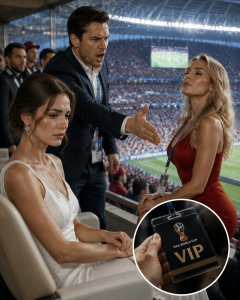
The whole stadium was chanting when Adrien Cross told his wife to stand up and give her VIP seat to his mistress.
Clare Whitmore didn’t move at first. She sat beneath the blazing lights of the World Cup final, one hand resting on a small velvet box in her lap, the other curled around the seat she’d chosen months earlier. Below, the field shone impossibly green. Adrien leaned close enough that his cologne cut through the smell of rain and champagne.
“Clare,” he said, through his smile. “Don’t embarrass me. Stand up.”
Beside him, Bianca Vale tilted her head with practiced sweetness — twenty-six, blonde, dressed for a yacht rather than a stadium. Around her neck hung a sapphire pendant Clare had noticed missing from her home safe two weeks earlier.
“I told him I didn’t mind sitting behind,” Bianca said, soft enough to sound innocent, loud enough for the row to hear. “But Adrien said I should have the better view tonight.”
Clare looked at the ticket in her hand. *Royal Box A12. Clare Whitmore.* Not Mrs. Cross. Not guest of Adrien Cross. Her name.
Adrien’s fingers tightened on her shoulder — he’d mistaken twelve years of her not raising her voice for an absence of one. “This is a networking night,” he murmured. “Bianca needs to meet people. You hate football anyway.”
“I watched qualifiers with my father before you knew what a penalty was,” Clare said.
“Don’t be dramatic,” Adrien said. Bianca laughed lightly. “It’s just a seat.”
“Then take another one.”
For the first time, Bianca’s eyes sharpened. Adrien’s hand slid from Clare’s shoulder to her upper arm — not a grab exactly, not enough for a scandal if photographed, just enough to remind her that he still believed her body could be moved by his will. “You will stand,” he said.
The velvet box in her lap felt suddenly heavy. Inside was the small gold pin her father had worn to every match before he died. She’d brought it because tonight the stadium would announce a youth football foundation funded in his name — something Adrien didn’t know, because he’d never read the invitation, never asked why her ticket arrived separately, never questioned why the tournament’s hospitality director had personally called to confirm her dietary needs. He’d only seen a royal box and assumed his business connections had finally placed him where he deserved to be. If a door opened near Adrien, he believed it opened for him.
“Remove your hand,” Clare said.
Around them, executives and federation guests pretended not to listen while listening completely. The anthem was moments away. Bianca stepped closer. “Clare, please. You’re making this uncomfortable.”
Clare almost smiled. For years, discomfort had been her assigned territory — hers to hold quietly so Adrien could move through rooms unburdened. Tonight she decided to return it.
She stood. Adrien’s expression eased with instant satisfaction. Then Clare picked up the small event tablet mounted beside her seat, tapped the concierge icon, and spoke into the live service line.
“This is Clare Whitmore, Royal Box A12. Please send the head of security and the tournament hospitality director. There’s an unauthorized guest attempting to occupy my assigned sponsor seat.”
Adrien froze. Bianca’s smile disappeared. The anthem began, and ninety thousand people rose. Clare stood with them — calm, beneath the roar, while her husband finally looked at the ticket in her hand and saw, beside her name, the gold crest he’d never bothered to read.
*Founding patron.*
—
Adrien had always liked public events because they made private cruelty efficient. In private, Clare might ask why Bianca had a suite in their hotel, why her name had appeared on a VIP access list his assistant claimed was a mistake. In public, surrounded by cameras, he expected her to protect his image while he damaged her dignity — their marital arrangement, long before he’d brought another woman into it.
When the anthem ended, the stadium exploded again. Adrien leaned close. “Cancel whatever you just did.”
“No.”
“Do you understand who’s here tonight?”
“Yes. I approved most of the guest list.”
The whistle blew below them. For one surreal minute Adrien said nothing, and Clare watched the ball move from midfield to the wing with the focused sorrow of a woman aware that one chapter of her life was ending in the middle of the world’s loudest celebration.
Two men appeared at the aisle — Thomas Reed, silver-haired and unflappable, tournament hospitality director since her father sponsored the youth league that gave him his first job, and a security supervisor whose expression invited no argument.
“Ms. Whitmore,” Thomas said. “You requested assistance.”
Adrien laughed brightly. “Thomas — small misunderstanding. My wife overreacted.”
Thomas didn’t look at him. Clare handed over her ticket and credential. “My assigned seat is being demanded for Ms. Vale, who isn’t listed in Royal Box A.”
“I was invited by Adrien,” Bianca said.
Thomas finally turned. “Mr. Cross is seated in A13 as a registered guest of Ms. Whitmore.” The sentence was polite enough to take a second to land. “Cross Global is a tournament partner — a hospitality vendor for regional advertising technology. Royal Box A is assigned to founding patrons, heads of delegation, and primary legacy sponsors.”
Clare felt the row’s attention sharpen toward Adrien. “Thomas, I suggest you handle this discreetly,” he said, low.
“That’s what we’re doing.” The security supervisor stepped forward. “Ms. Vale may be escorted to the guest lounge if she has a valid credential.”
*Guest lounge.* The words hurt Bianca more than the insult had — she’d expected cameras to find her in a royal box, not sandwiches under fluorescent light.
“Nobody’s moving,” Adrien said. “We’re all adults.”
“Then act like one,” Clare said. His eyes flashed — for one dangerous second she saw the man from their kitchen two nights earlier, slamming a cabinet hard enough to crack the hinge because she’d asked why Bianca was traveling to the final. “You’ll regret this,” he said quietly.
“I already do,” she replied. “Just not in the way you mean.”
Bianca set two empty champagne flutes on the ledge too hard; one tipped, spilling onto the floor. “Adrien,” she whispered. “Do something.”
Calculation moved across his face in quick, ugly pieces. “Bianca, go ahead to the lounge,” he said at last. “I’ll sort this out.”
She stared at him like he’d betrayed her. He had — just faster than she expected. As the security supervisor guided her toward the aisle, Bianca passed close enough for the pendant to brush Clare’s sleeve.
“Leave the necklace,” Clare said, without looking away from the field.
Bianca stopped. Adrien’s face went pale.
“That sapphire belonged to my mother,” Clare said, turning at last. “It was removed from my home safe without permission.”
Bianca touched the pendant, fingers trembling. “Adrien gave it to me.”
“I believe you,” Clare said. “That’s why I said leave it.”
—
## PART 2
The first goal came twelve minutes later, but Adrien didn’t see it. He was in the private corridor outside Royal Box A, arguing with security in a voice trying and failing to stay quiet, while Bianca stood beside him with the sapphire sealed inside a clear evidence pouch, her neck bare, her confidence emptier still.
Clare remained in her seat. When the striker curled the ball into the top corner, the stadium erupted so violently the floor seemed to lift, and she rose with the crowd — for a moment forgetting Adrien, Bianca, the pendant, the humiliation trembling somewhere under her ribs. She saw only the game her father had loved.
Then the giant screen shifted from replay to the pre-match sponsor montage. *Whitmore Legacy Foundation — for every child who was told the field was not for them.* Her father’s face appeared for three seconds, gray hair windblown, laughing beside a muddy youth pitch, one hand on the shoulder of a boy holding a football too large for his arms. Arthur Whitmore had built shipping lines, medical charities, an investment network so broad the papers called him unreachable and children in small towns called him the man who fixed the lights. He’d warned Clare once that Adrien Cross admired victory more than effort. She’d married him anyway. Love, she’d learned, could be a poor scout.
At halftime, Thomas returned. “The chairman would like to confirm whether you still intend to attend the foundation announcement after the match.”
Clare glanced toward the corridor. Adrien hadn’t come back. A message glowed on her phone: *Do not escalate this. We will discuss it at the hotel. If you embarrass Bianca again, I will make sure every camera sees what kind of wife you are.*
She read it once, then forwarded it to Eleanor Shaw — her attorney, and a foundation trustee. Eleanor’s reply came in under twenty seconds: *Preserved. Do not respond. Hydrate.*
“Yes,” Clare told Thomas. “I’ll attend.”
“Your father would be very proud.” That nearly broke her composure.
By the second half, Adrien returned alone, sitting stiffly, no longer touching her, his face holding the rigid calm of a man bracing a door against rising water. “You made a scene,” he said.
“You brought one.”
“Bianca is humiliated.”
“How difficult for her.” His phone buzzed — his chief operating officer, his assistant, a reporter, Bianca twice, then BIANCA in all caps. He flipped the screen down.
“What is this foundation announcement?” he asked, too casually. He’d seen the montage. He was beginning to understand the evening contained rooms he hadn’t been invited into.
“My father started the fund. I expanded it.”
“With what money?” For years he’d described her wealth as comfortable, old-family, decorative — he knew she had trusts, sat on boards, but had never cared enough to understand scale.
“Enough,” she said.
“That’s not an answer.”
“It’s the one you earned.”
In the seventieth minute, the stadium camera swept the royal box, landing on Adrien — instant smile — then sliding to Clare, composed, uninterested in helping him perform, then to the empty space beside him where Bianca should have been. The crowd didn’t know the story. The royal box did. Adrien’s smile collapsed one second too late.
—
## PART 3
The match went to extra time, a fine silver rain falling through the open roof. Adrien spent it trying to recover control without appearing to reach for it — texting, standing, sitting again when Thomas glanced over. Clare watched the field, loving the part of football that wasn’t perfection but revelation: under pressure, everyone became more honest. Adrien became smaller.
Penalties. Goal. Save. Goal. When the last one hit the net, confetti burst into the night and Clare applauded until her palm stung. Adrien didn’t — his phone had lit up with a name that wasn’t Bianca. Grant Mercer, chairman of Cross Global. He ignored it. Clare noticed. So did he, noticing her noticing.
“What did you do?” he asked.
“Watched football.”
A woman in a black suit appeared with Thomas at the row. “Ms. Whitmore, the post-match presentation team is ready.”
Adrien stood. “I’ll accompany my wife.”
“Your credential doesn’t grant access to the presentation tunnel.” The words weren’t loud. They didn’t need to be.
Adrien looked at Clare. “Tell them,” he said — the way he’d said it for twelve years, meaning *repair this for me.* Clare picked up the velvet box. “Enjoy the trophy ceremony from your seat,” she said, and walked away.
—
Eleanor waited at the tunnel entrance with a water bottle and a tablet. “You forwarded his message.”
“Hello to you too.”
“Cross Global’s stadium contract is financed through Whitmore Capital’s discretionary sports media fund,” Eleanor said, without preamble. “Grant Mercer has called Adrien three times. He’s called me once. I didn’t answer.”
“Why Grant?”
Eleanor gave her the look reserved for clients who already knew the answer. Clare did know. Adrien believed the fund was a passive investor Grant had introduced. He didn’t know Clare chaired the committee. He didn’t know she’d abstained from the original vote only because she was married to him. He didn’t know abstaining would no longer be enough after tonight.
“Committee meets tomorrow,” Eleanor said.
“Move it to tonight.”
—
When Clare stepped onto the field for the foundation ceremony, the stadium didn’t know her story. That was fine — she wasn’t there for pity. She walked the touchline beside two youth players: Sophia, twelve, from a coastal town whose old pitch used to flood every spring, and Milo, eleven, whose first boots had come from a foundation box with his name in black marker. The giant screen filled with children on dusty fields, girls under floodlights, a boy with missing teeth scoring into a net patched with blue rope. Her father’s voice rolled out over the stadium from an old interview: *The game does not belong to the powerful. It belongs to anyone brave enough to run toward the ball.*
Grief rose in Clare hard enough to taste. Then Sophia slipped a small hand into hers, not knowing she was saving a billionaire patron from crying on global television.
The announcer named the foundation’s expansion — a thousand community pitches across forty countries. Adrien, watching from the box, finally understood scale; the broadcast cameras caught his face doing it, and it would become the most replayed image of the night that didn’t involve the winning team.
Clare opened the velvet box and pinned her father’s gold crest to her collar. She’d planned two sentences. After the royal box, she chose three.
“My father believed access changes destiny,” she said. “Tonight is not about privilege in a box. It is about every child who deserves a field, a coach, and the right to be seen.” She paused. “No one should ever be pushed out of a place they earned.”
The applause deepened, as if the crowd sensed a second meaning without knowing the first. In the royal box, Adrien went completely still.
—
Eleanor led her from the tunnel to a converted executive suite where five members of the Whitmore Capital Sports Media Investment Committee waited on screen, all in different time zones, all more awake than midnight should allow. Grant Mercer wasn’t on the call. Adrien wasn’t on the call. That was the point.
Clare removed the gold pin and set it on the table. “Thank you for joining quickly.”
Martin Ellis, the committee’s risk chair, went first. “We’ve reviewed the initial incident report. Cross Global’s principal attempted to transfer a founding patron seat to an uncredentialed guest and invoked business importance while doing so.”
“Correct,” Clare said. “There is also a jewelry matter — family property removed from my home safe and given to the same guest.”
“Do you intend to recuse?” Martin asked.
“From any vote directly affecting Adrien’s personal position — yes. From protecting Whitmore Capital’s exposure — no. I will not let my marriage become a blind spot.”
They reviewed triggers, exposure, and alternatives for forty efficient minutes. By the end: Cross Global’s funding draw frozen pending executive review, the stadium contract subject to enhanced audit, Grant Mercer notified before morning, no public statement unless Cross Global lied first.
“He thought a seat was the insult,” Clare told Eleanor afterward. “He never realized the seat was evidence.”
—
Adrien found her outside the suite, bow tie loosened, hair fallen over his forehead — handsome still, which annoyed her more than it should have. “We need to talk,” he said.
“Five minutes,” Clare said. “With witnesses.”
They walked a few steps into the emptying corridor. “I made a mistake,” Adrien said. “A terrible mistake.”
“Which one?”
His mouth opened, then closed — the problem with calling a pattern a mistake was that naming it made the lie clumsy. “Bringing Bianca. The seat. The necklace.”
“You’re listing what you got caught doing.”
“You humiliated me in front of the entire stadium.” There it was — the true wound. Not that he’d hurt her, not that he’d brought a mistress to her father’s memorial night, not the theft from her family safe. His pain began where cameras noticed consequences.
“Did she know the necklace was mine?” Clare asked.
“No.” A pause. “I told her.”
Clare imagined Bianca fastening the pendant, enjoying not only the jewel but the knowledge — the intimacy of theft. “I want it in writing that you removed it from my safe.”
“That’s unnecessary.”
“It’s necessary for you. I’m giving you one chance to tell the truth before the security report tells it for you.”
For the first time, fear moved plainly across his face. “You’d call the police?”
“I haven’t decided.”
His phone rang — Grant Mercer again. Adrien answered, perhaps hoping to regain some terrain in front of her. Clare couldn’t hear every word, but she heard enough. *Frozen. Review. Conduct clause. Board.* His face lost color in stages.
“She chairs *what*?” he asked into the phone.
There it was — the missing piece, arriving at last. For twelve years he’d believed he understood the balance of their marriage: he was the builder, she preserved heritage; he moved markets, she wrote checks for children in museums. Now Grant was telling him the stadium deal, the expansion loan, and his entire future sat beneath the signature authority of the wife he’d just ordered to stand.
He ended the call without saying goodbye. “Whitmore Capital,” he said.
“Since when do you chair the sports media fund?”
“Before you applied for financing. I recused from the original vote because of our marriage. But I knew.”
“And you said nothing.” His voice twisted with the particular fury of a man realizing he’d built an accusation out of the wrong material. “You trapped me.”
“No,” Clare said. “I finally stopped cushioning the floor.”
—
By morning the photograph was everywhere — not the one Clare expected, but a shot from two rows back during the anthem: Adrien’s hand tight on her arm, Bianca beside him with champagne and a satisfied smile. *World Cup VIP drama. Businessman appears to force wife from seat for younger woman.* Cross Global called it “a private misunderstanding among friends”; tournament hospitality declined to confirm that description; the Whitmore Legacy Foundation released a statement confirming that founding patron seating was non-transferable for security and protocol reasons. It didn’t name Adrien. It didn’t need to.
Julian Whitmore arrived at the hotel suite that morning, Clare’s older brother by four years, a former goalkeeper whose knee ended a career before it began, now running Whitmore Logistics with the calm menace of a man who used to throw himself at flying objects for fun. He crossed the room and hugged her without asking. She held together until his hand touched the back of her head.
“I’m going to break his jaw,” he said, reading the incident report.
“No,” Clare and Eleanor said together.
At noon, Adrien arrived with Grant Mercer and Cross Global’s outside counsel, Meera Coleman. “We’re here to discuss containment,” Meera said.
“What a tidy phrase for theft, coercion, and public humiliation,” Eleanor said.
“What do you want?” Grant asked — the first useful question anyone on Adrien’s side had asked.
“The necklace returned through counsel,” Clare said. “A written admission that Adrien removed it from my safe. All communications involving Bianca’s travel and hospitality preserved. Adrien removed from any matter involving Whitmore Capital exposure pending review. No public statement suggesting I caused this through jealousy or instability.” A pause. “And personally — I want you to stop assuming there’s a private version of me who cleans up after the public version of you.”
Adrien’s public apology, posted that afternoon, was too polished to be sincere — *mistakes were made, emotions ran high, he regretted any discomfort caused to his wife, Miss Clare Whitmore.* Miss. Not beloved wife. As if she were an institution he’d inconvenienced. A retired goalkeeper with sixteen million followers posted: *If you make your wife leave her seat for your mistress, at least don’t choose a seat she owns.* It went viral. Clare felt no vindication — only exposure of a different kind. Strangers were defending her by consuming the worst night of her marriage as entertainment.
That evening she went alone to the empty stadium. Royal Box A12 waited where she’d left it — confetti in the corners like exhausted insects, the field covered for maintenance, the whole place less a cathedral than a body after fever. She sat, letting herself feel the ordinary facts: leather under her hands, cool air, the ache behind her eyes. No cameras. No Adrien. Her phone buzzed. Bianca.
“I know you don’t want to hear from me.”
“Correct.”
“I’m not calling to ask for forgiveness.”
“Good.”
“Adrien told me your marriage was over.”
“Before or after he gave you my mother’s necklace?”
A shaky breath. “Before and after. I knew it was wrong. I told myself you were cold, that maybe he deserved happiness. Last night, when he sent me to the lounge, I understood something. He didn’t choose me. He used me to hurt you, then dropped me the second I became inconvenient.” A pause. “Cross Global’s counsel wants me to sign a statement saying I misunderstood everything and acted alone.”
“Don’t sign it. Get a lawyer.”
“I did.”
“Then listen to them.” Clare closed her eyes. “I’m sorry about the necklace,” Bianca said.
“You were sorry when it became evidence,” Clare said. “I hope someday you become sorry because it was cruel.”
Silence, then, quietly: “I hope so too.”
—
Two days later, Cross Global’s board convened, Clare joining by video with Eleanor beside her. Adrien appeared on another screen, remorse rehearsed in the mirror, Meera and Grant behind him. “I accept responsibility for mishandling a personal matter in a public setting,” he said. “However, I strongly object to attempts to convert a private marital breakdown into a corporate crisis.” The line he’d chosen to make everyone else sound invasive.
“Miss Whitmore,” said board chair Helena Frost.
“Whitmore Capital didn’t freeze the funding draw because Adrien embarrassed me,” Clare said. “It froze the draw because the executive responsible for contract performance attempted to misuse tournament credentials, involved an unregistered guest in a restricted area, allegedly transferred family property under disputed circumstances, and may have used company resources for that guest’s travel.”
“Allegedly,” Eleanor added, “is a word that preserved messages are reducing the comfort of.”
Meera confirmed a litigation hold and expenses requiring further review — Bianca had submitted a “campaign concept” file, timestamped 11:43 the previous night.
“You are enjoying this,” Adrien said, glaring.
“No,” Clare said. “I’m documenting it.”
The board’s executive session lasted ninety minutes. It didn’t demand Adrien’s destruction — it demanded governance controls, temporary suspension from contract oversight, independent review of hospitality expenditures, and an interim operating lead for the stadium division. When Adrien reappeared to hear the decision, his face changed with each condition. “This is excessive,” he said.
“No,” Helena said. “This is late.”
—
Three nights later, Adrien came to the London townhouse Clare had inherited from her grandmother — no lawyers, no cameras, just white roses expensive enough to be mistaken for sincerity. An assistant had accidentally copied the receipt for identical flowers sent to Bianca’s suite into the preservation file. Clare let him in anyway, curious what version of him would show up without a stage.
“I’ve been trying to understand how it got this bad,” he said.
“That sounds like an excuse.”
“It does.” He rubbed his hands together. “Bianca wasn’t the beginning.”
“No,” Clare said. “She was proof.”
“Proof of what?”
“That you wanted an audience more than a partner.”
He winced. “I loved you.” She considered lying for mercy, then remembered the seat. “I believe you loved the version of me who made your life smoother. The wife who remembered birthdays, handled donors, never asked too publicly why your assistant booked one bedroom less than needed.”
“Is there any way back for us?”
The question found no place to sit. “Back to what?” Clare asked. “Back to editing myself so you feel large? Back to explaining away women who orbit you because I don’t want to seem insecure?”
“I’m sorry.”
“I believe you’re sorry tonight. I don’t believe sorrow can be a bridge by itself. Tell the truth without requiring a reward for it.”
He left the roses behind. Clare had Marcus throw them out, then went upstairs, opened the safe, and placed her mother’s sapphire back into its velvet tray. For the first time since the final, she cried — not because the necklace was safe, but because she finally understood she hadn’t been.
—
The divorce petition was filed on a quiet Tuesday, citing irretrievable breakdown, misconduct, and misuse of marital property. Adrien’s first settlement offer was, in Eleanor’s words, “a burglary wearing cologne” — a non-disparagement clause broad enough to silence Clare on basic facts, no admission about the necklace, continued access to Whitmore sporting contacts. She rejected it. The second offer improved once Cross Global’s independent review confirmed the retroactive documentation and unauthorized access; Adrien remained on leave, and Grant Mercer stabilized operations without him, which was good for the company and terrible for his ego.
The Whitmore Legacy Foundation became the one place the scandal turned useful. Donations arrived from strangers with notes: *No woman should lose her seat. For my daughter, build a field where girls don’t have to ask permission.* Three months after the final, Clare cut a ribbon on the first new pitch — a small coastal city, the old field once gravel and broken glass. Sophia was there. “You saved me from crying on live television,” Clare told her. During the ceremony she realized she hadn’t thought about Adrien in nearly forty minutes. That felt like a victory no headline could measure.
The final settlement gave Clare a clean separation — full material terms, a written admission about the necklace, no contact except through counsel, no use of Whitmore contacts. At the hearing, Adrien’s wedding ring was gone; Clare had removed hers weeks earlier. The judge reviewed it efficiently: personal property returned, financial claims resolved, non-disparagement limited to false statements, written acknowledgment of the pendant’s unauthorized removal.
Afterward, in the corridor, Adrien held out a small envelope. “My statement. The truthful one.”
“Why give it to me now?”
“For months I kept thinking truth was something I could trade for a result. Then I realized you were right. It’s just something I owe.”
She read it alone that evening — plain, active-voiced, no poetry. *I took. I pressured. I allowed my wife to be humiliated because preserving my image mattered more to me than preserving her dignity.* She cried again, differently this time — not because the apology fixed the past, but because the past had finally stopped arguing. She folded it into a file, took her wedding ring from the drawer, sealed it in an envelope, and wrote one word: *Finished.*
—
Adrien made two more attempts to author the story, and Clare handled both the same way — without theater. Six weeks after the divorce, he gave a televised interview in a navy sweater instead of a suit, reframing the scandal as a story about institutional imbalance: *when one spouse has access to institutional power, the other can become voiceless very quickly.* Julian wanted to respond with “three excellent insults.” Eleanor wanted a public statement. Clare sent Adrien’s own written admission to the journalist privately instead, and let the correction speak for itself. The update — *Mr. Cross’s characterization of the necklace matter as a misunderstanding is inconsistent with a written acknowledgment reviewed by this publication* — spread faster than the interview itself, with no quote from Clare at all.
Months later, a Cross Global corporate gift to the foundation arrived at a gala with an anonymous note: *in honor of the seat that should never have been questioned.* Grant Mercer, now permanent CEO, apologized for the misstep in person — Adrien had no part in the gift. Clare stood, accepted the twenty million pounds under the foundation’s usual transparency rules, and told the room, once, that the work had never been about one chair in one stadium — it was about building enough fields, boardrooms, and futures that no one had to beg to remain where they belonged. Then she sat down and let the applause be about the children, not the story.
Bianca’s reckoning came quietly too — a serious podcast interview months later, admitting without excuse that she’d worn a dead woman’s necklace because it made her feel chosen, that she’d hurt Clare and known it, that expecting forgiveness could be its own way of taking something from someone. Clare wrote her one unsentimental line: *Thank you for telling the truth without asking me to carry it for you.* She filed the reply somewhere between the legal folder and the trash — the place unfinished human things belonged.
—
Two years after the final, Clare sat in a different, smaller stadium — twelve thousand seats, popcorn and new paint — for the championship of the Whitmore Girls Academy League. Sophia, now fifteen, captained one side. Clare wore a navy dress and her father’s gold pin; the sapphire stayed home, resting.
Banners around the ground carried a line that had outgrown her: *No one leaves their earned seat.* She’d resisted using it at first, too personal, too tied to humiliation. Then coaches repeated it, girls painted it on practice signs, donors used it without knowing the whole story. Grief, like anything else, could change owners.
At halftime, Thomas Reed told her Royal Box A12 now had a small plaque — not about the incident, just the first foundation announcement — and that Adrien had requested standard tickets last month for a corporate group. Paid in full. No special access. Clare felt nothing sharp at the news, only information passing through a healed place. That was how she knew, finally and without drama, that she was free.
Sophia scored the winning penalty, looked up at the box first, and Clare lifted a fist before the girl ran to celebrate. That night, walking the empty touchline after the stands cleared, Clare thought of everything since the anthem that tried to make her disappear — fields built, lies answered, a ring put away, a sapphire reclaimed, a self rebuilt not as a monument to pain but as a life with its doors open in the right direction.
For years she’d believed strength meant enduring without complaint, then that it meant exposing every wound until no one could deny it. Now she understood it was larger than either — the freedom to choose the right response for the right moment. Silence when silence protected peace. Speech when speech protected truth. Departure when staying required self-betrayal.
At the World Cup final, Adrien had thought he was taking a seat from his wife. He’d had no idea he was showing her the exact place her old life ended and her real voice began.
Clare looked up at the empty stands and smiled. No crowd. No cameras. No husband demanding she move. Just a woman standing on grass she’d helped give to others, knowing at last that she no longer had to fight for every seat. Some were hers by record. Some were hers by memory. And some — the ones that mattered most — were hers because she had finally stopped abandoning herself to keep them.
**THE END.**