Four of the Mob Boss’s Children Were Dying of a “Genetic Anomaly” — the Housekeeper Knew It Was Something Else

—
PART 1
The nursery of the Castellano estate did not smell like a nursery. It smelled of isopropyl alcohol, sterile gauze, and the faint ozone tang of medical machinery running too hot. It was a sprawling room on the third floor of a fortress built by extortion and racketeering, repurposed into an intensive care unit.
Roman sat in the corner. He did not pace. He did not weep. He simply sat in a high-backed leather chair, a glass of untouched amber liquid resting on his thigh, his eyes dark and dead as a spent casing, tracking the rhythmic rise and fall of four narrow chests.
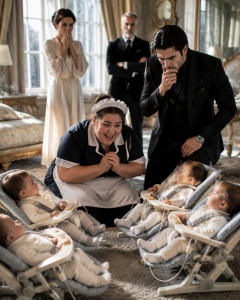
Gabriel, Thomas, Lily, and Chloe. Seven years old. Three years ago, they had been a hurricane of noise tearing through the mansion’s marble hallways, knocking over priceless vases, forcing hardened gunmen to play hide-and-seek. Now they were ghosts. They lay in a neat row, feeding tubes snaked from their noses, IV lines disappearing into arms no thicker than a rolled newspaper. They couldn’t see. They couldn’t hear. They couldn’t move. A slow, creeping paralysis had taken their legs first, then their hearing, then their sight, and finally their ability to breathe without the humming assist of the ventilators.
The world’s most expensive neurologists had stood exactly where Roman sat, stroking their chins, reviewing thick manila folders, throwing out terms like *early-onset degenerative neuropathy* and *idiopathic genetic decay.* They cashed his checks, offered sympathetic tilts of their heads, and left. Roman had broken a man’s jaw for one of those sympathetic tilts. It hadn’t made him feel better.
In the periphery of Roman’s despair moved Beatrice. She was a woman built like a brick oven, wide and solid, dressed in the starched gray uniform of the estate’s cleaning staff. Her thighs chafed as she walked. Her lower back radiated a dull, constant throb from carrying industrial laundry baskets up three flights of stairs. She was fifty, invisible, and entirely ignored. In a house filled with sharp-suited killers and impossibly thin, beautiful women draped in designer silk, Beatrice was a piece of furniture. That was exactly how she survived.
Beatrice carried a damp microfiber cloth, wiping down the stainless steel rails of Gabriel’s bed. She didn’t look at Roman. Looking at the boss was a good way to get fired, or worse, noticed. She kept her eyes on her work. She wiped the rails, then the plastic casing of the IV pump, then the monitor stand, breathing heavily through her nose, a soft rhythmic wheeze that blended with the hiss of the ventilators.
She liked the children. Before the sickness took them, Thomas used to sneak into the kitchens and steal the warm rolls she baked. Lily used to hide behind Beatrice’s wide skirts when thunder cracked. Beatrice had no children of her own. Her life was a long string of minimum wage jobs, bad knees, and quiet observations.
She moved to Thomas’s bed. She wrung out her cloth. The water in her small plastic bucket turned slightly gray.
Roman sighed — a heavy, cracking sound. He leaned forward, resting his elbows on his knees, burying his face in his hands. The diamond on his pinky ring caught the harsh fluorescent light. He was the head of a syndicate that controlled the docks from here to the coast. He could order a hit with a nod. He could buy a judge with a phone call. But he could not force his son’s fingers to twitch.
“Mr. Castellano.” The voice was smooth, cultured, carrying the quiet arrogance of a man who knew his own worth. Dr. Aris stepped into the room, wearing a tailored suit under a pristine white lab coat, carrying a leather medical bag that cost more than Beatrice made in a year.
Beatrice shrank back into the shadows near the heavy velvet curtains, making herself as small as a woman of her size could.
“What,” Roman said. He didn’t look up from his hands.
“I’ve reviewed the latest blood panels,” Dr. Aris said, stepping to Lily’s bed, pulling a pen light from his pocket, peeling back the little girl’s eyelid, flashing the beam. No pupillary response — just a blank, cloudy stare. “The demyelination of the nerve pathways is accelerating. The white blood cell count is plummeting. Roman, I am sorry. We are looking at organ failure within the month.”
Roman slowly lowered his hands. He looked at Aris. The temperature in the room seemed to drop ten degrees. “You said the new marrow treatment would buy them a year.”
“I said it might,” Aris corrected gently, packing away his pen light. “The decay is unprecedented. I’m administering a specialized palliative compound to ease the neural inflammation. It will keep them comfortable. It is all we can do now.”
Aris opened his leather bag, withdrawing four small vials of clear liquid and a set of fresh syringes.
From the corner, Beatrice watched. She always watched. She noticed things that men blinded by power or grief entirely missed. She noticed that the floors in the east wing creaked only when the temperature dropped. She noticed that the security guards rotated their patrols a minute later on Tuesdays. And she noticed the vials.
Aris drew the liquid into the first syringe. He injected it directly into the port of Gabriel’s IV line. He repeated the process for the other three. Roman watched, his face a mask of stone, unable to look away from the failure of his own bloodline.
Beatrice wiped down the windowsill. Her heart performed a strange, heavy stutter in her chest. She had seen Dr. Aris administer this palliative compound every week for the last year. Every time he did, the children grew worse. They lost a little more weight. Their hair thinned a little more. The dark circles under their eyes bruised a deeper shade of purple.
“I will be back on Thursday,” Aris said, snapping his bag shut. “Try to get some sleep, Roman. You are no good to them dead.” He walked out.
Roman remained in his chair, staring at the blank wall. Beatrice squeezed her rag. Drops of water hit the plastic bucket. A memory, old and sharp, clawed its way to the front of her mind — twenty years ago, working in a squalid pest control factory down south. The chemicals, the heavy metals, the rats that went blind, dragged their hind legs, and died slowly in the dark corners of the warehouse. The powder that dissolved clear in water. Thallium. Tasteless, odorless, the slow-acting poison of cowards.
—
PART 2
The next evening the mansion was suffocatingly quiet. A heavy storm rolled in from the coast, battering the high arched windows with sheets of rain. Beatrice was on her hands and knees in the hallway outside the nursery, scrubbing a scuff mark out of the marble, her joints screaming. Her mind, however, was locked on the medical waste bin inside the nursery. Earlier that morning she had emptied it, fishing out the empty glass vials Dr. Aris had discarded. She wasn’t a chemist, but she knew what thallium smelled like when it burned.
She had taken one empty vial down to the basement incinerator. When she tossed it onto the hot coals, the briefest flash of green flame licked the glass. Green flame — the signature of thallium. She had sat heavily on a milk crate in the basement for an hour, her thick hands trembling in her lap. *Why would a wealthy, respected doctor poison four children?* The answer was simple, ugly, and perfectly aligned with the world she scrubbed clean every day. Money. Dependency. As long as the children were sick, Dr. Aris was on a retainer of half a million dollars a month. Or worse — someone else was paying him to end Roman’s bloodline slowly, ensuring no heirs remained to take over the syndicate.
Beatrice was terrified. She was a maid. Fat, aging, entirely expendable. If she opened her mouth, Aris would deny it. Roman would likely shoot her in the head just for questioning a man he trusted. She had packed her duffel bag in her small servants’ quarters, planning to leave in the night, to walk out into the storm and disappear.
But as she scrubbed the marble floor outside the nursery, she heard a sound that froze the blood in her veins. A low, guttural sob. She stopped scrubbing, pushed herself up, wincing as her knees popped, and crept to the heavy oak door, cracked open an inch. She peered inside.
Roman was on his knees beside Chloe’s bed. The ruthless boss of the Castellano family, a man who had allegedly ordered a rival severed into pieces, was burying his face in the mattress beside his daughter’s paralyzed hand. His broad shoulders shook violently.
“I don’t know what to do,” Roman whispered, his voice cracking, stripped of its terrifying bass. “I don’t know how to fix you, bambina. I’m sorry. I’m so sorry.”
Beatrice stared, her chest tightening. She remembered Chloe running into the kitchen, dark curls bouncing, begging for a spoonful of cake batter. She remembered the warmth of the child’s small arms wrapping around her thick waist. *If you walk away, they’ll die. You know exactly what happens to the rats in the dark.* Fear tasted like copper in her mouth. She wiped her sweaty palms on her apron and pushed the heavy oak door open.
Roman’s head snapped up. In an instant, the grieving father vanished, replaced by a predator, his hand going instinctively to the holster beneath his jacket, his eyes red-rimmed and lethal. “What are you doing in here?” he snarled. “Get out!”
Beatrice stood frozen in the doorway, her heavy frame blocking the hall light, her heart hammering against her ribs like a trapped bird. She opened her mouth, but her throat was dry.
“I said, get the hell out,” Roman said, his towering frame casting a long shadow across the medical beds.
Beatrice didn’t move. She looked at the four beds. She looked at the clear IV bags dripping poison drop by drop into the children’s veins. She forced her jaw to unclench. She forced her lungs to draw a deep breath of the sterile chemical air. She met the eyes of the most dangerous man in the city. She did not blink.
“Your doctor is poisoning your children.”
Six words. They hung in the air, suspended in the hum of the ventilators and the driving rain against the glass.
—
PART 3
Roman went utterly still. The silence stretched tight as a piano wire ready to snap. He stared at her, uncomprehending, for a fraction of a second before the sheer absurdity of the statement registered, his expression darkening into a terrifying scowl. He took a slow, heavy step toward her.
“What did you just say to me?” His voice barely above a whisper. It was the tone he used before someone died.
Beatrice held her ground, though her knees shook hard enough to rattle her skirt. She reached into the deep pocket of her apron. Roman tensed, his hand gripping the butt of his pistol.
Beatrice slowly pulled out the second empty glass vial she had taken from the trash. “Thallium,” she said, her voice shaking but surprisingly clear. “It’s a heavy metal used for rats. It makes them lose their hair. It attacks the nerves. It makes them blind, deaf, and paralyzed before it stops their hearts. He’s putting it in the IV.”
Roman stopped two feet from her, looking from her face down to the small glass vial. “Aris is the best neurologist in the country,” he said, but the absolute certainty in his voice had fractured.
“You are a maid,” Roman said.
“I am a maid,” Beatrice agreed, her chin trembling. “Which means I clean up the messes men like him leave behind. Take that vial to a chemist. Not one he recommends. An independent one. Have them test the children’s hair follicles.” She swallowed hard, tears pricking her eyes. “If I am wrong, you can kill me yourself. I won’t run. But if I am right, you are paying the devil to murder your babies.”
Roman stared at the vial in her hand. The slow, rhythmic beep of the heart monitors seemed to echo off the walls. He looked at Gabriel’s thinning hair. He looked at Thomas’s wasted legs. The symptoms. The steady, inexplicable decline that no specialist could map. Slowly, Roman reached out. He took the glass vial from Beatrice’s hand. His fingers brushed hers. His skin was ice cold. He didn’t yell. He didn’t explode. Instead, a terrifying, absolute calm washed over his face — the face of a man who had just realized he had been played, and the price had been the flesh of his own children.
“Wait in your quarters,” Roman whispered. “Do not leave this house.”
Beatrice nodded once, turned, and walked away, her heavy footsteps echoing down the long, dark hallway.
Roman turned back to the room. He walked to Gabriel’s bed, his hand trembling as he reached out and clicked the machine off. He ripped the needle from the port. He did the same to Thomas, to Lily, to Chloe. He gathered the bags of clear liquid and threw them into the sink. Then he pulled his phone from his pocket.
—
The rain did not stop. It battered the Castellano estate through the night, turning the long gravel driveway into a river of dark mud. At 2 a.m., a black sedan idled past the heavy iron gates. A man stepped out clutching a metal briefcase. His name was Elias — not a doctor. A man who scrubbed crime scenes, disposed of chemical liabilities, and understood the exact boiling point of human bone. He owed Roman his life.
Roman led him into the mansion’s industrial kitchen. The stainless steel prep tables had been cleared. The massive overhead exhaust fans hummed, pulling cold, damp air out of the room.
“The hair,” Elias said, a raspy whisper. He wore a heavy wool sweater and thick acid-resistant gloves. Roman placed a small plastic bag on the steel counter — brittle, pale hair strands cut from Thomas’s scalp an hour ago. Beside the bag sat the empty glass vial Beatrice had handed him.
Elias opened his briefcase, setting up a portable centrifuge, a rack of test tubes, and a small Bunsen burner. The kitchen, usually smelling of garlic and roasted meats, quickly took on the sharp, astringent bite of hydrochloric acid and testing reagents. Roman stood by the massive refrigerator, silent, watching the flame flicker blue and yellow.
It took forty-five minutes of Elias measuring powders, mixing liquids, holding vials up to the harsh fluorescent lights. Finally, he took a pair of tweezers, held a treated strip of filter paper over the burner flame, and dropped a single droplet from the vial onto the paper. The flame instantly flared a vivid toxic emerald green.
Elias let out a slow, shaking breath. He turned off the burner. “Thallium sulfate,” he said. The exhaust fans seemed to swallow his words, but Roman heard them perfectly. “It’s odorless, colorless, completely soluble. It mimics potassium in the body, so the cells just drink it right up. It destroys the nervous system from the inside out. Causes alopecia, neuropathy, blindness. It’s slow. It’s agonizing.” He swallowed hard, staring at the green-stained paper. “Someone is taking a very long time to murder your children. Boss.”
Roman looked at the green strip of paper. The muscle in his jaw flexed, a tight, hard knot of violence under his skin. He didn’t throw a glass. He didn’t punch the steel cabinets. The rage that consumed him was entirely cold. It was the absolute zero of a vacuum. He had watched his children waste away for three years. He had held their limp hands. He had paid millions to the very man who was pouring liquid death into their veins.
“Can it be reversed?” Roman asked, his voice flat, devoid of any recognizable emotion.
“If they survive the withdrawal,” Elias said carefully. “Prussian blue. It’s an antidote. It binds to the thallium in the intestines and forces the body to excrete it. But the neurological damage — I don’t know, Roman. The nerves might heal. They might not. The priority is getting the poison out of their tissue.”
“Do it,” Roman said. “You don’t leave this house.”
Roman left the kitchen. He walked through the dark, silent hallways of his home. The guards at the stairwells saw his face and immediately looked at the floor. The air around him felt physically heavy. He bypassed the third floor nursery and walked up to the fourth floor, into the narrow, low-ceiling corridor of the servants’ quarters. He stopped in front of room 412. He didn’t knock. He turned the handle and pushed the door open.
Beatrice was sitting on the edge of a narrow twin bed. She still wore her gray uniform. A battered canvas duffel bag sat at her feet, fully packed. She had her hands folded in her lap, her thick fingers locked tightly together. She looked up when the door opened, her face pale, shiny with cold sweat. She fully expected to see a gun in his hand. She fully expected to die in this cramped, bleached room.
Roman stepped inside. He was too tall for the room. His presence suffocated the small space. He looked at the packed duffel bag. Then he looked at Beatrice.
“Unpack,” he said.
Beatrice stared at him, chest heaving. She didn’t trust her voice, so she just gave a jerky, terrified nod.
“You don’t clean floors anymore,” Roman said, his dark eyes locking onto hers. There was no warmth in his gaze, but there was a terrifying absolute sincerity. “You don’t do laundry. You don’t take out the trash.” He reached into his tailored jacket and pulled out a heavy ring of keys, tossing them. They landed with a metallic clatter on the cheap mattress beside her. “Those lock the nursery from the inside. You sit in that room. You watch the monitors. You watch the doors. If anyone — anyone except Elias or myself — tries to touch those children, you lock the door, and you scream until my men break it down. Do you understand me?”
Beatrice looked at the keys. Slowly, the terror in her chest began to recede, replaced by a strange, heavy weight of responsibility. She looked back up at the mafia boss. “I understand,” she rasped.
“Good.” Roman turned to leave, his hand on the doorknob. He paused, looking down the dark hallway. “What is your name?”
“Beatrice.”
“You saved my blood, Beatrice,” Roman said to the empty hallway. “No one in this city will ever lay a hand on you.” He closed the door, leaving her alone with the keys.
—
Thursday arrived with a breaking dawn that offered no warmth. The storm had passed, leaving the sky the color of a bruised plum. Inside the nursery, the atmosphere had fundamentally shifted. The children were no longer docile — the Prussian blue Elias had administered was working, binding the heavy metals and dragging them violently out of their systems. The withdrawal was horrific. Gabriel had seized twice in the night. Chloe’s heart rate spiked and plummeted so violently the monitors screamed every hour. Beatrice had not slept, sitting in a chair pulled directly between the beds, holding cold washcloths to their burning foreheads, her uniform stained with sweat and vomit, singing softly an old off-key lullaby over the mechanical hiss of the room. She was exhausted, her knees aching, but she had never felt more awake.
At exactly 10 a.m., the heavy oak doors opened. Dr. Aris stepped in, crisp navy suit, leather bag swinging lightly, looking impeccably rested. “Good morning,” he said smoothly, stopping halfway into the room. He noticed the changes instantly — the IV bags tinted deep murky blue, the machines calibrated differently, and Beatrice sitting in the center of the room, not cowering in a corner with a duster.
Before Aris could process the scene, the door clicked shut behind him. The heavy deadbolt slid into place with a sickeningly loud snap. Aris turned. Roman was standing against the door, wearing a black shirt, no tie, sleeves rolled up to expose the dark ink of his syndicate tattoos. He did not look like a grieving father today. He looked like the man who owned the docks.
“Roman,” Aris said, adjusting his grip on his bag. A flicker of unease crossed his manicured features. “I see you’ve brought in an outside consultant. The blue fluid — are we trying a heavy metal chelation? That’s highly inadvised given their compromised renal state.”
“You need to consult me before—put the bag on the floor,” Roman said.
Aris blinked. “Excuse me. The bag on the floor. Now.” Aris’s throat worked. The polished veneer began to crack. He slowly lowered the leather bag to the sterile tiles, taking a half step back. “Roman, I don’t know what you think you found, but you are emotional. The genetic degradation—”
Roman moved. He crossed the ten feet between them in a fraction of a second, moving with terrifying heavy speed. His massive hand shot out, wrapping entirely around Aris’s throat. He drove the doctor backward, slamming him against the reinforced glass of the window. The impact rattled the panes.
Aris gagged, hands flying up to claw at Roman’s iron grip, polished shoes kicking uselessly against the baseboard.
“Thallium,” Roman whispered, his face an inch from the doctor’s. “Industrial-grade thallium.”
Aris’s eyes went wide with pure unadulterated panic. The blood drained from his face, leaving it the color of old parchment. He tried to speak, but the pressure on his windpipe only allowed a wet, choking squeak.
Beatrice sat entirely still, keeping her hands on Thomas’s chest, feeling the weak, rapid flutter of the boy’s heart. She didn’t look away.
Roman loosened his grip just enough to let air hiss into Aris’s lungs. “Who?” A single word dropped like an anvil in the quiet room.
Aris gasped, spittle flying from his lips. “Roman, please. It wasn’t — I didn’t want to.”
Roman drew his pistol from his waistband with his free hand. He didn’t point it at Aris’s head. He pressed the hot muzzle directly into the doctor’s stomach, angling it upward. “If you lie,” Roman said, his voice a low mechanical hum, “I will shoot you in the liver. It will take you three days to bleed out in my basement. Who paid you to murder my children?”
“Carmine,” Aris shrieked, tearing from his bruised throat, tears spilling over his cheeks, ruining his perfect composure. “Carmine, the Lucesi family. He approached me a year ago. He said if you had heirs, the Castellano line would never surrender the ports. He threatened my wife, Roman. He paid me, but he threatened my family.”
Roman stared at him. The Lucesi cartel — his oldest rivals. Carmine hadn’t come at him with guns or car bombs. He had paid a coward in a white coat to poison four toddlers.
Roman’s expression didn’t change. He simply absorbed the information. He pulled the gun away from Aris’s stomach, let go of the doctor’s throat. Aris collapsed to the floor, coughing violently, dragging air into his burning lungs.
“I’m sorry,” he sobbed, curling into a ball on the tiles. “I’m so sorry. I can help fix them. I know the dosage.”
Roman looked down at him with an expression of profound disgust. He didn’t shoot him — a gunshot in the nursery would deafen the children. Roman reached into his pocket and pulled out a small glass vial. The thallium. He crouched down, grabbed Aris by the hair, and yanked his head back.
Aris screamed. “You’re going to drink this,” Roman said quietly. “Every last drop. Then my men are going to lock you in a room downstairs. We are going to watch exactly how long it takes for your nervous system to melt.”
Aris thrashed, a primal animal sound of terror tearing from his mouth, but Roman’s grip was unbreakable.
From the bed behind them, a sound cut through the struggle. Tiny. A fragile, dry rasp. Beatrice gasped. She leaned over Lily’s bed. The little girl’s fingers, completely paralyzed for a year and a half, were twitching. A faint, weak groan slipped past the tubes in her throat.
Roman froze. He dropped Aris to the floor. The boss of the Castellano empire turned his back on his enemy, falling to his knees beside the heavyset maid, watching his daughter’s fingers move for the first time in three years. The glass vial rolled across the sterile tiles, forgotten. Roman did not care if Aris crawled out the door. He did not care about the Lucesi family, the ports, or the millions of dollars bleeding out of his accounts. The universe had suddenly shrunk to the space between the metal bed rails.
He crawled forward on his hands and knees, the knees of his tailored trousers soaking up spilled medical fluids, reaching Lily’s bedside. Beatrice moved aside, her heavy breaths hitching in her chest. Roman hovered his large, scarred hands over his daughter’s tiny, frail ones. He didn’t dare touch her, terrified his rough skin would shatter the fragile miracle happening beneath the harsh fluorescent lights.
Lily’s index finger twitched again — a jerky, unnatural spasm, a misfire of nerves waking up in a body systematically poisoned for a year and a half. A low, ragged whimper forced its way through her cracked lips, fighting past the plastic feeding tube.
“She hurts,” Beatrice whispered, clutching her damp apron. “The nerves, they’re turning back on.”
Roman nodded slowly. Tears, hot and completely unbidden, carved tracks through the dust and exhaustion on his face. He gently laid his palm flat on the mattress. Lily’s twitching fingers brushed against his knuckles. It was the lightest touch. It hit him harder than a crowbar to the ribs.
Behind them, Aris had managed to drag himself to his feet, wheezing, clutching his bruised throat, edging toward the heavy oak door. He reached for the brass handle. Roman didn’t turn around. He simply pulled his phone from his pocket, hit a single speed dial with his left hand, and pressed it to his ear.
“Gideon,” Roman said, his voice stripped of all emotion. “Come to the nursery. Bring two men.”
Less than thirty seconds later, the heavy door swung open. Three men in dark suits stepped in — massive, built like freight trains, faces devoid of anything resembling mercy. Gideon, the lead enforcer, took one look at the weeping doctor and the blue-tinted IV bags. He didn’t ask questions.
“The vial on the floor,” Roman said, keeping his eyes on Lily’s hand. “Give it to him. Then take him to the soundproof holding cells beneath the south warehouse. I will deal with him when my children are stable.”
Aris began to scream, begging, thrashing wildly as Gideon’s massive hands clamped down on his shoulders. They dragged him out. The door clicked shut. The nursery returned to the rhythmic hiss of the ventilators.
—
The next three weeks were a descent into a very specific kind of hell. Thallium does not leave the body quietly. The Prussian blue bound to the heavy metal, forcing it out through the children’s gastrointestinal tracts, but the damage to their central nervous systems had been catastrophic. As the poison receded, the numbness faded. What replaced it was agony. The children seized. Their temperatures spiked to dangerous degrees, forcing Elias to pack them in ice. Their vocal cords, paralyzed for months, began to function just enough to allow them to scream. It was a horrific, broken, scraping sound that echoed down the third floor hallway. Guards stationed outside wore earplugs, their faces pale, unable to stomach the volume of the suffering.
Roman stopped sleeping. He stopped changing his clothes. He ran his empire from a leather chair in the corner of the nursery, issuing orders in low whispers over encrypted phones. But it was Beatrice who held the room together. She was a force of nature. Her heavy, aching body seemed immune to fatigue. When Gabriel thrashed so violently he threatened to tear his IV line out, Roman froze, terrified of breaking his son’s brittle bones. Beatrice did not freeze. She climbed directly onto the bed, wrapped her thick, soft arms around the boy, pinned him safely against her broad chest, rocking him, absorbing the blows of his frantic, spasming limbs. She sang. She hummed. She wiped away vomit and changed soiled stained sheets with terrifying stoic efficiency.
One Tuesday night at 3 a.m., Roman watched her sitting between Thomas and Chloe, a damp washcloth in each hand, her gray uniform ruined, dark circles heavy under her eyes, her knees swollen to the size of grapefruits. Roman stood up and walked out of the room. Ten minutes later, he returned carrying a silver tray — a thick ribeye steak, roasted potatoes, and a glass of expensive red wine. He set it on the small metal table beside her.
She looked up, blinking in surprise. “Eat,” Roman said softly.
“I’m not hungry, Mr. Castellano,” she rasped, her voice nearly gone from humming over the monitors.
“Roman,” he corrected. He pulled up a sterile metal stool and sat across from her. “My name is Roman, and you will eat, Beatrice. If you collapse, this room falls apart. I can pay a hundred doctors to stand exactly where you are, and my children would die. They need you.”
Beatrice looked at the mob boss, seeing the absolute crushing vulnerability in his dark eyes. She picked up the fork, her thick hands trembling as she cut into the meat. “They’re getting stronger,” she told him between bites. “Chloe squeezed my thumb today. Purposely, not a spasm. She squeezed it.”
Roman closed his eyes, exhaling a long, shuddering breath. “Elias says the blindness might be permanent. The optic nerves were submerged in it for so long.”
“Elias is a chemist,” Beatrice said flatly, taking a sip of wine. “He knows what chemicals do. He doesn’t know what children do. You just wait.”
—
Down in the subterranean war room of the Castellano estate, the air was thick with cigarette smoke and stale black coffee. Roman stood at the head of a massive oak table, exhaustion hollowing out his cheeks, deep bruised shadows beneath his eyes. But the men in this room didn’t see a tired father. They saw a predator calculating the angle of the kill.
“Carmine Lucesi,” Roman said, his voice a rasping scrape of gravel, tossing a thick folder onto the table. “He paid Aris. He has been funding the murder of my children for a year. He thinks they are still dying. He thinks I am too crippled by grief to notice his movements on the southern docks.”
Arthur leaned forward, crushing his cigarette into a glass ashtray. “If Carmine put the hit on the kids, he broke the commission rules. We can take it to the other families. They’ll hand him over.”
“No,” Roman said instantly, the word cracking like a gunshot. “I am not asking for permission from a table of old men. I am not looking for a sanctioned execution. A bullet to the back of Carmine’s head is a mercy he has not earned.” Roman placed both hands flat on the table, leaning his massive frame forward. “He wanted to end my bloodline to take my infrastructure. So we take his. All of it. Tonight.”
He tapped a finger on a map of the city’s harbor. “Leo, you burn the Lucesi warehouses on Pier 40. I don’t want a single crate salvaged. Arthur, hit his shell companies, the laundering fronts in the garment district. Rip the books, take the cash, burn the buildings. Vincent, you take thirty men to the Lucesi compound in the hills.”
Vincent sat up straight. “The compound, Roman, that’s a fortress. It’ll be a bloodbath.”
“Good,” Roman whispered, his eyes entirely black. “Kill his guards. Kill his capos. Drive him out of his own house. I want him stripped of his money, his men, and his legacy by sunrise. I want him to know exactly what it feels like to sit in the dark and watch everything he loves die.”
The room was silent. The sheer scale of the retaliation was staggering. It wasn’t a hit. It was an eradication.
Arthur slowly nodded. “Consider it done, boss.”
—
Roman left the basement, walked to the ground floor bathroom, and scrubbed his hands and arms with scalding water, washing away the smell of smoke and phantom violence. He tied a clean medical mask over his face, put on a fresh gown, and climbed back up the stairs. When he opened the heavy oak door to the nursery, the atmosphere was different. The frantic screaming alarms of the past three weeks were silent. The monitors hummed with steady rhythmic precision. Late afternoon sunlight cut across the floor.
Beatrice was standing by Gabriel’s bed, holding a small plastic cup of ice chips. Roman stopped in the doorway. Gabriel was lying flat, the feeding tube removed the day before, skeletal, skin pale and translucent, dark hair patchy from the chemical fallout — but he was awake, his chest rising and falling evenly, unsupported by the hissing ventilator now pushed into the corner.
Beatrice picked up a single ice chip with plastic tongs, moving it slowly back and forth over Gabriel’s face. Roman held his breath, his heart hammering against his ribs. Gabriel’s eyes, milky and vacant for a year, were tracking the movement — sluggish, unfocused, but his pupils were reacting to the light, following the tiny sliver of ice as Beatrice moved it left to right.
“That’s it, brave boy,” Beatrice murmured, her deep, raspy voice wrapping around the child like a warm blanket. “Follow the cold. You’re doing so good.”
Roman took a hesitant step forward. Gabriel’s eyes slowly drifted away from the ice, his brow furrowing. He turned his head on the pillow, inch by agonizing inch, toward the sound of footsteps. Roman froze at the foot of the bed, pulling the medical mask down from his face, letting it hang around his neck.
Gabriel stared at him. The milky film over the boy’s eyes was receding, revealing the dark, piercing brown irises he had inherited from his father. The boy’s gaze locked onto Roman’s face. He didn’t look through him. He looked at him. Gabriel’s cracked lips parted, his throat working a visible, agonizingly painful swallow, forcing air over vocal cords that had been dormant and chemically burned.
“Papa.”
Roman Castellano, the man who had just ordered the destruction of an entire crime family without blinking, shattered. He dropped to his knees at the foot of the bed, burying his face in the sterile white blankets, and sobbed.
—
By dawn, the eastern skyline was stained bruised purple and sickly orange, smoke from Pier 40 thick enough to blot out the morning sun. From the balcony of his private study, Roman watched the destruction of the Lucesi empire. His phone had rung twelve times in the past hour — the police commissioner, the mayor, the heads of two neutral crime families demanding to know why the streets were running red. Roman had answered none of them.
Vincent stepped out of a lead vehicle in the driveway, a bloody rag pressed to his forehead, looking up at the balcony, giving a single exhausted nod. It was done. Carmine Lucesi had been dragged from his bed in the hills. His empire was ash.
Roman washed the scent of stale air and adrenaline off his skin, changed into a clean linen shirt, and walked up to the third floor. The nursery smelled differently — the sharp chemical tang of isopropyl fading, replaced by the pungent scent of menthol muscle rub. The true nightmare of rehabilitation was beginning.
Beatrice stood over Thomas’s bed, sleeves rolled past her elbows, heavy hands slick with warming ointment, working the boy’s atrophied calves, pressing hard, forcing blood into dormant tissue. Thomas was sobbing — the loud, furious cry of a seven-year-old experiencing pure agonizing muscle strain.
Roman stopped in the doorway, chest tightening. “Beatrice, that’s enough. You’re hurting him.”
Beatrice didn’t stop. “I am hurting him,” she agreed, her voice flat. “And tomorrow I am going to hurt him again. And the day after that. Come here.”
Roman hesitated. He was a man who had just ordered the slaughter of forty men without a second thought. Yet the sound of his son crying paralyzed him. He walked slowly to the bedside.
“Hold his knee,” Beatrice commanded.
Roman stared at Thomas’s fragile leg, the skin almost translucent. “If I press too hard, the bone will snap.”
Beatrice straightened her aching back and looked directly into the eyes of the syndicate boss. “Roman. The poison stopped destroying him. Now the healing is destroying him. The nerves are firing. The muscles are waking up, and they are screaming because they forgot how to work. If we don’t break the scar tissue now, his legs will fuse into permanent hooks. He will spend the rest of his life in a wheelchair. You hold his knee down, or you walk out of this room.”
Roman looked at his son. Thomas’s face was red, streaked with hot tears, looking at his father, chest heaving. Slowly, Roman reached out. His massive scarred hand dwarfed the boy’s kneecap. He applied downward pressure. He felt the joint pop, a sickening little click beneath his palm. Thomas screamed again, thrashing against the mattress. Roman’s jaw locked. He didn’t let go, holding his son’s leg steady while Beatrice worked the calf, bending the foot backward to force the tendon to stretch.
“Look at him,” Beatrice told Roman, raising her voice over the boy’s cries. “Don’t look at the leg. Look at his face. Let him know you’re here.”
Roman shifted his gaze, meeting Thomas’s panicked, tear-filled eyes. “I’m here, Tommy,” Roman rasped, his voice thick. “I’ve got you. Be brave for me. Just a little longer.”
It took twenty minutes. By the time Beatrice finished, Thomas was exhausted, his head lolled to the side, breathing ragged but steady. Roman was soaked in sweat, his hands shaking.
Beatrice wiped her hands on a towel and walked to the sink, running the cold water. “You did good,” she said.
Roman slumped into the leather chair, dragging a hand over his face. “I broke an entire cartel last night, Beatrice. I didn’t feel a thing. But doing this—” he looked at his trembling hands, “—this is going to kill me.”
“No,” Beatrice said, turning off the tap. “This is what keeps you alive. The world you run out there, that’s death. This room, this is life. And life always hurts more.”
—
The Castellano warehouse in the meatpacking district smelled of rust, old blood, and salt water. In the center, beneath a single swinging industrial light bulb, Carmine Lucesi sat tied to a reinforced steel chair, sixty years old, usually draped in custom-tailored silk suits imported from Milan. Tonight he wore a torn undershirt stained with dirt and his own dried blood.
Roman walked out of the shadows, pulled a wooden crate across the concrete floor, and sat three feet from Carmine.
Carmine spat a glob of blood onto the floor, clinging to the pathetic ghost of his authority. “You violated the commission rules, Roman. You brought a war to the streets. They’ll hunt you down for this.”
Roman stared at him, then said quietly, “Thallium.”
Carmine stopped talking. The defiance drained out of his bruised face like water down a sinkhole.
“It’s a rat poison,” Roman continued, his voice conversational, devoid of anger. “Tasteless, colorless. You paid Dr. Aris to drip it into my children’s veins for eighteen months. You paid him to watch them go blind. You paid him to watch them lose the ability to swallow.”
“Roman, listen to me. This business, we have to secure the lines. Your heirs—”
“I am not going to yell at you,” Roman interrupted softly. “I am not going to torture you. Dr. Aris is currently locked in a soundproof room beneath this floor. He drank a full vial of his own medicine. He has been screaming for three days. You will not join him.” Carmine’s face flickered with desperate, confused hope. “I am a businessman,” Roman said, leaning back on the crate. “You wanted my docks, so I took yours. I took your accounts. I burned your shell companies. Your capos are dead. Your soldiers have defected to Arthur. And your wife and daughters were put on a private plane to Geneva three hours ago, with strict instructions never to return to this continent.”
Carmine’s breath caught. “You left my family out of it.”
“I am not you,” Roman said flatly. He stood, looking down at the ruined mafia boss. “You have no money. You have no men. You have no name in this city. You are a ghost. And I am not going to give you the dignity of a mafia execution. You don’t get to die a martyr.” He turned and walked back into the shadows.
“Wait!” Carmine yelled, thrashing against the ropes. “Roman, what are you doing?”
Vincent stepped out of the darkness behind the chair, holding a suppressed pistol. He didn’t aim for Carmine’s head or chest. He aimed low. Two quiet metallic coughs echoed in the warehouse. Carmine shrieked as both his kneecaps shattered. Vincent dropped a cheap burner phone onto the concrete beside the screaming man.
“Call an ambulance,” Vincent said coldly. “Or bleed out. The boss doesn’t care.”
They left him in the dark.
—
Six months later, the third floor nursery of the Castellano estate didn’t exist. The heavy medical beds had been dismantled and burned in the incinerator. The sterile white walls had been painted a warm sunlit yellow. The air smelled of fresh laundry and baking sugar drifting up from the kitchens.
Roman stood in the doorway of what was now simply a playroom, wearing a soft gray sweater, the heavy bruised shadows under his eyes gone. In the center of the room, Chloe and Lily sat on a thick rug surrounded by scattered blocks, wearing thick plastic leg braces, their movements jerky but their eyes bright, clear, tracking perfectly. Gabriel was on his feet, gripping the handles of a customized wheeled walker, his arms trembling slightly with the effort, but standing.
Sitting on a plush sofa by the window was Beatrice, no longer in her gray maid’s uniform, but a comfortable deep blue dress, her heavy feet resting on an upholstered ottoman, a silver tray with hot tea and cake beside her. She was reading a book, glancing up every few seconds to watch the children. She was no longer the invisible housekeeper. She was the absolute, unquestioned matriarch of the Castellano estate. Roman paid her a salary that dwarfed the incomes of his top lieutenants, but the money was irrelevant. She stayed because the children were hers as much as they were his.
Gabriel pushed his walker forward, the wheels gliding over the hardwood floor, aiming for the doorway, aiming for Roman. It took him a long time. Every step was a calculated, exhausting effort. Roman dropped to one knee, waiting. He didn’t reach out to help — Beatrice had forbidden him from helping unless the boy asked. Gabriel finally reached him, letting go of the walker with one hand, his fingers curling into the fabric of Roman’s sweater.
“I walked,” Gabriel said. His voice was no longer a raspy scrape. Quiet, but clear.
Roman pulled his son into his chest, burying his face in the boy’s thick, dark hair. He closed his eyes, listening to the chaotic, beautiful sounds of blocks clattering and his daughter’s laughing. He looked up over Gabriel’s shoulder and caught Beatrice’s eye. She smiled, lifted her teacup in a silent toast, and went back to her book.
—
Two years passed. The Castellano dining room, a cavernous space designed to intimidate rival bosses, had been utterly stripped of its menace. The thirty-foot mahogany table, once the site of extortion plots and divided territories, was currently covered in scattered crayons, spilled apple juice, and half-eaten dinner rolls.
Roman sat at the head of the table, a crisp white shirt, sleeves rolled up to the elbows, exposing the dark ink of his syndicate days, quietly cutting a piece of roasted chicken into tiny, perfect squares. Down the length of the table, the noise was deafening — Gabriel and Thomas arguing over a toy truck, loud, chaotic, entirely normal, their voices settled into the bright, piercing tenor of nine-year-old boys. Lily was building a tower out of mashed potatoes, ignoring her vegetables, while Chloe systematically fed her peas to the massive Neapolitan mastiff resting under the table.
They still bore the marks of the poison. Gabriel walked with a heavy limp, his left leg braced with molded carbon fiber. Chloe’s fine motor skills were delayed, her hands shaking when she tried to grip a pencil. They saw physical therapists four times a week. But they were alive. They were loud. They cast shadows in the afternoon sun.
Roman slid the plate of cut chicken down the table to Thomas, who grabbed a piece with his fingers, shoving it in his mouth without looking up from the toy truck. Roman didn’t scold him for his manners. He just watched the boy chew. Every swallow, every breath, every laugh was a victory Roman hoarded like stolen gold.
At the opposite end of the table sat Beatrice, wearing a heavy knitted cardigan over a simple floral dress, the expensive silver cutlery looking tiny in her thick, capable hands, surveying the chaos with the calm, absolute authority of a general overlooking a secured valley. The armed guards stationed at the dining room doors didn’t look at Roman for permission to clear the plates. They looked at Beatrice.
A sharp crash silenced the room. Thomas had knocked his heavy water glass off the table. It shattered against the hardwood floor, sending shards of thick crystal and ice water everywhere. The two guards at the door instantly flinched, hands dropping toward their holstered weapons. Old habits died hard. In the old days, a sudden noise at the boss’s table meant someone was getting dragged into the basement.
Roman didn’t move. He didn’t yell. He simply put his fork down. Thomas froze, looked at the broken glass, then up at his father, panic flickering in his dark eyes.
“I’m sorry,” Thomas whispered, his voice trembling. “My hand slipped.”
“Nobody is bleeding,” Roman said quietly. “Nobody is hurt. It’s just glass, Tommy.” He looked at one of the guards. “Get a broom, please.” The word *please* from Roman Castellano still made his men nervous. The guard hurried to the kitchen. Thomas exhaled a shaky breath, his rigid shoulders dropping. The boys went back to fighting over the truck.
After dinner, the children were herded upstairs by their tutors. The mansion settled into a quiet, heavy peace. Roman walked out onto the stone terrace overlooking the estate’s sprawling gardens, lit a cigar, the sharp scent of tobacco mixing with evening jasmine. He heard the heavy rhythmic thud of Beatrice’s orthopedic shoes before the terrace doors opened. She stepped out into the cool night air, carrying two small glasses of digestif, handed one to Roman, and leaned her heavy frame against the stone balustrade.
They stood in silence for a long time, watching the lights of the city blink on in the distance.
“You’re losing your edge, boss,” Beatrice said, flat, carrying no judgment, only observation.
Roman took a slow drag of his cigar, blowing the smoke into the dark. “Arthur told me the same thing yesterday. The unions in the garment district are pushing back. Ten years ago, I would have broken their strike lines with baseball bats. Today, I authorized a twenty percent pay bump and better health coverage.”
“Arthur thinks you’ve gone soft,” she noted, sipping her drink.
“Arthur is a thug who only understands fear,” Roman replied. He looked down at his hands, the knuckles still thick with calcium deposits from old fractures. “I spent my whole life building an empire built on blood. I thought I was securing a kingdom for my children. But blood only buys more blood. Carmine Lucesi proved that. He nearly took everything from me without firing a single shot.” He turned his head to look at her. “I’m dissolving the rackets, Beatrice. Slowly, carefully, so the power vacuum doesn’t tear the city apart. But I’m doing it. The extortion, the gambling, the violence. It ends with me.”
Beatrice raised an eyebrow. “You can’t just quit the life, Roman. Men who try usually end up in the trunk of a sedan.”
“I’m not quitting,” Roman corrected, his voice dropping into that terrifying mechanical bass that used to command armies. “I am pivoting. I own the docks. I own the freight lines. From now on, they transport legal cargo — textiles, electronics, pharmaceuticals. The syndicate is going to become a corporation. If the capos don’t like it, they can take their severance and walk. If they try to fight me—” the darkness returned to his eyes for a fraction of a second, “—I will remind them exactly who I am.”
He took another drag of the cigar, the red cherry glowing fiercely in the dark. “It takes three generations to wash the blood out of mafia money,” Roman said quietly. “My grandchildren might be able to sit in a boardroom and pretend their wealth is clean. Gabriel and Thomas won’t have that luxury, but they won’t have to order hits either. They will be businessmen, not butchers.”
Beatrice looked out over the gardens, thinking of the little boy walking with a carbon fiber brace and the little girl whose hands shook. They had already paid the price for their father’s sins.
“It’s a good plan, Roman,” Beatrice said softly.
Roman turned to her. The ruthless syndicate boss looked at the heavyset aging maid who had saved his soul. He reached out and gently laid his hand over hers on the stone railing.
“You stay,” Roman said. It wasn’t an order. It was a plea. “You stay until the end, Beatrice. Whatever you want. Wherever you want to go. The house is yours.”
Beatrice snorted, a short, dismissive sound, and patted his scarred hand. “I’m not going anywhere, Roman. Who else is going to tell you when you’re being an idiot?”
Roman smiled — a small, genuine thing that crinkled the corners of his eyes. He looked back at the city lights. For the first time in his violent, chaotic life, the dark did not frighten him.
THE END