A Janitor Walked in on a Mafia Execution — Her Only Complaint Was That She’d Just Waxed the Floor

—
PART 1
The 42nd floor of the Continental Trust building smelled like ozone, expensive cologne, and the lemon-scented floor cleaner Sophia bought in bulk. At 2 a.m., the city outside the floor-to-ceiling windows was a grid of silent, glittering amber. Inside, it was just her, her service cart, and the relentless hum of the HVAC.
Sophia was tired — not the temporary kind you fix with a weekend of sleep. A deep, cellular exhaustion that had set up permanent residence in her bones. At 32, carrying fifty extra pounds she couldn’t afford the time or fresh produce to lose, working two jobs to keep her sister in a nursing facility, wearing orthopedic sneakers that still failed to stop the sharp pain shooting up her heels. Her dark blue uniform stretched tight across her wide hips, cheap and unbreathable. She existed in a state of chronic invisibility. People in these offices looked right through her — a blur of blue and a mop. That was fine by her. Invisibility paid twelve dollars an hour.
She’d just finished buffering the main lobby of the executive suite, the marble a flawless mirror-like expanse, and parked her cart by the supply closet to swap out her water bucket.
Then came the sound. *Fut. Fut.* Like a heavy-duty staple gun. Then the wet thud.
Sophia froze, hand hovering over the faucet. The silence that followed was entirely the wrong texture. Too thick. She pushed the closet door open, leaning her substantial frame into the hallway.
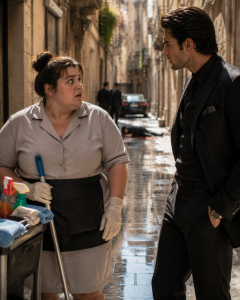
A man lay face down in the center of her freshly waxed floor, the back of his expensive suit jacket ruined by two dark, weeping holes. Standing over him was a man who looked like he belonged on the cover of a magazine about bespoke tailoring and generational wealth — charcoal overcoat, leather gloves, a handgun fitted with a long cylindrical suppressor. A second man, broader, built like a brick wall, watched the elevator bank.
The shooter turned his head slowly, his eyes locking onto Sophia. Dark, flat — the eyes of a man who did the math on human life and always found the sum wanting. This was Mateo Rossi. She didn’t know his name, but she recognized the type. The city was run by men in suits, but there were different kinds of suits. The man bleeding on the floor was a corporate suit. The man with the gun was a predator in wool and silk.
Mateo raised the weapon — not pointing directly at her yet, but the intent was clear. He expected her to drop the mop. He expected begging, weeping, bargaining with a god he knew didn’t listen to night shift cleaners.
Sophia looked at the gun. She looked at his pristine leather shoes. Then she looked at the blood, pooling fast, a thick dark maroon creeping across the polished white marble, seeping into the grout lines. Grout was notoriously difficult to clean once biological fluid set into it.
“Do you have any idea,” Sophia said, her voice flat, devoid of any tremble, “how hard it is to get arterial blood out of porous stone?”
Mateo’s gun dipped a fraction of an inch. His brow furrowed. The brick wall man by the elevator let out a sharp, confused breath.
“I literally just waxed that,” Sophia continued, stepping fully out of the closet, not raising her hands. Just a wide, solid woman holding a mop handle like a shepherd’s crook. “It took me forty-five minutes. My shift ends at three. If my supervisor comes up here and sees this mess, I’m getting docked.”
Mateo stared at her. For perhaps the first time in a decade, the head of the Sicilian syndicate in the five boroughs was entirely at a loss for words.
“Did you hear what I said?” Sophia asked, annoyed. “You couldn’t have shot him on the carpet. The conference room is right there.” She pointed a thick finger at a glass-walled room. “Dark carpet, masks everything. Now I need the enzyme cleaner.” She turned her back on the man with the gun and walked into the supply closet.
Mateo exchanged a glance with his enforcer, Julian, who shrugged, hand resting on his own weapon. Mateo felt a bizarre spike of adrenaline — not from the kill, but from the sheer, unadulterated absurdity of the moment. He walked quietly toward the closet, raising his weapon, half-expecting a trap. He found Sophia digging through the bottom shelf of her cart, muttering curses.
“Hey,” Mateo said, his voice a low rasp that usually made grown men hyperventilate.
Sophia stood up, a heavy jug of industrial bio-wash in hand, bumping the cart forward with her hip. “Look, mister, if you’re going to shoot me, aim for the head. If you put me in the hospital, my deductible will bankrupt me anyway. If you’re not going to shoot me, move. This needs to soak for ten minutes.”
He stepped directly into her path — six-foot-two, imposing, smelling of expensive tobacco and cordite — and raised the barrel, pressing the warm metal gently against the center of her forehead.
“You’re a witness,” he stated softly. A fact, a death sentence wrapped in a simple observation.
Sophia didn’t flinch. The heat of the suppressor was uncomfortable, but less uncomfortable than her bra wire, which had snapped an hour ago and was currently stabbing her in the ribs. She looked at him — sharp jaw, tired eyes, a faint scar through his left eyebrow, handsome in a brutal, detached way.
“I’m a cleaner,” she corrected him. “I didn’t see anything except a workplace hazard. Do I look like a hero to you?”
“You look like a liability.”
“I’m a ghost,” Sophia countered, her voice dropping into a tired, cynical register. “I come in when everyone leaves. I clean their garbage, wipe down their toilets, and go home to an apartment that smells like boiled cabbage. You think I care about whatever mafia business you have going on with suited guy over there? I don’t go to the cops. Cops tow my car when I’m five minutes late on the meter. Just let me clean the floor.”
Matteo didn’t move the gun. “You’re not afraid of dying.”
Sophia let out a short, humorless bark. “Buddy, I have twenty-three dollars in my checking account and a sister whose medical bills look like a phone number. Dying is a retirement plan. Now, are you pulling the trigger or not? Because my arms are getting tired holding this jug.”
—
PART 2
Julian stepped up behind him. “Boss, we got to move. Patrol car just swung by the front entrance.”
Mateo held her gaze, searching for the lie. People always broke eventually — they cried, they wet themselves, the animal instinct always took over. But Sophia’s eyes were completely deadpan, genuinely more irritated by the disruption of her routine than the threat to her life. There was a profound, deeply grounded resilience in her lack of panic. She wasn’t trying to be brave. She was just entirely devoid of hope, which made her incredibly dangerous or entirely harmless.
Matteo lowered the gun. “Dom. Wrap the body. Tarp from her cart.”
“Hey,” Sophia protested. “I have to inventory those.”
“Shut up,” Mateo said, not unkindly — a reflex. He pulled a thick money clip from his coat, peeled off five hundred-dollar bills, and shoved them into the front pocket of her smock. Sophia looked down, then back up, pulled the bills out, inspected the water marks under the fluorescent light, and nodded.
“Fair enough. But I’m going to need you to drag him to the freight elevator. He’s bleeding out, and I’m not tracking that through the lobby.”
Julian, holding a roll of black plastic, looked at his boss, bewildered. “Are we taking orders from the janitor?”
“It’s Mateo,” he corrected softly, rubbing the bridge of his nose. He was breaking protocol — protocol dictated a bullet in the heavyset woman’s head, a body left in the closet, a disappearance. But something stopped him. Maybe superstition. Maybe bizarre respect for her audacity. Maybe he simply didn’t want to make another mess for her to clean.
“Grab the legs, Dom.”
For the next ten minutes, Sophia directed two of the most dangerous men in the city on how to properly extract a bleeding corpse without ruining the reception chairs, spraying bio-wash over the remaining pool, watching it foam white as enzymes ate the proteins.
“You missed a spot,” she pointed out as Julian dragged the wrapped body toward the corridor.
“I’m a mechanic, not a maid,” Julian grumbled, sweating under the weight.
Mateo stood by the window, checking his watch. “We are out of time. The cleanup crew is three minutes out.”
“I am the cleanup crew,” Sophia said, scrubbing at the grout.
“Not this kind.” He walked over, looked down at her working the brush with rhythmic efficiency. “You can’t stay here.”
“Excuse me. I’m leaving.”
“Which means my people will be coming in to sanitize the scene. If they find a witness here, they won’t have a conversation with you. They will just shoot you.”
“I already told you I didn’t see anything.”
“They won’t ask.” Mateo reached down, grabbed her upper arm, and pulled her to her feet with shocking ease. She stumbled, her heavy frame colliding slightly with his solid chest.
“Hey, hands off.” She tried to wrench her arm away and couldn’t budge him. “You’re coming with us.”
“I’m on the clock,” Sophia yelled, genuine panic finally spiking — not because of the guns, but because of the job. “If I walk out now, I’m fired. I need this job.”
Mateo stared at her. “You are arguing about a minimum wage job while I am trying to save your life.”
“You’re the one who threatened my life in the first place,” she shot back, “and it’s twelve dollars an hour that pays for the electricity and the transit pass. You think your little tip covers my rent?” She shoved the five hundred back into his chest. He let the money fall to the floor.
He didn’t have time for this. He stepped in close, crowding her space. “Listen to me very carefully. You are leaving this building right now. You can walk out on your own two feet, get in the back of my car, and live to see tomorrow. Or I can let Dom carry two bodies down the freight elevator. Make your choice. You have five seconds.”
Sophia looked into his eyes. The flat, dead look was back. He wasn’t bluffing.
She sighed, a deep, rattling sound of defeat. “Fine. But let me grab my purse. My ibuprofen is in there.”
—
PART 3
The freight elevator ride was a study in uncomfortable silence, the dead man wrapped neatly in industrial black plastic lying at their feet. Julian stood in the corner, eyes darting between Sophia and his boss as if trying to solve a complex equation. Sophia leaned against the metal wall, arms crossed, having grabbed her worn canvas tote holding half a roll of mints, a transit card, keys, and the ibuprofen she desperately needed. She popped two pills dry.
“You’re going to get an ulcer doing that,” Mateo murmured, not looking at her.
“I already have an ulcer. It’s called my life.”
The elevator opened into a subterranean parking garage, cool and smelling of exhaust and damp concrete. A sleek black Maybach SUV idled near the exit. “Get in the back,” Mateo ordered. Julian popped the trunk unceremoniously, hauling the package inside with a grunt.
Sophia hesitated at the passenger door, looking at the pristine cream-colored leather, then down at her uniform, speckled with bleach stains. “I’m going to ruin your upholstery.”
“It’s a car. Get in.”
She climbed in awkwardly, feeling entirely out of place. The door slammed with a heavy, expensive thud, sealing her inside a soundproof bubble. Mateo slid in beside her, Julian took the wheel, and the SUV glided into sparse early morning traffic.
Inside, the tension was palpable. Sophia kept her knees pressed together, clutching her canvas bag to her chest like a shield, watching the city lights blur past the tinted glass. She was being kidnapped by the mafia. It was objectively terrifying, yet her mind kept drifting to mundane anxieties — who was going to feed her cat, would her landlord slide the eviction notice under the door or leave it on the handle.
“What is your name?” Mateo asked quietly.
“Sophia. Just Sophia Grace. Not that it matters.” She turned to look at him. “Where are you taking me?”
“Somewhere safe.”
“Safe for who? Me or you?”
A small, genuine smile touched the corner of his mouth, vanishing as quickly as it appeared. “Both. You’re a complication, Sophia Grace. I don’t like complications.”
“Then you should have let me finish mopping and walked away.”
“You saw my face. You saw Dom’s face. In my world, that requires a permanent solution.”
Sophia let out a bitter chuckle. “Your world, right? The world of fancy suits and shooting people in the back. Let me tell you something about my world, Mateo, or whatever your name is. In my world, the biggest threat to my life isn’t a gun. It’s a medical bill. It’s the price of groceries. I don’t have the energy to care about your turf wars or your crimes. I am tired. I am so deeply tired that if you threw me in the river right now, I might not even try to swim.” She spoke without melodrama — a simple, brutal recitation of facts.
Mateo felt a strange tightening in his chest. He was surrounded by people who lied, schemed, postured for power — even the women he interacted with playing a game drawn to the wealth and danger. This woman beside him, heavyset, wearing orthopedic shoes and a stained smock, was the most profoundly honest person he had spoken to in years.
“My name is Mateo,” he said. “And I don’t throw women in rivers.”
“Good to know. Standards.” She leaned her head back against the headrest — softer than her pillow at home. “So what’s the plan? You stash me in a warehouse somewhere?”
“I have a secure property in Long Island. You’ll stay there until I figure out how to handle this.”
“Long Island. I’m going to miss my shift tomorrow at the diner.”
Julian let out a bark of laughter from the front seat. “Lady, you’re sitting on top of a dead guy in a mafia car, and you’re worried about slinging hash at a diner.”
“That diner pays for my sister’s physical therapy, you meathead,” Sophia snapped, leaning forward. “So yes, I’m worried about it.”
Mateo raised a hand, silencing Julian. “I will compensate you for your lost wages.”
“Cash?”
“Cash.”
“Fine.” She slumped back and closed her eyes, the adrenaline finally draining, leaving her hollowed out and heavy. The gentle hum of the engine was surprisingly soothing. Mateo watched her breathing slow. He had taken hostages before, interrogated enemies — he knew the spectrum of human fear intimately. But Sophia Grace was an anomaly. Not fearless. Simply occupied by terrors he couldn’t fix with a gun.
—
Sophia woke with a violent jerk in a bedroom that felt like a cloud instead of a lumpy mattress. Heavy velvet curtains blocked the sun save for a single laser-thin line of light across a Persian rug. She yanked the curtains open — manicured lawns rolling down to a private cliffside over the Long Island Sound, a pool cleaner than her drinking water.
“Those drapes must cost a hundred bucks a panel to dry clean,” she muttered to the empty room.
A knock came. It wasn’t Julian — it was Mateo, in a fitted black henley, carrying a silver tray with a French press, a ceramic mug, and scrambled eggs that smelled like actual butter.
“You slept for eleven hours,” he said.
“I haven’t slept eleven hours since the Bush administration,” Sophia replied, staying planted, eyeing the food as her stomach rumbled traitorously. “Where’s my canvas bag?”
“Downstairs. It’s safe.” He poured coffee, held the mug out. “Drink. You look like you’re going to pass out.”
She snatched it, took a cautious sip — the best coffee she’d ever tasted — and hated that she liked it. “I need my phone. My sister is at the Oakridge Care Center. Her physical therapy co-pay is due today at noon. I also need to call the diner and tell my manager my appendix burst or something.”
Mateo pulled a small black notebook from his pocket, flipped it open. “Chloe Grace. Age twenty-eight. Severe spinal trauma from a motor vehicle accident four years ago. Currently residing at Oakridge. Outstanding balance of four thousand two hundred dollars.” He closed the notebook. “The balance was paid in full at eight this morning. An additional fifty thousand was deposited into her patient account to cover future treatments, private room upgrades, and a dedicated out-of-network physical therapist.”
Sophia stared at him. The air rushed out of her lungs. Four years of that debt sitting on her chest, dictating what she ate, whether she could afford new socks. To hear it dismissed so casually made her dizzy. But she didn’t cry.
“Why?” she demanded, hardening. “What do you want from me?”
Mateo looked slightly taken aback. “I told you last night, I am compensating you for your lost wages and your inconvenience.”
“Fifty grand isn’t compensation, Mateo. It’s a purchase price.” She stepped closer, pointing a thick finger at his chest. “You think because you throw money at my sister’s broken back, I belong to you? That I’m just going to sit here and keep my mouth shut like a good little pet?”
“You will keep your mouth shut because the alternative is a bullet,” he said, dropping back into a freezing deadpan. “The money is simply to ensure you don’t do something stupid out of desperation.”
“Desperation is all I know. So don’t think you can buy my peace of mind. I’m a hostage. Let’s call it what it is. How long do I have to stay in this museum?”
“Until I neutralize the people who hired the man I killed last night,” Mateo answered honestly. “If they find out there was a cleaner on that floor, they will torture you to find out what I took from his pocket. It could be three days. It could be three weeks.”
“Three weeks?” She rubbed her temples. “Fine. But I’m not eating in my room like an invalid, and I need clean clothes.”
His mouth twitched, almost a smile. “I’ll have my housekeeper bring you something.”
“Mateo.” He stopped at the door. “Did you really pay the facility?” Her voice cracked, just a fraction, the tough exterior slipping to reveal the raw, terrified older sister underneath. “You didn’t just tell me that to shut me up.”
“I don’t lie, Sophia. I don’t have to.” He held her gaze a long second before stepping out, pulling the door shut.
—
By the third day, Sophia felt like she was losing her mind. The high-end loungewear fit well enough, though it clung to curves she wasn’t used to showing. She’d spent two days pacing the east wing, watching armed guards patrol, waiting for the other shoe to drop. Nothing happened. Mateo was largely absent, locked in his study with Julian and men speaking hushed, urgent Italian.
Sophia couldn’t take the inactivity. Her body was wired for perpetual motion. Resting meant failing. Resting meant falling behind.
On the afternoon of the fourth day, Mateo walked into the industrial kitchen for water and stopped dead. The air smelled intensely of lemons and vinegar. Sophia stood on a step stool in yellow rubber gloves, sleeves pushed up, aggressively scrubbing the exhaust hood with a wire brush. Three kitchen staff stood by the island, paralyzed.
“What is happening here?”
The head chef threw his hands up. “She walked in an hour ago, boss. Told Maria her degreaser was garbage, mixed something in a bucket, climbed on the counter. Threatened to hit me with a wooden spoon.”
Sophia paused, wiped sweat from her forehead. “Your exhaust hood is a fire hazard, Mateo. You’ve got an inch of polymerized grease behind the primary filters. One bad flare-up on the grill and this whole wing goes up in smoke.”
“Get down from there.”
“I have ten minutes left. The vinegar needs to sit.”
“Down. Now.” The order carried the absolute authority of a man who commanded hundreds of violent men. Sophia sighed, tossed the brush into the sink, climbed down, peeled off the gloves, and walked to the island unfazed. “Out!” Mateo barked at the staff, who scattered.
“You are a guest in my home. Why are you behaving like the help?”
“I am not a guest, Mateo. I’m a captive. And I’m not behaving like the help. I am the help. It’s what I do. It’s who I am.”
“You don’t need to work here. I paid you.”
“You paid my sister’s medical bills,” she corrected sharply. “And I appreciate that. I really do. But you don’t understand how my brain works. I have been working eighty hours a week since I was nineteen. If I sit in that giant silent room and do nothing, I start thinking. If I start thinking, I start panicking. The work keeps the panic away.”
He walked slowly to the opposite side of the island. “What are you panicking about? You are perfectly safe here.”
“I’m panicking about the fact that I have zero control over my own life.” Her voice dropped, raspy, emotional. She leaned her hands flat on the marble. “My sister’s spine was shattered by a drunk driver. My father died of a heart attack because he couldn’t afford his medication. My whole life has been dictated by things I can’t control. The only thing I can control is how clean a floor is, how grease-free a stove is. It’s tangible. It’s a problem I can actually fix.” She looked up, eyes shining with fierce, unshed frustration. “So don’t take this away from me. Don’t make me sit in a velvet chair and pretend I belong here. Let me scrub the damn stove.”
Mateo looked at her hands — rough, calloused, knuckles red and swollen from years of harsh chemicals. He thought about the women he usually associated with, hands perfectly manicured, soft, useless. Sophia’s hands were the tools of her survival. He felt a sudden, inexplicable urge to reach across and touch them. He crushed the instinct immediately.
“The kitchen staff feels threatened by you,” he said, softer now, the anger evaporated.
“Julian’s a hack. He leaves his knives dull. Doesn’t clean the tracks of the sliding fridge doors. It breeds bacteria.”
A low rumble of laughter escaped his chest — rare, surprising both of them. “You’re critiquing my chef’s sanitation habits.”
“Someone has to. You’re paying him too much.” She picked up a damp rag, wiping the counter out of habit.
“Fine,” Mateo conceded. “If you need to work to keep the panic away, you can work. But no harsh chemicals without ventilation, and you don’t climb on counters. You fall and break your neck, it becomes my problem.”
She paused, rag in hand, surprised. “Deal. And Sophia?” “Yeah.” “Tomorrow you can organize the armory. Julian’s inventory system is a disaster.”
She raised an eyebrow. “You want the janitor to organize your illegal weapons cache?”
“I want someone who knows how to put things in their proper place,” he said, turning to leave. “And frankly, I trust you more than I trust half my men.”
—
The basement armory smelled of Hoppe’s solvent, damp concrete, and stale cigars — a windowless, climate-controlled bunker lined with reinforced steel shelving, and in Sophia’s professional opinion, a catastrophic mess.
“I don’t understand how you people run a criminal enterprise,” she muttered, dumping a box of loose ammunition onto a workbench, shell casings clattering. “You have nine-millimeter rounds mixed in with fifty-caliber sniper shells. It’s like a junk drawer in hell.”
Julian leaned against the doorframe. “We know where everything is.”
“You clearly don’t.” She held up a rusty magazine. “This was shoved behind a box of tactical vests. The spring is shot. It’ll jam. Not that I care if you get shot, Julian, but from an organizational standpoint, it’s embarrassing.”
“You want me to help sort them?”
“No. Your hands are too big. Go get me a label maker and six clear plastic storage bins.”
“I’m a button man, not a personal assistant.”
“I survived four years of retail inventory on Black Friday. You don’t scare me. Get the bins.”
He stared at her three seconds, then threw his hands up and walked off. Sophia found strange rhythmic comfort in the task — sorting the lethal instruments of a mafia syndicate wasn’t so different from organizing the chemical closet at Continental Trust. A place for everything, everything in its place.
The heavy steel door swung open again. “If you didn’t bring the label maker, Julian, you can turn right back around.”
“Dom is currently terrifying my logistics manager over the phone demanding plastic containers,” a low voice said.
Sophia froze, a handful of brass cartridges in her hand. Mateo had shed his suit jacket, sleeves rolled to his forearms, revealing faded jagged scars. The room suddenly felt suffocatingly small. He walked to the workbench, eyes scanning the neat rows of magazines, categorized ammunition, freshly oiled handguns.
“You’re efficient,” he noted, picking up a Sig Sauer, checking the action.
“I’m motivated. The sooner I make myself useful, the less likely you are to decide I’m dead weight.”
He set the gun down and leaned against the bench, turning toward her. Inches apart. She could feel the heat radiating off him.
“I am not going to kill you, Sophia.”
“You say that now. Wait till I start criticizing how you run your laundry room.” She tried to step back, hips bumping against a stack of body armor. Trapped between the workbench and the mafia boss.
Mateo studied the soft curve of her jaw, the dark circles finally fading under her eyes, the stubborn set of her mouth. Her breathing had gone shallow.
“You’re afraid of me right now,” he said. Not a question.
“You’re a man who shoots people for a living. I’d be an idiot not to be.”
“You weren’t afraid of me in the office building when I had a gun to your head.”
“That was different.” She looked away, at a box of hollow points. “Because dying on that floor was just the end of the shift. A mathematical probability. But this—” she gestured around the room, at him, “—the money, the house, the way you look at me. This doesn’t make sense. And things that don’t make sense are dangerous.”
Mateo reached out — not grabbing her, just resting two fingers lightly against the inside of her wrist, over her pulse. Calloused but incredibly gentle. She sucked in a breath.
“Your pulse is racing,” he murmured, thumb brushing her skin.
“It’s the poor ventilation in here,” she lied.
“You are not invisible here, Sophia.” His dark eyes locked onto hers, intensity entirely different from the dead, flat look of days ago. “For the first time in your life, people are seeing you. I am seeing you. And I think that terrifies you more than the gun ever did.”
Sophia swallowed hard. The truth hit her like a physical blow. She had spent a decade making herself a background object, a ghost holding a mop. Being seen — acknowledged as a woman with weight and presence and value — stripped away all her defenses.
Before she could form a cynical retort, the heavy door slammed open. “I got the bins,” Julian announced, then stopped, taking in the proximity between his boss and the cleaner. “Uh — should I come back?”
Mateo dropped his hand, his posture hardening instantly. “Put them on the floor, Dom, and get the cars ready. We have a meeting in the city at nine.” He didn’t look back as he walked out.
Sophia stood frozen against the workbench, her wrist burning where he’d touched her. She grabbed a handful of bullets and threw them violently into the nearest bin.
—
The illusion of safety shattered at 2:14 a.m. on a Tuesday. Sophia lay awake listening to rain drum the reinforced glass, calculating how many hours she’d been away from her apartment, when the lights cut out.
A low, pulsing red glow bathed the room as backup emergency lights clicked on. A claxon alarm wailed, rattling the floorboards. Sophia sat up. She didn’t scream, didn’t freeze. She shoved her feet into her sneakers, grabbed the heavy brass lamp off the nightstand, ripping the cord from the wall. Not a gun, but a solid ten pounds.
The bedroom door burst open. Sophia swung the lamp in a brutal blind arc. A large hand caught her wrist mid-swing.
“Stop. It’s me.” Mateo, breathing heavily, dark hair plastered with sweat and rain, tactical gear, a rifle across his chest, a handgun in his right hand. “What’s happening?” Sophia asked, dropping the lamp.
“Vincent’s crew. They bypassed the outer gate. They’re in the west wing. We need to move to the secure bunker below the armory. Now.” He grabbed her arm, not gently, and pulled her into the corridor.
The mansion was a war zone — pulverized drywall, smoke, the sharp chemical tang of cordite, muffled shouts, staccato suppressed gunfire from the lower levels. Sophia’s lungs burned, not built for sprinting, keeping pace with his long strides. They reached the grand staircase — the foyer below a mess of shattered marble, two guards laying down cover fire.
“Down the service stairs,” Mateo ordered.
As they rounded a corner, a figure in a wet ski mask stepped from a pantry door, raising a sawed-off shotgun. Mateo didn’t hesitate. He pushed Sophia violently against the wall, stepping entirely in front of her, and fired three times. The masked man crashed into a shelf of ceramics — but not before the shotgun went off, the boom deafening in the enclosed hallway. Sophia squeezed her eyes shut, hands over her ears.
“Keep moving!” He shoved her forward. They hit the service stairs two at a time; her unlaced sneaker slipped and he caught her around the waist, lifting her weight to keep her from tumbling. They burst into the basement, sprinting past the armory to a heavily concealed steel door. Mateo punched a code in with his left hand; the locks disengaged with a series of clunks. He shoved the door open, pushed her inside, slammed it shut, spun the locking wheel.
The silence inside the bunker was absolute, severing the chaos above like a severed nerve. Sophia collapsed against the wall, gasping, legs trembling.
“Are you hit?” Mateo’s voice was tighter than she’d ever heard.
“No. Just fat and out of shape.” She looked up. He leaned against the opposite wall, head thrown back, breathing ragged. Then she saw the blood, dripping from his right hand, pooling darkly on the concrete.
“You’re bleeding,” she said, exhaustion vanishing, crossing the small space. A piece of buckshot had caught him below the shoulder, tearing through the Kevlar sleeve, ripping a deep trench across his bicep. Blood flowed fast, soaking his shirt.
“It’s a graze!” he grunted, wincing as he tried to flex his fingers. “I’ll live.”
“That’s an arterial bleed, you idiot.” The panic of the gunfight was gone, replaced by the cold, familiar clarity of handling a crisis. She grabbed the hem of her cashmere sweater and pulled it over her head, standing in a simple white tank top.
“What are you doing?”
“I’m ruining a thousand-dollar piece of clothing.” She ripped the fabric down the seam with a sharp tearing sound, folded it into a dense pad, stepped into his space, grabbed his forearm despite his flinch, and pressed the pad directly into the wound. He hissed through his teeth.
“Hold this,” she ordered, grabbing his left hand and pressing it over the makeshift bandage. “Press hard. If you let up the pressure, I’ll hit you with the lamp again.”
Mateo stared down at her — cheap stretched tank top, wild frizzy hair, hands stained with his blood, no fear in her eyes, only annoyance and absolute focus. She wasn’t looking at him like a mafia boss. She was looking at him like a broken pipe that needed fixing.
“You’re bossing me around again, Sophia,” he breathed, voice rough with pain and something entirely different.
“Someone has to,” she muttered, tying the ruined sweater’s sleeves around his bicep to secure the pad. “I just got the grout upstairs clean. If you bleed out on this concrete, it’s going to stain permanently.”
He let out a short, breathy laugh, resting his head against the steel wall. The adrenaline was crashing, pain radiating to his fingertips, but all he could focus on was the solid, heavy warmth of the woman holding him together in the dark.
—
The bunker was a tomb of high-grade steel and damp concrete. Outside, the muffled thuds of gunfire were finally fading, replaced by the rhythmic beat of rain against the foundation. Sophia sat on the floor, her back against the wall, watching Mateo — pale, showing the waxy sheen of blood loss, the makeshift tourniquet stained dark but the bleeding slowed to a manageable seep.
“You’re shaking,” Mateo said, his voice a thin thread of sound holding a strange, persistent warmth.
“I’m cold,” Sophia replied, though it was a lie — shivering with the aftershocks of survival. For the first time in her life, she was profoundly tired — not just the physical fatigue of a double shift, but a deep psychic exhaustion. A woman who cleaned up after people, now cleaning up the literal biological residue of a war she hadn’t signed up for.
Mateo slid down beside her, leaning his head back, eyes half closed. “You should have run when we were in the hall. You could have made it to the service door and left.”
“You to bleed out? I wouldn’t have been able to get the stains out of the floorboards,” she said dryly.
He let out a small, jagged laugh, reaching out with his uninjured hand, fingers grazing her shoulder. Not pulling her closer, but the gesture felt heavy with intent.
“You are an impossible woman, Sophia Grace.”
“I’m a survivor, Mateo. There’s a difference.”
“I think you’re more than that.” He turned his head slightly to focus on her in the dim red glow. “I’ve spent my life surrounded by people who want something from me. Money, power, protection. You — you don’t want anything. You just want to keep things in order.”
“Order is safety,” she whispered.
“Is it?” He looked at her hands, still red-stained. “You spent your life in the shadows, waiting for someone to notice the work you did.”
“I noticed.” Sophia felt a lump form in her throat, a sharp sensation she hadn’t felt in years. She looked at the man who had kidnapped her, who had used her, who had brought her into his world of blood and chaos. She should have hated him. She should have been terrified. But as she sat there in the dark, she realized that for the first time in a decade, she wasn’t invisible. She wasn’t a janitor. She was Sophia.
“If we get out of this,” she began, her voice steady, “I’m not going back to the diner.”
Mateo smiled, faint and weary. “I suspected as much.”
“I need a job where I have more control. A place where things don’t constantly fall apart.”
“I have a business that needs cleaning, Mateo,” she paused, catching her own slip. He caught it too, a soft, intimate register entering his voice. “I have a house that needs to be a home. And I have a life that is, as you correctly noted, entirely too chaotic.”
Sophia looked at him. The danger was still there, lurking in the shadows of the bunker, but the fear had receded. What remained was a strange, terrifying possibility.
“I’m not a kept woman, Mateo.”
“I know,” he said, fingers brushing her hair away from her face. “You’re the only person I’ve met who’s strong enough to keep me from falling apart.”
—
The sun was bleeding into the horizon when the steel door finally groaned open. Not an assassin — Julian, his face covered in grime, a look of profound, exhausted relief.
“It’s over,” he announced, staring at the sight of his boss slumped on the floor, bleeding onto a pile of ruined cashmere, the janitor sitting beside him with her hand firmly on his uninjured arm. “The perimeter is secure. The cleanup crew is here. Called the doctor.”
Mateo nodded, a slow, deliberate movement. “Good.”
Sophia stood. Her legs felt like lead, but she stood tall. She walked out of the bunker, her gaze sweeping over the wreckage — broken glass, splattered blood, overturned furniture. To anyone else, it was a crime scene. To Sophia, it was a project.
“Julian,” she called out, her voice echoing in the grand, silent foyer. He looked up, startled. “Get me industrial-grade degreaser, a steam mop, and a dozen microfiber cloths. And tell your cleanup crew to stop throwing the trash in the garden. It ruins the drainage.”
He hesitated, looked at Mateo — slowly emerging from the bunker, supported by a medic — and shrugged. “You heard her. Get the woman what she needs.”
For the next ten hours, Sophia didn’t stop. She cleaned with a ferocity that bordered on religious. She scrubbed the blood from the marble. She polished the mahogany. She repaired the damage with the same precision she’d once used to keep a hospital floor sterile. By sunset, the house was silent and immaculate, the scent of ozone and cordite replaced by the faint, comforting smell of lemon and wax.
Mateo found her in the kitchen, sitting on a stool with a cup of coffee, in a clean white shirt, his arm in a sling, still pale. He looked at the room, then at her. The kitchen was perfect — a space of order, of peace.
He walked over and stood beside her, placing his good hand on the counter inches from hers, without a word. Sophia looked at his hand, then at him. She didn’t move away. She picked up her cup, took a sip, looked at the perfectly polished surface of the granite island.
“It’s finally clean,” she said.
“It is,” Mateo agreed. “Now what?”
He turned to look at her, his dark eyes filled with a quiet, terrifying clarity. “Now we decide how we’re going to build something that doesn’t need to be cleaned up.”
Sophia set her cup down. The weight of the last week — the fear, the violence, the relief — settled into a firm, grounding resolve. She reached out and placed her hand over his.
“That sounds like a lot of work,” she said.
“I have plenty of time,” he replied.
Sophia smiled — a real, genuine smile that reached her eyes. She wasn’t just a cleaner anymore. She was the one who held the keys to the kingdom.
And for the first time in her life, she liked the view.
THE END