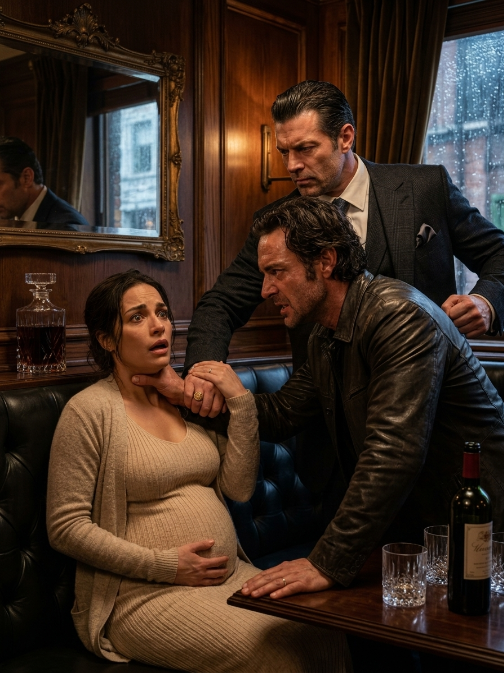
A cop was bleeding out in a freezing Chicago alley when the Mafia Boss carried her to safety. But when her department discovered who had saved her, they realized she didn’t need protection—she needed to disappear.

—
PART 1
The thing nobody tells you about being shot is how quiet it gets.
Not the silence of peace. The silence of a world contracting — the alley, the rain-slick bricks, the dumpster leaking rust and old grease — all of it pulling inward until the only sound left is your own breathing turning wet. Detective Cara Voss understood she was dying approximately six seconds after the second bullet entered her ribcage. She understood it the way she understood everything: by cataloguing what she could prove.
Shattered window: first shot.
Shoulder: second.
Ribs: third.
The men who had fired were already gone. Not fled — *gone*, orderly, no scramble. That was how she knew they were trained. Panic makes noise. Professionals make distance.
Her service weapon was four feet away on the pavement. She had crawled that far before her arm gave out. Her badge was still clipped at her back. She pressed both hands against her ribs and felt the heat of the blood and calculated, with the cold portion of her mind that never fully slept, whether there was any version of this where she survived long enough to file the report.
The report she had never submitted.
The report that would have named Captain David Harrow, eleven-year veteran, two commendations, department liaison for community trust initiatives.
The report that would have named Detective Kyle Marsh, her partner, who still kept a photograph of his daughter on his desk and bought decent coffee for the bullpen every Monday.
The report that documented what Cara had spent four months proving: that a significant portion of the Seventh District’s upper leadership had been quietly, surgically, catastrophically purchased by an organization called the Sorrenti network — a consortium of old money and older violence that had been threading itself through Chicago’s institutions the way water threads through limestone. Invisibly. Patiently. Until one day the stone isn’t stone anymore, it’s just the shape of a thing that used to hold.
She had sent herself to the warehouse on Delafield to surveil a meeting.
By the time the first shot came, she understood her informant had not given her a meeting.
He had given her a location to die in.
Now she was dying in it.
The man appeared at the mouth of the alley without sound.
Not a cop’s entrance — no radio, no flashlight, no announcement. He moved in the posture of someone who had learned very early that visibility was a vulnerability. He was perhaps forty, lean in a way that came from purpose rather than vanity. Dark coat. Dark gloves. A scar that ran from his left temple to the edge of his jaw like a margin drawn in violence.
He crouched beside her.
He did not flinch at the blood.
“Don’t make noise,” he said. Flat. Calm. The voice of a man giving weather information.
Cara looked at his face and looked at his hands and assessed her options and found that she had exactly none.
“I’m a detective,” she said. “CPD. Cara Voss.” Her voice came out thinner than she intended. “Call—”
“I know what needs calling.”
“An ambulance.”
“No hospital.”
She tried to pull back from him. He pressed his coat against her ribs and the pain went white and enormous and she heard herself make a sound she would later refuse to remember.
“Breathe,” he said. “Slow and deliberate. Or fast if that’s what you have, but keep it regular.”
“Who are you?”
He looked toward the alley’s exit, where a car had stopped with its headlights off.
“Someone who arrived before the men who were supposed to come back and confirm the job.”
She felt that land somewhere below her chest.
*Confirm the job.*
“My sister,” Cara said. “Naomi. She needs to know—”
“Tell me later.”
“I might not—”
“Tell me later,” he repeated. “That is not permission to die.”
He lifted her. The pain unmade her. She was aware of the car’s interior, the sound of doors, a voice she didn’t recognize saying something in a low register. Then Chicago blurred and darkened and dissolved into a nothing that felt, terrifyingly, like relief.
—
She woke in a room that cost money.
Not hospital money — the institutional economy of fluorescence and linoleum and meals that arrived in plastic. This was old-house money. Coffered ceiling. Plaster walls the color of heavy cream. Long drapes in a fabric that absorbed sound. Outside, through a gap at the curtain’s edge, she could see grounds — clipped grass, frost burning the edges silver, oak trees old enough to have witnessed worse things than whatever this was.
There was an IV line in her left arm.
There were sutures she could feel shifting beneath the bandages when she breathed.
A woman sat near the window, reading. Dark hair shot through with silver. Posture that suggested someone who had spent decades being the most organized person in any room.
Cara said, “Where.”
The woman turned a page. “Somewhere you’re not dead.”
“How long.”
“Twenty-six days.”
Cara closed her eyes. Then opened them, because closing them felt too much like the alley.
“The man—”
“Will come when he’s ready.”
“I didn’t ask about his schedule.”
“No. But that’s the answer you have.”
The door opened.
In the light of day he was cleaner than she remembered, which was not the same as safer. Dark slacks, sleeves rolled, a watch that could have funded Cara’s entire career in narcotics. The scar was pale against his olive skin, thicker at the temple, thinning toward his jaw.
“Marco Sorrenti,” Cara said, because she was a detective and detectives named what they knew. “You’re the Sorrenti network.”
The woman left quietly.
Marco closed the door.
Cara pulled at the IV.
He crossed the room in the time it took her to get a grip on the line and caught her hand — not roughly, just with a flat certainty that stopped the motion.
“You lose blood you can’t recover,” he said.
“You’re a criminal.”
“Yes.”
“You saved a cop’s life.”
“Also yes.”
“Why.”
He let go of her hand. Pulled a chair to the side of the bed and sat in it the way powerful men sit — not lounging, never lounging, but occupying the chair as if it were the appropriate place for a decision to be made.
“Because the men who shot you work for an organization that has spent two years claiming they own my network’s operations in this city. They do not own my network. But they have been creating the impression that they do — by purchasing law enforcement, then ensuring law enforcement destroys anyone who notices the purchase.”
Cara stared at him.
“You let them.”
“For a time. While I collected proof.”
“And now?”
“And now a detective is bleeding in my guest room who has spent four months collecting the same proof from a different angle.” He settled back slightly. “That seemed worth preserving.”
The silence in the room had weight.
“My sister,” Cara said.
“No.”
“She thinks—”
“She has been told you died at the scene. That your body was recovered.” His voice carried no apology for this information. “If you contact Naomi now, the people who staged your death will know they failed. The most likely response is to remove leverage.”
Cara understood *leverage* before he finished the sentence.
“You’re telling me they’ll go after her.”
“I’m telling you they will try.”
Something cold moved through her that was separate from the blood loss.
“You know her name.”
“I know a great deal about you, Detective Voss. I made it my business to know, when it became clear you were assembling information that intersected with my own.”
“You’ve been watching me.”
“Watching you survive an investigation that should have gotten you killed three months ago.” A faint movement at the corner of his mouth, barely a smile, closer to acknowledgment. “You’re careful. Methodical. You document well and trust poorly. Under different circumstances I might have hired you.”
“I’d never work for you.”
“No,” Marco said. “You wouldn’t.” And he seemed to find this neither disappointing nor surprising.
He opened the laptop on the side table.
Bank records. Wire transfers. Routing structures. Photographs of dock inventory logs, warrant delays, evidence catalog anomalies. Payments routed through real estate holding companies to accounts in the names of three people whose faces Cara had been staring at for months: Marsh. Deputy Commissioner Ellison. Captain Harrow.
She went through all of it twice.
Then she said, “I need to know this didn’t come from manufactured sources.”
“It came from the same places your evidence came from. Different angle of collection.”
“If this is fabricated—”
“If it were fabricated,” Marco said, “it would be cleaner. Fabricated evidence doesn’t include human error. It doesn’t show Marsh’s amateur attempt to run cash through his wife’s event planning business. It doesn’t include Harrow’s three-month gap where he thought he’d covered a payment in cryptocurrency that he did not, in fact, cover.”
Cara hated that this was persuasive.
She hated almost everything about the room, the IV, the crisp sheets, the careful precision with which Marco Sorrenti had arranged his explanation. She hated that the first person to tell her the complete truth after three months of watching the truth be erased was a man she had spent her career being trained to stop.
“Naomi,” she said.
Marco reached into his coat and produced a phone so stripped-down it barely qualified as a phone. No case. Burner.
“One call. You’re alive, nothing else. No location, no names, no reference to the investigation.”
Cara took it.
Her hands were not entirely steady.
Naomi answered on the second ring.
“Hello?” Her sister’s voice — cautious, the voice of someone who had stopped trusting unknown numbers, because grief made you careful about hope — and then Cara said her name, and the caution broke open into something that had no name.
“Cara.”
“I’m alive.”
The silence on the line was the loudest thing Cara had ever heard.
“Oh God. Oh God, Cara, where are you, I need—”
“You can’t know where. Not yet.”
“That doesn’t make sense—”
“It makes sense, I just can’t explain it.” Cara pressed her free hand flat against the blanket, steadying. “The department is part of what happened to me. Do you understand? You can’t tell anyone I called. You can’t search for me.”
“You’re asking me to—”
“I’m asking you to be safe. That’s all I’m asking.”
Naomi was quiet for three breaths.
“They held a memorial,” she said finally. “Harrow spoke. He talked about your integrity.”
The air in the room changed.
Cara looked at Marco.
He watched her without expression.
*Harrow spoke at my memorial.*
She thought about this man standing at a podium, saying words like *dedication* and *sacrifice* and *loss the department will long feel*, with her blood still not yet dry on the Delafield pavement.
“I love you,” Cara said to her sister. “I’m sorry. I’ll come back when I can.”
“*When?*”
Marco raised one finger.
“I don’t know yet. But Naomi—” Her voice dropped. “Don’t trust anyone who knew my case.”
The call ended.
Marco removed the SIM, snapped it clean, and burned it in a small ceramic dish with the matter-of-fact efficiency of someone who had done this many times.
Cara watched the plastic curl and blacken.
“You could have let me die,” she said.
“Yes.”
“Why didn’t you.”
Marco stood. Moved toward the window. The light through the curtains caught the scar, made it look older.
“Because useful things should survive,” he said. “And because I am tired of watching this city’s rot protected by the people assigned to clean it.”
Cara didn’t believe that was the whole answer.
But she was too exhausted, too depleted, too still-alive-against-the-odds to press.
She lay back against the pillow.
Outside, Chicago winter held the grounds in grey light.
Inside, for the first time since Delafield, Cara Voss did not feel like she was dying.
She wasn’t sure yet what she felt instead.
—
PART 2
Recovery was an argument between her body and her intention, and her body won most rounds.
She healed — slowly, furiously, in increments that felt like insults. Rosa, who ran Marco’s household with the quiet authority of someone who had been doing so for decades, changed her dressings without commentary and offered advice Cara didn’t ask for and often needed.
“You’re fighting the healing,” Rosa said one morning.
“I’m a fast healer.”
“You are an impatient healer. That is different.”
Marco appeared on no schedule. Days passed without him. Then he was in the doorway during her physical therapy, watching with arms folded and nothing useful to say, present in the way that things with weight are present: you feel them even when you’re not looking.
He never apologized for the confinement.
She had expected that to make it worse.
Strangely, the honesty of it made it easier to breathe.
By the sixth week she was walking the full corridor without bracing the wall. By the eighth she was sitting in his study, reviewing documents. By the third month the documents were spread across two tables and she had mapped every procedural weakness that had allowed the corruption to function — which warrants moved through which supervisors, which databases were theoretically secure but practically accessed with the casual negligence of people who trusted their badges to make them trustworthy.
Marco entered one afternoon with a single folder.
“I have a request.”
Cara did not look up from the financial transfer she was annotating. “No.”
“You haven’t heard it.”
“I don’t need to hear it.”
He set the folder open on the table in front of her.
Inside: a photograph of Naomi leaving her apartment building, coat buttoned against November, keys in one hand, coffee in the other, unaware.
Cara stood up so fast the chair scraped back and the pain in her ribs fired hard enough to blur her vision.
“What is this.”
“Evidence that I can protect her.”
“Or that you’re threatening her.”
“If I were threatening your sister,” Marco said, in a voice that had gone very flat and very quiet, “you would not require a photograph to understand it.”
The room settled.
Cara made herself breathe.
“Then why.”
“Because Harrow’s people watched her building three days ago. Mine intercepted the surveillance team before they got close enough to become a problem.” He closed the folder. “She doesn’t know. She was never in danger from my end. But she will be, repeatedly, if you don’t move faster than Richardson intends to.”
The use of Richardson’s name — Harrow’s deputy commissioner, the man above the man — landed like the third bullet had.
“He knows I’m alive,” Cara said.
“He suspects it. That is almost the same thing.”
“What do you need.”
Marco looked at her steadily. “I need you to walk me through police infrastructure. Procedural architecture — not access codes, not active case files, nothing that endangers officers uninvolved in this. Just the shape of the system. How corrupt command used the department’s own structures to slow, bury, and redirect everything your investigation was generating.”
“That’s what gets me to testify against you later.”
“Yes,” Marco said, without flinching. “Probably.”
She made him agree to terms. He agreed to all of them.
That should have worried her more than it did.
The work that followed changed the texture of the house. People Cara had never expected to find in a criminal’s orbit arrived in unmarked cars and settled into converted rooms: forensic accountants, cybersecurity contractors, two former federal investigators whose presence she chose not to examine too carefully. The operation had discipline. Marco refused certain things without discussion — she heard the silence that followed when someone suggested using a school near the target warehouse as a transfer cover point, and the way that silence made the room very still.
Later she found him alone.
“You have limits,” she said.
“Everyone does.”
“Not everyone.”
“Then they’ve stopped being people,” he said. “They’ve become what they want.”
Cara thought about Harrow. The photograph. The memorial speech.
“Some people want terrible things.”
“Yes,” Marco said. He looked toward the window. “Which is why the people who don’t have to stay organized.”
She didn’t answer that.
She didn’t sleep well that night either.
Letters to Naomi began in December. Every one passed through Marco first. Every response arrived in print, the originals destroyed. Naomi wrote like someone composing from the inside of a room she couldn’t leave:
*I’m angry.*
*I’m glad you’re alive.*
*I hate that I can’t find you.*
*I’m trying to understand.*
*Come home when you can. Come home.*
Cara folded the last letter seventeen times, unfolding and refolding it, until the paper softened at the seams.
Marco found her in the library one evening, not crying, but close.
He stood in the doorway long enough that she had time to collect herself.
“Harrow spoke at my memorial,” she said.
“Yes.”
“He ordered the shooting and then stood in front of her and said my name like it mattered to him.”
Marco was quiet.
“There are men,” he said, “for whom hypocrisy is the proof. It tells them how much power they have. That they can do the thing, and then speak beautifully about the thing, and no one stops them.”
“What tells you how much power you have?”
The question surprised him. She could see it in the slight stillness of his expression, the moment before the answer came.
“When the people I protect stay alive,” he said.
Cara looked away first.
By January they had the entire architecture mapped. Richardson had not merely taken money — he had built a system. Harrow was the execution layer. Marsh was the friendly face. A network of lower-ranking officers served as disposable hands, kept in line through a combination of small payments and the very reasonable fear of what happened to people who tried to leave.
The Sorrenti network believed they owned Chicago law enforcement.
Richardson believed he owned the Sorrenti network’s protection.
Everyone in the arrangement was using everyone else.
That was why it was beginning to collapse.
Marco entered her office one morning without knocking.
He never did that.
Cara looked up.
“Richardson has hired a private investigator,” Marco said. “The man has been photographing the gates for six days.”
“He knows where we are.”
“He suspects you may be somewhere in this property’s orbit. He doesn’t know you specifically. Not yet.”
“*Not yet* is not—”
“Not yet is the only kind of time we have,” Marco said. “Get ready. We’re going to let him watch. And wait for him to make a phone call.”
On the seventh day, the phone call happened.
Marco played the recording in the study.
Richardson’s voice filled the room. Low. Controlled. Tighter than it sounded in press conferences. Asking for confirmation that Marco Sorrenti was actively investigating police operations. And then, when the investigator pushed for more money, Richardson’s patience failing in one sentence:
*If Voss is alive, everyone involved burns.*
The room went silent.
Cara stopped breathing.
Marco turned off the recording.
Neither of them spoke.
Then Marco said, “Now you choose.”
He gave her three options. New identity, leave the country, disappear. Federal handoff, evidence package, testimony, witness protection. Or stay, continue working in shadows, let him dismantle the network without the courts.
Cara knew the third option was the one she wanted.
That told her everything about why she couldn’t take it.
She had been a cop before she was a ghost. And however much the system had tried to kill her, she still believed — *still*, despite everything — that truth had a different weight when it moved through light.
“I need to testify,” she said.
Marco nodded once.
“I know.”
“You’ve known.”
“Since you asked me, twice, about federal safe house protocols.”
“You could have tried to stop me.”
“No,” Marco said. “I couldn’t.”
She looked at him across the table, across the months, across the distance that lived between two people whose lives had intersected catastrophically and with strange, irreversible consequence.
“Why not?”
He was quiet long enough that she thought he might not answer.
“When I was young,” he said, “my father offered me a way out. Different name. Different country. Enough money to build something clean.” His jaw shifted. “I told myself I stayed for loyalty.”
“And the truth?”
“I stayed because I was afraid to become no one.” He looked at the window. “I know what it costs to choose the life that doesn’t disappear. I won’t make that choice for you.”
Two days later, black SUVs came up the drive.
The agent who stepped out first was a woman named Torres — fifties, sharp-cut face, eyes that had seen too many institutions fail and kept showing up anyway.
She did not look particularly surprised to see Marco in the entrance hall.
She had known about the arrangement.
Of course she had.
Cara carried one bag. Clothes, medical records, Naomi’s letters, a photograph Marco had placed in the bag without explanation — her and Naomi at a Cubs game three years ago, grinning into the sun.
She didn’t ask how he had gotten it.
Rosa hugged her at the door. Brief, not warm exactly, but real in a way that mattered.
“Live well,” Rosa said.
Marco walked her to the car.
“This isn’t goodbye,” he said.
“It has to be.”
“No. Goodbye is an ending. This is a consequence.”
She almost laughed. She almost hated him. It would have been so much easier to land on one.
Instead she touched the edge of his scar — she didn’t plan to, her hand simply moved — and felt the raised ridge of it, the history it contained, the evidence of a life that did not let people go clean.
“Thank you for the alley,” she said.
His eyes darkened.
“Thank yourself,” he said. “You survived before I got there.”
Torres opened the car door.
Cara got in.
The mansion shrank in the window and then was gone.
And for the second time in the same year, Cara Voss ceased to exist.
—
PART 3
The federal safe house was designed by someone who believed safety and discomfort were essentially the same experience.
Beige walls. A sofa that sagged with institutional resignation. Coffee that tasted like it had been brewed in resentment. Locked windows. The perpetual sound of ventilation working too hard.
Cara sat at the kitchen table for three days answering the same questions in different order.
Where were you when the first shot occurred?
What was your relationship with Detective Marsh?
How did you access the financial documentation?
At what point did you identify Captain Harrow as the primary coordinator?
Why did you not report your suspicions through internal channels?
*Because internal channels were the problem*, she said, every time. *That was the whole shape of it.*
Agent Torres — who had the look of a person who had built her career in the gap between what the law promised and what institutions delivered — conducted most of the questioning. The AUSA assigned to the case was a woman named Navarro, who was efficient and humorless and excellent at her job in the way that required leaving warmth outside the interrogation room.
They wanted Marco’s name.
Cara did not give it.
Not because she loved him.
Not only because she loved him.
She didn’t give it because the structure of the evidence they had assembled was precisely calibrated to make the prosecution about police corruption — about the specific, systemic, documented rot inside the Seventh District’s command structure. The moment Marco Sorrenti’s name entered the proceedings, the defense would pivot. Richardson would become a victim of criminal manipulation. Marsh would claim coercion. The trial would become about the mob instead of about the men who had sold their badges.
The truth she had survived for would drown under a more sensational truth.
“Corroborating documents came from a confidential source,” she said.
Navarro looked at her for a long time.
Torres said nothing.
The agreement held.
The grand jury was October. Cara testified for four hours and forty minutes in a navy suit and flat shoes and a blouse with a collar high enough to cover the scar near her collarbone. The federal building was cold. Her shoulder ached. She had grown accustomed to pain that arrived on schedule.
She told the jury about Delafield. The warehouse. The shots arriving in the rhythm of someone who knew how to shoot. The understanding — arriving between the second and third bullets — that she had been sent there by someone in her own precinct.
She told them about the transfers, the delayed warrants, the dock manifests that had been flagged and then unflagged by someone with supervisor-level access.
She did not perform the grief. She told it plainly and let it sit.
Jurors leaned forward.
That was the thing grief did when you refused to perform it: it became undeniable.
In a courthouse bathroom afterward, Cara locked herself in a stall and shook until the shaking passed. An agent outside asked if she needed assistance.
“No,” she said.
And this time, it was actually true.
Marsh was indicted first. His arrest appeared on news at six: suburban driveway, handcuffs, the familiar visual vocabulary of consequences finally catching the right person. His wife on the porch in a bathrobe. His daughter’s photograph still on his desk, which several colleagues mentioned to reporters as if it meant something.
It didn’t mean what they thought it meant.
Deputy Commissioner Richardson lasted longest.
He appeared at a press conference in a charcoal suit and called the investigation a painful political attack on the integrity of the Chicago Police Department. He promised full transparency. He thanked the officers under his command for their continued service.
Federal agents arrested him four days later in the parking structure beneath headquarters, bent over the hood of an unmarked car, hands behind his back, exactly as composed and controlled as he’d been at every press conference and every memorial he’d ever used to launder his image.
That image became the one America filed away.
The man who had spoken at Cara Voss’s memorial, at whose department funeral her sister had wept, whose voice had delivered the word *integrity* over her hypothetical grave — that man, hands locked, the hood of the car pressing his cheek.
Chicago erupted in the way cities erupt when institutions fail and people discover the failure all at once. Former defendants demanded case reviews. Families of men and women prosecuted by officers working under Richardson’s structure asked whether any of it had been real. Honest officers — and there were many, there were always many, that was what made betrayal function, the good people who made the badge credible — walked into work beneath a cloud they hadn’t made.
Naomi appeared on the local news once.
Cara watched from a safe house in another state, sitting on a beige sofa, her arms wrapped around her knees.
Her sister was inside the furniture restoration shop their parents had helped her open years ago. Green sweater Cara recognized from the year before she died. Hair pulled back. Her face older than it should have been.
“Are you proud of your sister?” the reporter asked.
“Yes,” Naomi said, without hesitation, without performance.
“Do you feel betrayed by the department?”
Rachel looked into the camera with the directness of someone who had decided not to protect anyone’s feelings anymore.
“My sister was betrayed. I was lied to. This city was lied to. So yes.”
“Have you spoken to Detective Voss?”
A pause.
“I love my sister,” Naomi said. “That’s what I can tell you.”
Cara pressed the back of her hand against her mouth.
The weather forecast came on.
She sat there through the weather forecast.
—
The trials moved from winter into spring with the slow, grinding momentum of institutional justice — which was not the same as justice, but was what justice had to work through to become real.
Marsh took a plea and testified against the others.
Richardson fought every day of it.
His attorneys were expensive and effective and deeply committed to the proposition that Cara was unstable, obsessive, motivated by a failure to advance in a male-dominated hierarchy, and had potentially fabricated or embellished portions of her investigation.
Cara sat in the witness box and let them try.
On the second day of cross-examination, a defense attorney in a gray suit paced in front of the jury and said, “Detective Voss, isn’t it true that there was no Chicago Police Department representative present when you were, as you claim, rescued?”
“Yes.”
“And the individual who allegedly rescued you has never been publicly identified?”
“Yes.”
“So this jury is being asked to accept that you disappeared for months under criminal protection, returned with evidence from an anonymous source, and we’re simply to believe you?”
Cara looked at Richardson.
He looked back. The same face he had worn at her memorial. The same carefully arranged steadiness.
“No,” she said.
The attorney hesitated. “No?”
“I’m not asking the jury to believe me. I’m asking them to read the bank records, the wire transfer logs, the dock inventory discrepancies, the warrant delay patterns, the financial analysis from three independent forensic accountants, Detective Marsh’s own testimony, and a recorded conversation in which Captain Richardson stated that if I was alive, everyone involved would burn.” She paused. “The jury can draw its own conclusions.”
The attorney did not effectively recover.
Marsh received nine years. Richardson’s deputy received eleven. Richardson received fourteen.
When the judge finished reading, Cara felt nothing triumphant. She felt the specific emptiness of aftermath — a storm you’d been prepared for so long that when it passed, you didn’t know what to do with an ordinary sky.
Torres found her in the hallway.
“It’s over,” Torres said.
“It’s sentenced,” Cara said. “That’s different.”
Torres nodded slowly. “That might be the most accurate thing said today.”
—
Witness protection moved her to a small city in Montana in early summer.
Her new name was Claire Morse. She worked remote data security contracts for a firm that asked few personal questions, which was exactly as ironic as it sounds and which she recognized with a laugh that startled her the first time it came out.
Her apartment was not much. Clean lines, thin walls, furniture that came from a showroom warehouse outside of town. She learned which grocery store had produce worth buying. She found a coffee shop where the staff knew her order and not her story. She hiked trails where mountains did not care what her name was.
Naomi visited in July.
They met at a coffee shop with genuinely excellent cinnamon rolls and genuinely terrible parking.
For five seconds they just looked at each other.
Then Naomi crossed the room and pulled Cara into a hug that protested both of Cara’s rebuilt ribs and that she had absolutely no intention of ending.
“You’re too thin,” Naomi said into her shoulder.
“You’re still bossy.”
“You died. I’m entitled.”
They laughed and then they weren’t laughing.
Later, with untouched coffees between them, Naomi said, “He’s a criminal.”
Cara looked down at the table.
“Yes.”
“He kept you alive.”
“Yes.”
“Do you love him.”
It wasn’t quite a question.
Cara could have lied. She had spent months lying about easier things.
“I love the man who found me before they came back to confirm the job,” she said. “I don’t know what to do with some of the things that man has also done. I’m not sure that makes me a good person.”
Naomi’s expression did something complex and kind.
“It makes you a person,” she said. “That’s the whole thing. That’s all it is.”
“I thought you’d judge me.”
“I am judging you. I’m your sister. I judge everything about you constantly.” She reached across the table and covered Cara’s hand with hers. “But I’m also trying to understand, because you came back. Not all the way. But back. And that matters more than having clean answers.”
Cara held on to her sister’s hand and didn’t say anything.
Some things don’t need words.
They need the particular weight of a hand on a table in a coffee shop in a city where nobody knows your name.
—
Three months after the trials concluded, a message came through a channel that should not have existed — through a work system, behind three layers of security, routed so carefully that Torres later told her she had never determined with certainty how it arrived.
Three words and a letter.
*You are safe.*
*M.*
Cara deleted it.
Then she sat completely still for eleven minutes.
She had counted.
—
A year after Richardson’s sentencing, Torres arranged a monitored call.
She called it closure.
Cara did not believe in closure. She believed in evidence. And the evidence of her own experience suggested that what people called closure was usually just the present moment asserting itself over the past.
She picked up the phone.
Marco’s voice came through steady and low, the voice she had first heard in a rain-wet alley telling her not to make noise.
“You’re alive,” he said.
“That was always the goal.”
“Safety and life are not identical.”
“No. I’m learning the difference.”
A pause. She could see him without seeing him — the window, the grounds, the lamplight against the scar.
“The Sorrenti network in Chicago is structurally finished,” he said. “What remains is manageable without me.”
“Did you do that.”
“I helped gravity.”
She smiled before she could stop herself. Torres shifted somewhere in the room, reminding her that every word was evidence of something.
“Marco.”
“Yes.”
“Why call.”
His breath moved slowly through the line.
“Because love is not always possession,” he said. “Sometimes it is the choice to keep a door closed because opening it would cost you the future you built from surviving.” A pause. “I wanted you to know the door is closed because I am holding it, not because you are locked behind it.”
Cara closed her eyes.
“I won’t forget you.”
“You are not meant to forget,” he said. “You are meant to live.”
The line ended.
Three hours later Torres arrived at Cara’s apartment with a file.
Photographs of the mansion. Gates. Grounds. Rosa near the front entrance in a winter coat. No Marco.
“He’s gone,” Torres said. “Off the grid. International activity we’re still mapping.”
“You made a deal with him.”
“We reached an arrangement.”
“That’s a cleaner word.”
“Yes,” Torres said, without apology.
Cara looked at the photographs.
“Was it worth it.”
Torres sat down across from her.
“Fourteen trafficking interdictions across three networks. Five organized crime financing operations disrupted at the infrastructure level. A counterterrorism lead that broke open a case we had been building for three years.” She folded her hands. “Because of information he provided.”
“The mob boss became a government asset.”
“The world is rarely clean.”
“No,” Cara agreed. “But people keep trying.”
—
Time moved the way it does after everything that was supposed to destroy you fails to.
Not easily. Not without cost. But forward.
Rachel opened a second studio and Cara visited twice, as Claire Morse, with a story ready and a face her sister knew. The Chicago Police Department entered a long, grinding, imperfect process of accountability. Some officers resigned. Some cases were reopened. Some families got answers, not all of them, enough.
Cara never saw Marco again.
Twice she thought she did — a dark coat in a crowd, a scar at the edge of her peripheral vision, a black car idling past a curb. The first time her heart did something loud and unreasonable. The second time she stood still and waited and the figure turned and was someone entirely ordinary.
She decided this was fine.
She decided she could live inside the uncertainty without resolving it.
—
Two years and four months after the Delafield alley, Cara stood outside a federal courthouse in Montana beside her sister, wearing the same navy suit she had worn to testify.
She had been asked to speak at a law enforcement ethics conference — closed session, protected identity — about how institutional corruption actually functioned.
Not as villains in film. Not as mustache-twirling monsters. As favors. As silence. As the gradual normalization of looking away. As the particular loneliness of being the person in the room who noticed something and said nothing because the room made saying something feel impossible.
Naomi squeezed her hand.
“Ready?”
Cara looked toward the mountains.
She smelled, briefly, winter Chicago — asphalt and rain and the specific cold that had held her to the Delafield pavement. She heard a voice telling her not to scream. She saw Richardson’s hands behind his back. She saw Naomi on television, looking into the camera with the directness of someone who had decided to stop protecting comfortable lies.
“No,” Cara said.
Naomi smiled. “Good. Go anyway.”
So she went.
She stood before a room of officers and prosecutors and auditors and recruits young enough to still believe the uniform would protect them from what they were capable of becoming.
She told them what she knew.
Not all of it.
Enough.
She told them that institutions do not save themselves. People do. Specific, particular, imperfect people who decide — after the cost has already become real, after the evidence has been collected and the betrayal is no longer deniable — to tell the truth anyway. Not because it’s easy. Not because it wins. Because the alternative is learning to live inside a lie so completely that you eventually stop feeling the shape of it.
At the end, a young officer in the front row raised her hand.
“Ms. Morse.” Then, glancing at the printed program: “Do you still believe in justice?”
Cara looked at Naomi, who was watching from the back of the room with an expression that contained everything that had ever cost them anything.
“Yes,” Cara said. “But I think justice isn’t a destination. It’s a decision you keep making after the truth has already cost more than you planned to spend.”
The room was quiet.
Cara stepped back from the podium.
Outside, walking through the courthouse’s tall glass doors into November light, her phone buzzed with a blocked number.
No message.
A photograph.
A white rose on a stone windowsill, ocean light behind it, water she couldn’t identify from any coast she had ever mapped.
She looked at it for a long time.
Then she showed it to Naomi.
Naomi looked at the photo. Then at Cara’s face.
“Was that him?”
Cara turned the phone over in her hand.
“Ghost,” she said.
“Your ghost.”
“Mine,” Cara agreed.
And she deleted it.
And she took her sister’s arm.
And they walked together into the cold, clear morning — two women reshaped by grief and sustained by something that had no cleaner name than love, or loyalty, or the particular stubbornness of people who decide to remain.
Somewhere else entirely, a man with a scar stood at a window overlooking water, watching light move across a surface that had no memory of what had passed over it.
He remained.
She remained.
Not together.
Both alive.
Which was the only promise that had ever been made.
Which was the only one that mattered to keep.
THE END