A 7-Foot Assassin Came for the Mob Boss — a Minimum-Wage Waitress Took Him Down With a Coffee Urn in Three Seconds

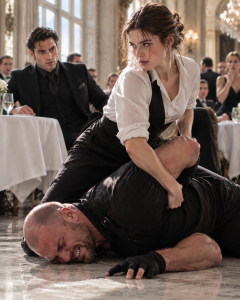
—
PART 1
The grease at Lombardi’s didn’t sit on your skin. It moved in — into the pores at the back of your neck, into the cheap polyester of the uniform, into the rubber treads of Sadi’s non-slip shoes until it became a permanent resident. It was a Tuesday. It was raining, the cold, spiteful kind that made the whole city smell like wet exhaust and rotting cardboard.
Sadi leaned against the stainless steel prep counter, pressing the heel of her hand to her temple, running the same exhausting ticker tape she ran every night. *Fifty tonight covers electricity. Still need eighty for groceries. Skip lunch tomorrow.* Rent was due in four days. Her feet throbbed with a rhythm that had stopped feeling like pain and started feeling like a second heartbeat.
“Sadi. Table four. Now.” Carl the floor manager snapped his fingers in front of her face, forehead slick with a nervous sweat that had nothing to do with the ovens.
“I’m on it, Carl.”
“Don’t just be *on* it.” He grabbed her elbow, voice dropping to a frantic whisper. “Do you know who’s at table four?”
She wiped down the tray. “Party of five. Three steaks, one branzino, sparkling water, no ice.”
“It’s Dominic Russo.”
Carl breathed the name like a bomb about to go off. Sadi wasn’t an idiot — you didn’t live in this city without knowing who Dominic Russo was. Not the flashy kind of mobster who made headlines. The kind who owned the concrete the clubs were built on.
“Okay,” she said, flat. Terror burned calories she didn’t have to spare. “Does he want his steak medium rare or not?”
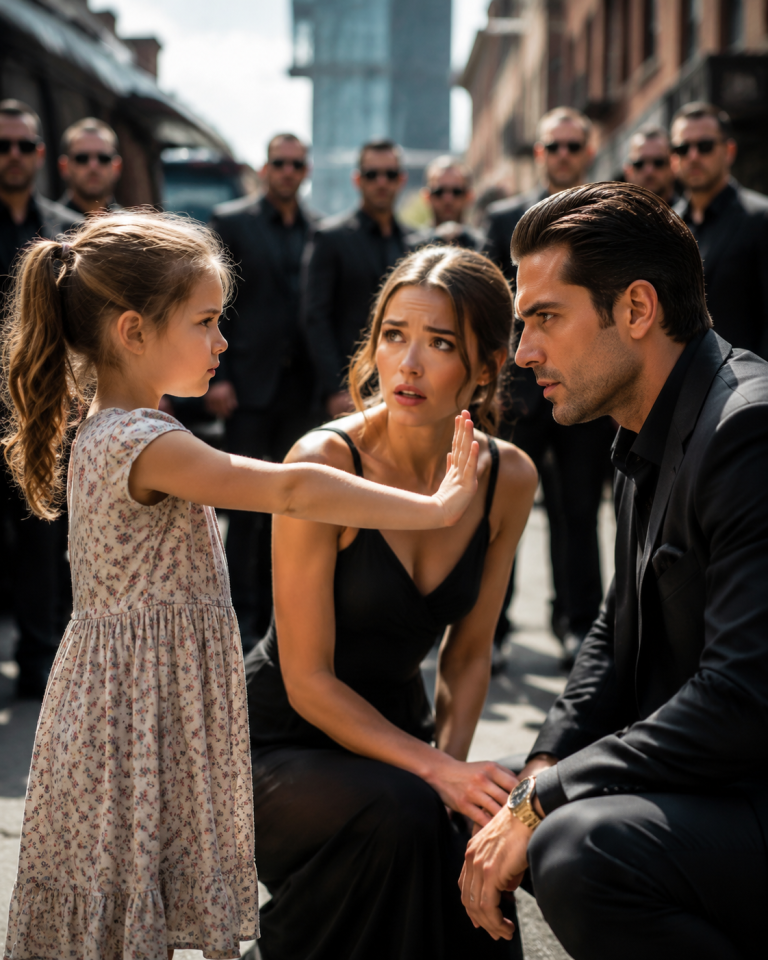
She pushed through the double doors into a dining room gone quiet in the wrong way — patrons leaning in, whispering, eyes cutting toward the back corner booth. Four men sat there. Three built like cinder blocks in straining wool suits. Then Dominic Russo, tie loosened, collar undone, tracing the rim of a water glass with a thick, calloused finger. He didn’t look like a monster. He looked exhausted.
Sadi served the plates, careful, mechanical. As she leaned in to set down his ribeye, the cast-iron skillet of garlic potatoes slid on her tray. Pure adrenaline: she jerked her bare hand up and caught the sizzling edge before it could tip. The burn was instant, blistering, a hiss escaping through her clenched teeth as she shoved the skillet back into place.
Dominic looked up. Flat, muddy brown eyes — no warmth, but no cruelty either. Just a heavy, suffocating emptiness. He looked at her reddening hand, then at her face.
“Ice,” he said. “For the water. For your hand.”
She didn’t know what to do with that. She nodded once and retreated.
Two hours left in her shift. She had no idea it hadn’t even started yet.
The lull hit around 9:45 — the kitchen quiet, the dishwasher humming, Sadi wiping down the wait station with her burned hand wrapped in a napkin and a rubber band. Outside, the rain had turned into a downpour, streetlights bleeding long yellow-red streaks across the wet pavement.
The heavy oak doors of Lombardi’s didn’t open. They were shoved inward hard enough to make the brass hinges scream.
A man stepped into the foyer. Too big — that was the first coherent thought in Sadi’s exhausted brain. Human beings weren’t supposed to be shaped like that. At least seven feet tall, shoulders so wide he had to turn sideways to clear the doorframe, a soaked dark green trench coat dripping onto the hardwood. No weapon drawn. No words. Just a slab of a scarred, weathered face under the brim of a sodden wool cap.
At table four, Dominic’s lead bodyguard froze mid-bite, fork clattering against porcelain. He reached for his jacket. Too slow.
The giant’s draw was jerky, brutal — a matte black pistol, a thick suppressor. It didn’t sound like gunfire in a movie. It sounded like an industrial staple gun misfiring. The bodyguard’s head snapped back. A fine red mist sprayed across the tablecloth. He slumped face-first into his plate.
Two seconds of total silence — the brain refusing to process what the eyes had seen. Then a woman screamed, high and endless, and the remaining bodyguards surged up, chairs kicking back. Two more suppressed shots. One guard went down clutching his collarbone. The other fired wild, missing the giant entirely, shattering the bar mirror into a rain of glass.
Sadi stood frozen at the wait station, ten feet away, feet set in concrete, heart hammering so fast it felt like one continuous vibration in her chest.
The giant dropped his empty pistol and pulled a rusted, three-foot steel pipe from inside his coat. He locked eyes with Dominic Russo, who hadn’t ducked, hadn’t run — just pressed himself into the corner of the booth, a compact silver revolver already drawn. He fired. The bullet caught the giant’s shoulder in a puff of fabric and blood.
He didn’t flinch. He let out a low, wet growl and charged — a freight train of meat and wet wool, closing the distance to table four with terrifying, mathematical certainty. Nothing was going to stop him.
Next to Sadi sat a towering stainless steel coffee urn, freshly filled with three gallons of boiling water for a chamomile order in the back room. The giant thundered past her, an arm’s length away.
Sadi didn’t make a heroic choice. She didn’t think at all. Pure animal panic took the wheel — she needed a barrier, needed something between herself and the thing rushing past her. She grabbed the urn’s plastic handles with her burned hand, screaming in protest. His shoulder clipped her arm as he passed, spinning her off balance. Her shoe slid on a patch of grease she’d meant to mop up. She was falling — and the urn was tipping toward her own face.
Survival, harsh and absolute, made the choice for her. She shoved it away from herself as she went down, hurling it directly into the giant’s path.
The lid popped. Three gallons of scalding water erupted in a steaming arc, catching him at the waist, soaking his thighs and boots — and the empty steel cylinder, still carrying momentum, slammed into the side of his kneecap with a wet, hollow crack louder than the screaming in the room.
He roared in pure agony. His leg buckled, but his speed carried him forward anyway, his boot planting on the water-slicked floor with no traction left to give. The seven-foot, three-hundred-pound assassin went horizontal in the air — and came down face-first into the marble corner of the hostess stand.
The sound wasn’t a thump. It was a crunch of bone against stone.
He hit the floor and slid into the base of the bar, taking down a row of stools, and didn’t move again. The steel pipe rolled to a stop against the toe of Sadi’s shoe.
She sat on the floor, ragged breath tearing out of her, burned hand shaking uncontrollably, a puddle of dark blood spreading from beneath the giant’s head and mixing with the spilled water. It smelled like copper and chamomile.
*I killed him,* her brain whispered. *I tripped him and I killed him.*
She crawled behind the wait station and threw up into a trash can.
Footsteps crunched on broken glass, slow and deliberate, and stopped right in front of her. She raised her head, bracing for a gun at her temple.
It was Dominic. His tie was gone entirely now, someone else’s blood speckled across his collar, his revolver hanging loose in his hand. He looked down at her — not at the dead giant, not at his bleeding man — just at her, trembling, clutching a trash can like a life preserver.
“What,” he said, quiet and gravel-rough, “is your name?”
“Sadi,” she choked out.
He nodded slowly, reached into his jacket, and dropped a thick folded stack of hundred-dollar bills into her lap without counting them.
“Go home, Sadi.” He turned away, already gesturing to his men. “Wipe the cameras. Call the cleaners. We leave in two minutes.”
Sadi sat on the sticky floor, staring at more cash than she’d made in two years, and understood with a cold, sinking dread that she hadn’t just saved Dominic Russo’s life.
She’d just made him owe her one. And in his world, debts were never paid gently.
—
PART 2
The crash came forty-two minutes later, on the sagging mattress of her fourth-floor walk-up. Adrenaline leaving the body feels like a sudden, violent flu — teeth chattering, knees knocking, the neon of the liquor store across the street bleeding pink and blue through cheap plastic blinds. Sadi peeled off her ruined uniform, tied it into a garbage bag like she could suffocate the memory inside it, and stared at the stack of hundreds on her nightstand. It didn’t smell like salvation. It smelled dirty — old leather, sweat, a chemical tang that turned her stomach.
$5,200. Rent was $800. She could pay off her card, fix the radiator, sleep for a week. Instead she shoved it into a sneaker at the bottom of her closet, behind a pile of winter sweaters, and lay awake all night waiting for the door to splinter inward, certain that loose ends in Dominic Russo’s world weren’t paid off — they were cut.
The morning news said nothing. No shootout. No seven-foot giant with a caved-in skull. The silence was heavier than the violence had been — it meant Russo owned the people who wrote the news, too.
Three days of white-knuckled quiet, and then, in the burn-cream aisle of a corner pharmacy, a man in a tailored navy peacoat appeared at the end of the row like he’d materialized out of the fluorescent hum. Young, sharp cheekbones, predator eyes.
“Sadi,” he said. Not a question. “Mr. Russo sent me. My name is Leo.”
“I don’t know anything,” she blurted, panic cracking her voice. “I went home. Straight home.”
“We know exactly where you went.” Leo’s expression didn’t change. He produced a small white jar. “Silver sulfadiazine. Prescription grade. Apply it twice a day.” When she didn’t take it, his voice dropped a razor’s edge under the smoothness. “Mr. Russo insists.”
She took it, trembling. “Why?”
“Mr. Russo protects his investments. You performed a service. You were compensated. A burn left untreated festers. Complications draw attention. Attention is bad for business.” He turned to leave, then paused. “And Sadi — don’t put the money in a shoe. It’s cliché. A safety deposit box at First National is far more secure. Have a good morning.”
They’d been in her apartment. They’d watched her sleep. She wasn’t a loose end to be cut — she was a pet on a very short leash.
Three days later, forced by an eviction notice into breaking a hundred-dollar bill at a check-cashing place, she came home to find a black Lincoln idling illegally outside her building, a parking enforcement officer crossing the street to avoid it entirely. Leo stepped out, said nothing, and gestured to the open door. Running was just an invitation for a hunt. She got in.
Twenty minutes later, in the back room of a bespoke tailor shop that smelled of hot steam and chalk dust, she found Dominic in his shirtsleeves, getting fitted for a waistcoat, the exhaustion of that night replaced by a low, coiled danger.
“You spent the money,” he said, dismissing the tailor with a wave.
“I bought groceries. I was hungry.”
“I didn’t ask for a justification. I stated a fact. You accepted the transaction.” He poured himself two fingers of amber liquid, didn’t offer her any. “Your men broke into my apartment,” she said, a spark of defiance flaring despite the fear. “My men *secured* your apartment,” he corrected, “to make sure the people who hired that giant didn’t decide to tie up loose ends. You are alive because I willed it.”
“I’m alive because I threw a coffee urn.”
The corner of his mouth twitched — not quite a smile, but a crack in the stone. “You broke his patella. You shattered his orbital bone on a hostess stand. It was violent. It was messy. And it was entirely improvised.” He stepped closer, close enough that she had to tilt her head to meet his eyes. “I owe you my life, Sadi. Russos do not live with unsettled debts.”
“I don’t want anything. I just want my job back.”
“Your job is gone.” His hand caught her elbow, firm, warm, absolute. “The girl who worked at Lombardi’s died the moment that man walked through the door. You are a civilian who killed an enforcer for the Vitiello syndicate. If they find out who you are, they will skin you alive to send a message. You belong to me now. Not as a prisoner. As an employee. I keep you hidden. I keep you fed. I keep you breathing.”
“What kind of work?” she asked, hollow.
Dominic turned back to his glass.
“You proved you can think under pressure. You’re going to clean up my messes.”
—
PART 3
The cleanup didn’t mean bodies. It meant paper — endless, suffocating paper.
Sadi’s new office was a windowless room beneath a commercial laundromat, the air thick with hot lint and industrial detergent, a single fluorescent bulb overhead vibrating in time with the washing machines pounding away upstairs. Dominic hadn’t handed her a gun. He’d handed her three cardboard boxes of burner phones, a commercial shredder, and a stack of ledgers bound in cheap faux leather.
“The men who work for me know how to pull a trigger,” he’d told her, standing in the doorway on her first day, already turning to leave. “They don’t know how to balance a column without leaving a digital footprint. You passed high school calculus. You understand poverty. You know how to make numbers disappear.”
So she became a ghost in the machine. For three weeks she sat under the vibrating light, her burned hand healing into a tight, shiny pink scar across the knuckles, snapping SIM cards in half with needle-nose pliers and dropping the shards into a coffee can half-filled with bleach. She cross-referenced cash drops against payroll from Dominic’s construction fronts, found the skimming, and wrote it in small, careful handwriting on yellow legal paper that she folded twice and handed to Leo every night at eleven.
She never learned what happened to the men who skimmed. She only noticed that the handwriting on the following week’s dock reports had changed.
It was tedious, exhausting work. Her fingers were permanently stained with cheap printer ink, the skin around her nails chewed raw with a low, constant hum of anxiety that never quite switched off. But the rent got paid. The refrigerator stayed full. Nobody knocked on her door at night.
On a rainy Thursday, the heavy steel door groaned open, and Sadi assumed it was Leo with the lukewarm afternoon coffee he always brought — black, two sugars, exactly wrong. The footsteps were too heavy.
Dominic stood in the doorway in a dark wool overcoat dusted with rain, looking terrible — bloodshot eyes, his usually rigid posture slumping by a fraction of an inch, smelling of wet asphalt, cigarette smoke, and dried blood that wasn’t his own. He didn’t look at her. He pulled a rusted folding chair into the corner, sat down heavily, tipped his head back against the concrete, and closed his eyes.
“Keep working,” he grated out, not opening them. “Turn on the shredder.”
She flipped the switch. The machine roared to grinding life, and his shoulders dropped a fraction, the tension easing out of his jaw. He wasn’t here to check on her. He was here to hide — the man who owned the streets, who decided who lived and died in the corner booths of restaurants, and had nowhere else in the entire city to sit quietly and simply breathe.
She fed old invoices into the shredder for forty minutes straight, giving him nothing but noise, and when he finally stood, the vulnerability folded itself back into the mask. On his way out he set a small velvet box on top of her ledger.
“Your hand,” he said. “The scar catches the light. People look at it.”
Inside: a pair of thin, buttery-soft black leather gloves, custom-made, fitted like a second skin. She slid one on. It felt warm. It felt like a brand.
—
The illusion of safety shattered on a Tuesday.
Leo had driven her to one of Dominic’s older fronts, a meatpacking facility on the edge of the river, to audit three months of backlogged inventory manifests from an office suspended above the cutting floor behind thick soundproof glass. It was 9:15 p.m., the night shift just clocking in, when the lights on the floor below abruptly died.
*Poof. Twack.* The exact sound from Lombardi’s. A suppressed weapon.
Emergency lights flickered on, jaundiced and yellow, revealing three men in tactical gear moving through the swinging sides of beef with military precision. Not Dominic’s men. Two night-shift butchers already down near the loading dock, dark pools spreading across white tile.
The Vitiello syndicate had found the front.
Sadi dropped below the sightline of the glass, crawled under the desk, curled into a ball, gloved hands clamped over her mouth. Boots pounded up the metal stairs. The office door took three kicks before the frame cracked and gave. *Clear the files. Pour the accelerant. We burn it.* Gasoline splashed near the door.
She pressed herself into the shadows, ribs aching from the violence of her own heartbeat. If she stayed, she burned. If she moved, she took a bullet.
Then a deafening, unsuppressed roar tore through the cutting floor below — *boom, boom, boom* — and the man in the office jerked toward the shattered window a half second before a bullet ripped through his chest and dropped him against the filing cabinet, his rifle clattering inches from Sadi’s hiding spot.
Gunfire below turned into a chaotic war of cracking rifles and booming handguns. Ten minutes, or ten hours — time had stopped meaning anything — and then it slowed, and stopped, and the silence that followed was worse than the noise.
Slow, deliberate footsteps crunched glass, stopping in front of the desk.
“Sadi.” Rough. Out of breath. Coated in gravel.
She lowered her hands and crept out. Dominic stood there in a tactical vest over a black sweater, his face smeared with grease and something dark, a smoking pistol in his hand, chest heaving for the first time since she’d met him. He didn’t look at the dead man on the floor. He looked at her — curled, trembling, gloves still on her hands — and dropped his gun. It hit the carpet with a dull thud.
He knelt in the broken glass, hauled her out from under the desk with a grip that was almost violent, and pulled her against his chest. The vest was hard and smelled of gunpowder, but underneath it his heart was slamming.
“Are you hit?” His voice cracked against her ear. His hands moved fast over her arms, her back, checking. “Tell me if you’re hit.”
“No. I’m okay. I hid.”
He let out a long, ragged breath and didn’t let go. It wasn’t romantic. It was the crushing grip of a man clinging to the one thing in his world that wasn’t trying to kill him.
“They tracked Leo’s car,” he muttered, mostly to himself, then pulled back to look her in the eye. “I’m getting you out of here. Walk behind me. Eyes on my back. Don’t look at the floor.”
She tried. The smell of raw meat and spent casings followed her the whole way out, seven bodies in her peripheral vision that she refused to let become memory. She kept her eyes on the black expanse of his sweater and understood, in the cold, hollow math of survival, that she didn’t care anymore which kind of monster he was, as long as he kept walking.
—
The penthouse was sterile and silent, forty stories above the city, more observation deck than home. It was 3 a.m. Dominic sat in a low armchair across from her, his tactical vest discarded on the marble floor, his sweater pulled up over a torso mapped in old pale scars — a physical ledger of a life spent climbing toward the top of a world that ate people alive. A fresh wound tracked below his ribs, a bullet graze that hadn’t gone deep but had torn an ugly furrow, bleeding sluggishly into his waistband.
Leo was dead. Shot twice in the back of the head in the alley behind the plant.
“The Vitiellos have ears in the underground clinics,” Dominic had said, throwing a first aid kit onto the coffee table. “You clean it. You stitch it.”
“I pour coffee, Dominic. I do math. I don’t sew skin.”
“You’ll learn.”
Now her gloves sat abandoned on the table, her bare hands slick with rubbing alcohol, and she pressed an iodine-soaked pad into the wound. His whole body went rigid, muscles cording like steel cable, but he didn’t make a sound, didn’t open his eyes.
“I’m sorry,” she muttered, hands shaking.
“Don’t apologize for necessary pain. Just finish it.”
She threaded the curved needle, pinched the torn edges together, and pushed through. His breath hissed sharply through his teeth, his knuckles white on the edge of the coffee table.
“Why did you come for me?” she asked quietly, pulling the thread tight. “At the plant. I’m your employee. You could hire a dozen accountants tomorrow who wouldn’t flinch at gunfire.”
Dominic was silent long enough that the only sound left in the room was the distant hum of traffic forty floors down.
“You didn’t look at me,” he said finally. “At the restaurant. When the skillet burned your hand, you didn’t look at me with terror. You didn’t look at me with greed. You looked at me like a man who was in the way of your job.” He shifted, wincing against the fresh stitches. “Everyone in this city wants to kill me, or wants me to kill someone for them. Every single person. Except you. You just wanted to go home.”
His hand, bloodstained, closed gently around her wrist. Not pulling her closer — just holding.
“You owe me a debt,” he murmured. “That’s what I told you. That’s how my world works. Debts and payments.”
“And when is the debt paid?”
His thumb brushed the pink scar tissue on her knuckles, impossibly gentle, a stark contrast to the violence she’d watched him deal out hours earlier.
“Never,” he said. “It was never a debt, Sadi. It was the only way I knew how to keep you in the room.” His eyes were stripped of every trace of posturing, every ounce of the man who ran the concrete under this city. “If I let you go, I’m entirely in the dark.”
She looked at the blood on her own hands, at the cold marble cage he’d built for both of them, and understood she could still run — take the money, walk to the bus station, disappear into some other city’s grease and double shifts. But she looked at the exhaustion carved into his face, felt the quiet weight of his hand over hers, and knew it was already too late to want to.
“Hold still,” she said, and finished sewing the monster who owned the city back together.
—
The war with the Vitiellos did not stay contained to a meatpacking plant.
It took eleven days for Carmine Vitiello — the syndicate’s aging, paranoid head, humiliated twice now by a woman he didn’t even know existed — to make his final, desperate move. Word came from one of Dominic’s own capos, a man named Frank who ran the docks: Carmine had put a price on Sadi’s head personally, twice what he’d have paid for Dominic’s, on the theory that killing the girl would break something in Russo that bullets never could.
Dominic didn’t tell her that part. She found out from the ledgers herself, cross-referencing a coded bounty sheet that had been smuggled into her stack of dock reports by mistake, her own name sitting in the columns between shipping manifests and payroll numbers like she was just another line item to be balanced.
She brought it to him in the penthouse at midnight, the paper shaking slightly in her gloved hand.
“You knew about this.”
“I found out this morning.”
“And you weren’t going to tell me?”
“I was handling it.”
“I am not a ledger you get to handle,” Sadi said, and something in her voice made him actually stop moving. “I stitched you back together with a sewing needle. I’ve watched seven men die on a factory floor because of a business you run. If there’s a price on my head, I get to know the number.”
Dominic looked at her for a long moment — the same cataloguing look he’d given her that first night at Lombardi’s, except this time there was nothing predatory in it. Just something closer to respect, and underneath that, something that looked almost like fear of losing her, which was a stranger and more dangerous thing on his face than any gun had ever been.
“Two hundred thousand,” he said finally. “For your death specifically. Confirmed, not just rumored.”
“Then let’s make sure it doesn’t happen,” she said. “You’ve been protecting me the whole war. Let me help you end it.”
What she proposed, over the following three days, was not violence. It was exactly the kind of work she’d spent a month becoming disturbingly good at. She’d learned Tommy Rossi’s kind of ledgers didn’t just belong to dead bagmen — every organization kept them, sloppy men writing down things they thought made them safer and instead made them targets. Working from the coded bounty sheet and three weeks of cross-referenced dock manifests, Sadi built a paper trail connecting Carmine Vitiello directly to a federal money-laundering operation running through the same construction fronts Dominic had once used to launder his own money — a operation Carmine had been quietly skimming from a corrupt union pension fund that neither the Vitiellos nor the feds knew the other was watching.
“You want to hand this to the FBI,” Dominic said, staring at the folder she slid across his desk, disbelief flat in his voice.
“I want to hand it to the *right people* at the FBI,” Sadi corrected. “Anonymously. Enough to bury Carmine under an indictment so heavy his own capos abandon him before the case even goes to trial. You don’t have to fire a single shot. You don’t have to lose a single man. You let the government do what it already wants to do, and Carmine simply — stops being a problem.”
“And what happens to me when they start pulling that thread?”
“Nothing,” she said. “Because you’re not in the ledger. I made sure of that three weeks ago, back when I was just doing my job.”
Dominic looked at her for a long time, something unreadable moving behind the flat brown of his eyes, and then, for the first time since she’d met him, he laughed — short, disbelieving, entirely genuine.
“You’ve been running a second set of books this whole time. Protecting me without telling me.”
“I told you,” Sadi said. “I do math.”
—
It took six weeks for the indictment to land, delivered through channels so carefully anonymous that no one — not the Vitiellos, not Dominic’s own capos, not even Leo’s replacement — ever traced it back to a windowless basement office under a laundromat. Carmine Vitiello was arrested at his daughter’s engagement dinner, in front of forty guests and three local news cameras, on charges that would keep federal prosecutors occupied with his empire for the better part of a decade. Within a month, his organization fractured into three squabbling factions too busy fighting each other to remember there had ever been a bounty on a waitress’s head.
Dominic Russo did not attend the arrest, did not celebrate it publicly, did not so much as mention Carmine’s name again once the story stopped appearing in the papers. He simply, quietly, absorbed the territory the collapse left behind, the way water finds the lowest point in a room.
The basement office stayed. So did the shredder, the burner phones, the endless columns of numbers that needed balancing. But Sadi wasn’t hidden there anymore out of necessity. Dominic had moved her ledgers — and, without much ceremony, her — into a proper office on the top floor of one of his legitimate construction firms, a room with actual windows and a door with her name on it, stenciled in gold: *S. Marchetti, Financial Oversight.*
She kept the gloves. Not because the scar still needed hiding — it had faded, months later, to a thin, barely visible line across her knuckles — but because Dominic had given them to her on the worst night of her life, and some things you keep not because you need them, but because of what they mean that you don’t need them anymore.
On a quiet evening in late autumn, Dominic found her at her new desk long after the building had emptied, the city glittering gold and orange through actual glass instead of the frosted skylights of a tailor shop’s back room. He set a cup of coffee down beside her ledger — black, two sugars, still, somehow, always slightly wrong, and she’d stopped trying to correct it months ago because it had become its own kind of ritual.
“The debt,” he said, leaning against the doorframe, “was never real. You know that.”
“You’ve told me. Several times.” Sadi didn’t look up from the column she was checking. “I believed you the first time.”
“Then why are you still here?”
She set down her pen and finally looked at him — really looked, the way she had that very first night when a boiling coffee urn had rewritten both their lives in three seconds flat. Not with fear. Not with greed. Just with the plain, unhurried honesty of someone who had chosen, deliberately, to stay in a room she was always free to leave.
“Because I’m good at this,” she said. “Because you needed someone who wasn’t trying to kill you or use you, and it turns out I needed something too — somewhere the math actually adds up to something, for once. That’s not a debt, Dominic. That’s just a life. Mine, this time.”
Dominic Russo, who had built an empire on the certainty that nothing in this city was ever given freely, crossed the small office, picked up the coffee cup he’d brought her, and set it gently back down within her reach — an offering, not a payment.
Outside the window, the city kept turning, indifferent and glittering, entirely unaware of the quiet, unbreakable ledger being balanced forty stories above its streets — not in blood, and not in debt, but in the simple, deliberate choice of two people who had decided, finally, to stay.
THE END