The Whole Town Laughed When He Paid Two Dollars for the Ruined Bride—Until She Looked at Him and Asked About the Graves Behind His House.

## PART 1
The first thing Mira Holloway heard when the hood came down over her face was silence.
Not the silence of mercy. The silence of a crowd deciding what to feel before it committed to cruelty.
Then someone laughed, and the rest followed, and that was the end of the waiting.
“Stand her up,” called the man on the barrel — Mayor Garrett Finch, whose voice she recognized from three years of watching it promise one thing and deliver another. “Folks in the back want to see the merchandise.”
A hand jerked her elbow. Her right foot, still wrong from the accident that had never quite healed, rolled sideways and she nearly went down, and the crowd took that as a gift.
She heard someone say *busted wheel on a busted axle* and the laugh that followed was the particular kind that came from men who had already decided they were looking at something less than a person.
Mira straightened.
The hood smelled of old grain and mildew, and it pressed against the scar on the left side of her face, and she stood in the Dunmore County Livery in the spring of 1884 while every man with a dollar and an opinion waited to see what she’d go for.
Three years.
That was how long she had been in this town since the fire. How long she had been the ruined girl, the ugly girl, the girl people brought their boots to because she could fix soles and they didn’t have to look at her hands while she worked. The hands were fine, actually. She had always thought it was almost funny that people found a way to avoid her face even when the rest of her was useful.
Her mother had called her *my solid girl* when Mira was young and round-armed and given to sitting in doorways reading things she’d borrowed from people who’d forgotten she’d borrowed them. That was before. After was something else.
*Before* had a fire in it, and men who came with kerosene in the dark, and her father’s ledger, and the reason she was standing on these feed crates while the county called it charitable.
Mayor Finch banged a block of wood against the barrel top.
“Now, gentlemen, Christian compassion asks us to help one of our own find a situation. Miss Mira Holloway may have certain—” a pause filled with delicate ugliness “—certain limitations of appearance and of gait, but she is strong and she can cook and the county poorhouse would be grateful to have one less responsibility.”
“Show her face!” yelled someone near the back.
“We don’t want a mystery, we want to know what we’re getting!”
Mira’s hands found the hem of her dress, found the old mended seam she had stitched six times because the thread always wore first. She found it and held it.
She had promised herself she would not cry on the crates. She had spent enough on crying. She had cried when they pulled her from the ash of her father’s dry goods store with her face half ruined and her brother not coming out behind her. She had cried when they took the debts and the property and left her the poorhouse and a reputation for trouble she’d never made. She had cried until the crying ran out, and then she had gone dry and quiet and learned to live in the space between what people said and what was actually true.
She knew what was true.
Her father had not been careless with the lamp.
She knew who had given the order and why, and she had three years of silence to show for that knowledge, and the thing pressed against her chest beneath her dress to show for those three years.
*Safe* was a word for people who had not yet learned what happened to people who knew.
“Opening bid,” Finch said. “Two dollars. She sews some. Cleans floors well enough. Strong arms on her.”
Nothing.
A horse shifted in the back stall.
“Two dollars,” Finch said again. “Come on, now. It’s not like you’re buying a horse.”
“I’ll take a dollar if you throw in a better sack,” said Harlan Pryce, who owned the tannery, and the laugh that followed was the one that came from men who were settling in, who had decided this was entertainment and not a question of conscience.
Then the doors opened.
Wind came first. Then rain, blown sideways. Then a man.
He stood in the frame of the livery doors wearing a coat made from something large and dark, and the way the light hit him from behind made him look like a problem come looking for a place to happen. He was broad. He moved like a man who had learned to take up space on purpose because being underestimated once had cost him something he didn’t intend to pay again.
The crowd went quiet the way crowds did when something unpredictable entered the equation.
Someone near Mira whispered the name: *Eli Crane.*
She had heard of him. Everyone in Dunmore County had heard of Eli Crane. He lived north of the ridge in a place nobody went voluntarily. He came down twice a year for salt and coffee and ammunition and didn’t stay longer than the trading required. People said he was dangerous and said it again more quietly when someone pointed out he’d never done anything to anyone except two men in Wyoming who had apparently needed doing.
The man who owned half of Dunmore County and the bank that owned the other half sat near the front on a good chair someone had carried in for him. Denton Ware. Silver-haired, well-dressed, with the settled ease of a man who had not had to want for anything in long enough that he’d forgotten wanting was possible for other people.
Ware looked at Crane the way a man looked at something he thought he’d arranged for and found had rearranged itself.
“Crane,” said Mayor Finch, recovering. “Didn’t expect you till summer.”
“Roads opened early,” Crane said.
His voice was low and dry, the kind that didn’t need volume because it expected to be heard.
His eyes found Mira on the crates. She couldn’t see his face clearly through the hood but she felt the quality of his attention, which was different from what she’d been getting. Men at the auction looked at her to decide what she was worth. This man looked at her the way you looked at a door when you were trying to decide whether it was locked.
“How much?” he said.
Finch blinked. “Pardon?”
“The woman. How much.”
Ware leaned back in his chair with a smile that cost him nothing. “Come to buy a bride, Crane? Or did you just wander in out of the rain?”
Crane didn’t look at him. He reached into his coat and set something on the barrel near Finch. The sound was not coins. It was a leather pouch, and the weight of it was different.
Finch opened it. Gold dust caught the lantern light.
“Twenty dollars,” Crane said.
The silence that followed had a different quality than the earlier ones. Earlier had been contempt. This was arithmetic.
Ware’s smile thinned by a degree.
“You don’t even want to look first?” he said.
“No.”
“She’s not much to look at, I’m told.”
“Neither are most things worth having,” Crane said.
There was no laughter this time.
—
Mayor Finch announced that the bride must consent by stepping down.
Mira thought about the word *consent* for a moment, which was almost enough to produce a sound she’d have regretted.
She could stay. She knew what staying meant. The poorhouse with its winter soup and its matron who put her near the stove because she said burned things belonged near heat. The work that nobody admitted needing. The three years of being useful in the way furniture was useful: necessary and not seen.
She thought about Denton Ware and what she knew about him and what she had been carrying for three years.
She stepped down from the crates.
Her bad foot caught the edge and she stumbled, and a large hand caught her arm before she went into the straw. Firm. Not painful. It held her upright and then, when she found her footing, it did not hold on.
“Don’t remove the hood,” Crane said to Finch, who had been reaching toward the knot at her neck.
Finch pulled his hand back. “Customary for the husband to—”
“Customary for mayors to stay out of my way.”
Ware’s voice came from his chair, still pleasant, still carrying nothing that could be called a threat. “You’re making an error, Crane.”
Crane looked at him then, the first time he’d looked directly at the man. Something passed between them that Mira couldn’t see and didn’t need to.
“Tell me about it when I make one,” Crane said.
He brought her out of the livery.
—
The horse he’d ridden down was a big gray animal that accepted the two of them without comment. Crane helped her up and swung up behind her, and when his arm came around her waist she held herself away from it out of habit.
“I won’t harm you,” he said near her ear.
She didn’t answer. Not because she believed him or disbelieved him but because she hadn’t decided yet, and she had learned that a decided wrong answer was more dangerous than an uncertain silence.
They rode north.
Rain became sleet as they climbed. The trail went through spruce and black rock and the temperature dropped with the elevation. Mira’s coat, which had been thin in town, was something close to nothing up here. She tried not to shiver in a visible way.
Crane stopped the horse.
She braced.
He reached behind the saddle, pulled out a blanket, wrapped it around her shoulders, and tucked it closed under her chin. His hands didn’t linger.
She hated how nearly that one gesture undid her, because she hadn’t expected it.
“Why?” she said.
“Why what?”
“The twenty dollars.”
The horse walked on. Sleet ticked against pine needles.
“Because Ware had arranged the auction,” he said.
She went still.
“What?”
“He wanted you out of town and married off and past the reach of county records. Once you were somebody’s problem on paper, he could send men up after you without anyone asking questions about the poorhouse girl.” Crane paused. “I bid because his man would have otherwise.”
The world rearranged itself slightly around this information.
“So I wasn’t bought,” she said.
“You were hunted. I changed the direction.”
The honesty of that hit differently than pity would have.
By the time the cabin appeared on a shelf of land beneath a cliff face, the sleet had become snow and Mira was shaking through the blanket and through her coat and probably through her bones. The cabin was larger than she’d expected — thick logs, stone chimney, smoke already coming from it, which meant he had banked a fire before leaving that morning.
She tried to get down on her own and made it halfway before her bad foot betrayed her.
Crane caught her.
She waited for the comment about weight. The comment about trouble. Men had always found a way to make her feel the inconvenience of existing in a body that required assistance.
He said: “Stop apologizing. You’re a person, not a problem to solve.”
She didn’t know what to do with that, so she didn’t do anything.
He carried her inside.
—
The fire. The warmth that hit first like a physical argument. Shelves with jars and books — more books than she’d seen anywhere except the schoolhouse back when there had been a schoolhouse worth attending. A rifle above the door. A narrow bed along one wall. A mirror on a shelf, face-down.
He set her in the chair nearest the fire and stepped back.
The question sat between them: the hood.
Mira’s hands went to the knot at her neck. She untied it slowly.
The burlap fell.
The firelight found her.
She had stopped being surprised by her own face a long time ago, but she was always surprised by the first moment other people saw it. The right side was the face she’d been born with. The left was the fire’s version of her: skin drawn tight, scar tissue from temple to jaw, her eye sitting slightly different than it should, her mouth curved a little wrong where the burn had healed. Not hideous. Not the monster people built in their descriptions. Just not what anyone called pretty, and in this territory *not pretty* was enough to be dismissed.
She waited for Crane to flinch.
He looked at her.
Not the way the town looked. Not searching for ugliness or cataloging damage. He looked at her the way you looked at something that had been through weather and you were trying to understand what kind.
“Kerosene,” he said.
Mira’s breath stopped.
“What?”
“The burn pattern. I’ve seen it before. Flames fed fast, spread faster. That’s not a lamp accident.”
She stood up too quickly, pain lancing through her ankle, and for a moment the room tilted.
“Who are you?” she said.
He didn’t answer immediately.
He reached under his shirt and pulled out something on a chain. A badge. Tarnished, dented, with a bullet mark along one edge, but legible.
*Deputy U.S. Marshal.*
Mira’s blood went to ice.
“The law belongs to Ware,” she said.
“In Dunmore County, yes.”
“Then what are you doing with its ghost?”
“Keeping it warm until I can use it.”
She backed until the chair pressed against her knees.
“How do you know August—” She stopped. “How do you know Denton Ware?”
“I’ve been looking for him for four years,” Crane said. “Railroad payroll robbery east of Billings. Guards killed, money gone into land purchases through men who’d never worked an honest day. I traced the money to Ware. I had a witness in Dunmore County who’d agreed to testify.”
The cabin seemed smaller.
“What was the witness’s name?” she whispered.
Crane looked at her.
“James Holloway.”
Her father.
“He agreed to testify,” Crane said, “and he had copies of Ware’s accounts. Names, payments, deed transfers, land bought through false debt before anyone knew the railroad route was coming. We were supposed to meet at his store the night it burned.” His jaw moved. “I was two hours late.”
Mira sat back down because her legs had made the decision before she did.
“I went looking for survivors,” Crane said. “I was told there were none.”
“My father got me out through the trapdoor before they came in,” she said. “I don’t know if he—” She stopped. “I heard a shot.”
“Yes,” he said. Quiet. Simple. Not trying to soften it.
“And Ware had you—”
“Accused of taking bribe money and abandoning the scene. Two witnesses produced. Badge pulled before I could respond. Since then, anyone who helped me had accidents.”
Mira pressed her hand flat against her chest. Beneath her dress, the thing she’d been keeping for three years pressed back.
“Mira,” Crane said carefully. “Did your father give you something before he got you out?”
The room was very quiet.
She could say no.
She had been saying no, in various ways, for three years.
But she was sitting in a cabin on a mountain with a man who had just told her the shape of the thing she already knew, and the lying had been very heavy, and she was tired of carrying it alone.
She reached inside her dress and drew out the oilskin packet.
She placed it on the table between them.
“This is why Ware kept me in the poorhouse instead of burying me,” she said. “He thought I had it. He wasn’t sure. He put me where he could watch me and made sure the town helped keep me small, and he waited for me to break or try to run.”
“And you didn’t.”
“I got quiet,” she said. “And I waited.”
Crane reached for the packet but stopped just short of touching it.
“May I?”
She nodded.
He opened it carefully. Inside: a small account book, smoke-stained, with her father’s careful figures on every page, and a pocket watch with a cracked crystal that had been her grandfather’s.
Crane read.
She watched his face.
“Names. Amounts. Dates. Payroll serial numbers.” He turned a page. “Payments to Finch. Payments to the sheriff. False mortgages used to take miners’ claims.” Another page. “Land purchases. Timing them against the railroad survey maps.” He stopped at the last page. “Your father added a note.”
He read it aloud: “*If I die, Denton Ware killed me. Tell Eli Crane. He was right.*”
The fire popped.
Outside, the snow had begun in earnest.
“He knew you?” Mira said.
“We met once. Before it went wrong. He believed what I was doing mattered.” Crane closed the book. “I’m sorry I didn’t get there in time.”
She looked at her hands.
“You paid twenty dollars for a woman you already knew had the evidence you needed,” she said.
“Yes.”
“You could have told Finch it was a legal matter—”
“Ware has Finch. If I’d gone through official channels in that town, you’d have been dead before I filed the paperwork.” He looked at her steadily. “I needed to get you out. The auction was the only door open.”
“And now?”
“Now I keep you alive long enough to use that ledger. There’s a federal circuit judge reaching Helena in six weeks.”
She almost laughed. “Ware won’t give us six days.”
“No,” Crane said. “He won’t.”
—
## PART 2
She woke the next morning to the sound of a rifle being cleaned.
For a moment she didn’t know where she was. Then the warmth of the cabin reminded her, and the smell of coffee, and the daylight coming through the shutters at the angle of actual morning, which was different from the poorhouse light that always came in gray.
Crane was at the table with the rifle in pieces. He didn’t look up.
“Plate on the hearth,” he said.
She ate. The food was simple and it was enough and he had made it without comment, which was more than she had expected.
“I know how to shoot,” she said.
He looked up then.
“My father taught me before the fire. He said a woman should be able to read figures and fire straight because men lied in both directions and you needed to correct for the error.”
Something moved in Crane’s expression. Not amusement exactly. Closer to recognition.
“Show me,” he said.
He set three bottles on a fence post behind the cabin.
She shot all three. The third one she caught at the neck because she was annoyed at herself for missing clean.
Crane said nothing for a moment.
Then: “Your father taught well.”
“He believed in not wasting time on things you already knew.”
That almost made him smile. She could see it at the corner of his mouth, which was where he kept the things he wasn’t saying.
Over the days that followed, they built a life shaped by the specific urgency of people who didn’t have the luxury of pretending they had time. He showed her the shutters, the escape routes, the places on the ridge where you could hear horses before you could see them. She showed him the ledger in detail — her father’s notation system, the way the numbers cross-referenced, the columns that tracked payments to specific people on specific dates.
In the evenings, they sat with the account book between them.
He talked to her like someone who needed information, which was the most useful thing anyone had offered her in years. She talked back.
By the third day she knew that he’d grown up in Tennessee, had fought at nineteen because the men on both sides of his family had fought and he hadn’t been able to see a way around it, and had come out of the war with the specific quality of quiet that settled over people who had done things they hadn’t chosen. By the fourth day he knew that she had wanted to run a dress shop, not for vanity but for the pleasure of making cloth do what she asked it to do, and that the fire had made her feel like her body was the thing that had survived wrong, and that she’d spent three years trying to make herself small enough not to be noticed.
“People who need you small,” he said one evening, “will always find a reason. Your body. Your face. Your voice. They move the target.”
She looked at him.
He seemed uncomfortable with what he’d said. He didn’t take it back.
On the sixth night, she found him watching the trail through a gap in the shutters.
“He’s coming,” she said.
“Yes.”
“When?”
“When he decides we’re comfortable.”
She thought about that. “How do we use that?”
Crane looked at her.
“We go to him first,” she said. “Not in Dunmore. In Helena. Before the circuit judge. If we take the ledger to the right person before Ware can move against us—”
“He has men between here and Helena.”
“He has men everywhere,” she said. “The question is which road he’s watching least.”
Crane was quiet.
“You’ve been alone on this mountain a long time,” she said. “Waiting for something you couldn’t prove yet.”
“Yes.”
“You’re not alone now.”
He looked at her for a moment in the specific way of a man who had gotten used to a particular kind of solitude and was adjusting to its absence.
“No,” he said. “I’m not.”
She didn’t say anything else. Neither did he.
But something shifted in the quality of the silence between them.
—
The attack came two nights later.
Not loud. That was the first wrong thing. Mira woke to the smell of smoke and the specific silence of a man who was not asleep but who wanted her to think he was.
Crane’s hand closed on her wrist in the dark.
“Not the fire,” he said near her ear, so quiet she almost couldn’t hear it. “Torches. Against the exterior wall. They want us to run out the front.”
Her chest turned cold.
“The tunnel,” he said.
“Wait,” she whispered. “The ledger.”
“I have it.”
He had thought of that before she woke up. Something about that was more steadying than she would have expected.
They moved through the dark cabin, low and fast. The gap beneath the back wall door showed orange light. They were running out of time.
The tunnel entrance was behind the cookstove, a narrow channel dug into the rock. She looked at it.
Crane looked at her looking at it.
“Twist left at the first turn,” he said. “There’s more room than it looks.”
She went in.
Her shoulders caught on the rock immediately and her bad foot dragged and the smoke was following them and the dark was complete. Old fear pressed in from all sides — the store, the trapdoor, the smoke, *don’t come out, Mira-bird, no matter what you hear.*
Crane’s hand found her ankle from behind.
“Move,” he said. “The mountain doesn’t get to finish this.”
She moved.
She came out into cold air and the cave above the cabin, and the night was red with the fire below. Crane came through behind her and put his hand briefly on her shoulder — checking, not claiming — and then they both looked down at the burning cabin.
Three men below. One torches. One with a long gun. The third on a horse at the edge of the firelight, wearing a pale coat.
Denton Ware.
He had come himself.
“Crane!” Ware called into the smoke. “Send the girl down with what she has, and I’ll let you walk away.”
Mira’s hand tightened on the revolver Crane had pressed into it before they left.
Crane had his rifle up, but the angle was wrong — Ware was behind his men, behind his horse, in the shadow.
“If you shoot him now,” she said, “it’s your word against nothing. He needs to be taken in broad daylight with witnesses.”
Crane was quiet for a moment.
“He planned this,” she said. “He wants you to make a bad move.”
“He wants a lot of things,” Crane said.
“Then let’s give him fewer of them.”
He looked at her.
“Can you ride?” he said.
“I never said I couldn’t ride,” she said. “I said I couldn’t get down easily.”
They came down the back of the ridge through wind and darkness while Ware’s men watched the front of the burning cabin. Crane knew the terrain the way you knew things you’d moved through hundreds of times without a lantern.
They reached the tethered horses.
One of the animals shifted and a man turned. Crane fired past him — Mira heard the specific sound of a bullet hitting a rifle, forcing it from the man’s hands. The man went sideways into the snow, more frightened than damaged.
Mira mounted on the second try, which was a personal best in the dark with smoke behind her and men shouting below.
They ran.
Crane called over the wind: “Where?”
Mira thought about Dunmore, where Ware owned the mayor and the sheriff and most of the people with authority. She thought about Helena, six hours away, where the circuit judge was expected.
She thought about one person in Dunmore who wasn’t owned. Who hated Ware for different reasons and had the kind of enemies whose endorsement was evidence.
“We don’t go to Helena yet,” she said. “We go to Dunmore first.”
He stared at her across the back of the running horse.
“He’s behind us—”
“He thinks we’re running,” she said. “He’s right about the direction. He’s wrong about why.”
—
## PART 3
They reached Dunmore County just before dawn, having circled wide enough to avoid the main road.
The person Mira was looking for lived on the edge of town in a house that had been arguing with its fence for years and winning. Margaret Sewell had been the schoolteacher until Ware closed the school because she’d been teaching accounting to the children of miners, and Margaret had never forgiven him for it with the specific unforgiving quality of a woman who considered literacy a moral issue.
She answered the door with a rifle and a lamp.
When she saw Mira’s face, uncovered in the lamplight, she stopped.
When she saw Crane behind her, she pointed the rifle at him instead of putting it down, which was pragmatic.
“This is Eli Crane,” Mira said.
“I know who he is,” Margaret said.
“He had my father’s back.”
A pause.
“Come in,” Margaret said. “Both of you. But I’m keeping the rifle on him until I decide.”
Inside, over coffee so strong it was practically a substance, they told her. Not everything. The sharp pieces.
Margaret read four pages of the ledger. Then she read four more.
She set it down.
“I knew your father was honest,” she said. “That was his problem. Honest men trust that truth speaks for itself.”
“It doesn’t,” Crane said.
“No.” Margaret folded her hands. “It requires a stage.”
Mira looked toward the window. Gray light was starting outside.
“The circuit judge reaches Helena in—”
“Not Helena,” Margaret said. “Not first.”
They both looked at her.
“The Northern Pacific land survey team has been in Dunmore County for six weeks,” she said. “Quietly. They received anonymous letters — from someone who died sending them — about discrepancies in the deed records for the railroad corridor. They’ve been auditing Ware’s land claims and finding exactly what you’d expect to find.”
Mira went very still.
“Who wrote the letters?” Crane said.
Margaret looked at Mira.
Mira thought about her father. About his ledger. About the way he had coded the numbers so that you needed to know what you were looking for before you could see what you had.
“He planned for this,” she said. It wasn’t a question.
“He wrote to the railroad office two weeks before the fire,” Margaret said. “He wrote to the federal land registry. He didn’t know if any of it would matter. He didn’t know what would happen to you.” She paused. “But he planted seeds.”
Mira covered her face with one hand.
She sat there for a moment with her father’s foresight pressing on her chest.
Then she took her hand down.
“Tell me about the survey team,” she said.
—
The church bell rang at nine o’clock.
Margaret rang it herself, which was how everyone in Dunmore knew it was either important or unusual, because Margaret Sewell did not ring bells without a reason.
The street filled with the specific efficiency of a small town responding to a summons. Men with buckets, women with shawls, children before they could be stopped.
On the church steps, Mira Holloway stood without the hood.
The crowd’s sound was the same it had been in the livery, but its direction was different. Now they were facing her instead of looking up at her, and the quality of attention shifted accordingly.
Mira let them look.
She had practiced things to say while they rode through the dark. She had practiced composure and authority and the careful presentation of evidence. She had prepared herself for exactly this moment.
When the moment came, what came out was simply true.
“Three years ago, my father’s store burned. My father and my brother died in it.” Her voice was level. “I have his account book. It documents five years of theft, fraud, bribery, and murder under the direction of one man.” She raised the ledger. “My father’s name was James Holloway. He kept honest figures. This is what honest figures showed.”
The crowd was quiet in the specific way of people who had known something and had been waiting to be permitted to know it.
Mayor Finch came through fast. “Now, now. A young woman under duress—”
“I am under duress,” Mira said. “I have been under duress for three years in your county poorhouse while this man—” she looked at Finch “—accepted payment to keep me there.”
Someone in the crowd said *what?*
Someone else said *let her finish.*
Finch’s voice took on the specific quality of a man preparing to call something hysterical. “Mr. Ware is a respected—”
“Mr. Ware killed my father,” Mira said.
The crowd had its moment of arithmetic.
Then Ware arrived.
He came from the north road with four riders, his pale coat clean despite the night, his face composed with the settled certainty of a man who had written this story before.
He looked at Mira. At Crane beside her. At the ledger in her hand. He looked at the survey team standing on the hotel balcony, which he had not noticed yet and then did, and something shifted in his expression by one degree.
“Mira,” he said, as if he were sad about this. “You’ve been through something difficult. No one doubts that. But the man beside you has been feeding you stories for his own—”
“The man beside me has your name in a federal complaint filed four years ago,” Mira said. “My father’s name is in the evidence that supports it. These—” she gestured toward the balcony “—are Northern Pacific representatives who have been auditing your land claims for six weeks and finding exactly what my father’s figures describe.”
Ware smiled.
“One ledger,” he said. “One burned girl. One discredited man. The county will decide who to believe.”
“The county,” Mira said, “has been deciding for three years. I was sold in a hood yesterday for two dollars and no one objected.” She paused. “I’d like to give them the chance to decide differently.”
She opened the ledger.
“June 14, 1880. Payment to Mayor Garrett Finch: two hundred dollars. For services rendered regarding Hart Claim alteration.” Finch made a sound. She kept reading. “September 3. Payment to Sheriff Moss: one hundred fifty. Coordination of Tolliver eviction. November 12. Kerosene order, freight, delivered after midnight. No invoice.”
The crowd’s sound changed.
Ware moved.
She saw him move before she understood what was happening, and then she understood: he was reaching, not for a weapon, for the person beside him, which was worse.
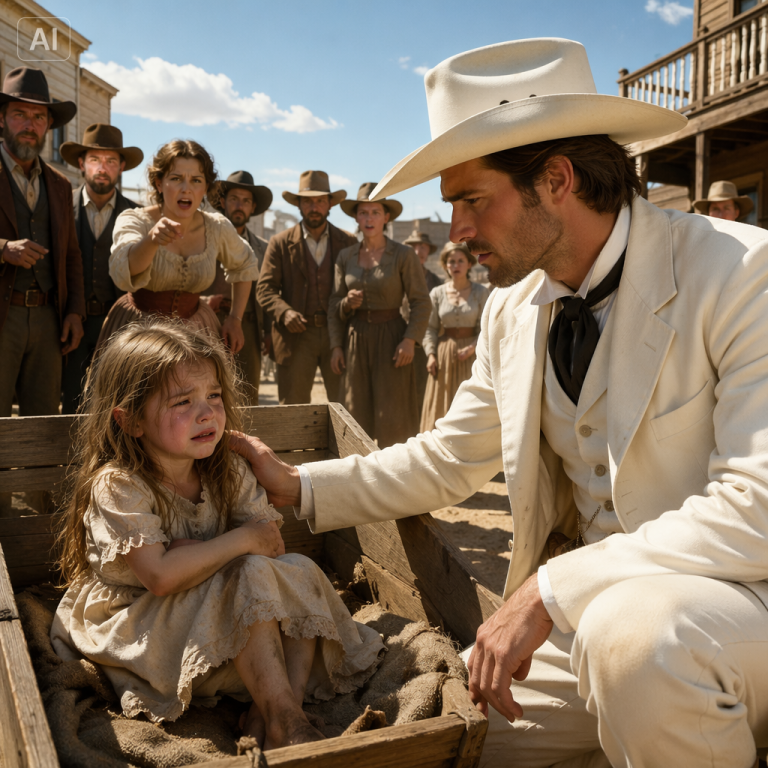
The child who had wandered up to the front while everyone was looking at Mira was six years old, maybe seven, with ribbons in her hair. Clara Finch. The mayor’s granddaughter.
Ware pulled her against him.
The revolver appeared at the child’s temple.
Mira felt the crowd suck in air.
“Bring me the book,” Ware said. “Or I demonstrate what it looks like when a man has nothing left to lose.”
Clara was very still. Not crying. Mira could see the whites of her eyes.
Crane had his rifle up but the shot wasn’t there — Ware was behind the child, behind his horse, and the margin wasn’t close enough.
“Give it to him,” someone in the crowd said.
“Don’t,” said someone else.
Mira looked at Clara.
Clara looked back.
“Close your eyes,” Mira said.
She didn’t wait for Ware’s response. She threw the ledger.
Not at his hands. At his face. At his eyes.
Pages burst open. Ware flinched — just the reflex of something coming at your eyes — and his gun arm shifted, and Clara dropped and scrambled and her mother materialized from the crowd in the way mothers materialized when their children were in danger.
Mira fired.
Ware’s revolver flew into the mud.
He screamed.
Crane crossed the distance between the church steps and Ware in the time it took the scream to finish, and hit him once, which was enough.
Ware went to his knees.
His men looked at the crowd. At the survey team. At the rifles appearing from doorways where miners had apparently been waiting with them. One by one, the men lowered their weapons.
Finch ran.
Margaret Sewell tripped him with her walking stick.
Sheriff Moss reached for his badge and seemed to decide that was the wrong direction and raised his hands instead.
One of the survey men came down from the balcony with a document case under his arm and a specific quality of federal efficiency.
“Denton Ware,” Crane said, in a voice that carried across the whole street. “You are under arrest for the murders of James and Thomas Holloway, for robbery, fraud, conspiracy, bribery, arson, and the attempted kidnapping of a minor.” He paused. “And for being the longest-running problem Dunmore County has ever failed to solve.”
Ware looked up from his knees, blood at his wrist, composure in pieces.
His eyes found Mira.
“You think this makes you something?” he said.
“No,” she said. “I think it makes you done.”
She began collecting the scattered pages from the mud.
Her hands were steady.
—
By sunset, Dunmore County had changed its configuration.
Not its appearance. The bank still stood. The livery still smelled of what it was. The same mud was on the same street. But power had moved, and the town was adjusting to the new weight distribution the way ground adjusted after something heavy was removed from it.
Sheriff Moss confessed before dinner. He was precise about it, which was more than anyone had expected, and it made the confessions easier for the prosecutor who arrived three days later.
Finch confessed after a night in his own jail, which Margaret considered fitting.
Ware said nothing.
He sat in the cell and looked at the wall and did not look at Mira when she came with Crane to deliver the ledger to the federal representatives.
She looked at him.
“You thought keeping me in the poorhouse would break it out of me,” she said.
“I still had three years of you,” Ware said.
“Yes,” she said. “And I had three years of you underestimating me.”
She turned and walked out.
Crane fell into step beside her.
—
Outside, the evening had the specific quality of spring in Montana when it decided to cooperate: clear air, light lasting longer than it had any right to, the mountains going blue-gray at their tops and gold at their bases.
“What happens now?” Crane said.
Mira had been thinking about this question for three years and had always arrived at the same problem: she didn’t know what happened to someone who had only been surviving. Survival had clear rules. Afterward did not.
“The land reverts,” she said. “My father’s deeds were fraudulent transfers. The property comes back to his estate.”
“Which means—”
“Which means I own the dry goods lot. And two parcels east of town. And—” she stopped.
“And?” he said.
“And apparently the survey ridge north of here, which my father bought for the water rights in 1879 because he believed in water rights.” She looked north. “Where your cabin was.”
Crane was quiet.
“Was,” she said. “I’m sorry.”
“A home isn’t the logs.”
She looked at him.
“You said that when we rode away,” she said. “I wasn’t ready to understand it then.”
“Are you now?”
She thought about what she understood.
She understood her father had planned for this. Not because he had known exactly what would happen but because he had believed in planting things that might grow even if he wasn’t there to see it. He had hidden the ledger where she’d know to carry it. He had written to people who might act on what he said. He had taught her to shoot and to read figures and to be quiet when quiet was survival and loud when loud was necessary.
He had trusted her with the weight of it.
“I’m going to open a shop,” she said.
Crane listened.
“Not just dressmaking,” she said. “Although that. But — cloth work. For anyone who needs it. Women who come in apologizing for their bodies. Women who’ve been told they’re too large, too small, too old, too much. Women who’ve stopped looking in mirrors.” She paused. “I know that kind of woman. I can make a dress that tells a woman the truth about herself.”
“The truth being what?”
“That she’s already exactly right,” Mira said. “The dress is just trying to keep up.”
Crane was quiet for a moment.
“And the ridge?” he said.
“The ridge needs a cabin,” she said. “Which requires someone who knows how to build one.”
He looked at her.
“That would be—”
“Someone who has already built one there,” she said. “Who knows the land. Who knows where the water runs and where the shelter is and how the wind moves.”
“That person would need to be on good terms with the landowner.”
“That person,” Mira said, “would need to ask the landowner directly. With words. Which I’ve been told he’s capable of.”
Crane said: “Mira Holloway.”
She looked at him. The evening light was doing something to his face that made him look like a man who had spent a long time being sure of very little and was reconsidering the practice.
“I’ve been waiting four years to finish something I couldn’t finish alone,” he said. “I don’t want to do the next part alone either.”
“What’s the next part?”
“Building something instead of just fixing what’s broken.” He paused. “I’m not good at waiting.”
“You spent four years on a mountain waiting for a ledger.”
“I was working,” he said. “That’s different.”
“Then work on this,” she said.
He reached into his coat.
She had been half-expecting the badge. Instead it was a ring, simple hammered gold, uneven in its shaping, with the specific roughness of something made from a material that wasn’t meant for it.
“Creek gold,” he said. “I panned it last fall. Was going to sell it for supplies and then didn’t.”
“Why didn’t you?”
“Because I didn’t want to.”
She looked at the ring.
“I’m not a small woman,” she said.
“I know.”
“I know you know. I’m telling you that people will keep saying things. About my size. About my face. About a man like you choosing a woman like me.”
“A man like me,” he said, “spent four years on a ridge waiting to do one useful thing. You’re considerably more than one useful thing.”
“Eli Crane,” she said. “That is not a proposal.”
“No,” he said. “This is.” He looked at her steadily. “I want to build a home where mirrors face upward. I want you to have the shop and the land and the choice of what comes after. I want to knock before I enter any room in your life. And I want to be—” he paused, looking for the word. “Present. In the way I haven’t been for anything in a long time. I want to be present for this.”
She held out her hand.
He put the ring on.
It fit.
She stepped forward first. Kissed him first, because she had spent three years waiting for permission and had decided she was done waiting. His arms came around her, careful and then not careful, and the evening light came down across the ridge and the ruined cabin site and the town that had sold her and the mountain that had held her and everything that came after.
—
Ware’s trial lasted five weeks in Helena.
Finch and Moss both testified, which was the most useful thing either of them had done in years. The railroad auditors produced records. The account book, authenticated by the federal land office, went into evidence alongside copies of Ware’s fraudulent deed transfers and the independent survey records that confirmed the discrepancies.
Ware’s attorney tried twice to introduce Mira’s appearance and her poverty as evidence of unreliability.
Mira sat in the witness chair and answered every question directly and without apology.
When the attorney said, *Miss Holloway, is it not true that you were sold at public auction for two dollars?*, she said, *Yes. And is it not true that the man who arranged that auction is the defendant?*
The court room was quiet for a moment.
The judge said: *Continue.*
Guilty on all counts.
—
Spring came late that year, which everyone in Montana said every year regardless of when spring came, because the ritual complaint was part of the season.
The Hart & Holloway Dressworks opened in the first week of May in the building that had been her father’s store. The front window displayed three dresses made from different patterns for different bodies, and a sign in Mira’s handwriting: *Nothing Beautiful Requires Permission.*
Women came.
First the ones who were curious. Then the ones who needed. Then women from two counties over whose husbands asked why they were driving that far for a dress and who said because it fits.
Mira measured with warm hands and did not comment on the bodies in front of her except to say *stand still, we’re making the dress work for you, not the other way around.* When women apologized for being large or small or irregular or marked by their histories, she pinned cloth and said *the dress is adjusting. You’re already right.*
Some cried.
She understood.
Crane rebuilt the cabin with two rooms and a stove that drew properly and east-facing windows that caught the morning. He also built a porch because Mira had mentioned she liked morning light, which he had stored quietly and acted on without comment.
He rode between the ridge and the town on a regular schedule that organized itself around where Mira needed help without her asking for help. She noticed this and didn’t say anything about it because it was the kind of thing that only worked if you didn’t name it.
The first winter after the trial, Mira found Margaret Sewell at her door with a cedar box.
“I found this in the county records,” Margaret said. “It was in your father’s file, marked for destruction. I preserved it.”
Inside: a letter in her father’s handwriting, dated ten days before the fire.
*Mira,*
*If this reaches you through some path I can’t see from here, then things went wrong in the way I feared they might. I’m sorry. I want you to know what I told Eli Crane when I met him: I believe honest figures matter even when nobody wants to see them. I believe in your hands with a needle, your mind with numbers, and your stubbornness with problems that don’t want to be solved.*
*I planned for you to get out. I planned for the ledger to go with you. I believe in the plan.*
*The shop is yours. The land is yours. The name is yours.*
*Don’t let them have any of it.*
*Your father*
Mira read it at the kitchen table.
Crane came in from outside and saw her face and sat down across from her and didn’t say anything.
She slid the letter across to him.
He read it.
When he finished, he folded it with care and set it back in front of her.
“He planned for you,” Crane said.
“Yes.”
“He trusted you with all of it.”
“Yes,” she said.
She looked at the letter.
“He’d never met you,” she said. “But he trusted you because you had his back.”
Crane was quiet.
“I was late,” he said.
“You came.” She looked at him. “That’s what I know about you. When you said you’d be somewhere, you came. You just needed more time than he had.”
She folded the letter and put it in the cedar box with her grandfather’s watch.
She put the box on the shelf where the mirror now stood, face-up.
—
That summer, a girl came into the shop with her mother. Fourteen, maybe fifteen, with the specific quality of a person who had been told something about herself so many times she had started to believe it. Her mother apologized before the girl was fully through the door — *she’s difficult to fit, she’s grown so fast, nothing sits right on her.*
Mira told the mother she could wait outside if she liked.
The mother looked surprised.
She went outside.
Mira looked at the girl.
“What’s your name?”
“Elsa,” the girl said. Quiet. Waiting for the measuring to begin.
“Elsa. What color do you like?”
The girl blinked. “What?”
“What color. For the dress.”
A pause. “Blue,” she said. “But mother says it doesn’t suit—”
“Your mother can have her own dress in whatever color suits her,” Mira said. “This one is yours. What shade of blue?”
The girl stood straighter by a degree.
“Dark,” she said. “Like the sky right before it goes fully dark. That color.”
“Good,” Mira said. “Stand still. We’re making the dress work for you.”
She measured.
The girl was quiet for a moment. Then: “What happened to your face?”
“A fire,” Mira said.
“Does it hurt?”
“Not anymore.”
“People look at it.”
“Yes,” Mira said. “They do.”
“Does that—” The girl stopped.
“Bother me?” Mira finished. “Sometimes. Less than it used to.” She put a pin in place. “I used to think about it all the time. Now I mostly think about the dress.”
Elsa looked at the mirror.
“You’re not going to tell me it doesn’t matter?” she said. “What people think?”
“No,” Mira said. “It matters some. It matters less than you’ve been told. And it matters less than what you do.” She smoothed the cloth at the girl’s shoulder. “The things I did after the fire — those are what people remember. The fire is just when it started.”
The girl looked at herself in the mirror.
At her body, which was fifteen and full and growing in all the ways she’d been told were wrong.
She looked.
“Can you make it so it looks like—” She stopped.
“Like what?” Mira said.
“Like it’s supposed to be this way,” the girl said.
Mira put a last pin in the hem.
“That,” she said, “is exactly what I can do.”
—
On a Thursday in October, Crane came back from Helena where he’d been finishing the last of the case paperwork, and Mira was on the shop steps waiting for him, which she sometimes was when she knew when to expect him.
He dismounted.
She said: “There’s coffee.”
He said: “Yes.”
They went inside.
The shop was closed for the evening. The lamps were lit. The mannequins in the window wore blue and green and red, none of them apologizing for their shapes.
Crane sat at the table with his coffee and looked at the mirror on the wall — it had been moved here from the cabin, because the shop needed it more.
Mira sat across from him.
“People still look,” she said. “At me. In the street.”
“Yes,” he said.
“Not the way they used to.” She thought about how to say it. “Before, they looked to see the damage. Now some of them look and remember.”
“The steps,” he said. “The ledger.”
“Clara,” she said. “They remember I told Clara to close her eyes.” She paused. “I think that’s the thing that stays.”
He drank his coffee.
“Do you mind?” he said. “Being remembered that way.”
She thought about it honestly.
“No,” she said. “I spent three years being invisible. Being remembered for something I chose — that’s different.”
The lamp threw their shadows long across the floor.
“My father left me the land and the shop and the name,” she said. “You left me—”
“The ring,” he said.
“The ring,” she agreed. “And the cabin. And the fact of someone keeping their word.” She looked at him. “That last one matters more than you know.”
He looked at her across the table with the specific quality of a man who had spent years being precise about most things and had recently discovered that precision didn’t reach everywhere.
“I know it matters,” he said. “I watched you build everything I couldn’t protect.”
“You protected enough,” she said.
He put his hand on the table between them.
She put hers on top of it.
Outside, the October wind moved through Dunmore County and didn’t belong to anyone anymore.
The mirror on the wall held the room: the table, the lamp, the mannequins in their colors, the man with the tarnished badge in his pocket, the woman with the scar on her face and the ring on her hand and the father’s name in the shop sign on the door.
Everything exactly where it was supposed to be.
No apologies.
*THE END*