SHE TRAVELED 3 WEEKS TO MARRY A STRANGER — HE LOOKED AT HER FOR FOUR SECONDS AND HANDED HER BACK HER OWN LETTER

*Part 1*
You’re not what I asked for.
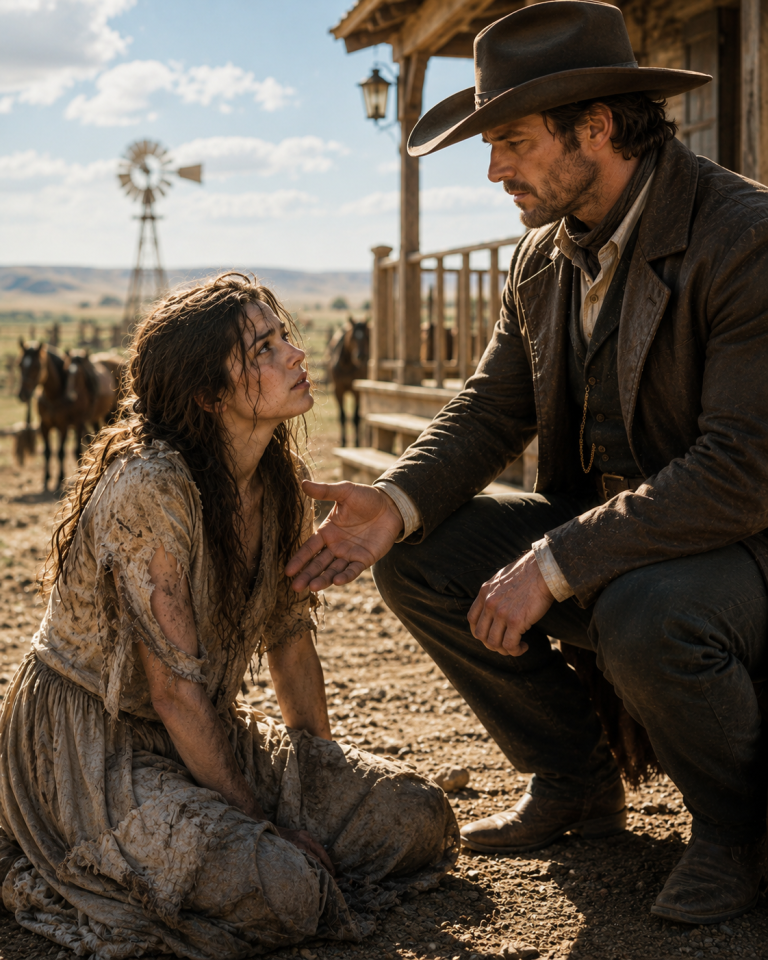
James Walton said it flat, without apology, after looking Wilhelmina Dawson up and down for exactly four seconds. Then he handed her back her own letter of introduction — the one she’d read six times on the three-week train ride from Boston — and walked away, leaving her standing on the Copper Creek depot platform with her trunk, her twelve dollars, and the desert sun burning straight through her coat.
The train pulled out without her.
She had told herself this was brave, not desperate. Somewhere outside Kansas City, forehead pressed to the window glass, watching the land turn from green to brown, she’d made herself a promise — whatever happened, she would not cry in public. She had cried enough in private. The public version of her was going to be made of something harder.
She needed that promise now.
The station master had already gone back to sorting freight, as though nothing of consequence had just happened. As though a woman hadn’t been unwrapped and rejected on a public platform like something delivered to the wrong address. Willa — her mother’s name for her, carried across two thousand miles like a second piece of luggage — pressed her lips together and did not cry.
“That bad, huh?”
The voice came from her left. A tall man leaned against the corner of the depot wall, hat pulled low, a coil of rope in one hand and a shipping receipt in the other. He had the look of someone who’d been minding his own business and simply happened to notice hers.
“I beg your pardon,” Willa said. “Didn’t mean to intrude.”
“Lucas Reed. Got a feed delivery coming in. I’ve been here about forty minutes.” A pause. “I saw what happened.”
“Then you saw very little. A brief conversation. Nothing of consequence.”
He looked at the letter she’d just dropped in the dust. He looked back at her. “Where are you planning to go?”
It was the directness that nearly broke her composure, because she had no answer for it. She had planned for three weeks toward an arrival. She had not planned for this.
“There’s one boarding house,” Lucas said, before she could invent something. “Mrs. Alderman runs it. She doesn’t take single women without references from a local resident.”
“I knew James Walton.”
“Walton won’t write you a reference.” He said it without cruelty — just the plain factuality of an honest man. “He’s been telling the whole Cattlemen’s Association his bride was coming. Now that she’s here and he’s walked off, he won’t want reminding of it.”
Willa turned and looked down the length of Copper Creek’s single street — the hardware store, the saloon, a church with a crooked steeple — and thought about the twelve dollars folded inside her glove. Three weeks of lodging, and that was all she had.
“There must be work,” she said. “I can cook. I keep accounts. I taught school in Boston for two years.”
“I believe you.” Something in his tone made her look at him properly. He’d repositioned himself so the sun wasn’t between them anymore, and she could see his face — younger than she’d expected, maybe thirty, doing the kind of quiet assessment she associated with men who made careful decisions.
“I need someone at my ranch,” he said. “Cook and housekeeper. Room and board, a private room, three dollars a week. No conditions beyond the work. If it’s not suitable in a month, I’ll drive you to the stage depot myself.”
“Why would you offer that to a woman you don’t know?”
“Because you’re in a difficult position through no fault of your own. And because I actually need the help.” He shrugged one shoulder. “I’m not asking you to trust me. I’m asking you to consider it. If I say no, I tip my hat and we go our separate ways.”
Willa looked at her trunk. She looked at the letter lying in the dirt, bent down, and picked it up — not to keep it, but because leaving trash on a platform wasn’t something her mother had raised her to do.
“Three dollars a week,” she said. “Private room. A door that locks.”
“I’ll put a bolt on it today.”
“And I manage the household my own way. I don’t take instruction on cooking from men who apparently haven’t eaten a proper meal in eight months.”
Something shifted at the corner of his mouth. Not quite a smile. “Fair enough.”
“All right,” Willa said. “I’ll come.”
He loaded her trunk into his buckboard with the same quiet efficiency he did everything, and they rode five miles in a silence that wasn’t quite comfortable but wasn’t hostile either — until Willa broke it.
“You told the station master I was your wife.”
“I did.”
“Why?”
“Because Copper Creek is small and gossip travels faster than weather. A rejected mail-order bride leaving town with another man — that story writes itself, and not in your favor.” He glanced at her sideways. “As my housekeeper, you’d answer questions every time you went to town. As my wife, people mind their business.”
“And you didn’t think to ask me first.”
“I made a judgment call. You can be angry about it.”
“I’m noting,” she said, “that you made a decision affecting my reputation without consulting me.”
“You’re right,” he said simply. “I should have asked. I’m sorry.”
She had not expected the apology — it arrived so cleanly, without defense or qualification, that for a moment she didn’t know what to do with it. James Walton’s letters had never once contained one.
“How do we handle it?” she asked. “If someone asks direct questions.”
“I thought we’d figure that out as we go.”
“That’s not a plan, Mr. Reed.”
“No,” he agreed. “It’s not.”
“We say we married quietly in Santa Fe,” she said. “That I came out on the train to meet you, and we found a justice of the peace there before continuing on. Vague enough to discourage questions.”
He was quiet a moment. “You came up with that fast.”
“I taught school,” she said. “You learn to think quickly when thirty children are waiting for an answer.”
The corner of his mouth moved, more definitively this time.
“Santa Fe it is.”
—
*Part 2*
The Double R Ranch did not look like the property of a man who’d been living without domestic order for eight months — the structure was solid, well-built. But the neglect was there in the details. A kitchen garden gone to seed. A front step board that flexed dangerously underfoot. Inside, the particular disorder of a man who cleaned by pushing mess to the edges rather than solving it.
Willa reorganized the entire kitchen in a single afternoon. Behind a crate of canned tomatoes, she found a small tin — dried rosemary, caraway seeds, two vanilla beans, kept deliberately, carefully.
“Lucas’s mother kept it there,” Eli Marsh told her the next day, watching her from the doorway with the wary, measuring look of a man who knew the marriage timeline didn’t add up and hadn’t decided whether to say so. “Before she passed. Four years now.”
“I’ll remember where it goes,” Willa said quietly.
By the fourth morning, she was on her knees in the dead kitchen garden, pulling weeds someone had once planned with real care — raised beds, good timber, structure buried under neglect. Lucas found her there with two cups of coffee.
“My mother built these,” he said. “It went to seed the first season after she died. I didn’t know to cut it back.”
Under a mass of grass in the far corner, Willa found three basil seedlings. Small, pale, alive. She sat with her hands in the dirt and said nothing about why it mattered so much to her to bring them back.
Walton came to the ranch on the sixth day, on horseback, not dismounting. “People in town are talking,” he said.
“People in town are always talking,” Willa answered, level and calm. “I arrived as a woman traveling alone, and I was returned at the station like unsatisfactory freight. What happened after that is my own business. I hope you find what you’re looking for, Mr. Walton. Good day.”
He didn’t come back. Lucas said he wouldn’t — he’d come to see if she was struggling, and she wasn’t.
That night she wrote to her cousin Margaret. Three drafts, two burned in the lamp flame. The one she kept said: *I am not where I expected to be, but I am not where I feared I might end up either. The man is decent, more than decent… I am afraid some days, but I am also interested in what this becomes.*
The weeks that followed built something she hadn’t expected — Eli’s grudging trust, earned the night she knelt in the dirt without hesitation to save a dying calf. Carson’s easy warmth. A shawl, Eleanor Reed’s own, that Eli quietly gave her the night before Founders Day, gruffly insisting it meant nothing. It meant everything.
But under all of it, real trouble was building. Old man Alderman’s land — the parcel bordering the Double R’s water rights — was about to be sold to Harlon Croft, a land baron consolidating acreage across the county. If Croft got it first, he could challenge Lucas’s decades-old, unrecorded water easement. Willa saw the opening no one else did: not to stop the sale, but to buy two weeks to file the paperwork first. It worked.
Then the cattle started disappearing. Eleven head, then more — fence wire cut clean, tracks running north, straight toward Croft’s line. Lucas rode out at night to check it, leaving Willa alone in a house that had never felt so quiet without him in it. He came back at dawn with mud on his boots and a jaw set tight enough to see the muscle working.
“That’s deliberate,” Willa said, looking at the cut wire report.
“That’s deliberate,” he agreed.
And that was only the beginning. Because two hours after their lawyer left with a witness statement naming Croft’s foreman, Harlon Croft himself rode up to the Double R’s front porch — unhurried, smiling, offering a “partnership.” And as he turned to leave, he said one line that told Willa exactly how far this man was willing to go.
*”Give my regards to your wife.”*
He knew. Or he suspected. And a marriage built on a story about Santa Fe — a story that had never actually happened — was about to become the single weakest point in everything Willa and Lucas had built.
—
*Part 3*
Croft’s horse was barely out of sight before Willa understood the shape of what was coming. A man like Harlan Croft did not waste a line like *give my regards to your wife* by accident. He had said it the way a card player lays down a hand he already knows is stronger than yours — quietly, with time to watch your face change.
Her face did not change. Not where he could see it.
Inside, Lucas set his hat on the table and looked at her the way he’d looked at her the day Walton rode up unannounced — steady, present, waiting to see what she needed before deciding what he needed to say.
“He knows about Picket,” she said.
“He knows about Picket,” Lucas agreed. “He came to make the offer before the statement becomes a real problem for him. If you’re his partner, you’ve got reasons not to pursue the complaint.”
“Are you going to think about it?”
He looked almost offended. “No.”
“Good.”
She turned back toward the kitchen, and he stopped her with three words that had been sitting in his chest since the porch. “I’m not going to let him have this ranch,” he said. “I want you to know that. Whatever he does next.”
She turned back. He was standing in the middle of the room, hands loose at his sides, saying one thing and clearly meaning several others — and she understood, because she had been doing the exact same thing for five weeks.
“I know,” she said.
“I just—” He stopped. Started again. “I wanted you to know.”
She looked at the man who had picked up a stranger’s trunk at a train depot, driven her five miles in silence, put a bolt on her door for her sake and not his, bought lemons for no practical reason at all, and stood at the edge of a crowded room offering his arm to a woman with nothing to give him back but company.
“Lucas,” she said. “I’m not going anywhere.”
He nodded once — the nod of a man setting down a weight he hadn’t realized he’d been carrying.
—
Greer, their lawyer out of Tucson, filed the civil complaint the following Monday, and by Wednesday the whole county had heard about it. Small towns didn’t let information travel — they let it detonate. Willa heard two women at the dry goods counter discussing the *Reed complaint against parties unknown* with the particular relish of people enjoying a story that wasn’t theirs to enjoy, and she bought her flour and her salt and said nothing, and walked back to the buckboard with the distinct sense that something in Copper Creek’s atmosphere had shifted, though she wasn’t yet certain which direction it would settle.
“He’ll push back,” Lucas told her that evening. “He’s not a man who absorbs a challenge without answering it.”
“What does answering look like?”
“Pressure on the people around me.” He looked at her directly. “On you, possibly. You’re the most visible part of my life he can reach.”
She thought about that honestly — thought about what her reputation actually consisted of, a fiction layered thin over a real situation, a story about Santa Fe that had held together only because no one had pulled hard enough on it yet.
“Let them talk,” she said. “I arrived in this town rejected on a public platform. My reputation started from a deficit. Whatever Croft says about me cannot be worse than what was already said at that station, and I survived that. Don’t worry about me. Worry about the case.”
“You’re the least worrying person I know,” he said. “And that worries me more than anything else.”
The pressure came Thursday, through Carson, who came in for the noon meal carrying something he clearly didn’t know how to put down. One of Croft’s men, a big fellow named Mullins, had cornered him in town that morning with “friendly information” — a rumor circulating that the Reed marriage wasn’t legal. That there had been no wedding in Santa Fe at all.
The table went very quiet.
“You did exactly right,” Willa said, her voice steady, her hands under the table not steady at all.
After the men went back out, she and Lucas sat with what they both already knew. “If someone files a formal challenge to the marriage,” she said, “what happens legally?”
“In this territory, a common law marriage has standing. If both parties present themselves as married, we’ve done that.” A pause. “But if someone pushes for documentation, and there’s no documentation—”
“There’s no documentation,” she finished. “Because there was no Santa Fe.”
“No.”
They sat with it, the ordinary sounds of Eli and Carson at the fence line continuing outside, oblivious to the size of the problem sitting at the kitchen table.
“We could fix that,” Lucas said quietly, to the table rather than to her.
She looked at him. “You’re talking about an actual marriage.”
“I’m talking about going to Reverend Holt and making the thing we’ve been pretending to have into something that holds up in court.” He held her gaze. “For the ranch. For the case. Those are practical reasons.” A pause. “There might be other reasons. I’m not going to put those on the table unless you want them there.”
She breathed in. She breathed out. She thought about this man who had wrapped something enormous in practicality specifically so she’d have room to say no if she needed it.
“Put them on the table,” she said. “The other reasons.”
He was quiet for three seconds that felt considerably longer.
“I think about you,” he said, “approximately all the time. I think that’s been true since about the eighth day.” He stopped. Tried again. “I don’t want you to leave. I don’t want you to have an exit and use it. I want the thing that already feels real to be something that actually is.”
Something cracked open in her chest — not painfully. The opposite. Like a window finally opened in a room shut too long.
“The bolt’s still on my door,” she said.
“I know. I put it there so you’d know I wasn’t going to make this into something you didn’t choose.” He paused. “You’ve had a lot of things happen to you that you didn’t choose. I didn’t want to be another one.”
“Lucas,” she said. “Ask me properly.”
Something moved across his face she’d never seen there before — not quite uncertainty, not quite vulnerability. The particular expression of a careful man standing at the edge of something he can’t plan for.
“Wilhelmina Dawson,” he said. “Would you marry me for real? All the reasons.”
“Yes,” she said. “All the reasons.”
—
They married the following Saturday in front of Reverend Holt with no guests but Clara Ambrose, who arrived with dried lavender from her own garden and an expression that said she’d been waiting for exactly this news. Eli stood beside Lucas holding his hat in both hands, saying nothing, which was the most eloquent thing he could have done. Carson arrived two minutes after it was over, having not been told in advance, and nearly knocked Willa over with his apologetic, overjoyed enthusiasm.
Walking back to the buckboard, Lucas’s hand rested at her back — not the formal escort of a man performing a role, but the specific, quiet claim of a person who intended to stay.
—
But Croft did not fold. Two days later, Willa learned that Alderman was revising his account of the conversation about the harrow debt — the very conversation Willa had suggested Lucas use to buy time on the easement filing. Croft had gotten to him first. If Alderman claimed he’d felt pressured, the recorded easement itself became vulnerable to challenge.
“Croft got there first,” Lucas said, coming in from Alderman’s place two hours later, his face telling her everything before he spoke. “He’s saying he felt coerced into the waiting period.”
Willa stood in the middle of the kitchen and breathed through clean, productive fury — the kind her mother had always called the only useful emotion, because it moved forward instead of inward.
They needed something that went directly to Croft, not just his foreman. And the only lead was a saloon rumor from Carson’s brief conversation with Mullins — that Croft kept a second set of books, the real ones, at his own house.
“It’s a pressure point, not a solution,” Willa said. “But we don’t need a solution today. We need Croft to feel the walls moving.”
“Cornered men make mistakes,” Eli said from the doorway, and Willa agreed.
Lucas rode to Tucson to meet Greer in person, and asked Willa to come with him — a full day’s ride, an overnight stay, the first time she’d left the ranch since arriving. On that long ride through the desert morning, something between them stopped being careful. He told her about his father, who’d once driven forty miles the wrong direction rather than admit he’d misread a map. She laughed — really laughed, unguarded — and caught him watching her do it.
“You should do that more,” he said. “Like you forgot to be careful about it.”
“I spent a long time being careful,” she said. “It’s exhausting.”
“What would you do if you stopped?”
She thought about it honestly. “I’d plant the whole south field in lavender. Not because it’s practical. Because it was the most beautiful thing in the room at our wedding, and I’ve been thinking about it since.”
“I’ll fence the south field in the fall,” he said. “Keeps the cattle out.”
She looked at him — this man who answered a confession of impracticality with a fence. “You are a good man, Lucas Reed.”
He kept his eyes on the road, but the line at the corner of his mouth deepened into something close to a real smile.
—
Greer subpoenaed Croft’s financial records the following Monday, broad enough that Croft would have to either produce everything or move to quash — and a motion to quash, Greer explained, told a judge there was something worth hiding. Judge Harmon denied Croft’s attempt to block it in two hours flat, the fastest ruling Greer had seen from him in fifteen years.
Croft did not take it quietly. An anonymous note appeared on the Reeds’ buckboard in town, suggesting Willa was a scheming Boston financial manipulator managing a fool of a husband. Lucas nearly burned it in the stove out of pure disgust.
“Don’t,” Willa said. “Keep it. Give it to Greer. One note is nothing. But a note, an approach to Carson, Croft’s visit — that’s a pattern.”
Then, five days into the standoff, Alderman himself walked two miles to the ranch on foot in the Arizona heat — a man who didn’t do that without a reason he didn’t want witnessed.
“I told Croft’s man something I shouldn’t have,” he admitted to Willa, turning his hat over in his hands. “About the harrow conversation. It wasn’t pressure. Lucas never pressured me. I was scared of losing my sale, and Croft’s man made it sound like I’d have problems if I didn’t cooperate.” He met her eyes. “I’d rather be an honest man than a comfortable one.”
Combined with the earlier witness statement naming Croft’s foreman, and the pattern of intimidation Willa had insisted on documenting rather than burning, Greer now had a direct line running from the cut fence wire all the way to Harlan Croft himself.
“A man with clean books,” Greer said, gathering his papers with quiet satisfaction, “doesn’t fight this hard to keep them closed.”
—
The offer came eight days later — not from Croft directly, but through his lawyer, and it was everything. Full, permanent, unchallenged recognition of the water easement. Restitution for every stolen head at market rate plus damages. Formal termination of the foreman’s employment and his own written statement. And a clause barring Croft’s land company from acquiring anything within three miles of the Double R for twenty years.
“Take it,” Willa said, reading it once. “This isn’t a number. This is everything. Croft saw his books going in front of Harmon and gave us all of it rather than let that happen.”
Lucas called for Carson before she’d even finished the sentence. “Ride to town. Tell Greer we’ll take the settlement.”
Eli, arriving in the doorway just in time to hear it, said one word — “Good” — and went back to work, which was, Willa had learned, precisely how the Double R celebrated its victories.
Croft did not attend the signing in Tucson. His lawyer signed on his behalf. Willa understood that, in a distant way — she had once been the kind of person who believed that not witnessing the hard thing made it somehow less real. She wasn’t that person anymore.
On the ride home, she finally told Lucas the whole story of that first morning — not the composed version she’d managed for public consumption, but the actual four seconds, the letter handed back, the station master’s indifference, the twelve dollars.
“I’ve thought about what I would have done,” Lucas said quietly, “if I’d left the depot twenty minutes earlier that day. I almost sent Carson for the feed delivery.”
She sat with the vertigo of how close any life comes to being an entirely different one. “I’m glad you didn’t,” she said.
“Me too,” he said. “More than I can say.”
She put her hand over his on the reins. He turned his palm up and held it. They rode home like that.
—
The lavender went in that October, once the south field was fenced as promised. Croft quietly began liquidating his Copper Creek holdings before the year was out; his foreman left the territory entirely; the two sets of books Croft had fought so hard to protect were never publicly examined, because the settlement made a hearing unnecessary — though Greer let it be known that Judge Harmon was well aware they existed, which amounted to the same thing in a county that small.
Willa planted lavender seeds in February with Carson complaining cheerfully about the cold and Eli insisting from the fence that she was staking the rows all wrong.
“This is Arizona,” Eli said. “They won’t grow that big.”
“These ones will,” Willa said, without looking up, and Lucas caught her eye across the row with the full, unguarded version of his smile, and she went back to her planting with the particular contentment of a woman who knows exactly where she is and means to stay.
That evening, at the north fence, she told him the rest of it. Penny the calf was walking without a limp now. The basil in the garden corner was ready to cut back for winter.
“And I think,” she said, “we’re expecting a child.”
The silence lasted three full seconds. Then something happened to Lucas Reed’s face that she had never seen before and would spend the rest of her life glad she hadn’t missed — every trace of careful management simply gone, replaced by something so unguarded it moved through her like the first warm day after a long winter. He crossed the distance between them in two steps and held her face in both hands and said nothing at all, because he was a man who knew the difference between when words served and when they failed, and he let them fail completely.
“All right,” she said.
“All right,” he said — which in his particular vocabulary meant *extraordinary*, and *more than I knew how to want*, and, completely without reservation, *yes*.
—
Sarah Elizabeth Reed was born the following spring, early in the morning before the heat set in, with Dr. Ambrose present and Clara holding Willa’s hand and Lucas pacing the next room in the specific agony of a man who cannot fix what is happening and has no idea what to do with his hands. Eli sat on the porch the whole time. Carson wore a groove into the yard.
When it was over, Lucas sat on the edge of the bed and looked at Willa first — just her, confirming the thing that mattered most before anything else — and she nodded, exhausted in a way she had no reference for, and whole in a way she had never once expected to be. She handed him their daughter, and he held her with the careful, faintly terrified competence of a man who understood the principle from newborn calves and was quietly amazed by how different this was.
“Sarah Elizabeth,” he said quietly, like an introduction.
“She has your jaw,” Willa said.
“She has your expression,” he said. “Like she’s already deciding something.”
“She probably is.”
He looked up from the baby to her, the full unmanaged version of his face on display again. “You know,” he said, “I almost sent Carson for that feed delivery.”
“I know,” she said. “I’m glad you didn’t.”
“Me too,” he said. “Every day.”
Outside, the Arizona morning was settling into its business of being warm, and Carson had clearly been told the news, because his celebrating carried all the way through the walls. This strange, unplanned, wholly assembled family — found through practical necessity and kept through everything that came after.
Willa closed her eyes for a moment and let herself feel all of it — the weight of the morning, her daughter’s small breathing, her husband’s hand resting near hers, the plain fact that this room, this ranch, this life belonged to her as completely as anything ever had.
James Walton had looked at her for four seconds and handed her back.
The life she’d found instead was worth every one of those four seconds, and every hard mile that came after them.
She had come to Arizona with twelve dollars and a stranger’s address, running out of other options. She had found, in the least likely of circumstances, the truest version of herself — not the careful one, not the managed one, but the one who planted lavender in a climate that wasn’t quite right for it, who kept records with the thoroughness of a woman who understood that the details were where truth lived, and who could say *I love you* plainly, on an ordinary evening, in a kitchen garden, without a single word of preparation.
Rejection had not been the end of her story.
It had only ever been the door she had to walk through to find the one that was always meant for her.
THE END