SHE CROSSED HALF A CONTINENT TO MARRY A STRANGER — THE FOREMAN MET HER AT THE STATION TO SAY HER GROOM WAS ALREADY DEAD

PART 1
The Massachusetts coastline disappeared into morning fog as Clara Hail pressed her forehead against the train window, watching everything familiar dissolve into memory. Her carpet bag sat wedged between her feet, hastily packed, containing almost nothing of value except her mother’s silver hairbrush and three changes of clothing that wouldn’t survive a Wyoming winter. She knew that already, just like she knew she was making a mistake. But mistakes were a luxury her family couldn’t afford anymore.
She was twenty-two, traveling alone toward a marriage arranged through newspaper advertisements and careful omissions. She’d told Elias Whitmore she was educated, capable, and willing. She hadn’t mentioned her father drinking himself into an early grave owing half of Boston money, or her mother’s cough turning bloody last winter, or the bank three weeks from seizing their home.
*Respectable rancher seeks educated woman for partnership and companionship. Wyoming territory. Established property. Serious inquiries only.*
“Sounds like a cattle baron trying to buy himself a wife,” Clara had said to her neighbor, hands already reaching for the newspaper.
“Sounds like opportunity wearing a different dress,” Mrs. Holloway had said. “Your mother needs medicine, Clara. Pride won’t keep you warm when you’re living on the street.”
Elias’s first letter arrived neat and patient. He didn’t promise anything he couldn’t keep, didn’t paint Wyoming as anything but harsh and demanding — but he wrote about the land like it mattered. *I won’t lie and say it’s easy,* he wrote. *But if you’re willing to learn and aren’t afraid of calluses, there’s a life here worth living. I’m looking for a partner, not a decoration.*
Over four months of letters, something unexpected happened. Trust. He asked her opinions on literature, on whether women should have the vote. *Of course they should,* she wrote back, and his response came back warm with approval: *You’ll fit in fine out here. Wyoming women don’t wait for permission.*
His proposal, in his eighth letter, was straightforward. *I’m not wealthy, but I’m stable. I can offer you security, respect, and a partnership in building something permanent. If you’re willing, I’ll send money for travel. You’ll have full legal claim to everything I own. Whatever happens between us, you won’t be left helpless.*
Clara had read that letter seventeen times, looking for the trap. Men didn’t offer women legal protection. They didn’t send travel money to strangers who might disappear with it. But Elias did.
Her mother had wept when Clara told her — not from sadness, from relief. “You’re saving us, baby,” she’d whispered.
The train carried her westward through landscapes growing increasingly foreign — Pennsylvania’s hills to Ohio’s flatlands to the endless sprawl of Illinois. In Kansas City, a woman about her age settled beside her with a sleeping infant.
“First time west?” She smiled at Clara’s silence. “Mail order bride, then. I did the same thing four years back. Scared myself half to death on the journey.”
“How did it turn out?”
“Better than I expected. My man wasn’t what I’d imagined, but he was decent. Honest. We grew into it.” She met Clara’s eyes. “Won’t lie to you — it’s hard out here. But if your man’s good and you’re willing to bend instead of break, you can build something real.”
The train to Wyoming was rougher, filled with miners and ranch hands. The prairies gave way to grassland, then sudden upthrusts of rock and mountain. The sky grew impossibly big.
Clara had expected to feel something when the conductor called out Sweetwater Springs. Relief, maybe. Instead, she felt numb.
The platform was barely a platform — rough wooden planks, a handful of people in the October cold, breath misting in air that bit with the promise of coming winter. She’d studied Elias’s photograph — dark hair, serious eyes, the kind of face that suggested reliability rather than charm. *I’m not handsome,* he’d written, *but I’m honest.*
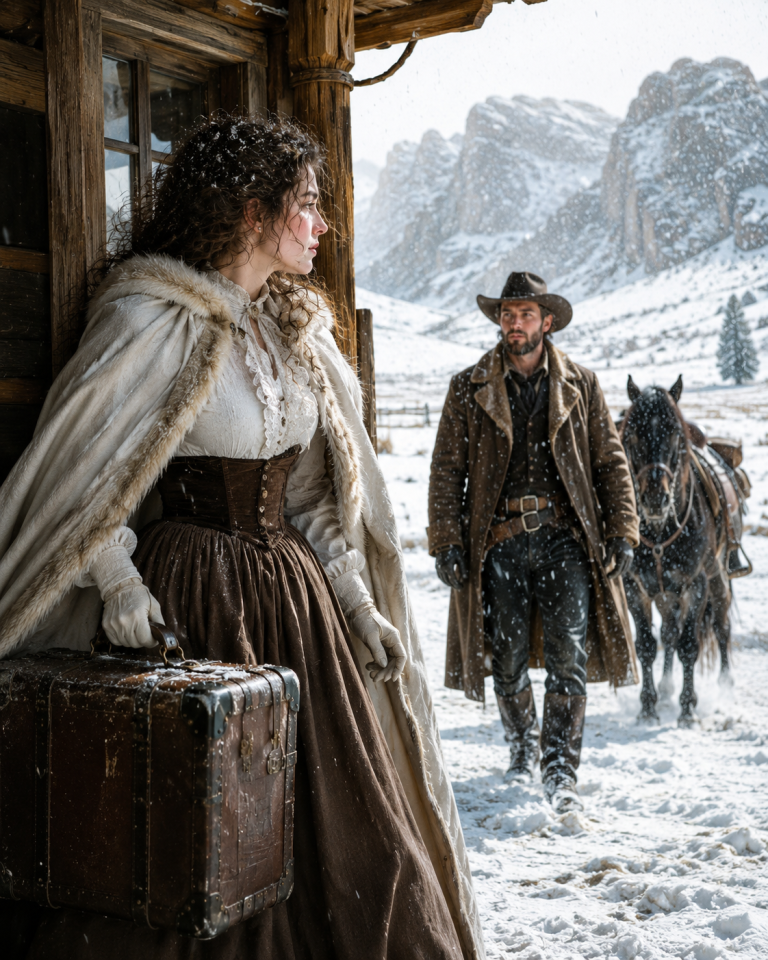
But Elias wasn’t there. Instead, a man in a worn duster coat stood near the station house — younger than Elias, late twenties, sun-weathered, dark blonde hair that needed cutting. When his eyes found Clara, something shifted in his posture. He walked toward her with the loose economical gait of someone who spent more time on horseback than on foot.
“Miss Hail.”
Clara’s chest tightened. “Yes. Are you—”
“Caleb Mercer. I’m foreman at the Whitmore ranch.” He pulled off his hat, and Clara saw exhaustion written in the lines around his eyes. “I’m afraid I’ve got bad news, Miss Hail. Elias asked me to meet you if — if anything happened.”
The platform seemed to tilt beneath her feet. “What do you mean, if anything happened?”
Caleb’s jaw tightened. “Maybe we should sit down.”
“I’ve been sitting for eight days straight. Just tell me.”
He looked at her a long moment, and Clara saw him make a decision.
“Elias is dead, Miss Hail. He was shot during a property dispute five days ago. The wound got infected.” He stopped, swallowed hard. “He died two days before you arrived. I’m sorry.”
PART 2
“You’re lying,” Clara said, the words flat, automatic.
“I wish I was.” Caleb’s voice was rough with something that sounded like genuine grief. “Elias was a good man. Best man I ever worked for. He talked about you constantly these last few months, showed everyone your letters, made plans for the house.” He reached into his coat and pulled out a folded, worn envelope. “He wrote this the day before the shooting. Asked me to give it to you if something went wrong. He knew he was pushing back against the wrong people.”
Clara took the envelope with numb fingers. Her name in Elias’s familiar handwriting cracked something in her chest.
“What am I supposed to do now?”
“That’s complicated. There’s a boarding house in town if you need a place to stay. Or—” He seemed to reconsider. “Elias left everything to you in his will. The ranch, the land, the cattle, the debts. Had it drawn up legal three weeks ago, when he heard you’d agreed to come.” He met her eyes steadily. “If you want it, it’s yours. But I won’t lie to you — it’s a mess right now. There are people who’d rather see the ranch fail than succeed under new ownership. Especially under a woman’s.”
“Can I sell it?”
“Eventually. Not quickly, and not for what it’s worth.”
“Who wants to see it fail?”
“Marcus Bellamy runs the Circle B to the east. Been trying to buy Elias out for two years, made threats when he refused. Can’t prove he was behind the shooting, but—” Caleb’s expression went hard. “Let’s say I have suspicions.”
Clara’s hands tightened on her bag. “So if I stay, I’m walking into a fight I don’t understand against an enemy I can’t prove exists.”
“More or less. If you leave, Bellamy probably buys the land at a fraction of its value, the hands lose their jobs, and everything Elias built disappears. But you’d be free to start over somewhere safer.”
Clara closed her eyes, exhausted, and thought about Boston — the debt, her mother’s cough, the return fare already spent on the journey west. There was no going back. She opened Elias’s letter with shaking fingers.
*Dear Clara. If you’re reading this, I’m dead and you’re standing in Sweetwater Springs wondering what the hell you’ve gotten yourself into. I’m sorry. I never meant to leave you stranded like this… I’ve left everything to you because I meant what I said in my letters. I was looking for a partner, not a dependent. You’re smart, educated, and brave enough to cross half a continent to start over. That’s the kind of person who can build something real out here.*
*Caleb Mercer is the best foreman in Wyoming. Trust him. The land is worth fighting for. And despite everything, this is a place where a woman can build her own life instead of living one someone else chose for her. — Elias.*
She folded it carefully, slipped it into her pocket. “He was a good writer.”
“He was a good man.” Caleb cleared his throat. “What do you want to do, Miss Hail?”
Clara looked around the platform — the rough buildings, the vast sky, the mountains rising like broken teeth.
“I want to see the ranch,” she said. “Before I decide anything, I want to see what Elias thought was worth dying for.”
“It’s a two-hour ride. We should go now if we want to make it before dark.”
“Then let’s go.”
He loaded her carpet bag into the wagon and offered his hand to help her up. Clara took it, feeling the calluses on his palm, the strength in his grip. This was real, all of it — the dead fiancé, the inherited ranch, the impossible decision — real in a way nothing in her carefully planned Boston life had ever been.
PART 3
They traveled through landscape that seemed designed to break the human spirit — endless grass punctuated by rock that looked like the earth’s bones showing through, the sky pressing down huge and unforgiving.
“You’ll want warmer clothes,” Caleb said eventually. “What you’re wearing won’t survive a Wyoming winter.”
“I don’t have money for that.”
“Ranch has an account at the general store. Elias would have wanted you equipped properly, regardless of what you decide.”
“That’s generous.”
“That’s practical. Can’t have you freezing to death before you make up your mind.”
“Did he talk about me?” Clara hated herself for asking.
“Constantly. Drove us all half crazy.” There was real warmth in Caleb’s voice now. “He was excited, Miss Hail. Nervous, but excited. Made plans, fixed up the house, practiced what he’d say when you arrived.” His jaw tightened. “He wanted this to work. Wanted to build something permanent instead of just surviving season to season.”
Clara blinked back tears fiercely.
They descended into a valley flanked by rough hills, a creek running through it like a silver thread. A main house, two stories, solid, with a wide porch. A massive barn. Smoke from a chimney, laundry on a line. It looked lived in.
“Two thousand acres,” Caleb said. “Elias was twenty-six when he came out here, broke and stubborn. Now it’s worth something.”
Six ranch hands appeared from the barn and bunkhouse to see who’d arrived. Caleb raised his voice. “This is Miss Clara Hail. She came from Boston to marry Elias, but she’s too late for that. What she’s not too late for is inheriting everything he owned. The ranch is hers now. I expect you to treat her with respect.”
One of the older hands, gray-haired, weathered, stepped forward. “Name’s Tom Brennan. Miss, this ranch doesn’t run itself. Winter’s coming. We need someone who knows what they’re doing.”
“He’s right,” Clara said before Caleb could speak. “I don’t know anything about running a ranch. I can’t ride. I don’t know cattle. But I can learn. If I stay, I’ll need all of you to teach me. If that’s not something you’re willing to do, tell me now.” She met Tom’s eyes. “Give me two weeks to learn the basics. If I can’t handle it, I’ll sell, and you’ll get fair severance. If I can, I stay, and we figure out how to make this work together.”
Tom studied her, then nodded slowly. “Fair enough.”
*
That night, alone in the bedroom Elias had prepared for her — clean curtains, a handmade quilt, an empty vase clearly meant for flowers — Clara finally let herself cry.
The next morning she found Caleb’s steadying presence in the kitchen, strong coffee, careful conversation. “I need to understand what I’m dealing with,” she told him. “Contracts, debts, enemies. Details, not generalities.”
He laid it out plainly. Five hundred head of cattle, a contract to deliver two hundred to Cheyenne in six weeks — the ranch’s main income for the year. A loan on the eastern section, manageable only if the cattle sale went through. Bellamy wanting the creek water access above everything, willing to cut fences and poison troughs to get it.
“You think he had Elias killed?”
“I think Elias was shot during an argument about boundaries, and the timing was convenient for Bellamy. Can’t prove it.”
“If I stay, Bellamy comes after me too.”
“Probably. Though he might underestimate you because you’re a woman. Could work in your favor. Until it doesn’t.”
“I want to see the cattle,” Clara said. “And I want to learn to ride today.”
*
In the corral, Sage stood steady and patient, “smarter than most people,” as Caleb put it. “Horses sense fear. Breathe. Relax your shoulders. Approach like you belong here.”
“I don’t belong here.”
“Then pretend better.”
It took three attempts and his steadying hand before she managed to haul herself into the saddle. Her thighs screamed, her back ached, but gradually, incrementally, she found the rhythm — the subtle shifts of weight that kept her centered.
“Better,” Caleb said after her first full circuit. “You’re a fast learner. Or sufficiently terrified of failure.”
“That works too.”
By afternoon they’d toured the whole operation — the barn, the bunkhouse, the pastures where cattle grazed toward the coming Cheyenne drive. Tom joined them, quizzing her, testing whether she retained anything he said.
At the creek, Clara understood immediately why Bellamy wanted it. Clear, steady, reliable even in dry seasons.
“Elias fought hard for this section,” Caleb said. “Bellamy tried to file claim first, but Elias beat him to the land office. Been bad blood ever since. Cut fences, poisoned troughs, cattle driven off in the night. Nothing we could prove.”
“Has he made contact since Elias died?”
“Not yet. But he will.”
Tom spoke up from behind them. “The men need to know your intentions, Miss Hail. Staying or selling?”
Clara realized she’d already made her choice — maybe on the platform in Sweetwater Springs, maybe reading Elias’s letter, maybe that very morning demanding to learn to ride.
“I’m staying,” she said. “I’m keeping the ranch, making the Cheyenne delivery, and learning everything I need to know. I’m not selling to Bellamy or anyone else.”
Tom nodded slowly. “I’ll tell the men.”
“You sure about this?” Caleb asked quietly once they were alone by the creek.
“No. I’m terrified and completely out of my depth. But going back to Boston means watching my mother die slowly while we lose everything anyway. At least here I have a chance to build something. Even if I fail, at least I’ll fail trying.”
“You won’t fail,” Caleb said. “You’re stubborn enough to make this work.”
*
Fifteen days later, Marcus Bellamy came calling — older than she expected, silver threading dark hair, money in every seam of his clothes. He offered her half what the land was worth, wrapped in condescension about a woman alone struggling to manage what she didn’t understand.
“That’s very thoughtful,” Clara said, “but I’m not selling.”
“Miss Hail, I don’t think you understand—”
“I understand perfectly. You want the water access. Elias wouldn’t sell, and neither will I.”
“When you fail — and you will fail — don’t expect me to offer again. The next buyer won’t be as generous.”
He rode off. Caleb had been listening from the barn the entire time.
“That went well,” he said dryly.
“He threatened me.”
“Of course he did. You just refused the easy solution to his problem. You handled it right, though. He’ll respect that even if he doesn’t like it.” He paused. “Still sure about this?”
“I’m sure,” Clara said. “Let Bellamy come. We’ll be ready.”
*
The cattle drive to Cheyenne came in early November. Clara insisted on riding with them despite Caleb’s objections. “If I’m the owner, I need to understand every part of the operation,” she told Tom while sorting equipment. “Including the parts that scare me.”
“You’ll slow us down,” Caleb said bluntly, maps spread across the kitchen table.
“Then I’ll keep up.” It was the first time he’d used her given name instead of Miss Hail — *It’s not comfortable, Clara* — and something about the informality made the warning feel more real.
“I need to prove I can do this,” she said. “Not just to the crew or to you. To myself.”
Caleb studied her a long moment. “Fine. But you follow orders without question. And if I tell you to stay back from a situation, you stay back.”
The drive was brutal from the start — 200 cattle in genuine chaos, dust and shouting and the constant work of keeping strays from bolting. Her body ached in places she didn’t know existed. On the second day, a storm hit with sudden violence — rain turning to sleet, cattle spooking. A steer broke away, and Clara, determined to prove herself, chased it without thinking.
It was a mistake. She lost her balance in the slick mud and hit the ground hard enough to knock the wind from her lungs.
“What the hell were you thinking?” Caleb hauled her to her feet, hands not gentle, face furious in the dim storm light. “I told you not to take risks. You could have been trampled. You don’t know this country, Clara.”
“I was trying to help.”
“Then act like it. The owner makes smart decisions, not reckless ones.”
“You’re right,” she said finally, bitter but honest. “I’m sorry.”
That night, sitting apart from the crew, Tom found her. “Caleb’s cooled off, if you’re wondering. He gets sharp when he’s scared, and you scared him today.” He was quiet a moment. “Courage and stupidity sometimes look the same in the moment. The trick is learning to tell them apart.”
At the Laramie River crossing the next day, Clara understood exactly what Tom meant — the current strong enough to knock cattle off their feet, no margin for error, no room for pride. She crossed carefully, followed instructions, and came out the other side soaked and shivering but intact.
“You did good at the crossing,” Caleb said, handing her coffee by the fire. “I’m sorry about yesterday. You were right. I was reckless.”
“You were brave,” he corrected, finally looking at her. “Just pointed in the wrong direction. You’re doing better than I expected, Clara. Better than I think you realize.”
They delivered the herd to the Morrison Cattle Company in Cheyenne on schedule — 200 head, a bank draft that would carry the ranch through winter. “Congratulations, Miss Hail,” the buyer said. “Elias always ran a quality operation. Glad to see it’s continuing.”
“You showed up,” Caleb told her afterward. “That matters more than you think.”
That night, unable to sleep in the Cheyenne boarding house, they sat together in the parlor. “Can I ask you something?” Clara said. “During the storm, when you found me on the ground, you were afraid. Not just angry. Why?”
He was quiet a long moment. “Because I made a promise to Elias. Not explicitly, but it was there between us. He trusted me to help you succeed.” He paused, jaw working. “And because somewhere in the past two months, I started caring whether you lived or died for reasons that had nothing to do with Elias.”
The admission hung between them.
“I care whether you live or die, too,” Clara said quietly. “For what that’s worth.”
“It’s worth something.” He stood, leaving before she could respond.
*
Winter arrived with the kind of cold that burned exposed skin. A brutal three-day storm cost them five head of cattle. Word came that some of the younger hands, including Jesse, would head south for the leanest months. The ranch narrowed down to Clara, Caleb, Tom, and a skeleton crew, fighting the weather day after day.
It was during one of those isolated stretches that Sheriff Morrison rode out with news of an accusation — Bellamy claiming Clara had been cutting his fences and driving off his cattle, though she’d barely left the ranch since the snow started.
“He’s testing your defenses,” Caleb said after Morrison left. “Seeing where you’re vulnerable.”
“What do I do about it?”
“Stay clean. Document everything. And be prepared for it to get worse before it gets better.”
It got worse. A message arrived pre-dawn: Bellamy’s final offer, $15,000, deal closed by end of January, or his offer withdrawn permanently and Clara left to face “whatever comes” alone.
“That’s more than his first offer,” Caleb said carefully, reading it. “Still less than it’s worth.”
“Is this the part where you tell me to consider it seriously?”
“This is the part where I remind you the decision is entirely yours.”
Clara looked out at the snow-covered valley — the land that had demanded everything from her and given back something she couldn’t quite name.
“I’m going to write back and tell Bellamy the ranch isn’t for sale at any price,” she said. “And then I’m going to figure out how to make sure he can never force me out.”
Caleb smiled, genuinely warm for once. “Good. I was hoping you’d say that. Even though it’s probably the stupid choice.”
“Courage and stupidity sometimes look the same,” she quoted back at him. “But this time, I think it’s courage.”
*
The retaliation came in February — the general store in Sweetwater Springs burned, along with all of the ranch’s credit and account records. Clara’s careful documentation, kept religiously at the ranch, proved to be one of the few complete accounts Sheriff Morrison could work with to reconstruct the town’s books.
Caught by a fresh storm on the return trip, Clara and Caleb sheltered overnight at the same boarding house where she’d first arrived in Wyoming.
“Do you ever regret it?” Caleb asked in the small, dim room. “Coming west, taking on the ranch, everything that’s happened?”
“I regret that Elias died. I regret not meeting him.” She met Caleb’s eyes across the room. “But regret coming here? No. I’d rather be here struggling for something that’s mine than back in Boston, drowning in someone else’s expectations.”
“We should get some rest,” Caleb said finally, standing.
“Thank you,” Clara stopped him at the door, “for coming with me. For staying when you could have gone.”
He turned, and in the lamplight, his expression was unguarded for once. “I didn’t stay for the ranch, Clara. I stayed for you.”
He left before she could respond. Clara lay awake long after, his words rearranging everything she thought she understood about their relationship.
*
They rode back into disaster the next morning — smoke rising over the ranch, the barn engulfed in flame. Kerosene cans found in the snow told the story before anyone said it aloud.
“This wasn’t an accident, Miss Hail,” Tom said grimly. “Someone set this deliberately.”
“Bellamy,” Clara said. “Can’t prove it. I know.”
The barn was a total loss, along with most of their stored hay and supplies. That evening, doing the math by lamplight, Clara reached the same devastating conclusion over and over — they couldn’t survive the loss and make it through winter without selling cattle at ruinous prices, or taking loans they couldn’t repay, or finally accepting Bellamy’s offer.
Caleb found her spiraling and asked to see the numbers.
“There’s no point. We’re finished.”
“Show me anyway.” He studied the ledgers, then looked up, something fierce in his expression. “What if we change the variables? What if we take the remaining cattle to market now, before Bellamy expects it, and use that capital to rebuild?”
“Early sale means lower prices.”
“Some. But we’d have cash immediately. We’d be acting instead of reacting.” He paused. “It’s your decision, Clara. Your ranch, your risk.”
She ran the numbers again with the new variable, tight but possible. “How fast can we organize a sale?”
“Tom and I can have the herd ready in two days. We send word to buyers in Cheyenne and Denver — create a bidding situation instead of taking what’s offered.”
“Do it,” Clara said, energized. “And Caleb — thank you for not letting me give up.”
“You weren’t giving up. You were processing.” He stood to leave, then stopped. “What I said at the boarding house—”
“I know,” Clara said. “We’ll talk about it after we’ve saved the ranch.”
*
The sale happened in mid-March, earlier than anyone expected — buyers coming from three territories, competitive bidding that pushed the prices above anything Clara had dared hope for.
“We made it,” Caleb said, finding her at the auction yard fence. “Not just made it. We came out ahead. Enough to rebuild the barn, stock supplies, and have surplus for spring.”
Clara felt tears on her face, this time from relief.
“You did it,” she said.
“You did it. You refused to break when Bellamy tried to break you.”
They stood together in the Cheyenne auction yard, and Clara understood this was the moment. “Caleb. What you said about staying for me — I meant it too.”
He finally met her eyes fully. “I know it’s complicated. I was Elias’s foreman. There’s a hundred reasons this doesn’t make sense. But somewhere in the last six months, I stopped seeing you as the woman who replaced Elias and started seeing you as Clara.”
“I see you too,” she said. “As Caleb. Not just the foreman. As the person who taught me to survive here, who stood beside me when I had every reason to fail.”
“I’m not Elias,” he said. “I don’t own land. I don’t have money saved up. I can’t offer you the security he promised.”
“I don’t need you to be Elias. I need you to be you.”
He took a breath. “Clara Hail. Will you marry me? Not because you need security or because it’s practical, but because somewhere in this frozen hell of a territory, I fell in love with your stubbornness and your courage and the way you refuse to break no matter what gets thrown at you.”
Clara laughed despite the tears. “That’s possibly the worst proposal I’ve ever heard.”
“It’s the only proposal you’ve ever heard.”
“Yes, Caleb,” she said, stepping closer. “Yes. I’ll marry you.”
He kissed her right there in the Cheyenne auction yard, buyers and sellers walking past, and Clara understood this was nothing like what she’d imagined boarding that train in Boston.
It was better.
*
They returned to the ranch as the first signs of spring appeared — bare ground through melting snow, ice breaking on the creek. Jesse and the others trickled back, hearing about the barn, the turnaround, the engagement, all in the same breath.
The wedding happened in late April on the ranch, under open sky, the whole crew and half of Sweetwater Springs in attendance. Tom officiated, weathered voice carrying across the valley. Clara wore a simple dress bought in Cheyenne; Caleb wore new clothes and looked deeply uncomfortable in them, and Clara loved him for it.
“Do you, Clara Hail, take this man to be your lawfully wedded husband, in prosperity and hardship, for as long as you both shall live?”
She looked at Caleb — at the man who’d taught her to survive, who’d stood beside her through every crisis, who’d seen her at her worst and loved her anyway.
“I do.”
“And do you, Caleb Mercer, take this woman to be your lawfully wedded wife?”
“I do.”
“Then by the authority vested in me by the territory of Wyoming, I pronounce you husband and wife. Caleb, you may kiss your bride.”
He did, thoroughly, to cheers from the assembled crowd.
*
Later that night, alone in the house that was now truly theirs, Caleb pulled Clara close. “Any regrets?”
She considered the question seriously. “I regret my mother didn’t live to see this. I regret Elias died before I could meet him. I regret the barn burning and the cattle we lost.” She met his eyes. “But regret choosing this life? Regret choosing you? Never. Even though it’s going to keep being hard. Even though Bellamy’s still out there.”
“Especially because of that,” Caleb said. “I don’t know what I did to deserve you.”
“You stayed when you could have left. That’s what you did.”
She had come west as a mail-order bride seeking security. She’d found instead something far more valuable — the strength to claim her own life, the courage to defend what mattered, and the unexpected grace of loving someone who saw her not as she wished to be, but exactly as she was, and loved her anyway.
Outside, the Wyoming night pressed close against the windows. Inside, the fire burned, and Clara stood in Caleb’s arms in the house they’d fought to keep, on the land that had tested her in every possible way and somehow, impossibly, become home.
THE END