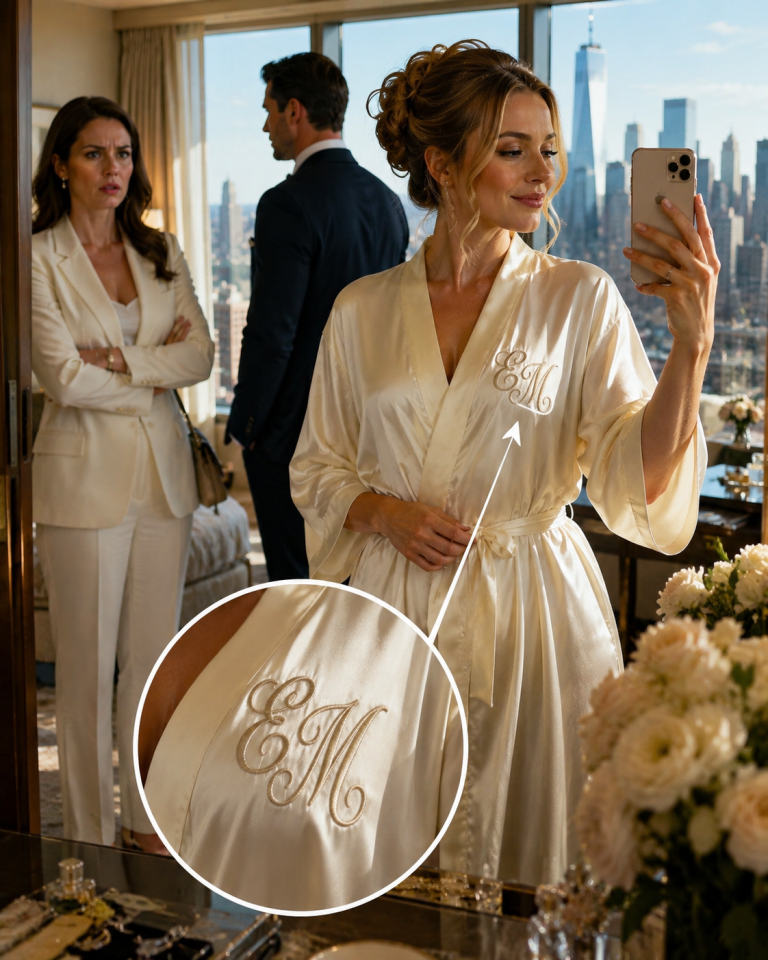
HE PAID SIXTY THOUSAND DOLLARS FOR MY MOTHER’S FACE — THEN THE CLERK ASKED WHOSE NAME WAS ON THE CARD

# Part 1: The Frame She Never Chose
The smell hit me before the humiliation did — beeswax polish, old cigar smoke soaked into velvet drapes, and underneath it, the river. New Orleans always smells like the river, even indoors, even in a gallery three blocks from the water where nothing has flooded in a decade.
My fingers found the stem of a champagne glass I had no intention of drinking. Across the room, under a track of soft gold light, my mother’s face watched the ceiling like she was waiting for rain.
Someone laughed too loudly near the back. I didn’t turn.
There was a hairline crack running through the varnish just above her left eyebrow, put there twenty-two years ago when I dropped the painting moving apartments after the funeral. I used to trace it with my thumb when I was homesick. Nobody else in that gallery had ever noticed it. Nobody else had earned the right to.
My husband’s hand rested on his own knee, not mine. That told me everything I needed to know about the evening before it had even started.
His name was Julian Voss, and I had married him believing love could survive money the way a candle survives wind if you just cup your hands around it long enough. I was wrong about the cupping. I was wrong about the wind.
Beside him sat his aunt, Dorothea Voss-Allain, a woman who wore her jewelry like scripture and quoted her late husband’s business philosophy the way other people quote the Bible. Dorothea had never once called me by my first name. To her I was “the girl Julian married,” as if marriage were something that had happened *to* him, an accident of weather.
And three seats down, in a dress the color of a struck match, sat Camille Reyes.
Camille had been introduced to me at a hospital gala as Julian’s “creative director.” By the time the magnolias bloomed that spring, she was in his calendar every Tuesday at four. By summer, she was wearing my late grandmother’s opal ring to a fundraiser and calling it “a piece I found in an estate sale, isn’t it wild.”
I hadn’t said a word about any of it. Not one word. In the Voss house, silence wasn’t submission. It was inventory.
My name is Adaline Boucher Voss. I grew up in a shotgun house in the Bywater with a mother who cleaned linens at three different hotels and painted her own face onto canvas once, in her thirties, with the last of her savings, because she said a woman should know what she looked like before the world finished telling her.
She died when I was nineteen. Ovarian cancer, diagnosed too late because she couldn’t afford the scan a year earlier. I promised her, sitting in a plastic chair that smelled like hand sanitizer, that I would never let anyone shrink me the way this city had shrunk her.
Seventeen years later, in a black dress that cost more than she’d made in a month, I was starting to wonder if I’d kept that promise or simply postponed breaking it.
“Lot Fourteen,” the auctioneer announced, a reedy man named Thibodeaux with a voice like a trumpet held underwater. The screen behind him bloomed with a photograph of her face. “Portrait of Yvette Boucher, oil on canvas, unsigned, provenance private. A rare piece with considerable local interest.”
*Private.* The word should have meant something. It didn’t, not tonight.
The painting had lived in our sun-room since Julian insisted I bring “some of my things” into the Voss family compound, so the house would feel like it belonged to both of us. I should have known a house doesn’t belong to you because your mother’s ghost is allowed to hang on its wall. It belongs to you when your name is on the paperwork.
Mine wasn’t. Not according to Julian. Not according to Dorothea. That was about to become the most expensive assumption either of them ever made.
“Opening bid, twenty thousand,” Thibodeaux said.
A paddle went up before the number had finished leaving his mouth.
Number 82. Mine.
It had been resting by my glass ten minutes earlier. I hadn’t seen a hand take it. I only saw Camille holding it now, two fingers curled around the edge like she’d been born gripping things that weren’t hers.
A murmur rolled through the room, soft as a held breath. Julian didn’t look surprised. Dorothea’s mouth curved at the corner, the particular smile of a woman watching a plan she’d funded come to life.
That was the moment I understood. This wasn’t an accident. This was a performance, and I had been given a front-row seat to my own unraveling — except no one in that gallery had checked whether I still knew my lines.
“Twenty thousand,” Thibodeaux called, pointing toward Camille. “Do I hear twenty-five?”
I turned to Julian. My voice came out quieter than I meant it to. “Why does she have my number?”
He didn’t look at me. “Don’t make a scene, Adaline.”
*A scene.* The word men like Julian used whenever a woman’s grief became inconvenient timing.
Camille lifted the paddle again before anyone else could bid, and somewhere behind my ribs, something didn’t break. It went still. There’s a difference. Breaking is loud. Stillness is where a woman starts calculating.
“Thirty thousand,” Thibodeaux sang out, delighted the room had energy tonight.
Dorothea leaned across Julian, her pearls catching the light. “Adaline, dear, don’t be theatrical. That painting has always looked a little sad in your rooms. It might do better somewhere with more light.”
Camille laughed as if it were the wittiest thing she’d ever heard.
My mother’s painted eyes stayed fixed on the middle distance, brave and unbothered, the way she’d looked at everything toward the end — hospital ceilings, unpaid bills, me.
I thought of her voice from that plastic chair. *Don’t let pretty rooms fool you, baby.* At nineteen I thought she meant houses. At thirty-six, watching a woman in borrowed jewelry raise my paddle over my dead mother’s face, I finally understood she’d meant people.
Another bidder lifted a card from the back — an antiques dealer I recognized from the historic district. “Thirty-five,” Thibodeaux called.
Camille snapped my paddle straight into the air like she was swatting a fly. “Fifty thousand.”
The room exhaled all at once. Julian’s jaw tightened — not from watching me humiliated, I realized, but from watching the number climb past what he’d budgeted for tonight’s theater. Dorothea saw it too.
“Camille,” she called lightly, threading warning through honey, “pace yourself, darling.”
*Darling.* The mistress had been promoted to family vocabulary.
I looked down at my own hands, resting in my lap. They were steady. That surprised me more than anything else that had happened all evening. For eleven years of marriage I had feared exactly this kind of room — raised voices, long silences used as punishment, the particular exhaustion of apologizing for things I hadn’t done because peace in a rich man’s house is often just obedience wearing better shoes.
But something had run out in me. Maybe it was the crack in the varnish only I had ever noticed. Maybe it was watching Camille wear my grandmother’s opal like she’d earned it through sheer proximity to cruelty. Maybe I had simply spent the last ounce of fear I had.
“Seventy thousand,” the antiques dealer called.
Camille raised my paddle immediately, chin lifted, savoring it. “One hundred thousand dollars.”
The room gave a soft collective gasp, the sound Savannah — no, New Orleans — reserved for weddings, funerals, and a wife discovering the truth in public, three events this city has always treated as the same genre of entertainment.
Camille looked at me directly then. She wanted tears. She wanted me on my feet, begging, proving every unflattering story Julian must have told her about his fragile, unstable, impossible first wife.
I gave her nothing. I reached for my champagne glass, touched the cool stem, and didn’t drink.
I thought instead about the night Julian proposed, on the levee at sunset with my mother’s portrait borrowed from storage and hung behind us in a gallery he’d rented for the evening. *I want all your memories inside my life,* he’d said. I had believed him completely. That is always the most humiliating part of betrayal — not the betrayal itself, but the memory of how sincerely you once trusted the person delivering it.
“Adaline,” Julian murmured, still facing forward. “Don’t.”
Just that. Not *don’t cry.* Not *don’t worry, I’ll fix this.* Just *don’t* — as if my reaction, and not his silence, were the problem tonight. As if the last thing he still controlled was how I chose to respond, and he intended to keep it that way.
Camille raised the paddle once more. “One hundred and twenty-five thousand.”
The dealer in back lowered his card and didn’t lift it again.
The room waited. Camille tilted her head toward the portrait, then toward me, and the message in her eyes was as childish as it was brutal: *I can take what you love, and you will sit there and watch me do it.*
I wondered, almost gently, if she understood she wasn’t the first woman Julian had used this way. I doubted it. Some lessons only arrive after the fire has already reached you.
# Part 2: The Number on the Card
Julian had started disappearing long before Camille had a name. First in small ways — he stopped asking about the reading program I’d built out of a Bywater church basement into four funded sites across the parish. He stopped calling me Ada. Then in larger ways: nights at the office that smelled like someone else’s perfume, a second phone that buzzed once in his coat pocket with a message reading *she suspects less than you think.*
When I found it, he didn’t deny holding the knife. He only complained about my fingerprints on the handle. “You always imagine yourself in some tragic novel,” he’d said, standing in our kitchen while I stood barefoot on marble cold enough to numb my feet.
His family had backed him instantly, the way old money always closes around itself like a fist. Dorothea called me sensitive. His cousin suggested therapy over brunch, sliding a card across the table like an eviction notice with better manners.
The only person who never accepted their version of me was my attorney, Josephine Arceneaux — seventy-three years old, barely five feet tall in her orthopedic heels, and the most frightening woman I have ever loved. She’d handled my mother’s small estate years ago and had never once let me forget that paperwork outlives feelings.
“Keep records,” she’d told me the first time Julian froze me out of an account. “You won’t need them until you need them badly.”
So I kept records. Three months before that auction, Josephine called me on a rain-soaked Tuesday and told me to sit down. Julian’s family compound, it turned out, wasn’t fully his — his grandfather had structured the estate through a trust with unusually strict marital clauses. My “routine spousal acknowledgment,” signed years earlier without a second glance, had triggered an amendment Dorothea never expected anyone to actually read.
If Julian committed marital fraud. If he diverted trust assets to conceal an affair. If a third party assisted in the misuse of protected property. If public harm came to the spouse named in that clause — control of the residence could pass, temporarily, to that spouse, pending divorce.
The spouse named was me.
So when the gallery called to confirm whether I’d authorized the sale of my mother’s portrait, I didn’t scream. I asked them to send everything in writing. The consignment form arrived with Julian’s signature, Dorothea’s initials beneath it, and next to the item description, in tidy block letters: *Client confirms spouse does not object.* Signed by Camille Reyes, listed as “family representative.”
I could have stopped the sale that same afternoon. Instead, I called Josephine.
She was quiet a long moment. Then she said, “Let them proceed.”
“Why?”
“Because private cruelty is nearly impossible to prove.” A pause, the sound of her setting down a coffee cup. “Public cruelty signs its own affidavit, Adaline.”
So I went to the gallery. I wore black. I let Julian seat me like a well-trained wife, let Dorothea kiss the air beside my cheek, let Camille walk past me wearing my grandmother’s opal like a trophy she’d already claimed.
And when my paddle disappeared from beside my glass, I didn’t reach for it.
I waited.
At the podium, Thibodeaux lowered his gavel mid-motion. His assistant leaned close and whispered something that made his glasses catch the light strangely. He looked down at the registration screen, then back up toward the room.
“Excuse me,” he said, “there appears to be an issue with paddle number 82.”
# Part 3: What the River Gives Back
For the first time all evening, Camille looked ordinary. Not radiant. Not victorious. Just a woman holding something in front of two hundred witnesses that had never belonged to her.
“I’m sure it’s a clerical mix-up,” she said, laughing a beat too fast.
Thibodeaux’s smile didn’t return. “Ma’am, this paddle is registered to Mrs. Voss, not to the bidder holding it.”
Every face in the room turned toward me. This was the moment they’d built the whole evening around — the moment they expected humiliation to make me messy, to make me the fragile, dramatic first wife Julian had spent a year describing to anyone who’d listen.
I stood instead. The legs of my chair whispered against the floor.
“No,” I said. One syllable, clean as the crack in that varnish. “I didn’t authorize this bid.”
Camille’s face flushed. “Adaline, don’t be ridiculous.”
Dorothea hissed for me to sit down. Julian reached for my wrist under the table; I moved before his fingers closed around air.
Thibodeaux cleared his throat. “Then we cannot accept the bid under this number.”
“I can pay myself,” Camille snapped, her voice cracking at the edge before she caught it and softened into a smile. “I mean — Julian can verify the funds.”
Julian’s face went the color of the tablecloth. That was his second mistake of the night. The first had been letting someone steal a paddle. The second was letting his own name land in a room gone this quiet.
From the back, a voice cut through before Thibodeaux could respond. “And tonight, it may verify a deposition, too.”
I didn’t need to turn around. I knew that voice. Josephine walked the center aisle in a navy suit, a leather folder tucked under one arm, flanked by a compliance officer from the gallery and a representative from the Voss family trust — a compact, exhausted-looking man named Perrault who had clearly spent his entire career explaining consequences to people who assumed money made them exempt from having any.
“Mr. Thibodeaux,” Josephine said, “I believe your office received notice this lot is subject to an ownership dispute.”
“At six-fifteen this evening,” he confirmed. “Yes, ma’am.”
“Signed by whom?” Josephine asked, opening her folder toward the compliance officer.
His eyes moved from Julian, to Dorothea, to Camille, and the room understood before anyone said a word aloud.
“Ms. Reyes,” Josephine said, turning, “did you sign a document stating you were authorized to represent Mrs. Voss in the sale of this painting?”
Camille’s chin lifted, defensive out of habit rather than conviction. “I signed what Julian’s office gave me.”
“Sloane — stop talking,” Julian said, and caught himself on the wrong name entirely, a slip so small and so telling that a woman two rows back actually laughed before remembering she was afraid of Dorothea.
Josephine’s eyes moved to the opal ring catching the light on Camille’s hand. “And is that Mrs. Voss’s grandmother’s ring?”
Camille’s fingers curled instinctively toward her palm. “No.”
I said nothing. I opened my small clutch and set an appraisal document on the table — serial number, insurance photograph, my grandmother’s looping signature on the original bill of sale from 1961.
Dorothea’s composure finally slipped. “For heaven’s sake, Adaline, it’s a ring.”
I looked at her fully for what felt like the first time in eleven years. “No, Dorothea. It’s inheritance.”
The word changed the temperature of the room the way it always does with families who’ve spent generations mistaking wealth for character. Grief, they can mock. Love, they can dismiss. But inheritance is a language they were all raised to respect, even when they hate what it’s telling them.
Julian stepped toward Josephine. “You had no right to stage this.”
She tilted her head, unbothered. “Stage it? I believe your family handled the staging, Mr. Voss. I only brought the paperwork.”
She set down a second document — the trust amendment — and then, last, a cream envelope sealed with a small pressed magnolia in red wax. My chest tightened before my mind caught up to why.
I knew that seal. My mother had used it on the backs of birthday cards when I was small, back when we couldn’t afford stamps that matched the occasion, so she made the occasion match the wax instead.
“This,” Josephine said gently, “is a letter from Yvette Boucher to her daughter.”
The room disappeared around me. For a moment I was nineteen again, sitting in a plastic chair that smelled of hand sanitizer, holding my mother’s hand while rain streaked a hospital window.
“Mrs. Boucher left instructions,” Josephine continued, “that this letter be opened only if someone attempted to sell, damage, or remove the portrait from her daughter’s possession without her consent.”
My mother had known. Not about Julian specifically, not about Camille, not about opals or paddles or amber gallery light. She had known, the way women who clean other people’s linens for a living often know before anyone tells them, that the world sometimes looks at a daughter’s grief and sees an asset with a resale value.
“Read it,” I said, before Julian could suggest privacy as another kind of leash. “Here.”
Josephine broke the seal. The sound was small. It felt enormous.
*My darling Ada,* she read, and my knees nearly gave at the nickname — no one in the Voss compound had called me that in eleven years; they had trained even my name to stand up straighter, to sound less like a woman who grew up over a shrimp cannery.
*If you’re hearing this, someone mistook what I left you for something they could price.*
A woman two rows back pressed a hand to her mouth.
*This portrait isn’t valuable for the paint or the frame or what it might fetch under gallery lights. It’s valuable because it watched you grow. It watched you spill coffee on the rug and blame the cat. It watched you dance in your socks when you thought no one could see. It watched you stay kind in a house that could have made you hard, and baby, I know houses like that. I cleaned them for a living.*
*If anyone ever tries to take this from you, let them reveal themselves completely before you say a single word. Don’t beg. Don’t perform your grief for people who’ve already decided not to understand it. Stand still. Let the truth walk into the room on its own, and when it’s finished speaking, take your life back without apologizing for how long it took you.*
Josephine folded the letter but didn’t put it away. “There’s a legal portion as well,” she said, and nodded to Perrault.
He stepped forward, adjusting his glasses. “Julian Marcus Voss. As of 7:51 this evening, the trustees have voted to suspend your discretionary control of the family compound and two associated operating accounts, pending review of misused trust assets, misrepresentation involving a spouse beneficiary, and an attempted unauthorized sale of protected personal property.”
Dorothea’s hand found the back of her chair. “You cannot do that.”
“We can,” Perrault said. “We have.”
Josephine turned to Julian last. “Additionally, Mrs. Voss filed for divorce this afternoon in Orleans Parish.”
Something left Julian’s face that wasn’t quite sadness. It looked more like the particular disbelief of a man who has never once, in his entire life, been told no by someone he assumed had no leverage to say it.
“You think you can humiliate me in public and walk away with the house?” he said.
“No,” I told him, and let the whole room hear it. “I think you humiliated yourself in public, and lost access to a house you never bothered to actually understand.”
Dorothea rounded on me, stripped finally of every ounce of polish. “You ungrateful — you came into this family with nothing. A dead mother. A cleaning woman’s daughter. We gave you a name.”
I looked past her, to the portrait, to the crack above the eyebrow only I had ever noticed. “No,” I said. “You borrowed mine. My mother’s name funds three reading rooms in this parish now. My father paid off every debt this city ever whispered about at his own funeral. And your nephew needed my signature to keep pretending he owned what his grandfather locked away from him on purpose.”
Camille, very slowly, unclasped the opal ring and set it beside the appraisal papers, her hands shaking. “I didn’t know,” she whispered.
I believed her. Partly. She had known he was married. She hadn’t known she’d be sent first into the fire, alone, while he stood behind her calculating the cost of the theater rather than the cost of her exposure. That was her lesson to carry, not mine to soften.
Thibodeaux cleared his throat into the microphone. “Given the circumstances, Lot Fourteen is withdrawn.” He looked at me, not at Julian. “Mrs. Voss, the portrait will remain secured until released to you or your representative.”
“Thank you,” I said.
Julian laughed once, hard and hollow. “You planned this whole evening.”
I thought about the girl beneath the portrait in the Bywater. The wife in the cold marble kitchen. The woman who had just watched a room full of strangers learn her mother’s handwriting.
“No,” I said. “I survived long enough to be ready when it finally came looking for me.”
—
The divorce took just over a year. Julian fought everything, the way men who claim to want peace usually mean they want surrender delivered quietly and on schedule. Camille, to her lasting credit, stopped protecting him the month he stopped paying her studio rent. Her deposition wasn’t noble, but it was useful — she confirmed the sale had been framed to her as “closure Adaline needed,” that Dorothea had joked about “trimming her out of the family portrait,” and that the paddle had been lifted from my table on purpose, timed to the exact minute Julian knew Josephine wasn’t yet in the building.
I wore my grandmother’s opal to the final mediation. Not for spite. For clarity.
In the settlement, I kept the compound for five years under the trust’s charitable-use provision. I converted the east wing into offices for the reading program. The old ballroom, where Dorothea had once hosted brunches for women she secretly despised, became a children’s library with a plaque beneath my mother’s portrait that mentions no one’s name but hers:
*Yvette’s Room. For every child who deserves to be watched over by someone who loved them first.*
People sometimes ask if I feel like I won something. The honest answer is complicated. Revenge is a hot thing to imagine and a quiet thing to actually hold. Real freedom turned out to be smaller than I expected — waking up and realizing no one in the house is punishing me with silence. Choosing my coffee because I want it, not because someone is grading how I take it. Laughing without checking the doorway first.
The auction paddle sits framed in my office now, behind glass, number 82 facing out. Visitors ask why I kept it. I tell them it reminds me that the very thing used to humiliate you can, if you let it, become the proof that finally sets you free.
They usually smile, unsure if I’m joking.
I’m not.
His mistress raised my paddle to buy my mother’s face. My husband told me to let the past go. His aunt said the portrait belonged somewhere with better light.
In the end, she was right. It did.
So I built one.