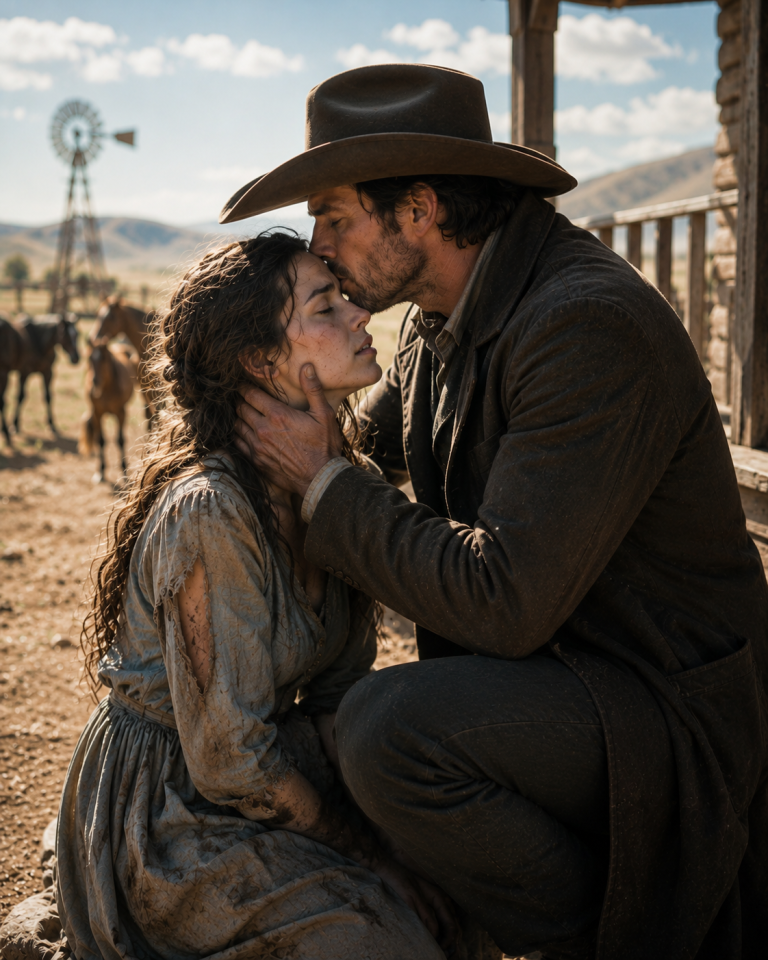
SHE ARRIVED IN WYOMING WITH A FAKE JOB OFFER, THREE BULLETS, AND NOTHING ELSE — AND EXPOSED THE THEFT THAT CHANGED EVERYTHING

## PART 1
The Chicago winter that killed Evelyn Hart’s father didn’t have the decency to be dramatic about it.
No sudden tragedy. No opera-worthy final words. Just three months of watching Thomas Hart shrink inside his own clothes while creditors knocked harder each week, their voices getting meaner through the door, until one February morning he simply didn’t wake up. The doctor said heart failure. Evelyn knew better. Her father had died of shame, buried under debts he’d spent twenty years accumulating while pretending the Hart family still mattered in a city that had long since forgotten them.
She was twenty-three years old, standing in a dress she’d already pawned and bought back twice, watching strangers auction off every piece of furniture her mother had picked out before the consumption took her six years earlier. The house on Webster Avenue — the one her father swore would always be theirs — sold for less than he owed on it.
By March, Evelyn Hart owned a worn leather suitcase, $43, her father’s revolver, and a fake letter promising her a position that didn’t exist.
She didn’t know it was fake yet.
—
The journey took six days by rail. Chicago to Omaha, Omaha to Cheyenne, then a smaller line that rattled north through country that got emptier with each passing mile. The other passengers changed as they traveled. Well-dressed merchants gave way to rough miners, then soldiers, then men who didn’t offer any explanation for why they were heading into territory where civilization thinned out like butter scraped over too much bread.
One of them, a man with tobacco-stained teeth and hands that kept drifting toward Evelyn whenever the train swayed, had tried talking to her outside Cheyenne.
*”Heading to Sweetwater alone?”* His smile didn’t reach his eyes. *”That’s ambitious for a lady.”*
*”I can manage.”*
*”You carrying anything valuable?”*
Her hand had moved to her handbag, where the revolver sat loaded. *”Nothing worth dying over.”*
He’d laughed. But he’d also moved to a different car.
—
Sweetwater Station wasn’t really a town — just a collection of wooden buildings clustered around the rail line like they were afraid of the emptiness beyond. The stage coach office sat between a trading post and a saloon, both establishments looking like a strong wind might reconsider their existence.
The man running the stage line, a weathered individual named Pritchard, looked Evelyn up and down with the expression of someone calculating odds he didn’t like.
*”You sure about Black Hollow? That’s two days northwest. Rough country. Hayes don’t usually send for women.”*
*”I have a letter of employment.”*
He’d frowned. *”This got Hayes’s signature. Says the name right there. Don’t mean Coulter Hayes wrote it.”*
Evelyn had paid the fare anyway, watching her total savings diminish, trying not to think about what would happen if the job really didn’t exist. She’d told herself the thought was catastrophizing.
She had been catastrophizing correctly.
—
The ambush came on the second day, twenty minutes after the stage coach left a way station. A single shot cracked across the valley, then more — sharp, purposeful cracks that sent splinters flying from the coach’s wooden frame. The man with the rifle who’d been riding inside kicked open the door and got off two shots before something hit him hard enough to throw him backward. Blood sprayed across Evelyn’s dress. The preacher started screaming. The rifle clattered to the floor.
Evelyn grabbed it without thinking.
Her hands moved on instinct while her mind struggled to process what was happening. The coach hit something — a rock, a hole, maybe nothing at all — and suddenly they were tilting, tipping, rolling. Her head cracked against wood. The world spun in fragments of sky and ground and blood.
When she opened her eyes, the coach was on its side and Foster was gone. Just gone, his seat empty, the horse traces cut. The preacher was pinned and unconscious under the dead man with the rifle. Evelyn’s shoulder felt wrong — not broken, but wrenched hard enough that lifting her arm sent fire down her spine.
She pulled herself through the shattered door and saw them.
Five men on horses, moving down from the treeline with weapons drawn and faces covered by bandanas. One of them was laughing.
*”Looks like we got a survivor,”* he called. *”Pretty one, too.”*
Evelyn ran. Not heroically, not with any plan. Just pure animal panic driving her into the trees while bullets whipped past, thudding into bark and kicking up dirt. She made it maybe two hundred yards before her boot caught a root and sent her sprawling behind a boulder.
Blood ran down her temple. Her shoulder screamed. The rifle was empty.
Which left her father’s revolver. Three bullets. Five men.
The math wasn’t encouraging. She’d fired the gun exactly twice in her life — both times at bottles, and she’d missed both times.
*”Come on out,”* one of them shouted. *”We don’t want to hurt you. Just want to talk.”*
The lie was almost insulting.
She pressed her back against the stone and tried to remember how to breathe. This was how she was going to die. Not in Chicago, surrounded by familiar streets, but in Wyoming Territory behind a rock, killed by men whose names she’d never know for reasons that didn’t matter.
Her father’s voice echoed: *Hart women don’t run off to live among cowboys and savages.*
*”Should have listened,”* she whispered.
Then the valley exploded.
Not gunfire — something deeper, heavier. Thunder without clouds. The ground itself seemed to shake and the outlaws started shouting in confusion. Evelyn risked looking around the boulder and her breath caught.
Horses — not five, but *dozens* — pouring down from the ridge like a flood of muscle and fury. The riders wore no uniforms, carried no flags, but they moved with military precision, a wedge formation aimed straight at the outlaws like a spear.
At the front, on a black horse that moved like smoke made solid, rode a man who looked like he’d been carved from the same stone as the mountains.
He was tall — even sitting a stride, he looked tall — with shoulders that filled a dark coat and a hat pulled low over eyes that Evelyn couldn’t see clearly, but somehow felt watching everything. He held a rifle in one hand with the casual familiarity of someone who’d been born with it. And as he closed the distance to the outlaws, he never slowed.
The outlaws scattered, or tried to. The man on the black horse shot one of them without breaking stride. No hesitation, no warning. Just one fluid motion — rifle up, crack of gunpowder, man falling — and then he was past.
It was over in less than two minutes.
The man on the black horse dismounted with the economical grace of someone who spent more time in a saddle than on his feet, handed his rifle to one of his men, and walked toward Evelyn’s boulder.
She realized she was still pointing her revolver at him.
She lowered it quickly.
He stopped ten feet away and pushed his hat back just enough that she could see his face properly for the first time.
Coulter Hayes wasn’t handsome in any conventional sense. His face was too hard for that, carved by weather and circumstance into something more intimidating than attractive. Maybe thirty-five, maybe older — the frontier aged people in ways that made guessing difficult. Dark hair, darker eyes, a jaw that looked like it had never softened for a smile.
*”You hit?”*
His voice matched everything else. Deep, quiet, and carrying the kind of authority that didn’t need volume.
*”I don’t think so.”* She tried to stand and her legs disagreed. She sat back down hard. *”The others—”*
*”Driver’s gone. The other passengers.”* He said it without inflection. *”You’re the only one who made it out.”*
The words hit harder than they should have. She’d known. Of course she’d known. But hearing it confirmed made her stomach twist.
*”How did you—”*
*”We were moving cattle through the valley. Heard shots.”* Hayes glanced at the outlaws being rounded up, then back at her. *”You carry identification?”*
*”What?”*
*”Need to know who you are. For the report.”*
*”Report to who? There’s no law out here.”*
*”I’m the law out here.”* He said it like he was commenting on the weather. *”Now. Identification.”*
Evelyn fumbled in her bag with numb fingers and produced the letter. *”I was traveling to Black Hollow Ranch. I have a position there as a bookkeeper.”*
Hayes took the letter, read it in three seconds, and his jaw tightened almost imperceptibly.
*”No, you don’t.”*
*”What?”*
*”This letter is a forgery.”* He handed it back. *”I never sent for a bookkeeper. Don’t need one.”*
The world tilted again. Worse than the coach crash.
*”But it has your signature—”*
*”Has my name. That’s not the same thing.”* Hayes studied her with eyes that missed nothing. *”You came all the way from Chicago based on this.”*
*”Yes.”*
*”Alone.”*
*”Yes.”*
*”That was stupid.”*
The blunt assessment stung worse because he was right. Evelyn felt something crack inside her chest — the last remaining piece of composure that had kept her together through her father’s death, the debt collectors, the endless train ride, and nearly dying in a Wyoming canyon.
*”I know it was stupid.”* Her voice came out harder than intended. *”I’m well aware. But I didn’t have other options, and I’m excellent with numbers, and I thought—”* She stopped herself before the tears could start. *”It doesn’t matter what I thought.”*
Hayes watched her for a long moment. One of his men called something from the prisoners, and he held up a hand without looking.
*”You got money for a return ticket?”*
*”No.”*
*”Family back east? Anyone who’d take you in?”*
*”If I had any of that, do you think I’d be here?”*
The words came out sharper than smart. She waited for him to respond with anger. Men like him — powerful and used to obedience — didn’t appreciate sass from women with three bullets and no prospects.
Instead, Hayes just sighed. The sound carried the weight of someone solving a problem he didn’t want.
*”Can you ride a horse?”*
*”Yes. Not well, but I can stay on.”*
*”Good enough.”* He turned toward his men. *”Garrett, get one of the spare mounts ready.”*
He looked back at Evelyn.
*”Black Hollow’s four hours north. You can stay there tonight, and I’ll figure out what to do with you tomorrow.”*
*”I don’t need charity.”*
*”Wasn’t offering charity. Was offering shelter, which out here is just basic human decency.”* His expression didn’t change. *”You can accept it, or you can sit behind this rock and wait for the next stage coach. Which won’t come for five days. Assuming it comes at all.”*
*”Your choice,”* he said.
It wasn’t really a choice, and they both knew it.
—
—
## PART 2
Black Hollow wasn’t a ranch.
It was a kingdom.
The valley spread below them like something from a painting as they crested the final ridge — endless grass turned gold by the dying light, a river cutting silver through the center, and scattered across it all, more buildings than some towns Evelyn had passed through. The main house sat on a rise: three stories of timber and stone that looked like it had been built to withstand sieges. Around it clustered barns, bunkhouses, workshops, corrals full of horses, and what looked like a small store.
*”How many people work here?”* she asked quietly.
*”One hundred forty, give or take.”* Hayes didn’t look at her. *”During roundup, double that.”*
*”And you run all of it.”*
*”Someone has to.”*
They descended into the valley as lamps began lighting in windows. Ranch hands looked up from evening chores as they rode past — expressions mixing respect with something else, maybe weariness. Hayes acknowledged a few with nods but didn’t stop. The main house loomed larger as they approached. Up close, it was even more impressive: not ostentatious, but solid, built by someone who understood that frontier wealth meant security, not luxury.
Martha, the cook, took one look at Evelyn and her expression shifted to concerned efficiency.
*”Heavens. What happened?”*
*”Stage coach ambush,”* Hayes said. *”She needs food, a bath, and somewhere to sleep. Can you handle it?”*
*”Of course.”*
Hayes turned back to Evelyn. *”What about tomorrow?”*
*”Tomorrow we’ll talk. Tonight you eat and rest.”* He was already moving toward another room, pulling off his coat. *”That’s an order, not a suggestion.”*
Then he was gone.
—
The bath was the first genuinely good thing that had happened in days.
Evelyn soaked until the water cooled, watching dirt and blood swirl away, trying not to think about how close she’d come to dying.
Through the walls, she could hear male voices in another room. Hayes and some of his men discussing the ambush.
*”Brennan gang remnant,”* someone said. *”Thought we’d cleaned them out last year.”*
*”Obviously missed some.”* Hayes’s voice cut through, quieter but carrying absolute authority. *”Double the patrols.”*
Martha showed her to a small bedroom on the second floor. *”You’re safe here,”* she said at the door. *”Whatever happened today — Mr. Hayes won’t throw you out without making sure you’ve got somewhere to go. He’s hard. But he’s not cruel.”*
Evelyn collapsed onto the bed, fully clothed. Her last thought before sleep claimed her was that somewhere in Chicago, her father’s ghost was probably shaking his head at the mess she’d made of everything.
She dreamed of gunfire and falling and hands reaching for her through smoke.
She woke to morning sun streaming through unfamiliar windows.
And on the chair by the door: clean clothes someone had left for her while she slept.
She was still alive. She was still in Wyoming. And downstairs, the man whose name was forged on a letter that had ruined her life was waiting in his office, surrounded by ledgers that would turn out to be an even bigger disaster than she was.
—
## PART 3
—
The ledgers were worse than Evelyn had thought.
She discovered this three days into the job, sitting in a cramped office that smelled like old paper and mouse droppings. What Hayes had shown her during their first meeting was just the surface. Beneath that were months — years, actually — of creative bookkeeping that bordered on fiction.
*”This doesn’t make sense,”* she muttered, comparing two different ledgers that supposedly tracked the same cattle sale. One showed three hundred head sold to a buyer in Cheyenne for $42 each. The other showed two hundred eighty head at $38 each.
*”Which one is real?”*
*”Neither, probably,”* said a voice from the doorway.
Cooper, the foreman, leaned against the frame with his arms crossed. He was somewhere past fifty, with a face that looked like it had been assembled from spare leather and barbed wire.
*”Hayes’s cousin — the previous bookkeeper — had a drinking problem. When he was sober, the numbers were close to accurate. When he wasn’t, he just made things up that sounded reasonable.”*
*”That’s not bookkeeping. That’s creative writing.”*
*”Won’t argue with you there.”*
Cooper stepped into the office. *”Hayes wanted me to check if you needed anything. Supplies, clarification, whatever.”*
*”I need a miracle.”* Evelyn rubbed her temples. *”Or a time machine so I can go back and strangle whoever thought this system was acceptable. The tax assessors are coming in two and a half weeks, and I can’t give them numbers I don’t trust.”*
*”Can you fix it?”*
*”I can rebuild it from source documents if I can find them. Bills of sale, receipts, purchase orders. But that’ll take time.”*
*”Hayes keeps everything,”* Cooper said. *”File cabinets in the storage room behind the study. Plus boxes in the barn loft. Going back at least five years.”*
*”That’s actually helpful.”*
*”Don’t get too excited. It’s not organized.”*
*”Of course it isn’t.”*
—
Hayes appeared at dinner that evening for the first time in three days. He’d been out on the range dealing with broken fences and possible rustlers.
*”Cooper says you’re drowning in paperwork,”* he said without preamble, loading his plate.
*”I’m making progress. But your cousin’s recordkeeping was creative.”*
*”That’s diplomatic.”*
*”I’m trying to be professional.”*
*”Don’t bother on my account.”* He cut into his steak. *”He was a drunk and a terrible bookkeeper. I only kept him because my uncle asked me to, and I owed my uncle.”* A pause. *”Can you deliver accurate numbers before the assessors arrive?”*
*”Not in two and a half weeks. Not unless you want me to guess on forty percent of the transactions.”*
*”I don’t pay you to guess.”*
*”Then I need more time.”*
Hayes chewed, thinking. *”The assessors can be delayed. I’ll send word we had a personnel change.”*
*”Give me six weeks and I’ll have everything reconciled and organized.”*
*”Four weeks.”*
*”Five, and I’ll build you a new system that won’t fall apart the next time someone incompetent touches it.”*
Hayes almost smiled. Almost. *”Five weeks. Done.”*
Across the table, Cooper and Thomas exchanged glances. Evelyn had the sense she’d just passed some kind of test she hadn’t known she was taking.
—
Three weeks into the job, she found the theft.
It was hidden in a series of supply purchases from a merchant in Sweetwater named Dalton — invoices that looked legitimate, amounts that weren’t suspicious individually. But when Evelyn cross-referenced them against the delivery logs Cooper had helped her find, nothing matched.
The invoices showed $500 worth of supplies delivered in January. The delivery logs showed maybe $200 worth actually arrived. She found similar patterns in February, March, and April. Thousands of dollars paid for supplies that had never made it to the ranch.
She sat back, her stomach sinking.
This wasn’t incompetence or drunken recordkeeping.
This was theft.
She spent two more days verifying her findings, checking every number three times, making sure she wasn’t missing something obvious. Then she took the evidence to Hayes.
He was in the study going over maps with Thomas. They both looked up when Evelyn knocked.
*”This better be important. We’re in the middle of something.”*
*”Someone’s been stealing from you.”*
She set the ledgers on the desk. *”Systematically. For at least six months, possibly longer.”*
That got his attention.
Hayes listened without interrupting as she walked him through it — the invoices, the delivery logs, the pattern of discrepancies. His jaw got tighter with each revelation.
*”How much total?”*
*”Conservatively, four thousand dollars. Possibly more if the pattern extends back further than I’ve checked.”*
*”$4,000.”* Hayes’s voice was very quiet, which somehow made it more intimidating. *”And you’re certain it’s Dalton in Sweetwater?”*
*”The invoices have his signature. Either he’s involved or someone’s forging his name.”*
Evelyn paused. *”There’s something else.”*
*”Your cousin would have seen these discrepancies if he’d been doing his job. Either he was too drunk to notice, or—”*
*”Or he was in on it,”* Hayes finished, his expression turning glacial. *”Thomas — send word to Dalton. Tell him I want to meet regarding our supply contract. Routine business discussion. Don’t mention any problem.”*
He looked at Evelyn. *”Good work. This would have bled us dry over time.”*
*”That was probably the plan. Small enough amounts to avoid immediate notice. Large enough to add up.”*
*”Smart. Which means whoever’s behind it isn’t stupid.”* Hayes rolled up the maps. *”I’ll handle this.”*
*”I’d like to come with you.”*
Both men stared at her. Hayes recovered first. *”Why?”*
*”Because I found the theft and I know the numbers. If Dalton tries to dispute the evidence, I can counter him immediately.”*
*”This isn’t a debate, Miss Hart. This is potentially dangerous.”*
*”I understand that. But I’m still asking to come.”*
Hayes studied her for a long moment. *”You know how to use that revolver you carried when you arrived?”*
*”I know which end the bullets come out of.”*
*”That’s not an answer.”*
*”I can shoot. I’m not good, but I can shoot.”*
*”Good enough.”* Hayes looked at Thomas. *”Arrange it for tomorrow.”*
—
That night, unable to sleep, Evelyn went downstairs for water and found Hayes in the study, reading through her evidence by lamplight.
*”Can’t sleep either?”* she asked from the doorway.
*”Sleep’s overrated.”* He didn’t look up. *”You did solid work here. Most bookkeepers would have missed this pattern.”*
*”Most bookkeepers aren’t trying to rebuild a system from nothing.”*
*”True.”* Hayes finally looked at her. *”Why’d you really want to come tomorrow?”*
She considered lying, then decided against it. Hayes seemed like he’d spot dishonesty from a mile away.
*”Because I’m tired of being helpless,”* she said. *”The stage coach ambush. Arriving here with nothing. Spending weeks in an office while everyone else does the actual work of running this ranch. I know I’m useful with numbers, but I’m not used to being sheltered. It doesn’t sit right.”*
*”Most women would appreciate the shelter.”*
*”I’m not most women. If I were, I’d still be in Chicago trying to find a husband rich enough to solve my problems.”*
Hayes almost smiled again — that flicker of expression that never quite manifested fully.
*”Fair enough. But tomorrow you follow my lead. If things go bad, you do what I say without argument.”*
*”Agreed.”*
*”Good. Now go get some sleep. We leave at dawn.”*
—
Dalton’s office was cramped, dominated by a desk covered in papers and a man who looked up with a smile that didn’t reach his eyes. He was maybe forty, running to fat, with the kind of face that probably looked trustworthy to people who didn’t look too closely.
*”Coulter, this is a surprise—”*
*”We need to discuss some discrepancies in our accounts,”* Hayes said, his tone conversational but carrying an edge that made Dalton’s smile falter.
*”Discrepancies?”*
*”Miss Hart, would you explain?”*
Evelyn stepped forward, pulling out the documents she’d brought. *”For the past six months, your invoices show supplies delivered to Black Hollow Ranch totaling over four thousand dollars. However, our delivery logs show we received less than half that amount.”*
The color drained from Dalton’s face. *”There must be some mistake.”*
*”There’s no mistake,”* Hayes interrupted. *”I’ve verified the records personally. Either you’ve been sending invoices for supplies you never delivered, or someone’s been intercepting shipments.”*
*”Which is it?”*
*”I — I would never—”* Dalton stammered, his eyes darting between Hayes and the door. *”I swear.”*
*”Then who did?”*
Dalton’s mouth opened and closed. Sweat beaded on his forehead.
*”If I tell you, he’ll kill me.”*
*”If you don’t tell me, I’ll let the territorial marshal handle it, and they’ll hang you for theft.”* Hayes leaned on the desk. *”Quick death from whoever you’re protecting. Slow death from a rope. Or you tell me everything right now, and maybe I’m feeling merciful.”*
The silence stretched. Evelyn could hear her own heartbeat.
*”It was your cousin’s idea,”* Dalton finally whispered. *”Nathan. He approached me about eight months ago. Said Hayes was too busy to notice small discrepancies. Said if I inflated the invoices, we could split the difference. He’d sign off on the deliveries. I’d submit the invoices. Nobody would know.”*
Hayes’s expression didn’t change, but something in the room’s temperature dropped.
*”Nathan initiated this.”*
*”Yes, I swear. He said you’d never find out because you trusted him to handle the books.”*
*”Where’s Nathan now?”*
*”I don’t know. He left town three weeks ago. Said he was heading to Denver.”*
Hayes straightened slowly. *”Here’s what’s going to happen. You’re going to return every dollar you stole, plus twenty percent interest. You have two weeks.”*
*”I don’t have that much—”*
*”Then sell something. Your store, your house, your grandmother’s silver. I don’t care. Two weeks, or I file charges.”* Hayes turned toward the door. *”And Dalton — if I find out you warned Nathan or tried to contact him, I’ll come back. And we won’t be having a conversation.”*
They left him sweating in his office.
They were halfway back to Black Hollow before Hayes spoke again.
*”I should have seen it.”*
*”You couldn’t have known,”* Evelyn said. *”He was family.”*
*”I gave him a job because my uncle asked me to, and I trusted him because—”* Hayes stopped himself. *”Doesn’t matter. I was stupid.”*
*”You were loyal. That’s different.”*
*”Is it? Because from where I’m sitting, loyalty cost me four thousand dollars and almost got my ranch audited into the ground.”*
Evelyn didn’t have a good answer for that. They rode in silence until the valley came into view.
*”Thank you,”* Hayes said finally. *”For finding it. And for pushing to come today. You were right — having the numbers immediately available made the difference.”*
*”You’re welcome.”*
*”Don’t let it go to your head. You’re still the bookkeeper, not a ranch hand.”*
But there was something in his tone that suggested he was teasing rather than dismissing. And Evelyn felt an unexpected warmth in her chest that had nothing to do with the afternoon sun.
—
The territorial assessors arrived three weeks later.
The taller one, Garrison, studied Evelyn with undisguised skepticism. *”You’re the bookkeeper?”* He made it sound like an accusation. *”And you rebuilt these accounts from scratch in five weeks?”*
*”Six, actually. Mr. Hayes was generous with the deadline.”*
*”Generous.”* Garrison exchanged a glance with his colleague. *”Miss Hart, we’ve been auditing ranches in this territory for fifteen years. In that time, we’ve seen every kind of creative accounting imaginable. What we’re looking at is either legitimate reconstruction or very sophisticated fraud.”*
*”It’s legitimate.”*
*”The previous bookkeeper’s records are a disaster, and suddenly everything’s perfectly organized under your tenure.”* His skepticism bordered on accusation. *”That’s convenient timing.”*
Evelyn felt her temper spark.
*”The previous bookkeeper was a drunk who couldn’t add. I spent six weeks cross-referencing every transaction against source documents because the ledgers were worthless. If you’re suggesting I fabricated thousands of pages of receipts, invoices, and delivery logs, I’d love to hear your theory on when I found the time.”*
*”Miss Hart—”* Hayes started.
She was already moving to the file cabinets.
*”Here.”* She pulled out a box of receipts. *”Every cattle sale from January through March, organized by date and buyer. Here’s the corresponding bank deposits. Here’s the invoices for supplies, cross-referenced against delivery logs signed by ranch hands who can verify what actually arrived. And here—”* she dropped a ledger on the desk hard enough to make both assessors flinch— *”is where the previous bookkeeper recorded a sale of three hundred cattle that never happened, because he was too drunk to remember he’d already recorded it two weeks earlier.”*
The room was very quiet.
Garrison picked up the ledger and flipped through it. His colleague examined the receipts. After a long moment, Garrison looked up.
*”These source documents are legitimate.”*
*”Every single one. You’re welcome to verify them against bank records, bills of sale, anything you want.”*
More silence. Then Garrison sat down the ledger and actually smiled — barely, but actually.
*”Miss Hart, in fifteen years, I’ve never seen reconstruction work this thorough. If you ever want to work for the territorial government, I can make an introduction.”*
*”I’m happy where I am.”*
*”I can see why.”* He looked at Hayes. *”Your books are in order, Mr. Hayes. Better than in order, actually. You’re one of maybe three operations in the territory I can say that about.”*
After they left, Hayes leaned against the desk and looked at Evelyn with an expression she couldn’t quite read.
*”What?”* she asked.
*”You just browbeat two territorial assessors into submission.”*
*”They were questioning my work.”*
*”Most people would have been intimidated.”*
*”I’m not most people.”* Evelyn started reorganizing the papers the assessors had shuffled. *”Besides, the numbers don’t lie. Either they trust math or they don’t.”*
*”Remind me never to get on your bad side.”*
*”You’re my employer. You’re always potentially on my bad side.”*
Hayes actually laughed. A short, surprised sound that made him look younger.
*”Fair enough.”*
—
The territorial celebration arrived before Evelyn was ready for it.
Hayes had asked her to attend three weeks earlier, in his office, late at night, with the careful neutrality of a man who was being deliberately pragmatic about something that wasn’t.
*”People are already talking. You living at the ranch, riding into town with me. If I show up alone to the celebration, the gossip gets worse. If I show up with you, at least I’m controlling the narrative.”*
*”That’s very pragmatic.”*
*”I’m a pragmatic man.”*
*”And if I say no?”*
*”Then I go alone and deal with the gossip.”* A pause. *”Your choice.”*
Evelyn considered part of her — the part that sounded like her father — screaming that this was dangerous territory. Attending a social event as Hayes’s guest would cement her reputation as something more than just an employee, true or not.
But another part of her, the part that had come west with nothing and survived an ambush and rebuilt a ranch’s accounts from chaos, didn’t particularly care what people thought.
*”I’ll go,”* she said. *”But I’ll need something to wear. I can’t show up in work pants.”*
*”Tell Martha what you need. She’ll arrange it.”*
The dress arrived on a Tuesday — dark blue silk with black trim, elegant without being ostentatious, fitted enough to be flattering but practical enough that Evelyn could actually move. It was the nicest thing she’d owned since before her father’s death.
Looking at herself in the mirror made something twist in her chest.
*”You look like a lady,”* Martha said from the doorway.
*”I look like I’m pretending to be a lady.”*
*”Same thing out here. Nobody’s born to this. We all just figure it out as we go.”* Martha adjusted the dress’s shoulder. *”Mr. Hayes is going to have a heart attack when he sees you.”*
*”That’s not the goal.”*
*”Maybe not yours.”*
Hayes was waiting at the base of the stairs, wearing what was probably his best suit — dark, well-tailored, making him look less like a rough frontier rancher and more like someone who could buy and sell most of the territory without blinking. He looked up as she descended, and something in his expression shifted.
*”You clean up well,”* he said finally.
*”So do you.”*
*”I clean up adequately. You clean up dangerously.”* He offered his arm. *”Ready?”*
*”Absolutely not.”*
*”Good. Let’s go.”*
—
The celebration drew the entire territory. Ranchers and their wives, merchants and politicians, families who’d traveled a day to attend. Hayes’s arrival drew immediate attention — people stopped talking mid-sentence to watch their carriage roll past, dozens of eyes tracking their progress.
*”They’re staring,”* Evelyn muttered.
*”They’re always staring. Ignore them.”*
*”Easy for you to say. You’re not the scandalous woman living at the territory’s most powerful ranch.”*
*”True. I’m just the scandalous man who put her there.”*
Before Evelyn could ask what that meant, he tucked her hand into the crook of his arm and walked directly toward the largest cluster of people — ranchers and their wives, all dressed in their finest, all suddenly very interested in examining Evelyn like she was a curious specimen.
The introductions were calculated, she realized. Not *my guest* or anything that implied a personal relationship — just the professional connection stated clearly enough to draw a line, but ambiguous enough to keep people guessing. She handled the wives’ thinly veiled judgment with polished patience and fielded their questions about her background with the same efficient honesty she brought to disputed invoices.
Then Marcus Brennan stepped directly into their path.
He was younger than Hayes, maybe thirty, with the kind of polished appearance that suggested money and city origins. His smile was friendly, but his eyes were calculating.
*”Hayes, good to see you out among the common folk.”* His gaze traveled to Evelyn in a way that made her skin crawl. *”And who’s this lovely creature?”*
*”Miss Evelyn Hart,”* Evelyn said before Hayes could respond. *”And you are?”*
*”Marcus Brennan. My family owns several mining interests in the territory, plus the second-largest ranch after Black Hollow.”* He smiled. *”If you ever tire of frontier living, Miss Hart, my operation could use someone with your skills. I pay better, and the accommodations are far more comfortable.”*
*”I’m satisfied where I am.”*
*”For now. But the frontier teaches us that loyalties are negotiable.”* He walked away before Hayes could respond.
*”Who was that?”* Evelyn asked.
*”Trouble.”* Hayes’s jaw was tight. *”Marcus Brennan’s father, Jacob, ran the Brennan gang twenty years ago. Rustlers, thieves, occasional murderers. The territorial government finally cleaned them out. Marcus survived by distancing himself and building legitimate businesses.”*
*”You don’t trust him.”*
*”I don’t trust anyone who smiles that much. Means they’re hiding something.”*
When the music started and a young man named Daniel Pritchard asked Evelyn to dance, Hayes intercepted him with territorial efficiency.
*”You’re being ridiculous,”* Evelyn hissed after Daniel retreated.
*”I’m being protective. Different thing.”*
*”I don’t need protection from polite conversation.”*
*”You need protection from men who see a woman living at my ranch and think she’s available for courting.”*
*”Maybe I am available.”*
Hayes’s jaw tightened. *”Are you?”*
The question hung between them, loaded with implications neither of them was prepared to address. Evelyn felt her heart rate pick up and cursed herself for letting the conversation go this direction.
*”That’s not — I didn’t mean—”* She stopped, frustrated. *”This is your fault for being overbearing.”*
*”Noted.”*
But Hayes’s expression had shifted into something she couldn’t read, and he was quiet for the rest of the evening.
They danced once — Hayes asking before someone else could, leading with the same quiet competence he brought to everything. He was surprisingly good, better than someone who spent most of his time on a horse had any right to be.
*”You dance well,”* she said grudgingly.
*”My mother insisted I learn.”* A pause. *”She died when I was twenty. Never got to see Black Hollow.”*
It was the most personal thing he’d ever shared. Evelyn wasn’t sure what to do with it.
*”Your father,”* Hayes said. *”You never talk about him much.”*
*”There’s not much to say. He was charming and useless and spent my entire childhood pretending we were important. When he died, I felt relieved, which makes me a terrible daughter.”*
*”Makes you honest. That’s worth more than false grief.”*
They danced in silence for a moment, Evelyn acutely aware of how many people were watching. The most powerful rancher in the territory, dancing with his bookkeeper. Both dressed like they belonged together, moving with an ease that suggested this wasn’t their first time.
*”This is going to make the gossip worse,”* she said quietly.
*”I know.”*
*”People are going to assume—”*
*”Let them assume.”* His expression was unreadable. *”I stopped caring what people think about fifteen years ago. Makes life simpler.”*
*”Must be nice.”*
*”It’s practical. There’s a difference.”*
The song ended. Hayes released her, but didn’t step back immediately. For a moment they stood close enough that Evelyn could see the exact shade of his eyes in the lantern light — darker than she’d thought, with flecks of gold near the iris.
Then someone called Hayes’s name, and the moment broke.
—
Three weeks after the celebration, the rustlers arrived.
First it was fences cut and cattle scattered in the north pasture — twenty head missing, tracks suggesting four riders. Then they hit the Patterson ranch, thirty head and a man with a broken arm who’d tried to stop them.
The territorial ranchers called an emergency meeting. Evelyn attended because everyone suddenly wanted accurate cattle counts, and because by now it was simply assumed she went where Hayes went.
She was the only woman present.
*”This is the Brennan gang all over again,”* one rancher shouted.
*”Could be drifters, could be opportunists, could be organized,”* Hayes said. His voice cut through the chaos with quiet authority. Everyone turned to look at him. *”Professional rustlers don’t just steal cattle. They have buyers lined up, ways to move stock quickly. That takes planning and connections.”*
When he looked at Evelyn with a gesture toward the poorly organized ledgers spread across the table, she found herself at the table with six ranches worth of records, cross-referencing sales data that ranged from meticulously recorded to barely legible.
Two hours later, she found something.
*”Here.”* She pointed to a series of sales. *”Patterson sold fifteen head to a buyer in Cheyenne three weeks ago. The buyer’s name is listed as J. Morrison. But Morrison Ranch is right over there, and his first name is Charles.”*
She pulled out another ledger. *”And here — Black Hollow sold twenty head to the same Jay Morrison two months ago. Except we never received payment, and when I tried following up, the address didn’t exist.”*
The room went quiet.
*”Someone’s using fake buyers to hide stolen sales,”* Hayes said slowly. *”They hit a ranch, move the cattle, file fake paperwork showing a legitimate sale to cover the theft.”*
*”That’s bold.”*
*”That’s smart. Without cross-referencing between ranches, nobody would catch it.”*
He looked at Evelyn with something like admiration. *”How’d you spot it?”*
*”The handwriting.”* She showed them. *”Same person filled out both sales records. You can see the distinctive way they write the letter M. Different ranches, different dates, but the same hand.”*
*”Which means someone inside the ranching community is facilitating this,”* Cooper finished.
The accusations started immediately. Ranchers turned on each other, suspicions flying, old grudges resurfacing.
Hayes let it go for about thirty seconds before slamming his hand on the table hard enough to make everyone jump.
*”Enough.”* Absolute authority. *”Pointing fingers at each other is exactly what they want. United, we’re too strong to rob. Divided, we’re easy targets.”*
He looked around the room. *”We find the fake buyer. Track every Jay Morrison sale in the territory. See where the cattle actually ended up. Follow that trail — we find the rustlers. But it requires real cooperation. Who’s in?”*
Nobody argued.
—
They rode back to Black Hollow in the dark, and halfway home, one of the advanced riders came galloping back.
*”Smoke. Coming from the direction of the ranch.”*
Hayes didn’t waste time with questions.
The barn was fully engulfed by the time they arrived, flames shooting through the roof, orange against the night sky. Ranch hands had formed a bucket line from the water trough, but the fire had too much of a head start.
Evelyn jumped from the wagon before Thomas stopped it and followed Hayes toward the fire.
*”How’d it start?”* Hayes demanded.
*”Don’t know. We were in the south pasture. Came back to find it burning.”*
Hayes made a decision instantly. *”Everyone back. Let it burn. Focus on keeping it from spreading.”*
It took three hours to contain. By the time the flames finally died, the barn was a smoking skeleton, and everyone looked like they’d aged years.
Cooper approached. *”We found bootprints near the fire. Same size as the ones from the fence cutting.”* He held up a piece of torn cloth — red and black plaid. *”Same fabric as before.”*
*”Not a coincidence,”* Hayes said quietly. *”A message.”*
He turned away from the ruins. His expression was harder than Evelyn had ever seen.
*”I want every man armed and on rotating watch. Nobody goes anywhere alone.”* He looked at Evelyn. *”I want you to stay inside the main house unless absolutely necessary.”*
*”I’m not hiding.”*
*”I’m not asking you to hide. I’m asking you not to make yourself an easy target.”* His tone softened slightly. *”Whoever did this knows you exposed their fake sales. That makes you a problem they might want to eliminate.”*
The blunt assessment sent ice through Evelyn’s stomach. She’d been thinking about the investigation as an intellectual puzzle, not as something that could get her killed.
*”Please,”* Hayes said. *”Just until we sort this out.”*
It was the first time he’d used that word with her. Just the one syllable, but it carried weight that his orders never did.
*”Fine,”* she said. *”But I’m not stopping work.”*
*”Didn’t expect you to.”*
—
Three nights later, the attack came.
Evelyn woke to gunfire and shouting. She grabbed her father’s revolver from the nightstand and ran to the window. In the yard below: men on horseback firing at the house, ranch hands returning fire from defensive positions, and everywhere the orange flicker of torches being thrown at buildings.
They were trying to burn Black Hollow to the ground.
Downstairs, Hayes was already coordinating the defense despite Martha’s protests about his recent stitches — an injury from a meeting in Sweetwater that had turned into a gunfight, because apparently everything in Wyoming Territory eventually turned into a gunfight.
He saw Evelyn and his jaw tightened.
*”I told you to stay upstairs.”*
*”I don’t take orders.”*
*”Evelyn, please.”*
There it was again. *Please.* Not *this is a command*. Not *you’ll do what I say.*
*”I can’t focus if I’m worried about you getting shot,”* he said, and that was the most honest thing he’d said about his feelings yet, even wrapped in practical concern.
She moved to the interior hallway, staying out of the direct line of fire. Close enough to see what was happening.
The fight was brutal but short. Black Hollow’s defenders outnumbered the attackers and had better positions. Within twenty minutes, the raiders were retreating. One of the barns was burning again, but the hands had it under control quickly.
When the gunfire finally stopped, Cooper approached with something that made his expression go dark.
It was a contract, signed by Marcus Brennan, promising $500 to anyone who successfully destroyed Black Hollow’s main house or killed its owner.
*”He put a price on your head,”* Evelyn said quietly.
*”He put a price on my ranch. I’m just part of the package.”* Coulter stared at the burning barn. *”This ends now. Tomorrow we’re going to his operation and we’re ending this.”*
*”That’s not a plan. That’s revenge.”*
*”Sometimes they’re the same thing.”*
*”I know you’re going to argue about coming along.”*
*”I’m coming along.”*
Hayes looked at her for a long moment. *”You follow my orders exactly.”*
*”Agreed.”*
—
They rode out as pink light touched the eastern horizon. Coulter, Evelyn, Cooper, Thomas, and twenty armed ranch hands who looked like they’d rather be doing this than anything else.
Brennan’s guards were posted, but not enough. They’d gotten comfortable thinking Black Hollow would stay on the defensive. That was their mistake.
Coulter rode forward into the yard, and Evelyn rode beside him despite his glare.
*”I said stay back.”*
*”You said I could come. You didn’t say I had to hide.”* She kept her voice steady. *”Besides, I have the evidence. If Brennan tries to deny anything, I can prove it.”*
*”This isn’t a business meeting.”*
*”No, it’s a reckoning. But it’s still about what I found in those ledgers.”* She looked at him. *”Let me finish what I started.”*
Coulter studied her. Then nodded once.
Marcus Brennan appeared on the porch looking surprised but recovering quickly into a smile that didn’t reach his eyes.
*”Hayes — didn’t expect a visit so early. And you brought your bookkeeper.”*
*”I brought proof that you’ve been running a rustling operation that’s stolen from every major ranch in the territory,”* Coulter said. *”I brought documentation of your fake buyers, your intermediaries, and your involvement in last night’s attack on my property.”*
*”That’s a serious accusation.”*
*”It’s a fact.”* Evelyn held up the papers. *”I have the sales records, the handwriting analysis, and a contract you signed hiring men to destroy Black Hollow. Want to deny any of it?”*
Brennan’s smile finally faded.
*”You can’t prove—”*
*”I can prove all of it. And I already sent copies to the territorial marshal, the governor’s office, and every stockyard that was receiving your stolen cattle.”* She felt strangely calm despite the guns aimed in her direction. *”Your operation is finished. The only question is whether you surrender peacefully or make this worse.”*
The silence stretched.
Brennan looked at the armed men surrounding his property. Looked at Coulter. Looked back at Evelyn. Something collapsed behind his eyes.
*”Fine,”* he said quietly. *”You win.”*
And then his hand went to a concealed weapon.
Cooper shouted a warning. Evelyn’s horse spooked sideways. Coulter was suddenly between her and Brennan, his own gun coming up.
The shots were nearly simultaneous. Brennan went down, blood spreading from his chest. Coulter stayed standing, but his left side was bleeding again, and his expression showed pain he couldn’t hide.
*”Coulter—”*
*”I’m fine.”*
He wasn’t fine. He was swaying slightly, and his voice had gone tight in that way that meant he was hurting worse than he’d admit. She got him sitting down before he fell down, pressing cloth against the wound.
*”You couldn’t just let your men handle him,”* she said, fear making her voice sharper than intended.
*”He was drawing on both of us. Mostly you.”* Coulter’s eyes were slightly unfocused. *”Couldn’t let that happen.”*
*”So you threw yourself in front of a bullet again.”*
*”Didn’t throw myself anywhere. Just moved faster.”* He tried to smile and didn’t quite manage it. *”Besides, he missed.”*
*”He didn’t miss. You’re bleeding.”*
*”Barely. Just reopened the old wound.”*
His hand covered hers where she was pressing the cloth.
*”I’m okay,”* he said. *”Really.”*
—
He wasn’t okay.
But he was alive, which was more than Brennan could say, and probably more than Coulter deserved given his habit of using his body as a shield.
Martha restitched the wound with the efficiency of someone who’d expected this outcome and the lecture of someone who hadn’t accepted it. After she finished and swept out, Evelyn sat across from Coulter in the study, both of them too tired to move.
*”Before you came here,”* he said finally, *”I had this ranch and nothing else. It was enough. Or I told myself it was enough.”*
Evelyn waited.
*”And then you showed up and started reorganizing my books and arguing with me and making me realize that maybe it wasn’t enough. Maybe I’d just been too afraid to want more.”* He met her eyes. *”I need you to know that before I lose the nerve to say it.”*
It was the most emotionally vulnerable she’d ever seen him.
*”I’m not leaving,”* she said quietly. *”I already told you that.”*
*”I know. But I’m asking you to stay for a different reason now. Not because of the job or the ranch or any practical consideration.”* He reached for her hand. *”Stay because I’m asking you to. Because I want you here. Because—”*
Evelyn kissed him before he could finish the sentence.
Partly because she wanted to. Partly because watching him struggle through emotional honesty was too painful to endure.
He responded immediately, and she pulled back before he could hurt himself worse.
*”Your stitches.”*
*”Don’t care about the stitches.”* He was smiling for real now — the expression transforming his usually serious face into something younger and lighter. *”But I care about the answer to my earlier question.”*
*”Are you available?”*
*”Yes.”* The word came out without hesitation this time. *”Yes. I’ve been available. I was just too stubborn and scared to admit it.”*
*”That makes two of us.”*
They sat together in the study as the house settled around them, her hands in his, and Evelyn realized that somewhere between the ledgers and the investigations and the near-death experiences, she’d stopped thinking about Black Hollow as a temporary refuge.
She’d started thinking of it as home.
Not the ranch itself, though she’d grown to love the valley and the vast empty spaces. The man who’d built it. The life they’d accidentally started building together.
—
The territorial marshal arrived two days later to officially close the case against Brennan’s operation. Thirteen of his men were arrested for rustling, theft, arson, and attempted murder. His business interests were seized to pay restitution. Black Hollow’s share came to nearly $8,000 — more than the cattle had been worth, but reflecting punitive damages for the attacks.
*”What will you do with it?”* Evelyn asked, helping Coulter review the settlement documents.
*”Rebuild the barns properly. Expand the herd.”* He looked at her. *”And I want to establish a fund for frontier education. Teachers, supplies, maybe a small school. The territory is growing. We need to grow with it.”*
It was the kind of forward thinking she’d learned was characteristic of Coulter when he wasn’t being stubborn or overprotective. He saw beyond immediate needs to what a community would require in five or ten years.
*”You could help administrate it,”* he said. *”If you’re interested.”*
*”I’m a bookkeeper, not an educator.”*
*”You’re whatever you decide to be. That’s how the frontier works.”* He almost smiled. *”Besides, you’re good at organization and planning, and you care about making things better. That’s most of what running a fund requires.”*
Evelyn considered it. The idea of building something that would outlast her — that would help families and children in the territory — appealed in ways her work with ledgers never quite had.
*”I’d need to learn about educational administration.”*
*”So learn. We’ll figure it out together.”*
*Together.* The word carried weight beyond its simple meaning, suggesting a future that Evelyn had stopped letting herself imagine back in Chicago.
—
The wedding happened in December.
A simple ceremony in Sweetwater with the territorial judge officiating and what felt like the entire valley in attendance. Ranchers who’d once whispered about the scandalous bookkeeper now brought gifts and well-wishes. Martha cried. Cooper actually smiled. And Coulter looked at Evelyn like she was the only thing in the room that mattered.
They returned to Black Hollow as husband and wife. The ranch hands had decorated the main house with pine boughs and lanterns that made everything look almost magical.
*”They went to a lot of trouble,”* Evelyn said, looking around.
*”They like you. Took them a while, but they like you.”* Coulter helped her down from the carriage. *”You earned their respect, which out here is worth more than affection.”*
*”I’ll take both if they’re offering.”*
*”Greedy.”*
*”Practical. There’s a difference.”*
—
The baby came in October, a daughter they named Sarah after Coulter’s mother.
She was born during the first snowfall of the season, arriving with a fury that suggested she’d inherited her parents’ stubbornness. Holding her for the first time, Evelyn felt something slot into place that she hadn’t known was misaligned.
This was what she’d been searching for when she left Chicago. Not just work or safety or a fresh start — but a reason to build something that would outlast her own survival.
Sarah wouldn’t grow up pretending to be more important than she was, the way Evelyn had. She wouldn’t learn that her worth was tied to social position or family reputation. She’d grow up knowing that value came from work and honesty and the choice to build rather than just inherit.
That was the frontier’s real gift, Evelyn realized. Not the empty land or the opportunity for wealth, but the freedom to decide who you wanted to be without the weight of who you were supposed to be.
—
On Sarah’s first birthday, they held a celebration that brought together ranchers, merchants, families, and workers from across the valley. The education fund had opened its first school by then — a small building in Sweetwater with one teacher and twenty students. Not much. But a start.
Standing on the porch watching people gather, Evelyn thought about the desperate woman who’d arrived at Black Hollow with nothing but a fake job offer and three bullets in her father’s revolver.
That woman had been so focused on survival that she’d forgotten to imagine what might come after surviving.
This was what came after.
Coulter appeared beside her, Sarah balanced on his hip and already reaching for everything within grab range.
*”What are you thinking about?”* he asked.
*”How sometimes the worst things lead to the best outcomes.”* She took Sarah from him, settling the baby against her shoulder. *”Losing everything in Chicago was the worst thing that could have happened. And it brought me here, which was the best thing that could have happened.”*
*”That’s very philosophical.”*
*”I’m allowed to be philosophical. I helped build a school.”*
*”Technically I helped build the school. You just organized the finances.”*
*”Same thing.”*
*”Not really.”*
He wrapped an arm around her waist. They stood together watching the celebration, their daughter between them.
Years later, when Sarah was old enough to ask about her mother’s past, Evelyn would tell her about Chicago and debt and arriving in Wyoming with nothing. She’d tell her about ledgers and rustlers and a stubborn rancher who’d taken a chance on a desperate bookkeeper. She’d tell her about choosing to stay when leaving would have been safer, and about building a life from work rather than waiting for one to appear.
But that was future knowledge.
In the present, standing on the porch of Black Hollow Ranch with her husband and daughter and a valley full of people who’d become family, Evelyn had everything she needed and most of what she’d ever wanted.
It wasn’t the life she’d planned.
It was better than that.
It was the life she’d earned.
—
**THE END**