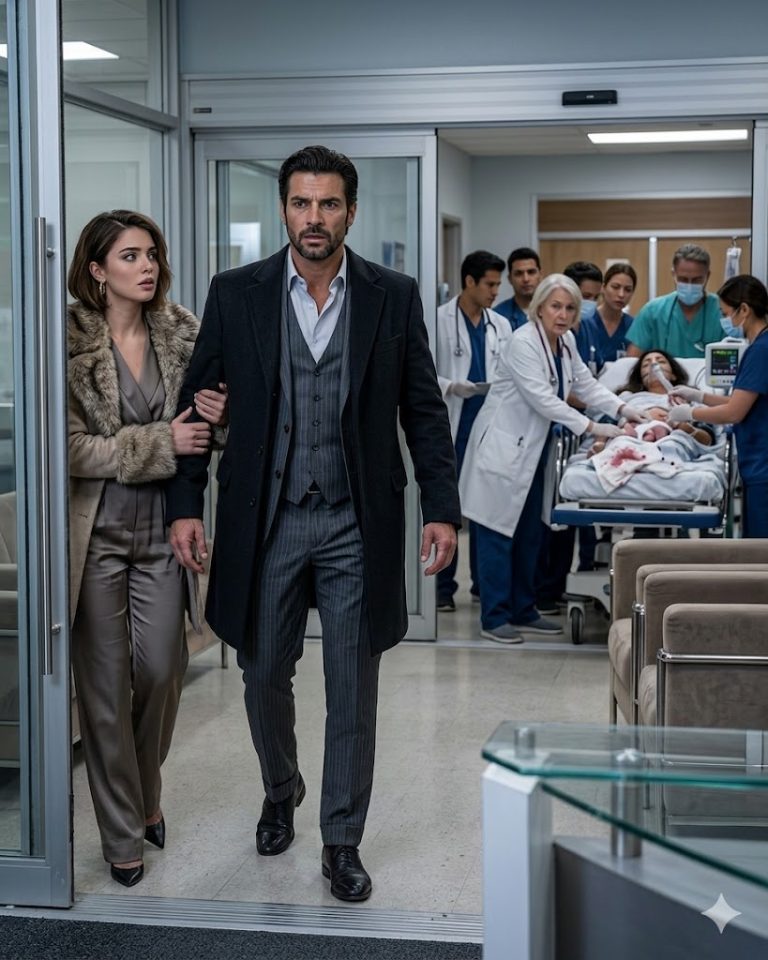
SHE STAYED BEHIND IN A CATEGORY FOUR STORM TO GIVE BIRTH ALONE — HER HUSBAND ONLY CAME BACK WHEN HE LEARNED WHAT SHE HAD HIDDEN IN A LOCKED DRAWER**

**PART 1: The Woman He Left Standing in the Glass**
I remember the smell before I remember the pain — salt, wet cedar, and the particular metallic sharpness of a house about to lose power.
My palm was flat against the window when the first real contraction folded me in half. Not the practice ones I’d been having since Tuesday. This one had teeth.
Outside, my husband was folding another woman’s suitcase into the trunk of the only working car we had left on the island.
Bianca Reyes was six months along. I was thirty-eight weeks. Only one of us was wearing a wedding ring, and it wasn’t the one carrying his actual, undisputed child — or so I still believed, in that last unbearable minute before everything changed.
Nathaniel Kade did not look away when he saw me through the glass. He simply lifted his phone to his ear and, in the calm voice he used for board meetings and eulogies, told the county dispatcher that his wife had already evacuated.
I did not pound on the door. I did not scream his name into the storm. I had spent six years learning that begging only fed him. So I watched instead — watched the rain darken his coat, watched Bianca’s mouth curl into something too satisfied to be an accident, watched the headlights swing across a driveway that was starting to flood.
Then he got in the car and drove my husband’s certainty straight into the eye of Hurricane Marisol, leaving me alone in a house made entirely of windows to have his son.
—
The Kade beach house sat on the northern tip of Bellhaven Island, a place where old money built glass palaces and called them summer homes. Nathaniel used to tell people the house was proof of what we’d built together. His mother, Margaret, called it “an appropriate address for a Kade heir to be born into,” which should have warned me from the start that she had already decided whose birth mattered and whose didn’t.
Two days before landfall, I’d begged Nathaniel to drive me to the mainland hospital while the bridges were still open. He’d kissed my forehead in front of his mother and promised he would. By that afternoon the promise had quietly evaporated, the way all his promises did once no one important was watching.
Bianca had been his director of client relations at Kade Maritime — twenty-six, glossy, and skilled at looking helpless exactly when it benefited her. She arrived at the house in ivory silk with a raincoat that had gold buttons, moving through the foyer like a woman auditioning for a role she assumed was already hers.
Margaret called me from Charleston at 2:17 that afternoon. “Try not to be dramatic, Elena,” she said, the way she always said my name — like something slightly beneath the furniture.
“I’m in labor,” I told her.
“Nathaniel is only getting Bianca somewhere safe. Her building flooded.”
“She’s pregnant with his child.”
The silence on the line wasn’t shock. It was confirmation. Six years of holiday dinners and charity boards, and my mother-in-law’s first instinct wasn’t horror at her son — it was fear that I might embarrass the family by having feelings about it in public.
“Men make mistakes under pressure,” she said.
I looked out at the ocean climbing the dunes. “Mistakes don’t come with ultrasounds, Margaret.”
She didn’t have an answer for that, so I hung up before she could offer me money to disappear quietly, and walked into Nathaniel’s study — the one place in that glass house that still smelled like him, cedar and bourbon and the particular arrogance of a man who has never once been told no.
The evacuation folder sat open on his desk, exactly where he’d forgotten it. Insurance papers. Property deeds. And beneath them, an envelope from my own attorney that Nathaniel didn’t know I’d already read cover to cover — the prenuptial agreement his father had insisted on before our wedding, the one Nathaniel had called “just a formality” while I signed it under a chandelier dripping white roses.
My attorney, Dana Okafor, had built in clauses Nathaniel’s family never bothered to read closely. Infidelity voided his protections. So did abandonment during a medical emergency. “Rich men plan their exits before they make promises,” Dana had told me once. “Make sure yours costs him.”
I folded the copy into my robe pocket. Then I opened the second envelope — the one I’d actually come looking for.
A lab report. Not for my baby. For Bianca’s.
I’d found the receipt in Nathaniel’s jacket three weeks earlier, after a fundraiser at the maritime museum. I hadn’t confronted him. I’d hired Dana instead, and quietly learned to read my husband the way you learn to read weather — by what he tried hardest to hide.
The results had arrived that morning.
Probability of paternity: zero.
I hadn’t decided yet when to tell him. The storm decided for me.
When Nathaniel came back inside for Bianca’s last bag, rain streaming off him, he looked irritated to find me still standing instead of collapsed on the floor where it would’ve been convenient for him.
“Her building lost power. I have to get her somewhere safe.”
“And me?”
“You said the contractions weren’t close together.”
“I said ten minutes.”
“You always exaggerate.”
That landed cleaner than a slap. Bianca appeared behind him with a bag he’d bought her on our joint account, glanced at my stomach, and said, “I’m sorry, Elena” — the kind of apology that only exists to be witnessed.
“The neighbor’s staying next door,” Nathaniel said, already backing toward the door. “Dr. Cross. He’ll check on you.”
Julian Cross. The retired trauma surgeon Nathaniel mocked at every dinner party for driving a beat-up truck and keeping his porch light on through every storm. Nathaniel called him “the monk with a medical degree,” because men like Nathaniel have never known what to do with men who don’t need applause.
Another contraction bent me over the console table. Nathaniel looked away. Bianca didn’t.
That’s when I understood — they wanted me small. They wanted me begging, because my begging would make the cruelty feel like power instead of what it actually was.
So instead, I straightened, looked at the woman carrying a child that wasn’t his, and said, “Your mascara’s running.”
Her smile disappeared.
“You’re unbelievable,” Nathaniel said.
“No,” I told him. “I’m finally awake.”
He locked the front door from the outside, told the dispatcher I was already gone, and drove my husband and my future into the storm — leaving me alone with a truth in my pocket he didn’t yet know I was carrying.
**PART 2: The Man Who Answered the Storm**
The power failed at 4:11. I know because my phone screen was the only light left in the house when the minute changed.
My contractions dropped to five minutes apart, then closer, until counting stopped mattering more than breathing did. I called 911 and lost the line. I called Nathaniel out of legal instinct more than hope, and he sent back one text: *Stop being dramatic. I’ll send someone when roads clear.* I screenshotted it with shaking hands. Dana had taught me that rage keeps better as evidence.
Lightning split the sky white for one second, and in the reflection of the glass wall I saw myself — soaked, huge, alone — and behind that reflection, a man running across the flooded lawn toward the house.
Julian Cross came through the porch door with a medical bag, a flashlight, and a calm that didn’t ask permission to exist. He dropped to one knee beside me on the marble.
“How far apart?”
“Five minutes.”
“Pain level?”
“I’m in labor during a hurricane my husband drove away from.”
Something flickered behind his eyes — not pity, something closer to controlled fury. “So, a ten,” he said, and despite everything, I laughed, once, sharp as breaking glass.
He turned the guest room into something between a delivery suite and a field hospital while the storm tried to peel the roof off the house. He told me the roads had already flooded — that Nathaniel couldn’t have sent help even if the thought had crossed his mind, which it hadn’t.
At 6:31, he looked at me and said, “Elena, the baby’s coming now,” just as Hurricane Marisol made landfall and the ocean climbed over the garden wall.
“Again,” he said, when I told him I couldn’t.
“I hate him,” I told Julian, gripping the bedframe.
“Good,” he said. “Use it.”
So I did. I used every dinner where I’d mistaken silence for grace. I used Margaret’s voice on the phone. I used Bianca’s wave.
At 7:04 p.m., in the dead calm of the eye wall, my son entered the world without a sound. For three full seconds there was no wind, no rain, nothing — just the terrible quiet of waiting for a soul to announce itself.
Then he screamed, and it was the most beautiful sound I had ever heard.
Julian placed him on my chest, warm and furious and alive, and asked, “What’s his name?”
Nathaniel had wanted a name that belonged on a law firm’s letterhead. I thought instead of my father, a high school teacher who kept blankets in his trunk for strangers and never once made my mother feel small.
“Owen,” I said. “Owen Marsh.”
Julian looked at me carefully — no judgment, just something like respect. “Not Kade?”
“No.”
Outside, the storm kept tearing at the glass walls of a house built for parties, not survival. But the walls held. So did I.
By morning, the eye had passed, the pool was full of sand, and my phone filled with messages the moment service returned — Margaret, Nathaniel, unfamiliar numbers from Kade family attorneys.
And a photo. Bianca, wrapped in cashmere by a fireplace at the Kade estate, Nathaniel’s hand visible on her shoulder, captioned: *Safe with people who choose love in a storm.*
I saved the screenshot. Then I called Dana.
“Tell me you’re alive,” she said.
“I am. So is the baby.”
“And Nathaniel?”
“Not invited.”
She was quiet for a moment. Then: “Elena, listen to me carefully. You are no longer a wife in distress. You’re a plaintiff with a newborn and a folder full of consequences.”
For the first time in twenty-four hours, I smiled — right before my phone buzzed again with a message that would turn everything I thought I knew about Bianca’s pregnancy inside out.
**PART 3: What the Chandelier Saw**
Three days later, Nathaniel came back for the baby, arriving in a borrowed Range Rover because our SUV had drowned near the causeway after he’d ignored a road closure. Bianca wasn’t with him — cowards rarely bring their prize to the consequences.
Julian was on the porch fixing a storm-torn railing when Nathaniel climbed the steps, his golden retriever, Duke, planted between them with his hackles raised.
“This is private property,” Nathaniel snapped.
“Then you should’ve stayed to protect it,” Julian said, and didn’t put down the hammer.
I opened the door before either of them could go further. I wore a cream sweater, my hair clean, pearls at my ears — nothing like the wreckage Nathaniel had clearly braced himself for.
“Where’s my son?” he demanded.
I handed him a folder instead of an answer. Dana’s associate stepped from behind the door and served him a temporary protective order — for me, and for Owen Marsh, whose birth certificate now carried my name where the father’s line used to sit blank.
“You put your maiden name on my son’s certificate?”
“I put *my* name on my son’s certificate. You had no presence to put yours on.”
He flipped through the pages until he hit the security footage summary — the timeline, the dispatcher call, the porch audio his own cameras had caught. *She’ll call someone. She always makes people feel sorry for her.*
His face went the color of the storm clouds still hanging over the dunes.
Then I handed him the second envelope. Bayfield Diagnostics. He tore it open, and I watched him read the number that ended his fantasy of two women pregnant with his children — Bianca’s daughter belonged to someone else entirely.
“She wouldn’t,” he whispered.
“She did,” I said. “Now the only child that’s actually yours is the one you drove away from in a hurricane.”
He straightened, grasping for the old leverage. “Daniel’s mine. I want a paternity test. I want to see him.”
“You’ll get a court date,” I said. “Not a doorway.”
A black sedan pulled up behind him before he could push further. Dana Okafor stepped out in a charcoal suit, red lipstick immaculate despite the humidity, radiating the particular energy of a blade with a law degree.
“Beautiful morning for consequences,” she said.
Nathaniel tried his father’s name like a weapon. “Richard will bury this.”
“Richard already called,” Dana said pleasantly. “He offered my client two million dollars and an NDA.”
I hadn’t known that yet. My stomach tightened; my face didn’t move.
“What did she say?” Nathaniel asked.
“She said no,” I told him myself. And for the first time, I watched him understand that his family’s money had stopped being weather I had to stand in.
—
Three weeks later, the Kade family held their anniversary gala anyway — “a symbol of resilience,” Margaret called it. Dana called it a crime scene with floral arrangements.
I wasn’t invited. That was their first mistake. Their second was forgetting how many women in that ballroom had survived men like Nathaniel and remembered every single insult.
I arrived anyway, in black velvet, Owen’s tiny hospital bracelet tucked into my clutch. Dana stood beside me. Julian, invited separately by a medical charity receiving an award that night, kept a respectful distance near the doors.
Nathaniel was mid-speech at the podium — something about character being revealed in crisis — when the foundation’s promotional video cut to black behind him and the security footage began to play instead, arranged by a contractor whose sister Kade Maritime had denied medical leave.
The whole ballroom watched him load Bianca’s luggage while I doubled over behind the glass. They heard the dispatcher call. They heard the porch audio. They saw the final slide — a birth certificate with no father listed.
Whispers sharpened into gasps, then phones. Richard Kade rose from the front table like a king watching his own kingdom catch fire. Margaret found me across the room, and for once she looked less like a matriarch and more like a mother staring at exactly what she’d raised.
Nathaniel pushed through the crowd toward me. “You ruined me.”
“You left me,” I said.
“I was scared,” he admitted — the first honest sentence he’d offered in six years.
“You were scared of inconvenience.”
Bianca appeared behind him in emerald satin, hissing that I’d humiliated her. “No,” I told her quietly. “You did that when you waved.”
Then, cornered and desperate, she made the mistake that finished them both — grabbing Nathaniel’s arm in front of a room full of cameras. “You said your father would make her go away.”
Richard turned to his son with a horror that had nothing to do with me anymore. “What did you do?”
“I was going to fix it,” Nathaniel said — not a denial. A confession.
Somewhere behind me, Dana closed her eyes like a woman receiving a gift she hadn’t dared ask for.
—
The custody hearing, weeks later, played out exactly the way the ballroom had — Nathaniel’s own recorded words undoing him piece by piece, Julian’s testimony calm and unshakable (“She was exceptionally controlled,” he said, when asked how I’d seemed. “He was absent,” he said, when asked why he’d stayed the night). Under cross-examination, Nathaniel finally admitted, voice breaking, that he’d said his father would “make Elena go away.”
I was granted sole physical custody. In probate court weeks after that, a trust clause Richard had written years earlier — meant to protect a future Kade heir from a scheming spouse, never imagining his own son would be the danger — activated in my favor. Because Nathaniel’s actions had endangered Owen and me during a declared emergency, I became temporary voting trustee of Owen’s ownership stake in Kade Maritime. Nathaniel lost his executive position within the month. Not because I demanded it. Because a board that watched that footage couldn’t unsee what kind of man they’d trusted with fiduciary duty.
When the paternity results eventually confirmed Owen was, biologically, his son after all, Nathaniel wept in the courtroom. Maybe from love. Maybe from relief he still had a claim on something. The judge allowed him five supervised minutes to hold his son. Owen studied him with serious gray eyes, reached for me within a minute, and Nathaniel handed him back with his face crumpling — not the villain anymore, just a man who’d burned his whole life down to stay warm beside someone who never loved him back.
It didn’t make me forgive him. It made me stop needing him punished every single hour of every day. That isn’t mercy. That’s just freedom, finally arriving on schedule.
—
The first time Julian kissed me, there was no hurricane, no ballroom, no jury. It happened almost a year later on the back porch of the beach house at sunset, after Duke stole a teething biscuit and Owen laughed so hard he hiccupped.
We moved slowly — so slowly Dana once joked Owen would be in college before we held hands. But slow felt sacred after Nathaniel, who had loved like conquest. Julian loved like weathered wood: quiet under your palm, strong because it had survived seasons without needing to shine for anyone.
He never asked me to forget. He never called my caution cold. When I finally took down the framed family portraits and imported silver rattles from the nursery, he was the one who asked, gently, “What do you want on that wall instead?” No one had asked me that in six years of marriage.
A week later he brought me a photograph I hadn’t known existed — taken by a neighbor the morning after the hurricane, the house standing battered but upright under a bruised pink sky. On the porch, barely visible through the open door, I sat wrapped in a blanket with Owen asleep on my chest. A few feet away, Julian stood watching the wrecked road, keeping guard without asking to be called a hero for it.
I hung it over Owen’s crib. Nathaniel saw it during his supervised visits and never said a word about it, which told me more than an argument would have.
Two years after Marisol, I stood in that same Kade ballroom again — not as a wife this time, but as the founder of the Marsh Storm Relief Fund and the voting trustee of my son’s stake in a company that once tried to write me out of its own paperwork. Dana sat on the board. Julian ran the medical advisory committee. Richard donated publicly because refusing would have looked worse. Margaret shook my hand for the cameras, her diamonds still flashing, her grip trembling in a way mine no longer did.
A reporter asked if I considered the hurricane the night my life fell apart.
Across the room, Owen — sturdy, stubborn-chinned, three years old — was dancing badly with Dana to a jazz cover of an old song. Julian watched him with the solemn focus of a man guarding treasure. Nathaniel stood near the edge of the crowd, hands in his pockets, present but no longer trying to own the room.
“No,” I told the reporter. “The storm didn’t destroy my marriage. It only revealed who had already left it.”
I married Julian a year after that — not under a chandelier, not on a guest list built from country club rosters, but in a small chapel near the dunes that had sheltered evacuees the night of the storm, its floors still faintly water-stained. Owen carried the rings in a seashell. Duke slept through half the ceremony. Nathaniel came to collect Owen for a scheduled visit at the edge of the reception lawn, dressed simply, holding a small gift bag, and said only, “I’m glad you’re safe” — late, inadequate, and true all at once.
As they walked off together, Owen waved back at me over his father’s shoulder, small hand opening and closing against the gold evening light.
Once, a woman had waved at me from a car window as my whole life split open.
This wave meant something else entirely — that my son could leave and come back and still, always, find his way home to being loved.
Julian took my hand, not to steady me, just to be there. I leaned into him because I wanted to, not because I had nowhere else left to stand.
He had chosen his mistress in a hurricane.
I had chosen the man who stayed.
And in the end, the storm hadn’t taken my life from me at all.
It had only handed it back — cleaner, truer, and finally, entirely mine.