HE RODE INTO TOWN FOR LUMBER AND SEED — Then Married a Stranger No One Wanted Before Sundown

PART 1
Victor Ellis had cleared most of the trees himself.
He had built the cabin by hand — first the frame, then the walls, then the roof, all through a summer when the only company was the sound of the Bitterroot wind and the occasional hawk riding the thermals above the ridge. It was not a large house. It was not a pretty one. But the walls were plumb and the roof held against the worst of it, and a man who had been through enough winters learns to value what holds over what impresses.
He showed it to Roslyn Cade without ceremony on the evening of their first day as husband and wife.
She stood in the doorway and looked at the wood plank floor, the stone hearth, the single window facing west. She did not say it was small. She did not say it was dark. She ran her eyes over it the way a woman does when she is cataloguing what can be done, not mourning what isn’t there.
“There is one bed,” Victor said.
“You take it.”
She turned. “I can sleep near the fire.”
“No.” He set her bundle down against the wall. “Bed is yours.”
She looked at him for a moment. Her eyes were the kind that took things in and kept them — pale brown, clear, already measuring the distance between what he said and what he meant.
“All right,” she said.
The days came fast after that.
Snow melted into mud. The river swelled. Victor planted oats and barley in ground still cold enough to resist the blade. Roslyn mended the roof herself, carrying shingles up the ladder without being asked, her movements methodical and unhurried. She split logs. She patched his shirts. She never asked why he had come to that churchyard, never asked what he had seen in her that made him walk across the dust and upend both their lives in a single afternoon.
She simply worked. Every day, as if she meant to earn the air in her lungs.
One night a storm rolled in off the mountains, hard and sudden. The wind found every gap in the walls. Victor lit the lantern and came around the hearth to find her sitting on the cot, arms around her knees, watching the fire with the expression of someone who has learned to wait out most things alone.
“Storms bother you?” he asked.
“No.” She paused. “Sometimes I wonder if this is real.”
He sat across from her. The lantern threw long shadows. Outside, the wind pushed hard at the shutters.
“It is,” he said.
She looked up. “Why me?”
Her voice was low. Not bitter — just honest, the way people are honest when they’ve run out of the energy for performance.
He looked back at her.
“Because no one else saw you.”
She held his gaze for a long moment. Then she looked back at the fire, and they did not speak again that night.
But something shifted.
The next morning she made coffee and waited until he sat before she poured his cup.
Weeks passed. Spring warmed the earth and the air changed character — less knife, more breath. They spoke more. Laughed sometimes. He showed her how to saddle the horse she’d taken to calling by the wrong name on purpose, which he pretended not to notice. She showed him how to make cornbread without burning the bottom, which involved a technique he was skeptical of until he tasted the result.
Then one morning, while Victor was hauling stone from the creek, Roslyn came running down the trail.
She was not a woman who ran for small things.
He dropped the rope.
She was breathless when she reached him. “There are children. Two of them, near the barn.”
Together they found them in the shadows behind the barn wall — one barely walking, maybe two years old, holding tight to the leg of a boy of eight or nine with the look of someone who has recently had to become very much older than he was.
The older one stepped forward.
“I’m Ryland. This is my sister Ruthie.” His voice was steady but his hands were shaking. “Our ma and pa burned in the cabin south of here. I tried—” He stopped. The small girl pressed her face against his leg.
Victor crouched down in front of the boy.
“You two hungry?”
Ryland nodded. Fast, like he’d been waiting to be asked.
Roslyn was already beside Ruthie.
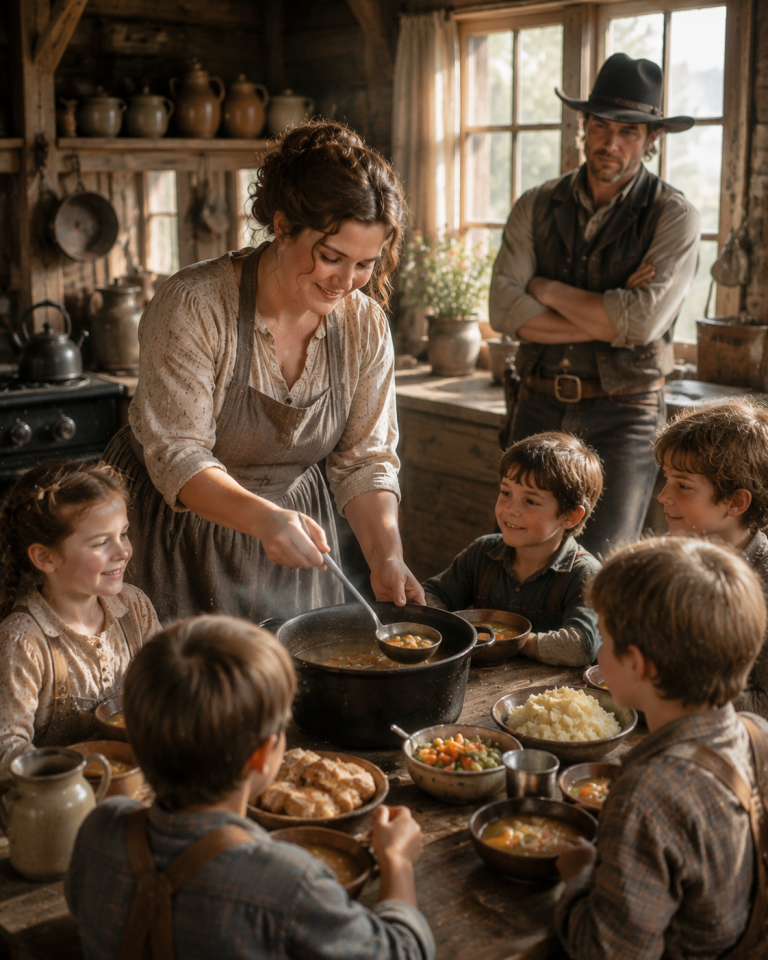
“Would you like to come inside with me?” Her voice was low, soft. “We have stew.”
The girl blinked at her. Then reached up.
Roslyn lifted her without hesitation.
That night they fed the children, washed them, and put them in the cot by the fire. Victor took the floor. Roslyn sat against the wall beside him, her knees drawn up, her voice barely above a whisper.
“They have no one.”
“Then they stay.”
She looked at him. Something moved across her face — something soft and deep, the expression of a woman encountering more grace than she had prepared for.
“You mean that.”
“I do.”
She touched his hand.
Just rested her fingers there, against his knuckles, in the quiet dark.
“You are not like other men,” she said.
He looked at where her hand rested.
“Neither are you like other women.”
Outside, the storm had gentled to rain.
Inside, the house held four people now.
And it had never felt less empty.
—
PART 2
Days turned into weeks.
Victor built a second room — not quickly, not all at once, but steadily, the way he did everything that mattered, taking the time to get the joinery right. Roslyn made clothes from old flour sacks, cutting the fabric with an economy that wasted nothing. Ryland followed Victor everywhere, watching his hands, asking questions about things he’d decided he needed to understand. Ruthie called Roslyn Mama by the end of June.
No one discussed it.
No one needed to.
One evening, Roslyn stood on the porch as the sunset bled across the hills, her arms loose at her sides, and Victor stepped up beside her.
“I never thought I would find this,” she said.
“What?”
“Peace. Belonging.”
Victor reached into his coat and set a small silver band on the porch rail between them.
“I bought this the day after we married,” he said. “Didn’t want to give it until I was sure you’d stay.”
She looked at it. Then at him.
“I never planned to love anyone again,” she said.
“Nor did I.” He turned to face her. “But you brought something back I thought was gone.”
Her eyes went wet. She looked at him the way people look when something they’d given up on turns out to still exist.
“Victor.”
He kissed her.
Not rushed. Not hesitant. The way a man kisses a woman when he has finally run out of reasons not to, and the running out of reasons feels like relief.
She whispered, “I love you.”
“I know,” he said. “I feel it every day.”
And when the stars broke through and the children slept in the next room, she curled against him in the dark, and he put his arm around her, and neither of them moved for a very long time.
The first summer rains came early.
Victor stood knee-deep in the rye testing the stalks while Ryland hunted grasshoppers with a tin pail and Ruthie napped beneath the cottonwood with a doll Roslyn had sewn from scraps. The land had taken on a different quality since spring — not different land, just seen differently, the way places change when someone finally starts belonging to them instead of passing through.
One afternoon, while Ruthie helped Roslyn wash linens at the creek, Roslyn called across to Victor in the pasture.
“She’s limping,” she said, nodding toward a cow grazing by the fence.
He crossed the field, knelt, pressed his palm along the animal’s leg.
“Bruise,” he said. “I’ll wrap it tonight.”
Roslyn watched him a moment. “You always know what to do.”
He didn’t look up. “Not always.”
Back at the house, she stood beside the porch while he washed mud from his hands at the trough. After a pause, she said: “Ruthie asked if she could call you Papa.”
Victor dried his hands.
“What did you tell her?”
“I told her to wait until you were ready.”
He nodded once.
“I’d be proud if she did.”
Roslyn didn’t answer.
She just found his hand as they walked inside.
That evening, a wagon rolled up the trail with a man named Haskins sent by the county clerk to take stock of the outlying homesteads. While Victor answered questions by the corral, Roslyn stood near enough to listen.
“And your wife’s name?” Haskins asked, his pencil hovering over the ledger.
“Rosalyn Ellis.”
She heard it from five feet away.
Her breath caught.
*Rosalyn Ellis.*
Her name, wearing his. Worn like something that had always been there, just waiting to be said aloud.
When Haskins was gone, she lingered by the fence, trailing her fingers along the top rail.
“You said it like you’ve always known it,” she said.
Victor looked up, wiping sweat from his brow.
“Felt true the moment I heard it.”
—
PART 3
By midsummer, the rye stood knee-high and green, and the valley held the particular fullness of a season that had decided to be generous.
Ryland had taught Ruthie to skip stones, though she was more likely to drop them on her toes and howl about it. Roslyn hung laundry between twin aspens with her bare feet in the warm soil, the sheets catching the mountain wind and snapping white in the sun. Victor hauled pine from the ridge for fence posts, working in the patient, methodical way that got things done without hurry, and the sound of his axe carried clean across the valley.
One cloudless evening, as moths circled the lantern on the porch, Roslyn came inside with a folded piece of paper.
“I never posted this,” she said, and held it out to him.
He took it. Looked at her once. Then unfolded it.
The handwriting was small and careful, the lines slightly uneven — the writing of someone working by poor light, or working while emotional, or both.
*She left behind a place that never wanted her,* he read, *and found a man who never asked her to prove her worth.*
He stood with it in his hands for a long moment.
Then he folded it carefully and set it on the shelf.
“I didn’t save you,” he said.
“I know,” she replied. “You saw me. That was enough.”
The silence afterward was the good kind — the kind that exists between people who no longer need to fill it.
Outside, the frogs had started their slow chorus in the creek bottom. The wind moved through the grass. Inside, the walls held all the warmth two people could build from nothing, and Victor looked at the woman across the room and felt, for the first time in years, that he was somewhere he was supposed to be.
“You ever miss the town?” he asked.
She shook her head. “There’s nothing there I left behind.”
He crossed to her and reached for her waist, drawing her close. She leaned her head against his shoulder and said, quietly, into the fabric of his shirt: “This is the only place I’ve ever felt like someone wanted me to stay.”
He kissed her temple.
Slow and steady.
“Then stay for all your days.”
And she did.
—
Late August brought dry heat and the kind of light that made everything look like it had earned its years.
Dust clung to the porch rail. The garden roses needed watering twice a day. Victor rose before the sun fully cleared the ridge, and by the time Roslyn came out to ring the triangle for breakfast, he was already back from the lower field with his shirt damp at the collar.
She handed him his plate. “There’s a wagon heading to Missoula next week. I want to send for a set of readers for Ryland. He’s been squinting at the old Bible and the print’s worn thin.”
Victor chewed slowly. Nodded. “Write out what you want. I’ll give it to Brandt when he rides through.”
She ran her fingers along the edge of the table. “And if there’s enough left from the egg sales, maybe a spool of red thread.”
He looked at her with a flicker of something that was almost amusement. “We’ve got plenty of brown.”
“I’ve mended every seam in this house in brown. Just once I’d like to stitch something that didn’t come from a feed sack.”
He didn’t argue.
He reached for his coffee.
“Red it is.”
—
The next day, while Ruthie napped under a quilt Roslyn had pieced from old shirts, Ryland sat cross-legged in the dirt sorting nails by length. Victor set aside his hammer and watched him work.
“You ever see a sawmill run?” Victor asked.
Ryland shook his head. “Just heard about them. My pa used to say machines would take the man out of everything.”
Victor considered this. “When you’re older, I’ll take you to see one. But for now, there’s still plenty of work a man can do with his hands.”
Ryland looked up. “Will I always live here?”
Victor studied the boy — the set of his shoulders, the careful way he sorted, the way his jaw worked when he was thinking. He had the bearing of someone who had been through something real and come out the other side still standing.
“That’s for you to choose,” Victor said. “But if you stay, there will always be a place at the table.”
Ryland went back to his sorting. But something in his face settled.
That evening, Roslyn was rinsing the last of the supper plates at the washtub, her sleeves rolled, her hair loose from its ribbon, when Victor came up behind her and rested his hand lightly on her back.
“Brandt’s wagon came through early. Left this.”
He held out a small parcel wrapped in cloth.
She dried her hands and took it. Unfolded it slowly.
A thin sheath of readers bound with twine. And a spool of deep red thread.
She didn’t speak. Her fingers moved over the cover of the first book — the slight raise of the letters, the worn edges of something new.
“Figured you’d make something better with it than a bolt ever could,” Victor said.
She turned to face him.
“I wasn’t used to being seen.”
“You are now.”
That night, after the children were in bed, they sat by the hearth. She was stitching a square of muslin, the red thread moving in and out with the regularity of something that knows its own purpose. He worked a piece of leather, cutting a strap for Ruthie’s new boots. Neither of them spoke for a long time.
Then she said, without looking up: “I used to think love had to be loud.”
Victor set down the knife.
“And now?”
She looked at the thread. At the even, careful stitches. “Now I know it’s in the quiet things. The way you remembered the thread. The way you never asked me to be anything but what I am.”
He didn’t answer.
He reached across and took her hand. Warm and calloused, her fingers in his. Held it there without needing more than that.
—
The harvest came in slowly.
Oats bundled, beans dried, squash stored in straw-lined crates in the root cellar that Ryland had helped dig deeper. Ruthie carried potatoes in her apron until she fell asleep on the porch swing still holding a small one. The days shortened, turned blue at the edges, and the ridge line went amber.
One morning, Roslyn rode out with Victor to check the far fence.
She sat the saddle steadily, her skirts tucked neat beneath her legs, and they traveled together in the kind of silence that stopped being empty weeks ago. When they reached the western ridge, she dismounted and walked to the edge. Below, the valley spread wide — the river silver through the trees, the fields a patchwork of harvested and fallow, the cabin just visible at the far end of the trail they knew by heart.
She turned back to him.
“I used to think I’d never belong to anything solid.”
Victor stepped beside her.
“And now?”
She reached for his hand.
“Now I’m part of a life that holds.”
He didn’t kiss her. He didn’t need to.
They stood at the edge of the ridge with the wind coming up from the valley below, the horses grazing quiet behind them, and neither of them moved for a long time.
When they returned home, the sun had dipped low. Ryland was chopping kindling with methodical care. Ruthie was chasing a chicken across the yard with her bonnet hanging off her head at an angle that defied gravity.
Roslyn laughed.
It startled her — the sound of it, full and unguarded, the kind of laugh that has forgotten to protect itself. She looked back at Victor once, her eyes bright.
He watched her cross to Ruthie, lift the girl into her arms, and spin her once.
The chicken escaped.
Nobody cared.
—
One night, late in the season, Roslyn sat in the lamplight mending something and said, without particular preamble: “I never asked what brought you here.”
Victor leaned back in his chair.
“My father died in a mine shaft collapse near Butte.” He said it the way facts get said when they’ve been carried long enough to lose their jagged edges. “I went east for a time — Ohio, then Illinois. Worked rails, broke horses. Nothing held.”
She waited. She was good at waiting. He had noticed that early and valued it more as the months passed.
“I found this valley by accident. Got turned around trying to reach Kalispell. Camped near the creek. When I woke up, the air smelled like pine and thawed earth.” A pause. “It felt like the first peace I’d had in years.”
She looked at him. “You never told me you’d been east.”
“Didn’t want to bring any of it here.”
She nodded slowly. “I understand that.”
He stood and crossed to where she sat. Knelt beside her. Rested his hand on her knee.
“But I’m not carrying it alone anymore.”
She set the mending aside and leaned forward until her forehead rested lightly against his.
“No,” she said. “You’re not.”
—
September gave way to October.
The cottonwoods along the creek went gold and then went bare. Frost appeared on the grass each morning, thin as eggshell, gone by midmorning. Victor nailed oilcloth over the window frames against the coming cold. Roslyn brought out the woolens and checked for moth holes, and the children grew in the ways children grow in good soil — steadily, visibly, with the kind of ease that comes from not being afraid.
Ruthie’s sleeves barely reached her wrists. Ryland’s boots pinched at the toes.
Victor came back one afternoon from a neighbor’s place with a bundle wrapped in burlap. A pair of scuffed leather boots, nearly Ryland’s size, and a coat with one missing button.
“Miller’s oldest outgrew them last fall,” he said.
Roslyn turned the coat over in her hands. “Ryland will be proud to wear it.”
Victor leaned against the wall. “He offered to sleep in the loft. Make room in the house if we ever take in more.”
She looked up. “Did he say why?”
“Said there’s room in the house and sometimes the world doesn’t leave much.”
Roslyn folded the coat and set it on the chair.
“He’s got more sense than most men twice his age.”
Victor said nothing. Just reached for her hand and held it a while.
—
That night, Roslyn sat near the hearth with a ledger open in her lap. She tapped the pencil against the page.
“There’s a parcel of land due east of us,” she said. “Belongs to a widow named Corbin. She’s heading back east to her sisters in Missouri.”
Victor looked over. “You thinking what I think?”
“She’s asking twenty dollars and a team to haul her wagon as far as Helena.”
He leaned forward, elbows on his knees. “You want to buy it?”
“I want to grow something that lasts longer than a season.”
He studied the firelight on her face. The certainty in it. The way she looked when she had already done the arithmetic and arrived at an answer she trusted.
“We’d need to fence it before snow.”
“I can help. And Ryland can drive posts.”
“You planning to run the place next door to mine?”
She smiled — small and sure, the smile of a woman who knows exactly what she’s proposing.
“I’m planning to build something beside you.”
They bought the land that week.
Mrs. Corbin came in a mule-drawn cart with her belongings stacked under a tarp. She hugged Roslyn at the fence gate and handed over the deed folded in oilskin. “Don’t plant beans where I did,” she said. “Soil’s tired there.”
Then she climbed back on the cart and headed south, and Victor and Ryland began hauling pine rails down from the ridge.
Roslyn and Ruthie cleared brush with a hatchet and a branch hook. They worked until their hands were raw and the days shortened into long blue dusks, and the new fence line extended east across ground that was theirs now — not inherited, not given, earned the way land should be earned: by showing up and staying.
One evening, Victor stood at the edge of the new field. His jaw was tight against the chill. Roslyn came up beside him and rubbed the cold from her arms.
“I never thought past survival,” he said.
She waited.
He looked at the fence lines extending into the dimming light, the smoke rising from the chimney, the lamp burning behind the glass.
“Now I want more than just to make it through.”
She reached for his hand.
“Then let’s build it,” she said. “Whatever it turns out to be.”
He kissed her in the dark. Slow and certain. The night wind curling around them.
—
The next morning, Ryland asked if he could learn to read maps.
Roslyn brought out the almanac and showed him how to trace rivers, mark elevation, read the shape of land from its lines. Ruthie sat beside her and copied letters in the dirt with a stick, gravely serious, erasing and rewriting.
Victor watched from the barn door while he mended the latch. He didn’t say anything, just watched the four of them arranged around the almanac in the morning light — the girl with her stick, the boy’s finger tracing a river north, Roslyn’s voice patient and clear.
That evening he brought in a rolled parchment and spread it on the table.
“County registrar drew this when the township lines were redrawn. Shows every parcel from here to the base of the Swan Range.”
Roslyn smoothed it flat.
“This is ours?” she asked, pointing.
“And this.” He tapped a spot just west of the creek. “Could be a good location for fruit trees come spring.”
She looked up. “You’re thinking years out.”
“For the first time,” he said, “I can.”
That night he found her outside under the stars with her shawl around her shoulders and the ledger in her lap. He sat beside her without speaking.
After a long silence, she said: “I used to think I had to earn every scrap of kindness. That if I stopped moving, I’d disappear.”
He looked at her.
“You haven’t moved in months.”
She turned her face toward his.
“And I’ve never felt more real.”
He slid his arm around her and pulled her close. Inside, the fire had gone to embers. The children breathed steady in their beds. Outside, frost covered the grass in its thin silver sheet.
They sat until the moon rose high — two people solid against the cold, building something stronger than shelter, deeper than land.
—
October settled fully.
The trees beyond the eastern ridge turned deep rust and gold. Mornings came pale and cold, Victor’s breath hanging in the air when he stepped out before dawn. Frost lined the trough each morning, thin as paper, gone by mid-morning. The days compressed.
Inside, Roslyn had begun stitching heavy blankets from wool bolts traded up from Fort Benton. She worked in the quiet hours, her fingers steady, her expression one he had come to know — not entirely at rest, but close. The expression of someone who has stopped waiting for something to go wrong.
One night she paused mid-stitch and looked toward the fire.
“I never asked what brought you to Clearwater that particular day,” she said. “Not the valley. That specific day. With the lumber order and the seed.”
Victor rubbed his thumb along the rocking chair arm.
“My father died in the winter. I was going through his things. Found an old letter from a cousin who’d settled in the Territory.” A pause. “I thought — I don’t know what I thought. That going somewhere new might make the quiet feel less like absence.”
She was quiet for a moment. “Did it?”
“No,” he said. “Not until you.”
She set down the blanket and looked at him across the fire.
“I was going to leave that morning,” she said. “Before you came into the churchyard. I’d decided I would walk to the next town and find work, any work, and stop — stop waiting to be found.”
He looked at her. “What made you stay?”
“I was tired,” she said simply. “I sat down on that bench outside the church and I was just — tired of moving.”
He was quiet for a moment.
“I’m glad you were tired.”
She almost laughed. Then: “I’m glad you needed lumber.”
He stood and crossed to where she sat. He knelt beside her, rested his hand on her knee.
“I want to give you a proper wedding come spring. A gathering. Food. A circle of people around us.”
She looked at him. “You already gave me more than I thought I’d have.”
“I want to stand beside you with the whole valley watching,” he said. “Not because I need to prove it. Because you deserve to be known.”
Her hand rose to his face. Her thumb traced the line of his jaw — the roughness of it, the particular way it was worn.
“Then in the spring,” she said, “we’ll stand together.”
—
Winter settled in steady.
Snow came deep and patient, burying the fence posts and blanketing the new land in silence. Ryland learned to set traps with Victor, moving through the cold with the focused quiet of a boy becoming a man on his own terms. Ruthie helped Roslyn stir tallow into soap molds, narrating the process to herself in a low, authoritative voice that suggested she was preparing to teach it to someone.
The days slowed. But they held.
On the first warm afternoon of May — after the last snow had melted from the northern slope and the creek ran high and silver and the first green was pushing through the dark soil — Roslyn stood in a patch of wild flowers just beyond the barn.
Her hair was braided with sprigs of sweet grass. Ruthie danced around her in a dress newly stitched from pale blue muslin, too wound up to stand still.
Victor waited near the old cottonwood in his cleanest shirt, his boots polished as well as bear grease would allow. Ryland stood beside him, taller than he’d been in the fall, holding a small wooden box he’d carved himself through the winter months — the edges smoothed carefully, his initials hidden inside the lid where only someone looking for them would find them.
There were no strangers.
Only neighbors and kin by choice, gathered in a ring in the May light.
The preacher from Clearwater came carrying the same book he’d used the day Victor married her in the dust and the silence with no one watching. This time the words were spoken clearly, into the open air, with people around them who had come because they wanted to witness something good.
Victor took Roslyn’s hands in his.
He looked at her — really looked, the way he had looked across the churchyard two years ago, when something about her stillness had reached out and taken hold of him.
“You were the first peace I found after years of dust and noise,” he said. “You are my place.”
Her eyes did not waver.
“You saw me when no one else did,” she said. “And you stayed. That’s the love I’ll carry every day.”
The preacher asked if they would live in honesty and strength.
They both said yes.
Ryland opened the wooden box.
Victor slid the new silver band onto her finger.
She pressed a kiss to his palm before lacing her fingers through his.
—
There was food. There was laughter. A fiddle came down from the mountains and played until the stars were fully out.
Ruthie fell asleep beneath a quilt in the grass, her head in Ryland’s lap. He sat very still so as not to wake her, one hand resting lightly on her back, with the easy protectiveness of someone who started young and never stopped.
Roslyn sat beside Victor on the porch step, her hand resting on his knee. The valley had gone dark beyond the lantern light, and the air was the good kind of cold — the kind that makes the warmth beside you feel like something earned.
He leaned close.
“You tired?”
“No,” she said.
“What, then?”
She looked toward the field — the new oats coming in green, the fence lines extending east across the land they’d bought for twenty dollars and the hauling. The house. The light in the windows. The children.
“Full,” she said.
“Of what?”
“Of everything I never thought I’d have.”
They did not speak again that night.
They didn’t need to.
—
Years passed.
The orchard grew — the fruit trees Victor had marked on the county map came in slow and then suddenly abundant, and in late summer the branches hung heavy and Ruthie learned to judge ripeness by pressing her thumb lightly to the skin.
Ryland took up a parcel of land near the ridge — his own, chosen, the deed signed in his own name by a young man who had once sorted nails by length in the dirt and asked if he would always live here. He built his own fence. His own cabin. He came for supper most Sundays and always left the lamp burning on his way back up the trail.
Ruthie learned to read with the intensity of someone who suspects there is a great deal of world they haven’t seen yet. She took to drawing in the margins of the almanac — maps, mostly, some real and some invented, rivers she planned to trace someday when she was older.
The house stayed warm.
The fence held.
The fire never went out.
And every evening when the sun dropped behind the mountains and the shadows stretched long across the porch, Victor put his arm around Roslyn’s waist and she leaned into him — not because she needed to, but because she wanted to, which is a different thing, and the difference matters.
Two people worn thin by a world that had never made room for them.
Finding each other in the windswept quiet of Montana Territory.
Building a life from nothing but willingness and steady hands and the particular kind of faith that doesn’t announce itself but shows up every morning and does the work.
And this time — this time — neither of them would ever be left behind.
THE END