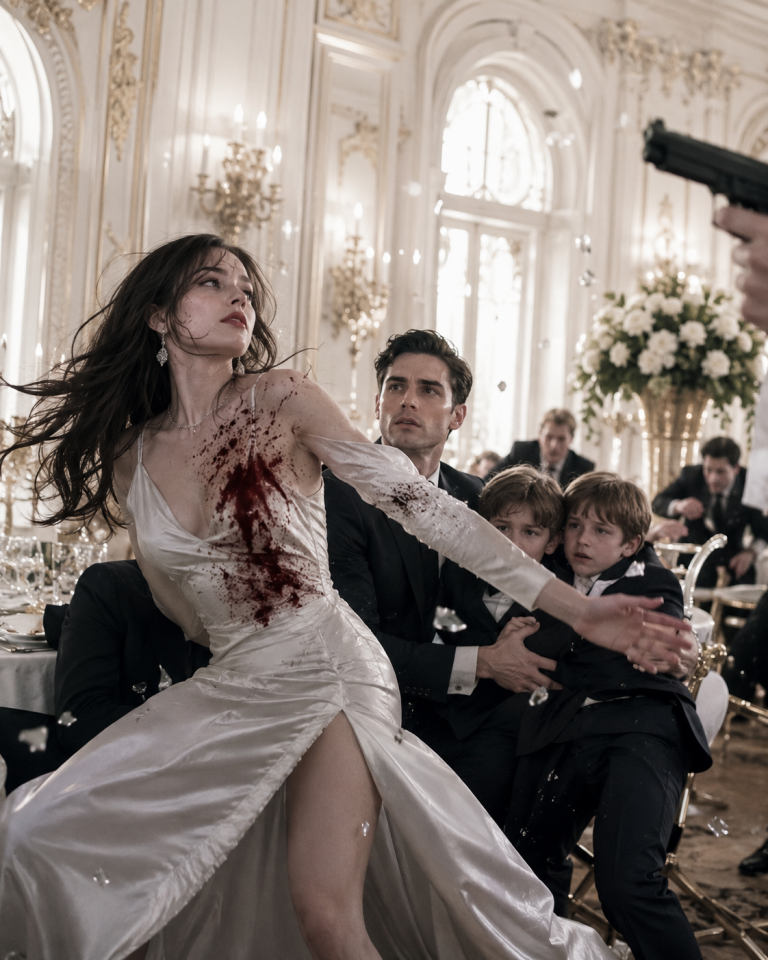
For Six Months She Wept at His Grave — Then a Midnight Package Proved the Dead Man Had Been Watching Her All Along

## PART ONE
The grave had a name on it that I still could not make my mouth say without breaking.
RAFAEL MORETTI. 1994–2025. The letters had been chiseled deep and gilded, and I had traced them so many times over the last half-year that I half expected to find them worn smooth. Six months of kneeling in this same patch of churned mud in whatever the weather offered. Six months since two men in dark coats had handed me a death certificate and a check I would never cash. Six months since color had drained out of the world and left everything the gray of dishwater.
“I’m sorry,” I whispered to the stone, the way I always did. “I’m sorry I wasn’t enough to keep you here.”
The rain answered for him, drumming its small indifferent applause against my umbrella.
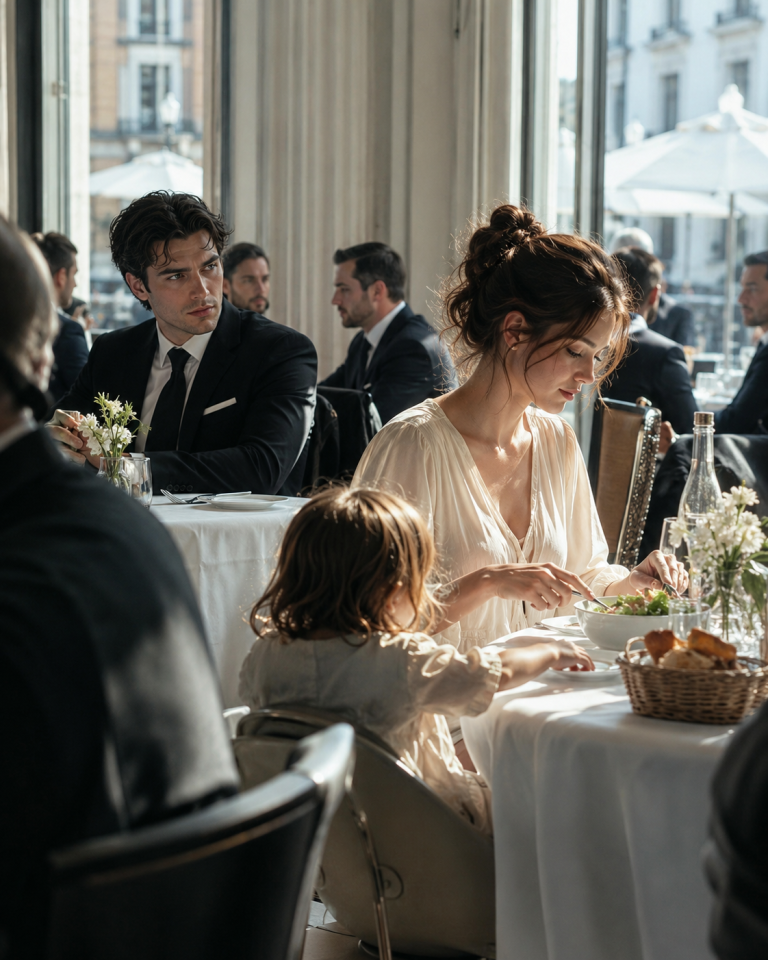
I had met Rafael on the worst night of my life, though at the time I’d have called it the best. I was three weeks into a job at Verrone’s, one of those restaurants where the wine costs more than my rent and the staff are trained to be furniture. My feet were ruined, my apron was soaked, and I was carrying a tray of champagne flutes back toward the bar when I walked straight into what felt like a wall wearing a suit that cost more than I’d make in a year. The glasses went up. The champagne arced into the air in long gold ribbons. And a pair of hands shot out of nowhere — faster than hands should move — and caught the whole tilting tray an inch above the floor.
I looked up into the darkest eyes I had ever seen. Not brown. Black, or near it, the black of deep water where you can’t tell how far down it goes.
“Careful,” he’d said, in a voice like smoke and low music, an accent curling under the word. “The floors here are treacherous.”
Behind him, two men in identical dark suits had shifted their weight and let their hands drift toward their jackets, and the whole dining room had gone strangely still, the way a field goes still before weather. I was the only person in that room who didn’t know his name. Rafael Moretti — the young king of the city’s underworld, who had inherited a bloody empire at twenty-five and made it larger and more terrifying than his father ever had. To me he was only the beautiful stranger who’d saved me from disaster, whose thumb had grazed my wrist and sent something electric climbing my arm.
He waited out my whole shift at a corner table, conducting silent business with men who came and went like smoke, and when I clocked out he was leaning against a black car by the staff door as if he owned the night. He drove me home. He frowned at my neighborhood and said, “That will change,” in a voice that was equal parts promise and threat, and God help me, the threat was the part that made my chest flutter. He pressed a card into my hand with nothing on it but a gold phone number. *If you ever need anything,* he’d said. *Anything at all.*
And so I fell. Not gradually — all at once, the way you fall down stairs. Within a week he’d moved me into a renovated brownstone on a street where the lamps all worked. Rare flowers arrived at my door daily, blooms I couldn’t name. He refused to let me take the bus, walk alone, exist in his city unguarded. *You’re light in a world of shadows,* he told me once, his fingers in my hair, the city glittering below his windows. *I’m far too selfish to let the dark touch you.*
*Then what does that make you?* I’d asked.
*Your dark,* he’d said, and kissed me, and I’d believed that a monster who would burn the world to keep me safe was a kind of love a girl should be grateful for.
I was at his penthouse the night it happened, waiting for him to come home from a meeting he’d sworn would be quick. His last message still lived in my phone: *I love you. Everything I do is to build you a life where you’ll always be safe.* Two hours later his right hand, Enzo, arrived with three grim men and the news that a warehouse had gone up in a professional detonation with Rafael inside it. They gave me back his watch — the one I’d bought him — its crystal spidered, its band scorched. DNA took weeks. The certificate did not.
I refused their money. Blood money felt obscene, and without him none of it meant anything anyway.
Now I hauled myself up off his grave, knees stiff, the sky bruising toward night, and told myself the cologne was grief doing what grief does — conjuring a ghost out of rain and wanting. I pressed two fingers to my lips and then to his carved name. “I’ll always love you,” I said. “I’m sorry I couldn’t save you.”
I didn’t see the tall figure detach itself from the shadow of a mausoleum behind me. I didn’t see it step to the grave with a walk too fluid, too familiar, to belong to a stranger. I only felt the weight of being watched follow me all the way out through the iron gates like a hand at the small of my back.
The apartment was a tomb when I got home. I peeled off my wet dress, pulled on the black silk shirt I’d stolen from his closet months ago because it still, faintly, carried him, and dropped onto the bed to wait out another sleepless night.
My phone buzzed.
*Unknown number:* You shouldn’t go to the cemetery alone. It isn’t safe.
My thumb went cold on the screen. A wrong number. A cruel joke. But the phrasing — that particular, obsessive fixation on my safety — landed in me like a key finding an old lock.
*Me:* Who is this?
The three dots pulsed. Stopped. Started.
*Unknown number:* Someone who has never stopped caring whether you make it home. Lock your doors. Don’t go out alone after dark.
*Me:* This isn’t funny. Stop.
*Unknown number:* I’m not laughing. There are people in this city who would hurt you to hurt me. Stay inside. Stay safe, bellissima.
The phone slid out of my fingers and lay face-up on the blanket, glowing.
*Bellissima.* His word. His and no one else’s. And *to hurt me* — present tense — as if the man in the grave I had just left were alive enough to still have enemies.
—
## PART TWO
The buzzer went off at midnight, and I nearly came out of my skin.
No one visited me anymore. His world had swallowed my old life so completely that there was no one left to knock. But the voice on the intercom was polished and immovable in a way I recognized down to my bones — the courtesy of a man who has never once doubted his orders would be obeyed. A delivery, he said. Instructions were specific: tonight, whatever the hour, and only into my hands.
I went down in jeans and his shirt like it was armor. Through the glass a man in a dark suit stood with a black box and the patience of someone prepared to wait until dawn. I opened the door on its chain.
“Who sent you?”
“I’m not able to say, ma’am. But I was told to promise you this: you’re safe. You have always been safe, even the whole time you believed you weren’t.” He slid the box and a slim envelope through the gap. “He said you’d demand a name. He said to tell you instead — *remember what I promised you the first night. Everything I do is to keep you safe.*”
The floor tilted under me. That was his sentence. His exact liturgy, repeated every time I’d flinched from the armed men outside my window.
Inside the box, wrapped in tissue thin as breath, was a phone — new, charged, one contact saved. A single letter. *R.*
The letter was in his hand. Those bold, controlled strokes I’d have known anywhere.
*Nora — forgive me. They were coming for you, using you to break me, and the only way to keep you alive was to be dead. But death couldn’t keep me from you. I’ve watched over you every day. Every visit to that grave. Every shift. Every sleepless night. I’ve been in the shadows the whole time, making sure nothing reached you. Tell no one — not Enzo, not anyone. The danger isn’t finished. If you ever truly need me, turn this phone on. I’ll be there in minutes. You’re my heart, bellissima. Every lie, every day I’ve stayed dead — all of it was for you. Yours, even from the grave, R.*
I read it until the words stopped being words. Rafael was alive. He had watched me shatter at his grave, watched me stop eating, watched me want to follow him into the ground — and he had let me, because in his arithmetic my grief was the price of my life.
I went to the window on legs that didn’t feel like mine. A black sedan sat two buildings down, its windows a wall of dark. My regular phone buzzed one more time.
*Unknown number:* Good girl. Keep it off until you’re ready. But know this — I’m never far. I have men outside. No one touches you while I’m breathing. Sleep, bellissima.
How long had that car been there? Days? Every day? I had spent six months mourning a man who had been parked outside my grief the whole time, watching it happen and choosing not to stop it. The thought should have sent me running to the police.
Instead something in me turned over — and I knew, standing at that black glass, that tomorrow I was going to walk straight into whatever he’d been hiding, and find out exactly what was worth burying himself alive to keep from me.
—
## PART THREE
Morning came thin and gold and unreal, and the sedan was still there.
In daylight I could make out two men in the front seat, motionless, watching my door the way you watch a thing you’ve been paid with your life to protect. I pulled on a jacket to go clear my head, and the secret phone stayed dark in the nightstand while my own buzzed before I reached the threshold.
*Unknown number:* Where are you going?
He was watching. Right now. Through the men, or a camera I hadn’t found, or some method I couldn’t imagine. The cage wasn’t the apartment. The cage was everywhere his reach touched, which in this city meant everywhere.
*Me:* I need air. I need to think.
*Unknown number:* Take the car. The driver will bring you anywhere. You don’t walk this city alone. Not anymore.
*Me:* I’ve walked it alone for six months.
*Unknown number:* No. You thought you were alone. Those aren’t the same thing.
I hated that he was right — that if I set out on foot the sedan would simply crawl along behind me, turning his protection into a public spectacle. So I surrendered. The back door opened the instant I stepped outside, as if the driver had been holding his breath for exactly that. He was older than I expected, silver-haired, with eyes that folded into kind lines when he nodded.
“Miss Vance. I’m Tommaso. It’s been my privilege to keep you safe these months.”
“You’ve been *following* me.”
“Protecting,” he corrected, easing into traffic. “There’s a difference. What Mr. Moretti did — dying — it nearly killed him. But there were people who’d have used you to take him apart. He had no choice.”
“Everyone has a choice, Tommaso.”
“Not men like him.” He met my eyes in the mirror. “When you love someone more than your own life, the choices get very simple. You keep them breathing. Everything else is detail. Even when the detail is breaking the person you’re protecting.”
“Where to, Miss Vance?”
I almost said the cemetery — almost went to rage at that false grave — but stopped. If Rafael was watching, going there felt like agreeing to his story. “The harbor,” I said instead. “The old fishing pier.”
It was the one place in the city he had never taken me. Too public, too rough, too far from his velvet rooms and reserved tables. He had kept me in a curated bubble of safety and never once let me see the parts of his city that showed their teeth.
The harbor opened up gray-green and honest, salt and diesel and fish on the wind — real smells, nothing like the perfume of his world. I got out before Tommaso could open my door, needing to own one small act, and walked to the end of the pier where the fishing boats knocked against the pilings and men shouted to each other in languages I didn’t know. My phone buzzed. The regular one.
*Unknown number:* You chose well. I’ve never brought you here. Too many sightlines I can’t watch. It makes me nervous.
I turned in a slow circle, scanning boats and rooftops and rusting warehouses. *Where was he?*
*Me:* Good. You should be nervous. You should feel a fraction of what I’ve felt.
*Unknown number:* I felt every second of it, Nora. Watched you weep at my grave and couldn’t hold you. Watched you disappear an inch at a time and couldn’t feed you. Don’t tell me I didn’t suffer.
*Me:* Then WHY. Why not just tell me?
*Unknown number:* Because the people hunting me are artists with pain. And your face can’t lie. If you’d known I was alive, they’d have read it on you in a second, and they’d have taken you apart to find me.
*Me:* Who are they?
*Unknown number:* The Volkovs. My father’s oldest enemies. They spent years waiting for me to love something more than the business. The night I couldn’t hide what you were to me, I handed them the weapon.
*Me:* So you destroyed us to keep it out of their hands.
*Unknown number:* I saved you. That’s not the same thing.
I wanted to hurl the phone into the water and watch his excuses sink. My fingers wouldn’t let go of it.
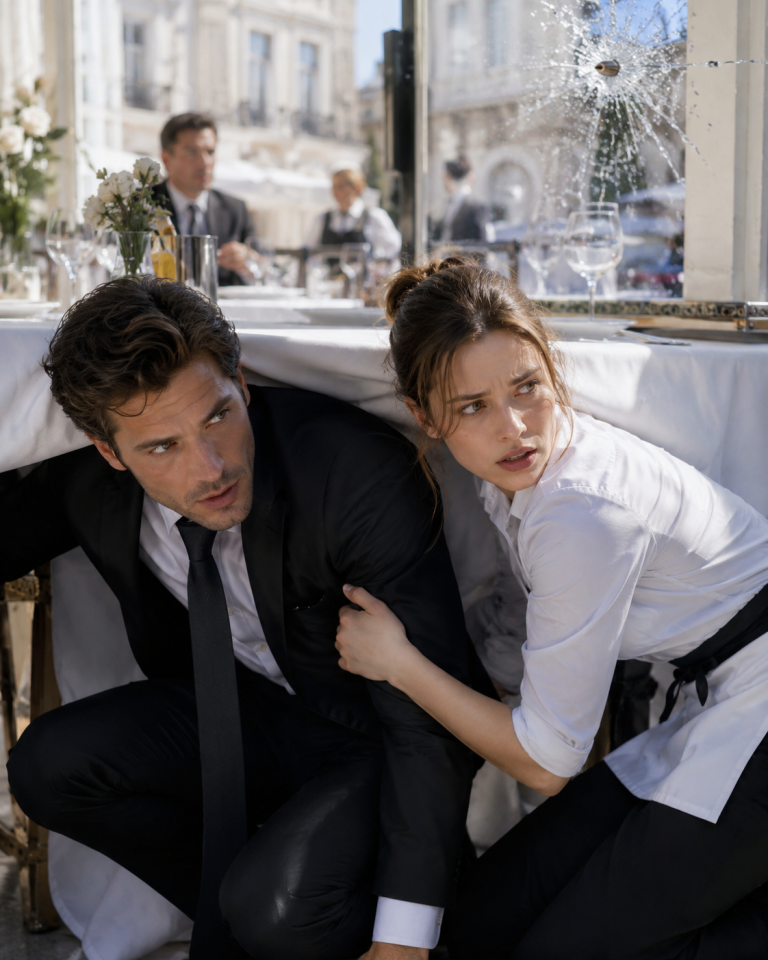
That was when the shooting started.
It came from near the warehouses — Italian shouted, then Russian, then the flat hard crack of a gun that split the morning like a dropped plate, then another. The fishermen scattered like startled birds, dropping nets, sprinting for cover. Tommaso was at my side before I’d finished flinching, his hand closing on my arm, already hauling me toward the car.
“We go. Now.”
“What’s happening—”
“No questions, Miss Vance, *move.*”
He threw me into the back seat and we were moving before the door shut, tires screaming. The secret phone rang from my jacket — I’d grabbed it on the way out without deciding to — and I fumbled it up with shaking hands and heard, for the first time in six months, his actual voice.
“Are you hurt?” Rough with fury and terror, wrapping around me like arms I’d thought I’d never feel again.
“I’m fine. Tommaso got me out. What is this?”
“The Volkovs. They’ve been watching you too — waiting to see if I’d slip, make contact, prove I wasn’t in that grave. The harbor’s their ground. I should have known.” Under his words I could hear running, more Russian, the metallic bite of a magazine snapping home. “Tommaso — the safe house. The one in the financial district.”
“Yes, sir.”
“I don’t want a safe house,” I said. “I want answers, I want—”
“You want to be *alive.*” His voice dropped to that register that was tender and immovable at once. “And right now that means you go where I put you. We’ll talk. I swear it. But first I handle this.”
“Handle what? Rafael — what are you going to do?”
A silence heavy with things I didn’t want named. “What I’ve always done,” he said, and the cold in it reminded me precisely what kind of man I’d fallen in love with. “Protect what’s mine. By whatever it takes.”
The line went dead.
—
The safe house was nothing like the concrete bunker I’d braced for. Tommaso brought me up to a penthouse of glass and modern art — the top three floors of a building Rafael owned, biometric locks, a sixteen-digit code, the city shrinking to a toy beneath us as we climbed. From the windows I could see the harbor in the distance, smoke rising where the shooting had been, police lights converging blue and red on the scene we’d fled.
“How long do I stay?” I asked.
“As long as it takes,” Tommaso said carefully. “There’s food. Clothes in your size in the bedroom. He’s thought of everything.”
Of course he had. The closet held clothes I’d never seen in exactly the cuts and colors I’d have chosen — a museum of myself, curated by a man who knew me better than I knew me. My shampoo. My face cream. The specific toothbrush I used. I stood in that bathroom and understood, with a chill, how long he must have been preparing for the day his world would require me to vanish into luxury.
Night fell. The city lit up like fallen stars. I had begun to believe he wouldn’t come when the elevator opened, and every muscle in my body locked, and there he was.
Rafael Moretti. Alive. Real. Leaner than I remembered, harder, shadows carved under his eyes to match my own, his hair grown long enough to curl at his collar. Dressed all in black. And there was blood on his hands — not his, I somehow knew. Someone else’s, spent on my behalf.
For a long moment we only looked at each other, the air between us charged like the half-second before lightning.
“Nora.” My name in his mouth broke something loose in me.
I stayed frozen by the window. “You’re alive,” I said, stupidly, because my brain had nothing else.
“I’m alive.” He took one careful step, the way you approach something wounded. “I know you’re angry. I know you hate me. You have every right.”
“I don’t hate you.” The words tore out before I could stop them. “I’ve tried. God, I’ve tried. I hate *myself* for still loving you after what you did.”
His face cracked. “Bellissima—”
“Don’t.” I lifted a hand. “Don’t call me that. Not with the words you used when I thought any of it was real.”
“It *was* real.” He came closer, unstoppable as a tide. “Every word, every promise. The only lie was the grave, and I told it to keep you breathing.”
“By making me want to stop.” My voice split. “I wanted to follow you, Rafael. The only thing that kept me here was thinking you’d be disappointed if I gave up. And you *watched* that. You saw what it did to me and you did nothing.”
“I did *everything.*” His voice roughened. “I’ve killed seventeen of their men in six months. Seventeen Volkov soldiers who got too close, who asked the wrong questions, who looked at you wrong. I’ve been fighting a war in the dark to keep you safe while they thought I was ash.”
“I never asked you to kill for me.” A wine glass I didn’t remember picking up shattered against the marble, red spreading like a wound. “I never asked you to lie to me. I just wanted *you.* The real one. The truth, even if it cut.”
“The truth would have gotten you tortured.” He was close enough now that I could smell gunpowder over his cologne. “The Volkovs don’t just kill, Nora. They make suffering last. They’d have taken you apart slowly, kept you alive for days, just to make me hand over everything I’ve built. And your face — your beautiful, honest face — can’t hide what it feels.”
“So you made the choice for me. Again.” I pressed my palms to his chest to shove him back. They didn’t shove. They stayed, feeling his heart slam against them, fast and hard and *real.* “You’ve always made the choices. Where I live. How I’m guarded. Who I see. What I’m allowed to know. You built me a beautiful cage and called it love.”
“Yes.” He covered my hands with his, blood flaking under my fingers. “Yes, I built you a cage, because the other option was watching you walk into a fire I couldn’t put out. Because I’m a selfish bastard who’d rather have you safe and furious than free and dead.” His other hand rose to cradle my face, thumb tracing my cheekbone with a tenderness that didn’t match the blood. “I know what I am. I’m a monster. But you — you’re the only clean thing I’ve ever touched. And I’ll become anything, burn anything, to keep you. Even if you hate me for it.”
Tears ran hot down my face. “I can’t live like this. Never knowing what’s real. Always waiting for the next threat that needs you to fake another death, or lock me away, or decide my life without me in the room.”
“Then leave.” The word seemed to cost him everything he had. His hand fell from my face and he stepped back, and the space between us felt like an ocean. “The elevator code is your birthday. Walk out. Take the money I set aside. Start over somewhere far from this city and far from me, and I swear on my life I’ll never contact you again. You’ll be free.”
I searched his face for the trick and found only exhaustion and a love so total it looked like grief. “You’d let me go? After all of it?”
“If it’s what makes you happy.” His jaw worked around every word. “I’ve taken enough from you. The least I can give you now is a choice. But if you stay — nothing changes. I’ll still be overprotective. I’ll still make calls I think keep you alive. I’ll still love you in a way that probably isn’t sane. Because I can’t be other than what I am.”
Behind him the city glittered, a thousand lit windows, and somewhere out in it the Volkovs were already planning what came next. And here in this glass fortress stood the man who had loved me enough to bury himself alive.
“What happened at the harbor?” I asked instead of answering. “What did you do?”
His face hardened into the one the underworld feared. “They had men on you. When you turned up on their ground, they thought I’d surfaced. They were going to take you. So I took them first.” He didn’t look away from the words. “All of them. Then I sent them back to Grigori Volkov with a message. *Nora Vance is under my protection. Whoever touches her signs his own death warrant.*”
“But you’re supposed to be dead.”
“Not anymore.” He lifted one shoulder, and I saw the whole weight of the last six months in the motion. “I can’t stay in the ground if it means watching you walk into their guns. The Volkovs know now, or they will by morning. Rafael Moretti is alive, and he’s coming. It’s open war, bellissima. And you’re the reason I’m willing to set the whole city on fire.”
I should have run for the elevator. Instead I understood that I’d known my answer since the doors opened — maybe since the night I first walked into him and felt his gravity take hold.
“Promise me something,” I said quietly.
Hope flared in the dark of his eyes. “Anything.”
“No more lies. No more staged deaths. No more deciding for me. If there’s a threat, I hear it from you. If there’s danger, we stand in it together. I will not be kept in the dark again. I can’t survive it a second time.” I stepped in, closing the ocean between us. “Promise me, or I walk out that door right now and you never see me again.”
The war on his face was terrible to watch — the instinct to shield me from every ugly truth grinding against the need to keep me. Then he nodded. “I promise. No more secrets. You’ll know all of it. The good, the bad, the bloody. Even when it makes you see the monster.”
“I already see it,” I whispered, reaching up to feel the rough of his jaw. “I always have. I just needed you to trust me enough to stop hiding it.”
His arms closed around me hard enough to steal my breath, and I felt the tension pour out of him, felt him shake, felt this dangerous man come apart in my hands. “I’m sorry,” he said into my hair, ragged. “For all of it. For watching you break and doing nothing. For putting my fear above your right to the truth.”
I held him as hard as he held me — two broken people clinging together in a glass tower while the city burned below. It wasn’t forgiveness. Not yet. But it was a place to start.
—
The war moved faster than either of us wanted.
Three days after Rafael came back from the dead, the Volkovs answered — a car bomb outside one of his legitimate restaurants in the theater district, a place where families ate Sunday dinner. Twelve hurt. Three dead. Strangers caught in a war they’d never known existed. I watched it on the news from the penthouse while he barked Italian into his phone, one hand heavy on my shoulder, anchoring me to him as his world detonated into the open.
“They’re baiting me,” he said, ending the call. “Hitting civilians to make me sloppy. They want me angry.”
“Aren’t you?”
“I’m furious. But fury loses wars. Strategy wins them.” He led me to a table spread with maps and photographs like an accounting of sins. “Grigori Volkov has three sons. Andrei runs the product. Sasha handles enforcement — he’s the one who’d have hurt you. The youngest, Kolya, is supposed to be at Oxford keeping his hands clean for the day they need a respectable face.” His smile was all teeth. “But Kolya has a gambling problem. Loses fortunes at private tables. And he’s been skimming from his father’s operations to cover it. Grigori didn’t know — until I sent him the proof this morning.”
I stared at the surveillance photos of a boy who looked barely twenty. “You’re turning them against each other.”
“I’m giving Grigori a choice. Lose his youngest to his own paranoia, or accept that I’m untouchable. Either way the Volkovs tear themselves apart from the inside, and my hands stay relatively clean.”
It was brilliant and merciless — exactly what made him what he was. And I was at the war table now, learning his strategy, accepting the blood that would spill in my name.
Over the next week I watched him unmake a family with surgery rather than a hammer: anonymous tips to the father, the money trail delivered in photographs, whispers seeded among the soldiers about which son would inherit. I learned the rhythm of his life — calls at three in the morning, men arriving with reports and leaving with orders, the constant low hum of the awareness that death could knock at any hour. He barely slept. He lived on espresso and adrenaline and the ferocious need to keep me breathing.
“You have to rest,” I told him one night, finding him at the glass, staring out at the city he ruled through fear.
“Can’t.” He didn’t turn. “The second I close my eyes I’m back at that harbor. I see Tommaso a second slower. I see them taking you.” His voice cracked. “I can’t survive that picture, Nora. So I stay awake.”
I wrapped my arms around him from behind, my cheek against his spine. “I’m here. I’m safe. You kept your word.”
“For now.” His hands covered mine. “There’s always another threat. Always someone who sees you as the crack in my armor. Being mine means living like this. Is that really what you want?”
It was the question he’d been circling for days, and every time my answer was the same. “I want *you.* The rest comes with it.”
He turned in my arms, taking my face in hands that had killed for me and trembled anyway. And I understood that this was my life now — beautiful and terrifying at once, a love story written in devotion and blood.
—
The end came two weeks in. Grigori Volkov called a meeting: neutral ground, a private room in a hotel neither family owned. Rafael brought six men. I insisted on coming, over every protest he had.
Grigori was in his sixties, gray, with eyes that had witnessed and ordered too much cruelty to count. He looked me over the way his kind looked at women — as property, not people.
“So this is the girl worth dying for,” he said. “She must be remarkable, to earn such devotion.”
“Watch your mouth,” Rafael said, in the voice that came before violence, “or I take your tongue and hand it back to you.”
Grigori laughed without joy. “You’ve won, Moretti. My youngest is dead — I killed him myself when I learned of his betrayal. My other sons barely speak to me. My house is in ruins. You got what you came for.”
“I came to make one thing clear,” Rafael said coldly. “Nora Vance is beyond your reach. Touch her, threaten her, look at her wrong, and it means death for you and everyone you love. Are we understood?”
“Understood.” Grigori’s jaw flexed. “But hear me. You’ve made an enemy who won’t forget. One day, when you’re old, when she’s gone or she’s left you, when you love something more than your own life — I’ll be there. Or my sons will. Or theirs. The Volkovs remember.”
“Then I’ll bury every Volkov who reaches for what’s mine,” Rafael said, pulling me against him. “Generation after generation, until your line ends screaming. That’s my promise. Test it.”
Two predators stared at each other across a ruined table, and finally the old one nodded once and rose and led his men out.
“It’s over,” Rafael murmured into my hair when they’d gone. “They can’t afford another war, not with their family split. You’re safe.”
—
That night he took me not to the safe house but to the real penthouse — the home we’d shared, the place where I’d spent that last night waiting for a man who never walked back through the door. It smelled the same. It felt like a different planet.
“I want to show you something,” he said, and led me to his office, a room I’d never once been allowed into.
One wall was covered in photographs of me. Hundreds. Six months of them. Me at the grave. Me at Verrone’s. Me crossing the street, asleep in my old bed, curled around his stolen shirt. A shrine to his obsession. Proof of every hour he’d spent watching over me while I thought he was ash.
“This is what I meant about the monster,” he said quietly. “This is how far it goes. I couldn’t trust anyone else with you. Every moment you breathed, I needed to see it. It isn’t normal. It isn’t healthy. It’s—”
“It’s you.” I touched one photo — me weeping at his headstone, my grief laid bare. “You watched me break, and it broke you too.”
“Every tear.” His voice went rough. “But I couldn’t show myself. So I watched, and I waited, and I planned how to end anyone who’d ever threatened you.”
I should have been horrified. Standing there in front of the wall, I understood something truer instead: we were both wrecked, both starving, both willing to raze ourselves for the other. It wasn’t a fairy tale. It wasn’t well. But it was real, and it was ours.
“Take them down,” I said. “All of them. You don’t need cameras anymore. I’m here. I’m yours. I’m not leaving.”
“Nora—”
“I mean it. No more surveillance. No more watching from the dark. If you want to know how I am, you ask me. If you want to protect me, you stand next to me. We do this together now, or not at all.”
He pulled me in, shaking with relief, and I felt a man who’d trained himself out of feeling drown in it all at once. “Together,” he said. “Always together.”
—
Three months later we married in a private room with Tommaso and a handful of his most trusted men as witnesses. No white dress, no church, no pretense that it was anything but what it was — a claim that ran both ways, a vow sealed in blood and devotion.
“You’re certain?” he asked one last time, before the officiant. “There’s no undoing this, bellissima. You’ll be mine, in this life and whatever comes after.”
I kissed him, tasting coffee and mint and the danger that would always be part of us. “I was yours the second I walked into you at Verrone’s. This just makes it official.”
The life we built was never easy. His world demanded vigilance, and sometimes violence, and the standing knowledge that our happiness was a thing we’d have to defend every single day. I learned to shoot. I learned to read a room for threats, to move through his city like someone who belonged in it. He learned to hand me his plans, to trust me with the dark he’d spent his life hiding, to understand that keeping me safe had never required keeping me ignorant. And on the nights the nightmares dragged him up out of sleep — dreams of losing me in a hundred ways he couldn’t stop — I held him and promised, over and over, that I wasn’t going anywhere.
Standing at our windows a year after his resurrection, his arms around me and our child a small certain weight beneath my hands, I finally understood the truth about cages. Sometimes they aren’t prisons. Sometimes they’re sanctuaries. Sometimes the bars that lock the world out are the same ones that keep a love this fierce, this consuming, this unbreakable, safely in. He had built me a cage of devotion and called it protection — and I had walked into it with my eyes open, pulled the door shut behind me, and let the key stay in the hand of the only man I’d ever chosen.