THE DON WAS BLEEDING OUT ON HIS OWN FLOOR — AND HIS NANNY WAS THE ONLY ONE WHO DIDN’T RUN

**PART 1**
The smell woke her first — copper, thick and wrong, threading up through the vents like something the house itself was trying to warn her about.
Ivy Hensley had learned a long time ago that some smells meant danger before your brain caught up to explain why.
She was four months into the strangest job of her life when she found herself standing in a dark hallway at two in the morning, barefoot, holding a glass of water she’d never get to drink, staring at four men carrying a fifth through the back door of the Faust estate.
Blood soaked one entire side of his white shirt.
“Get the doctor,” a voice growled — low, rough, wrapped in something almost like velvet stretched too tight.
Ivy’s slipper squeaked against marble. Every head turned. Four guns came up, level with her chest, before she’d even finished flinching.
“Stand down,” the bleeding man snapped. “It’s the nanny.”
The guns lowered. Not far.
He crossed toward her, favoring one side, jaw locked against pain he refused to acknowledge out loud. He was enormous up close — six foot three of something built rather than born, black hair, and eyes the color of a gas flame, blue-white and merciless. He smelled like gunpowder and cologne and something underneath that Ivy would later learn to recognize as adrenaline curdling into shock.
This was Rourke Faust.
And he had just taken a bullet.
“You didn’t see this,” he said, close enough that she could count the flecks of dried blood on his collar. “You saw me spill wine at dinner. Say it back to me.”
“You spilled wine,” Ivy whispered.
“Good girl.” He turned away before she could decide whether that had sounded like praise or a threat. “Get her out of here. Get me the doctor.”
—
*Three weeks earlier*, the offer had come from a lawyer, not a father — a compact man named Dorsey with a briefcase full of paperwork thick enough to double as a doorstop, interviewing her in the back of a car that circled the Loop twice before she understood they weren’t going anywhere at all.
“Clean record,” Dorsey had said, thumbing through her file without looking up. “No family in-state. Nursing degree, unfinished. Why?”
“My mother’s care ate the tuition,” Ivy said. It was the truth, stripped down to the parts that were nobody’s business.
“The position pays twelve thousand a month. Room, board, zero expenses.” He watched her carefully now. “The condition is silence. Total. No social media, no visitors, no leaving the property unescorted, and you never — under any circumstance — discuss Mr. Faust or his business with anyone. Ever. Breach this contract and you will not be sued, Ms. Hensley. You will simply cease to be findable.”
He said it the way other people announced rain.
Ivy had looked at the eviction notice folded in her coat pocket and signed anyway.
The estate in Barrington Hills sat behind twelve feet of iron and a wall of oak trees thick enough to swallow sound. Men in tailored suits patrolled the lawn with the unmistakable outlines of weapons beneath their jackets, and the housekeeper, a sharp-eyed woman named Odette, delivered Ivy’s instructions like a warning.
“East wing is yours. West wing belongs to Mr. Faust. He does not like noise. He does not like strangers.” A pause, almost pitying. “If you’re lucky, you’ll never meet him at all.”
The twins, Ezra and Mabel, were five years old and grieving a mother they barely remembered and a father who had become a ghost in his own house. Ivy found them mid-warfare in the playroom — Ezra shrieking from atop a bookshelf, Mabel methodically beheading a row of designer dolls with craft scissors.
“Get out,” Ezra screamed. “No more nannies. We want Daddy.”
“Daddy’s working,” Ivy said gently, stepping over a decapitated doll’s head. “I’m not here to replace anyone. I heard somebody in this room can build a Lego Death Star, and I’ve never managed it once in my life.”
Ezra stopped mid-scream, eyeing the box in her hands.
By dinnertime the room was clean, the Death Star was half-finished, and — for the first time in six months, according to Odette — the house was quiet.
That quiet lasted exactly two weeks.
One Tuesday, playing hide-and-seek in the hedge maze with the twins, Ivy heard tires shriek at the front gate. The perimeter guards snapped into position, rifles rising toward a black SUV idling at the entrance.
Something old and animal in her chest recognized the shape of the moment before her mind did.
“Game’s over,” she called out, voice suddenly hard as steel. “Ezra, Mabel — inside, now. Run.”
She herded them through the mudroom and threw the lock just as Rourke burst from his study, pistol already drawn. He watched the SUV reverse and vanish, then turned his fury on her.
“Who told you to move them?”
“I saw a car moving wrong,” Ivy said, breathless, checking both children for injuries. “It didn’t look right.”
He stared at her for a long moment. Lowered the gun.
It had been a probe — a rival family testing his response time. Most people froze. She had read the threat and secured his children in under ten seconds.
“Good instincts,” he said finally, something in his voice loosening.
“I grew up somewhere that teaches you what a drive-by looks like before it happens,” Ivy said, smoothing Mabel’s hair.
He looked at his daughter clinging to Ivy’s leg — a child who flinched from everyone — and something behind his eyes shifted, filed her away under a different heading entirely.
“Dinner,” he said abruptly. “Tonight. All of us.”
—
Dinner was a stilted affair at a table built for twenty, occupied by four. Rourke ate in silence, phone buzzing beside his plate like a second heartbeat.
“Ezra has his recital Friday,” Ivy said, cutting Mabel’s steak with deliberate calm. “He’s been practicing the triangle for weeks.”
“I have meetings,” Rourke said. “Dorsey’s men can take them.”
“He doesn’t want Dorsey’s men,” Ivy said, and felt every guard along the wall go still. “He wants you.”
Rourke set down his fork.
“Do you understand what I do to put this food on this table, Ms. Hensley?”
“I understand you’re a father,” Ivy said, hands trembling under the table, eyes steady on his. “And right now, that’s the only title in this room that matters.”
He stared at her the way a man stares at weather he hadn’t forecasted.
“Friday. Two o’clock. Put it on the calendar.”
Ezra’s face lit like a struck match.
Later, in the hallway, Rourke’s second-in-command — a smooth, charming man named Vance who made Ivy’s skin crawl on instinct alone — blocked her path with a smile that never touched his eyes.
“You’re playing with something you don’t understand, sweetheart,” Vance murmured. “Push him too far toward soft, and this whole family bites back.”
She didn’t know it yet, but it wasn’t a warning.
It was a threat — from a man who had already made a deal with people who wanted Rourke’s territory, and who understood that a father distracted by recitals and dinners was a father who couldn’t be controlled.
Ivy was becoming a problem.
And in Vance’s world, problems were things you removed.
**PART 2**
Friday arrived under a sky the color of a healing bruise. Rourke adjusted his tie in the hallway mirror, silk feeling more like a noose than fabric — he was headed not to a cartel meeting, but to a kindergarten recital.
“You look nice,” Ivy said from the stairs, in a navy dress instead of her usual jeans.
Something dangerous woke in his chest and he looked away before it showed.
The recital itself was an hour of screeching violins — until Ezra walked onstage, froze, found his father’s eyes in the third row. Rourke gave one firm nod. *I see you.*
Ezra hit the triangle with perfect timing.
For one suspended second, Rourke Faust was only a man watching his son, and he understood — with sudden, unwelcome clarity — that he owed the feeling entirely to the woman beside him.
“Thank you,” he murmured against her ear, their faces suddenly inches apart.
Then Vance appeared at the end of the row, face bloodless, earpiece live.
“We have a problem.”
The father vanished. The don returned.
“We’re leaving. Now.”
In the parking lot, chaos — too many civilians, too many blind spots. Rourke hustled the children into the SUV as a gray van’s window dropped two rows over.
“Get down—”
Gunfire tore the afternoon open. While Rourke drew fire from the van, a motorcycle roared between two buses behind them, gun leveling at the open rear door where the twins screamed.
Rourke was too far. The guards were pinned.
Ivy didn’t calculate the contract, the salary, anything.
She threw herself across the seat, covering both children with her body.
Three shots.
A sledgehammer of pain slammed her against the leather.
“She’s not waking up, Daddy,” Mabel sobbed, hands red.
Rourke pulled her out onto the asphalt, pressing both hands to the wound.
“The kids,” Ivy wheezed.
“Safe. You saved them.” His voice broke entirely. “Stay with me.”
Her eyes rolled back.
**PART 3**
The private clinic sat in an old warehouse district near the docks — off the grid, staffed by surgeons who’d lost their licenses or been paid enough not to ask questions. Rourke had not moved from the leather chair beside her bed in four hours. He hadn’t changed the shirt stiffened with her blood. He needed the smell to keep his rage focused, needed the reminder that he had failed to keep his one promise to her.
The doctor emerged at last, pulling off his mask. “She’s stable. The bullet missed her spine by two millimeters, collapsed a lung, broke her scapula. She’s young. She’ll live.”
Rourke exhaled ten years of held breath and asked to see her.
She was small against the white sheets, chest rising in shallow rhythm he found himself syncing his own breathing to. *If she stops, I stop,* he thought, and did not examine what that meant.
Odette brought the twins in briefly — Mabel touched Ivy’s cheek and whispered, “She’s an angel. Mommy sent her,” and the words hit Rourke like a physical blow, cracking something in him that had been sealed shut since his wife’s funeral.
When the children were gone, Luca — his silent, mountain-built head of security — delivered the news that turned Rourke’s blood to ice.
“We hit the Sokol crew hard tonight. Gutted their whole operation. But we found a burner on the underboss’s body. Last call went to a number we recognized.”
“Say it.”
“It was Vance.”
Not a rival. A cousin. A man who had driven Rourke to the hospital the night his wife died, who was godfather to Ezra. Rourke closed his eyes and felt the sick certainty settle into his bones — Vance had called Ivy a liability days before the recital, had said if she disappeared, Rourke would “get his focus back.”
“He’s coming to finish it,” Luca said. “Called the front desk to check visiting hours.”
“Then let him come,” Rourke said quietly. “Clear the floor. Kill the cameras in this hall. I want it to look empty.”
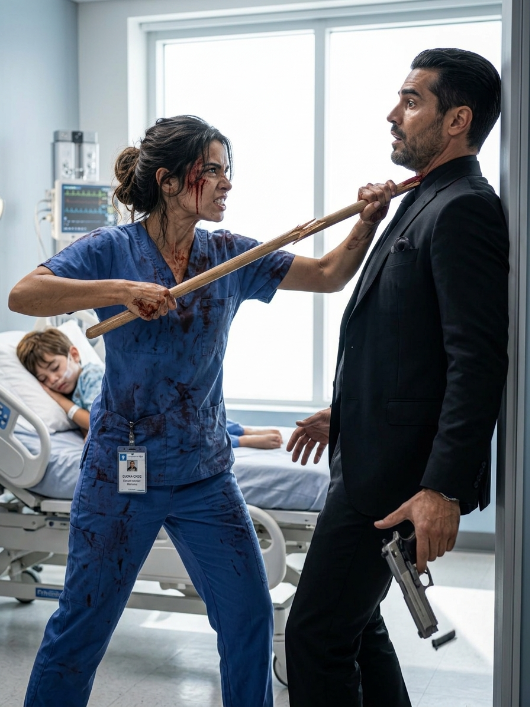
He left his pistol on the bedside table, chamber loaded, safety on — bait — and slipped into the dark bathroom, door cracked an inch, and waited.
Twenty minutes later, Italian loafers whispered down the linoleum. Vance stepped inside in a charcoal suit, a bouquet of flowers in one hand — a grotesque prop for what he’d come to do. He tossed the flowers onto the chair and pulled a glass vial and syringe from his jacket, tapping out the air bubbles with the casual precision of a man discussing a recipe.
“Potassium chloride,” he murmured to Ivy’s unconscious form. “Stops the heart clean. Cardiac arrest from the trauma, they’ll say. Rourke will grieve, and then he’ll come back to himself.” A frustrated sigh. “You broke him, you know. Men like us don’t get dinners and recitals. We get power. I can’t let him throw away an empire for a babysitter.”
He reached for her IV port.
“He didn’t throw it away,” Rourke said from the dark. “He grew up.”
Vance spun, the syringe clattering to the floor. “Dom — Jesus, you scared me. I was bringing flowers—”
“I heard every word.”
The mask fell entirely. “I did it for the family. You’ve gone soft. Sitting here crying over the help while the Sokols circle our territory — I made a deal to save the Faust name.”
“You ordered a hit on a car with my children in it.”
“Collateral,” Vance spat. “The kids weren’t the target. If they’d gotten hurt — well, tragedy builds character. Would’ve made you ruthless again.”
Rourke lunged. It wasn’t a fight; it was a dismantling. He slammed Vance into the wall hard enough to crack plaster, snapped his wrist with one twist, sent him crashing into the medical cart. Vance scrambled for the pistol on the table, aimed, fired.
*Click.*
“Firing pin’s out,” Rourke said, standing over him like judgment itself. “You think I’d leave a loaded gun where you could reach it? I’m not sloppy, Vance. You are.”
He lifted his cousin by the throat until his feet left the ground. “Clara — Ivy is family,” he said, the slip of a name that wasn’t hers cutting through his own rage for just a second before he corrected it. “You are nothing.”
Luca dragged Vance out, screaming about blood and loyalty, and the door slammed shut on it.
Rourke scrubbed his hands raw at the sink until he heard a voice behind him.
“How much did you hear?” he asked without turning.
Ivy was awake, pale, lucid despite the pain etched into her face. “Enough. He wanted to inject me.”
“He wanted to take you from me. He failed.”
She studied his clean hands, thinking of the violence she’d just witnessed, thinking that a nanny who built Lego castles had no business in a room with a man capable of that kind of judgment.
Then she looked at his face instead — the exhaustion, the terror that had nothing to do with Vance and everything to do with almost losing her.
“The children?” she asked.
“Safe. Odette’s guarding them with an actual shotgun. I’m not joking.”
A weak smile touched her lips. “She always did scare me.”
Rourke took her hand, tracing the veins at her wrist like he needed proof she was still warm.
“I have to ask you something, and I need honesty. No contracts. No obligations.” He looked into her eyes. “Why did you cover them? You could have stayed down.”
“I didn’t think,” Ivy admitted. “I just knew I couldn’t let them get hurt. I love them, Rourke. I know I’m just the nanny, but I love them.”
“You’re not just the nanny,” he said fiercely. “Not anymore.”
He laid it out plainly, the way he laid out everything: she could heal and leave with five million dollars, a life anywhere in the world, safety guaranteed and distance from him guaranteed too. Or she could stay — knowing there would be other Vances, other threats, no promise of peace, only his promise to protect her with his last breath.
Ivy considered the ceiling, her empty apartment, her mounting debt, and then Ezra’s laugh, Mabel’s hugs, and this broken, dangerous man looking at her like she was the only light left in his world.
“Five million is a lot of money,” she said.
His face fell. He began to pull his hand back.
“I’m not finished,” she said, tightening her grip. “I don’t want the money. I want the risk.”
“Ivy—”
“I can’t go back to normal after this,” she whispered. “Not after those kids. Not after you. I’m staying. But we’re renegotiating terms.”
He let out a breath that sounded almost like a sob, turning his face into her palm. “Name them.”
“No more secrets. If there’s a threat, you tell me. If you’re bleeding, you show me. We do this together or not at all.”
“Together,” Rourke swore. “I swear it.”
—
Six months later, the estate had transformed. The twelve-foot fences and armed patrols remained, but a swing set now stood by the fountain, and the garden bloomed with color instead of sterile hedges. On a crisp autumn afternoon, Ivy stood before a full-length mirror in a gown of lace and silk, the scar on her shoulder hidden beneath delicate fabric — a badge she wore with quiet pride.
“You look like a queen,” Ezra declared solemnly, straightening his bow tie. “Daddy said so.”
Odette knocked, smiling in a way Ivy had never seen on her before. “It’s time, dear. He’s been pacing the altar for twenty minutes. I think he’s convinced you’ll climb out a window.”
“He should know better by now,” Ivy said, lifting her bouquet of white roses. “I don’t run.”
The ceremony was small, intimate, held in the back garden overlooking the lake — no politicians, no judges, only the men who’d bled beside Rourke and the handful of people in Chicago who could be trusted. When Ivy stepped into the aisle, Rourke’s composure broke entirely, tears standing in eyes that had stared down gun barrels without flinching.
The darkness in him hadn’t disappeared. It never would. But it had become a shield instead of a cage.
“You came,” he whispered when she reached him, as if he still didn’t quite believe it.
“I told you,” Ivy smiled, thumb brushing his knuckles. “I had to check you were honoring the new contract terms.”
They exchanged vows they had already lived — sworn first in a parking lot under gunfire, then in a hospital room soaked in blood, and finally in the quiet, ordinary mornings of healing that had followed. When the priest pronounced them husband and wife, Rourke kissed her like the whole dangerous world had finally gone still.
As they walked back down the aisle hand in hand, petals falling, the twins running ahead of them laughing, Ivy understood the story wasn’t finished — there would be new dangers, new names to fear.
But watching Rourke laugh, freely, for the first time since she’d known him, she understood one thing with total certainty.
Whatever came next, they would face it exactly the way they’d survived everything so far.
Together.