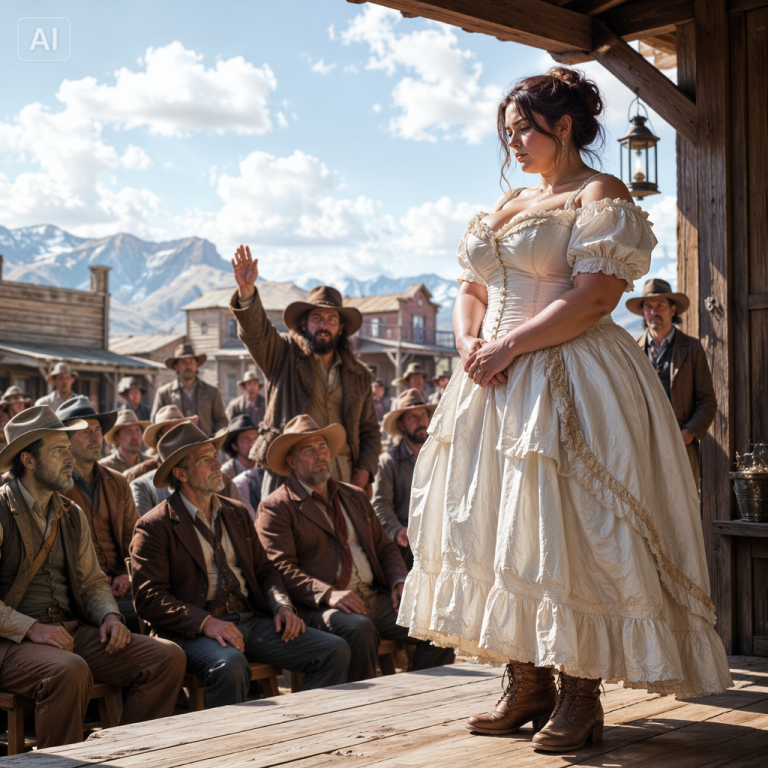
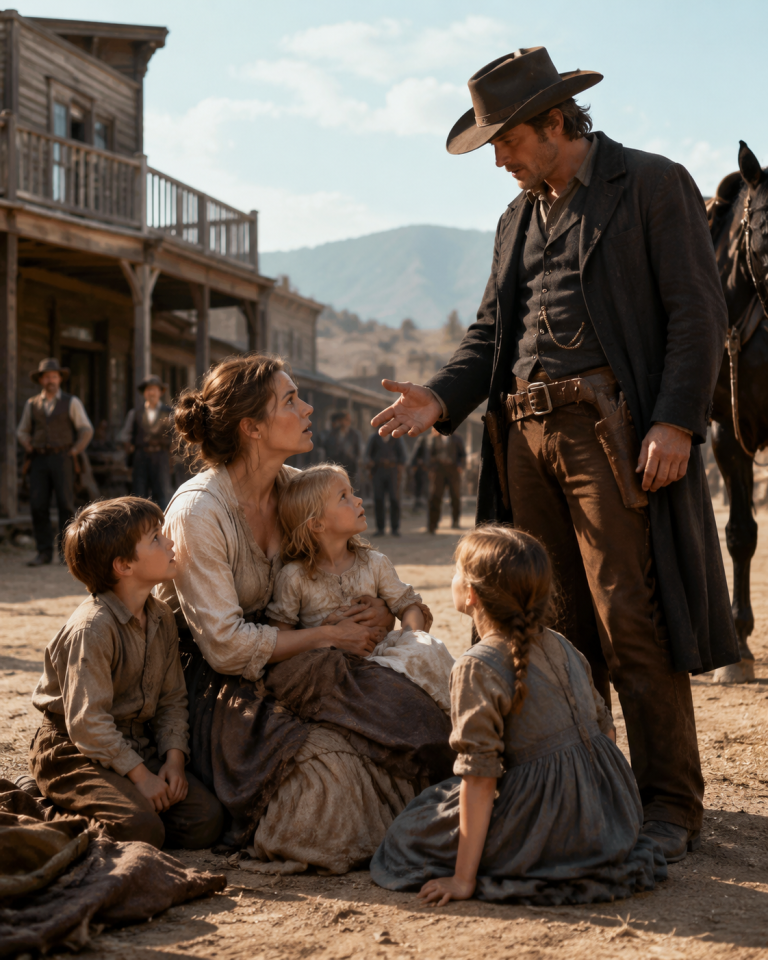
A Dying Man Named His Price For Selling His Daughter As A Bride — What The Stranger Who Bought Her Was Really Offering Changed Everything

Part 1
Clara Bennett’s hands were still warm from her father’s chest when the stranger rode out of the blizzard and offered to buy her as a wife.
Three hundred and fifty dollars. That’s what he said she was worth — enough to bury her father proper, enough to keep the debt collector from taking everything else. The whole town would call her desperate. They’d whisper she’d sold herself to a mountain hermit with worn clothes and a guilty conscience.
They didn’t know about the three motherless daughters waiting in his hidden valley.
They didn’t know anything.
The coughing woke her, the way it always did — wet, rattling, the sound of a man drowning in his own lungs. Clara crossed the cabin barefoot, four steps she’d counted a thousand times over three years of nights just like this one.
“Papa. Breathe. Just breathe.”
Henry Bennett’s body shook with the force of it. When the fit finally passed, he sagged against her, lighter than a man should be. She could feel every rib through his nightshirt.
“Clara girl.” His voice came out wet, ruined. “You shouldn’t be up, and I shouldn’t be dying. But here we are.” He laughed, tried to. It turned into another cough that left dark spots on his pillow. Neither of them mentioned the blood anymore. What was the point?
“Hartley’s coming today,” he said. It wasn’t a question.
Clara’s jaw tightened. “Let him come.”
“Two hundred eighty-seven dollars. That’s what my whole life amounts to. A debt I can’t pay and a daughter I can’t protect.”
“You protected me plenty.”
“Did I?” His hand found hers, bones like bird wings, fragile and hollow. “He proposed again. Hartley. I heard him through the wall last week.”
“I turned him down.”
“What’d you tell him?”
“That I’d rather freeze to death than warm his bed.”
Henry’s eyes, faded blue like denim left too long in the sun, found hers. “That’s my girl. Stubborn as your mama.” His grip tightened. “Clara, after I’m gone—”
“You ain’t gone yet.”
“I will be soon.” He said it plain, the way you’d say the weather was turning. “Promise me something. Promise you won’t marry Hartley. Not to save this cabin. Not to clear the debts. That man’s got darkness in him. I’ve seen it. The way he looks at you.”
Clara knelt beside the bed, eye to eye with the man who’d taught her to ride, to read, to survive.
“I promise. I won’t marry Samuel Hartley. Not ever.”
“Good.” Something eased in his face. “Good.”
—
Hartley’s horse was black and expensive, just like everything else about him. Clara met him at the door before he could knock.
“State your business.”
“Write to it, then.” He pulled papers from his satchel. “Two hundred eighty-seven dollars, plus interest. Due by December fifteenth.” He glanced at snow clouds piling up like dirty wool. “That’s twelve days, Miss Bennett. The bank won’t wait longer.”
“We’ll find the money.”
Hartley laughed. Not mean. Worse — pitying. “You’ve sold the horses, the cattle, everything worth selling.” His eyes traveled over her slowly, and Clara felt her skin crawl. “Almost everything.”
“Watch yourself.”
“I’m trying to help you.” He stepped closer. “Marry me. The debts disappear. Your father dies comfortable instead of in a charity ward. You become respectable.”
“Respectable.” Clara tasted the word like poison. “That what you call it?”
“I call it practical. You should try it.” He leaned in close enough that she could see the broken blood vessels in his nose. “Here’s practical for you, Mr. Hartley. I’d rather be a homeless orphan than your wife.”
“Pride.” His voice went cold. “That’s all you’ve got left, isn’t it? Pride and a dying father in a cabin that’ll be mine in twelve days anyway.”
“It ain’t yours yet.”
“No.” He smiled, and the darkness her father had warned about flickered behind his eyes. “But it will be. And when you’re standing in the snow with nothing, you’ll remember this conversation different.”
He mounted without another word. Clara watched until he vanished into the treeline, her hands shaking with rage she couldn’t afford to feel.
Three days later, the stranger came.
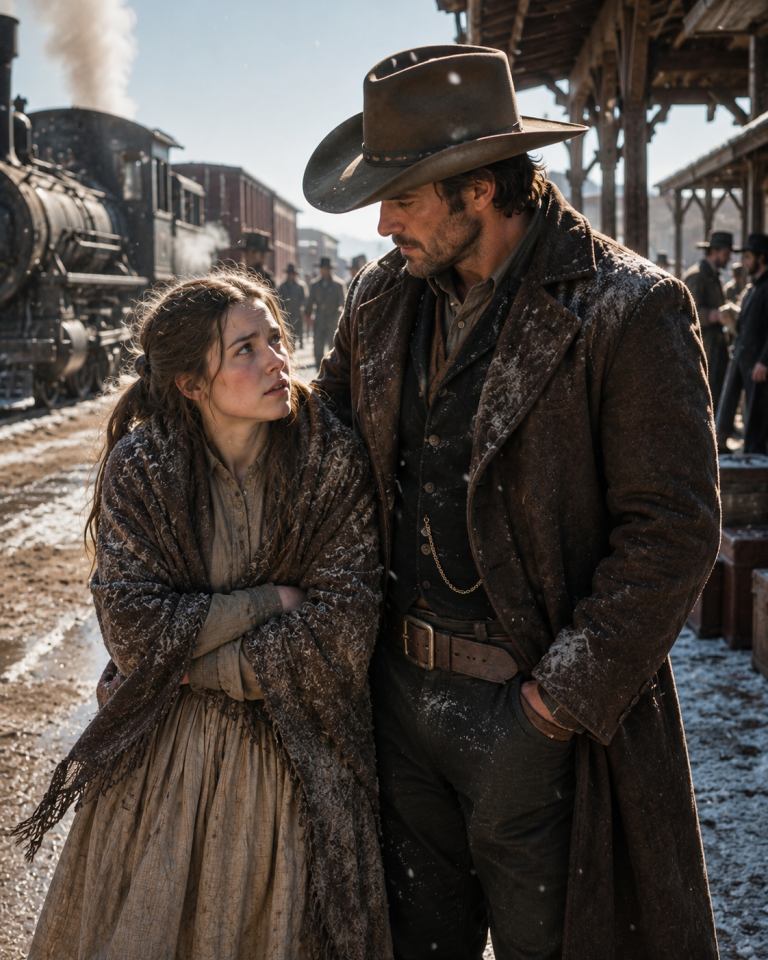
Clara was splitting wood when she heard the hoofbeats — slow, steady, wrong somehow. She straightened, axe still in hand, and watched a rider materialize out of the snow like a ghost. Tall. Broad-shouldered. Sitting his horse like he’d been born there. Worn canvas coat, patched at the elbows. Nothing about him suggested money.
He stopped at the edge of the property. Didn’t push closer.
“Miss Clara Bennett.”
She didn’t answer. Out here, you didn’t confirm nothing to strangers.
“Fair enough. Name’s Jacob Stone. I rode down from the high country looking for you specifically.”
“Why?”
“Because I got a proposition. One that might solve problems for both of us.”
—
Part 2
“May I get down from this horse?” Jacob asked.
Clara considered. He’d kept his distance, asked permission. That was something. “Fine. But this axe stays where it is.”
Something flickered across his face — amusement, maybe. He dismounted, dark hair shot through with gray at the temples, eyes the color of storm clouds. When they met hers, they didn’t waver.
“I’ll speak plain,” he said. “I know your situation. The debts. Your father’s sickness. Hartley’s proposal. I know you turned him down when saying yes would’ve solved your problems. That tells me about your character.”
“What do you want, Mr. Stone?”
Something shifted in his composure, the mask slipping just enough to show exhaustion underneath. “I got a ranch up in the high country. Hidden valley. Isolated, but profitable.” He pulled a folded paper from his coat. “I also got three daughters. Emma’s twelve. Lily’s eight. Rose just turned four.”
Clara’s stomach dropped. Three children. She hadn’t counted on children.
“Their mother died birthing Rose,” Jacob continued, voice going rough. “I ain’t done right by them since. They need someone strong. Patient. Someone who don’t scare easy.”
“You’re offering me a job.”
“I’m offering you marriage.”
The word landed between them like a thrown stone. “You want to marry me? We’ve never met.”
“I know enough.” He held out the paper. A bank draft. “Three hundred fifty dollars. Enough to clear your debts and leave your father money for proper care.” His eyes held hers. “Marry me. Come to the ranch. Help me raise my girls. The money’s yours either way, whether this works or not.”
“Why marriage? You could hire a governess.”
“Governesses quit. Housekeepers leave.” His jaw tightened. “My daughters have lost enough people. They need someone who can’t just walk away when things get hard.”
“So you want to trap me.”
“I want to offer you a contract. A fair one.” He stepped closer — not threatening, just earnest. “You’ll have your own room, your own space. I ain’t looking for that kind of marriage. Not unless we both want it someday. I’m looking for a partner.”
“Why me? Why specifically me?”
“Because I watched you tell Samuel Hartley you’d rather freeze than marry him. Because you’re still standing in front of your father’s cabin with an axe in your hand instead of running.” He swallowed. “Because my girls need someone who won’t break. And you don’t look like you break easy, Miss Bennett.”
Clara stared at him — the worn clothes, the tired eyes, the set of his jaw that said he’d carry this weight whether she helped or not.
“Your wife,” she said slowly. “How did she really die?”
Pain crossed his face, raw and immediate. “Childbirth. The doctor was two days’ ride. I went for him myself. Rode through the night.” His voice cracked. “By the time we got back, Rose was alive. Sarah wasn’t.”
“You blame yourself.”
“Every damn day.” He didn’t look away. “I couldn’t save her. Can’t give my girls their mama back. But I can give them someone who might help them remember how to be a family.”
What Clara didn’t yet know — what she wouldn’t discover until she’d already said her vows beside her father’s deathbed and ridden two days into a mountain range that could swallow a person whole — was that inside that hidden valley waited a twelve-year-old girl who had already decided, before Clara ever arrived, that she would do everything in her power to make this stranger leave.
—
Part 3
Clara thought about her father in that narrow bed, about Hartley’s smile, about the fence posts she’d counted through the frosted window her whole life, each one marking the edge of a world that kept shrinking.
“I need to talk to my father.”
Jacob nodded. “I’ll wait.”
Henry listened to the whole thing without interrupting. When Clara finished, he was quiet a long time, the only sound his breathing, wet and labored, counting down.
“This Jacob Stone,” he said finally. “What’s your gut tell you?”
“That he’s telling the truth. About the girls, about his wife, about being desperate. Just a different kind of desperate than Hartley.”
“Desperate men do desperate things.”
“I know.”
Henry turned toward the window, where snow was falling thick and fast. “Three little girls. That’s a lot of responsibility.” He pushed himself up on his own strength, meeting her eyes with an intensity she hadn’t seen in months. “I’m dying, Clara. We both know it. When I go, you’ll have nothing. Hartley will be circling like a vulture.” He held up a hand before she could speak. “This Stone fellow — he’s offering you an escape. Maybe good, maybe bad, but an escape.” His voice was stronger than it had been in weeks. “You’re the strongest person I know, including your mama. If anyone can walk into the unknown and come out standing, it’s you.”
“You want me to say yes?”
“I want you to have a chance.” His hand found hers. “That’s all I ever wanted.”
Clara felt the tears coming and didn’t try to stop them. “I don’t want to leave you.”
“I know, baby girl.” His thumb brushed her cheek. “But you got your whole life ahead. Go live. Find something worth fighting for.” He pulled her close, pressed his lips to her forehead. “Promise me one more thing.”
“Anything.”
“Don’t let those little girls forget how to laugh. Whatever else happens. Don’t let them forget.”
—
She found Jacob exactly where she’d left him, snow piled on his shoulders. He hadn’t moved.
“You didn’t take shelter.”
“You didn’t say I could.”
She almost smiled. “Well, that’s honest.”
“I try to be.” He watched her cross the yard. “What’s your answer?”
“I got conditions.”
“Name them.”
“My father gets a real doctor from Helena, if you have to. I want him comfortable. I write to him as often as I want — you don’t read my letters.” She stopped in front of him, close enough to see snowflakes caught in his dark hair. “And this marriage. It’s a partnership, not ownership. You don’t control me. Don’t make choices for me.”
“I had a real marriage once, Miss Bennett. I know the difference between a wife and a possession.” He held out his hand. “You have my word.”
Clara looked at it — work-roughened, steady, real. “Your daughters. Tell me about them. Really.”
Jacob’s hand dropped. He looked toward the mountains she couldn’t see through the snow. “Emma’s the oldest. Twelve. She remembers her mama best, which means she remembers losing her best, too. She’s already decided no one can replace Sarah. Lily’s eight. Shy. Gets sick easy. She’s scared all the time — of storms, of strangers, of losing anyone else. And Rose is four. Never knew her mother at all. She asks *why* all day, and I never have an answer that makes sense to a child.”
“They might hate me,” Clara said. “Emma might, for a while.”
“I’m asking you to try. That’s all I can ask.”
Clara thought about her promise to her father. *Don’t let them forget how to laugh.* She reached out and took Jacob’s hand.
“Then I reckon you better start calling me Clara.”
—
The ceremony took ten minutes, held beside Henry’s bed because he couldn’t stand. Jacob wore the same worn clothes. Clara wore her mother’s blue wool dress, smelling faintly of lavender and memory.
“Do you, Jacob Elijah Stone, take this woman?”
“I do.”
“And do you, Clara Louise Bennett, take this man?”
Clara looked at Jacob — this stranger who would be her husband, whose children she’d mother, whose life she’d share for reasons neither of them fully understood. His gray eyes waited, not demanding, just waiting.
“I do.”
No kiss. Just a nod between two people who’d struck a bargain and meant to keep it.
*Clara Louise Stone.* The name felt like a stranger’s coat. It was hers now.
That night, she sat with her father one last time. “Write to me every week,” he said, voice fading. “Promise.”
“I promise.”
His eyes closed, his breathing slowed. Clara sat beside him until dawn crept through the window, memorizing the sound of him, the weight of his hand in hers. Then she kissed his forehead, whispered goodbye, and walked out of the only home she’d ever known.
Jacob was waiting with two horses. “The gray mare’s yours. Name’s Sage.”
Clara mounted without help. “Ready?”
She looked back at the cabin one last time. “No,” she said. “But let’s go anyway.”
They turned toward the mountains and rode into the snow.
—
The trail climbed for two days through snow that never stopped falling. On the second night, they made camp in a shallow cave that barely kept out the wind.
“You ain’t poor,” Clara said flatly, once she’d learned the size of what she was riding toward — fifty thousand acres, three thousand head of cattle. “Never said I was,” Jacob answered. “I let you make your own assumptions. Would you have believed me if I’d ridden up in fine clothes claiming to be wealthy? Or would you have thought I was lying to take advantage?”
She opened her mouth to argue, then closed it. He was right.
“Your daughters,” she said instead. “Do they know I’m coming?”
“They know I went down the mountain for a wife.”
“That ain’t the same thing.”
“No, it ain’t.” His jaw tightened. “Emma’s going to hate me. Probably.”
“And you’re just letting me walk in there blind.”
“What else do you want to know?”
“Sarah. What was she like?”
The name hit Jacob like a physical blow. “Kinder than anyone I ever knew. She could walk into a room and make everyone feel seen.” He stared into the flames. “Emma has her eyes. Same color, same way of looking right through you. It’s hard sometimes, looking at my daughter and seeing my wife.”
“Is that why you can’t give them what they need? Because looking at them hurts too much?”
The silence stretched, filled with wind and fire-crackle.
“Yes,” Jacob finally admitted. “That’s part of it.”
“And you think I can fix that?”
“I think you can help. That’s all I’m asking.”
—
The third day dawned gray and heavy. Just past midday, the trail leveled out.
“Look,” Jacob said.
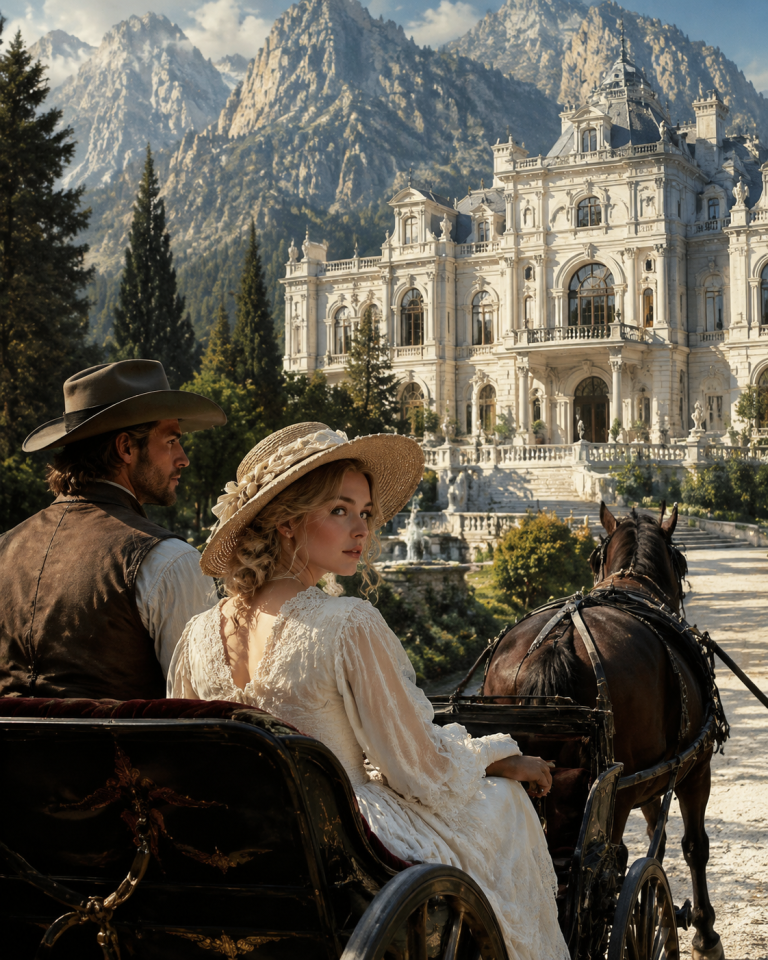
Clara’s breath caught. The valley spread below them like something from a dream — a massive barn, stables, a bunkhouse, and set back on a gentle rise, a house that was practically a mansion.
“Welcome to Stone Valley.”
They were greeted on the porch by a gray-haired, sharp-eyed woman named Martha Hayes, who ran the household and had been Sarah’s friend. “This is my wife, Clara Stone,” Jacob said. Martha’s eyebrows rose a fraction, but she recovered quickly.
“Mrs. Stone. Welcome to the valley.”
“The girls,” Jacob said. “Where are they?”
Something shifted in Martha’s expression. “Emma’s in her room. Has been since you left. Didn’t take it well. Rose has been asking every day, three or four times, *is Papa back yet?*”
—
Rose came down the stairs first, a small figure in a dress too big for her, staring at Clara like she’d never seen another human being.
“Papa!” She flew into Jacob’s arms.
“Is that her?” Rose asked, peering over his shoulder. “The new lady?”
“Her name is Clara. She’s going to live with us now.”
Rose studied her with unfiltered intensity. “Are you our new mama?”
The question hit like a fist. Clara crouched to the girl’s eye level. “No, honey. I’m not trying to be your mama. Your mama was special, and nobody can replace her. I’m just Clara, and I’m hoping we can be friends.”
“Do you like horses? Do you like cookies? Do you like stories?”
“I do. Very much. And I do the voices right.”
Rose looked back at her father. “I think she’s okay, Papa.”
Lily appeared next — thin, pale, pressed against the wall like she wanted to disappear into it. “Are you going to stay?”
“That’s the plan.”
“The last helper didn’t stay. She said Emma was—”
“Difficult.” The word came from above, cold and flat.
Emma Stone stood at the top of the staircase like a queen surveying her territory — dark hair, her father’s stubborn jaw, and her mother’s piercing blue eyes.
“So you’re the one he bought,” Emma said, descending each step deliberately. “How much did he pay for you? I hope it was a lot, because you’re going to need it when you leave.”
“I ain’t leaving.”
“They all say that. The governesses said that, too. And then they left. Every single one.”
“I ain’t a governess.”
“No. You’re worse. You’re pretending to be family.” Emma’s voice cracked, the composure splitting to reveal the wounded child underneath. “You left us for eight days. You went to find a replacement for Mama, like she was just something that broke and needed fixing.”
“Emma,” Jacob started.
“I don’t want her here.” Tears streamed down Emma’s face now, but her voice stayed hard. “My mother is dead. You can’t fix that. Nobody can fix that.”
She turned and ran up the stairs. A door slammed. The silence she left behind was deafening.
“Emma cries at night,” Rose whispered, slipping her small hand into Clara’s. “When she thinks we can’t hear.”
“I’m not going anywhere,” Clara said, meeting Rose’s and Lily’s eyes. “Not tonight. Not tomorrow. Not until you ask me to. Can we start there?”
Rose nodded immediately. Lily, after a long moment, nodded too.
“That’s enough for today.”
—
The fever came on the third night. Martha’s pounding on Clara’s door woke her.
“It’s Lily. She’s burning up.”
Clara reached the room before Martha finished speaking. Lily lay small and pale, chest heaving with each labored breath. “How long?” Clara demanded, pressing a hand to the girl’s forehead. “Too hot.”
“Where’s Jacob?”
“Gone. Rode out before dawn. Won’t be back till nightfall.”
There was no doctor coming. No help from outside. Clara’s mind raced back to a chest fever her own brother had survived, snowed in, no doctor able to reach them.
“Boil water. Find me onions, raw ones, honey, mustard powder.” She sent Rose running for Emma. *”Tell her Lily’s sick and we need help.”*
Emma appeared minutes later, pale, eyes fixed on her sister. “What’s wrong with her?”
“Chest fever. I need your help. You know her. You know what comforts her.”
Emma hesitated — Clara could see the war on her face, the desire to help battling the walls she’d built so carefully. Then Lily whispered, “Emmy,” and the walls crumbled. Emma climbed onto the bed and gathered her sister close.
Clara crushed onions into a paste with mustard powder and honey, spread it on cloth, pressed the poultice to Lily’s chest. She steamed the room, forced sips of honey water past cracked lips, and worked through the hours that blurred together — Emma singing broken snatches of songs their mother used to sing, Rose asleep in the corner curled around a rag doll.
Near midnight, Jacob burst through the door, gray with exhaustion and fear.
“The fever’s not breaking,” Clara said, refusing to soften it. “If it doesn’t break soon—”
He fell to his knees at the bedside. “Lily. Sweetheart. Papa’s here.”
“I saw Mama,” Lily murmured, eyes unfocused. “In my dream. She said she missed me. She said she was waiting.”
“No,” Jacob’s voice cracked. “Not yet, Lily. Not yet.”
Clara watched the strongest man she’d ever met come apart at his daughter’s bedside, and made a decision.
“Everyone out. Give me one hour alone with her.”
“I’m not leaving my daughter.”
“You’re scaring her. She can feel your fear. It’s making it harder for her to fight.” She gentled her tone. “Trust me. One hour.”
“How do I know you won’t let her die?”
“I made a promise to a dying man three days ago that I’d take care of these girls. I ain’t about to break it.”
“Clara,” Emma said — the first time she’d used the name — as Jacob carried her toward the door. “Don’t let her die. Please.”
“I won’t. I promise.”
—
Alone, Clara kept the steam going, changed the poultices, sang the same hymn her own mother used to sing, watched Lily drift in and out.
“Are you going to leave, too? Like the others?” Lily whispered at one point.
“No. Promise.”
“Emma says promises don’t mean anything. She says people always break them.”
“Some people do. But not me.”
“My mama promised she’d always be here. But she left anyway.”
The words hit Clara like a physical blow.
“Your mama didn’t choose to leave, sweetheart. Sometimes things happen we can’t control. But that doesn’t mean she loved you any less.” She leaned closer. “Your mama would want you to keep fighting. Can you do that?”
“I’ll try.”
Sometime just before dawn, something shifted. Lily’s breathing eased. Her skin cooled. The fever broke.
When Jacob and Emma burst back in, Clara could only say, “She’s going to be okay.” Jacob made a sound that wasn’t quite crying — something deeper, finally allowed to heal.
“You did it,” Emma said, staring at Clara. “You actually did it.”
“We did it. All of us.”
Something shifted in Emma’s eyes — the first crack in armor built over four years. “I was wrong about you.”
—
Weeks passed. Rose asked, quietly one morning, if she could call Clara “mama” — just sometimes, when she needed to. “Yes,” Clara said, throat tight. “That’s okay. Just sometimes.” Emma slowly softened, no longer hostile, occasionally asking questions about the world outside the valley.
Then the letter came — carried by the last supply rider before the passes closed. Mrs. Miller’s careful hand. Clara’s father had died five days after she’d left. Peacefully. Proud of her. *He went easy, Mrs. Stone. He wasn’t afraid.*
Clara’s knees buckled. Jacob caught her before she hit the ground.
“I left him,” she sobbed. “I left him to die alone.”
“He wasn’t alone,” Jacob said. “Mrs. Miller was with him. He knew you were safe. You did the right thing. The hard thing, but the right thing.”
She walked out into the snow-covered fields alone and screamed until her voice gave out.
Emma found her there. “Papa told us about your father. I’m sorry.” When Clara, raw with grief, lashed out — *one less thing connecting me to this family* — Emma didn’t flinch.
“I remember when my mama died,” Emma said quietly. “I wanted to scream, too. But someone had to hold everything together, so I didn’t. I’ve been carrying it for four years.”
“You don’t have to carry it alone anymore.”
“Why?”
“Because you’re here now.” Clara told her, then, about her father’s second promise — the one that had nothing to do with debts or Hartley. *Don’t let them forget how to laugh.* “He never met you. Never knew your names. But his last wish was that I’d take care of you. So don’t tell me I’m going to leave.”
Emma stepped forward and wrapped her arms around Clara’s waist — the first time she’d voluntarily touched anyone since Sarah died.
“I’m sorry about your papa,” she mumbled. “I know what it feels like. The empty space that never fills up.”
“Can we start over?” Emma asked finally.
“I’m Clara Stone,” Clara said, holding out her hand. “I make really good biscuits.”
“I’m Emma Stone. I’ve been terrible to you since you got here.”
“Nice to meet you, Emma.”
—
That evening, Jacob found the courage he’d been circling for weeks.
“Somewhere between that first night and now, something changed,” he told her on the porch. “I stopped seeing you as a solution to a problem.” His hand hesitated near her face. “I care about you. More than I expected to.”
“I wasn’t wondering,” Clara said softly. “I already knew.”
She kissed him — brief, but it changed everything.
“I ain’t ready for more than that,” she said, pulling back. “Not yet. But I feel it, too.”
“Then we’ll figure it out together.”
—
Spring brought new trouble in the shape of Jacob’s brother, Thomas — arriving with three lawyers, two investors, and enough arrogance to fill the valley, claiming Jacob was mentally unfit, the marriage invalid, the ranch mismanaged.
Clara stood in the study and dismantled him piece by piece — the ledgers, the contracts, the plain fact of a profitable operation built by a grieving man who never once stopped showing up. “You want to talk about mental fitness?” she said, stepping close enough that Thomas leaned back. “Let’s talk about a man who followed through on every promise he made. That’s not instability. That’s intelligence.”
The investors sided with Jacob before the hour was through. Thomas left within it, lawyers trailing behind him like beaten dogs.
“That was something,” Jacob said, once the dust had settled.
“He’ll be back.”
“Let him come. He’ll find the same thing waiting for him. A family that fights together.”
Clara looked up at him. “I love you,” she said — no planning, no thinking, just true the moment it left her mouth.
“I love you, too,” Jacob answered. “I think I have for a while. I was just too scared to admit it.”
—
Summer came, and with it, an evening on the hill where Sarah was buried. Jacob told Clara everything — the dance in Denver, the wedding with wildflowers Sarah had picked herself, the night he’d held her hand and failed, for four long years, to keep the promise he’d made her.
“You taught me that honoring her memory doesn’t mean drowning in it,” Jacob said. “It means living again.”
Later, on the porch, with a year almost behind them and a letter from a territorial judge dismissing every claim Thomas Stone had ever made, Jacob pulled a small box from his pocket.
“This was my mother’s,” he said, opening it to reveal a simple gold band, worn smooth with age. “She told me it wasn’t the gold that made it valuable. It was the promise it represented — to show up every day and choose each other again.” He slipped it onto Clara’s finger. “I choose you, today and every day after. Will you keep choosing me too?”
Clara looked at the ring, at Jacob, at the life stretched out before them — imperfect, uncertain, and absolutely right.
“Every day,” she said. “For the rest of my life.”
She kissed him then, under the vast mountain sky, the valley standing witness, holding them all safe.
A year ago, Clara Bennett had married a stranger to save her dying father. Tonight, she married him again — for real, this time, for love.
She had come to this valley with nothing but a promise and a desperate hope. She left it — every ordinary evening, every fever survived, every daughter who’d learned, slowly, to laugh again — with something better. A home. A purpose. A love grown from the most unlikely soil.
Her father had asked her to be brave.
She had been.
**THE END**