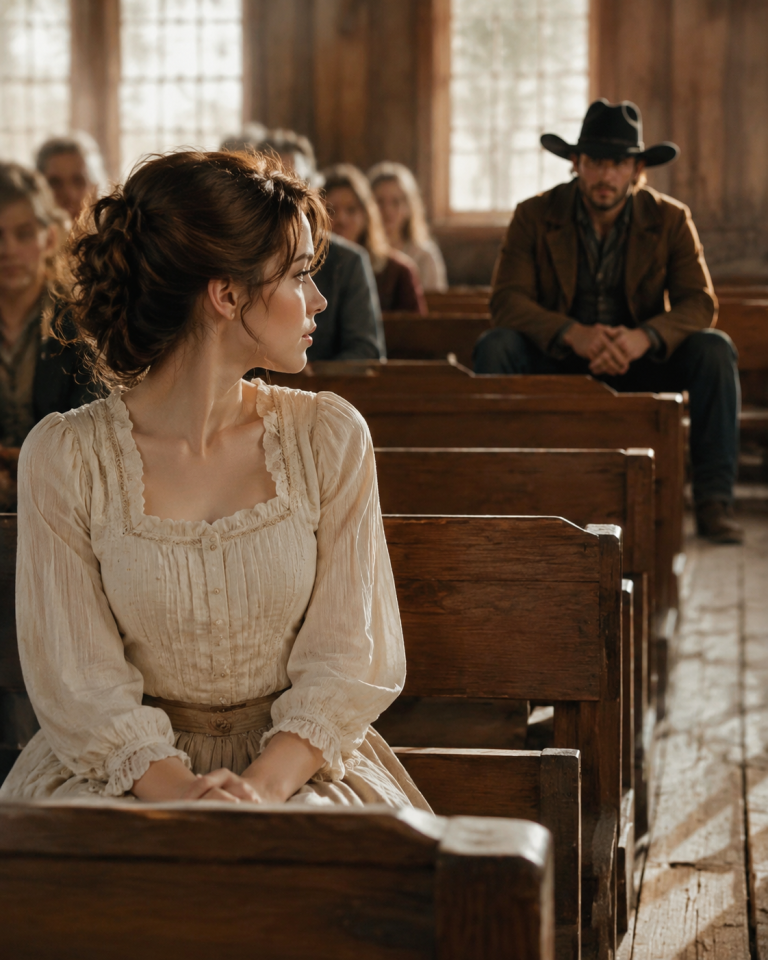
A MOUNTAIN MAN HEARD A WOMAN SCREAMING AND FOLLOWED THE SOUND — WHAT HE FOUND HER FATHER DOING TO HER NEWBORN TWINS CHANGED EVERYTHING

PART 1
The sound came sharp and wrong. A wet crack that split the mountain air. Then a woman cried out, low and broken, like breath torn straight from her chest.
High on the shoulder of the Colorado Rockies, a man stopped mid-step. Snowdust slid off a ledge. Pine boughs stilled. He listened again. Another strike. Another sob. His boots turned downslope before he’d made any conscious decision to move.
The mountains had taught him many sounds — hunger, wind, death. This one was different. This one was cruelty, and it was close.
They called him Caleb Holloway. A name passed quietly between trappers who rarely saw him twice. He lived where trails gave up, where ridges grew too steep for wagons and silence pressed heavy as snow. He spoke little, needed less. The mountains weren’t empty to him. They were precise. Honest. If you listened, they told you what would kill you, and what might let you live. He moved now like part of them — down shale and through spruce, no sound, no rush, only purpose.
The cabin appeared suddenly, squatting in a clearing like something ashamed to be seen. Beside it, in the dirt, a woman lay curled around herself. A man stood over her, holding a hickory switch worn smooth by years of use. Each time it rose, it whistled. Each time it fell, flesh answered.
The man’s face was hard, pale with certainty. Not anger. Conviction.
“You brought filth into my house,” he said, voice steady. “You will learn what that costs.”
The woman made no plea. She had learned those were wasted. Her dress was torn at the shoulder, blood streaked her arm, her breath came shallow and fast. Near her, a wooden crate shook with thin cries. Two voices — small, desperate.
Caleb saw everything, and did nothing. Yet.
The man struck again. Then again. Then stopped, coiling the switch like rope after work. He looked down once more — not at his daughter’s face, but at the crate.
“Bastards,” he muttered.
Then he turned and walked toward the trees.
Only when the forest swallowed him did Caleb move. He stepped into the clearing like a shadow made solid. The woman flinched, raising her arms weakly, bracing for more pain. She didn’t look at his face — only saw boots, a man’s shape, enough to make her shake.
No blow came.
Instead, a canteen touched the dirt near her hand. Caleb backed away two steps and stopped, looking not at her wounds but toward the treeline, giving her space. Giving her dignity. After a long moment, thirst won out over fear. Her fingers closed around the canteen. She drank, spilling half down her chin, sobbing once when the cool water hit her throat. When she finished, she set it down with care, like something borrowed.
Her eyes lifted then, just briefly. He was big, broad through the shoulders, beard dark with frost at the tips. His eyes were gray. Not unkind. Not curious either — as if he’d already decided something and was simply waiting for the world to catch up.
He turned to the crate. Inside lay two newborn girls wrapped in rags, faces red and scrunched with hunger. Caleb’s hands, scarred and strong, slid beneath the rough wood. He lifted them like lifting glass.
Then he held out his other hand to the woman.
She hesitated. Every lesson of her life screamed at her to crawl away. Men took. Men judged. Men hurt. But something in the way he waited made space for a choice.
Her name was Eliza Boone, and she was very tired of choosing pain.
She placed her bruised fingers in his palm. His grip was firm. Careful. He pulled her up without jarring her back, steadying her when her legs buckled. She swayed once, then stood.
They left without looking back. The path he took didn’t look like a path — twisted through rock and brush, vanished, reappeared. Eliza stumbled; each time, his arm was there, silent, solid. He carried the crate in one arm, never tilted, never rushed.
They reached a hidden fold in the mountain where stone opened into shadow — a cave masked by laurel and thyme. Inside, the air was cool and clean, a spring whispering somewhere deep within.
Caleb set the babies down on pine needles softened by hand, knelt beside Eliza, and began to clean her wounds. Water, buckskin, movements sure and respectful. When he pressed a dark green paste to the welts on her back, she gasped at the sting.
“Breathe,” he said quietly.
The first word he had spoken.
Night came. The babies cried, hungry, relentless. Eliza’s body trembled as she tried to give them what little she could. Caleb watched a moment, then stood and was gone before she could ask where.
Fear crawled back into her chest. The cave felt larger without him. Colder.
Then, near moonrise, a shape returned. Caleb led a small cream-colored goat on a braided rope, moving slow and calm, speaking to it like wind through grass. Somehow, impossibly, he coaxed milk into a tin cup, warmed it, tested it, and passed it to Eliza.
She laughed once — a broken sound — then cried.
PART 2
Days followed a new rhythm. He hunted. She healed. She fed the girls, learned his silences, learned to read the tightening around his eyes when the hunt had gone poorly and the looseness when it hadn’t. He never asked about her father. Never asked where the girls’ father was.
That silence felt like mercy.
She named the twins Anna and Mave. Caleb nodded when she told him, and said nothing more. Weeks passed. She grew strong enough to stand longer, walk farther, help — sweeping the cave floor, gathering pine needles, watching how he worked and storing each movement away like a map.
One morning, she told him she needed to go to town. To Ridgeway, just for supplies. Salt, cloth. Silence stretched. The fire popped. At last, he nodded, reached into his pack, and pressed a beaver pelt into her hands — soft, perfect, worth more than pity. Their fingers touched briefly. A strange warmth traveled up her arm.
She left at first light. By the time Ridgeway came into view, her heart had tightened into something hard and small. The town was all straight lines and right angles, and eyes followed her before she even heard the whispers start.
She laid the pelt on the counter of the general store. The storekeeper’s brows rose — surprise, then something colder. Before he could speak, the bell over the door rang.
“Why, if it isn’t Eliza Boone.”
Martha Hale, the preacher’s wife, stood with two other women, their eyes skimming Eliza’s worn dress, her empty hands. “We were worried. After all that trouble. And now with children.” Eliza said nothing. “Twins, I hear. And no husband. Such a burden. Where is your father?”
The question cut clean. Eliza’s throat closed.
“I need salt,” she managed, barely audible.
Martha smiled. “Of course. Charity is important.”
Eliza turned and walked out. She left without the salt, the cloth, the pelt — ran until her lungs burned and the town fell away behind her, shame chasing her up the trail, whispering old words she’d thought she’d buried.
By the time she reached the cave, night was falling. Caleb was waiting. He saw her empty hands, her red eyes, and said nothing — just took the canteen from his pack and handed it to her. She drank, leaned against the stone, and cried without sound.
Two days later, the sky went a strange brass color over the peaks. The air grew heavy. Still. Insects vanished. Even the birds went quiet. Caleb stiffened, packed fast, motioned Eliza to gather the babies. They moved deeper into the cave, through a narrow crack she’d never noticed, into a small chamber higher up.
The storm broke like the sky had split. Rain in sheets. Wind screaming. The ground shook as water tore loose stone and soil, a roar rising from below, louder than thunder.
When dawn came, the world was changed. The clearing was gone — scoured clean, mud and rock piled where trees had stood. The laurel curtain was torn away.
And the goat was gone.
Caleb found the tracks — large, heavy, ending in blood and churned earth.
PART 3
Eliza sank to her knees. Without the milk, the babies cried thin and hungry. Caleb hunted longer, returned with less. He made broth from bones and meat, strained thin. It wasn’t enough, and they both knew it.
Eliza began gathering roots and berries herself, anything she remembered him touching, her hands blistering, her back aching. Still she went. One evening, Caleb returned empty-handed and found a small pile of roots by the fire. Looked at them. Looked at her. Something shifted in him.
He nodded once, slower this time. Partners.
The next morning, Anna coughed — a dry sound, small but wrong. By nightfall, her skin burned hot beneath Eliza’s hand. Caleb knelt, touched the baby’s brow, listened to her breathing. His jaw tightened. He stood and pointed north, toward the high peaks.
“Coline,” he said. Then he was gone.
Eliza watched his shape disappear into the stone and prayed he would come back.
The first night alone was the hardest. She sat with Anna pressed to her chest, counting breaths instead of time, each cough a thin, tearing sound scraping her nerves raw. Mave slept fitfully beside them, unaware of the quiet war being fought inches away. The mountain, once her shelter, felt vast and indifferent again. She kept the fire low, whispered songs her own mother once sang before silence took her place.
Morning came, then afternoon. No Caleb. By the second night, fear had settled into her bones. Anna’s breathing grew shallow, her cries weaker. Eliza crushed the last herbs she knew, bathed the child’s brow with cool water. Nothing changed. She did not sleep.
On the third day, clouds crept low across the peaks. Eliza’s voice grew hoarse with prayers she had never believed in before.
Then, near dusk, stone shifted outside the cave.
Caleb stumbled into the clearing, coat torn, blood soaking the sleeve at his forearm, face drawn tight with exhaustion. But in his hand, clutched like a promise, were pale blue flowers — delicate, almost fragile enough to vanish. He dropped to his knees without a word and crushed the petals between two stones. Eliza rushed to him, adding water, steadying his shaking hands. Together they fed the medicine to Anna.
Then there was nothing to do but wait.
They sat side by side through the long night, firelight dancing against the cave walls. At one point Eliza’s hand brushed his. Neither moved away. Just before dawn, Anna’s breathing eased, the heat fading slowly like a storm retreating.
Eliza broke, covering her face, crying into her palms, quiet and shaking. Caleb sat beside her, unmoving, keeping watch while hope returned breath by breath.
When the sun rose, Anna slept deep and calm. The mountain felt kinder again.
—
Days passed. Healing followed. Caleb spoke more — just a little. Names of plants, signs of weather, the way clouds gathered before snow. Eliza listened, learned, repeated the words until they stuck. She tended his wounded arm, cleaned it carefully, and something unspoken passed between them each time. Gratitude. Respect. Something deeper neither dared to name.
Until the day Caleb came back from patrol with different eyes. Sharper. Harder. That night he sharpened his knife long after the fire burned low, the sound scraping through the quiet. Eliza felt it before she understood it.
The next morning, he led her down-trail to a patch of soft earth. Pressed in the mud: horse tracks, shod fresh. Beside them, bootprints.
Her father.
The fear that rose in her was old, familiar. But this time it did not hollow her. It hardened her.
Caleb didn’t speak. He didn’t need to. They prepared — a hidden climb, a ledge above the clearing to hide if needed, stones rearranged, traps set to look like accidents. The valley became something else. No longer a home. A battleground.
The men arrived two days later. Eliza heard them first — harsh voices, complaining. She gathered the twins and slipped into the fissure behind the cave, pressed against stone, held her breath as a man stepped close enough she could hear his spurs jingle. One baby stirred. She hummed low and desperate. The man moved on.
When Caleb returned, she told him everything with her eyes, with the shake in her hands. He nodded once. That night, she went to him.
“I won’t run again,” she said.
He met her gaze, saw the resolve there, and nodded again.
—
The next morning, they left the cave. High above, Eliza watched her father step into the clearing, rifle slung easy, confidence heavy on his shoulders. A hired man followed close behind.
“Come out,” her father called. “This ends today.”
The answer did not come from the cave. Caleb stepped from the shadows across the valley. Still. Silent. Unmoving.
Her father sneered, ordered the hired man forward. The trap sprang. Stones fell. A scream cut short. The hired man lay pinned and broken. Her father raised his rifle. Caleb did not move.
Something passed between them — a truth older than words. The mountain, choosing its own.
Her father’s hands trembled. His certainty cracked. He lowered the rifle. He fled.
Caleb freed the hired man with cold efficiency and spoke one word. “Go.”
When it was over, he climbed to Eliza. She took his hand. The past loosened its grip at last.
—
That night, Caleb spoke of another valley, of people who lived by different rules, where strength mattered more than shame. Eliza listened and chose. They left days later.
The hidden settlement smelled of smoke and creek water. Children laughed. Women worked without watching her with narrowed eyes. Caleb told her story plainly, and the people listened and accepted her. That evening, standing beside him, watching her daughters sleep safe and unafraid, Eliza believed for the first time that this was not the end. It was the beginning.
The valley breathed differently than the high ridges. Eliza felt it the first morning — the air softer, not easy, but kinder. She learned where to gather water, how to trade roots and berries for cloth and salt without begging. No one asked her story outright. They waited, understanding truth arrived in its own time.
Ezra, an older trapper, sat by the fire one evening and told her plainly, “Your father won’t stop. Men like that don’t lose. They only retreat.”
Two days later, a boy ran breathless into the settlement. Riders, from the south. The valley shifted, men gathering rifles, women drawing children close. No panic. Preparation. Caleb found Eliza near the creek.
“Stay with Sarah,” he said.
“You’re going?”
He nodded once. “Come back,” she said. His eyes held hers, steady, certain. He left without another word.
The riders never reached the valley. Turned back at the pass, warned, watched. This place was not unguarded.
When Caleb returned at dusk, Eliza let out a breath she hadn’t known she was holding. That night, after the children slept, she sat beside him.
“You don’t owe me this,” she said softly.
He poked at the embers. “I chose this,” he said.
—
Then, one cold morning, a familiar figure appeared at the edge of the settlement. Bent, smaller, but unmistakable.
Josiah Boone stood alone this time. No rifle, no hired men — just a hat clutched tight and eyes hollowed by something close to desperation.
“I’ve come to take my daughter home,” he said.
The valley went still. Caleb did not raise his voice. “She’s not yours anymore.”
Josiah laughed, thin and broken. “We’ll see.”
Eliza stepped forward, heart pounding, spine straight. “No,” she said.
For a moment the old power flickered in her father’s eyes. Then it died. She did not bow her head. Did not look away. For the first time in her life, he had nothing left to strike her with.
“I raised you,” he said at last, voice scraped thin. “You don’t belong in a place like this.”
“I belong where my children are safe,” she said, voice shaking once, then steadying. “You lost the right to decide anything for me.”
A murmur rippled through the valley — controlled, not anger. Agreement.
Josiah’s eyes flicked to Caleb. “You think these people will protect you forever? Men like him leave. They always do.”
Caleb said nothing. Eliza turned to him for a breath. No hesitation in his face. Only presence.
She turned back to her father. “Go.”
Something in him broke, jagged and ugly. “This isn’t finished,” he muttered. Caleb took one step forward — not threatening, final. Josiah flinched, turned, and walked away without another word, his shadow long and small against the valley floor.
That night the fires burned later than usual. Caleb sat beside her. “You did well,” he said. She nodded, unable to speak.
—
Winter came early that year, sealing the valley in white. Eliza adapted — learned to smoke meat, mend wool, read the silence before a storm. Her daughters grew plump and strong. Sometimes fear still whispered; sometimes she woke expecting her father’s shadow at the door. Each time, it was only Caleb, standing watch, quiet as stone.
One evening she finally asked, “Why did you stay?”
“I was alone,” he said simply.
“Then I wasn’t.”
Spring came slow. One afternoon, Ezra returned from the lower trails with a grim face. “Word from Ridgeway,” he said. “Josiah Boone is dead. A fall. Drank in ice. No one claimed the body.”
Eliza felt nothing at first. Then something loosened in her chest — a knot she hadn’t known was still there. That night she cried, not for the man he was, but for the father he never chose to be. Caleb stayed beside her until the tears ran dry.
Summer returned warmth to the valley. Anna and Mave took their first steps between the pines. One evening, Caleb stood at the edge of the ridge, pack at his feet.
“I need to go,” he said. “Check the high trails.”
Her heart tightened, old fear stirring. “Will you come back?”
“Yes.”
She nodded, trusted him, let him go.
Days passed. On the eighth day, a storm rolled in early — thunder cracking against the peaks, wind tearing at the valley like it meant to peel it open. Eliza did not sleep, listening for footsteps that did not come.
Morning broke gray and heavy. Still no Caleb. Ezra and two others rode out at first light, following the high trail, the river bend, the narrow pass where rock fell easy after rain. By dusk, they returned, carrying Caleb between them. His leg was bound tight, blood darkening the cloth, his face pale, jaw clenched against pain.
But his eyes were clear. Alive.
Eliza ran to him, dropped to her knees, held his hand as they laid him down. A fall, they said. Loose shale. A long slide. He’d crawled for hours before they found him.
She cleaned his wounds, set the leg as best she could, stayed with him through the night. He woke near dawn.
“You stayed,” he said.
“Always,” she answered.
—
The leg healed slow — too slow for the high ridges. Caleb knew it before the others said it. His days of walking alone above the clouds were over. Not forever, maybe. But for now. He watched Eliza move through the cabin, watched the twins crawl and laugh, watched smoke rise steady from the hearth.
The mountain had changed him.
One evening, weeks later, when the pain had eased and the valley glowed gold in the setting sun, he spoke.
“I don’t need to go back up there,” he said quietly.
Eliza looked at him.
“I was alone because it was easier,” he continued. “Because no one could be taken from me.” He met her eyes. “I don’t want that anymore.”
The words were simple. They shook her all the same. She did not rush him, did not answer right away — just stepped outside with him and looked over the valley. Children played near the creek. Smoke curled from chimneys. Life moved forward.
“This isn’t a rescue,” she said softly. “I won’t be owned or hidden.”
“I know,” he said. “I don’t want to own you. I want to stand with you.”
Silence stretched, comfortable, earned. She reached for his hand.
That was enough.
—
Seasons turned. Caleb built onto the cabin — wider roof, stronger walls. Eliza planted near the creek. The twins grew fast, their laughter loud and fearless. They called Caleb by his name first. Then, one day, something else. He didn’t correct them.
The mountain folk noticed. Smiled. Said nothing.
There was no ceremony. No church bell. No papers signed. Just two people choosing, every morning, to stay.
Years later, travelers would pass through the valley and hear the story — about the lone mountain man who stepped out of the shadows, about the single mother who stood up to the world, about how violence met stillness and broke, about how family was forged, not inherited.
And high in the Rockies, where wind still sings through pine and stone, a home stood warm against the cold, built not on fear, but on courage. On choice. On love that never needed to shout to be heard.
THE END.