The Emeralds Weren’t Hers to Wear — Then the Gate Wouldn’t Open for My Husband

**Part 1**
The smell hit her before anything else — her own perfume, ghosted into leather that used to warm for her and no one else.
Wren Ashworth stood on the wet curb outside The Wexford, watching another woman’s bare shoulder settle into the seat that had absorbed eight years of her marriage. Not a seat. *The* seat. Right rear, cream leather, the one Weston used to reach across and open for her whenever a camera happened to be within a block of them. The one where she’d gripped his hand through the worst hour of his father’s funeral. The one where she’d once believed, foolishly, dressed in borrowed diamonds, that loyalty was a thing money couldn’t rot.
Vivienne Cross crossed her legs like she was auditioning for the position of wife.
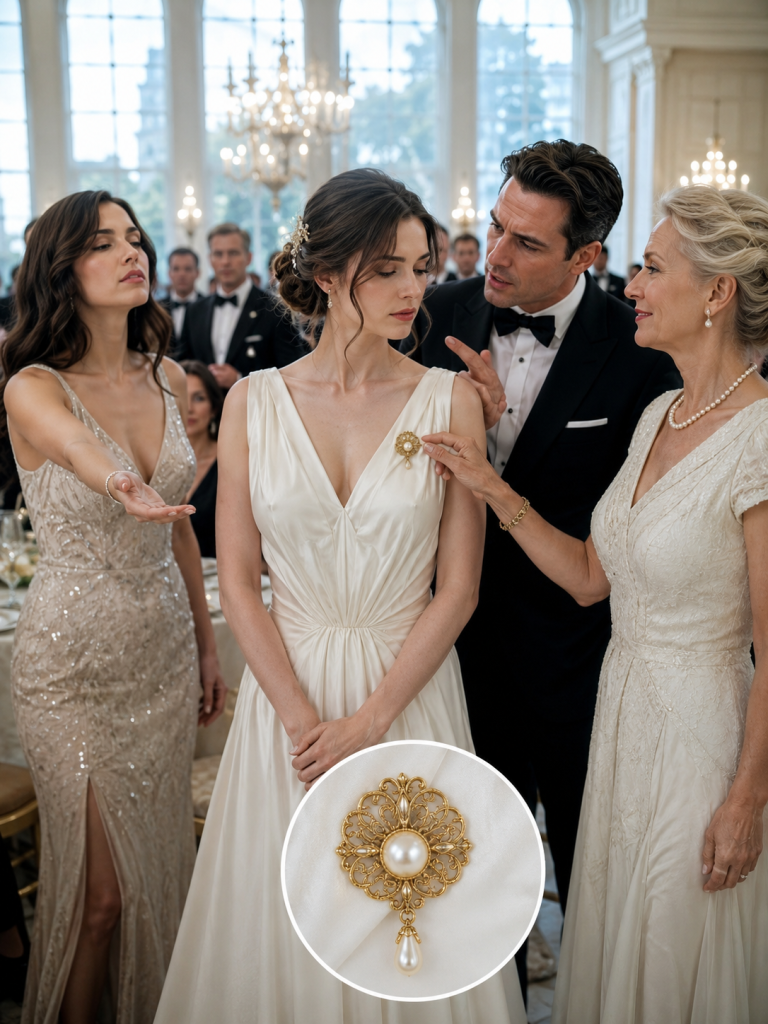
Around her throat sat an emerald pendant that did not belong to her. It had never belonged to anyone but Wren’s mother, and after her mother died it had gone into the vault at Ravensmoor, under two keys and a code only three people on earth knew.
Weston knew all three.
He lowered the window two inches, just enough to speak without the rain touching his cufflinks.
“Find your own way home,” he said, already bored of the sentence before it finished leaving his mouth.
That was the part that landed first. Not the fury. The boredom. As if ending her dignity on a public sidewalk was an errand wedged between cocktails and dinner.
The valet froze mid-reach. Two women from the museum board pretended to study their phones. Somewhere across the avenue, a shutter clicked.
Desmond, the driver, met her eyes in the side mirror. He looked like a man watching a building he loved catch fire.
Wren didn’t cry. Tears were a gift she refused to hand Weston in public. She didn’t ask why. Questions would have given him a stage. She didn’t reach for the necklace. That would have turned a theft into a performance for an audience that already had its verdict written.
She looked at Desmond instead. One small nod — the cheapest gesture she had ever made, and the most expensive thing Weston Ashworth would ever choose to ignore.
“Yes, ma’am,” Desmond said quietly.
Vivienne laughed, testing the word in her mouth. “*Ma’am.* How quaint.”
Weston’s jaw twitched. “Don’t make a scene, Wren.”
She looked at the man she had married under six thousand roses and a ceiling lit gold with candles. She remembered his hand shaking as he slid the ring on. She remembered him whispering *you saved me* the week her father’s money kept his family’s company out of bankruptcy court.
Then she looked at the emeralds around another woman’s throat.
“I never make scenes,” she said, and the window slid shut on the rest of whatever he might have said.
The limousine pulled away. For three full seconds the city seemed to hold its breath with her. Then it exhaled — a horn, a bus sighing at the curb, someone’s laughter spilling out of the hotel bar too loud to be real.
Her phone buzzed once.
*Desmond: Audio and video secured.*
She watched the taillights dissolve into traffic and typed back three words.
*Begin Phase Four.*
An Escalade she hadn’t called pulled to the curb as if summoned by instinct. The driver stepped out and opened the door before she reached the handle.
“Mrs. Ashworth.”
She got in. The leather was cold. The silence, for the first time in years, felt like something she’d actually chosen.
—
Nobody had ever asked how a shipping heiress’s daughter ended up married into the Ashworth name, and that omission was the first mistake everyone made about her.
The Ashworths were old money the way old houses are old — glorious from the street, rotting quietly behind the plaster. Their name sat carved over hospital wings and prep school libraries. Their actual bank accounts had been hemorrhaging for a decade before Wren ever wore the ring.
Weston’s grandfather had built Ashworth Maritime on rail contracts and political favors. Weston’s father inherited it with a polo handicap and a genius for denial. By the time Weston met Wren at a benefit auction, the company was three quarters from collapse, a fact he never once mentioned while telling people he’d fallen for the quiet daughter of Julian Thorne, the shipping magnate from Newport.
That part was true. What Weston never grasped was that Julian Thorne hadn’t handed him a cent out of trust.
“They’ll call you family the moment they need you,” her father told her in a hospital room six weeks before he died, his skin gone the color of old paper under fluorescent light. “And difficult the second you stop paying.”
She’d been twenty-eight, exhausted, wearing the same sweater three days running. Weston was two floors down, taking calls from lenders he liked to call friends.
“He loves me,” she’d said.
Her father smiled the particular smile of dying men who no longer had energy for lies. “Then make sure love has paperwork.”
So before the wedding, his attorneys built Hawthorn Holdings — quietly, thoroughly, in Wren’s name alone. Hawthorn bought Ashworth Maritime’s suffocating debt. Hawthorn bought the private security contracts. Hawthorn bought the lease on every car in the family fleet, including the black Maybach everyone still called *the family limo*, as if ownership were a matter of nostalgia rather than title.
Weston signed the sixty-four-page prenup in a navy suit, kissed her afterward like the ink meant nothing, and for five years played the devoted husband so convincingly she almost forgot to keep counting.
Then came the hotel charge in Miami during a week he swore he was in Dallas. The bracelet billed through the foundation’s donor account. The concierge appointment with an OB-GYN neither of them had discussed.
Then came Vivienne — hired as a communications consultant after a warehouse injury nearly became a headline, thirty-one, glossy, hungry, the kind of woman who insisted she wasn’t impressed by money while photographing the chandeliers.
Weston’s mother, Constance, adored her by the second brunch.
By the third, Constance had started asking, in front of guests, why there were still no grandchildren.
Wren never answered. None of them knew about the pregnancy she’d lost alone in a private suite at Mercy General while Weston claimed to be snowed in at Aspen — a claim the weather reports contradicted, and the white tulips in Vivienne’s apartment confirmed. His favorite apology flower, delivered to the wrong woman’s door.
That was the day Wren stopped being heartbroken and became something far more dangerous.
She didn’t hire a man in a trench coat. She audited. Company phones. Foundation transfers. Security logs. Digital keycards. The truth, when it finally surfaced, didn’t arrive as a confession — it arrived as a spreadsheet.
Vivienne’s rent, paid through a consulting vendor that did no consulting. The emerald pendant, pulled from the Ravensmoor vault using Weston’s emergency override code. A prenatal visit, billed to the family foundation under “maternal outreach research.” And in Weston’s drafts folder, a press plan titled *Legacy Announcement* — preparing to unveil Vivienne’s pregnancy as the future of the Ashworth line.
There was only one flaw in the plan.
The child wasn’t his.
**Part 2**
A text had surfaced on the company phone two weeks earlier — a paternity screening Vivienne had sent Weston herself, naming a Miami nightclub investor named Dante Cruz as the father.
Weston knew. He’d decided to claim the child anyway. Not love — strategy. A public heir would soften the board. A scandal would make Wren look unstable. A mistress with a baby was a weapon. A wife without one was a footnote, easily deleted.
He wanted her to collapse on a sidewalk, slap someone, hand the cameras a story: *cold wife, barren wife, unfit wife, unstable wife.* The words were already loaded, waiting only for footage.
So when Vivienne slid into her seat and Weston told her to find her own way home, Wren understood exactly what she was being handed.
She gave them footage.
Just not the kind they were expecting.
The Escalade crossed into rain-slick avenues while her phone lit up — Constance calling. Wren let it ring three times before answering.
“Where are you?” Constance demanded.
“In a car.”
“Don’t be childish.”
“Weston left me at the hotel with his mistress in my seat.”
A pause, then the practiced sigh Constance used to launder cruelty into weather. “He’s under pressure. Vivienne is carrying an Ashworth child.”
“No,” Wren said. “She isn’t.”
The silence on the line changed shape — not shock. Calculation.
“Come to Ravensmoor,” Constance said finally. “We’ll discuss terms like adults.”
Ravensmoor. Twenty-two acres in Greenwich, a house everyone called the family seat, though the deed — bought quietly through Hawthorn the year before her father died, leased back to the Ashworths for one dollar a year — told a different story.
“I’m on my way,” Wren said, and meant every word of it.
She opened the live feed from the limousine. Vivienne had kicked off her shoes. The emeralds glittered against her throat as Weston poured himself a drink from the crystal compartment.
“She didn’t even fight,” Vivienne said.
“That’s what makes her dangerous,” Weston answered, watching the window. “Calm means she already decided something.”
For one unbearable second, Wren remembered exactly why she’d loved him.
Then Vivienne touched his jaw. “Your mother said the board packet’s ready.”
“It is.”
“And after tomorrow?”
“After tomorrow, Wren’s out as chair. Emergency vote. Reputational risk.”
“What risk?”
He smiled into his glass. “The sidewalk footage.”
Wren’s thumb froze over the screen. They had staged all of it — the humiliation, the cruelty, the camera waiting across the street — engineered so that any reaction from her, silence or fury, could be twisted into evidence against her.
Then Vivienne lifted the necklace between two fingers. “And this?”
“Insurance,” Weston said. “If she accuses you of theft, we say she gave it to you and forgot. Grief does that.”
Wren stopped breathing. He intended to use her mother’s death — her actual grief — as proof her mind couldn’t be trusted.
That wasn’t betrayal anymore. That was architecture. He had built an entire room for her destruction and furnished it with her own pain.
A new text arrived, this one from her attorney.
*Celeste Marlowe: All directors confirmed at Ravensmoor. Preservation order signed. Forensic packet uploaded. Vehicle feed live.*
Wren typed one line back.
*Let them finish talking.*
**Part 3**
Ravensmoor rose out of the storm in pale limestone, windows lit gold, slate roof black with rain, the kind of house that looked inherited from a more disciplined century. The gate opened before the Escalade even slowed. It knew her plate. It knew her phone. It knew exactly whose name was on the deed.
Inside, the library was already full — attorney Celeste Marlowe in cream, two associates, three bankers, a forensic accountant, folders bound in slate ribbon. The Ashworth board sat around the long walnut table: family, investors, men who’d called her *dear* right up until they needed her signature.
They stood when she entered. Not affection. Uncertainty. Power, she’d learned, was only fear wearing better manners.
Constance sat at the head of the table, silver hair immaculate, an emerald ring on her finger that matched the pendant currently soaking in rain two miles down the road.
“You look pale,” Constance said.
“Rain does that.”
“This has gone far enough.”
“I agree.”
Nolan, Weston’s younger brother, cleared his throat. “We were told Weston would be here.”
“He will be,” Wren said. “Eventually.”
Celeste pressed a button on the conference screen, and the live feed from the limousine filled the wall. Weston’s face, laughing. Vivienne’s hand on his thigh. The room went silent enough to hear the rain.
*”Do you think Wren will leave quietly?”* Vivienne’s voice, tinny through the speakers.
*”She’ll do what she’s told once the board removes her.”*
Nolan looked down at the table. Constance’s jaw tightened, but her eyes didn’t widen — she wasn’t surprised. That told Wren everything she needed to know about who else had been in on it.
“Every passenger consents to monitoring as a condition of using Hawthorn Secure Transport,” Celeste said evenly. “Signage is posted inside the vehicle. Hawthorn owns the transport company. The transport company owns the limousine.”
“Vulgar,” Constance said, meaning the recording, not the affair, not the theft, not the fraud — the recording.
Wren almost laughed. “Vulgar is putting his mistress in my seat while she wears my mother’s necklace.”
She opened her folder. “Let’s discuss terms like adults.”
Celeste laid out the motions one by one — Weston suspended as CEO pending investigation into misused foundation funds and unauthorized asset transfers; Constance removed from the compensation and governance committees for undisclosed conflicts and attempted coordination of a fraudulent control vote; the deed to Ravensmoor slid down the table so Constance could watch her own hand tremble over it.
“That house belonged to my husband’s family,” Constance said.
“It was collateral,” Wren answered.
The screen kept playing. Weston’s voice again, softer now, worse. *”If she fights, we leak the fertility stuff.”*
Nobody in the room breathed. Not the three days of silent bleeding in a hospital bed while a nurse braided her hair because her hands wouldn’t stop shaking. Not that.
“Enough,” someone muttered.
“No,” Wren said. “All of it.”
The recording rolled on — Dante Cruz’s name, a signed payout, a deleted paternity test that Celeste had, of course, already recovered. The screen displayed it plainly: probability of paternity, 99.98 percent.
Constance sat down slowly on the nearest chair. Nolan looked physically ill. The vote took eleven minutes and passed unanimously.
By midnight Weston was no longer CEO. By ten past, his corporate card was dead. By quarter past, the gate codes belonging to every Ashworth who had ever treated Ravensmoor like inherited oxygen were revoked.
Wren didn’t send a statement. She didn’t need to. She simply stood in the foyer beneath her mother’s portrait and let paperwork finish what tears never could.
Headlights swept the drive. The Maybach appeared through the rain, trailed by two cars of photographers Vivienne herself had apparently invited, hoping to be photographed arriving as the new mistress of the house.
The gate did not open.
A guard stepped out with an umbrella. Weston lowered the window. “Open the gate.”
“I’m sorry, sir. Your access has been revoked.”
“This is my house.”
“No, sir.” The guard glanced, just once, toward the security camera — toward her. “Mrs. Ashworth is unavailable.”
She was, in fact, standing ten feet from a monitor, watching the man who’d told her to find her own way home discover he no longer had one.
Weston stepped out into the storm. His tuxedo darkened instantly. Vivienne followed barefoot, satin hem soaking into the gravel, emeralds flashing under camera flashes she’d summoned herself and could no longer control.
His phone rang. Hers did too.
“Wren,” he said, and for once the word came out soft, stunned, almost human.
She said nothing.
“You can’t do this.”
She looked around the foyer — the flowers she’d paid for, the staff who stayed because she paid them fairly, her mother’s portrait he’d once tried to have removed.
“I already did.”
“Vivienne’s pregnant.”
“No,” Wren said. “She’s useful.”
A long silence, rain filling the line between them.
“She took your seat,” he said finally, as if that single detail might still explain everything.
He still didn’t understand. The seat had never been the point. The seat was only ever the place he chose to show her exactly what he thought she was worth.
“Yes,” she said. “And you gave it to her.”
“I’ll fix it.”
“No.”
“This is my family.”
“No, Weston.” She watched the locked gate glow through the glass. “This is your consequence.”
She ended the call. Desmond stepped out with an umbrella, walked past Weston without a glance, and gently removed the emerald pendant from Vivienne’s shaking hands once the guard produced the police report. Vivienne surrendered it the moment she saw the cameras still rolling.
“Where are you going?” Weston shouted as the limo reversed.
“To return Mrs. Ashworth’s vehicle,” Desmond said, and drove away, leaving both of them standing in the rain beneath the lie they’d tried to dress up as destiny.
—
The divorce went public two days later, though Wren never gave an interview. She didn’t have to. Weston had arranged an audience for her humiliation, and that same audience stayed long enough to watch his.
*ASHWORTH HEIR LOCKED OUT OF FAMILY ESTATE BY THE WIFE WHO OWNS IT*, one headline read. She didn’t write it. She didn’t correct it either.
Constance relocated to a cousin’s townhouse in Boston. Nolan resigned from the board and later sent a letter of apology Wren accepted but never framed. Vivienne sued no one, because discovery is a room liars learn to fear. Dante Cruz’s name surfaced once in a gossip column, then quietly vanished, the way certain men do when sunlight becomes inconvenient.
Weston fought for six months before he settled — not out of remorse, Wren had learned, but because the invoices eventually become unbearable for men like him.
She kept Ravensmoor. She kept Hawthorn. She kept her father’s company and her mother’s emeralds, and she funneled every misused foundation dollar into a maternal health wing at Mercy General — a private recovery suite for women who’d lost pregnancies and didn’t owe anyone an explanation for their grief. She named it for her mother.
Never for him.
On the first warm Sunday of spring, she opened every window at Ravensmoor and let the house fill with rain-washed air, lemon oil, and roses just waking in the garden. Desmond drove her into the city that afternoon in the Maybach, and when he opened the rear door, she paused.
The right rear seat waited, cream leather, quiet, hers.
She didn’t sit there. She walked around and slid in behind the driver instead.
Desmond caught her eye in the mirror. “New seat, ma’am?”
“New life,” she said, and for the first time in years, the smile that answered him didn’t feel like something borrowed. It felt like breath.
A woman can be humiliated in public and still refuse to be defeated by it. She can stand alone on a sidewalk in someone else’s spotlight and still, quietly, own the road beneath everyone’s feet. She can lose a husband and find, at last, the true weight of her own name.
And sometimes, when another woman takes your seat, the universe doesn’t ask you to fight for it back.
Sometimes it simply lets you remember who owns the car.