SHE ASKED ME TO UNPIN MY DEAD GRANDMOTHER’S BROOCH IN FRONT OF FOUR HUNDRED GUESTS — THEN I READ WHAT WAS ENGRAVED ON THE BACK

**PART 1**
Champagne doesn’t taste like anything when your husband’s mistress is holding out her palm, waiting for you to hand her your grandmother’s brooch.
I noticed the ice sculpture first — a swan, already weeping at the beak under the ballroom lights — before I understood what Simone Reyes had actually said to me. She’d said it lightly, the way people announce a seating change, not a coronation. Behind her, my mother-in-law’s mouth had already curved into the smile she saved for moments she’d rehearsed.
My husband, close enough that I caught bourbon under his mint, murmured, “Don’t turn this into something.”
I almost laughed. After fourteen years, two lost pregnancies, one federal audit, and a hundred nights of translating his family’s cruelty into small talk, he still thought I was the one making things difficult.
The garnet rose pinned below my collarbone had belonged to my grandmother, and to her mother before that. Four hundred guests under that chandelier were about to watch me lose it.
—
I had been Adaline Sterling before I became Mrs. Weston Calder, and in Savannah that name used to open doors people liked to pretend were already open for everyone. My grandmother, Cornelia, never trusted that kind of ease.
“A name isn’t a crown,” she told me once, straightening my collar before some luncheon I no longer remember. “It’s a debt your people left you. You either pay it in decency, or you shame every woman who carried it before you.”
She wasn’t gentle. She was kind, which is a different animal entirely, and one that men like Weston routinely mistake for softness.
The Calders had all the trappings of old Savannah money and none of the liquidity — my grandmother’s word, delivered flatly the first time Weston’s father came to her office asking for a bridge loan disguised as a favor. I was twenty-six, freshly engaged, foolish enough to think being chosen was the same thing as being loved.
Weston proposed in my grandmother’s garden after a summer storm, magnolia petals still wet on the flagstones, Spanish moss dripping silver in the porch light. He cried when he slid the ring onto my finger. I remember thinking no man could fake tears that convincingly.
That was my first mistake.
My second was trusting his mother’s affection. Eleanor Calder called me *darling girl* and taught me which pew the Calder women occupied at church, which cousins drank too much, which donors needed flattering, which wives had survived their husbands’ wandering by simply not looking. “Marriage is weather,” she told me once, stirring lemon into her tea. “You don’t burn the house down over a little rain.”
I was too young to hear the threat folded inside the advice.
On my rehearsal dinner night, my grandmother fastened the garnet rose to my dress herself, in her bedroom, away from the noise downstairs. It wasn’t the most valuable piece in the Sterling collection. It was the one every woman in the family noticed anyway — five gold petals, one dark red stone at the center, small enough to seem modest, old enough to mean something.
“Why this one?” I’d asked her.
She’d looked at me through the mirror. “Men hand you diamonds when they want applause. Women hand down weapons when they want you to survive.”
I laughed. She didn’t laugh with me.
For the first several years, I called it happiness because it was close enough. I signed guarantees when Weston’s development firm needed a cushion. I let my trust cosign a loan the banks wouldn’t otherwise touch. I quietly paid his father’s hospital bills so Eleanor wouldn’t have to be embarrassed at the country club. When the Calder Family Foundation nearly collapsed under an audit, I sat with the accountants for eleven hours and handed over records my husband had never once read.
The foundation survived. The name survived. Weston called me his angel. Eleanor called me a blessing.
Nobody called me the one holding the rope.
That is the particular trick families like the Calders play. They praise you until sacrifice starts to feel like a personality. Then, once you’re hollowed out, they call you cold.
I lost the first pregnancy in March, after a spring luncheon. The second the following winter, while Weston was skiing with investors in Aspen. The third on an ordinary Tuesday, in our own bathroom, while a plumber worked downstairs and I pressed a towel between my knees so he wouldn’t hear.
After that, Weston didn’t change all at once. Men rarely become strangers in one clean motion. He started staying later. His phone began sleeping face-down. He kissed my forehead instead of my mouth. And Eleanor began talking about *legacy* in front of me — not children, legacy, a colder word dressed in pearls.
“Some women,” she told me once, arranging place cards for a fundraiser, not even glancing up, “are asked to love a family enough to step back from certain expectations.”
The pen in my hand snapped. Blue ink bled across my fingers and onto the white tablecloth. Eleanor looked at the stain like I’d bled on her linen on purpose.
That was the day I understood she’d stopped seeing me as wounded and started seeing me as an obstacle.
Simone arrived at the foundation six months later as the new communications director — twenty-nine, glossy, gifted at making powerful men feel understood. The first time I saw her in Eleanor’s borrowed emerald earrings, Eleanor told me not to be old-fashioned. The second time, Weston told me they were just earrings. The third time, I said nothing at all, and silence became the country I lived in.
**PART 2**
In that silent country, I started keeping receipts — not for revenge, just because denial gets harder with paperwork attached. A hotel bill from Nashville. A calendar invite titled *legacy discussion.* A photo sent by accident: Simone at my dining table, Eleanor fastening a necklace around her throat, my wedding portrait already gone from the wall behind them.
I asked Weston about it. He only sighed. “You’ve been fragile a long time,” he said. “Everyone’s been afraid to say it.”
*Fragile.* Not grieving. Not betrayed. Fragile — Eleanor’s word first, then his sister’s, then his own, delivered gently in front of our housekeeper, as if he needed a witness rehearsed.
One week before the ball, my grandmother died in her sleep at Ashwood. Her nurse handed me an envelope at dawn: *Wear the pin. Speak last. Do not save people from the consequences they begged for.*
At the funeral, Weston performed grief like a man campaigning for office. Simone came too, veiled. Eleanor squeezed my shoulder at the graveside and murmured it was time to think about what Cornelia would want for the family.
“What family?” I asked.
Her grip only tightened. She smiled for the cameras anyway.
The night before the ball, Weston found me in the library at midnight, reading my grandmother’s trust papers for the first time in a decade.
“You don’t have to come tomorrow,” he said from the doorway.
“I’m chairing the donor committee.”
“We could explain your absence.”
“I’m sure you could.”
His jaw tightened. “Adaline.”
There it was — the warning register husbands use once they’ve already told everyone you’re unstable and now need you to perform it. He stood there in a navy suit he hadn’t worn to the office, a faint plum stain inside his collar that wasn’t his own lipstick shade. Not mine, either.
“Are you asking me to skip my own family’s ball?” I said.
“Your name is part of what makes it work.”
*Part of it.* That was the phrase that had kept the whole Calder machine running for years — a woman’s name on the invitations, her signature behind the curtain, her body in pearls at the front of the room.
“You should sleep,” he said. “I need you calm tomorrow.”
“I am calm.”
For one second, something flickered across his face that wasn’t irritation. It was fear. Small, but real.
Men like Weston have never once been afraid of tears.
What frightens them is calm.
**PART 3**
The Calder Midwinter Ball was held at Ashwood Manor, the white-columned estate my grandmother had quietly bought out from under Weston’s father during the last recession. The Calders still called it their ancestral home. It amused Cornelia enough that she let them keep saying so.
“Never interrupt a fool narrating his own importance,” she used to tell me.
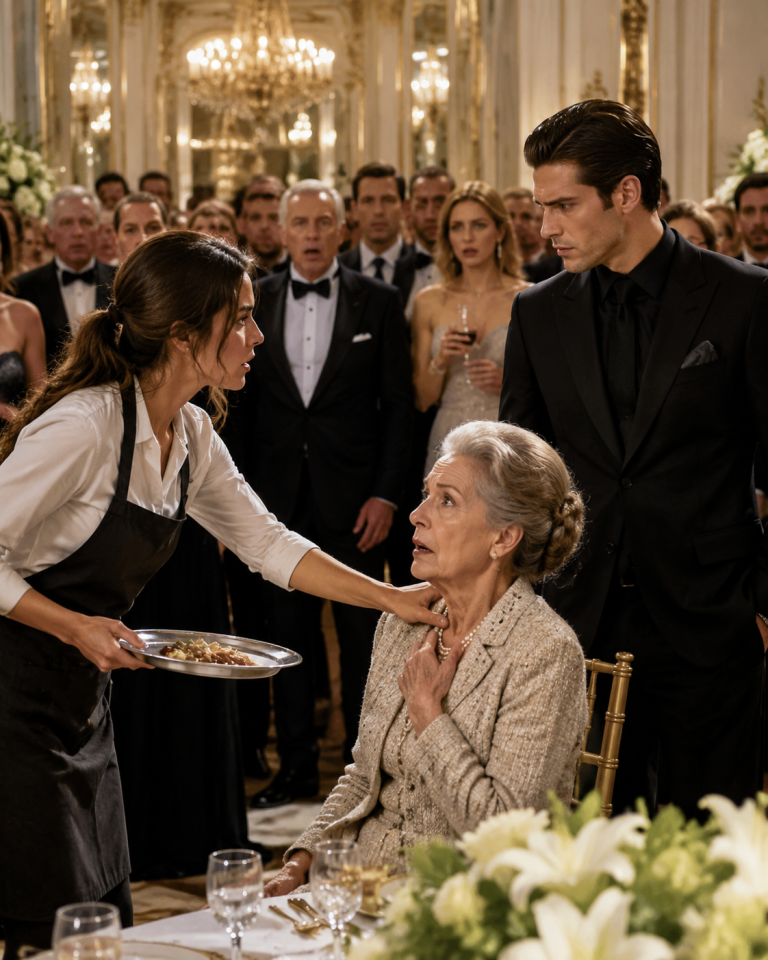
The chandelier had been lowered, polished, and rehung until every crystal threw light like broken ice. A quartet played near the staircase. Waiters moved through the crowd with trays of oysters and champagne, the particular theater rich people call dinner.
At the donor table, my name sat printed at the top of every pledge card. Not Eleanor’s. Not Weston’s. Not Simone’s.
*Adaline Sterling Calder, Ball Chair.*
I wore ivory, not white — the color of old paper and older promises — with the garnet rose fastened at my collarbone for the first time since my wedding weekend. My hands didn’t shake when I clasped it.
Josephine noticed first, froze near the champagne tower, whispered something to her husband, who whispered it to Uncle Roland, who looked toward Eleanor. The message crossed the room without a single phone.
Eleanor found me by the donor wall in burgundy velvet, wearing the careful smile of a woman approaching a dog she suspects might bite.
“You wore Cornelia’s pin,” she said.
“It was hers to give me.”
“Of course.”
Simone appeared behind her in black silk, Eleanor’s diamond bracelet on her wrist, Weston’s hand resting at the small of her back. The room rearranged itself instantly around that image. People saw. People understood. People busied themselves admiring the flowers.
There was supposed to be a script — I learned this later. Weston would thank me publicly for my years of devotion. Eleanor would announce that I was stepping into a quieter role following my grandmother’s death. Simone would be introduced as interim foundation chair. The pin would change hands as a gesture of continuity. The donors, trained to applaud any transition that cost them nothing, would applaud. Within six months, Weston would file for divorce and claim I’d withdrawn from the family voluntarily.
It was tidy. It was elegant. It was vicious.
The only flaw in the plan was that it needed my cooperation.
“Adaline,” Simone said, soft and rehearsed, “I know this is emotional. The family agrees the pin should be worn by whoever represents the Calder future now.”
A photographer lowered his camera an inch — not enough to stop shooting, just enough to look polite about it.
“I’d never want to hurt you,” Simone added. “But it would mean so much if you’d bless the transition.”
*Bless. Transition. Future.* Clean words laid carefully over something already rotting underneath.
Weston leaned toward me. “Don’t turn this into something.”
The old Adaline might have asked why. Might have searched Eleanor’s face for the mother she’d pretended to be. Might have felt the floor tilt.
That woman had died somewhere between the third loss and the afternoon I found my own wedding portrait leaning face-first against a hallway wall.
I unclasped the pin. The room held its breath collectively, the way expensive rooms do — too polished to gasp, too hungry to look away.
I turned the brooch over before I handed it off, and that’s when I finally saw it: tiny letters worn smooth by eighty years of thumbs.
*Only the betrayed one will know when to use this.*
For a moment the whole ballroom went silent inside my own head. Then my grandmother’s voice came back whole: *Wear the pin. Speak last. Do not save people from the consequences they begged for.*
I looked at Simone, then at Weston, then at Eleanor.
“I want to be precise about what’s happening,” I said, and my voice traveled farther than I expected. The quartet faltered and stopped. “You are asking me, in public, as Weston Calder’s lawful wife, to hand my family’s brooch to his mistress.”
Simone’s composure slipped a fraction. Enough.
“Adaline,” Weston hissed.
“No. Words matter.”
Eleanor stepped in, still smiling. “There’s no need for ugliness, darling.”
“You brought the ugliness. You just dressed it in silk.”
“I am not his mistress,” Simone said, chin lifting.
I smiled — not warmly. “Then what are you?”
Weston reached for my arm. I stepped back before he could touch me.
“Let her answer,” I said.
Simone glanced at Eleanor, who gave the smallest nod. That nod was the second mistake of the night.
“I’m carrying his child,” Simone said.
A sound moved through the crowd like wind through dry leaves. Weston closed his eyes — he’d wanted the insinuation, not the sentence, but Simone wanted the crown badly enough to mistake confession for triumph.
Eleanor recovered fastest. “And that child deserves to be welcomed without bitterness.”
There it was. Not betrayal. Not the affair. *Bitterness* — my pain repackaged as the actual problem, their cruelty repackaged as its cure.
I held the pin out. Simone reached for it.
“Wait,” I said. “I need one more witness.”
Weston’s voice cracked. “Enough.”
The ballroom doors opened. A silver-haired man in gray stepped through, followed by a woman carrying a leather case. Eleanor went pale beneath her foundation the instant she saw him.
“Mr. Marsh,” she said.
Bennett Marsh had been my grandmother’s attorney for thirty-seven years and had, at one point or another, represented half the room.
He looked at me first. “Mrs. Calder. You asked me to be present if the Sterling brooch was ever formally demanded.”
“You called a lawyer?” Weston said.
“I followed instructions.”
Simone’s hand dropped from her stomach. The cameras kept rolling. I placed the pin in her open palm, and the instant her fingers closed around it, Bennett opened his case.
Behind him, his assistant — a quiet woman named Priya who would later become someone I trusted with almost everything — set a second folder on the linen tablecloth, careful not to disturb the flowers.
“Let the record show,” he said, “that the Sterling matriarch brooch was surrendered by Adaline Sterling Calder under public demand from Simone Reyes, acknowledged intimate partner of Weston Calder, in the presence of Eleanor Calder, members of the Calder family, foundation donors, and press.”
“Record?” Weston’s voice cracked clean in half.
“Cornelia Sterling believed in clarity,” Bennett said.
Eleanor stepped toward him. “This is absurd.”
“This is contractual,” he said.
That single word did more damage than any insult could have. He drew a thick cream document from the case, sealed with my grandmother’s wax stamp.
“The Sterling-Calder Continuity Agreement was executed in 2011 by Weston Calder, Eleanor Calder, Roland Calder, Josephine Calder Whitfield, and Adaline Sterling Calder, among others.”
“That was foundation paperwork,” Weston said.
“It was foundation, estate, and loan-security paperwork,” Bennett said, “as Mrs. Sterling explained personally at the signing.”
Eleanor’s mouth flattened into a line. My grandmother had told me once that wealthy men will sign nearly anything in a hurry if lunch is waiting and the woman explaining the document is someone they’ve decided not to take seriously.
Bennett kept reading. “Within this agreement is a clause concerning the Sterling brooch, designated a symbolic instrument of authority over Sterling-backed Calder holdings.”
“It’s a brooch,” Eleanor snapped.
“No,” I said quietly. “It’s a key.”
Bennett read the clause aloud. In the event the lawful bearer of the brooch was publicly pressured, displaced, or ceremonially replaced by a spouse’s intimate partner for purposes of succession or reputation management, the final clause would activate on transfer — revoking every Sterling guarantee, accelerating every obligation those guarantees secured, freezing all foundation spending pending audit, stripping Calder family voting rights from Sterling-controlled boards, and restoring full authority to the betrayed bearer.
Simone stared at the pin like it had turned hot in her hand.
Bennett wasn’t finished. He drew a smaller envelope from Priya’s folder, the paper cream-colored, sealed with a disc of red wax pressed with my grandmother’s initials.
“There is one further matter,” he said. “Mrs. Sterling instructed me to read this only if the final clause activated within her lifetime, or within one year of her death.”
My throat closed the way it hadn’t all night, not at the funeral, not at the ballroom door.
“Read it,” I said.
He unfolded it carefully, the way you’d unfold something that might tear.
*My dearest Adaline. If Bennett is reading this to you, then someone in that family finally mistook your silence for surrender, the way they once mistook mine.*
A murmur moved through the older guests at that. Eleanor’s gaze dropped to the floor, and I understood, in that instant, that she’d already known this story. Families like the Calders always know exactly which histories to keep buried.
*When I was thirty-two,* Bennett continued, *your grandfather brought another woman to a Sterling dinner and asked our attorney to bless what he called the practical future of the family. He believed my grief over a stillborn son had made me too weak to object.*
Weston’s face changed. For the first time all evening, something that looked almost like shame found him and stayed.
*He was wrong,* Bennett read. *So I built this clause for whichever woman came after me. I hoped, more than anything, that she would never need it. You owe no grace to people who used your grace as furniture. You owe no silence to those who rehearsed your erasure. And you owe no loyalty to a family that only called you family while you were paying its bills.*
Someone near the bar was crying softly. Maybe more than one person. It was not me. Not yet.
I looked down at the garnet stone glinting in Simone’s fist and understood, fully, for the first time, that I wasn’t improvising a scene. I was finishing one my grandmother had started decades before I was born, in a dining room I’d never seen, at a table where a much younger, much more frightened version of the woman who’d raised me had once sat exactly where I was standing now.
Bennett folded the letter and slid it back into the envelope. “There’s a financial matter as well,” he said, and drew out a third document, this one bearing the letterhead of the bank that had funded half the Calder family’s ambitions for two generations.
Weston lunged toward him before he’d read a single line.
I had never once seen my husband move like that. Not when I lost our first pregnancy. Not when my grandmother died. Not on the night I sat up until dawn saving his foundation from an audit he’d caused. But for a piece of paper, apparently, he could still find his legs.
Two security guards stepped between him and the attorney before he reached the table.
That was the moment the room finally understood this had stopped being a scene. It had become a collapse, and everyone in that ballroom was standing close enough to hear it happen.
By the time the first phones started ringing near the bar, Weston already understood what had happened. So did his uncle, cursing under his breath. So did the banker near the donor wall, who went the color of the tablecloths. Eleanor’s own phone rang from inside her evening bag, and she didn’t move to answer it.
“You froze my company,” Weston said.
“You built your company on my grandmother’s guarantees,” I said. “You didn’t build anything alone.”
Eleanor dropped the endearments entirely. “Do you understand what you’re doing?”
“Yes.”
“Weston made a mistake.”
“No,” I said. “Weston made a life. With someone else. While calling me fragile for noticing.”
I looked at Simone once more, at her phone lighting up in her clutch a moment later with a name that wasn’t Weston’s — *Marcus,* her yoga instructor, as it would turn out, and the actual father of the child she’d used as a crown. I didn’t feel triumphant watching that particular piece fall. I felt tired, mostly, the way you feel after carrying something heavy for so long that even setting it down aches.
Security guards moved quietly to Weston’s side before he could reach for the documents. Four auditors entered through a side door at ten past nine, no sirens, just laptops and legal authority, which is somehow worse. Clipboards feel like consequences. Sirens feel like accidents.
By midnight his corporate card was declined at the hotel bar. By morning, Eleanor’s car had been repossessed from the club lot, its lease held by a Sterling subsidiary. By noon, the foundation’s website carried a notice of independent review. By evening, the first clip of the ballroom had seven million views, and my phone had stopped being a phone and started being a siren I couldn’t switch off.
I didn’t watch the video myself until two days later. My friend Margo made me. We’d been roommates at Wesleyan two decades earlier, and she’d since become the divorce attorney every woman in three counties called when a marriage finally cracked past repair. She arrived at Ashwood with groceries, a bottle of Sancerre, and a legal pad thick enough to double as a doorstop.
“You’re trending,” she said, setting the wine on the counter.
“I’m grieving.”
“You’re allowed to do both.”
We sat in my grandmother’s kitchen, copper pots hanging above the island, rain ticking softly against the window glass, and Margo opened her laptop without asking permission. There I was in ivory, the pin catching the chandelier light, Simone’s black silk beside Weston’s shoulder. *Don’t turn this into something.* I watched myself reach for the clasp. I watched my own face change the instant I found the engraving.
It was strange, watching the exact second a woman leaves one life and steps into another. There was no lightning in it. Just a stillness that had never belonged to me before that night.
The comments blurred together after a while — some cruel, some funny, an alarming number from strangers describing their own humiliations at bridal showers, deathbed reunions, custody hearings, church parking lots. One woman wrote that she wished her own grandmother had left her a pin instead of silence. Another wrote that hers had left a recipe box, but the energy, she said, was the same. A third wrote that the words *words matter*, spoken so plainly in front of four hundred strangers, had healed something in her she hadn’t known was still raw.
That last one undid me quietly enough that Margo closed the laptop without asking why.
The divorce took the better part of a year to finish, not the single clean afternoon revenge always promises in the retelling. Weston tried emotional distress first, then coercion, then insisted his mother had orchestrated the whole evening without his knowledge, then finally claimed I’d never truly supported his dreams — a line so absurd that Margo laughed hard enough to spill coffee straight across a subpoena. Eleanor tried shame, then legacy, then a sudden and very convenient illness, then a handwritten letter on cream stationery that I threw directly into the trash unread. Margo fished it back out. “Evidence,” she said, and filed it anyway.
Simone gave exactly one interview, wearing beige, weeping beautifully about being manipulated by a powerful family that had used her. Nobody believed her once Marcus surfaced publicly a week later, first in the comments of her own interview clip and then, more definitively, in a paternity result neither Weston nor Simone had wanted made public. I didn’t celebrate that particular reveal. People expected me to. They wanted to watch me dance across the wreckage. I mostly just felt tired, the way you feel after finally setting down something heavy you’d carried so long you’d forgotten your own shoulders without it.
Weston called once, late, after the paternity news broke. I let it go to voicemail and only listened to it once, days later, out of something closer to curiosity than forgiveness.
“Adaline,” his voice said, smaller than I’d ever heard it, “I know I don’t deserve anything from you. I just need you to know I’m sorry.”
I deleted it without replying. Some apologies aren’t bridges. They’re receipts, filed after the debt’s already been called.
The prenup held. The postnuptial loyalty clause held. The Sterling-Calder continuity agreement held against every appeal Weston’s lawyers filed. He left the marriage with his watch collection, his clothes, and a settlement small enough to sting his pride and large enough to keep him from standing in front of a judge and claiming poverty.
Eleanor moved out of Ashwood’s guest cottage and into Josephine’s pool house that spring, a detail that traveled through Savannah faster than the ballroom video ever had. I didn’t evict her out of cruelty. I gave her thirty days and paid for the professional movers myself. I simply wanted my grandmother’s house cleared of her voice, the way you air out a room after a long illness has finally left it.
Josephine, to my genuine surprise, called me herself that same week — not to defend her mother, and not to apologize on Weston’s behalf, but to ask, in a voice I’d never once heard her use at any family dinner, whether the fund might need a volunteer who understood spreadsheets better than sympathy cards. I told her yes before I’d fully decided I meant it. She showed up that Saturday with her own laptop and didn’t mention the Calder name once. Some people, it turns out, only need one honest ballroom to finally stop performing.
The Calder Family Foundation survived, but not as theirs. I renamed it the Cornelia Sterling Legacy for Women’s Independence, and the first grants went to women rebuilding after financial abuse, medical debt, widowhood, and family coercion. Margo said the name ran too long for a press release. I told her women’s suffering had already been shortened enough by everyone else’s convenience.
We held the inaugural fundraiser that October under a tent in my grandmother’s garden, magnolias blooming late as if they’d deliberately waited for us. There were no Calder portraits anywhere in sight. There were no speeches about legacy delivered by men standing on money that had never once belonged to them. There was just food, string lights threaded through the live oaks, and a room full of women — some wealthy, some barely scraping by, some newly divorced, some still working up the nerve, some old enough to know that heartbreak, however it feels in the moment, is weather and not a verdict.
I wore navy that night. The brooch sat at my collarbone, exactly where it had always belonged. A woman named Marisol found me near the dessert table, silver-haired, nervous, and told me she’d seen the ballroom video months earlier. She said she was sorry, the way so many people had said it to me since — though I’d slowly come to understand that some of them meant they were sorry it happened, and others meant they were sorry they’d watched.
“My daughter’s leaving her husband next week,” she told me. “He controls every account in the house. She doesn’t have so much as a debit card in her own name.”
“We can help with that,” I said.
Her eyes filled. “Why would you? You don’t even know us.”
The answer came from somewhere old, somewhere my grandmother had left unlocked in me long before I understood what she’d built.
“Because someone should,” I told her, and meant every word of it.
One year to the day after the ball, I stood beneath that same chandelier again — not at a Calder event this time, but inside the east wing of Ashwood, which the fund had since converted into temporary housing for women leaving dangerous marriages. It hadn’t been easy to buy the property outright. Weston’s final appeal had dragged the closing out by nearly four months, and Eleanor had shown up at the courthouse twice, dressed for a funeral neither of us was actually attending. But the continuity agreement did exactly what my grandmother had built it to do, and by summer the deed was mine free and clear, no Calder name attached to a single line of it.
The ballroom where Simone once asked for my brooch now held a legal aid clinic twice a week. The dining room where Eleanor had once arranged donors by net worth had become a quiet counseling space with soft chairs and a box of tissues on every table. Weston’s great-grandfather’s portrait had been taken down, cleaned, and put into storage; in its place hung photographs of ordinary women who’d survived extraordinary things — nurses, teachers, widows, immigrants, daughters, mothers with tired eyes and steady hands, women who had learned, each in her own time, that dignity isn’t something a family hands you. It’s something you eventually stop handing over.
A young mother named Tessa stood beside me that evening, a toddler balanced on her hip, a fading bruise just visible beneath her makeup. She looked up at the chandelier like she didn’t quite believe she was allowed to be standing under it.
“I don’t belong somewhere like this,” she said.
I knew that sentence. I had lived inside it for years.
I touched the pin at my collarbone. “Yes, you do.”
Her daughter reached up and tapped the garnet stone with one small finger, and for a moment I felt the whole line of women standing behind me — my grandmother, her mother, all the quiet ones before them, all the women who had learned, one generation at a time, how to turn silence into strategy and grief into paperwork.
“Is it famous?” Tessa asked, nodding at the pin.
“A little.”
“What does it mean?”
I looked around the room — at the legal aid table, at the children coloring beneath portraits of women who’d made it out, at the chandelier still throwing its old, indifferent light over a room that had once been built to erase me.
“It means you don’t have to scream to be heard,” I said. “It means you don’t have to beg anyone to be decent to you. And it means that when someone asks you to hand over your dignity, you check what’s written on the back first.”
Tessa smiled like she wanted to understand and would, in time.
Mine had come beneath a chandelier, in front of four hundred witnesses, with my husband’s mistress holding out an open hand. They thought they were taking my place. They thought they were taking my name. They thought they were taking the last beautiful thing my grandmother had ever given me.
She hadn’t given me an ornament.
She’d given me a warning, a witness, and a final clause — and all any of them had to do to set it loose was ask me for the pin.