HER SISTER REFUSED TO MARRY THE RANCHER SHE’D PROMISED HERSELF TO — SO THE FAMILY SENT THE “PLAIN” DAUGHTER IN HER PLACE INSTEAD

PART 1
The morning light came thin and yellow through the curtains of the Bramwell farmhouse, laying long tired bars across the floorboards and the faded rag rug by the window. Faith Bramwell stood there with her forehead against the cool glass, watching small dust devils spin through the yard and vanish out over the Nebraska prairie like thoughts too brief to hold onto. At twenty-four, she’d long since learned how the world sorted women into categories before they ever opened their mouths. Camille was the beautiful one. Faith was the useful one. Camille was the daughter people noticed the second she walked into a church social or a summer picnic. Faith was the daughter who cleared the dishes, mended hems, turned the soil, kneaded the bread, and kept the whole farm from sliding into disorder around everyone else.
She’d accepted that division so completely by now that she no longer wasted much energy resenting it day to day. Some griefs simply become part of the weather of a life.
“Faith, get down here this instant.”
Her father’s voice cracked up the stairwell like a whip.
She straightened, smoothed the front of her faded calico dress, and went down carefully, one hand trailing the narrow banister worn smooth by years of use. The kitchen sat colder than it had any right to be for morning. Her mother was at the table, hands folded so tight the knuckles had gone white. Her father, Walter Bramwell, stood by the cast-iron stove with a face dark and hard as an oncoming storm front. And Camille — golden-haired, porcelain-skinned, lovely even mid-cry — sat with a lace handkerchief pressed to her mouth, tears somehow making her blue eyes look brighter instead of ruined.
“Tell her,” Walter said.
Camille gave a delicate sob that came off almost rehearsed. “I can’t marry him, Faith. I simply can’t. A rancher out in Wyoming Territory, living in some hovel at the edge of the wilderness — I’d rather die.”
The words dropped into the room and rearranged everything in it.
For six months, Camille had been corresponding with a rancher named Holt Ferris, answering his newspaper notice for a mail-order bride. The whole family had treated the arrangement like a kind of salvation. Holt had land, work, seriousness, and enough money set by to send for her passage west. One less mouth to feed. One respectable future secured. One beautiful daughter settled advantageously. Walter had spoken of the whole business like Providence itself had finally remembered the Bramwells existed.
“You gave your word,” their mother, Louisa, said quietly, though her eyes still held their usual sympathy for Camille, same as always.
“I was confused,” Camille wailed. “I didn’t know what I was agreeing to. Besides — Roland Pace has been calling on me. He owns the general store. I could stay right here. Near family. Near civilization.”
“Enough.” Walter’s fist came down hard on the table. “You took that man’s money. Made promises. This family’s whole reputation—”
“Then send Faith instead.”
Silence swallowed the room whole.
Faith felt all three of them turn to look at her at once.
“What?”
Camille straightened, and her tears slowed almost by magic. “Mr. Ferris has never once laid eyes on me. We’ve only exchanged letters, and that one photograph where you can barely make out a face at all. Faith could go in my place. She’s more suited to that kind of life anyway.”
*More suited.*
The phrase struck harder than any plain insult could have, because it arrived dressed up as practicality. More suited because her hands were rough already. More suited because she was plain. More suited because no man in town was waiting on her. More suited because she’d spent her whole life doing the hard, unglamorous things without ever once being asked whether she wanted to.
“That’s dishonest,” Faith said, and was almost startled at how steady her own voice came out.
“Is it?” Walter studied her with the same calculating coldness he reserved for livestock sales and bad weather. “You’re both Bramwell daughters. He advertised for a bride, and he’ll get one. Besides—” his mouth twisted into something mean “—what prospects have you got here anyway? Think any man’s going to come courting while your sister’s still available?”
The truth of it stung precisely because it held enough truth in the shallow, social sense of things. Faith had watched men’s eyes pass right over her for years and land on Camille instead. She’d stood minding punch bowls while Camille danced. Stayed home doing chores while Camille went off to church picnics and harvest socials trimmed in ribbons and brighter dresses. She knew exactly what she looked like. She also knew what people had decided that look meant about her.
“I won’t lie to him,” she said.
“Then tell him the truth once you arrive,” Walter said, with a shrug so indifferent it made her want to hate him and know, in the same breath, that she couldn’t afford to. “Let him decide for himself. But you’re going. You’ll honor this family’s commitment, one way or another.”
“Father, please.”
“It’s decided.”
He left the room after that, and once he’d gone, whatever heat remained in it left with him. Louisa said little as she helped Faith pack over the next two days — folding dresses mended too many times to count, wrapping food for the journey, tucking in an old Bible and a handful of essentials. Careful work, practical, almost tender in its way, but with no rebellion anywhere inside it. Her mother’s love had always been the resigned kind — the kind that could comfort a person without ever once defying the source of the harm.
Camille avoided her almost entirely after that, though Faith heard her laughing with friends out in the yard the very next afternoon, apparently well recovered from the tragedy of not having to keep her own word.
That night, Faith found Holt Ferris’s letters tucked under a small stack of linens in her room — a place Camille must have chosen in haste, or guilt, or both. Faith lit a candle and read every one of them straight through.
His handwriting ran neat and educated. The letters weren’t florid, but they were thoughtful. He wrote of two hundred acres in Wyoming Territory, of horses and cattle, of mountains so large they made a man feel humbled and grateful in the same breath. He wrote of weather and fences and the practical demands of running a ranch. He wrote of loneliness too, though that part mostly lived in the spaces between his sentences rather than in the sentences themselves. He was thirty-one, a veteran of the war, a man who’d built his home with his own two hands. He wanted a wife, certainly — but more than that, he wanted a partner. Someone strong enough for the frontier, sensible enough for hardship, gentle enough to turn a house into a home.
Faith traced one line with her fingertip and tried hard not to think about how every word of it had been written for Camille.
What would he see, the moment she stepped down off that coach? Not the golden-haired woman from the photograph. Not the lovely correspondent who’d filled pages with chatter about dresses and socials and polished small talk. He’d see Faith — sun-weathered skin, brown hair that never quite behaved, hands marked plainly by labor, a face no one had ever once called beautiful without some kindness softening the lie of it.
She slept badly. Dawn came in gray and bitter. At the coach station her father pulled her aside one last time. “Remember,” he said. “You’re representing this family. Don’t shame us.”
Her mother pressed peppermint candies into her palm and kissed her cheek. Camille stood apart in a fine blue coat, and for one brief instant looked almost human in her discomfort — Faith thought she caught a flicker of guilt there. Then her sister looked away.
The journey west seemed determined to prove that uncertainty alone could be physically exhausting. The coach rattled through farmland, then prairie, then terrain that grew rougher and emptier by degrees until the whole world seemed to widen past all reason. Her back ached constantly. Dust worked its way into her hair and clothes no matter what she did to stop it. The food at the stagecoach stops was every bit as bad as rumor claimed. Reverend Osgood, traveling aboard, proved kind enough and spoke cheerfully of opportunity waiting out west. A heavyset woman named Mrs. Fenwick complained about nearly everything under the sun and, on the third day, finally asked Faith why she was headed to Wyoming at all.
“To be married,” Faith said.
The woman’s eyes lit up. “A mail-order bride? How brave. Or desperate.” She laughed right after saying it, as though the cruelty in the question excused itself through humor alone.
Faith turned to the window instead of answering. Brave or desperate. Perhaps both. Perhaps neither. Perhaps she was simply obedient, in the particular way daughters without real options tend to become obedient, because defiance so rarely has anywhere useful left to go.
By the time the coach finally reached Cheyenne, her stomach had knotted so tight she could barely draw breath.
She searched the platform for Holt Ferris before the driver had even finished setting down her trunk. He’d described himself plainly enough in his letters — tall, dark-haired, a good black hat — but that description fit half the men on the platform at once. Then a voice behind her said, “Miss Bramwell?”
She turned.
He stood taller than she’d expected, broad-shouldered, severe-faced, dark hair under a black hat, gray eyes that seemed to miss very little at all. There was weather written into his face, and something sterner than plain reserve set into the line of his mouth. Holt Ferris looked at her once, and the confusion that crossed his features, brief as it was, came through unmistakable.
Faith had promised herself she’d tell the truth immediately, before politeness or hope had any chance to soften her into delay.
“Mr. Ferris, I’m Faith Bramwell. Camille’s sister.”
His brow furrowed. “Sister?”
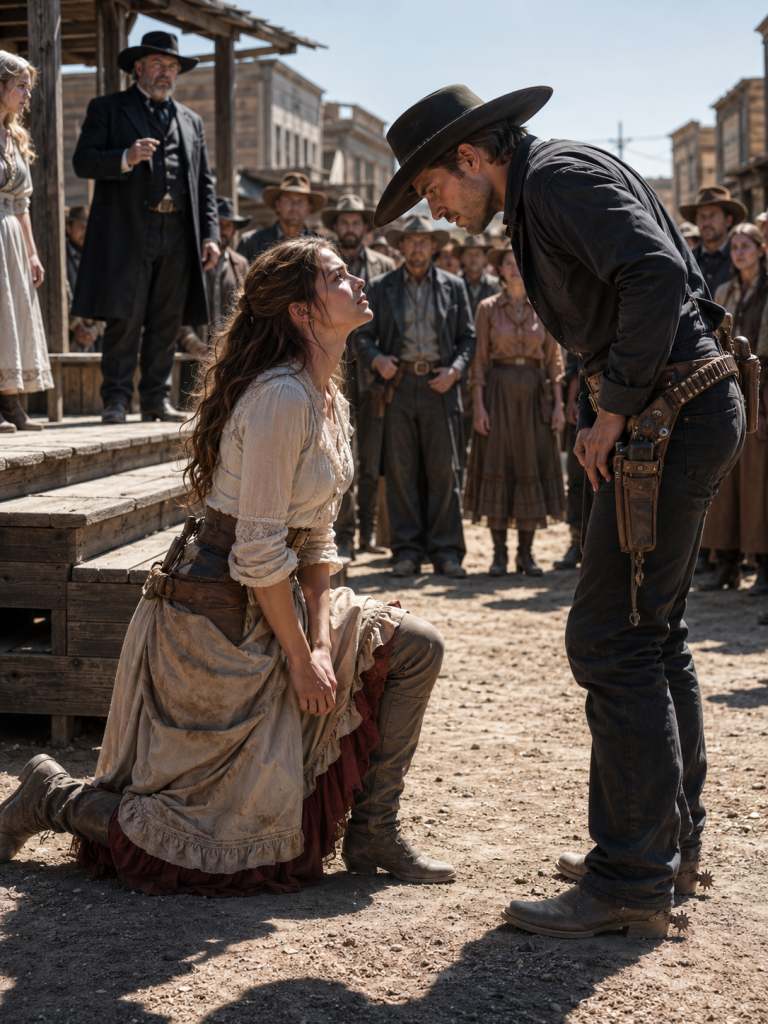
“Yes. There’s something I need to tell you right away. Camille couldn’t come. She changed her mind about the marriage. My father sent me in her place.” The words tumbled out too fast, tripping over each other. “I know this isn’t what you were expecting, and I understand entirely if you want to put me on the next coach back east. I only wanted to tell you the truth straight off.”
“She’s not coming.” Not a question.
Faith shook her head, shame burning up the back of her throat. “No. I’m sorry. I told them it wasn’t right. But I won’t hold you to anything at all. You were expecting Camille, and I’m not her.”
PART 2
Holt studied her a long moment. Faith stood perfectly still under it, though she wanted badly to smooth her dress, hide her hands, explain herself into somebody more acceptable. She already knew exactly what he was seeing. She’d spent a whole lifetime knowing.
At last he asked, “You traveled five days alone?”
“Yes.”
“To marry a man you’d never met. A man who wasn’t even writing to you.”
“To honor my family’s obligation,” Faith said, lifting her chin despite herself. “And to tell you the truth so you could choose for yourself.”
Something shifted in his face then — not warmth exactly, but a subtle change around the eyes, a crack somewhere in that first impression.
“I see.” He lifted her trunk like it weighed nothing at all. “Wagon’s this way.”
She blinked. “But don’t you want to decide first?”
“Near dark already. Won’t be another coach for three days. You’ll come to the ranch tonight. We’ll sort the rest out come morning.”
PART 3
He helped her up into the wagon with careful, impersonal courtesy, and the ride out of town passed mostly in silence. At one point he asked her age. At another, why she wasn’t already married. The bluntness of it might have stung coming from another man, but from Holt it felt less like insult and more like simple habit.
“I’m not the sort men court,” she said. “Especially not when they can court my sister instead.”
“But you came anyway, to marry a stranger.”
“I came to tell you the truth. What happens after that is your choice to make.”
He made a sound that might have been approval.
The ranch, once they reached it, surprised her. Not grand, but substantial — house, barn, outbuildings, real glass windows freighted in at obvious expense, fences standing straight and true, evidence everywhere of hard work done steadily over years rather than in fits and starts. Holt helped her down, led her inside, showed her through a house sparse but plainly cared for, in the particular way lonely men care for the things they build with their own two hands.
“Stew’s keeping warm,” he said in the kitchen. “If you’re hungry.”
She was.
Over supper he asked whether she could cook, keep house, tend a garden, handle livestock, birth a calf if it came to that. She answered yes to all of it, because yes had long since become the shape of her whole life.
“Raised on a farm,” she said simply.
“And you read and write.”
“Obviously. Though the letters were Camille’s doing.”
“I’m not blaming you for that.”
“You should.”
“Your sister deceived me. Your father did too. You didn’t.”
He showed her to a small, clean guest room afterward. At the door she finally asked the question she’d been holding as long as she could manage. “What will you decide about me?”
He paused in the doorway, one hand braced on the frame. “I advertised for a wife,” he said. “A partner to share this life with. Your sister promised that much in her letters and broke her word before she ever had to keep it. You came all this way knowing full well I might turn you around and send you straight back, and you told me the truth anyway.” He held her gaze steady. “I’ll decide based on who you are. Not who you aren’t.”
When he closed the door, Faith sat on the edge of the bed in the darkening room and listened to the unfamiliar sounds of the ranch settling in around her — coyotes calling somewhere out in the distance, the house creaking softly as it cooled. She thought of Camille, warm back in Nebraska, likely already being courted properly by Roland Pace, and of Holt Ferris downstairs in the home he’d built for one woman and was now being asked, by circumstance and plain decency, to judge an entirely different one.
*Tomorrow,* she thought, *whatever else happens, at least I told him the truth.*
Morning came early and clear. Faith woke to cattle lowing and a rooster’s crow and went down to find Holt already out at the barn. The kitchen stood quiet and practical before her — a good stove, decent supplies, all the arrangements of a man who’d lived alone too long. Without quite thinking it through, she put coffee on, mixed up biscuit dough, fried bacon, and had breakfast waiting by the time he stamped the mud off his boots at the back door.
He stopped short in the doorway. “You didn’t have to do that.”
“I wanted to,” she said, and found, a little to her own surprise, that it was true.
Weeks folded into each other after that. Holt never spoke of marriage again outright, not after that first awkward exchange on the porch. Instead he simply began treating her like she belonged there. He fixed the loose stair she’d nearly tripped on twice. Built new shelves into the pantry after she mentioned once, only in passing, needing more room for preserves. When he sold cattle in town he came home with some small thing she’d once admired but never thought to ask for — a spool of blue ribbon, a new bread knife, a packet of seeds for the flower bed under the kitchen window. He never once called them gifts. He simply set them on the table and walked back out to the barn.
Faith counted the weeks at first, out of old habit, the way a person counts days left before something ends. Somewhere along the way she noticed she’d stopped. She’d started counting reasons to stay instead.
Then, one bright afternoon nearly three months in, a stagecoach rolled unannounced into the yard.
Faith looked up from the laundry line, a basket balanced against her hip. A woman stepped down in a traveling dress that had clearly been expensive before weeks of dust had dulled every seam of it. Beautiful. Elegant. Entirely confident of her welcome.
Holt’s whole expression hardened the moment he saw her.
“Camille.”
Faith lowered the laundry basket slowly. So this was her sister, come all this way after all.
Camille smiled like nothing unpleasant had ever passed between any of them. “I’ve come home.”
“You never lived here,” Holt said flatly.
“I’ve changed.”
“No.”
Camille’s eyes drifted to Faith. “So this is the replacement.”
“My name is Faith,” she said, meeting her sister’s gaze without flinching.
Camille ignored that entirely. “You can go now.”
Silence dropped over the yard.
“I said,” Camille repeated, sharper, “you may leave.”
Holt stepped forward. “No.”
Camille frowned. “You sent for a bride.”
“I did.”
“You wanted me.”
“I thought I did.”
The words hung there a moment in the open air. Then he looked over at Faith. “I was wrong.”
Camille laughed, short and disbelieving. “Don’t be ridiculous.”
“I’m not.”
“You can’t seriously choose—” she looked Faith up and down “—her.”
Holt answered without a beat of hesitation. “I already have.”
For the first time since she’d arrived at the ranch, Faith found herself entirely speechless.
Camille stared at him. “You don’t even know her.”
Holt’s mouth curved, faint. “I know she wakes before sunrise because she likes watching the mountains turn gold.” Faith blinked, startled. “I know she leaves fresh bread on old Mr. Tillman’s porch every Sunday, on account of his hands shaking too bad these days to bake for himself anymore.” Tears stung suddenly at Faith’s eyes. “I know every stray animal that wanders onto this land somehow ends up following her home.” He took a step closer to Faith. “And I know this house stopped feeling empty the exact day she walked through that front door.”
Camille’s face slowly lost every bit of its color. “You chose the wrong sister,” she whispered.
Holt shook his head. “No. I finally chose the right woman.”
Camille left before sunset. She didn’t look back once. Faith watched the stagecoach roll away and disappear over the ridge.
“I almost feel sorry for her,” she admitted.
“So do I,” Holt said.
“But not enough to change your mind?”
He smiled. “Not even a little.”
A month later, beneath a sprawling cottonwood down by the creek, they married. No grand decorations. No orchestra, no silk. Only neighbors, wildflowers gathered by the local children, homemade pies, fresh bread, and laughter carrying out over the water. The preacher smiled as Holt slipped a simple gold band onto Faith’s finger.
“Do you promise to choose her every day?”
Holt looked only at her when he answered. “I already do.”
The ranch changed with the seasons after that. Flowers bloomed under the windows. The once-empty dining table filled with friends and neighbors every Sunday. Music came back into the house, and laughter with it. Travelers passing through Larkspur Ranch often remarked how unusually peaceful the place felt, and old Mr. Tillman always gave them the same answer when they asked why.
“That’s because a house isn’t built by lumber.” He’d smile toward Faith whenever he said it. “It’s built by the woman who turns it into a home.”
Years later, when their children asked how the two of them had fallen in love, Faith only laughed.
“We didn’t.”
The children looked confused every time. “You didn’t?”
Holt wrapped an arm around her shoulders. “We built it. One ordinary day at a time.”
Their oldest daughter frowned, thinking it over seriously. “So Papa didn’t choose Aunt Camille?”
Holt smiled. “I almost chose the woman I imagined.” He looked at Faith with quiet, steady gratitude. “Then life went and introduced me to the woman I actually needed instead.”
Faith squeezed his hand. Outside, the evening sun settled low over the rolling fields, painting the whole ranch in gold, the wind carrying the scent of fresh hay and blooming wildflowers clean across the porch.
It didn’t matter anymore that she’d arrived by accident. Or that she’d been sent west wearing someone else’s name on the arrangement.
Because sometimes the greatest love stories begin with the wrong name written on the right letter.
And sometimes fate doesn’t make mistakes at all.
It simply takes the long way home.
THE END