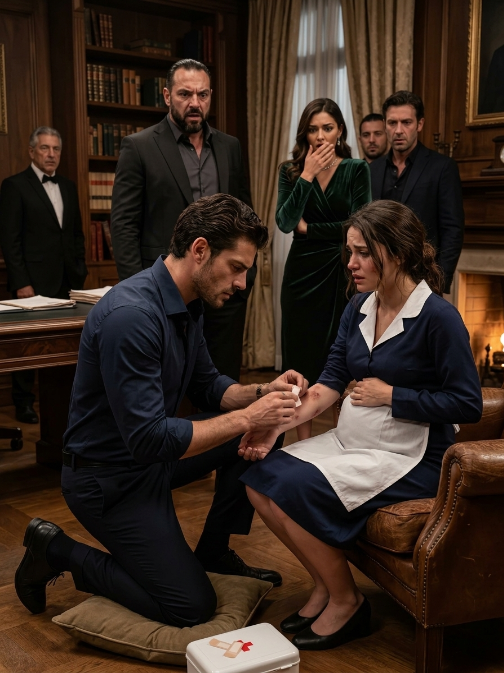
She Took the Slap Meant for the Mafia Boss’s Mother—Then He Arrived and Made an Empire Tremble

## PART 1
There’s a kind of smile you learn when you can’t afford to cry.
I had been wearing it for six hours straight by the time the champagne ran down my arm.
My name is Clara Reeves, and the night everything changed, I was carrying a silver tray through the most expensive party I had ever worked, wearing shoes borrowed from my roommate and a black catering dress that was one size too small across the shoulders. My feet had gone numb somewhere around the second hour. My collar scratched. Underneath the pressed uniform, I was running on a granola bar and the particular quiet desperation that comes from watching your brother’s medical invoices stack up while your bank account counts down.
The Montrose mansion on the Upper East Side smelled like white flowers, aged spirits, and old money performing generosity at each other.
I kept moving. That was the job.
“Still water,” a woman said without looking at me.
“Of course,” I said.
She had already turned away.
I was thirty-two hours from my brother Eli’s next prescription refill. The pharmacy had already called twice. Our landlord, Mr. Fitch, had taped a second notice to our door two days ago — the kind with a dollar amount underlined twice in red. Eli was seventeen and smart and funny and he had a pulmonary condition that cost more to manage than my body could earn in the hours available to it.
I was not going to cry at a party where the centerpieces cost more than my rent.
I kept moving.
Near the buffet table, I saw her.
An older woman, standing alone beside a towering arrangement of gardenias and crystal, clutching a small beaded purse with both hands. Her black dress was simple and well-made, the kind that had been expensive once and was now simply good. Her white hair was pinned carefully, one piece beginning to slip. She was looking around the room with the expression of someone trying to locate a landmark they were sure should be visible.
Not uncomfortable.
Lost.
I recognized that look the way you recognize a sound from your own house. It was the look Eli wore the first time they moved him to a different ward without telling him, when he stood in a hallway full of strangers and pretended very hard to be fine.
I set my tray on the service console and started toward her.
I did not make it in time.
Celeste Aldridge cut across the ballroom in a cream designer gown, one hand already gesturing with her champagne. She was the evening’s guest of honor — her engagement to Griffin Montrose had been announced three weeks ago, and the party was less a celebration than a merger ceremony, two family fortunes shaking hands over flowers and caviar. Beautiful in the way that things are beautiful when they have been curated to be admired from a careful distance.
She was walking fast and talking over her shoulder.
The collision was a matter of physics.
Red wine across cream silk. A glass breaking. A sharp, ugly sound cutting through the orchestra.
Everything stopped.
Celeste looked down at her dress with the expression of a woman who has decided something is a catastrophe before checking whether it is. Then she turned, and her gaze fell on the elderly woman.
“You,” she said.
It was one word, but the way she said it carried everything: contempt, certainty, the absolute confidence of someone who had never been held accountable by anyone she respected.
The woman shrank back. “I’m so sorry. I was looking for someone — I’m afraid I got turned around—”
“I don’t care,” Celeste cut in. “Do you have any concept of what this gown is worth?”
“Let it go, Celeste,” Griffin said beside her, though he was smiling.
He was smiling.
“I’m just looking for my son,” the woman said.
“Then perhaps you should have brought better eyes.” Celeste reached out and gripped her shoulder. Not a touch. A grip. “You ruined my evening.”
Something in my chest broke clean through.
I don’t know how to explain what happened next except that it wasn’t courage. Courage implies calculation. This was something older and more reflexive, the same thing that made me sleep on the hospital cot beside Eli every night for a week after his first bad episode, not because it helped medically, but because I could not stand for him to be frightened in a room alone.
“Let go of her,” I said.
The ballroom turned.
Celeste blinked. She looked at me the way people look at furniture that has suddenly developed an opinion.
“I beg your pardon?”
“She apologized,” I said, moving until I stood beside the woman. “It was an accident. Let go of her arm.”
Celeste’s expression didn’t harden so much as clarify.
“And who are you, exactly?”
“Nobody,” I said. Because I knew what answer she wanted and I was too tired to pretend it wasn’t true.
Her smile arrived then. The slow, specific smile of someone who has just been handed permission.
“Exactly,” she said.
She raised her hand.
I didn’t think about the paycheck I was about to lose. I didn’t think about Mr. Fitch’s red pen. I didn’t think about the pharmacy, or the invoice, or the three other agencies I had not yet called because I was embarrassed they wouldn’t hire me again.
I turned my body, wrapped both arms around the woman, and made myself a wall.
The slap landed across the side of my face with the full force of Celeste’s arm and the weight of her cocktail ring.
The ring caught skin.
The pain was white and immediate, a tearing sensation below my eye that turned the room sideways.
I did not let go.
“Are you all right?” I asked.
The woman stared at me. Her eyes were gray-green, sharp, and suddenly, completely different from the lost woman she had appeared to be thirty seconds ago.
“Child,” she breathed.
Blood ran warm down my cheek.
Celeste’s voice, from somewhere behind me: “She attacked me. You all saw it. Get her out and call security.”
My manager, Davies, materialized from the kitchen hall, sweating through his collar.
“Miss Aldridge, I am deeply sorry, this is absolutely unacceptable—” He turned to me with the face of a man who had already calculated how this affected him. “You’re done. Leave the uniform in the back. Don’t come back to the building.”
The room waited for me to fall apart.
I inhaled.
“I’m leaving,” I said.
I turned to the woman one last time.
“I hope you find your son,” I said.
She looked at me with gray-green eyes that no longer held any confusion at all.
“I already have,” she said quietly.
I did not understand what she meant.
I walked to the service hall before the tears arrived — silent, private tears, the kind that don’t ask for an audience — and pressed a cloth napkin against the cut on my face. Blood soaked through it immediately.
Behind me, in the ballroom, the woman reached into her purse and found her phone with steady hands.
“Nikolai,” she said when the line connected.
Her voice was completely calm.
“Come get me. Not quietly.” A pause. “And find out the name of the girl who just bled for me.”
I was peeling off my bloodstained uniform in a cold staff bathroom, calculating whether the emergency clinic copay would leave enough for Eli’s prescription, when the woman who called herself lost placed a name into her son’s hands.
She was not lost.
She was Margot Serov.
And her son was not someone you called for a quiet exit.
—
## PART 2
The emergency clinic in Midtown smelled like disinfectant and waiting.
I sat in a plastic chair at 2 a.m. with a butterfly closure across my cheekbone and a bill folded in my coat pocket that I was not yet brave enough to open. My phone had four percent battery. Eli had called five times. I did not know what to tell him that would not make him feel like the reason for all of it — which he wasn’t, but which he would believe anyway, because seventeen-year-olds who have been sick since childhood carry guilt the way other people carry keys.
I was staring at the scuff on my shoe and wondering if catering agencies kept blacklists when the clinic door opened.
He was tall. Dark overcoat over a dark suit. Hair nearly black, combed back from a face that was — I would find a better word later, but in that moment the only one available was *constructed*, as if every angle had been deliberate. He moved through the room the way weather moves through an open window: you felt it before you understood it.
Every person in the waiting area noticed him before they looked at him.
His gaze found me immediately.
He stopped in front of my chair and looked at the closure on my cheek.
Something happened in his jaw. A tightening. Brief and controlled, the way people control things they do not want others to see but cannot fully eliminate.
“Clara Reeves,” he said.
I stood. Instinct. “Who are you?”
“Margot Serov is my mother.”
The woman. The lost woman with the gray-green eyes who had not been lost at all.
“Is she okay?” I asked.
For one second, something shifted in his face. Something that might have been unexpected.
“Because of you,” he said.
I exhaled. “Good. I’m glad. I only did what anyone—”
“No,” he said. “You did what no one else in that room was willing to do.”
I looked away, uncomfortable.
“I don’t need anything,” I said.
“Your brother’s name is Eli,” he said. “He’s seventeen. Pulmonary condition. The specialist at St. Catherine’s denied the treatment extension last month because your insurance lapsed during your employment gap.”
The air went out of me.
Fear came in to replace it.
“How do you know about Eli?”
“Because in the time between my mother’s call and my arrival here, I learned everything that matters.” His voice was measured. Not cold. Something more complicated than cold. “Stay away from threats about my brother,” I said.
His eyes sharpened.
“I intend to keep him alive.”
He held out a folder.
Inside: hospital admission papers. A pulmonologist’s name I recognized from the research I’d done and couldn’t afford to act on. A treatment plan. A room already reserved at Mount Sinai.
Eli’s name, printed at the top.
My vision blurred.
“I don’t take charity,” I whispered.
“It isn’t charity. It’s a debt.”
“I didn’t protect her for payment.”
“I know.” His voice dropped. “That’s why the debt is real.”
My phone buzzed one final time before dying. The screen showed Eli’s name.
I looked at it.
Then at the man in front of me.
Then at the folder.
“What do you want from me?” I asked.
“My mother trusts you,” he said. “She has not trusted easily since my father died. Come to my home. Keep her company. Let my doctors treat your brother.”
“And if I say no?”
“Your brother’s care is covered regardless.”
That answer undid me more than any threat could have.
“Men like you,” I said carefully, “don’t give without taking.”
His mouth moved.
“No,” he said. “They don’t.”
“Then what do you take?”
He looked at me for a long moment in the flat light of a clinic waiting room, blood still visible on the closure on my face, and said:
“The right to make every person who watched you bleed answer for their silence.”
I should have walked away.
I didn’t.
What I didn’t understand yet — what I couldn’t have known, holding that folder in a borrowed coat in the middle of the night — was that Nikolai Serov had not simply compiled facts about my brother in the time between one phone call and one drive across the city.
He had already moved on Celeste Aldridge.
And what he found in her family’s finances was not just cruelty.
It was a crime.
—
## PART 3
The townhouse was on the Upper East Side, four blocks from the Montrose mansion.
I noticed that when the car stopped, and I noticed it again when I saw the lights still burning at the Montrose property and realized they were cleaning up the party while I was being driven into a new life I had not planned for.
Nikolai said almost nothing during the ride. He looked out the window. His driver did not speak. I clutched the folder in my lap and watched the city rearrange itself from the borough I knew into the one I had only ever served.
At the townhouse, a woman came down the stairs before we reached the front door.
Margot Serov was not wearing the modest black dress anymore. She had changed into a soft gray cardigan, her white hair unpinned, and she looked exactly like someone’s grandmother except for the gray-green eyes, which had not changed at all — sharp, still, watching everything.
She took my face in both hands when she reached me.
Careful of the closure. Deliberate.
“I have been thinking about you since they called me a car,” she said.
“I’m fine,” I said.
“You are not fine. But you will be.” She turned toward the hall. “Come in. I have tea and something that is either a very late dinner or a very early breakfast.”
I looked at Nikolai.
He was watching his mother with an expression I could not name — something between old grief and current relief that lived in the same place at the same time.
“Come in, Clara,” he said.
—
I slept in a guest room with walls the color of pale sage and curtains that blocked the city entirely. The bed was too soft. I woke twice convinced I had overslept for a shift.
In the morning, a message on my phone — charged overnight, returned to me by Nikolai’s housekeeper — told me Eli had been admitted to Mount Sinai at 7 a.m. The doctor’s name was Yuen. He had already called once.
I sat on the edge of the bed and cried for four minutes.
Then I washed my face, avoided looking too long at the closure in the mirror, and went downstairs.
Margot was in the kitchen with espresso and a newspaper and what appeared to be genuine irritation at something she had just read.
“Sit,” she said. “You look like you’re about to apologize for existing.”
I sat.
“I want to see my brother,” I said.
“Of course. Nikolai will take you after breakfast.” She set the newspaper aside. “Eat first. I can see your collarbones from across the table.”
I ate.
—
Eli was awake when we arrived. Propped up in a bed with an actual window, IV in his arm, already arguing with the nursing staff about whether the TV remote counted as light activity.
When he saw me, his face did the thing it did when he was trying not to show relief — too still, too controlled, the expression of a boy who had learned very young that showing how scared he was made the adults around him more frightened, which made everything worse.
“Hey,” he said.
“Hey,” I said.
I sat on the edge of the bed and he leaned his head against my shoulder, and we stayed like that for a while without talking.
Nikolai remained in the doorway. I had almost forgotten he was there until Eli looked up.
“He’s big,” Eli said.
“He’s standing right there,” I said.
“I know. I’m talking to you, not him.” Eli studied Nikolai with the frank assessment of a teenager who had no social fear left after years in hospitals. “You the one who did all this?”
“Yes,” Nikolai said.
“Why?”
“Your sister protected my mother.”
Eli considered this. “Clara’s always doing that. Protecting people.” He glanced at me. “Did she get hurt?”
“She did,” Nikolai said, before I could deflect. “She was brave.”
Eli looked at my cheek.
His jaw tightened in a way that was purely Reeves — I had seen the same expression in every mirror when I was angry and trying not to be.
“Is the person who did it going to get away with it?” he asked.
Nikolai’s answer came without pause. “No.”
Eli looked at him for another moment. Then he settled back against the pillow.
“Okay,” he said simply.
—
Over the following days, I learned that Margot Serov was neither fragile nor forgotten.
She had come to the Montrose party for reasons that had nothing to do with champagne or engagement celebrations. The Montrose and Aldridge families had been clients of her late husband’s shipping firm for two decades, and after his death, several irregularities in those contracts had come to Margot’s attention. She had been looking for documents she believed were stored in the Montrose estate’s private archive.
She had also, she admitted over tea on the third morning, been testing whether her son’s sources inside the party were reliable.
She had not expected to need rescuing.
She had absolutely not expected me.
“I thought I would find what I was looking for and leave quietly,” she said, refilling her cup. “Instead I got tangled in a wine glass and found out something more valuable.”
“What?” I asked.
She looked at me over the rim of her cup.
“That decent people still exist.”
I looked down at my tea.
“I only did what anyone should have.”
“Clara.” Her voice was firm. “Stop saying that. You did what everyone else calculated the cost of and chose not to. That is not ordinary. Do not let people reduce it to ordinary because it makes them comfortable.”
I was quiet for a moment.
“Is that what Nikolai told you?”
“Nikolai said something less elegant.” She smiled. “But the meaning was the same.”
—
Nikolai was harder to know than his mother.
He was present in the house the way certain weather is present — not always visible, but always affecting the atmosphere. He worked long hours, often past midnight. He made calls in languages I didn’t speak from a study with a closed door. Men came and went from the townhouse at irregular hours, none of them explaining themselves, all of them with the specific kind of politeness that is actually a form of warning.
I knew what Nikolai Serov was.
Not precisely. Not in the legal sense, the way a prosecutor would need to know it. But the way you know something from the texture of a room — from the way people moved around him, from the things that were not said, from the particular manner in which problems seemed to dissolve before they reached him formally.
I asked Margot once, directly, while we were reviewing foundation grant applications in her sitting room.
“Your son,” I said. “What is he?”
She set down her pen.
“He is a man who inherited a world he did not build and has been deciding ever since how much of it to dismantle.” She paused. “He is also my son. Those two things are not always comfortable together.”
“Should I be afraid of him?”
She looked at me.
“You should be honest with him,” she said. “Nikolai has been lied to in every direction for fifteen years. He is not accustomed to people who simply say what they mean.”
That night, I said what I meant.
He was in the kitchen — it was apparently where he ended up when the house was quiet and his thoughts were loud — standing over coffee he had made too strong and was drinking anyway.
“You’re investigating the Aldridge and Montrose families,” I said from the doorway.
He turned.
“Yes.”
“For your mother.”
“Partly.”
“And the rest?”
He set down the cup. “There are contracts connected to a port authority that have been running fraudulent assessments for eleven years. Two dock workers were hurt when safety equipment was falsified in a cost-cutting measure that went into the Aldridge family’s personal account. One of them is still in a wheelchair.”
I stared at him.
“This isn’t about me,” I said.
“No,” he agreed. “It never was about only you. But what happened to you gave me the last piece I needed. A reason to move before I was entirely ready.”
“What was stopping you?”
He looked at me steadily.
“Wanting everything in order before I struck. Fear of what would be lost if I moved too early.” He paused. “You didn’t wait for everything to be in order.”
“I didn’t have time to calculate.”
“Sometimes that’s better.”
I crossed to the counter and poured myself water I didn’t particularly want.
“What are you going to do to them?” I asked.
“Give the port authority evidence to the federal investigators. Give the safety fraud documents to the DA’s office. File a civil suit on behalf of the workers.” He paused. “And release the ballroom footage.”
I went still. “There’s footage?”
“Fourteen cameras,” he said. “Ballrooms like that always have security coverage. The Montrose family’s own system recorded everything.”
“And they don’t know you have it?”
“They know I have access to it. They don’t yet know I intend to use it.”
I thought about Celeste’s face. About the smile that arrived when I said I was nobody. About the hand going up, the absolute certainty in that gesture that nothing would follow it except silence and compliance.
“They filed a report against me,” I said. “Celeste told the police I started it.”
“I know.”
“Can they actually—”
“No,” he said. “Not anymore.”
I turned to look at him.
He was watching me with that steady, difficult-to-read attention.
“Why does any of this matter to you personally?” I asked. “The dock workers, yes. Your mother, yes. But me — I’m a stranger who happened to be carrying a tray.”
He was quiet for a long moment.
“My mother was invisible in that room,” he said finally. “Three hundred people watched her be grabbed and humiliated and not one of them moved. You moved.” He looked away. “When I was a boy, there were rooms where my mother was invisible in exactly that way. Rooms where her opinion was not asked for and her discomfort was not noticed. I made myself powerful enough that it would not happen again.” He paused. “And it still happened. In a room full of cameras and witnesses. Because power only protects the people in its immediate radius.”
The kitchen was quiet.
“But you protected her,” he said. “Without any radius at all.”
—
The footage posted at 6:58 a.m. on a Tuesday.
I did not know it was coming. Nikolai had not told me, which I later confronted him about and which he apologized for with the slightly pained expression of a man who had operated alone for so long that the concept of asking someone’s permission for something that affected them had not yet been fully installed.
I was eating toast with Margot when her phone lit up with six messages in a row.
She looked at the screen, then at me.
“You should see this,” she said.
The clip was forty seconds. Silent — the security camera had no audio — which made it somehow worse and better simultaneously. You could watch the whole thing without narrative. Without anyone telling you what to see. Celeste in cream silk. The woman in black stumbling backward. The reach, the grip, the raising of the hand. My body turning. The impact. The blood.
The clip ended with me still holding Margot upright while blood ran down my face and nobody in the room moved.
By 8 a.m., two million people had watched it.
By 9:30, Celeste’s publicist had released a statement about context and misrepresentation.
By 10:15, someone had found the police report Celeste filed against me.
By noon, the internet had decided the police report was the story.
Eli watched it from his hospital bed with an expression I had never seen on his face before — not fear, not worry, but a cold, focused anger that reminded me, startlingly, of Nikolai.
“She lied to the police,” he said.
“Yes.”
“About you.”
“Yes.”
He was quiet for a moment.
“What happens to her?”
“There are a lot of people working on that question,” I said.
—
The federal investigators had been waiting for what Nikolai gave them.
The port authority documents arrived in their hands forty-eight hours after the video. The safety fraud evidence followed twenty-four hours after that. By the end of the week, the Aldridge family’s shipping interests were under formal review, three of Griffin Montrose’s father’s board seats had been quietly resigned, and Celeste’s engagement announcement had been quietly removed from the family’s website.
Celeste tried to reach me twice.
Once through a lawyer, with an offer attached to a nondisclosure agreement. The number was significant. The clause requiring me to state that the incident had been a misunderstanding was not something I would sign if the number had been ten times larger.
Once in person, arriving at the hospital where Eli was still receiving treatment, flanked by counsel and a publicist who looked like she had stopped sleeping days ago.
I was in the hallway with coffee when the elevator opened.
We looked at each other.
She had taken the diamonds off. The cream silk was replaced by a camel coat and flat shoes. Without the performance of wealth around her, she looked younger and, somehow, more dangerous, the way certain things look more threatening when stripped of ornamentation because what remains is just the person.
“I came to apologize,” she said.
I studied her.
“Did your lawyer write it?”
Her cheeks colored.
One of the lawyers began: “Miss Aldridge sincerely regrets—”
“I asked her,” I said.
Celeste’s expression flickered. The old anger moved through it like weather, briefly visible.
“You have no idea what you cost me,” she said.
Something settled in my chest. Not satisfaction — simpler than that.
“You cost yourself,” I said. “You raised your hand in a room full of cameras because you believed it didn’t matter what you did to people who couldn’t stop you. That was your cost. I just didn’t get out of the way fast enough to let you avoid it.”
Her publicist put a hand on her arm.
Celeste looked at me for a long moment.
There was no remorse there, not really. There was humiliation, and recalculation, and something that might eventually, in years, become self-awareness. But not yet.
“Will you sign the agreement?” she asked.
“No,” I said.
She left.
I drank my coffee.
Down the hall, through the glass, I could see Eli trying to teach the duty nurse a card trick.
—
Months passed in the way months do when your life has been fundamentally reassembled and you are still learning the new floor plan.
Eli was discharged in October. He came to Margot’s foundation office his first afternoon out, because he had heard me talking about it and wanted to see it, and within an hour he was reorganizing their intake database system with the particular energy of a teenager who has discovered something he’s better at than adults and is being restrained from saying so.
Margot offered him a part-time position.
He accepted before I could advise him either way.
I worked with the foundation full-time by then. It was not what I had expected to do — I had a degree I had never fully used in social services, had spent four years carrying trays because the hours were flexible around Eli’s medical schedule, and had grown so accustomed to invisible work that visible work felt strange. But the foundation helped families navigate medical billing disputes, housing claims, and employment rights, and it turned out that invisible work had given me a very complete understanding of exactly how those systems tried to discourage people from asking for what they were owed.
Margot said I was a natural.
I said I had been practicing for years.
She said that was what she meant.
—
Nikolai remained complicated.
We were in the same building most days, and we developed a particular choreography — careful distances, specific politeness, the heightened awareness of two people who are both pretending not to notice the other one. I had stopped being afraid of him in the simple sense. The more nuanced sense — the understanding that he was genuinely dangerous, that his world operated by rules I did not fully know, that the man who brought espresso to the kitchen table at 7 a.m. and argued gently with his mother about her schedule was the same man who moved through a city like a current that shaped things without being seen — that I did not lose. I just stopped needing to resolve it before I could be in a room with him.
One night in November, I found him in the library.
Documents spread across the reading table. Photographs. Bank records. Names I did not recognize alongside names I now did.
He looked up.
“The dock workers’ civil case settles next week,” he said. “Both of them.”
“Full amount?”
“More than full. The Aldridge legal team wanted it closed before Griffin’s father’s indictment becomes public.”
I sat down across from him.
“Is it over?” I asked.
“The legal part. Most of it.”
“And the other parts?”
He leaned back in his chair.
“Celeste takes a plea on the false report. Thirty days and a fine she will not notice financially but will notice publicly. Griffin’s father is likely looking at eighteen months. The port authority commissioner resigned last week ahead of the announcement.” He paused. “None of it is enough.”
“No,” I agreed. “It never is.”
We were quiet for a moment.
“Nikolai,” I said.
He looked at me.
“What you told me once, about making yourself powerful enough that your mother would never be invisible again.” I paused. “Did it work?”
He considered the question honestly, which was the thing I had come to rely on most about him — that he did not perform answers.
“No,” he said. “And yes. She was never invisible in rooms I controlled. But I cannot control every room.” He looked at the table. “You cannot build enough walls to protect people from every careless hand. You can only make sure the people you love are not alone when the careless hands arrive.”
I thought about that.
“She wasn’t alone,” I said.
His eyes came up.
“No,” he said. “She wasn’t.”
The fire in the grate had burned down low. The city outside the tall windows was its own kind of luminous, winter light on glass and stone.
“I’m going to stay,” I said. “Working for the foundation. Watching out for your mother. That’s a choice I’m making because I want to make it, not because of the closure you put on the end of a debt.”
His expression did not change dramatically. But something in it shifted in the way a room shifts when a window is opened.
“I know,” he said.
“I’m also going to need you to tell me things before you do them. The video — I understand why you moved when you did. But it was my face. My story. You should have asked.”
“Yes,” he said. “I should have.”
No hedging. No defense.
“Okay,” I said.
“Okay,” he said.
We sat across from each other in the library with the fire going quiet and the city making its ordinary sounds outside, and something that had been held at careful distance stopped holding.
“I am not good at this,” he said.
“What?”
“Wanting something I am not certain I have the right to.”
My pulse changed.
“You can ask,” I said. “I’m fairly good at saying no when I mean no.”
His mouth moved. Not quite a smile. But close.
“Clara.”
“Yes.”
“Would you have dinner with me tomorrow. Not here. Somewhere I am not the owner and there are no business conversations and nothing is being asked of either of us except being in the same room together.”
I looked at him.
“That’s a very careful way to ask someone to dinner.”
“I wanted to be clear about what I was asking.”
“Yes,” I said.
He looked at me.
“Yes,” I said again, more clearly. “I would like that.”
—
We had dinner on a Wednesday at a small Italian place in the West Village that smelled like garlic and old wood and someone’s grandmother’s recipe and had absolutely no connection to any of Nikolai’s business interests.
He was different there. Not unguarded — I was not sure Nikolai Serov had an unguarded setting — but quieter in a way that had nothing to do with control. He asked about Eli’s card tricks. He told me about learning to cook from his mother’s housekeeper as a child because Margot was a beautiful woman with no talent whatsoever for food, which was apparently a family joke told at every opportunity.
He told me about his father.
Not everything. I understood there were rooms in him that were still locked, and I did not try the handles.
But enough. Enough that I understood the shape of what he had inherited and what it had cost him and why he had spent fifteen years being necessary in violent rooms and what it felt like to want something that wasn’t that.
I told him about Eli’s first hospital admission. About sitting in a plastic chair in a waiting room at two in the morning and feeling the specific, total aloneness of being the only person responsible for another person and not knowing if you were doing it right. About the way Eli had woken up and immediately asked if *I* was okay, at nine years old, in a hospital bed.
“He sounds like you,” Nikolai said.
“He’s better than me,” I said. “He got the same starting conditions and he’s funnier.”
Nikolai’s mouth moved into the not-quite-smile.
“The bar for better is not as low as you think it is,” he said.
I looked at him across the table.
“Careful,” I said. “That was almost a compliment.”
“I am working up to them,” he said.
—
Six months after the Montrose party, the Serov Foundation opened a second clinic.
This one in the Bronx. A real clinic, not a satellite office — twelve examination rooms, a pediatric wing, a legal aid office on the second floor for families navigating medical billing and housing disputes. Margot had been building toward it for three years, waiting for the funding to align.
On opening day, the courtyard was full.
Families with children. Elderly men in good coats. A woman with a legal aid folder already in her hands. A teenager who had come with his grandmother and was immediately recruited by Eli, who had appeared without my knowledge and was already explaining something on his phone to three people at once.
Margot gave a speech that made seven people cry, including me, and which she delivered with the complete composure of someone who had been crying in private for thirty years and saved her public face for the rooms that needed it.
Nikolai stood near the back.
He always stood near the back at things Margot had built. I had come to understand this as a form of respect — these were hers, and his presence at the center of them would have made them about him.
After the ribbon cutting, after the first families went through the doors, I found him near the edge of the courtyard.
“Your mother built something extraordinary,” I said.
“Yes.”
“You helped.”
“I moved money,” he said. “She built it.”
“Both things,” I said.
He looked at me.
I looked at him.
The November light was thin and clear, the kind that makes everything look more itself.
“I have something for you,” he said.
He reached into his coat pocket.
A small box. Dark blue velvet, old and worn at the corner, the kind that comes from somewhere with a history.
I went still.
“Nikolai.”
“This was my grandmother’s,” he said. “Margot wanted you to have it regardless of what you say. Those are her words, not mine.”
I laughed once, helplessly.
“That does sound like her.”
He opened the box.
The ring inside was not ostentatious. A modest oval stone, pale and clear, flanked by two small ones in a setting that was clearly old — not antique-store old, but family old, the kind of jewelry that has been worn and repaired and handed across decades.
Nikolai looked at it, then at me.
“I am not good at the language of this,” he said. “I know that. I know I come with a history that is not clean and a world that is not simple and a tendency to solve problems in ways that require apologies afterward.”
“You have gotten better at the apologies,” I said.
“Yes. Because of you.” He paused. “You walked into a room where you were invisible and made yourself visible on behalf of a stranger. You didn’t wait for someone to give you permission or protection or the right conditions. You moved because something in front of you was wrong and you were the person standing nearest to it.”
My throat was tight.
“I have spent fifteen years being the person standing nearest to things,” he said. “I did not know it was possible to do it the way you do it. Without the weight of it becoming who you are.”
“It has a weight,” I said.
“I know. But you carry it differently.” He looked at the ring. “I want to learn how.”
I looked at him — this complicated, controlled, genuinely trying man — standing in the courtyard of a clinic his mother had built and I had helped fill, in a city we had both navigated from the outside in.
“Yes,” I said.
He looked up.
“Yes,” I said again. “Ask me properly.”
His mouth curved into the full version of the smile I had been seeing pieces of for months.
He went down on one knee on the courtyard stones, which Margot would later claim she had not engineered but which I remain forty percent certain she had, and he said:
“Clara Reeves. Will you stay?”
It was the most Nikolai Serov way to propose that I could have imagined.
“Yes,” I said. “I’ll stay.”
He slid the ring onto my finger and stood, and when he kissed me it was brief and certain and witnessed only by the city and a handful of clinic staff pretending they weren’t watching from the doorway.
“Your mother is absolutely watching from a window,” I said against his mouth.
“Yes,” he said. “She is.”
—
We married the following spring.
Not at a hotel. Not at a mansion. Not at a venue chosen for its capacity or its guest list or its ability to imply something about the families involved.
We married at the Brooklyn clinic, in the same courtyard where Margot had first given a speech that made me cry, on a day when the flowers were real and the room was full of people I knew because I had learned their names.
Eli walked me in. Breathing clearly. Grinning in a way that he would later deny was at all sentimental.
Margot sat in the front row in a deep green dress and cried before the music started, and when I caught her eye she mouthed *I told you* and gestured vaguely at Nikolai, meaning nothing specific and everything.
The scar under my eye had faded to a thin white line, nearly invisible unless the light was direct.
I had stopped wearing anything over it.
When Nikolai lifted my veil, he saw it — as he always did, that small automatic acknowledgment — and touched it briefly with one careful finger before he kissed me.
We said our vows without performance.
We meant every word.
—
Years later, people would tell the story as if it were a fairy tale with a clean arc — waitress takes a slap meant for a powerful woman, powerful woman’s son arrives to rewrite her fate, injustice is punished, love blooms in the wreckage.
They were not wrong, exactly.
They just missed the part that mattered.
I did not shield Margot Serov because I knew who she was. I did not know. I did not do it because I calculated a reward or sensed a rescue coming. I did it because a woman was frightened and alone in a room full of people who had decided she was not worth the cost of helping.
I knew what that felt like.
I moved because I was standing nearest to it and I had nothing left to lose that was worth protecting by staying still.
The rest — Eli’s lungs, the clinic, the ring, the courtyard, Nikolai at the end of an aisle looking at me like I was the only thing in the room he was certain of — none of that was the point.
The point was the moment before all of it.
A woman in a borrowed dress, bleeding on a marble floor, being asked if she was all right and saying: *I’m leaving.*
Not running. Not falling. Not waiting for someone to tell her she was allowed.
Just leaving.
One step at a time.
On her own two feet.
—