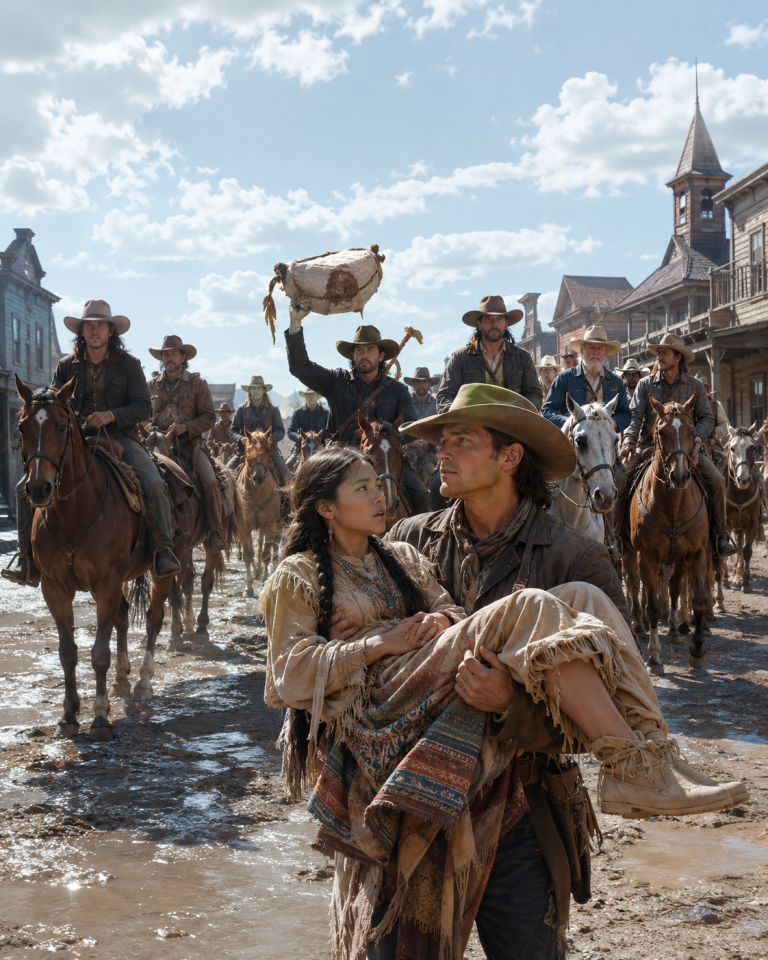
When the Whole Town Laughed at the Obese Widow, the Cowboy’s Twins Begged Him to Choose Her — Then One Hidden Letter Revealed Who She Really Was

The smell of her own fear was something Margaret Doyle had learned to recognize years ago — sour and metallic, rising off her own skin when humiliation arrived faster than she could brace for it. It arrived now, in the packed assembly hall of Stone Hollow, riding on Loretta Cabot’s voice like a blade unsheathed in daylight.
“So choose,” Loretta said, chin lifted, the lace at her collar trembling with the force of her own righteousness. “Choose your name in this town, Jonas Calder, or choose her.”
The hall had gone silent in the particular way a room goes silent right before something breaks.
Margaret sat on the back bench with her hands pressed flat against her thighs, willing them still. She had survived worse rooms than this one. She told herself that, the way she always did, and mostly believed it.
She would not lower her eyes. Not for Loretta Cabot. Not for any of them.
That rule had kept her upright through three weeks of sideways glances and whispered arithmetic about the width of her shoulders, the give of her arms, the way her dress strained at the seams she’d let out twice already. She had stopped expecting kindness from Stone Hollow. She had not stopped expecting herself to survive it.
Beside her, small fingers found her sleeve and gripped.
Eight-year-old Tobias Calder had wedged himself against her side the moment Loretta started talking, and he had not let go since. His twin, Eli, stood rigid in the aisle, fists curled, glaring at the grown-ups with the kind of fury only a child who has already lost one parent can summon.
At the front of the hall, Jonas Calder rose.
He was not a tall man by exaggeration, but he filled a doorway, and he had the sun-cracked hands of someone who had never once in his life waited for another man to do the hard work first. His jaw was set. His eyes, when they found Margaret’s, did not flinch.
“Margaret works for my household,” he said. “That is the whole of it.”
It should have ended there. In a town with any decency left in its bones, it would have.
Loretta only smiled, slow and pleased, the smile of a woman who believed she had finally cornered something soft enough to break.
“That isn’t what the town is saying, Jonas.”
“I don’t run my house by what the town says.”
“Then run it by your sons.” Loretta turned, sweeping a hand toward the twins as though presenting evidence. “What are you teaching these boys? That any drifter with a sad story can walk into a grieving man’s home and make herself impossible to remove? That desperation is a virtue to be rewarded?”
The words landed in the room like stones dropped into still water, and Margaret felt the ripples reach her even from the back bench. For one terrible second, the old shame rose so fast in her throat she nearly stood, nearly walked straight out the double doors and let them say whatever they wanted about her back.
That was precisely what Loretta wanted. Not just to wound her — to make her leave. To do the work of her own erasure and call it manners.
Then Tobias slid off the bench.
“Papa,” he said, and his voice cracked on the single syllable.
Jonas looked down at his son. The whole hall looked at him.
Tobias swallowed once, hard, and forced the words out before fear could take them back. “Please don’t make her go.”
A gasp moved through the crowd like wind through dry wheat.
Eli stepped up beside his brother, pale but unmoving. “Please, Papa,” he said, louder. “Choose Margaret.”
The silence that followed had weight to it. Margaret could feel it pressing against her ribs.
She turned her head toward Jonas, and for one suspended moment the hall fell away entirely — the benches, the mayor’s wife, the heat, the murmurs — until there was only the rancher across the room and the question sitting unanswered in his eyes.
It was not a new question. It had been there from the first night she arrived at his ranch, road-dust ground into the creases of her hands, blisters weeping through her stockings, with nowhere left in the world to walk to.
Three weeks earlier, nobody in Stone Hollow would have called Margaret Doyle a woman worth choosing.
She had looked, by then, like the far end of a road that had taken everything from her and asked for more.
Her husband, Samuel, had died nineteen days before in a rockslide at a quarry two counties north, where he’d gone because the autumn wages were good and the autumn wages were the only thing standing between his family and a hard winter. He had kissed her goodbye on the porch step and promised to be home before the first frost cracked the water barrel. Instead two men she’d never met arrived at her door carrying his hat and a folded note from the quarry office. Slide came without warning. He did not suffer. The foreman’s signature was tidy, almost apologetic, as if good penmanship could soften what the words actually meant.
The wages owed didn’t cover the burial. They didn’t come close.
In the days after, Margaret learned how quickly grief turns into arithmetic when there’s no money in the house. The landlord wanted his rent. The grocer stopped extending credit. The woman who ran the boardinghouse, who had once called her dear over Sunday tea, began looking at the width of Margaret’s shoulders as though measuring how much space sorrow was allowed to take up before it became an imposition.
By the second week she had sold Samuel’s tools, her mother’s ring, the second quilt off the bed. By the third she had nothing left but the dress she stood in and a wool shawl gone thin at the elbows.
Someone mentioned that Stone Hollow had ranches, and ranches meant kitchens, and kitchens sometimes meant work for a woman with steady hands and no pride left to spare. So Margaret walked. The road was long and pale and indifferent, throwing dust at her ankles by day and cold into her joints by night. She drank from horse troughs when she found them. She sat only when her legs threatened to fold beneath her. And because hope, unlike bread, cost nothing, she fed herself on that instead, in small careful portions, for three days.
When she finally reached Stone Hollow, the church doors were locked, and the late sun was already sliding toward the hills, and she had nowhere left to ask.
That was when she saw the boy.
He couldn’t have been older than eight. One boot lace trailed loose in the dirt. He stood outside the general store wrestling with a flour sack nearly as big as he was — and then the sack tore, and flour burst across the boardwalk like sudden snow, and a knot of townsfolk near the store window laughed before they’d even finished looking.
The boy’s face went the color of a ripe plum.
“I’m sorry,” he whispered, to no one, to everyone, to the flour scattering itself uselessly into the dust.
Margaret was kneeling before she’d decided to kneel. She scooped what flour she could rescue back into the torn sack, tied it shut with a strip torn from her own petticoat hem, and held it out.
“There,” she said. “Good as new, near enough.”
The boy stared at her like she’d performed a magic trick. “Thank you.”
“What’s your name?”
“Tobias.”
A second boy came running, near-identical, breathless. “Eli.”
“Well, Tobias and Eli,” Margaret said, allowing herself the first smile she’d managed in days, “your father’s going to think you two have been wrestling a bakery.”
Both boys laughed — really laughed, helpless and surprised by their own laughter, the kind of sound that comes out of children who haven’t had much reason to make it lately.
A man crossing the street from the feed store stopped mid-stride. He had been in for seed and harness leather. Instead he found a stranger kneeling in spilled flour, making his sons laugh without seeming to try.
He came over slowly. “Boys.”
Both twins straightened.
“I dropped the flour,” Tobias admitted.
“I gathered as much.” Jonas Calder looked at the woman rising to her feet, at the torn hem of her dress, at the dust ground into her hands. “You ruined your petticoat.”
“It was already worn through.”
He looked at the flour. At her boots, cracked at the toe. At the locked church behind her.
“You looking for someone?”
“Work,” she said simply.
“Found any?”
“Not yet.”
By sundown she’d knocked on five ranch doors. Three women had answered and shut the door before she finished her sentence. One man said he needed somebody quicker on her feet. Another, not unkindly, not kindly either, said the bunkhouse was already full, though Margaret had seen no bunkhouse at all from the gate.
She found a sheltered corner behind the livery stable as the light failed and wrapped her shawl tight, telling herself she had slept colder. It wasn’t a lie. It also wasn’t comfort.
Jonas found her there an hour later, a lantern swinging from one hand.
“You’ll freeze out here.”
“I’ve managed worse.”
He studied her for a long moment, the way a man studies weather before deciding whether to bring the cattle in. “My boys need somebody to keep the house in order. I can’t pay much, but I can pay something, and there’s a dry room.”
Margaret’s spine straightened despite the cold. “I don’t take charity.”
“Good,” Jonas said. “Because I’m not offering any.”
The arrangement, as he laid it out walking her back toward the ranch under a sky gone hard with stars, was plain enough: she’d cook, clean, keep the boys fed and the house from falling into the particular disorder that settles over a home after a mother dies. He’d pay wages and give her a room with a door that locked from the inside. Nothing improper. Nothing promised beyond the work itself.
But houses have a way of changing the people inside them, especially houses that have forgotten what laughter sounds like.
Margaret baked bread every Tuesday until the kitchen smelled like something worth coming home to. She taught Tobias long division with a handful of dried beans spread across the table. She showed Eli how to mend a torn shirt cuff instead of throwing the shirt away in disgust. She planted mint and thyme in a tin box outside the kitchen window. She read to the boys by lamplight until their eyes went heavy, and slowly, without either of them quite marking the day it happened, the Calder house stopped sounding like an echo of itself.
Then came the ledgers.
One rain-soaked afternoon, Jonas set a stack of account books on the kitchen table with the helpless expression of a man facing a language he’d never learned to read. “I’ve never had a head for figures,” he admitted. “My wife used to keep all this.”
“My father loved numbers,” Margaret said. “Let me look.”
She spent three evenings by lamplight sorting feed invoices, tax records, hay receipts, cattle sale slips — and on the third evening she went very still.
Every shipment from a single supplier arrived lighter than the delivery receipt claimed. Every short weight had been signed off by the same witness at the town scales. Every shortfall had pushed Jonas, and apparently half the ranchers in the valley, toward buying replacement feed from one company.
“Jonas.” Her voice came out tighter than she meant it to.
He looked up from the rifle he’d been cleaning. “What is it?”
“Who owns the public scales?”
“Mayor Cabot.”
“And who keeps the weight records?”
He thought a moment. “Same man.”
Margaret laid three ledgers side by side across the worn kitchen table, the lamplight catching the columns of numbers like something almost alive.
“This isn’t bad luck,” she said quietly. “This is a pattern.”
Jonas crossed the kitchen and looked down at the figures she’d circled in pencil. “What kind of pattern?”
“The scales,” Margaret said, “are lying. And every family they’ve cheated has been buying their way out of the shortage from Cabot Grain Supply ever since.”
It was meant, originally, to be a meeting about grazing boundaries. Loretta Cabot had other plans for it.
She wanted Margaret shamed out of the valley before anyone started asking inconvenient questions about her husband’s scales — and that was how, three days later, Margaret found herself sitting on the back bench of the Stone Hollow assembly hall with Tobias’s hand wrapped around two of her fingers, listening to a woman in lace dismantle her in public.
And now, in the ringing silence after both boys had begged their father not to send her away, Jonas Calder looked at his sons. Then at Margaret. Then, finally, at Loretta Cabot.
“You asked what I’m teaching my boys,” he said. His voice did not rise, but it carried to the back wall all the same. “I’ll answer that.”
He turned to Tobias. “Tell them what happened the day you split that flour sack.”
Tobias blinked, uncertain, then found his footing. “Miss Margaret helped me.”
“To impress me?”
“No, sir.”
“Because she knew who we were?”
“No. She didn’t even know our names yet.”
Jonas faced the room. “She didn’t know I owned a ranch. She didn’t know I had two motherless boys who needed somebody. She only knew a child had dropped his flour and was about to be laughed at for it.” He let that settle. “My sons chose her long before I ever did, Loretta. And they chose right.”
Loretta’s mouth thinned. “She has no standing in this town.”
“No,” Jonas agreed. “She has character. Those aren’t the same thing, and I’d thank you to stop pretending they are.”
A few benches creaked as people shifted, uncertain which way the wind of the room had just turned.
Then Margaret rose, the ledgers still under her arm where she’d carried them in out of habit, never expecting to need them.
“Since we’re discussing standards,” she said, and her voice, though quiet, did not shake, “perhaps we should discuss these.”
Mayor Cabot, seated near the front, frowned. “What is the meaning of this?”
“The meaning,” Margaret said, opening the first ledger to a page she had marked with a strip of cloth, “is that the weights recorded at the town scales don’t match the weights recorded on the original freight receipts. Not once, not twice. Twenty-three times across nine different ranch accounts that I’ve personally reviewed.”
A ripple of disbelief moved through the hall. Mayor Cabot attempted a laugh that didn’t quite land. “You expect this town to take the word of a — ” he stopped himself, but not quickly enough, and the unspoken word hung in the air anyway.
“I don’t expect anyone to take my word,” Margaret said evenly. “I expect them to take the arithmetic. Numbers don’t care what I look like, Mayor. They only care whether they add up. And yours don’t.”
She turned a page. “Every shipment weighed at the public scales came in lighter than what the freight company recorded at the point of loading. Every shortage, without exception, drove the affected rancher to purchase replacement feed from Cabot Grain Supply at a premium price. And every family forced deepest into debt eventually sold land — to relatives of the mayor.”
The hall had gone utterly silent.
Margaret held up a final page. “This is the freight company’s original weight record, dated and witnessed outside this town. This is the town’s altered record for the same shipment, dated three days later.” She looked directly at Mayor Cabot. “The only figures that changed between the two, sir, are yours.”
Mayor Cabot’s face had drained of every trace of color. Loretta turned toward her husband, searching for some denial in his expression, and found none. He would not meet her eyes.
Sheriff Holt, who had been leaning against the back wall through the whole proceeding, pushed off and walked forward. “Mrs. Doyle, I’ll need those ledgers.”
Margaret handed them over without hesitation.
Old Ezra Hutchins, who’d ranched in the valley longer than anyone could remember, rose stiffly from his bench. “My weights have come up short for two years running. I thought it was just my own bad luck.”
“Mine too,” called a woman near the middle.
“And mine.”
One voice became three, became ten, became more than the sheriff could easily count. For years, every family in Stone Hollow had quietly believed their own misfortune was theirs alone to bear — a run of bad weather, a careless hired hand, simple ill fortune. None of them had imagined the scales themselves were the thief.
By the time the hall finally emptied that evening, the county auditor had already been sent for. Within two weeks the investigation confirmed what Margaret’s ledgers had shown in pencil: systematic, deliberate fraud, run through the public scales for the better part of three years. Mayor Cabot resigned before the formal hearing could finish. The grain contracts were voided. A dozen ranching families, the Calders among them, received restitution that would see them through the coming winter without fear for the first time in years.
Late one evening in early autumn, with the fields gone gold and the boys’ laughter carrying up from the yard where they were chasing fireflies in the last of the light, Jonas found Margaret sitting on the porch steps, watching them.
“They still think you might leave one day,” he said, settling onto the step beside her.
“I know,” she said softly. “I see it in how Tobias watches the road sometimes.”
“Are you going to?”
She looked out at the darkening fields, the light catching gold in the dust the boys kicked up. “When I first walked into this town,” she said, “I thought all I needed was a kitchen to work in and four walls to keep the cold off me.”
Jonas waited, the way he’d learned to wait for her these past weeks, without pushing.
“I found a family instead,” she finished.
“So did we,” he said quietly.
The silence between them settled comfortably, the kind of silence two people share when they’ve stopped needing to fill it. Then he said, “I owe you an apology.”
“For what?”
“The first night. I told myself I only needed someone to keep house. I didn’t let myself consider anything past that, because it was easier.”
“You were grieving,” Margaret said. “Grief makes a man careful about what he lets himself want.”
“I was foolish,” Jonas said, and met her eyes squarely. “I let this whole town’s idea of worth sit in my head longer than it deserved to.”
She looked toward the yard, where the boys had stopped chasing fireflies and stood instead, watching the porch with twin expressions of held breath.
“Most people in this town did,” she said.
Jonas rose, crossed the few feet of porch between them, and held out his hand — not in invitation to dance or walk, but simply held out, open, waiting.
“My boys saw you first,” he said. “Before I had the sense to.”
Tears gathered, unbidden, at the corners of Margaret’s eyes. “I know.”
“And eventually,” Jonas said, voice dropping, “so did I.”
From the yard, Eli’s voice rang out, half-laughing, unable to wait any longer. “Papa! Did you choose?”
Jonas turned, Margaret’s hand now warm in his, and looked back at his sons standing together in the gathering dark, fireflies blinking gold around them like the whole evening had decided to celebrate alongside them.
“I already did,” he called back, loud enough to carry across the whole yard, loud enough, perhaps, to carry clear into a town that had once decided a woman’s worth could be measured by the width of her shoulders.
The boys whooped and ran for the porch. Margaret laughed through tears she didn’t try to hide, and Jonas pulled her gently into the noise and warmth of his sons’ homecoming embrace.
Years later, when people in Stone Hollow told the story of the scandal that brought down a corrupt mayor, most of them remembered the forged weight records, the ledgers spread out across a table in the assembly hall, the arithmetic that didn’t lie even when everyone wanted it to.
But the children of Stone Hollow remembered something else entirely. They remembered the evening two small boys stood up in a crowded hall and begged their father not to send away the woman everyone else had mocked — and how, in doing exactly that, they taught an entire town that a person’s worth was never carried in the size of her, but only ever in the size of the kindness she left behind wherever she walked.
THE END