“please marry me” — desperate mail order bride begs the feared caged mountain man, but discovers his hidden secret

—
PART 1
The stagecoach didn’t stop so much as slow down enough for the driver to kick a trunk off the roof and shout for the passenger to jump. Hattie Corkran hit the mud hard, the cold clinging wet and heavy to her skirts, thick with the smell of horse manure and raw sulfur. She stood, wiped a smear of black mud off her cheek, and looked at the town she’d crossed half a continent to reach.
Orafhino wasn’t a town. It was a wound cut into the side of a mountain, bleeding gold and silver for men who’d long since stopped counting what it cost them.
She clutched her reticule against her chest. Inside was a letter from a man named Arthur Pim — the only family she had left in the world, and the closest thing to a father she’d had since her own died owing money to men who didn’t forgive debts. Arthur had taken her in when she was twelve, walked her to her first day of work at the laundry so the foreman wouldn’t shortchange a girl alone, sent her a little money every Christmas even in years he could barely spare it. *My dearest Hattie,* his letter had read. *Come west. I have struck a vein. I have a house with glass windows. Be my wife, and you shall never scrub a floor again.*
She was twenty-four, her hands roughened by years of laundry work in Chicago, her eyes the gray-blue of a bruised sky. She wasn’t naive — she’d assumed Arthur was exaggerating, at least a little, the way he always had. She had expected a man. A handshake. Instead, she was met with silence, and then with a voice like gravel grinding under a boot.
“You the girl come to marry Pim?”
She turned. A man leaned against a hitching post, a tin star pinned to a coat too grimy to deserve the shine on it. Marshal Jebediah Crane — a man built entirely of sharp angles, with a smile that never once reached his flat, pale eyes.
“I am Hattie Corkran,” she said, keeping her voice level despite the trembling in her knees. “I’ve come to marry Mr. Arthur Pim.”
“Is he delayed?” Crane’s chuckle was dry, a rattling sound. He spat tobacco juice near her boot. “You could say that. Pim’s been delayed under six feet of dirt for three weeks now. Cave-in at the Lucky Strike.”
The world tilted. “Dead?”
“Dead as a doornail.” He stepped closer, close enough she caught the stale whiskey and rot on his breath. “And that leaves you in a bit of a bind, don’t it, darling. See, Pim owed this town money. A lot of it. And since he paid for your ticket, that makes you part of his estate.”
“I am not property.”
“In Orafhino, you’re whatever I say you are.” His hand drifted toward the revolver on his hip, unhurried, certain. “Pim signed a contract. His assets cover his debts. You’re an asset. You’ll work it off at the saloon upstairs.”
Hattie took a step back, her heart slamming against her ribs like a trapped bird. She scanned the street — gaunt, soot-faced miners watching from doorways, no pity in a single one of their eyes, only calculation. “I have money for a return ticket,” she lied.
“Stage don’t run back till the snow clears. Month, maybe more.” Crane grinned, confident in the trap he’d already sprung. “You’ve got nowhere to go, Hattie. Tonight you stay at the hotel. Tomorrow you start work.” He turned to walk away.
She stood frozen, wind biting through her thin coat, scanning the street for a church, a schoolhouse, anything that looked like civilization might still exist here.
Instead she saw the cage.
It sat in the middle of the thoroughfare — thick rusted iron bars, no bigger than a horse stall, open to wind and rain and the jeers of passing drunks. Inside, huddled under a ragged buffalo robe, sat a mountain of a man. Matted black-and-gray hair, a beard reaching his chest, chained hand and foot to the cage floor. Even seated, his shoulders looked broad enough to block out the sun.
“Who is that?” she asked a boy passing by, her voice barely a whisper.
The boy’s eyes went wide, the way children’s eyes do when they’ve been handed a story instead of a fact and never once thought to question it. “That’s Gideon Holt. Killed five men at Blackwood Creek and near tore a deputy’s arm off with his teeth, they say. Marshal keeps him out here so folks remember what happens to men who cross the law.”
*They say.* Hattie noted the phrase and filed it away, along with the fact that no one she’d yet asked had actually witnessed anything — only heard it, from someone who’d heard it from someone else, in a town where the only paper was printed on Crane’s own press.
She looked at the man in the cage. He wasn’t moving. He looked less like a man than a dormant volcano — and something about the stillness of him, the deliberate economy of it, didn’t match the wild animal the boy had just described. She looked at Crane, disappearing into the saloon. She looked at the brothel that waited for her.
Hattie Corkran didn’t scream. She began to think.
—
That night, the wind howled through the cracks in the boarding house walls, but she didn’t sleep. She unpacked the one thing she’d carried the whole way from Chicago besides Arthur’s letters — a slim, leather-bound legal primer that had belonged to her father before his debts caught up with him, the one skill he’d left her that no collector could repossess. She’d spent two years as a clerk for a solicitor on Halsted Street after her father died, copying writs and filing motions to keep a roof over her own head, and she still knew how to find her way through a page of statute language faster than most men twice her age.
She found what she needed by lamplight: a territorial provision, ordinary enough that she’d copied it out herself once for a client back in Chicago — that an accused man, prior to formal indictment and trial, could be released into the custody and legal responsibility of a bondsman who posted surety for his conduct and covered any outstanding civil debts in his name. Husbands and wives, under territorial law, were each other’s natural bondsmen without needing separate paperwork at all.
It wasn’t a magic loophole. It was simply the law working the way it was supposed to — if Gideon Holt had never actually been tried, if Crane was holding him on nothing but a rumor and his own authority, then the law already said someone could step in and demand due process on his behalf.
Which meant the real question was simpler and colder than any statute: why hadn’t Crane ever brought him before a judge?
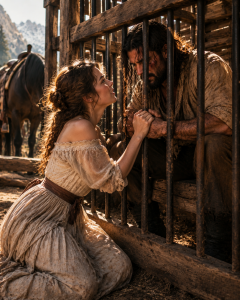
At dawn, before the town had fully woken, she walked to the square. Frost lay thick on the iron bars. Gideon Holt was awake, sitting cross-legged, staring at nothing, breath steaming in the cold. He tracked her approach the way a wolf tracks a deer — without moving, without needing to.
“Mr. Holt?” No answer. “My name is Hattie Corkran,” she said, voice shaking. “And I have a proposition for you.”
The chains rattled as he shifted. His voice, when it came, was a low rumble she felt in her own chest. “I ain’t got no money, girl, and I ain’t got no prayers.”
“I don’t want your money.” She leaned closer, checking over her shoulder for Crane. “You’ve never been tried, have you. Never stood in front of a judge.”
Something flickered behind his eyes — surprise, maybe, that anyone had bothered to check. “Circuit judge don’t come till spring.”
“Then legally, Mr. Holt, you are an accused man, not a convicted one. And an accused man can be claimed by a spouse as surety — someone who takes legal and financial responsibility for him in place of the marshal holding him on nothing but his own say-so.” She held up the small book. “If we marry, I become the one Crane has to answer to. Not the other way around.”
Gideon stared at her for a long moment, then let out a dark, humorless laugh. “You’re a fool, little bird. You think Crane cares about paperwork? He’ll shoot us both and call it self-defense before your ink’s even dry.”
“He might try. But he wants to be governor one day, and a federal inspector’s already been asking questions about missing claim owners in this valley — I heard it from the hotel clerk before I’d even finished my supper. Crane can’t afford a story about a lawfully married woman gunned down defending due process. Not with Helena already looking this way.”
“So he’s arrogant,” Gideon said slowly, “but not stupid enough to hang himself for spite. That the whole plan?”
“It’s the only plan I’ve got.”
—
PART 2
The sun rose over Orafhino like a bruise, purple and swollen behind gray clouds. By noon the mud on Main Street had thawed into a quagmire that sucked at the boots of miners shuffling toward their midday meal — but they never made it to the saloon doors. A crowd had gathered around the iron cage instead.
Hattie stood in the mud, boots ruined, posture rigid. Beside her, Reverend Josiah Reed’s hands shook with delirium tremens, a bible in one fist and a stolen five-dollar gold piece in the other.
“You sure about this, miss?” he stammered, eyeing the mass of hair and muscle behind the bars.
“Read the words, Reverend.” Her voice was loud, meant to carry. She needed witnesses. She needed every eye in this godforsaken valley on this moment.
“Well, ain’t this a picture.” The crowd parted like water as Marshal Crane strolled through, thumbs hooked in his gun belt, flanked by two low-browed deputies with shotguns. He took in the scene and laughed, wet and ugly. “Hattie. Step away from the animal before I have you arrested for public disturbance.”
“He has never been indicted, Marshal,” Hattie said, holding the book up. “Territorial law entitles an accused man, prior to trial, to be released into the custody of a spouse acting as bondsman. As of this moment, I assume his debts and his conduct becomes my legal responsibility.”
Crane’s smile thinned. His eyes flicked to the crowd — miners who hated him, men who paid him protection money and were watching for any sign of weakness. Shooting a woman for reading the actual, uncontested law in broad daylight, with a federal man already sniffing around his ledgers, was a different kind of risk than the ones he was used to taking.
“That man is a killer,” he spat. “Sentenced to hang.”
“He hasn’t been sentenced, because he hasn’t been tried,” Hattie countered. “I checked the ledger, Marshal. Not one filing. If you’d truly had a case against him, you’d have wanted a judge and a jury to say so — publicly, where it would help your name, not just your fear.”
Crane stepped in close, leaning down to whisper so only she and Gideon could hear. “You think a piece of paper protects you? Take him out of that cage, you won’t last the night. I’ll have my men burn you out.”
She didn’t flinch, though her heart felt ready to burst through her ribs. “If we die tonight, Marshal, a federal inspector already asking about missing claim owners is going to want to know exactly why.”
His face went purple. He looked at Gideon, who smiled — a slow, weary thing, more exhausted than feral.
“Finish it, preacher,” Gideon said.
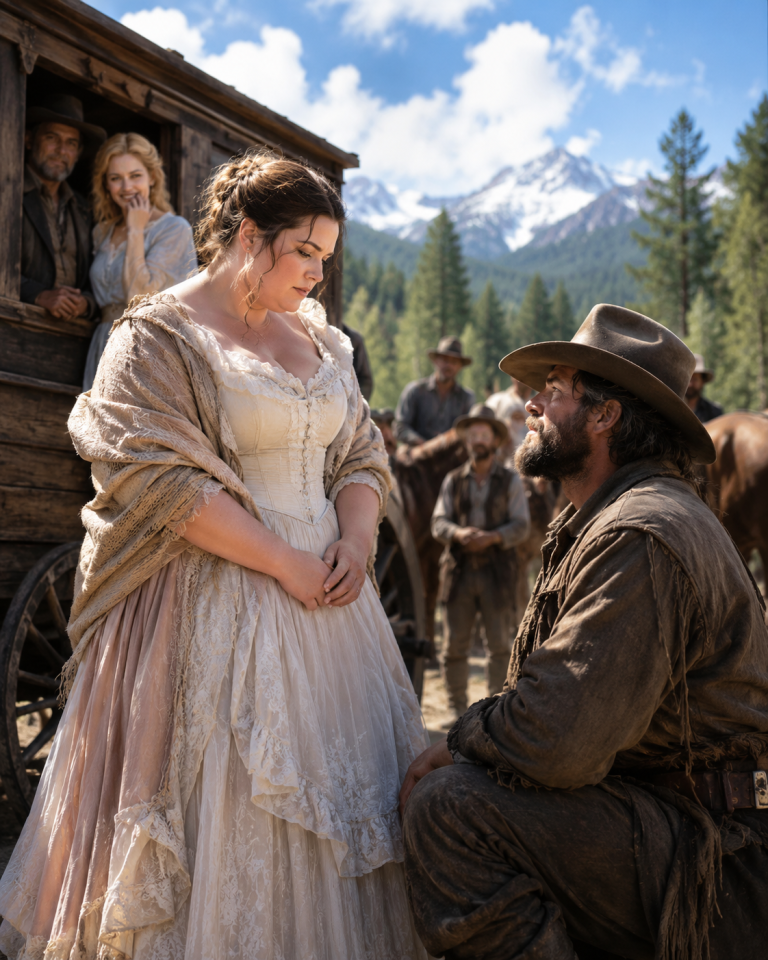
Reed scrambled through the verses. “Do you, Hattie Corkran, take this man?”
“I do.”
“And do you, Gideon Holt?”
“I do.”
“Then by the power vested in me, I pronounce you man and wife.” Reed snapped the bible shut. “God have mercy on your souls.”
Hattie turned to the marshal, hand out. “The keys, Marshal. Or shall we discuss with the circuit judge, come spring, exactly why an unindicted man was held in an open cage through a Montana winter?”
The street went silent, wind whistling through the bars. Crane stared at her with a hatred so pure it felt like heat, then unhooked a heavy iron key ring and threw it into the mud at her feet.
“He’s yours,” he said flatly. “But remember, Mrs. Holt. One foot out of line — I shoot him. And then I come for you.”
He turned and marched back to his office. Hattie knelt in the mud, hands shaking too badly to grip the padlock at first, and when it finally clicked and the rusted hinges screeched open, it was, for one suspended second, the loudest sound in the world — and neither of them yet understood how much further from safe the law had just made them both.
—
PART 3
He was taller than she’d imagined up close — at least six foot four, thick with muscle earned the hard way. He stretched arms still shackled at the wrist, breathed in the free air, and looked down at her. The crowd stepped back, fear rippling through them, though Hattie noticed more than one face in the crowd looking almost relieved instead — men who’d clearly wondered, quietly, for months, whether the story they’d all repeated about him had ever actually been true.
“Free the leg irons,” he said, quiet now.
She did. He kicked the heavy chains loose and rubbed at the raw skin beneath them.
“Where to, wife?” There was no mockery in the word. Only a strange, heavy weight.
“Arthur Pim had a cabin,” she said, keeping her voice as steady as she could manage. “At the edge of the Blackwood claim. We go there. We’ve no horses.”
He nodded, looked once at the silent, unmoving crowd, and took the carpet bag from her hand — his fingers brushing hers, rough, calloused, warm.
“Walk behind me,” he murmured as they started off. “If they shoot, they’ll shoot me first.”
—
**THE CABIN**
The hike took three hours, the snow falling harder with every mile. By the time they reached the cabin, Hattie’s lips had gone blue and she couldn’t feel her toes.
The place was a ruin — sagging roof, oil-skin windows, a door hanging by one hinge. Gideon kicked it the rest of the way open and went straight for the cold hearth.
“Search for dry wood,” he ordered.
“I am not your servant, Mr. Holt.”
“You are a woman freezing to death in a shack with no door. Get the wood, Hattie. We can discuss the hierarchy once we’re not both at risk of frostbite.”
She glared, but the logic won. Within minutes he had a fire roaring, and once the table was dragged across the broken door, he turned to face her, and the silence that followed felt suffocating in a whole new way.
She realized, for the first time, that she was truly alone with him — no bars, no crowd, no law book between them, only whatever she’d decided to believe about a man she’d known for less than a day.
Gideon sat by the fire and pulled a knife from his boot. Hattie tensed. “Cutting the rot out of my boots,” he said, not looking up. “Sit down, Hattie. You’re shaking the floorboards.”
“The boy in town said you killed five men and tore a deputy’s arm off with your teeth,” she said. “Is any of that true?”
He stopped cutting. “I was a scout for the Union Pacific. Tracked routes. Found water.” His voice had gone low, rhythmic. “The men who died at Blackwood weren’t miners. They were claim jumpers working for a syndicate out of Denver. They’d slaughtered a Chinese family to take their spot on the river. I found them and I killed them, in a fight, not a massacre — but Crane needed a story uglier than the truth, so his own paper printed one. Once a story like that runs, nobody in a town this small ever checks it twice. It’s easier to believe a monster did it than to believe the marshal let it happen.”
A chill ran through her that had nothing to do with the cold. “And the deputy’s arm?”
“Never happened. I’ve heard three different versions of my own crimes since they caged me. None of them match, because none of them are true. That’s how you know a story’s a lie, Hattie — the details keep changing to fit whoever’s telling it.”
She let that sit a moment. “Why didn’t Crane just hang you outright, then, if the story was already believed?”
“Because I’d sent a telegram to the governor about the Denver syndicate before they caught up to me. He couldn’t hang a man who might already have federal eyes turned his way without a trial to make it look clean. So he did the next best thing. Left me out in the weather long enough that most folks assumed I’d die there anyway, and called it patience.”
He crossed toward her, and she stiffened slightly, clutching her reticule out of habit more than real fear now. “Why did you really marry me, Hattie? You could’ve claimed any accused man with a debt hanging over him. Why the one everyone in town is afraid to look at?”
She reached into her pocket and drew out Arthur’s last letter, handing it over. “He wrote that he’d found something. Not gold — something else. Something that frightened him enough that he told me where to look if anything happened to him. When Crane told me he died in a cave-in, I knew it was a lie. Arthur panned river gravel his whole life. He was terrified of tight spaces — wouldn’t even go down into a root cellar if he could help it. He’d never have gone into a mine shaft on his own.”
Gideon read the letter, expression darkening. “So you needed someone Crane was already afraid of.”
“I needed someone he couldn’t simply have removed without consequence,” she corrected. “You were the only person in that town he hadn’t already found a way to kill.”
He let out a short, surprised laugh. “Well, Mrs. Holt. That’s a colder answer than I expected, and I mean that as a compliment.”
He crossed to the far wall, where the stone chimney met the wooden floor, knelt, and ran a hand over the hearthstones until one gave a hollow sound. He pried it loose. Underneath: a small canvas-wrapped bundle and a heavy, strange-looking rock.
He unwrapped the canvas — a map, and inside the map, a deed.
“Mother of God.” He traced the lines with a finger the size of a sausage. “This is a survey map of the whole valley. Look here.” He tapped a red line drawn straight through the town itself. “That’s the railroad.”
“The railroad bypassed Orafhino years ago.”
“That’s what they told everyone, so land prices would drop and Crane’s backers could buy up every claim for pennies. Arthur found the real survey.” He picked up the rock — dull gray until the firelight caught a deep violet gleam inside it. “Silver?”
“Better. Copper. With electricity coming to the cities, this is worth more than gold. Your cousin wasn’t killed for a debt, Hattie. He was killed because he wouldn’t sell.”
As if summoned by the sentence, a gunshot shattered the night. The oil-skin window exploded inward.
—
**THE CABIN, BURNING**
“Down!” Gideon flipped the heavy table for a barricade, hauling her behind it.
“They followed us,” she gasped.
“Crane doesn’t wait for permission.” He reached into the canvas bag. “Did you bring the Colt?”
She’d stolen it from the marshal’s office during the chaos of the wedding. He checked the cylinder. “Six shots against however many he’s brought. Hattie — can you shoot?”
“Rats. In the tenement basement, growing up.”
“Good enough. Stay here. Anyone who isn’t me comes through that door, you put a bullet in his gut and don’t apologize for it.” He looked toward the back wall, where the logs had rotted thin. “I know these hills better than whoever he’s hired to chase us into them. That’s the only edge I’ve got tonight, and it’s a real one — use it if I don’t come back.”
He went through the back wall in a controlled shoulder-check rather than a headlong charge, choosing the weakest section of timber deliberately, and disappeared into the dark. Hattie was alone behind the table when the front door gave way under a boot.
“Open up, Mrs. Holt. Honey, I’m home.”
She fired. The recoil jarred her teeth. The silhouette in the doorway crumpled — a deputy, not Crane. A torch came flying in after him, catching the dry cedar instantly, smoke thickening fast.
“She’s armed! Burn the witch out!”
From behind the cabin came the sound of a scuffle, brief and economical rather than prolonged — Gideon using the dark and the terrain the way a man does who’s spent years learning a mountain instead of relying purely on size. He didn’t wade into the open where three armed men could surround him; he pulled them one at a time into the collapsed timber and loose rock behind the cabin, where their footing gave out before his did, using the ground itself as a weapon as much as his own hands.
Two men went down before they ever got a clean shot off. Crane, watching his numbers fail faster than he’d planned for, fired two wild shots into the dark — one clipping Gideon’s coat sleeve, drawing blood along his forearm rather than anything worse — before shouting the retreat.
“Fall back! Regroup at the ridge!”
Gideon came around the burning cabin favoring one arm, breathing hard but steady. “Hattie! Out, now!”
She grabbed the bag and ran to him, colliding with his chest. “Are you hit?”
“Graze. Nothing that’ll slow me.” He looked at the burning cabin. “We lost the shelter, and the fire’s a beacon. We can’t stay in open ground tonight.”
“Where do we go?”
“Blackwood Mine. Cuts through the mountain, comes out near Garnet. Only way to lose them without freezing to death trying.” He took the bag from her. “Stay in my footprints.”
—
**THE BONE CHAMBER**
The mine mouth looked like the entrance to hell — a jagged tear in rock, the wind through it moaning low and mournful. Gideon lit a salvaged lantern.
“Miners used to say something smelled wrong past the second junction,” he said as they entered. “Wouldn’t send crews past it even when there was ore to be had. I always figured it was bad air. Might’ve been something worse.”
They walked an hour, the tunnel narrow, shored by bowed beams, the drip of water and crunch of shale the only sound. Gideon stopped once, leaning against the wall.
“Let me see your arm,” Hattie said.
“It’s a graze.”
“Then it costs us a minute, not an hour. Sit.”
He sat. She tore a strip from her petticoat and bound the shallow wound with whiskey from the flask in the bag, and he watched her work with an expression she couldn’t quite name.
“You didn’t flinch,” he said. “At the fight. At the blood.”
“I’ve dressed worse on my own hands, doing laundry work. Lye burns clean through skin if you’re careless.” She tied off the bandage. “Talk to me. Tell me about the cage — not what the town says. What actually happened.”
He was quiet a moment. “First few weeks, I raged. Screamed till my throat bled, rattled the chains till my wrists broke open. Then I understood Crane wanted exactly that — wanted the whole town to see a beast, because it made the story easier to believe. So I stopped giving him the performance. Sat still. Waited. Told myself stories instead, about a life that wasn’t the one in front of me.”
“What kind of stories?”
“A cabin with no bars around it. A fire that was mine to tend. Somebody in the room who wasn’t afraid of me.” He looked at her, firelight catching in his eyes. “Didn’t imagine anyone who looked like you, though. Didn’t think anyone that particular would ever actually walk up to those bars.”
Her hands stilled over the last knot in the bandage. Before either of them could say anything more, a sound echoed down the tunnel behind them — footsteps, deliberately quiet.
Gideon’s face shut like a door. “Two men, maybe three. Move.”
He extinguished the lantern, navigating by memory, until they reached a chamber and struck a match to check it — and the light fell across a floor covered in bones.
“The smell everyone used to warn against,” Gideon said quietly, understanding arriving all at once. “It was never bad air.”
Hattie pressed a hand to her mouth. Dozens of skeletons, still in the rags of miners’ clothes. Gideon knelt near one and went still.
“Arthur,” Hattie whispered, recognizing the plaid coat before he even said the name. The skull had been crushed from behind.
“He found this,” Gideon said. “Not just the survey. The graveyard. Everyone Crane killed to keep this valley’s real worth quiet.”
“We have the deed,” she said, voice hardening. “Now we have proof of the rest too.”
The footsteps grew closer. There was no exit from the chamber but the way they’d come.
“Behind the rocks,” Gideon said, pressing the Colt into her hand. “Four shots left. When they come in, they’ll look at the bones first. Fear slows men down. That’s the only edge I need.”
Torchlight spilled in. Two men, and this time Gideon didn’t drop from the ceiling like something inhuman — he simply waited in the dark until the nearer man’s torch swung the wrong way, and used the half-second of blindness to put him down hard against the rock wall, quick and economical rather than theatrical. The second man swung his rifle wildly at shadows he couldn’t track.
Hattie fired from behind the rocks, catching him in the shoulder before he found his aim. Gideon finished stripping both men of their weapons and their nerve.
“Check the tunnel,” he said, chest heaving, one hand pressed briefly to his side where the older strain of the night’s fighting had clearly begun to cost him something.
“Clear. But horses. More coming down the main drift.”
The torch dropped by the fallen man had caught the dry, ancient cloth on the chamber floor; smoke was already thickening. “Can’t go back that way,” Gideon said, looking up at a narrow fissure where fresh air drafted through. “We go up.”
They climbed, Hattie first, hauling him after her by main effort more than skill — he was slower now, breathing hard, the accumulated cost of the night finally showing through — until they broke out into the gray light of dawn on the far ridge above the ghost town of Garnet.
—
**THE RETURN**
Gideon sat heavily in the snow. “We made it,” Hattie said.
“Not yet.” He pointed down the slope, where Crane’s posse rode hard toward the mine entrance, unaware their quarry had already climbed above them.
“They’ll find the men we left. Then they’ll hunt in earnest.”
“We can’t outrun a dozen fresh horses,” Gideon admitted. “Not today.”
Hattie looked at him — worn through, bleeding a little, still standing anyway — and at the bag holding the map, the ore, and Arthur’s watch. “Then we don’t run. We go back to Orafhino, while every one of Crane’s men is out here instead of guarding the telegraph office.”
“It’s a gamble.”
“It’s the only hand we’ve got left to play.” She offered her hand. “You wanted to prove the story about you was a lie. Let’s go make sure the whole territory hears the true one instead.”
—
**HIGH NOON**
They stole two horses off a terrified supply clerk at Garnet and rode back into Orafhino at high noon, under a sky scoured clean by the breaking storm. They rode straight down Main Street — Hattie’s dress torn and stained, hair wild in the wind; Gideon slumped slightly in the saddle but upright, present, undeniably a man rather than the shape the town had spent months describing.
They stopped at the telegraph office. The clerk, Abernathy, dropped his coffee at the sight of them. “Mrs. Holt. The marshal said Indians killed you.”
“The marshal lied.” Hattie set the survey map and the copper ore on the counter. “Send a wire to the governor. Send another to the federal inspector already asking questions in this valley — he’ll want to know his instincts were right.”
“Marshal reviews every outgoing message—”
Gideon set a hand on the counter, coat falling open just enough to show the Colt at his hip, without raising his voice at all. “Send it, Abernathy. Tell them what’s under this valley, and tell them what’s under the Blackwood Mine besides.”
The key began to click. Outside, the crowd gathered, murmuring at the copper on the counter — they understood, better than most, exactly what that word meant for their own wages.
“You think this saves you?” Crane’s voice cut through the street. He’d followed the tracks back into town, posse fanned out behind him. “Step away from the telegraph, Hattie!”
She walked out onto the boardwalk, planting herself in front of Gideon. “He is not a prisoner, Marshal. He is my husband, and he has broken no law you can actually name.”
“He’s a killer!”
“Liar.” She held up Arthur’s watch. “This was in the Blackwood Mine. In a cave full of the bones of everyone you murdered to keep this valley’s worth a secret.”
The crowd’s murmur turned dark. Crane’s eyes darted across faces he’d bled dry for years — men who’d stayed quiet out of fear of losing work, not out of any real loyalty. Fear, it turned out, was a much shallower thing than he’d built his whole reign on believing.
“She’s hysterical,” Crane sneered, though his voice cracked. “Boys. Cut them down.”
“No.” Miller the blacksmith stepped out of the crowd first, hammer in hand. “I recognize that watch. Arthur showed it to me the week he died. Said he was scared of you.”
One by one, more of the town stepped forward — not because they’d suddenly grown brave, but because the balance of fear had finally, visibly tipped the other way, and men who’d spent years calculating risk recalculated it now in front of everyone.
Crane looked at the telegraph wire humming overhead, carrying his ruin toward Helena, and understood the arithmetic had turned against him completely. He raised his revolver — not at Gideon.
At Hattie.
“If I go down, I take the witch with me.”
Gideon didn’t shoot to kill. He’d had four bullets and a lifetime of practice, and he put one through Crane’s gun hand instead, the revolver spinning into the mud before Crane had finished registering the pain of it. The marshal went down clutching a shattered wrist, screaming, disarmed and very much alive.
“You don’t get an execution,” Gideon said, standing over him, voice flat and entirely without triumph in it. “You get exactly what you always denied me. A trial. Let the circuit judge and the whole territory hear what’s really under this valley, and what you did to keep it quiet.”
Miller and two other men hauled Crane up and dragged him toward the jailhouse he’d built himself, and the crowd, for the first time in longer than most of them could remember, didn’t look afraid of anything standing in that street.
—
**THE COPPER KING**
*April, 1884.*
Crane hanged in May, after a trial that lasted four days and drew reporters up from Helena — the same paper that had once called Gideon the beast of Banick ran, without any apparent sense of irony, a full correction on its front page.
The snow had melted by then, green shoots pushing up across the valley floor. Orafhino was nearly unrecognizable, hammers ringing from dawn past dusk, the railroad spur half-finished. Hattie stood on the porch of a new house with real glass windows and watched the man chopping wood in the yard — moving slower than he once had, favoring the arm Crane’s man had grazed, but steady.
He still woke some nights convinced he could hear the wind through cage bars instead of a real roof, and there were still a few families in town who crossed the street rather than pass too close to him, old habits slower to die than old lies. Trust, Hattie had learned, didn’t rebuild all at once just because the truth had finally won. It rebuilt one ordinary morning at a time — one fair wage paid on schedule, one child from town allowed, cautiously, to pet the horse he kept gentle for exactly that purpose.
Gideon climbed the porch steps and took her hand. “Lawyers want to know what we’re naming the mine.”
“Not the Holt Copper Works,” she said, before he could even suggest it. “Call it the Arthur Pim. It’s his claim, and it’s the only thing left of him that isn’t a grave.”
He nodded, kissed her knuckles. “And the cage. Council wants to know what to do with the iron.”
He thought about the cold, the hunger, the months of performing a story that wasn’t true because the truth would’ve been inconvenient to a man with a badge. He thought about the woman who’d walked up to those bars not out of love, not at first, but out of the plain, clear-eyed arithmetic that he was the only weapon left available to her — and who’d stayed anyway, long after the arithmetic had stopped being the only reason.
“Melt it down,” he said. “Make it into a bell. Let it ring for something instead of over it.”
He put his arm around her, and together they walked back inside, closing a door that had a lock neither of them needed anymore, in a house they’d both had to fight — and were, most days, still fighting — to actually feel safe inside.
**THE END**