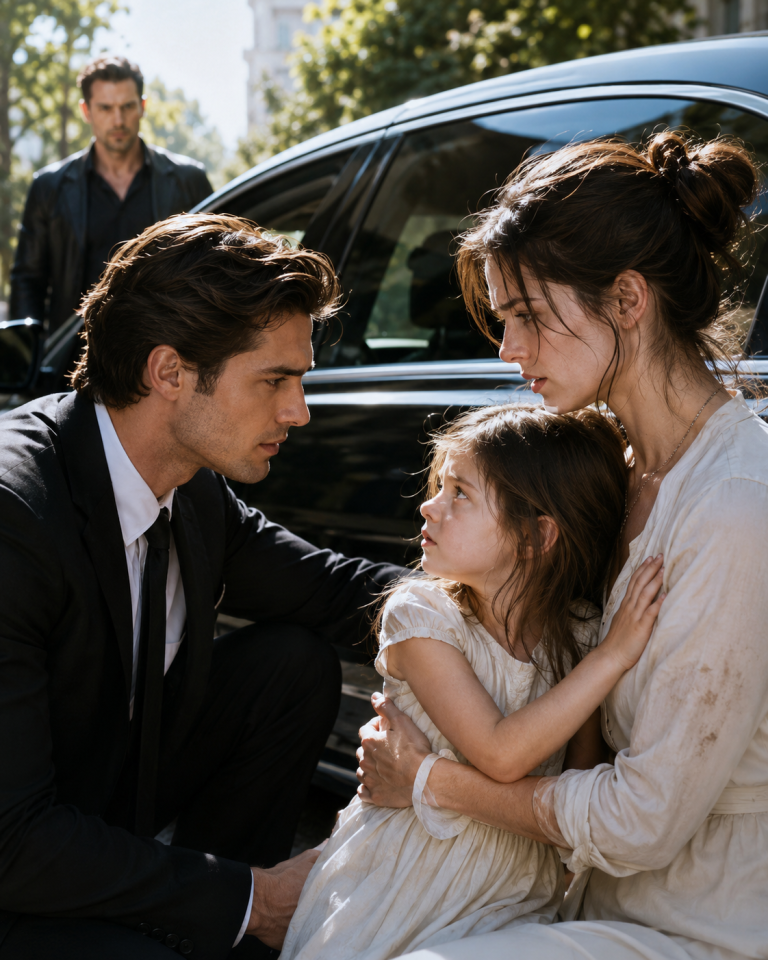
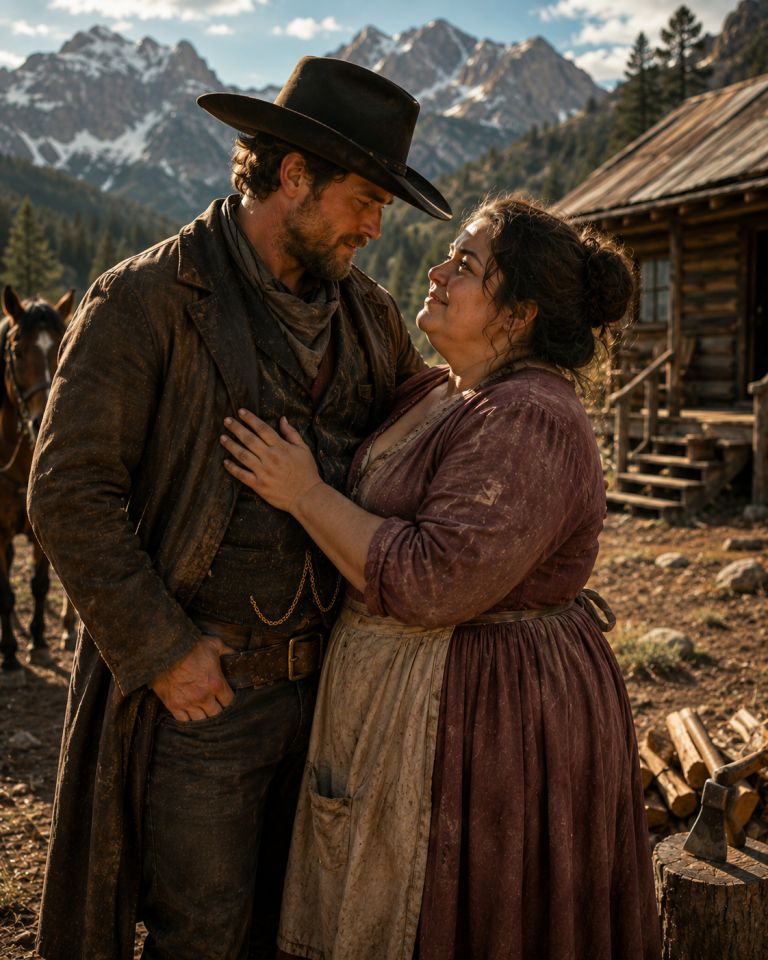
The cowboy was ready to ride away when a barefoot boy grabbed his leg and begged, “Please, sir… don’t leave.” But when the cowboy saw what the child was hiding behind his back, he knew walking away would make him a coward.

## PART 1
Grant Dawson had learned to measure his remaining life in small, manageable units: miles between towns, bottles of whiskey, the number of days he could push his horse before it demanded rest he was not inclined to give it.
Thirty-eight years old. Former Texas Ranger. A man carrying guilt heavy enough to sink ships, buried inside a body that refused to follow.
Seven weeks since he had spoken to another living person. Seven weeks of deliberately moving through the world like a ghost, avoiding connections, evading memory. The burn scar on his right hand—the place where he had clawed through ashes looking for his wife and daughter—had started to fade. Grant found this infuriating. Pain should not diminish. Grief should not become manageable.
But the world had other plans.
The boy appeared on the mountain trail during the afternoon when snow had turned the landscape into something that resembled forgetting. He was barefoot, which was impossible. No child could survive barefoot in snow. And yet here one stood, his small body shaking, his lips already turning the color of dying.
The boy’s hands—small, raw, desperate—reached for Grant’s boot.
“Please, sir.” The child’s voice shattered something Grant had spent weeks reinforcing. “Mama’s bleeding. Mama won’t wake up.”
Grant looked down from the saddle with the face of a man who had decided the world held nothing worth feeling. He tried to pull his leg free.
“I’m just passing through.”
Behind the boy stood four more children, arranged like a family portrait from a funeral. Lucy, perhaps thirteen, held a baby so still she might have been holding a doll. Jack, eleven or so, gripped an axe with hands too small for the work. Clara, maybe eight, clutched a dog that barked at Grant’s horse. And Thomas, the smallest, still clung to Grant’s leg with the desperation of someone drowning in air.
“Our mama hit her head on the stove,” Lucy said. Her voice trembled, but she forced it to stay steady—the sound of a child trying to sound grown because no adult had appeared to do it for her. “We don’t know if she’s still breathing. If you won’t help us, say so and ride on.”
That voice—that attempt at dignity in the face of abandonment—cut deeper than begging would have.
Grant turned his horse away.
He made it four steps before Thomas whispered words that rebuilt everything Grant had spent weeks destroying.
“I’ll give you Papa’s knife. It’s all I got left of him. Just help Mama.”
Grant felt something break open in his chest. A memory that he had locked away: his own daughter, holding his leg, begging him not to leave for that last patrol. His wife’s hand on his shoulder, understanding that this time was different somehow, that this particular goodbye might be the one that mattered.
He got down from his horse.
He took the baby from Lucy’s arms and pressed his ear to her tiny chest. The heartbeat was faint, irregular, but present. The baby was alive, barely, but alive.
“Run,” he said to the children. “Show me where your mother is.”
The cabin sat a half-mile from the trail, nearly invisible against the snow. Inside, a woman lay on the wooden floor beside an overturned stove, blood matted in her dark hair, her breathing so shallow Grant had to place his hand on her chest to confirm she was still among the living.
The house was colder than the storm. The fire had died hours earlier. The baby was hypothermic. The children were frostbitten. If Grant had ridden past, they would all have been dead by morning.
He spent the night building fires, warming the baby by holding her against his chest, convincing the smaller children to stay awake by asking them their names. Lucy, Jack, Clara, Thomas, and baby Rose. The children of a woman named Sarah Coleman, whose husband had apparently died weeks before.
At three in the morning, Sarah woke.
She saw a stranger holding her infant and reached for the iron poker beside the stove. Her hand came up trembling, ready to strike.
“Don’t,” Grant said quietly. “I’m not here to hurt anyone.”
Sarah’s hand wavered. Then Thomas, still half-asleep, murmured something that made Sarah’s entire body go rigid.
“The man with the star came before Papa left. He gave Papa bad news.”
Sarah’s hand dropped. The poker clattered to the floor.
“Sam talks too much,” she whispered, but her voice carried the weight of absolute terror.
By dawn, Sarah had recovered enough to stand, and she ordered Grant away with the kind of finality that suggested she was not accusing him of something—she was protecting the children from something.
“You need to go,” she said. Her hand kept moving to her head, touching the wound, then dropping away. “I appreciate what you did, but we can’t have—I can’t have you here.”
Grant saddled his horse.
He had learned not to argue when people needed him to leave. The world had taught him that lesson repeatedly.
Then Jack appeared in the doorway, his father’s axe held in both small hands, his face carrying years he had no right to possess.
“The judge wants our land,” the boy said. “Deputy Hayes came last week. Said Mama has until Christmas to sell the property, or they’re taking all of us to an orphanage. They said the ranch is too valuable to stay in family hands.”
Grant felt cold move through him—a different kind of cold, the kind that came from understanding that someone had calculated suffering and found it profitable.
“Your father died in the storm?” Grant asked.
Jack’s jaw tightened. “Papa went to town to talk to the judge about property boundaries. He had papers proving our line was correct. His horse came home without him.”
Grant knew that story. He had worn a ranger badge long enough to understand how land disputes could transform into disappearances.
“I’ll stay,” he said. “Through Christmas.”
Over the following weeks, Grant fixed the barn door, split wood, and earned enough of the children’s trust that Thomas began to follow him like a shadow. The boy would crawl under the table where Grant sat repairing tools and whisper what he had seen on the day before his father left.
“A big man came. He had a star on his chest. He and Papa argued. The man said Papa was blocking important business. He said Papa needed to understand what happened to people who blocked important business.”
Sarah, overhearing this conversation, covered her mouth and disappeared into the bedroom. She returned holding a wooden box, old and worn, the kind that might have held photographs or jewelry in another life.
Inside lay evidence.
Will Coleman’s journal documented conversations with Judge Silas Porter. Porter wanted the Coleman ranch because it bordered protected old-growth forest—land that should never be harvested, protected by federal decree. But Porter owned a timber company, and he had already bribed county officials to ignore the protection laws.
Will Coleman stood in his way.
The journal’s entries, written in increasingly shaky handwriting, described threats. Veiled at first, then explicit. Porter telling Will that uncooperative ranchers tended to have accidents. Will writing that he had gone to the federal office in the territorial capital with evidence of Porter’s bribery.
The final entry, dated the day Will died, consisted of three words: “I’m going to town.”
There were also letters—copies of correspondence between Porter and Deputy Nathan Hayes, the local lawman who seemed to do most of Porter’s violent work.
A surveyor’s report documented that the Coleman property line was legally accurate and that the protected forest boundary was binding under federal law.
Two years of evidence that could destroy Judge Porter.
Sarah’s hands shook as she held the box. “I was going to take this to the federal office in Denver. But I was afraid they’d arrest me too, or take the children. So I hid it. I waited. I prayed the judge would stop wanting the land.”
The hoofbeats outside the cabin came at dawn.
Five riders.
Deputy Nathan Hayes at the front, his face carrying the particular kind of confidence that came from knowing the law answered to him.
And when Thomas saw the silver star on Hayes’s chest, the boy’s breathing stopped, like the nightmare had stepped out of memory and become solid, visible, real.
—
## PART 2
“Morning, folks,” Deputy Hayes said, his smile arriving before his words. “Just checking on the Coleman family. Making sure everything’s appropriate out here.”
Sarah stood in the doorway, Lucy and Jack positioned slightly behind her. Grant remained inside, watching through a gap in the door frame.
“We’re fine,” Sarah said.
“Looks to me like you’re harboring a stranger,” Hayes observed. “A man, traveling alone, stopping with a widow and her children. Town’s concerned about that. Judge Porter is concerned about that.”
“The stranger helped when our baby was dying,” Sarah said. Her voice stayed steady, but her hands trembled. “He leaves today.”
Grant understood what she was doing—protecting the evidence, protecting the children, ensuring that Hayes would have no reason to search the cabin.
“That’s good,” Hayes said. “Because the judge wanted me to remind you that Christmas is coming. Time’s running out on that property sale. After Christmas, well, he’ll have to take action. County can claim abandoned land for unpaid taxes and such.”
After Hayes left, Grant understood that the threat had become explicit. The judge was finished playing with pretense. After Christmas, Sarah would either sell her land or lose everything—land, house, children. The judge would win.
Grant studied Sarah’s face and saw that she had always known this was coming. She had been preparing, waiting, hoping that someone with authority would care enough to intervene.
No one had.
That afternoon, Grant told Sarah he was leaving—but not the way she had ordered him to leave. He was riding to the territorial capital. He was taking the wooden box. He was presenting Will Coleman’s evidence to federal authorities, and he was not coming back until Judge Porter was arrested.
“They might kill you on the road,” Sarah whispered.
“Probably,” Grant agreed. “But someone has to try.”
He made it two miles before Deputy Hayes and four riders cut off the trail.
“That box belongs to the judge,” Hayes said, his hand resting on his revolver.
Grant stopped his horse. He could feel the wooden box in his saddlebag, could feel the years of Will Coleman’s investigation against his ribs.
“It belongs to a dead man’s family,” Grant said.
Hayes drew.
Grant was faster—a skill that had kept him alive through seven years of rangering, through gunfights and standoffs and the kind of violence that the frontier had trained him to survive. His bullet took Hayes in the shoulder, spinning the deputy off his horse.
The other riders hesitated.
That hesitation cost them everything. Grant’s second shot took one through the leg. His third made them understand that fighting a former ranger over a piece of paper was not how they wanted to spend their lives.
They retreated, carrying Hayes toward town.
Grant rode hard toward the territorial capital.
—
## PART 3
Federal Marshal Thomas Whitmore examined Will Coleman’s journal with the kind of attention that suggested he had been waiting for exactly this evidence.
“I’ve been investigating Judge Porter for three years,” Whitmore said, reviewing the surveyor’s reports. “We didn’t have proof. Just suspicions and testimony from people too frightened to file formal complaints. This—this is everything we need.”
The investigation that followed consumed the next three weeks.
Federal agents rode to the Coleman ranch with warrants. They arrested Judge Porter at his office, seizing his correspondence with state officials, his payment records, his communications with Deputy Hayes.
The evidence showed a systematic campaign of intimidation and murder. Will Coleman was not the first rancher to die conveniently. Porter had orchestrated at least five disappearances over the course of eight years, each one timed perfectly to precede the judge’s acquisition of valuable land.
Deputy Nathan Hayes, once recovered from his shoulder wound, agreed to testify in exchange for leniency. He described being hired as Porter’s enforcer. He described being given names and instructions. He described Will Coleman’s refusal to be intimidated, which had made Will a problem that Porter decided could only be solved through murder.
Hayes testified that he had been ordered to take Will into the mountains during a storm. Hayes testified that he had done exactly that, and that he had left Will there to die.
Judge Silas Porter was convicted of five counts of murder, conspiracy, and land fraud. He received a life sentence.
Deputy Hayes received twenty years.
The Coleman property was declared legally protected, belonging to Sarah and her children, with federal authority ensuring that no one could challenge the title.
Grant remained at the ranch through Christmas and long past it.
Lucy learned the accounts of ranching and eventually managed the property with both business skill and moral clarity. She refused to sell to Porter’s timber company successors. Instead, she maintained the land as it was meant to be—a working ranch, a refuge, a home.
Jack recovered from the damage that premature adulthood had inflicted. He became a carpenter and builder, using his skills to help families rebuild after disasters. He often worked for free when the families could not afford to pay.
Clara grew into a woman who worked with territorial authorities to establish legal protections for children in similar circumstances—orphaned, vulnerable, dependent on the whims of adults who might exploit them.
Thomas never forgot the man with the star who had tried to take everything. But he also never forgot the man without a star who had stayed anyway. When Thomas grew old enough to understand the difference between threat and protection, he became a lawman himself—one who understood that badges could be used to hurt people or to help them.
Rose, who had been barely alive when Grant arrived, grew into a girl who understood survival not as something shameful but as something remarkable. She helped establish a home for children whose parents had been killed by land disputes and corruption.
And Grant Dawson, who had ridden toward the Coleman ranch intending never to stop, never to feel, never to connect—he stayed.
He married Sarah five years after Will’s death, not out of obligation or pity, but out of genuine love. He adopted her children formally, giving them his name and his protection. He worked the ranch alongside them, teaching them about the land, about survival, about the kind of integrity that mattered when no one was watching.
The burn scar on his right hand faded over the years, but Grant never forgot what it represented. When Lucy’s children asked him about it, he told them the truth: that some losses never entirely heal, but they can transform into something that drives you toward protecting other people from similar pain.
Years later, when a federal agent asked Grant how he had found the courage to ride toward trouble instead of away from it, he struggled to answer.
“I didn’t find the courage,” Grant finally said. “A boy holding a knife he wanted to give away taught me something I should have understood long before. Sometimes refusing to help is the same as choosing evil. So I helped.”
He looked toward where Thomas was teaching Grant’s grandchildren to split wood, where Lucy reviewed the ranch accounts, where Clara’s home for orphaned children operated in a building Grant had helped construct.
“That boy’s refusal to let me ride away saved all of us,” Grant said. “Including me.”
The Coleman ranch became known throughout the territory as a place of refuge. It became the model for how land could be held, how justice could be served, how ordinary people could stand against corruption and win.
Grant Dawson lived there for the rest of his life, no longer a man passing through but a man who had decided to build something that mattered.
The grief that had driven him to isolation never entirely disappeared.
But it transformed into something stronger—the kind of love that comes from being chosen by children who had nothing else to offer except their knife, their trust, and the belief that a stranger might stop long enough to help.
—