The Widow Hit Her Worst Night With No Food, No Fire, and No One Left to Trust—Then a Giant Cowboy Stepped Into Her Doorway and Said, “You’ve Never Seen a Man My Size Fight for What’s Mine.”

# PART 1
Catherine Marshal stood behind her cabin door with a rifle shaking in her hands and a sick child dying behind her.
Outside, the blizzard screamed across the frontier like it wanted in.
Then the stranger knocked again.
Harder.
“Please,” the man called through the wood, his voice deep and steady. “I will not make it another hour in this.”
Catherine’s finger hovered near the trigger.
She had learned what men were.
Her dead husband, Thomas, had taught her with fists, threats, and the bullet hole still patched with tar paper six inches from where her head had been. Men did not come to help. They came to take. They came to hurt. They came smiling and left you bleeding.
Behind her, little David coughed from the cot.
Wet. Rattling. Wrong.
The seven-year-old boy was burning with fever, his face pale under the blankets. Catherine had found him half-frozen near the creek three weeks earlier, with no parents, no food, and no one coming back for him.
She had taken him in because some part of her had survived Thomas after all.
“I have sickness in here,” she shouted. “You come in, you might catch it.”
The wind roared.
For one moment, she thought the stranger had gone.
Then his voice came again.
“Then I will risk it.”
Catherine closed her eyes.
Stupid.
So stupid.
But David coughed again, and she thought about the empty medicine shelf, the snowed-in road, the doctor ten miles away, and the boy who might not live until morning.
She slid the bolt back.
The man who stumbled inside was enormous.
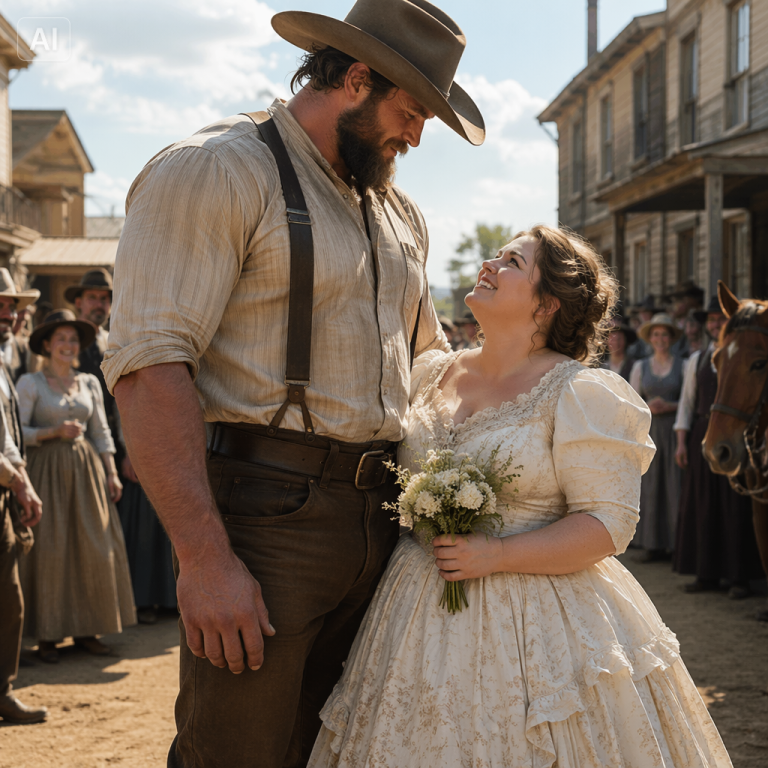
Over six feet, broad enough to fill the doorway, his beard crusted with ice, one side of his coat torn and dark with blood. His gray eyes found hers for only a second before he looked away, as if he knew better than to stare at a frightened woman holding a gun.
“Barn,” Catherine said. “You do not come in the house.”
He nodded.
No argument. No smirk. No demand.
Just, “Thank you.”
That startled her more than his size.
She sent him to the barn and locked the door behind him, shaking so hard the rifle nearly slipped.
By morning, David’s fever had eased.
And the stranger was on her roof.
Catherine stormed outside and found him ripping away rotten boards Thomas had never bothered to fix.
“What the hell do you think you are doing?”
“Fixing your roof.”
“I did not ask you to.”
“I know.”
“Then why?”
“Because it needs fixing.”
That was all he said.
By the third day, he had rebuilt her fence. By the fifth, he had split enough firewood to last a month. David followed him everywhere, staring up at him like he had wandered out of a storybook.
“What is your name, mister?”
“Abraham.”
“You are real big.”
Abraham looked down at him, and something almost gentle moved across his scarred face.
“You are real small.”
David giggled.
Catherine had not heard that sound in weeks.
The stranger—Abraham—said nothing about staying. He moved through the work as if it were prayer, as if repairing Catherine’s neglected land was a way of asking forgiveness for something Catherine did not know he had done.
She found herself leaving coffee on the stove. She found herself waiting until he came in to eat. She found herself watching him with David and understanding, in the way that survivors understand each other, that this man carried his own violence and had learned to make amends through gentleness.
Then the rich man came.
Harrison Klene rode up in an expensive coat, smiling like a man who had already won. He handed Catherine a paper and told her Thomas had owed him twelve hundred dollars.
If she could not pay, he would take the land.
Catherine’s whole world tilted.
“I cannot pay that.”
“I know,” Klene said softly. “That is why I am prepared to offer an alternative.”
From behind her, Abraham appeared.
He read the paper once.
Then his face went dark.
“This is extortion.”
Catherine looked at him, terrified and furious. “It is legal extortion.”
Abraham crumpled the paper in one massive fist.
“Maybe you cannot fight him,” he said. “But I can.”
That night, three riders came with torches blazing.
Abraham walked into the yard alone and waited.
Catherine stood in the doorway with the rifle raised, David clutching her skirt, and for the first time since Thomas died, she realized the most dangerous man on her land might be the only one trying to save it.
The lead rider laughed from his horse. “You have a death wish, friend?”
Abraham’s voice dropped so cold the horses shifted under their riders.
“You really want to find out?”
—
# PART 2
The sheriff arrived before dawn.
He came with papers of his own, legal ones, and a warrant for Abraham’s arrest.
“Murder,” the sheriff said, showing the document to Catherine. “Occurred three years ago in Colorado. A man named Solomon Boone.”
Catherine’s grip on the rifle tightened.
“He was defending someone,” she said.
The sheriff barely looked at her. “The law does not excuse murder.”
Abraham stepped out of the barn, already knowing what was coming.
“I killed a man,” he said.
The sheriff reached for the iron cuffs hanging from his belt.
Catherine kept the rifle raised.
“Why?” she asked.
The sheriff glanced at her. “Mrs. Marshal, this does not concern you.”
“It happened on my land, in front of my child. It concerns me.”
Abraham looked down at David, who was still clutching his coat.
“The man’s name was Solomon Boone,” Abraham said. “He owned a silver claim outside Creede. He also owned the debts of every family working it.”
The sheriff’s expression changed slightly.
Abraham continued.
“Boone kept the men underground fourteen hours a day. When one died, he charged the widow for the burial. When families could not pay, he took their homes.”
“That does not explain murder,” Catherine said.
“No.”
Abraham’s massive hands curled at his sides.
“My sister married him.”
The wind pushed snow across the yard.
Abraham explained that his younger sister, Caroline, had written to him for months, hiding bruises beneath stories about falling from horses and walking into doors. By the time Abraham understood the truth, Boone had broken her arm and locked her in a cellar.
Abraham had ridden through the night to reach her.
“He was beating her when I came in,” Abraham said. “I pulled him away. He drew a gun.”
“Did he fire?” the sheriff asked.
“Yes.”
Abraham opened his coat and lifted his shirt. A white scar crossed his ribs.
“I fired back.”
“Your sister testify to that?”
“She died two days later.”
Catherine’s rifle lowered an inch.
“From what he did to her?”
Abraham nodded.
The sheriff looked away.
“The warrant says Boone was unarmed.”
“He had friends who owned the judge.”
“And you ran.”
“I buried my sister first.”
Silence fell over the yard.
Then David stepped between Abraham and the sheriff.
“You cannot take him,” the boy said. “Bad men are coming.”
The sheriff’s gaze moved to the burned torch lying near the fence.
“Who sent those riders?”
“Harrison Klene,” Catherine answered.
She handed him the debt paper, which Abraham had smoothed out after crushing it. The sheriff read it twice.
“This bears Thomas Marshal’s signature.”
“My husband could barely write his own name,” Catherine said. “And he never borrowed twelve hundred dollars.”
The sheriff studied the paper again.
Abraham pointed toward the bottom.
“That witness signature belongs to Solomon Boone.”
The sheriff’s head snapped up.
—
# PART 3
Catherine felt the cold sink deeper than the storm.
“Klene knew Boone?”
“Klene financed his mine,” Abraham said. “He was there the night Caroline died.”
The sheriff’s hand remained near the cuffs, but he no longer reached for them.
Before he could speak, hoofbeats sounded beyond the trees.
Not three riders this time.
More than a dozen.
Harrison Klene rode at the front beside a black carriage. Men spread behind him with rifles across their saddles.
Klene smiled when he saw the sheriff.
“Perfect timing. Arrest the murderer, then remove the widow from my property.”
“This land is not yours,” Catherine said.
“It will be by sundown.”
The sheriff stepped forward. “These papers may be fraudulent.”
Klene’s smile vanished.
“They are legal.”
“They carry the signature of a dead mine owner from Colorado.”
For the first time, fear flickered across Klene’s face.
Then he drew his revolver.
Everything happened at once.
Abraham knocked Catherine and David behind the water trough. A bullet struck the cabin wall. The sheriff fired from beside his horse while Klene’s men scattered across the yard.
Catherine crawled through the snow, dragging David toward the barn.
“Stay behind the stalls,” she ordered.
“I can help!”
“You help by living.”
She shoved him behind a stack of hay and turned back.
Abraham stood in the open yard, firing with terrifying calm. His size made him an easy target, but it also made him impossible to ignore. Every gun turned toward him instead of the barn.
Catherine understood what he was doing.
He was drawing the fire away from her.
A bullet struck Abraham’s shoulder and spun him halfway around.
“Abraham!”
He stayed on his feet.
Klene slipped from his horse and ran toward the barn.
Catherine met him at the door with her rifle.
He stopped.
“You do not have the nerve,” he said.
Catherine remembered Thomas laughing before he hit her. She remembered hiding bruises and apologizing for blood on the floor. She remembered every man who had mistaken fear for weakness.
“You have already lost one husband,” Klene whispered. “Think carefully before you lose another man.”
Abraham was not her husband.
But the thought of losing him struck harder than the threat.
Klene lunged.
Catherine fired.
The bullet tore through his coat and struck the doorframe behind him. Klene stumbled backward, shocked that she had pulled the trigger.
Abraham came from the side and hit him once.
Klene fell into the snow and did not rise.
The fighting ended moments later when the sheriff shot one rider from his saddle and ordered the others to surrender. Without Klene’s money or courage behind them, the remaining men dropped their weapons.
Abraham finally sank to one knee.
Catherine ran to him.
Blood covered his left arm, but the bullet had passed through the flesh without striking bone.
“You fool,” she said, pressing her apron against the wound. “You stood where every man could see you.”
“You have never seen a man my size,” he said through clenched teeth. “Hard to hide me.”
Despite everything, Catherine laughed.
It came out broken and wet with tears.
The sheriff found more than forged papers in Klene’s carriage. There were deeds belonging to six widows, debt contracts from Colorado, and letters connecting Klene to the judge who had issued Abraham’s murder warrant.
Within a month, the warrant was suspended.
By spring, it was dismissed completely.
Klene went to prison, and every stolen property was returned.
Abraham could have left then.
His name was cleared. The mountain passes were open. There was work for a man like him anywhere cattle were driven and fences needed building.
Catherine found him saddling his horse one morning.
David stood on the porch, trying not to cry.
“You are going,” Catherine said.
Abraham tightened the saddle strap.
“I do not want trouble following me back here.”
“The trouble is gone.”
“There will always be another Klene.”
“There will always be another storm too. That does not mean we abandon the roof.”
Abraham turned toward her.
Catherine’s courage nearly failed. Asking a man to stay felt too much like placing a weapon in his hands. Thomas had taught her that love could become a locked door.
But Abraham had been given every chance to take.
He had only built, repaired, protected and waited.
“I do not need saving,” she said.
“I know.”
“And this land belongs to me.”
“I know that too.”
“You do not raise your hand to me. You do not frighten David. You do not decide what I am allowed to say, wear or think.”
Abraham stepped closer, but stopped before touching her.
“Catherine, I would cut off my own hand first.”
She searched his face.
“Then why are you leaving?”
His voice softened.
“Because I do not know how to ask you for something I do not deserve.”
“What something?”
“A place beside you.”
Catherine looked toward David. The boy nodded furiously from the porch.
She turned back to Abraham.
“You can stay until the roof is finished.”
“The roof is finished.”
“Then the barn.”
“I repaired that too.”
“Then you had better find something broken.”
Abraham smiled.
It transformed his whole face.
“I believe the porch step is loose.”
“It may take years to fix.”
“I am a patient man.”
He remained on the ranch.
By summer, David called him Pa without realizing he had done it. Abraham froze in the middle of repairing a plow, then turned away so the boy would not see his eyes.
Catherine saw.
She said nothing.
That autumn, Abraham married her beneath the cottonwood tree beside the cabin. He made no promises about owning her, leading her or protecting her from the world.
He only promised that she would never face it alone.
Years later, the land was known as one of the finest properties in the territory.
The cabin had been expanded into a real house. The barn was solid. The fences ran true. The fields produced well. Everything Abraham built reflected his care for what Catherine had claimed as hers.
David grew into a young man strong enough to match Abraham in size and gentle enough to match Catherine in wisdom.
He learned to run the ranch alongside his Pa while understanding that authority belonged to his Ma.
The three of them formed a family that people spoke about quietly—not with gossip, but with a kind of respect reserved for those who had survived what should have broken them.
When Abraham was struck by illness in his fifties, David sat beside his bed while Catherine held his hand.
“You should know,” Abraham said, “that I have asked the lawyer to put everything in your name, Catherine. Every acre. Every building. All of it.”
“I know. You told me this five years ago.”
“I told you I was leaving you prepared.”
“You told me you had learned something from loving a woman who had nothing and had built everything herself.”
Abraham smiled faintly. “That too.”
He lived another ten years, long enough to meet Catherine’s grandchild. Long enough to see that the trauma of violence and loss could be transformed into something that built rather than destroyed.
When he died peacefully in his sleep, David and Catherine sat beside him in the quiet morning, understanding that a man who had arrived in a blizzard as a fugitive had left as a father, a partner, and a man redeemed.
The land Catherine Marshal built continued for generations.
Her descendants spoke of the widow who had taken in a child and opened her door to a fugitive. They spoke of how she had stood in a barn door and fired a rifle to protect both of them. They spoke of a marriage built on the understanding that true partnership meant both people remained themselves.
But most of all, they spoke of how a woman who had survived violence with one man learned to trust gentleness with another.
How size could mean protection instead of threat.
How a fugitive could become family.
How the most dangerous thing in the world was sometimes just opening the door and saying yes.
Years later, someone asked Catherine what she had seen in Abraham when he first arrived, half-frozen and bleeding.
She was old then, sitting on the porch of the cabin she had defended, looking out over the land she had built.
“I saw a man,” she said, “who was running from what he had done wrong. And I knew something about that. I had also been running.”
“From what?”
“From the idea that a man’s size meant he was the same as every other man who had hurt me. From the belief that all strength was predatory. From the fear that I could never trust anyone again.”
She paused.
“Abraham taught me that we can choose differently. That the past does not determine the future. That opening the door—even when it is terrifying—sometimes brings exactly what we need.”
“Did you ever regret it?”
Catherine smiled. “Not for a moment.”
And in that smile lay the proof: that sometimes the bravest thing a person could do was not fire a gun or rebuild a fence.
Sometimes it was simply opening a door to someone the world had labeled dangerous.
And discovering they had been the gentle one all along.